
Authors
News Type
Q&As
Date
Paragraphs

In a Q&A, Stanford postdoctoral fellow Darika Saingam explains why Thailand's battle against drugs continues and what is needed to introduce good policy that works to prevent illegal drug trade and supports recovering addicts.

Despite Thailand’s decade-long crackdown on drugs, demand for illegal substances has risen. A green leaf drug known as ‘kratom’ is a symbol of this rise as young people eagerly adopt the drug for entertainment and join an older generation of laborers who chewed it to survive long hours of work in the fields—and are now heavily addicted. Curtailing substance abuse and its consequences takes good public policy and solutions must be area-specific and evidence-based, according to a Stanford postdoctoral fellow.

Darika Saingam, the 2015-16 Developing Asia Health Policy Postdoctoral Fellow, has conducted two cross-sectional surveys and more than 1,000 interviews with drug users, recovered addicts, and local public officials in an effort to better understand the evolution of substance abuse in southern Thailand.

At Stanford, she is preparing two papers that offer policy options suitable for Thailand and other developing countries in Southeast Asia. Saingam spoke with the Shorenstein Asia-Pacific Research Center (APARC) where she will give a public talk on May 17. The interview text below was edited for brevity.

For decades, Thailand has been an epicenter of drugs. Can you describe the extent of the problem today?

According to a 2014 report, 1.2 million people were involved in illegal drug activities across Thailand. The total number of drug cases saw a 41 percent increase from 2013 to 2014. New groups of drug traffickers are mobilizing while existing groups are still active. Drug users who are young become drug dealers as they get older. The number of drug users below 15 years of age has increased dramatically.

According to your research, what drives Thais toward illegal drug use and the trafficking business?

Adults in Thailand use drugs to relieve stress and counteract the effects of work. Adolescents use them for entertainment. Historically, farmers and laborers from rural areas of Thailand would use opium for pain relief. More recently, a consumable tablet known as yaba has become popular along with crystal methamphetamine and marijuana. Young people are increasingly using yaba and kratom.

Thailand is still a developing country, but it is industrializing quickly. Social and cultural norms have been shifting and people want an improved quality of life. A lot of young people are unemployed and lack social support and are therefore more likely to turn to drug trafficking for economic opportunity. The economic recession and political strife in countries bordering Thailand have exacerbated the situation.
Image
drug policy 1a
    
Image
drug policy 2

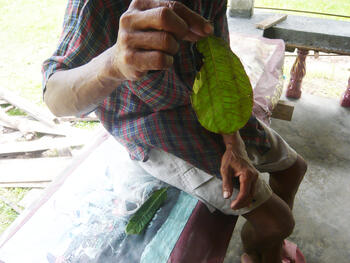
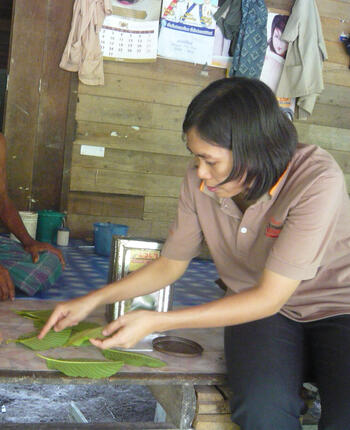
Photos (left to right): A man holds up a kratom leaf. / Saingam examines kratom leaves as part of her research to understand illegal cultivation practices.


What is kratom and why is it popular?

For nearly a century, the native people of Thailand have chewed kratom. It is a leaf that grows on trees resembling a coffee plant. Historically, kratom was used to reduce strain following physical labor, to be able to work harder and longer, and to better tolerate heat and sunlight. Kratom is also embedded in Thai culture and given as a spiritual offering in religious ceremonies. My field research in the southern province of Nakhon Si Thammarat has shown that these motivations are still true today.

Within the past seven years, kratom use has skyrocketed and people are using it in increasingly harmful ways. Chewing kratom is not immediately harmful to health, but combining it with other substances is. This is the recent trend. Users have created new ways to consume it such as in a drink known as a ‘4x100.’ It contains boiled kratom leaves, cough syrup and soft drinks. Additional methamphetamines and benzodiazepines are sometimes added to that mixture.

What strategies must be employed to control substance abuse?

The first step is to realize that the patterns of substance abuse are specific to each location therefore solving the problem must also be. Drug usage is also dynamic. Placing hard control measures on one substance often provokes the emergence of another in its place therefore a holistic approach is important.

Thailand should employ multiple strategies toward effective prevention and control of substance abuse. These strategies include examining the problem and creating policies from an economic perspective (supply and demand), an institutional perspective (national and international drug control cooperation), and a social perspective (structural supports for recovered addicts and mobilization of public participation).


What is the Thai government doing to address the drug problem, and what could they be doing better?

Politicians in Thailand must do a better job at representing the people. Government health workers are often gathering information, assessing needs, and reporting findings to politicians, but these needs are not being accurately addressed. An example of this is politicians ordering to cut down kratom trees – a public display that does not get at the root cause of the problem. The reality is that drug users will quickly find substitutes. According to my study, of the regular users that stopped using kratom, more than 50 percent turned to alcohol instead and did so on a daily basis. This is merely a shift from one substance to another.

On the upside, a crop substitution program created under King Bhumibol Adulyadej offers a successful working model. The program works to replace opium poppy farming with cash crop production. It began in 1969 and is cited for helping an estimated 100,000 people convert their drug crop production to sustainable agricultural activities. Crops cultivated can be sold for profit in nearby towns. The program has also introduced a wide variety of crops and discouraged the slash-and-burn technique of clearing land. It is win-win because it stymies drug trade and provides economic opportunity while also being ecologically sound. This type of program should continue to be scaled up.

Can this model be co-opted elsewhere? What lessons from other countries could inform Thailand’s approach?

Yes, the model could plausibly be implemented in other areas in Thailand and in other Southeast Asian nations.

I think a judicial mechanism such as the kind seen in France could benefit the rural areas in Thailand. The French government has established centers across the country that act as branches of the court that try delinquency cases of minor to moderate severity, and also recommend support services for drug users. Members of the magistrate and civil society actors manage center operations thus placing some responsibility back onto the local community.

I believe an opportunity also exists for Thailand to legalize kratom. Legalization would show a respect for the cultural tradition of chewing kratom leaves and allow the government to suggest safer ways of using it. Bolivia has created a successful model of this through its legalization of coca leaves. Coca in its distilled form is cocaine, but left as a leaf, it is not a narcotic. Indigenous peoples are allowed to chew coca leaves. The government policy is being credited for a decrease in cocaine production as well.

Hero Image
drug policy headline
Stanford postdoctoral fellow Darika Saingam conducts interviews and collects data in southern Thailand. | All photos courtesy of Darika Saingam
All News button
1
Authors
News Type
News
Date
Paragraphs


Image
nick finney photo
Nick Finney put his Leadership Academy for Development (LAD) training to work almost immediately. The 40-year old native of Yorkshire, England, directs Asian operations for Save the Children, an international humanitarian relief organization focused on the needs of children. Finney participated in LAD’s 2015 workshop, “The Role of Public Policy in Private Sector Development,” conducted in partnership with the Singapore Management University (SMU).

Two of the case studies Finney discussed during the week-long LAD workshop required students to analyze options to improve border management in Costa Rica and Indonesia. They were particularly relevant to Finney since much of his work in 2015 for Save the Children has involved directing food and medical supplies to families in the wake of the Nepal earthquake, the ongoing conflict in Afghanistan and elsewhere. 

“I deal all the time with the complex behaviors of governments and difficult regulatory environments where the goal posts keep moving,” he said. “The LAD training really helped me understand all this in a more holistic way.”

The Leadership Academy for Development, part of the Center on Democracy, Development and the Rule of Law at Stanford University, trains government officials and business leaders from developing countries to help the private sector be a constructive force for economic growth and development. Participants benefit from lectures and discussions centered on real-life case studies led by a team of international scholars and local experts. Students are also required to work in teams to apply the ideas and skills they have gained to specific challenges they are facing in their professional duties.

LAD Case Study Cover

That team assignment “triggered something for me,” Finney recalled. He had been thinking about Save the Children's work to persuade more motorcycle riders in Thailand, Vietnam and Indonesia to wear helmets. Motorcycle accidents are now the leading cause of childhood deaths in Thailand, for instance, where parents often balance multiple kids on their bikes, and teenagers as young as 13 race one another through traffic-clogged streets. Thai law requires all riders to wear helmets but few people comply and police are often reluctant to issue tickets.

Finney and the Save the Children team are applying some of these ideas around compliance and enforcement in Thailand: The “Helmet Hero” campaign includes playful videos designed to appeal to young people that have attracted a wide following. One video, for instance, features a monk who warns young people that even his blessing can’t protect them if they don’t wear a helmet. 

After the Singapore workshop, Finney stayed in touch with LAD-affiliated faculty member Kent Weaver who will teach the LAD curriculum at SMU again early next year.

“Kent suggested I write the helmet campaign as a case study about how to affect behavior change.” Finney has done that and come January, the student will become the teacher—Finney will take the podium, helping to teach a new group of LAD participants. 


Hero Image
yff 2015 5454
LAD students at Singapore Management University
All News button
1
-

This four-and-a-half-day intensive program for a select group of mid- and high-level government officials and business leaders is desgined to address how government can encourage and enable the private sector to play a larger, more constructive role as a force for economic growth and development. A driving principle of this LAD-NIDA program is that policy reform is not like engineering or other technical fields that have discrete skills and clear, optimal solutions. Instead, successful reformers must be politically aware and weigh a broad range of factors that influence policy outcomes. For example, they must have a solid grasp of country-specific economic, financial, political and cultural realities. Most importantly, they must have a sense of how to set priorities, sequence actions and build coalitions. This program is designed to provide participants with an analytical framework to build these leadership abilities and operate effectively under adverse conditions.


More information and application form available to download at NIDA's website.

TThis four-and-a-half-day intensive program for a select group of mid- and high-level government officials and business leaders is designed to address how government can encourage and enable the private sector to play a larger, more constructive role as a force for economic growth and development. A driving principle of this LAD-NIDA program is that policy reform is not like engineering or other technical fields that have discrete skills and clear, optimal solutions. Instead, successful reformers must be politically aware and weigh a broad range of factors that influence policy outcomes. For example, they must have a solid grasp of country-specific economic, financial, political and cultural realities. Most importantly, they must have a sense of how to set priorities, sequence actions and build coalitions. This program is designed to provide participants with an analytical framework to build these leadership abilities and operate effectively under adverse conditions. This four-and-a-half-day intensive program for a select group of mid- and high-level government officials and business leaders is designed to address how government can encourage and enable the private sector to play a larger, more constructive role as a force for economic growth and development. A driving principle of this LAD-NIDA program is that policy reform is not like engineering or other technical fields that have discrete skills and clear, optimal solutions. Instead, successful reformers must be politically aware and weigh a broad range of factors that influence policy outcomes. For example, they must have a solid grasp of country-specific economic, financial, political and cultural realities. Most importantly, they must have a sense of how to set priorities, sequence actions and build coalitions. This program is designed to provide participants with an analytical framework to build these leadership abilities and operate effectively under adverse conditions. ThisTThis four-and-a-half-day intensive program for a select group of mid- and high-level government officials and business leaders is designed to address how government can encourage and enable the private sector to play a larger, more constructive role as a force for economic growth and development. A driving principle of this LAD-NIDA program is that policy reform is not like engineering or other technical fields that have discrete skills and clear, optimal solutions. Instead, successful reformers must be politically aware and weigh a broad range of factors that influence policy outcomes. For example, they must have a solid grasp of country-specific economic, financial, political and cultural realities. Most importantly, they must have a sense of how to set priorities, sequence actions and build coalitions. This program is designed to provide participants with an analytical framework to build these leadership abilities and operate effectively under adverse conditions.  four-and-a-half-day intensive program for a select group of mid- and high-level government officials and business leaders is designed to address how government can encourage and enable the private sector to play a larger, more constructive role as a force for economic growth and development. A driving principle of this LAD-NIDA program is that policy reform is not like engineering or other technical fields that have discrete skills and clear, optimal solutions. Instead, successful reformers must be politically aware and weigh a broad range of factors that influence policy outcomes. For example, they must have a solid grasp of country-specific economic, financial, political and cultural realities. Most importantly, they must have a sense of how to set priorities, sequence actions and build coalitions. This program is designed to provide participants with an analytical framework to build these leadership abilities and operate effectively under adverse conditions. This four-and-a-half-day intensive program for a select group of mid-
This four-and-a-half-day intensive program for a select group of mid-
and high-level government officials
and business leaders is designed to address how government can encourage and enable the
private
sector to play a larger, more constructive role as a force for economic growth
and development. A
driving principle of th
is
LAD-NIDA program is that policy reform is not like engineering o
r other technical
fields that have discrete skills and clear, optimal solutions. Instead, suc
cessful reformers must be
politically aware and weigh a broad range of factors that influence policy
outcomes. For example, they
must have a solid grasp of country-specific economic, financial, poli
tical and cultural realities. Most
importantly, they must have a sense of how to set priorities, sequence actio
ns and build coalitions. This
program is designed to provide participants with an analytical framework to
build these leadership
abilities and operate effectively under adverse conditions.and high-level government officials
and business leaders is designed to address how government can encourage and enable the
private
sector to play a larger, more constructive role as a force for economic growth
and development. A
driving principle of th
is
LAD-NIDA program is that policy reform is not like engineering o
r other technical
fields that have discrete skills and clear, optimal solutions. Instead, suc
cessful reformers must be
politically aware and weigh a broad range of factors that influence policy
outcomes. For example, they
must have a solid grasp of country-specific economic, financial, poli
tical and cultural realities. Most
importantly, they must have a sense of how to set priorities, sequence actio
ns and build coalitions. This
program is designed to provide participants with an analytical framework to
build these leadership
abilities and operate effectively under adverse conditions.

National Institute of Development Administration

Khlong Chan, Bang Kapi,

Bangkok, Thailand 10240

Workshops
Encina Hall E301616 Serra StreetStanford, CA94305-6055
(650) 724-5321 (650) 723-6530
0
darika_saingam.jpg Ph.D.

Darika Saingam joins the Walter H. Shorenstein Asia-Pacific Research Center as the Developing Asia Health Policy Postdoctoral Fellow for the 2015-16 year.  Saingam’s research interests are public health, substance abuse, drug policy and Southeast Asia. While at Shorenstein APARC, she will research the evolution of substance-abuse control measures and related policy in Thailand.  Saingam seeks to identify potentially effective policy directions suitable for Thailand, and other developing countries in Southeast and East Asia.

Saingam completed her doctorate in epidemiology at the Prince of Songkla University in 2012, and has served as a researcher at the University’s epidemiology unit since, as well as a researcher at the Thailand Substance Abuse Academic Network since 2014.

2015-16 Developing Asia Health Policy Postdoctoral Fellow
Encina Hall E301616 Serra StreetStanford, CA94305-6055
(650) 724-5595 (650) 723-6530
0
Pavin_Chachavalpongpun.png Ph.D.

Pavin Chachavalpongpun joins the Walter H. Shorenstein Asia-Pacific Research Center (Shorenstein APARC) during the 2015-2016 academic year from the Center for Southeast Asian Studies at Kyoto University, where he serves as associate professor.

His research interests include Thailand's domestic political and international relations, particularly the role of the Thai monarchy in the political domain in the past decades; politics of Myanmar and Indochinese states; politics of ASEAN; and the concept of nationalism and its relevance to domestic and foreign policy. During his time at Shorenstein APARC, Pavin will work on the concept of neo-royalism and the future of the Thai monarchy--an issue which is important at this critical juncture of the royal succession in Thailand.  Pavin is the author of two books: "A Plastic Nation: The Curse of Thainess in Thai-Burmese Relations" and "Reinventing Thailand: Thaksin and His Foreign Policy". He is also a chief editor of the online journal Kyoto Review of Southeast Asia. After the coup of 2014, Pavin was twice summoned by the Thai military for his critical comments on its political intervention. Denying the legitimacy of the coup, Pavin rejected the summons. Shortly afterwards, a warrant was issued for his arrest and his passport was revoked. This situation forced him to apply for a refugee status with Japan. Pavin received his PhD from the School of Oriental and African Studies, University of London. He earned his BA from the Department of Political Science, Chulalongkorn University, Thailand.
2015-16 Lee Kong Chian NUS-Stanford Distinguished Fellow on Contemporary Southeast Asia
Paragraphs
Cover of the book "Crossing Heaven's Border," showing a defector looking at North Korea across the border with China.

From 2007 to 2011 South Korean filmmaker and newspaper reporter Hark Joon Lee lived among North Korean defectors in China, filming an award-winning documentary on their struggles. Crossing Heaven’s Border is the firsthand account of his experiences there, where he witnessed human trafficking, the smuggling of illicit drugs by North Korean soldiers, and a rare successful escape from North Korea by sea.

As Lee traces the often tragic lives of North Korean defectors who were willing to risk everything for their hopes, he journeys to Siberia in pursuit of hidden North Korean lumber mills; to Vietnam, where defectors make desperate charges into foreign embassies; and along the 10,000-kilometer escape route for defectors stretching from China to Laos and to Thailand. 
 

Desk, examination, or review copies can be requested through Stanford University Press.

All Publications button
1
Publication Type
Books
Publication Date
Authors
Book Publisher
Shorenstein APARC
Authors
Larry Diamond
News Type
News
Date
Paragraphs

Is democracy heading toward a depression? CDDRL Director Larry Diamond answers in a recent Foreign Policy piece, assessing the challenges of overcoming a global, decade-long democratic recession. With much of the world losing faith in the model of liberal democracy, Diamond believes the key to setting democracy back on track involves heavy reform in America, serious crackdowns on corruption, and a reassessment of how the West approaches its support for democratic development abroad. 

Hero Image
protect your republic protest   1 2007 04 14 2
'Protect your Republic Protest' in Anıtkabir, Ankara, Turkey. 14 April 2007. | Selahattin Sönmez, Wikimedia Commons
All News button
1
-

Abstract: 

Why have some developing countries faced persistent challenges at extending state authority throughout their territories? The consequences of incomplete governance are often severe in terms of public order, public goods, and economic growth, which raise the question of why ungoverned spaces remain without effective authority. Although there are many reasons why states leave broad swathes of their territory ungoverned, existing scholarship has overlooked the role of international politics. This dissertation demonstrates the importance of international factors in accounting for variation in state weakness, and argues that enemy states can subvert or deter the exercise of state authority near the borders of their neighbors. External interference can create or sustain ungoverned spaces in the target state, and yields policy benefits to the enemy state. Drawing on original data and a new measure of state authority, I support this argument with a cross-national statistical analysis that examines variation within countries, and a natural experiment from the case of Thailand that identifies the causal effect of hostile neighbors on state authority.


Speaker Bio:

Image
lee
Melissa Lee is a Ph.D. candidate in Political Science at Stanford University. Her research interests bridge the subfields of international relations and comparative politics, and include the international causes and consequences of state weakness; statebuilding; conflict and security; and political and economic development. Her dissertation asks why some developing states leave parts of their territory ungoverned, and argues that state weakness near state borders is a function of hostile regional neighborhoods. Specifically, she argues that neighboring states can subvert or deter the exercise of state authority, resulting in the emergence or persistence of ungoverned space. She employs a variety of methods in her research, including statistical methods, quasi-experimental techniques, geospatial analysis, archival research, and field interviews.

Her research is supported by the National Science Foundation Graduate Research Fellowship Program, the Center for International Security and Cooperation, the Freeman Spogli Institute, and other research centers at Stanford University. She is a former research consultant for the Global Commission on Elections, Democracy, and Security, a project of the Kofi Annan Foundation and the International Institute for Democracy and Electoral Assistance.

Seminars
Subscribe to Thailand