Paragraphs

Image
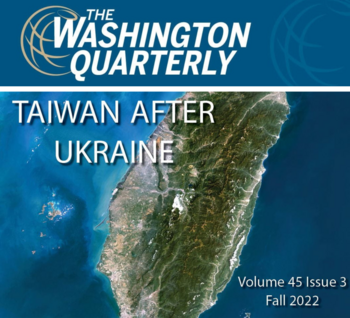
Aerial view of Taiwan and text "The Washington Quarterly, Vol 45 Issue 3, Fall 2022"
Compared to alliances like Japan and Australia, which seek to counter potential Chinese aggression, the role of South Korea is often secondary. Particularly with President Yoon’s new government in place, what can South Korea do to support U.S.-led efforts to compete with China, and what are the major hurdles in attaining deeper bilateral cooperation to enhance deterrence over Taiwan? 

To answer this question, the authors build upon traditional concepts of balancing to create a more granular, operationally relevant set of strategies for South Korea. They argue that, while it is politically infeasible for South Korea to fight side-by-side with US forces against China in a Taiwan scenario or to attempt to build its military sufficiently to deter the People’s Republic of China (PRC) from aggression against Taipei, these classic external and internal balancing strategies are not South Korea’s only options.

In this article, they provide background on South Korea’s approach to the Taiwan issue to date; evaluate South Korea’s strategic importance and what it can theoretically bring to the table; and explore how China and North Korea may respond to increased South Korean cooperation with the US, along with the potential obstacles this cooperation could create. Lastly, they recommend ways to leverage the US–South Korean alliance to enhance deterrence against China with respect to Taiwan.

All Publications button
1
Publication Type
Journal Articles
Publication Date
Journal Publisher
The Washington Quarterly
Authors
Oriana Skylar Mastro
Number
3
Authors
Michael Breger
News Type
News
Date
Paragraphs

As healthcare costs for patients with non-communicable diseases such as diabetes have risen, governments and healthcare providers have sought creative measures to align financial incentives with better patient outcomes. One incentive payment system known as “pay-for-performance” (P4P), in which providers are beholden to metric-driven outcomes, represents a potential path forward for healthcare providers to improve healthcare processes, resulting in higher quality and better patient health outcomes. The evidence on the effectiveness of P4P programs, however, is mixed.

To address this uncertainty, a new study, published in The European Journal of Healthcare Economics, assesses the effectiveness, in monetary terms, of a P4P program for patients with diabetes at a hospital system in Taiwan. 

The study coauthors, including APARC’s Asia Health Policy Program Director and FSI Senior Fellow Karen Eggleston, employed new patient-level data on clinical indicators, utilization, and expenditures, combined with data from the national death registry, to better understand the costs and benefits of the P4P program. Their results show that Taiwan’s implementation of the P4P program for diabetic care yielded positive results in terms of net value, defined as the value of life years gained minus the cost of care.


Sign up for APARC newsletters to receive our experts' research updates.


Assessing Net Value of Taiwan’s P4P

Taiwan’s Bureau of National Health Insurance (now National Health Insurance Administration) introduced P4P in 2001 and enhanced the program in 2006 with an incentive for pay-for-reporting of outcomes. Financial incentives were used to encourage continuity of care with metrics such as new patient enrollment, follow-up visits, and annual reports, each tied to a specific monetary value. The program’s features are common across P4P, so the study’s findings have implications in other settings that incorporate similar designs in their P4P programs.

The study compares two different groups of patients at a large regional hospital in Taiwan, one consisting of newly enrolled P4P patients and another using P4P patients who have been enrolled since the beginning of the program. The researchers leverage detailed clinical data not used in previous assessments of the P4P program to better identify both costs and longer-term clinical outcomes based on measured biomarkers and predicted mortality.

Using an economic cost-benefit analysis conducted from a budgetary perspective, the study is the first analysis of any P4P program that estimates changes in the quality-adjusted price index relative to usual care. The authors consider health benefits in terms of survival and predicted survival and convert them into monetary terms. This net value approach is especially useful for policymakers and healthcare administrators who implement value-based purchasing and monitor outcomes for any service delivery innovation over time.

“These encouraging findings of the positive value of quality improvement net of expenditures adds evidence to the literature that has found mixed results of P4P programs.”

The study finds that Taiwan’s P4P program provided a positive net value for payers and patients, ranging from $40,084 USD to $348,717 USD. These positive net value results are primarily derived from health outcomes as measured by lower mortality rates in the P4P versus non-P4P cohorts, across both newly enrolled and continuously enrolled groups of patients. According to the authors, “these encouraging findings of the positive value of quality improvement net of expenditures adds evidence to the literature that has found mixed results of P4P programs.” 

 This study develops a new model for assessing the net value of service delivery innovations like P4P programs that can be applied in other contexts globally, providing healthcare systems researchers with new tools to better understand an emergent option for incentivized care. With a more economically-translatable understanding of P4P programs, this research helps build the bridge between the oft-disparate worlds of healthcare and policy.

Read More

Two old men
News

Education Level Will Widen Disparity in Health Outcomes of the Future Elderly Population, New Study Projects

In the first study to compare the progression of educational disparities in disability across two rapidly aging Asian societies, APARC coauthors Cynthia Chen and Karen Eggleston project that from 2015 to 2050, elders with high educational attainment will have a lower prevalence of functional disability and chronic conditions compared to elderly with low educational attainment.
Education Level Will Widen Disparity in Health Outcomes of the Future Elderly Population, New Study Projects
Portrait of Cynthia Chen with background of Encina Hall colonade
News

New Approaches to Aging: Understanding and Managing Society-Level Characteristics in Elderly Populations

Broadening the existing scholarship on aging and the needs of different societal groups, Cynthia Chen, Visiting Scholar at APARC’s Asia Health Policy Program, presents nuanced and comprehensive aging metrics that account for the critical factors that influence societal function.
New Approaches to Aging: Understanding and Managing Society-Level Characteristics in Elderly Populations
A trio of elderly women in Japan
News

Japanese Population Projected to Live Longer Without Dementia

A new microsimulation projects that over the next 20 years, Japanese people will live longer without dementia, but older women with a less than high school education will benefit less than men.
Japanese Population Projected to Live Longer Without Dementia
Hero Image
Doctor and nurse working on computer together. Female medical professionals are wearing uniforms. They are standing in hospital corridor. Portra/Getty Images
All News button
1
Subtitle

In the first study to evaluate pay-for-performance implementation at a hospital system in Taiwan, APARC’s Asia Health Policy Program Director Karen Eggleston and co-authors reveal how incentive-based measures to ensure continuity and quality of care resulted in positive health outcomes.

Authors
Oriana Skylar Mastro
News Type
Commentary
Date
Paragraphs

This commentary originally appeared in The Economist.


In the afternoon of August 4th, the People’s Liberation Army (PLA) kicked off the largest and most sophisticated military exercises it has ever conducted. Over the course of a week, the Chinese launched dozens of missiles and conducted drills near Taiwan with 100 aircraft, ten destroyers and support vessels. Submarines and aircraft carriers also played a role. The display has made the third Taiwan Strait crisis, which occurred between 1995-96, when China conducted four rounds of tests over the course of several months, with barrages of no more than six missiles, look like child’s play.

Part of the rationale for the latest exercise was to signal Beijing’s anger over Nancy Pelosi’s visit to Taiwan. Ms Pelosi, the speaker of the House of Representatives, was the highest-ranking American government official to visit the island since 1997. Back then Newt Gingrich, who was also the House speaker, made the trip. China warned that if Ms Pelosi added Taipei to her itinerary, there would be hell to pay.

The exercise is also a bit of a “coming-out party” for Beijing. In 1996 the third crisis ended when America sent two aircraft-carrier strike groups within 200 miles (322km) of Taiwan. America saw this as a great strategic success, and Chinese leaders were unhappy with its interference in what China considers a domestic affair. The resentment helped to drive China to build the PLA into one of the greatest armed forces in the world.


Subscribe to APARC newsletters to receive our experts' analysis and commentary.


Compared with 1996, China’s forces today are barely recognizable. Back then it had a large army, with roughly 4m people, but that was a sign of its backwardness more than anything else. With obsolete equipment and poor training, China barely had what could be considered an air force and a navy. Its pilots could not fly over water, at night or in rough weather. In 1999 less than 2% of its fighters were fourth generation, just 4% of its attack submarines were classed as modern (nuclear powered, for example) and none of its surface ships was. Its navy was a glorified coastguard with ships that, lacking air-defense systems, had to hug the coastline on any patrol. Its nuclear weapons, solid-fuelled and housed mainly in fixed silos, could have been taken out in one fell swoop by America.

Now China’s armed forces are comparable to America’s in quality and quantity. Most of its platforms are modern (of the latest technology for the relevant domain) and it boasts the largest navy in the world. In some areas, Chinese military capabilities already surpass America’s—in shipbuilding, land-based conventional ballistic and cruise missiles, and integrated air-defense systems. China possesses the world’s third-largest nuclear arsenal in the world, one that is currently undergoing major modernization.

Chinese leaders knew the PLA had to conduct a series of large, realistic exercises to identify issues and hone their capabilities. If China had done so out of the blue, instead of using Ms Pelosi’s visit as a pretext, international opprobrium would have been stronger.

But even with all these improvements, it is unclear whether China could take Taiwan by force. China has not fought a war since 1979, when it made heavy weather of a “punitive” invasion of Vietnam. An amphibious attack, and to a lesser degree a blockade of the type the exercises off Taiwan were simulating, would demand complex joint operations (involving army, air force and navy), which in turn require impeccable logistics and command and control. Xi Jinping, China’s leader, launched a massive organizational reform to improve in these areas, and the PLA undoubtedly has. But the war in Ukraine may have given him heightened anxiety, given that the Russians struggled precisely with logistics and command.

For this reason, we should see the massive exercises off Taiwan less as a signal, and more as a rehearsal for combat. Mr Xi wants progress on the Taiwan issue, and domestically talk in the press is shifting from peaceful reunification to armed reunification. Chinese leaders knew the PLA had to conduct a series of large, realistic exercises to identify issues and hone their capabilities. If China had done so out of the blue, instead of using Ms Pelosi’s visit as a pretext, international opprobrium would have been stronger.

China will seize the opportunity to practice as much as possible. It has announced already that this round of exercises will continue and that another round in the Bohai Gulf/Yellow Sea is next. And it won’t just be large-scale exercises. It is unlikely that Beijing will return to its previous level of operations. Instead, China might attempt to normalize greater Chinese activity around Taiwan. That makes war more probable. Through a series of exercises the PLA, and the party leadership, might gain confidence that China’s forces are ready to take Taiwan sooner than they would otherwise have thought.

Of course, this all depends on how the exercises and operations go. From the outside, this is hard to assess. The missiles landed where they should have in recent days, and there were no accidents. But we don’t know how much and how well different groups are communicating with each other. To prepare for joint operations, air-force units need to operate in close proximity and coordinate with ground troops and amphibious elements. The PLA needs to practice providing supplies, such as prepositioned fuel stocks, and bringing munitions and medical supplies to forward locations such as Fujian, the province directly across the Taiwan Strait.

This is where the real trouble lies. If activities in the vicinity of Taiwan become more routine, not only does this heighten anxiety in Taipei (and probably other regional capitals as well) but it helps to disguise any preparations for a real military campaign. China needs an element of surprise to be able to take Taiwan before America has time to mobilize adequate forces in the region to defend the island. If China’s forces are simulating formations, blockades, attacks, and amphibious landings, it will be harder to decipher when they are preparing for the real thing. Ms Pelosi’s visit has allowed Beijing to move to a new level of military activity unchallenged, which will make it harder for America to defend Taiwan. No signal of America’s commitment to the island can fix that.

Read More

Honor guards prepare to raise the Taiwan flag in the Chiang Kai-shek Memorial Hall square.
Commentary

Biden Says We’ve Got Taiwan’s Back. But Do We?

Many will applaud Mr. Biden for standing up for democratic Taiwan in the face of Chinese threats. But he could be putting the island in greater danger, and the United States may not be able to come to the rescue.
Biden Says We’ve Got Taiwan’s Back. But Do We?
An Island that lies inside Taiwan's territory is seen with the Chinese city of Xiamen in the background.
Commentary

The Taiwan Temptation

Why Beijing Might Resort to Force
The Taiwan Temptation
Hero Image
A Taiwanese F-5 fighter jet is seen after taking off from Chihhang Air Base on August 06, 2022 in Taitung, Taiwan.
A Taiwanese F-5 fighter jet is seen after taking off from Chihhang Air Base on August 06, 2022 in Taitung, Taiwan. Taiwan remained tense after U.S. Speaker of the House Nancy Pelosi's visit to the island as part of a tour of Asia aimed at reassuring allies in the region. China has been conducting live-fire drills in waters close to those claimed by Taiwan in response.
Annabelle Chih/ Getty Images
All News button
1
Subtitle

Nancy Pelosi’s visit was more pretext than provocation.

Date Label
Authors
Oriana Skylar Mastro
News Type
Commentary
Date
Paragraphs

This opinion piece first appeared in the New York Times.


President Biden’s recent trip to Asia nearly went off without a hitch — until Taiwan came up. Mr. Biden was asked whether the United States would respond “militarily” if China sought to retake the self-ruled island by force.

“Yes,” he said. “That’s the commitment we made.”

It was one of the most explicit U.S. defense guarantees for Taiwan in decades, appearing to depart from a longtime policy of “strategic ambiguity.” But it’s far from certain that the United States could hold off China.

I have been involved in dozens of war games and tabletop exercises to see how a conflict would turn out. Simply put, the United States is outgunned. At the very least, a confrontation with China would be an enormous drain on the U.S. military without any assured outcome that America could repel all of China’s forces. Mr. Biden’s comments may be aimed at deterring a Chinese attack, and hopefully they will.

After a decades-long military modernization, China has the world’s largest navy and the United States could throw far fewer ships into a Taiwan conflict. China’s missile force is also thought to be capable of targeting ships at sea to neutralize the main U.S. tool of power projection, aircraft carriers. The United States has the most advanced fighter jets in the world but access to just two U.S. air bases within unrefueled combat radius of the Taiwan Strait, both in Japan, compared with China’s 39 air bases within 500 miles of Taipei.

If China’s leaders decide they need to recover Taiwan and are convinced that the United States would respond, they may see no other option but a pre-emptive strike on U.S. forces in the region. Chinese missiles could take out key American bases in Japan, and U.S. aircraft carriers could face Chinese “carrier killer” missiles. In this scenario, superior U.S. training and experience would matter little.


Sign up for APARC newsletters to receive our experts' analysis.


The need to project power across vast distances also makes U.S. forces vulnerable to China’s electronic and cyberwarfare capability. China could disrupt networks like the United States Transportation Command, which moves American assets around and is considered vulnerable to cyberattacks. China may also have the ability to damage satellites and disrupt communications, navigation, targeting, intelligence-gathering, or command and control. Operating from home turf, China could use more-secure systems like fiber-optic cables for its own networks.

Under a best-case battle scenario for the United States, China would attack only Taiwan and refrain from hitting American forces to avoid drawing in U.S. military might. This would allow the United States time to bring its forces into the region, move others to safety and pick where and when it engages with China.

If the United States did ever intervene, it would need regional allies to provide runways, ports and supply depots. But those partners may be eager to stay out of the crossfire.

I’m not the only one who’s worried. A 2018 congressionally mandated assessment warned that America could face a “decisive military defeat” in a war over Taiwan, citing China’s increasingly advanced capabilities and myriad U.S. logistical difficulties. Several top former U.S. defense officials have reached similar conclusions.


Mr. Biden’s remarks were made in the context of Ukraine, and America’s failure to prevent that war may be driving his thinking on Taiwan. Mr. Biden may be calculating that Russia’s setbacks in Ukraine will give China pause and that guaranteed U.S. intervention in a conflict over Taiwan would cost Beijing too much, even if it took the island.

But comparing Ukraine and Taiwan is problematic. Beijing views Taiwan — self-ruled since 1949 — as an integral part of Chinese territory since ancient times, a significantly deeper attachment than Vladimir Putin’s obsession with Ukraine. Reunifying the island with the mainland is one of the Chinese Communist Party’s most cherished goals, and China would see U.S. intervention as a bitter betrayal of the “one China” principle — the idea that China and Taiwan belong together, which Washington has acknowledged since the 1970s.

China’s military is bigger and more formidable than Russia’s, and its economy far larger, more resilient and globally integrated. Rallying support for economic sanctions against Beijing during a conflict — China is the biggest trading partner of many countries — would be more challenging than isolating Russia.

The White House is once again walking back Mr. Biden’s comments, saying official policy has not changed.

If so, then Mr. Biden should stop rocking the boat and focus instead on strengthening America’s position in the Taiwan theater. This doesn’t just mean more weapons for Taiwan and a more robust U.S. military presence in the region, though the former would help the island hold out if China attacked, and both would boost deterrence.

It also means shrewd diplomacy. Mr. Biden needs to stand firm against Chinese intimidation of Taiwan, while working to ease Beijing’s anxieties by demonstrating a stronger U.S. commitment to a peaceful resolution of the Taiwan issue. Mr. Biden should also persuade regional friends to provide more bases for the United States to use. This not only increases U.S. operational flexibility but also heightens deterrence.

Whatever Mr. Biden’s calculations, departing from the “strategic ambiguity” that has helped keep peace for decades misses the point. The main question for President Xi Jinping must be not whether the United States would join in, but whether China could beat the United States in a battle for Taiwan. Twenty years ago, China’s poorly trained army and largely obsolete naval and air forces had no chance. But that was then.

Many will applaud Mr. Biden for standing up for democratic Taiwan in the face of Chinese threats. But he could be putting the island in greater danger, and the United States may not be able to come to the rescue.

Read More

Vladamir Putin and Xi Jinping shake hands.
Commentary

Beijing Is Used to Learning from Russian Failures

The invasion of Ukraine is offering useful lessons for the PLA.
Beijing Is Used to Learning from Russian Failures
Benxi steel plant
Commentary

Next Steps in U.S.-China Climate Cooperation

There are multiple, concreate areas for constructive cooperation between the United States and China as they tackle growing environmental challenges.
Next Steps in U.S.-China Climate Cooperation
Hero Image
Honor guards prepare to raise the Taiwan flag in the Chiang Kai-shek Memorial Hall square.
Honor guards prepare to raise the Taiwan flag in the Chiang Kai-shek Memorial Hall square ahead of the Taiwanese presidential election on January 14, 2016 in Taipei, Taiwan.
Ulet Ifansasti/ Getty Images
All News button
1
Subtitle

Many will applaud Mr. Biden for standing up for democratic Taiwan in the face of Chinese threats. But he could be putting the island in greater danger, and the United States may not be able to come to the rescue.

Date Label
Authors
Oriana Skylar Mastro
News Type
Commentary
Date
Paragraphs

This commentary first appeared in Foreign Policy.

Russia’s invasion of Ukraine has been a double disaster for President Vladimir Putin, as he faces a poorly performing military combined with an inability to shield his country from economic punishment. Both of these possibilities historically have also been sources of apprehension for the Chinese Communist Party (CCP). But China’s leadership turned its anxiety into action about 10 years ago, deliberately working to fix many of the problems and minimize the risks currently plaguing Russia in Ukraine.

One result is that the Chinese military is more likely to perform well even though it has not fought a war since 1979, when it lost thousands of troops in a punitive but brief invasion of Vietnam. Adding to that, China’s economy is both far larger and deliberately more diversified than Russia’s. A sanctions effort like the one presently aimed at Russia would be much harder to sustain against China. These two observations do not mean deterrence won’t hold, only that the unfolding events in Ukraine will likely do little to make Beijing more cautious.

Nearly everyone overestimated Russia’s military capabilities—including probably Putin himself. During its invasion of Ukraine, Russia’s air-ground coordination has been ineffective, and Russian forces have shown risk-adverse tendencies in the air. Russia has also struggled with logistics and keeping its military supplied. Notably, it appears that Russia acted on bad intelligence and therefore did not believe initial strikes that maxed out its firepower were necessary. Furthermore, many Russian weapons platforms are outdated (for example, its Cold War-era tanks), and modern Su-57 fighter jets and T-14 Armata tanks only exist in comparatively small numbers.

The Chinese military used to clearly exhibit the same deficiencies. But over the past decade, it has embraced significant reforms, creating a much more capable fighting force that should give even the United States pause.


Sign up for APARC newsletters to receive our experts' commentary and analysis.


Chinese President Xi Jinping identified similar training and competency issues [to the human element of Russia’s failures in Ukraine] in the PLA 10 years ago. But under his command, the PLA has been proactively implementing significant reforms to avoid similar pitfalls.

First, while Russia allowed its conventional capabilities to atrophy, Chinese military spending has exploded over the past three decades, increasing by 740 percent (in comparison to Russia’s 69 percent) from 1992 to 2017. According to data from the Stockholm International Peace Research Institute, China spent almost four times on its military in 2020 than Russia ($244.9 billion to $66.8 billion). In 1999, less than 2 percent of its fighter jets were fourth-generation, 4 percent of its attack submarines were modern, and none of its surface ships were. Twenty years later, not only did China have much more of everything, but the majority was the most advanced, modern versions available—with China exhibiting advantages over Russia, even in combat aircraft, a traditional area of weakness for China.

Indeed, People’s Liberation Army (PLA) commentators often refer to China’s economic might as one of the reasons their military would outperform Russia’s—Russia has been “stingy” with its military modernization and production of precision-guided munitions primarily because of a lack of resources. By contrast, China has more than 2,200 conventionally armed ballistic and cruise missiles, making the PLA Rocket Force the world’s largest ground-based missile force. Estimates place the number of missiles positioned against Taiwan alone at around 1,000.

Russia’s poor performance does remind us that it takes more than just a lot of fancy systems to win a war (though having more advanced systems and more of them surely would have helped). The human element of Russia’s failures is front and center. Putin probably did not have an open and honest communication channel with the military, which was fearful of providing unfavorable information to the erratic leader. Russian troops were largely considered incompetent, but Putin thought superior technology could overcome human deficiencies.

Chinese President Xi Jinping identified similar training and competency issues in the PLA 10 years ago. But under his command, the PLA has been proactively implementing significant reforms to avoid similar pitfalls. And unlike Putin, who apparently believed technology could overcome deficiencies in personnel, Xi came to the opposite conclusion. When he came to power, he took one look at the military and recognized that with all its fancy equipment, the PLA probably could not fight and win wars and perform the missions it had been assigned. Of particular importance, according to China’s national military strategy, was to fight local wars under informationalized conditions. This meant that the network between platforms and people—the ease of connectivity—was the main feature of modern warfare. China needed the best equipment; an advanced command, control, computers, communication, intelligence, surveillance, and reconnaissance (C4ISR) network; and tons of precision-guided munitions. But perhaps most importantly, it needed troops that could leverage these systems to conduct seamless operations across services and top-down through the chain of command.

The Chinese military is learning lessons from Ukraine, whether it is to stockpile more precision-guided munitions, ensure solid command and control, or cut off internet access [...], which will only serve to improve its warfighting capability in the future.

What followed was a series of slogans—the two incompatibles, two inabilities, two big gaps, the five incapables—all designed to point out the organizational and personnel issues of the military and focus leadership attention and resources on fixing the issue. A massive military reorganization followed with moves such as reorganizing effective combat units to be smaller so that they can mobilize more quickly and can remain self-sufficient for long periods of time. This means, in contrast with the Russian military, the PLA will likely have less reliance on generals at the front lines. China also established theater commands to facilitate joint operations and prioritized realism in its military exercises to help it prepare for real combat. Part of all of this was Xi’s demand that the military communicate its failures and weaknesses so that they could be addressed. Moreover, to improve command and control, China has moved toward engaging in multidomain joint operations all while standing up a new joint operations center that will ensure that, unlike with the Russian military, orders will be communicated and understood at the lowest levels. Indeed, the main reason that Xi has not yet made a play for Taiwan is likely his desire to hone this command and control structure and practice joint operations in realistic conditions for a few more years—a cautious and pragmatic approach that the situation in Ukraine only encourages further.

The PLA itself acknowledges that it still has some distance to go with training, particularly with regard to joint operations, but it looks as if the hard work is paying off. The complexity and scale of China’s national military exercises are eye-opening. It takes a great deal of planning, synchronization, and coordination to take service-level operations to the joint level. China appears to have made great strides in this area. The United States has observed, for example, China executing deep-attack air operations in its exercises that have combined intelligence, surveillance, and reconnaissance (ISR) with multi-domain strike; lift for rapid mobility and advanced fighter manuevers. Russia has relied heavily on artillery and tanks, now and historically, while the PLA is showing a more balanced approach to combined arms operations.

For all these reasons, we should not expect the Chinese military to perform as poorly in its first real military operation since 1979. The PLA is structurally superior to the Russian military. And the Chinese know it. Granted, it’s hard to know whether some of the outlandish claims in the Chinese media are true—that the PLA Air Force would actually “be able to take out the Ukrainian air force in one hour.” But one thing is for certain—the Chinese military is learning lessons from Ukraine, whether it is to stockpile more precision-guided munitions, ensure solid command and control, or cut off internet access to prevent the leaking of information to the West, which will only serve to improve its warfighting capability in the future.

That does not mean it’s perfect. China is still in the process of building its corps of noncommissioned officers, recruiting more college graduates and technical experts so as to be less reliant on conscripts and shift away from an officer-heavy structure. Also, there is always the possibility that Xi’s anti-corruption campaign, which has impacted even the highest levels of the military, may begin to impinge on these reforms. But to date, it seems that those against necessary reforms have been largely targeted. In other words, Xi has not had to choose yet between his goals of consolidating domestic power and the professionalization of the armed forces.

The economic side is less about what has happened in the past six weeks than what will happen in the next six months or even six years. As tempting as it is in the case of Russia’s invasion, the impact of economic sanctions cannot be properly evaluated over a short time period. The need for a longer time horizon also applies to Russia-China economic comparisons, as it will generally require more extensive and more durable sanctions to deter or compel China than it would Russia.

Russia is thought, at least, to be highly vulnerable to sanctions applied to date. And it is certainly the case that China can be harmed by sanctions. Beijing is more integrated in global trade and finance than Moscow and thus has more to lose. But integration cuts both ways—compared with Russia, more countries would be harmed to a greater extent by equivalent actions taken against China. Further, China has demonstrated greater capacity to weather extended economic blows. This combination of features reduces the willingness of the United States and others to enforce durable sanctions, a fact that Beijing well appreciates.

The CCP survived three decades of worse poverty than experienced by the Soviet Union at the time, a self-inflicted depression in 1989-90 paralleling in some respects the events that ended the Soviet Union, the global financial crisis, and another partly self-inflicted economic wound via China’s determination to maintain its zero-COVID policy in 2021-22.

During more recent events, Beijing has been able to mobilize first greater capital resources than Moscow and then far greater. In 2020, the World Bank put China’s gross fixed capital formation at 20 times Russia’s. Xi attacked some of China’s richest citizens, as well as other elements of the private sector, in part because he believed them too intertwined with foreign capital. These were voluntary steps by China that mirror how the world currently seeks to punish Russia. Whatever their wisdom, Xi knows China can afford them, while Russia’s capability is in doubt.

Some Russian foreign reserves have been effectively frozen and some financials excluded from the Society for Worldwide Interbank Financial Telecommunication (SWIFT), limiting international transactions. In the short term, these steps could have a similar impact on China, but they would be much harder to sustain.

Beijing has conducted currency swaps with dozens of countries that will want their renminbi to be useful. China also holds foreign government bonds in amounts that countries cannot ignore. U.S. Treasurys see the largest holdings, but there are also sizable quantities of Japanese government bonds, for instance. With official Chinese reserves upwards of $3 trillion, perhaps five times Russia’s, a partial freeze would quickly wear on governments and firms looking for bond buyers.

For any SWIFT restrictions that interfere with outbound U.S. portfolio investment, that volume stood at $85 billion in Russia and $1.15 trillion in China in 2020. The stock of U.S. direct investment was 10 times higher in China than Russia—companies willing to exit Russia would face leaving a lot more behind in a China contingency. Most broadly, the yuan can erode the role of the dollar; the ruble certainly cannot. Beijing lacks the will to allow free movement of the yuan and make it a true reserve currency, but heavy, durable sanctions might change that.

On the goods side, existing pressure to spare Russian vital exports would be more intense in China’s case. The loss of Russian oil and gas exports of $230 billion in 2021 threatens energy markets. Chinese exports are at least as important within chemicals, textiles, household appliances, industrial machinery, and consumer electronics. Would they all be exempted?

Certain Russian exports, such as palladium, play supply chain roles beyond their direct financial value. As expected from its manufacturing and export volumes, China’s supply chain participation is far larger than Russia’s, extending from inputs crucial to global pharmaceuticals to processed rare earths crucial to clean-energy applications. Russian ships have been banned from some ports. By tonnage, Russia accounts for a bit over 1 percent of the world’s commercial fleet, while China accounts for more than 11 percent. Banning Chinese ships would cause seaborne trade to noticeably contract, hitting supply chains that would already be strained by the diversion of Chinese goods.

Even an area of clear Russian advantage—lower import dependence—is double-edged. Inhibiting Chinese imports of iron ore or integrated circuits, for example, would hit the country hard. But China is such a huge purchaser that many producers would refuse to join a sustained embargo against it. As elsewhere, the barriers to Russian imports adopted thus far could hurt China only in the unlikely event that they are maintained for many months.

From how to remain in power to how to advance on the international stage, militarily and economically, the CCP has been learning what not to do from the Russian or Soviet experience for decades. Chinese strategists are unquestionably evaluating whether the nature of warfare has changed or if they failed to consider some critical factors necessary for success. Chinese economists are certainly looking to identify missed vulnerabilities based on how the economic dimension of the war in Ukraine plays out—and will work to address them to prevent exploitation by the United States and others.

Not that it will all be easy for Beijing. But China is already better prepared than Russia, economically and militarily. The steps to support Ukraine and punish Russia are immediately less potent in a China contingency. And an unfortunate side effect of the tragedy in Ukraine is that China has a relatively low-cost opportunity to learn—it may become a more formidable challenger than it would’ve been otherwise. The United States and its allies should realize that their effectiveness with regard to Russia is highly unlikely to translate. In a Taiwan contingency, the United States must be able to immediately implement both a stronger package of actions aimed at China and also a second package aimed at minimizing the long-term cost of the first.

Read More

Protesters display placards in front of the Representative Office of the Moscow-Taipei Coordination Commission to protest against Russia’s military invasion of Ukraine on February 25, 2022 in Taipei, Taiwan.
Commentary

Invasions Are Not Contagious

Russia’s War in Ukraine Doesn’t Presage a Chinese Assault on Taiwan
Invasions Are Not Contagious
millward
News

Unpacking the Crisis in Xinjiang: James Millward on China's Assimilationist Policies and U.S.-China Engagement

APARC Visiting Scholar James Millward discusses PRC ethnicity policy, China's crackdown on Uyghur Muslims and other minorities in Xinjiang province, and the implications of the Xinjiang crisis for U.S. China strategy and China's international relations.
Unpacking the Crisis in Xinjiang: James Millward on China's Assimilationist Policies and U.S.-China Engagement
Hero Image
Vladamir Putin and Xi Jinping shake hands.
All News button
1
Subtitle

The invasion of Ukraine is offering useful lessons for the PLA.

Date Label
Authors
Larry Diamond
News Type
Commentary
Date
Paragraphs

In these next few minutes, I’d like to reflect on the moment we are at in world history, and what it means for the future of democracy. I know you have already heard a lot today, and will hear more tomorrow, about the war in Ukraine and its global implications. Here is my perspective.

Russia’s brutal and unprovoked aggression against Ukraine, which is now about to enter its seventh week, is the most important event in the world since the end of the Cold War.  9/11 changed our lives in profound ways, and even changed the structure of the U.S. Government. It challenged our values, our institutions, and our way of life. But that challenge came from a network of non-state actors and a dead-end violent jihadist ideology that were swiftly degraded. The Russian invasion of Ukraine, and the larger rising tide of authoritarian power projection, represent the return of great power competition. And more, they denote a new phase of what John F. Kennedy called in his 1961 inaugural address a “long twilight struggle” between two types of political systems and governing philosophies. Two years after JFK’s address, Hannah Arendt put it this way in her book, "On Revolution":

No cause is left but the most ancient of all, the one, in fact, that from the beginning of our history has determined the very existence of politics, the cause of freedom vs. tyranny.

That is what the war in Ukraine, the war FOR Ukraine, is about: not about Ukraine someday joining NATO, but about Ukraine — a country so important to Russia’s cultural heritage and historical self-conception — becoming a free country, a functioning liberal democracy, and thus a negation of and an insult to everything that Vladimir Putin and his kleptocratic Kremlin oligarchy cynically represent.

But it is not simply a “Resurrected Russia” (as Kathryn Stoner has termed it) that is counterposed to the global cause of freedom. The greater long-term threat comes from China’s authoritarian Communist party-state. China has the world’s fastest growing military and the most pervasive and sophisticated system of digital surveillance and control. Its pursuit of global dominance is further aided by the world’s most far-reaching global propaganda machine and a variety of other mechanisms to project sharp power — power that seeks to penetrate the soft tissues of democracy and obtain their acquiescence through means that are covert, coercive, and corrupting. It is this combination of China’s internal repression and its external ambition that makes China’s growing global power so concerning. China is the world’s largest exporter, its second largest importer, and its biggest provider of infrastructure development. It is also the first major nation to deploy a central bank digital currency; and it is challenging for the global lead in such critical technologies as AI, quantum computing, robotics, hypersonics, autonomous and electric vehicles, and advanced telecommunications.


A narrative has been gathering that democracies are corrupt and worn out, lacking in energy, purpose, capacity, and self-confidence. This has been fed by real-world developments which have facilitated the rise of populist challengers to liberal democracy.
Larry Diamond
Mosbacher Senior Fellow in Global Democracy at FSI

While China now innovates in many of these technologies, it also continues to acquire Western intellectual property through a coordinated assault that represents what former NSA Director General Keith Alexander calls “the greatest transfer of wealth in human history.” And every technological innovation that China can possibly militarize it does, through a strategy of “civil-military fusion.” With this accumulated power, Beijing plans to force Asia’s most vibrant liberal democracy, Taiwan, to “reunify with the motherland.” It also seeks to establish unilateral Chinese control over the resources and sea lanes of the South China Sea, and then gradually to push the United States out of Asia.

Russia’s aggression must be understood in this broader context of authoritarian coordination and ambition, challenging the values and norms of the liberal international order, compromising the societal (and where possible, governmental) institutions of rival political systems, and portraying Western democracies — and therefore, really, democracy itself — as weak, decadent, ineffectual, and irresolute. In this telling, the democracies of Europe, Asia, and North America — especially the United States — are too commercially driven, too culturally fractured, too riven by internal and alliance divisions, too weak and effeminate, to put up much of a fight.

At the same time, China, Russia, and other autocracies have been denouncing the geopolitical arrogance of the world’s democracies and confidently declaring an end to the era in which democracies could “intervene in the internal affairs of other countries” by raising uncomfortable questions about human rights. 

On the eve of the Beijing Winter Olympics on February 4, Vladimir Putin and Xi Jinping issued a joint statement denouncing Western alliances and declaring that there were no limits to the strategic partnership between their two countries. Many analysts believe Putin told Xi then that he was about to invade Ukraine and that Xi probably said, okay, just wait till the Olympics are over and make it quick. 

Four days after Xi’s closing Olympics fireworks display, Putin launched his own fireworks by invading Ukraine. It has been anything but successful or quick. Xi cannot possibly be pleased by the bloody mess that Putin has made of this, which helps to explain why China twice abstained in crucial UN votes condemning the Russian invasion, rather than join the short list of countries that stood squarely with Russia in voting no: Belarus, Eritrea, Syria, and North Korea. Xi must think that Putin’s shockingly inept and wantonly cruel invasion is giving authoritarianism a bad name.


Russia’s aggression must be understood in this broader context of authoritarian coordination and ambition, challenging the values and norms of the liberal international order and portraying Western democracies as weak.
Larry Diamond
Mosbacher Senior Fellow in Global Democracy at FSI

It is also costing China a lot of money in global trade at a time when China’s economic growth rate has slowed dramatically. And it’s undermining the narrative China was trying to push that the autocracies know what they are doing and represent the wave of the future. Moreover, this is coming at a moment when one of China’s two most important cities, Shanghai, is gripped by panic and a substantial lockdown over the Covid-19 virus, which Xi’s regime has no other means to control except lockdown, because it has refused to admit that the vaccines it developed are largely ineffective against the current strains of Covid, and instead import the vaccines that work.

All of this explains why this moment could represent a possible hinge in history as significant as the 1989-91 period that ended the Cold War. 2021 marked the fifteenth consecutive year of a deepening democratic recession. In both the older democracies of the West and the newer ones of the global South and East, the reputation of democracy has taken a beating. A narrative has been gathering that democracies are corrupt and worn out, lacking in energy, purpose, capacity, and self-confidence. And this has been fed by real-world developments, including the reckless and incompetent US invasion of Iraq, the 2008 financial crisis, steadily rising levels of economic inequality, widespread job losses, economic insecurity and status anxiety due to globalization and technological change, and the challenges of managing cultural diversity amid expanding immigration. These factors have fed or at least facilitated the rise of populist challengers to liberal democracy and the decay of democratic norms and institutions across many democracies — rich, poor, and middle-income. 

The Germans have a word for these trends in the global narrative:  “zeitgeist” — the spirit of the times, or the dominant mood and beliefs of a historical era. In the roughly 75 years since WWII, we have seen five historical periods, each with their own dominant mood. From the mid-1940s to the early 60s, the mood had a strong pro-democracy flavor that went with decolonization. It gave way in the mid-1960s to post-colonial military and executive coups, the polarization and waste of the Vietnam War, and a swing back to realism, with its readiness to embrace dictatorships that took “our side” in the Cold War. Then, third, came a swing back to democracy in southern Europe, Latin America, and East Asia, and a new wave of democracy, from the mid-1970s to around 1990. That period of expanding democracy was then supercharged by a decisively pro-democratic zeitgeist from 1990 to 2005, the so-called unipolar moment in which one liberal democracy, the U.S., predominated. That period ended in the Iraq debacle, and for the last 15 years, we have been in the tightening grip of a democratic recession and a nascent authoritarian zeitgeist. 

Could Russia’s criminal, blundering invasion of Ukraine launch a new wave of democratic progress and a liberal and anti-authoritarian zeitgeist? It could, but it will require the following things.


Freedom is worth fighting for, and democracy, with all its faults, remains the best form of government.
Larry Diamond
Mosbacher Senior Fellow in Global Democracy at FSI

First, Russia must fail in its bid to conquer and extinguish Ukraine. The United States and NATO must do everything possible, and much more than we are doing now, to arm and assist Ukraine militarily, and to punish Russia financially and economically.

Second, we must wage a more effective and comprehensive battle of information and ideas to expose Russia’s mendacity and criminality and to document its war crimes, not only before the court of public opinion, but in ways that reach individual Russians directly and creatively. We need an intense campaign of technological innovation to circumvent authoritarian censorship and empower Russian, Chinese, and other sources that are trying to report the truth about what is happening and to promote critical thinking and the values of the open society. In general, we need to promote democratic narratives and values much more imaginatively and resourcefully. The message of the Russian debacle in Ukraine is an old one and should not be difficult to tell: autocracies are corrupt and prone to massive policy failures precisely because they suppress scrutiny, independent information, and policy debate. Democracies may not be the swiftest decision makers, but they are over time the most reliable and resilient performers.

Third, we must ensure that we perform more effectively as democracies, and with greater coordination among democracies, to meet the challenges of developing and harnessing new technologies, creating new jobs, and reducing social and economic inequalities.

Fourth, to win the technological race, for example in semiconductors, artificial intelligence, biomedicine, and many other fields of science, engineering, and production, we must open our doors more widely to the best talent from all over, including China. We URGENTLY need immigration reform to facilitate this. As our late colleague George Shultz said:  Admit the best talent from all over the world to our graduate programs in science and engineering, and then staple green cards to their diplomas.

Finally, we have to reform and defend our democracy in the United States so that it can function effectively to address our major domestic and international challenges, and so that American democracy can once again be seen as a model worth emulating. We cannot do this without reforming the current electoral system of "first-past-the-post" voting and low-turnout party primaries, which has become a kind of death spiral of political polarization, distrust, and defection from democratic norms.

I believe we entered a new historical era on Feb 24. What the Ukrainian people have suffered already in these seven weeks has been horrific, and it will get worse. But the courage and tenacity of their struggle should renew our commitment not only to them but also to ourselves—that freedom is worth fighting for, and that democracy, with all its faults, remains the best form of government.

Larry Diamond

Larry Diamond

Mosbacher Senior Fellow in Global Democracy at FSI
Full Profile

Read More

Some of the original Ukrainian alumni from the Draper Hills Summer Fellowship gather in Kyiv in 2013.
News

A History of Unity: A Look at FSI’s Special Relationship with Ukraine

Since 2005, the Freeman Spogli Institute for International Studies has cultivated rich academic ties and friendships with Ukrainian scholars and civic leaders as part of our mission to support democracy and development domestically and abroad.
A History of Unity: A Look at FSI’s Special Relationship with Ukraine
Vladamir Putin and Xi Jinping shake hands.
News

Understanding the Global Rise of Authoritarianism

National security analyst and veteran podcaster Ben Rhodes joins Michael McFaul on World Class to discuss his new book, After the Fall: Being American in the World We've Made, and the reasons nationalism and authoritarianism are on the rise across the globe.
Understanding the Global Rise of Authoritarianism
Larry Diamond, center, with the Mosbacher family - Nancy, Bruce, Emily and Jack.
News

Larry Diamond Named Mosbacher Senior Fellow in Global Democracy at the Freeman Spogli Institute for International Studies

CDDRL’s Larry Diamond, a world-renowned expert on comparative democracy, is recognized for a career of impact on students, policymakers and democratic activists around the world.
Larry Diamond Named Mosbacher Senior Fellow in Global Democracy at the Freeman Spogli Institute for International Studies
Hero Image
Larry Diamond speaking in the Bechtel Conference Center in Encina Hall
Larry Diamond, the Mosbacher Senior Fellow in Global Democracy at FSI, speaks in the Bechtel Conference Center at the Freeman Spogli Institute for International Studies at Stanford University.
CDDRL
All News button
1
Subtitle

Speaking at the April 2022 meeting of the FSI Council, Larry Diamond offered his assessment of the present dangers to global democracy and the need to take decisive action in support of liberal values.

Authors
Oriana Skylar Mastro
News Type
Commentary
Date
Paragraphs

This commentary was originally published by The Wall Street Journal.


A Russian invasion of Ukraine would be the most consequential use of military force in Europe since World War II and could put Moscow in a position to threaten U.S. allies in Europe. Many in the American foreign-policy establishment argue that the appropriate U.S. response to any such invasion is a major American troop deployment to the Continent. This would be a grave mistake.

The U.S. can no longer afford to spread its military across the world. The reason is simple: an increasingly aggressive China, the most powerful state to rise in the international system since the U.S. itself. By some measures, China’s economy is now the world’s largest. And it has built a military to match its economic heft. Twenty-five years ago, the Chinese military was backward and obsolete. But extraordinary increases in Beijing’s defense budget over more than two decades, and top political leaders’ razor-sharp focus, have transformed the People’s Liberation Army into one of the strongest militaries the world has ever seen.


Sign up for APARC newsletters to receive our experts' commentary and analysis.


China’s new military is capable not only of territorial defense but of projecting power. Besides boasting the largest navy in the world by ship count, China enjoys some capabilities, like certain types of hypersonic weapons, that even the U.S. hasn’t developed.

Most urgently, China poses an increasingly imminent threat to Taiwan. Xi Jinping has made clear that his platform of “national rejuvenation” can’t be successful until Taiwan unifies with the mainland—whether it wants to or not. The PLA is growing more confident in its ability to conquer Taiwan even if the U.S. intervenes. Given China’s military and economic strength, China’s leaders reasonably doubt that the U.S. or anyone else would mount a meaningful response to an invasion of Taiwan. To give a sense of his resolve, Mr. Xi warned that any “foreign forces” standing in China’s way would have “their heads . . . bashed bloody against a Great Wall of steel forged by over 1.4 billion Chinese people.”

If Taiwan falls into Chinese hands, the U.S. will find it harder to defend critical allies like Japan and the Philippines, while China will be able to project its naval, air and other forces close to the U.S. and its territories

The U.S. must defend Taiwan to retain its credibility as the leader of a coalition for a free and open Indo-Pacific. From a military perspective, Taiwan is a vital link in the first island chain of the Western Pacific. If Taiwan falls into Chinese hands, the U.S. will find it harder to defend critical allies like Japan and the Philippines, while China will be able to project its naval, air and other forces close to the U.S. and its territories. Taiwan is also an economic dynamo, the ninth-largest U.S. trading partner of goods with a near-monopoly on the most advanced semiconductor technology—to which the U.S. would most certainly lose access after a war.

The Biden administration this month ordered more than 6,000 additional U.S. troops deployed to Eastern Europe, with many more potentially on the way. These deployments would involve major additional uncounted commitments of air, space, naval and logistics forces needed to enable and protect them. These are precisely the kinds of forces needed to defend Taiwan. The critical assets—munitions, top-end aviation, submarines, and intelligence, surveillance and reconnaissance capabilities—that are needed to fight Russia or China are in short supply. For example, stealthy heavy bombers are the crown jewel of U.S. military power, but there are only 20 in the entire Air Force.

The U.S. has no hope of competing with China and ensuring Taiwan’s defense if it is distracted elsewhere. It is a delusion that the U.S. can, as Pentagon press secretary John Kirby said recently, “walk and chew gum at the same time” with respect to Russia and China. Sending more resources to Europe is the definition of getting distracted. Rather than increasing forces in Europe, the U.S. should be moving toward reductions.

To be blunt: Taiwan is more important than Ukraine. America’s European allies are in a better position to take on Russia than America’s Asian allies are to deal with China.

There is a viable alternative for Europe’s defense: The Europeans themselves can step up and do more for themselves, especially with regard to conventional arms. This is well within Europe’s capacity, as the combined economic power of the NATO states dwarfs that of Russia. NATO allies spend far more on their militaries than Russia. To aid its European allies, the U.S. can provide various forms of support, including lethal weapons, while continuing to remain committed to NATO’s defense, albeit in a more constrained fashion, by providing high-end and fungible military capabilities. The U.S. can also continue to extend its nuclear deterrent to NATO.

The U.S. should remain committed to NATO’s defense but husband its critical resources for the primary fight in Asia, and Taiwan in particular. Denying China the ability to dominate Asia is more important than anything that happens in Europe. To be blunt: Taiwan is more important than Ukraine. America’s European allies are in a better position to take on Russia than America’s Asian allies are to deal with China. The Chinese can’t be allowed to think that America’s distraction in Ukraine provides them with a window of opportunity to invade Taiwan. The U.S. needs to act accordingly, crisis or not.

Ms. Mastro is a center fellow at the Shorenstein Asia-Pacific Research Center, part of Stanford’s Freeman Spogli Institute for International Studies, and a nonresident senior fellow at the American Enterprise Institute. Mr. Colby is a principal at the Marathon Initiative and author of “The Strategy of Denial: American Defense in an Age of Great Power Conflict.”

Headshot of Oriana Skylar Mastro

Oriana Skylar Mastro

Center Fellow at the Freeman Spogli Institute for International Studies
Full Biography

Read More

President Xi and Kim Jong Un meet on a TV screen
Commentary

North Korea Is Becoming an Asset for China

Pyongyang’s Missiles Could Fracture America’s Alliances
North Korea Is Becoming an Asset for China
Chinese military propaganda depicting the Second Taiwan Strait Crisis of 1958.
News

Reassessing China’s Capabilities and Goals for Strategic Competition

On the World Class podcast, Oriana Skylar Mastro argues that in order to set effective policy toward China, the United States needs to better understand how and why China is projecting power.
Reassessing China’s Capabilities and Goals for Strategic Competition
Taiwan Wall
Commentary

Would the United States Come to Taiwan's Defense?

On CNN's GPS with Fareed Zakaria, APARC Center Fellow Oriana Skylar Mastro shares insights about China's aspirations to take Taiwan by force and the United States' role, should a forceful reunification come to pass.
Would the United States Come to Taiwan's Defense?
Hero Image
Army Reserve members during practice
U.S. Army Reserve members during a Cold Weather Operations Course near Fort McCoy, Wisconsin, Jan. 13, 2022.
U.S. Army Reserve photo by Sgt. 1st Class Clinton Wood
All News button
1
Subtitle

Getting bogged down in Europe will impede the U.S.’s ability to compete with China in the Pacific.

Date Label
Authors
Oriana Skylar Mastro
News Type
Commentary
Date
Paragraphs

In her recent Foreign Affairs essay, The Taiwan Temptation: Why Beijing Might Resort to Force, Center Fellow Oriana Skylar Mastro argues that Chinese leaders now consider a military campaign to take Taiwan a real possibility and cautions that the United States cannot by itself alter Beijing’s calculus on Taiwan. The essay sparked a heated debate. In the September/October issue of Foreign Affairs, several scholars — Rachel Esplin Odell and Eric Heginbotham, Bonny Lin and David Sacks, and Kharis Templeman — provide counterarguments to Mastro's analysis and she responds to their criticism. Read her complete rebuttal below.


Sign up for APARC newsletters to receive our experts' analysis and commentary. 


Rachel Esplin Odell and Eric Heginbotham, Bonny Lin and David Sacks, and Kharis Templeman all argue that China is unlikely to attempt armed unification with Taiwan. Although I appreciate their perspectives, they do not present any new evidence that would make me reconsider my assessment that the risk of Chinese aggression across the Taiwan Strait is real and growing. To the contrary, they repeat many of the increasingly dangerous misperceptions that I sought to dispel in my original article—namely, that China does not have the military capabilities to pull off an amphibious invasion, that the economic costs of an invasion would be sufficient to deter Chinese President Xi Jinping, and that China can afford to wait indefinitely to achieve its most important national goal of unification. My critics assume that insofar as there are risks, they can be dealt with through relatively limited adjustments in U.S. policy and military posture — a position with which I still strongly disagree. 

Let’s take these arguments in order. My critics say that I have exaggerated China’s military capabilities and understated the difficulties of an invasion. But their assessments rely on outdated or largely irrelevant comparisons. Odell and Heginbotham, for instance, note that the United States needed more naval tonnage to capture Okinawa from Japan in 1945 than China has today. But this example is inapposite. Japan’s military was more than six million strong in 1945 and had been fighting for over a decade; Taiwan’s military consists of 88,000 personnel and two million reservists, of whom only 300,000 are required to complete even a five-week refresher training course. Tonnage, moreover, is not a useful metric. Modern navies have moved to lighter, more flexible fleets. Odell and Heginbotham point out that civilian ships were of only limited use in the Falklands War, but the United Kingdom used just 62 of them in that campaign. The People’s Armed Forces Maritime Militia has many thousands of ships and is closer to a naval force than a civilian one. If China were to mobilize all its naval vessels, including its new large amphibious transport ships and civilian ships, it could hypothetically carry hundreds of thousands of troops across the 80-mile-wide Taiwan Strait in a short period of time. Even if the United States had enough warning to optimally position its submarines, it does not have enough munitions to target such a large force. 

For their part, Lin and Sacks argue that to believe China can take Taiwan by force is to fall for a Chinese misinformation campaign. They warn that “analysts should not accept at face value China’s claim that it could easily win a fight against Taiwan.” But no one, not even the cockiest of People’s Liberation Army analysts, argues that a full-scale attack on Taiwan would be easy, only that the PLA could prevail at an acceptable cost. Moreover, my assessment of Chinese military capabilities is not based on Chinese discourse or the results of war games alone. Reams of unbiased and rigorous analysis—from the U.S. Department of Defense’s annual report to Congress on China’s military modernization to Congressional Research Service reports on Chinese naval modernization to hundreds of studies by think tanks and defense-affiliated organizations, such as the RAND Corporation—suggest that the PLA has made unparalleled advances in the past two decades and could take on the United States in certain scenarios. Indeed, Heginbotham himself argued in 2017 that “the balance of power between the United States and China may be approaching a series of tipping points, first in contingencies close to the Chinese coast (e.g., Taiwan).” 

I do not mean to suggest that a Chinese invasion would be a cakewalk. Taiwan could get some shots in, but it does not have the ability to defend itself. Luckily, the United States would, I believe, come to Taiwan’s aid and could still prevail in many scenarios. Taiwan is far from a lost cause. But ten years ago, the United States would have prevailed in any scenario. Because there are now some scenarios in which U.S. strategists think the United States could lose, it is not unfathomable to think that Chinese strategists have come to a similar conclusion. 

My critics also argue that economic considerations will deter Beijing. Should China attempt to use force to assert control over Taiwan, the international response would be severe enough to imperil Xi’s ambitious development goals. But as I argued in my original article, Chinese analysts have good reason to think the international response would be weak enough to tolerate. China could even reap economic benefits from controlling Taiwan, whose manufacturers accounted for more than 60 percent of global revenue from semiconductors last year. The United States is heavily reliant on Taiwanese semiconductors. Should China take Taiwan, it could conceivably deprive the United States of this technology and gain an economic and military advantage. 

But economic costs or benefits, while part of Beijing’s calculus, are unlikely to be the determining factor. Xi’s top priority is protecting China’s sovereignty and territorial integrity—as Beijing defines it. China’s Belt and Road Initiative, its militarization of the South China Sea, and its sanctions against countries that offend it, such as Australia or South Korea, all demonstrate that Chinese leaders are willing to subordinate economic considerations to considerations of power and prestige. In a speech marking the 100th anniversary of the Chinese Communist Party in July, Xi warned against foreign attempts to bully or oppress China, declaring that “anyone who dares try to do that will have their heads bashed bloody against the great wall of steel forged by over 1.4 billion Chinese people.” Those words should be taken seriously. 

Finally, my critics argue that China has no need to attempt to forcibly unify with Taiwan. Lin and Sacks think peaceful unification is working; Templeman believes China can wait indefinitely to resolve the issue. I disagree because I think unification is a top priority for the Chinese Communist Party and Taiwan will not give up its autonomy without a fight. 

A Chinese invasion is by no means imminent or inevitable, but Beijing is now seriously considering initiating a conflict to gain political control over Taiwan, whereas in the past the only scenario in which it would have used force was to prevent Taipei from declaring independence. I agree with Templeman that China is unlikely to invade in the next four years (although I think this is largely because China could benefit from more time to prepare, not because it fears U.S. President Joe Biden’s resolve), but his argument that China can wait indefinitely is logically and empirically flawed. As I argued in my original article, Xi has made numerous statements that suggest he wants to achieve unification during his reign. It would be unwise to dismiss these as mere rhetoric, since he has repeatedly voiced his intention to assert control over other territorial claims before doing exactly that — in the South China Sea, by building military infrastructure and conducting naval drills, and in Hong Kong, by imposing a harsh national security law last year.

Beijing still needs to put boots on the ground to gain full political control of Taiwan.
Oriana Skylar Mastro

Templeman argues that if China believes the United States is in decline, then it has every reason to wait on Taiwan. But in the eyes of Chinese strategists, American decline actually hastens the need for action. Power transition theory, which holds that war becomes more likely as the gap between a rising power and an established great power diminishes, is also studied in Beijing. And although U.S. strategists fret that a rising China, dissatisfied with the U.S.-led international order, will become aggressive and start a conflagration, Chinese strategists fear a different pathway to war. They worry that the United States, unable to accept its inevitable decline, will make a dangerous last-ditch effort to hold on to its unrivaled great-power status. By this logic, a declining United States is more dangerous than a stable, ascendant one. 

Lin and Sacks make a different argument for why Beijing does not need to attempt armed unification. They believe that Chinese leaders remain committed to their long-standing approach of limited coercion coupled with economic incentives showcasing the benefits of unification because that strategy is working. As evidence of Beijing’s progress, Lin and Sacks point to polling that shows the majority of people in Taiwan support the status quo, not independence. But it is an enormous leap from not supporting independence to desiring or conceding to unification. As Lin and Sacks themselves acknowledge, China has employed this strategy of limited coercion and economic inducements for decades, but Taiwan is no closer to being a part of mainland China. In a September 2020 poll conducted by National Chengchi University, only six percent of Taiwanese citizens preferred eventual or immediate unification. So although Lin and Sacks are correct that Beijing will likely continue with its carrot-and-stick approach, it will still need to put boots on the ground to gain full political control of Taiwan. 

My critics also raise concerns about some of the policy implications of my argument. Odell and Heginbotham warn against focusing too much on the credibility of the U.S. military threat when it comes to deterrence, rightly highlighting the equal importance of reassurance. They warn that changes in U.S. policy toward Taiwan could convince Beijing that the United States now supports Taiwanese independence — a misperception that could lead to war. But my argument is for a change in posture, not in policy: the United States should develop the force posture and operational plans to deny China its objective in Taiwan and then credibly reveal these new capabilities. It should not make dangerous policy changes that would risk provoking a Chinese military response. Indeed, I have argued elsewhere that even if a war breaks out over Taiwan and the United States wins, Washington should not demand Taiwan’s independence as one of the terms of peace. 

Templeman raises a separate concern: that highlighting the potential costs of defending Taiwan could bolster the case of those advocating that Washington abandon Taipei. If this were a serious worry, I would be the first to shift my work to more private channels. But those calling for the United States to reconsider its commitment to defend Taiwan are still in the minority, and the Biden administration has been clear that it would come to Taiwan’s aid in the event of an invasion.

Moreover, the reaction of the U.S. Department of Defense to the threat posed by China’s growing military power has been not to back down but to ramp up efforts to counter it. From new doctrines that enhance joint capabilities between the U.S. Air Force and the U.S. Navy to base-resilience initiatives to efforts to improve U.S. early warning systems in the region, the Pentagon is firing on all cylinders to ensure it can deter and, if necessary, defeat China in a wide range of conflict scenarios. U.S. Cyber Command, the U.S. Space Force, and the Department of Defense’s Joint Artificial Intelligence Center were all established partly to counter Chinese advantages in those organizations’ respective domains. If Lin and Sacks are correct that China exaggerates its capabilities to try to convince the United States to give up, Beijing has achieved the opposite.   

In the end, all my critics highlight an important truth: the situation across the Taiwan Strait has been relatively stable for 70 years because of the United States. Washington has managed to convince Beijing that armed unification would fail and that China would pay a hefty price for trying. But China is not the same country it was 70 years ago. Its rapid military modernization, spectacular economic ascent, and growing global influence have changed Beijing’s calculus on many issues. It has taken a more assertive approach to international institutions; built one of the world’s largest, most capable militaries; and extended its economic influence deep and far throughout the world. It would be wishful thinking to assume that China has not also changed its thinking on Taiwan.

Indeed, although my critics argue that China is unlikely to invade, they still recommend that Taiwan improve its defenses and that the United States enhance its military posture in the region — not exactly a vote of confidence in Beijing’s restraint. I had hoped to convince skeptics that China is now seriously considering armed unification, but at least our debate has yielded a consensus that more must be done in Taipei and Washington to enhance deterrence across the Taiwan Strait.

Read More

An Island that lies inside Taiwan's territory is seen with the Chinese city of Xiamen in the background.
Commentary

The Taiwan Temptation

Why Beijing Might Resort to Force
The Taiwan Temptation
A case holding lunar rock and debris collected from the Moon by China's space program that is part of a display at the National Museum of China is seen on March 2, 2021 in Beijing,
Commentary

Chinese Space Ambition

On the American Foreign Policy Council Space Strategy podcast, Center Fellow Oriana Skylar Mastro discusses how China views space and why the United States must not surrender global leadership in pursuing aspirational and inspirational space goals.
Chinese Space Ambition
Indian Prime Minister Narendra Modi rides in a tank at Longewala in Jaisalmer, Rajasthan, 14 November 2020.
Commentary

India, China, and the Quad’s Defining Test

The Ladakh crisis between China and India seems to have settled into a stalemate, but its trajectory could again turn suddenly. If it flares into a limited conventional war, one of its incidental victims could be the Quad.
India, China, and the Quad’s Defining Test
Hero Image
Figures of Kuomintang soldiers are seen in the foreground, with the Chinese city of Xiamen in the background, on February 04, 2021 in Lieyu, an outlying island of Kinmen that is the closest point between Taiwan and China.
An Rong Xu/ Getty Images)
All News button
1
Subtitle

Debating Beijing’s Threat to Taiwan

Date Label
Paragraphs

Cross-strait deterrence is arguably weaker today than at any point since the Korean War. Impressive Chinese military modernization, U.S. failure to build robust coalitions to counter Chinese regional aggression, and Xi Jinping’s personal ambition, all coalesce to create a situation in which Chinese leaders may see some aggregate benefit to using force. Mastro supports this assessment in her response to the Commission’s specific questions. 

All Publications button
1
Publication Type
Testimonies
Publication Date
Subtitle
Statement before the U.S.-China Economic and Security Review Commission on “Deterring PRC Aggression Toward Taiwan”
Authors
Oriana Skylar Mastro
Authors
Noa Ronkin
News Type
Commentary
Date
Paragraphs

Space strategy is central to great-power competition and China believes it needs to excel and compete effectively in space, whether in civilian, commercial, or military usage, says Center Fellow Oriana Skylar Mastro on Space Strategy, a podcast from the American Foreign Policy Council (AFPC). Listen below:

Sign up for APARC newsletters to receive the latest updates from our experts.


Mastro joined podcast host Peter Garretson, Senior Fellow in Defense Studies at AFPC, to examine how China views space and why space is key to any military conflict, particularly across the Taiwan strait.

The U.S. military is far superior to the Chinese, says Mastro, yet one main reason China might prevail in a conflict over Taiwan is that it might achieve its goals before the United States can amass enough forces to respond. “Whether the United States can do this is largely dependent on space."

During this conversation, Mastro discusses China's approach to negotiation, deterrence, diplomacy, and inducements; the potential for misunderstanding and escalation in targeting U.S. space assets; and the considerations that impact U.S.-China space cooperation. She also explains how freedom in space is critical to avoiding foreign dependence and why the United States must build a resilient military space architecture and not surrender global leadership in pursuing aspirational and inspirational space goals.

Read More

An Island that lies inside Taiwan's territory is seen with the Chinese city of Xiamen in the background.
Commentary

The Taiwan Temptation

Why Beijing Might Resort to Force
The Taiwan Temptation
President Biden and President Suga walk through the Rose Garden colonnade at the White House
Commentary

China Looms Large, Despite a Strong US-Japan Alliance

From Taiwan and the Senkaku Islands to economics, trade, and human rights issues in Xinjiang and Hong Kong, the U.S.-Japan alliance has plenty to tackle with its policies towards China.
China Looms Large, Despite a Strong US-Japan Alliance
Hero Image
A case holding lunar rock and debris collected from the Moon by China's space program that is part of a display at the National Museum of China is seen on March 2, 2021 in Beijing,
A case holding lunar rock and debris collected from the Moon by China's space program that is part of a display at the National Museum of China is seen on March 2, 2021, in Beijing. China's mission to the Moon marked the first time in 40 years that fresh lunar rock samples were returned to Earth. The unmanned spacecraft, called Chang-e 5, collected roughly 4 pounds of rock and debris from a region of the Moon's surface that had not been previously explored.
Kevin Frayer/ Getty Images
All News button
1
Subtitle

On the American Foreign Policy Council Space Strategy podcast, Center Fellow Oriana Skylar Mastro discusses how China views space and why the United States must not surrender global leadership in pursuing aspirational and inspirational space goals.

Subscribe to Taiwan