-

Join the REDI Task Force for an invigorating keynote speech by Professor Tracey L. Meares, weaving together the past and present linkages between racial inequality and the law.

Safety and security are critical building blocks of community vitality, but too often the state’s response to safety — especially in race-class subjugated communities — is to assume that armed first responders are coincident with public safety. This response is wrong both normatively and empirically, but it does not mean that the state ought to retreat from its obligation to address safety deprivation.  This lecture will focus on the concept of “the police power,” which has a long history outside the policing service, and what it might mean to rethink it.
 

This online event is free and open to the public.


Image
image of Tracey L. Meares

Speaker bio:

Tracey L. Meares is the Walton Hale Hamilton Professor and a Founding Director of the Justice Collaboratory at Yale Law School. Before joining the faculty at Yale, she was a professor at the University of Chicago Law School from 1995 to 2007, serving as Max Pam Professor and Director of the Center for Studies in Criminal Justice. She was the first African American woman to be granted tenure at both law schools.

Professor Meares is a nationally recognized expert on policing in urban communities. Her research focuses on understanding how members of the public think about their relationship(s) with legal authorities such as police, prosecutors and judges. She teaches courses on criminal procedure, criminal law, and policy and she has worked extensively with the federal government having served on the National Academy of Sciences Committee on Law and Justice, a National Research Council standing committee and the U.S. Department of Justice, Office of Justice Programs Science Advisory Board.

In April 2019, Professor Meares was elected as a member to the American Academy of Arts and Sciences. In December 2014, President Obama named her as a member of his Task Force on 21st Century Policing. She has a B.S. in general engineering from the University of Illinois and a J.D. from the University of Chicago Law School.

Zoom Registration required:

REGISTER

Tracey L. Meares Walton Hale Hamilton Professor of Law and Founding Director of The Justice Collaboratory Speaker Yale University
Lectures
-

Image
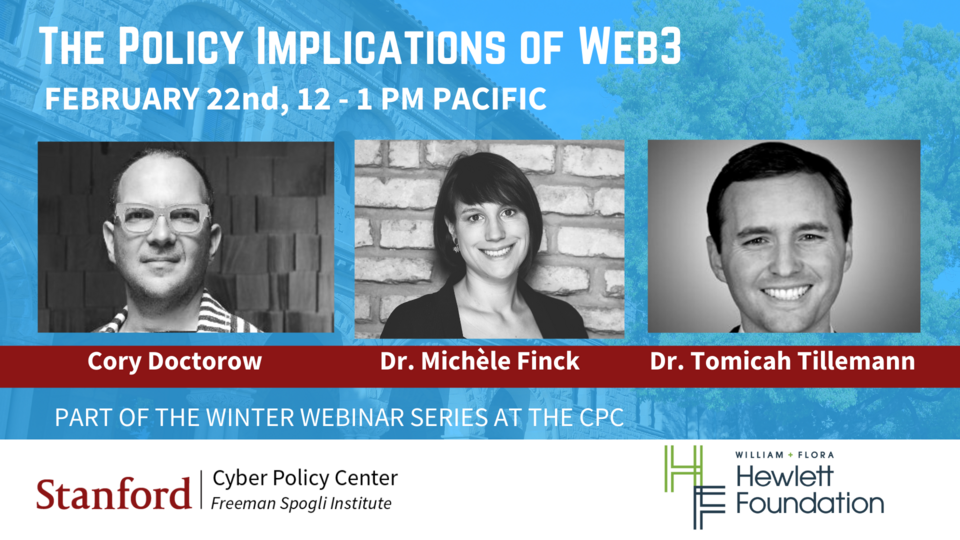
collage showing cory doctorow, Dr. Tomicah Tillemann and Michelle Finck

Join us on Tuesday, February 22 from 12 PM - 1 PM PT for a panel discussion on “The Policy Implications of Web3”, featuring Tomicah Tillemann of KRH Partners, Cory Doctorow of Craphound.com, and Michèle Finck of the University of Tübinge in conversation with Marietje Schaake of the Stanford Cyber Policy Center. This weekly seminar series is jointly organized by the Cyber Policy Center’s Program on Democracy and the Internet and the Hewlett Foundation’s Cyber Initiative.

The year 2021 marked an important moment for web3. Proponents believe the potential of web3 to democratize, decentralize and improve the internet is huge. Others argue that evangelists have yet to deliver results, and that web3 will inevitably tend towards centralization. Few however have explored the policy and political implications of the concept: how should regulators approach a potential web3 explosion? How should lawmakers think about the wider internet infrastructure? Is web3 an opportunity to reimagine the internet, or will it present even more challenges to policymakers? This webinar will explore these angles and foster a reflection on public policy by leading technologists and academics. The session is open to the public, but registration is required.

ABOUT THE SPEAKERS:


Image
cory doctorow
Cory Doctorow (craphound.com) is a science fiction author, activist and journalist. He is the author of many books, most recently Radicalized and Walkaway. He maintains a daily blog at Pluralistic.net. He works for the Electronic Frontier Foundation, is a MIT Media Lab Research Affiliate, a Visiting Professor of Computer Science at Open University, a Visiting Professor of Practice at the University of North Carolina’s School of Library and Information Science and co-founded the UK Open Rights Group. In 2020, he was inducted into the Canadian Science Fiction and Fantasy Hall of Fame.

Image
Michele Finck
Dr. Michèle Finck is Professor of Law and Artificial Intelligence at the University of Tübingen, an Affiliated Fellow at the Max Planck Institute for Innovation and Competition in Munich and the Centre for Blockchain Technologies at University College London as well as a Visiting Professor at LUISS University in Rome. She previously worked at the University of Oxford and the London School of Economics.


Image
tomicah tillemann
Dr. Tomicah Tillemann is a partner and Global Chief Policy Officer at KRH Partners, a new crypto venture fund led by former a16z General Partner Katie Haun, where he builds public policy architecture to support the next generation of the Internet. Until recently, he was the Global Head of Policy for an arm of Andreessen Horowitz. He worked in collaboration with the Rockefeller Foundation, the World Bank, MIT, and governments around the world to develop a new generation of open source technology platforms to power the public sector. He also oversaw the work of the Blockchain Trust Accelerator and the Responsible Asset Allocator Initiative.

Image
Marietje Schaake
Marietje Schaake (Moderator) is international policy director at Stanford University Cyber Policy Center and international policy fellow at Stanford’s Institute for Human-Centered Artificial Intelligence. Between 2009 and 2019, Marietje served as a Member of European Parliament for the Dutch liberal democratic party where she focused on trade, foreign affairs, and technology policies. Marietje is an (Advisory) Board Member with a number of nonprofits including MERICS, ECFR, ORF and AccessNow. She writes a monthly column for the Financial Times and a bi-weekly column for the Dutch NRC newspaper.

Seminars
-


Image
an image of a map of the world with a U.S. and China flag with the event text details.


How can we understand the geopolitical rivalry between the U.S. and China without fueling anti-Asian hate?

Join REDI's student representatives, Maddy Morlino and Miku Yamada, for an open discussion on how we can avoid contributing to racial discrimination when engaging in academic dialogues on U.S.-China competition.

This in-person event will facilitate an open dialogue with participants and invited speakers, FSI Senior Fellow Thomas Fingar and Postdoctoral Fellow, Dongxian Jiang. Since seating is limited, registration is reserved for current Stanford faculty, students, and staff only with a Stanford.edu email.

Confirmed attendees will be notified by email on February 22.

Speaker bios:

Thomas Fingar is a Shorenstein APARC Fellow in the Freeman Spogli Institute for International Studies at Stanford University. He was the inaugural Oksenberg-Rohlen Distinguished Fellow from 2010 through 2015 and the Payne Distinguished Lecturer at Stanford in 2009. From 2005 through 2008, he served as the first deputy director of national intelligence for analysis and, concurrently, as chairman of the National Intelligence Council. Fingar served previously as assistant secretary of the State Department’s Bureau of Intelligence and Research (2000-01 and 2004-05), principal deputy assistant secretary (2001-03), deputy assistant secretary for analysis (1994-2000), director of the Office of Analysis for East Asia and the Pacific (1989-94), and chief of the China Division (1986-89). Between 1975 and 1986 he held a number of positions at Stanford University, including senior research associate in the Center for International Security and Arms Control.

Dongxian Jiang is a political theorist and intellectual historian. His primary research interests lie in comparative political theory, the history of political thought, and pressing practical questions of democratic and international politics, including Western and non-Western perspectives on human rights, democracy, good governance, and political legitimacy. He is also interested in the transmission and traveling of political ideas across divergent intellectual traditions. He holds a B.A. in International Politics and Philosophy from Peking University, an M.A. in Political Science from Duke University, and a Ph.D. in Politics from Princeton University (as of September 2020). Dongxian Jiang is currently Civics Initiative Postdoctoral Fellow, Department of Political Science, Stanford University.

Registration required:

REGISTER


Thomas Fingar FSI Senior Fellow Speaker Stanford University
Dongxian Jiang Political Science Postdoctoral Fellow Speaker Stanford University
Seminars
Authors
Oriana Skylar Mastro
News Type
Commentary
Date
Paragraphs

This commentary was originally published by The Wall Street Journal.


A Russian invasion of Ukraine would be the most consequential use of military force in Europe since World War II and could put Moscow in a position to threaten U.S. allies in Europe. Many in the American foreign-policy establishment argue that the appropriate U.S. response to any such invasion is a major American troop deployment to the Continent. This would be a grave mistake.

The U.S. can no longer afford to spread its military across the world. The reason is simple: an increasingly aggressive China, the most powerful state to rise in the international system since the U.S. itself. By some measures, China’s economy is now the world’s largest. And it has built a military to match its economic heft. Twenty-five years ago, the Chinese military was backward and obsolete. But extraordinary increases in Beijing’s defense budget over more than two decades, and top political leaders’ razor-sharp focus, have transformed the People’s Liberation Army into one of the strongest militaries the world has ever seen.


Sign up for APARC newsletters to receive our experts' commentary and analysis.


China’s new military is capable not only of territorial defense but of projecting power. Besides boasting the largest navy in the world by ship count, China enjoys some capabilities, like certain types of hypersonic weapons, that even the U.S. hasn’t developed.

Most urgently, China poses an increasingly imminent threat to Taiwan. Xi Jinping has made clear that his platform of “national rejuvenation” can’t be successful until Taiwan unifies with the mainland—whether it wants to or not. The PLA is growing more confident in its ability to conquer Taiwan even if the U.S. intervenes. Given China’s military and economic strength, China’s leaders reasonably doubt that the U.S. or anyone else would mount a meaningful response to an invasion of Taiwan. To give a sense of his resolve, Mr. Xi warned that any “foreign forces” standing in China’s way would have “their heads . . . bashed bloody against a Great Wall of steel forged by over 1.4 billion Chinese people.”

If Taiwan falls into Chinese hands, the U.S. will find it harder to defend critical allies like Japan and the Philippines, while China will be able to project its naval, air and other forces close to the U.S. and its territories

The U.S. must defend Taiwan to retain its credibility as the leader of a coalition for a free and open Indo-Pacific. From a military perspective, Taiwan is a vital link in the first island chain of the Western Pacific. If Taiwan falls into Chinese hands, the U.S. will find it harder to defend critical allies like Japan and the Philippines, while China will be able to project its naval, air and other forces close to the U.S. and its territories. Taiwan is also an economic dynamo, the ninth-largest U.S. trading partner of goods with a near-monopoly on the most advanced semiconductor technology—to which the U.S. would most certainly lose access after a war.

The Biden administration this month ordered more than 6,000 additional U.S. troops deployed to Eastern Europe, with many more potentially on the way. These deployments would involve major additional uncounted commitments of air, space, naval and logistics forces needed to enable and protect them. These are precisely the kinds of forces needed to defend Taiwan. The critical assets—munitions, top-end aviation, submarines, and intelligence, surveillance and reconnaissance capabilities—that are needed to fight Russia or China are in short supply. For example, stealthy heavy bombers are the crown jewel of U.S. military power, but there are only 20 in the entire Air Force.

The U.S. has no hope of competing with China and ensuring Taiwan’s defense if it is distracted elsewhere. It is a delusion that the U.S. can, as Pentagon press secretary John Kirby said recently, “walk and chew gum at the same time” with respect to Russia and China. Sending more resources to Europe is the definition of getting distracted. Rather than increasing forces in Europe, the U.S. should be moving toward reductions.

To be blunt: Taiwan is more important than Ukraine. America’s European allies are in a better position to take on Russia than America’s Asian allies are to deal with China.

There is a viable alternative for Europe’s defense: The Europeans themselves can step up and do more for themselves, especially with regard to conventional arms. This is well within Europe’s capacity, as the combined economic power of the NATO states dwarfs that of Russia. NATO allies spend far more on their militaries than Russia. To aid its European allies, the U.S. can provide various forms of support, including lethal weapons, while continuing to remain committed to NATO’s defense, albeit in a more constrained fashion, by providing high-end and fungible military capabilities. The U.S. can also continue to extend its nuclear deterrent to NATO.

The U.S. should remain committed to NATO’s defense but husband its critical resources for the primary fight in Asia, and Taiwan in particular. Denying China the ability to dominate Asia is more important than anything that happens in Europe. To be blunt: Taiwan is more important than Ukraine. America’s European allies are in a better position to take on Russia than America’s Asian allies are to deal with China. The Chinese can’t be allowed to think that America’s distraction in Ukraine provides them with a window of opportunity to invade Taiwan. The U.S. needs to act accordingly, crisis or not.

Ms. Mastro is a center fellow at the Shorenstein Asia-Pacific Research Center, part of Stanford’s Freeman Spogli Institute for International Studies, and a nonresident senior fellow at the American Enterprise Institute. Mr. Colby is a principal at the Marathon Initiative and author of “The Strategy of Denial: American Defense in an Age of Great Power Conflict.”

Headshot of Oriana Skylar Mastro

Oriana Skylar Mastro

Center Fellow at the Freeman Spogli Institute for International Studies
Full Biography

Read More

President Xi and Kim Jong Un meet on a TV screen
Commentary

North Korea Is Becoming an Asset for China

Pyongyang’s Missiles Could Fracture America’s Alliances
North Korea Is Becoming an Asset for China
Chinese military propaganda depicting the Second Taiwan Strait Crisis of 1958.
News

Reassessing China’s Capabilities and Goals for Strategic Competition

On the World Class podcast, Oriana Skylar Mastro argues that in order to set effective policy toward China, the United States needs to better understand how and why China is projecting power.
Reassessing China’s Capabilities and Goals for Strategic Competition
Taiwan Wall
Commentary

Would the United States Come to Taiwan's Defense?

On CNN's GPS with Fareed Zakaria, APARC Center Fellow Oriana Skylar Mastro shares insights about China's aspirations to take Taiwan by force and the United States' role, should a forceful reunification come to pass.
Would the United States Come to Taiwan's Defense?
Hero Image
Army Reserve members during practice
U.S. Army Reserve members during a Cold Weather Operations Course near Fort McCoy, Wisconsin, Jan. 13, 2022.
U.S. Army Reserve photo by Sgt. 1st Class Clinton Wood
All News button
1
Subtitle

Getting bogged down in Europe will impede the U.S.’s ability to compete with China in the Pacific.

Date Label
-

For winter quarter 2022, CISAC will be hosting hybrid events. Many events will offer limited-capacity in-person attendance for Stanford faculty, staff, fellows, visiting scholars, and students in accordance with Stanford’s health and safety guidelines, and be open to the public online via Zoom. All CISAC events are scheduled using the Pacific Time Zone. 

SEMINAR RECORDING


About the Event: With the devastating loss of life, economic disruption, and political instability it has wrought, COVID-19 has revealed that national governments and the international community are woefully unprepared to respond to pandemics—underscoring the world’s vulnerability to future catastrophic biological threats that could meet or exceed the severe consequences of the current pandemic. To effectively guard against future biological risks, leaders should take a longer-term view and recognize that, while naturally occurring pandemics remain a threat, the next global catastrophe could result from a laboratory accident or the deliberate misuse of bioscience and biotechnology.   This talk will provide a high-level overview of the broader biothreat landscape and outline actions that national leaders and the international community should take with a view to preventing catastrophic biological events—specifically by constraining capabilities and shaping the intent of powerful actors who may wish to exploit the tools of modern bioscience to cause harm. This talk will outline two priority NTI initiatives to strengthen international capabilities to prevent catastrophic biological events. We are working to develop and launch the International Biosecurity and Biosafety Initiative for Science (IBBIS), a new international organization that will focus on preventing the deliberate abuse or accidental misuse of bioscience and biotechnology by strengthening international biosecurity norms and developing innovative, practical tools to reduce risks throughout the research and development life cycle. NTI is also working to develop the concept of a new Joint Assessment Mechanism to strengthen UN-system capabilities to investigate high-consequence biological events of unknown origin. The ability to rapidly discern the source of emerging pandemics is critical to mitigating their effects in real time and protecting against future risks.
 

About the Speaker: Dr. Jaime M. Yassif is Senior Director and Lead Scientist for Global Biological Policy and Programs at NTI, where her work focuses on strengthening governance of dual-use bioscience and reducing global catastrophic biological risks. Yassif previously served as a Program Officer at Open Philanthropy, where she led the Biosecurity and Pandemic Preparedness initiative. In this role, she managed approximately $40 million in biosecurity grants, which rebuilt the field and supported work in several key areas, including developing new biosecurity programming at leading think tanks, establishing the Global Health Security Index, and initiating new biosecurity work in China and India. Prior to this, Yassif served as a science and technology policy advisor at the U.S. Department of Defense and worked on the Global Health Security Agenda at the U.S. Department of Health and Human Services.

Virtual to Public. Only those with an active Stanford ID with access to William J Perry Conference Room in Encina Hall may attend in person. 

Jaime Yassif NTI
Seminars
-
Kevin Munger photo on a flyer for the Cyber Policy Center's Winter Seminar Series Event  Does Demand Create Its Own Supply?: YouTube Politics During the 2020 Presidential Campaign

Join us on Tuesday, February 15 from 12 PM - 1 PM PT for Demand-Driven Ideology on YouTube in the 2020 Election and Beyond​ featuring Kevin Munger of Penn State University in conversation with Nate Persily of the Stanford Cyber Policy Center. This weekly seminar series is jointly organized by the Cyber Policy Center’s Program on Democracy and the Internet and the Hewlett Foundation’s Cyber Initiative.

"YouTube Politics" has evolved considerably over the past decade. Expanding on a supply-and-demand framework, we argue that the changing composition of the audience and the wider political ecosystem influences what videos get created and by whom. Of particular interest is the emergence of a second dimension, largely orthogonal to the traditional left-right divide: the pro- / anti-establishment dimension. The movement of some portion of American citizens across the first dimension towards the anti-establishment pole during the 2000s and 2010s was observed and responded to by media and political entrepreneurs. We chart this process at large scale during the 2020 US Presidential Election campaign and throughout 2021. Using data from nearly three thousand channels who discuss US Politics and a quarter-billion comments left on their videos, we plot the ideological space of YouTube Politics and argue for the insufficiency of a unidimensional model of US politics on YouTube, online, and in general.

About the Speakers:

Image
Kevin Munger
Kevin Munger is an Assistant Professor of Political Science and Social Data Analytics at Penn State University. Kevin's research focuses on the implications of the internet and social media for the communication of political information. His specialty is the investigation of the economics of online media; current research models "Clickbait Media" and uses digital experiments to test the implications of these models on consumers of political information.


Image
nate persily
Moderator: Nathaniel Persily is the James B. McClatchy Professor of Law at Stanford Law School, with appointments in the departments of Political Science, Communication, and FSI.  Prior to joining Stanford, Professor Persily taught at Columbia and the University of Pennsylvania Law School, and as a visiting professor at Harvard, NYU, Princeton, the University of Amsterdam, and the University of Melbourne. Professor Persily’s scholarship and legal practice focus on American election law or what is sometimes called the “law of democracy,” which addresses issues such as voting rights, political parties, campaign finance, redistricting, and election administration. He has served as a special master or court-appointed expert to craft congressional or legislative districting plans for Georgia, Maryland, Connecticut, New York, North Carolina, and Pennsylvania.  He also served as the Senior Research Director for the Presidential Commission on Election Administration. His current work, for which he has been honored as a Guggenheim Fellow, Andrew Carnegie Fellow, and a Fellow at the Center for Advanced Study in the Behavioral Sciences, examines the impact of changing technology on political communication, campaigns, and election administration.  He is codirector of the Stanford Cyber Policy Center, Stanford Program on Democracy and the Internet, and the Stanford-MIT Healthy Elections Project, which supported local election officials in taking the necessary steps during the COVID-19 pandemic to provide safe voting options for the 2020 election. He is also a member of the American Academy of Arts and Sciences, and a commissioner on the Kofi Annan Commission on Elections and Democracy in the Digital Age.

Nate Persily

Zoom

Kevin Munger Program on Democracy and the Internet

Stanford Health Policy
Encina Commons, Room 185
615 Crothers Way
Stanford, CA 94305-6019

0
sharon_medium.jpg

Sharon Beckstrand currently supports the faculty and staff at the Center for Health Policy and the Department of Health Policy. Before coming to Stanford, Sharon was a technical and marketing writer for companies in the Austin area, as well as a supply chain analyst. She received a BA in Liberal Arts from St. John’s College, Santa Fe.

Administrative Associate
-

 All CISAC events are scheduled using the Pacific Time Zone. 

SEMINAR RECORDING


About the Event: The Russian military continues to mass forces near Ukraine, while the Kremlin says that the United States and NATO have addressed its secondary concerns but have ignored its key demands, such as that the Alliance foreswear further enlargement. Britain has played a critical role in NATO deliberations on how to respond to Moscow proposals and actions, and the British military is sending additional forces to bolster the Alliance's eastern flank. Sir Roderic Lyne, a former British ambassador to Russia and former foreign policy advisor to the prime minister, will describe how the crisis is viewed in London, the motivations driving Russian actions, and how the West should respond.


About the Speaker: Roderic Lyne served in the UK's Diplomatic Service for 34 years, including three postings to Moscow between 1972 and 2004, and was the last Head of the Soviet Department in the Foreign Office. In the mid-1990s he was the adviser to the Prime Minister on foreign affairs, security and Northern Ireland. Since retiring as Ambassador to the Russian Federation in 2004 he has visited Russia about fifty times as a business consultant and lecturer, and has written extensively on the subject. His most recent article was "Putin's Gamble: Must It End Up As Lose/Lose", published by Chatham House in late January. From 2009 to 2016 Roderic Lyne served on the UK's Inquiry into the Iraq conflict of 2003.

Virtual only.

Sir Roderic Lyne
Seminars
-

Image
Adrienne Sabety of University of Notre Dame

Adrienne Sabety, PhD, is a Wilson Family LEO Assistant Professor in the Department of Economics at the University of Notre Dame. She is also a research faculty member at the Wilson Sheehan Lab for Economic Opportunities at Notre Dame. Her research focuses on access to care and treatment for disadvantaged populations, like undocumented immigrants. She also studies major changes in health care markets, such as the design of insurance marketplaces and adverse climate shocks. She received an AS in Mathematics from Cuesta Community College, a BA in Economics from UC Berkeley, and a PhD in Health Policy from Harvard in 2020.

You are invited to a Zoom meeting. 

When: Feb. 18, 2022, at 12:00 PM Pacific Time (US and Canada)

Zoom Link

Seminars
-
image showing Richard Hasen and the cover of his new book, Cheap Speech, on a blue background with Encina Hall

What can be done consistent with the First Amendment to ensure that American voters can make informed election decisions and hold free elections amid a flood of virally spread disinformation and the collapse of local news reporting? How should American society counter the actions of people like former President Donald J. Trump, who used social media to convince millions of his followers to doubt the integrity of U.S. elections and helped foment a violent insurrection? What can we do to minimize disinformation campaigns aimed at suppressing voter turnout?Join us on March 8 for a book talk with author Rick Hasen, the Chancellor’s Professor of Law and Political Science at the University of California, Irvine in discussion with Cyber Policy Center co-director, Nate Persily on Rick’s newly released book, Cheap Speech.

Note the publisher is offering a 30% discount with code YECS30. Visit yalebooks.com for purchase.

About the Speaker:

Image
Richard L. Hasen
Professor Richard L. Hasen is Chancellor’s Professor of Law and Political Science at the University of California, Irvine and is Co-Director of the Fair Elections and Free Speech Center. Hasen is a nationally recognized expert in election law and campaign finance regulation, writing as well in the areas of legislation and statutory interpretation, remedies, and torts. He is co-author of leading casebooks in election law and remedies. He served in 2020 as a CNN Election Law Analyst. From 2001-2010, he served (with Dan Lowenstein) as founding co-editor of the quarterly peer-reviewed publication, Election Law Journal. He is the author of over 100 articles on election law issues, published in numerous journals including the Harvard Law ReviewStanford Law Review and Supreme Court Review. He was elected to The American Law Institute in 2009 and serves as Reporter (with Professor Douglas Laycock) on the ALI’s law reform project: Restatement (Third) of Torts: Remedies. He also is an adviser on the Restatement (Third) of Torts: Concluding Provisions. Professor Hasen was named one of the 100 most influential lawyers in America by The National Law Journal in 2013, and one of the Top 100 Lawyers in California in 2005 and 2016 by the Los Angeles and San Francisco Daily Journal.


Nathaniel Persily

Zoom

Richard L. Hasen Chancellor's Professor of Law and Political Science UC Irvine Law
Seminars
Subscribe to The Americas