Authors
Héctor Fuentes
News Type
News
Date
Paragraphs

The Democracy Action Lab (DAL), a practitioner-centered initiative of the Center on Democracy, Development and the Rule of Law at Stanford University, is proud to officially announce the first cohort of its Democracy Garage, the first accelerator program of its kind dedicated to strengthening frontline democracy defenders across Latin America and the Caribbean.

The Democracy Garage was born from a simple but urgent conviction: democratic resilience is built not only through ideas, but through the capacity of organizations to act strategically, use evidence effectively, communicate persuasively, and adapt to rapidly evolving political environments. DAL built this program to close a persistent gap in democracy support, bridging high-level research with the real-time, operational needs of the organizations doing the hardest work on the ground.

Over the next few months, DAL will work side by side with eight extraordinary organizations across the region, applying a structured accelerator methodology to co-develop strategies tailored to the specific democratic challenges in each country. This is not a traditional growth program: it is a deep collaboration grounded in evidence, strategy, and solidarity.

A Three-Track Accelerator Model


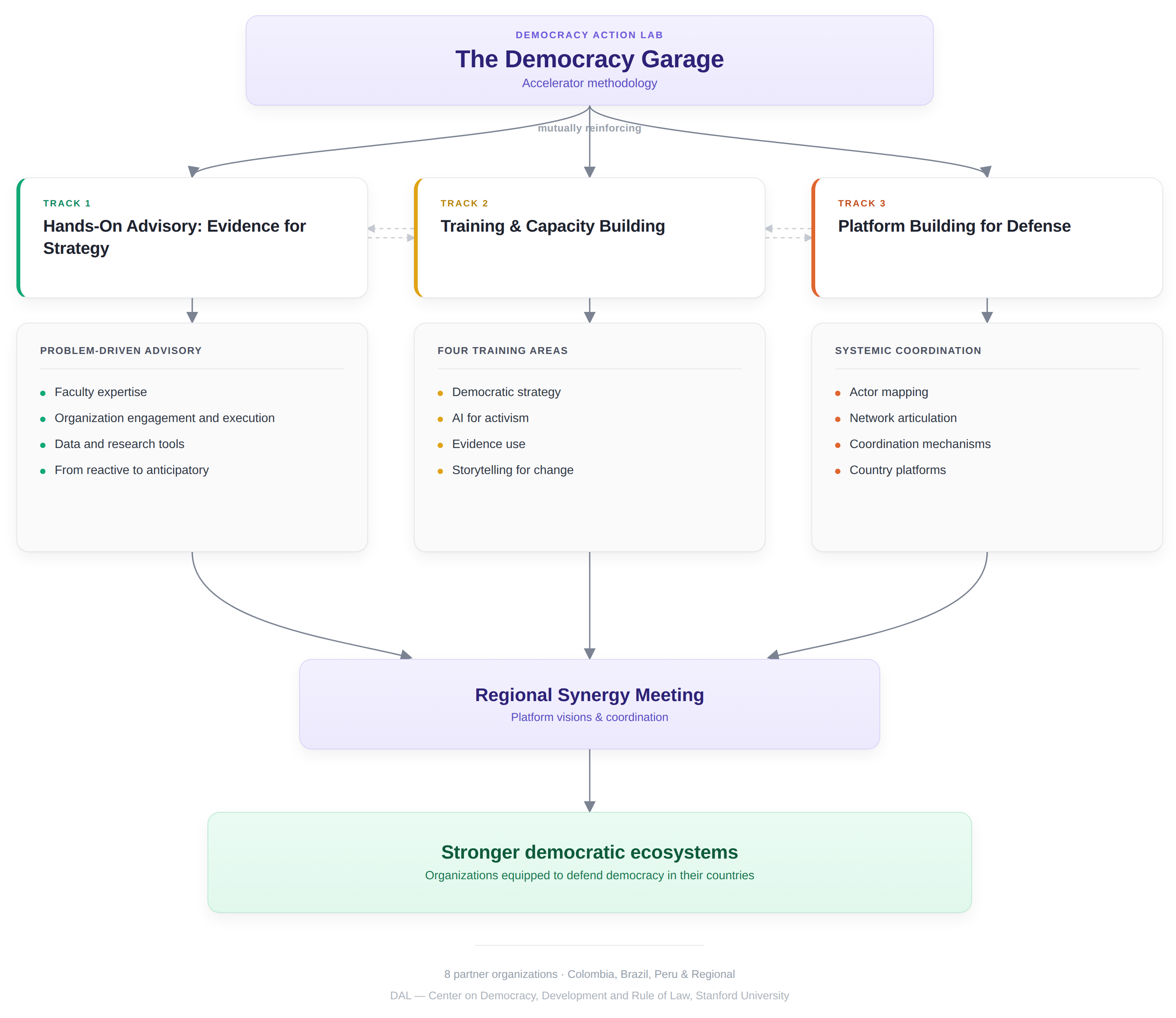
The accelerator model of the Democracy Garage is organized around three mutually reinforcing tracks designed to address a key gap in the democracy support ecosystem: many programs either provide high-level training disconnected from immediate needs or short-term technical assistance that does not build lasting capacity. The Garage bridges this divide.

Track 1  |  Evidence Analysis for Democratic Strategizing  —  Hands-On Advisory

The first track provides direct, problem-driven advisory support. Each of the selected organizations enters the Garage with a defined, real-time challenge. DAL mobilizes its analytical capacity, including faculty expertise, student engagement, and data tools, to help address it collaboratively. This is not one-directional technical assistance: it is a joint process that builds organizations' own capacity to use evidence as a strategic tool, shifting from reactive to anticipatory modes of operation.

Track 2  |  Training and Capacity Building  —  Four Core Areas

The second track offers structured training in four areas critical to democratic action: (1) Strategizing for democratic defense — understanding the state of democracy in the region and its main challenges; (2) AI for activism — practical applications of artificial intelligence for monitoring, communication, and decision-making; (3) Evidence for democratic defense — data collection, analysis, and interpretation linked directly to strategic decisions; and (4) Storytelling for change — translating complex analysis into compelling narratives that resonate with policymakers, media, and citizens alike.

Track 3  |  Platform Building for Democratic Defense  —  Scaling for Systemic Impact

The third track supports participating organizations in becoming foundational nodes of country-level democratic defense platforms. Democratic erosion rarely unfolds in isolation: it requires coordinated responses across civil society, media, academia, and institutions. Through actor mapping, network articulation, and the development of coordination mechanisms, the Garage helps build structured ecosystems capable of collective action. This track culminates at the Regional Synergy Meeting in August 2026, where organizations will present their platform visions and lay the groundwork for regional coordination.
Image
Diagram of Democracy Action Lab's Democracy Garage accelerator methodology, showing three mutually reinforcing tracks — Advisory, Training, and Platform Building — leading to a Regional Synergy Meeting and stronger democratic ecosystems.


DAL's Accelerator Methodology (click to enlarge)

Eight Organizations. Three Countries. One Region.


After a rigorous selection process, The Democracy Garage is proud to welcome the following participating organizations:

CESJUL — Centro de Estudios Socio Jurídicos Latinoamericanos (Colombia)  

Works at the intersection of criminal law, human rights, and democratic governance, bringing rigorous legal analysis to the most pressing challenges in Colombian democracy — including the use of law as both a tool of repression and a vehicle for accountability.

Dejusticia (Colombia)

One of Latin America's most respected human rights organizations — a true think-and-do tank combining rigorous legal research with strategic litigation, direct advocacy, and capacity-building across anti-discrimination, transitional justice, and the protection of civic space.

Instituto Sou da Paz (Brazil)

A 25-year leader in public security policy in Brazil, shaping national legislation on firearms regulation and homicide reduction through an evidence-first approach that centers the communities most affected by violence — particularly Black Brazilians.

Pacto pela Democracia (Brazil)

Brazil's preeminent pro-democracy coalition of more than 200 organizations, and an internationally recognized model for coalition-based democratic defense. Its coordinated protection of the 2022 elections — over 80 actions across 35 organizations — demonstrated the power of building coalitions before the crisis arrives.

Instituto de Estudios Peruanos (IEP) (Perú)

One of Latin America's oldest and most distinguished social science institutions, IEP has spent six decades producing the empirical foundation for democratic analysis in Perú — from public opinion surveys and electoral studies to interdisciplinary research on power, inequality, and the state

Recambio (Perú)

In a country that has seen eight presidents in a decade, Recambio is rebuilding democratic culture from within the political system — with a network of over 500 alumni from 28 political parties, cross-partisan dialogue, and the 'Voices Against Polarization' initiative.

Espacio Crítico (Regional, LAC)

A regional organization providing tailored strategic support, technical training, and security advice to civil society organizations, independent journalists, and political leaders on the front lines of democratic backsliding across Latin America and the Caribbean.

D-Hub (Regional, Global)

A global community of democracy defenders connecting frontline activists and civil society organizations with experts who have faced similar challenges — building the infrastructure for cross-border democratic solidarity that no single organization can sustain alone.

A Historic First


The Democracy Garage is the first accelerator program of this type designed specifically for democracy defenders in Latin America and the Caribbean. By combining the rigor of evidence-based research, the agility of an accelerator model, and the depth of long-term collaboration, DAL is pioneering a new approach to democratic resilience — one grounded in the conviction that the organizations closest to the crisis are best positioned to address it, when equipped with the right tools, knowledge, and connections.

"We are immensely proud to launch the Democracy Garage alongside these eight remarkable organizations," said DAL co-director Beatriz Magaloni, the Graham H. Stuart Professor of International Relations. "Each of them represents what democratic defense looks like in practice, not in theory. Together, we are committed to something unprecedented: building a community of strategy and solidarity that makes democracy stronger, one country at a time."
 

About the Democracy Action Lab

The Democracy Action Lab (DAL) is a research and strategy initiative housed at Stanford University’s Center on Democracy, Development and Rule of Law, dedicated to translating social science into practical tools for democracy defenders. DAL works at the intersection of evidence and action, partnering with frontline organizations to strengthen democratic institutions, protect civic space, and counter authoritarian threats across Latin America and beyond.

Read More

Wall plastered with posters and graffiti text reading "DEMOCRACY NOW"
News

Stanford Launches New Democracy Action Lab to Confront Global Democratic Backsliding

By combining rigorous research with practitioner collaborations, the Democracy Action Lab at the Center on Democracy, Development and the Rule of Law turns ideas into action.
Stanford Launches New Democracy Action Lab to Confront Global Democratic Backsliding
DAL launch panel
News

Political scientists emphasize need for pro-democracy coalitions at launch of Democracy Action Lab

Political science scholars discussed strengthening pro-democracy coalitions in a Wednesday event marking the launch of CDDRL’s new Democracy Action Lab.
Political scientists emphasize need for pro-democracy coalitions at launch of Democracy Action Lab
Prof. Adam Prezworski, Prof. Beatriz Magaloni, and Prof. Alberto Díaz Cayeros present during DAL’s Inaugural Conference at El Colegio de Mexico.
Blogs

Stanford’s Democracy Action Lab Launches in Mexico City

The new initiative from the Center on Democracy, Development and the Rule of Law connects research with frontline efforts to address democratic backsliding across Latin America.
Stanford’s Democracy Action Lab Launches in Mexico City
Hero Image
Illustration of diverse young activists emerging from a garage carrying books and a raised-fist flag, with a network of connected stars overhead, symbolizing the Democracy Garage.
Pariplab Chakraborty
All News button
1
Subtitle

The first democracy accelerator of its kind in Latin America and the Caribbean.

Date Label
In Brief
  • CDDRL’s Democracy Action Lab (DAL) has launched Latin America's first democracy accelerator, the Democracy Garage.
  • The program pairs DAL’s research capacity and faculty expertise with eight organizations across Colombia, Brazil, and Perú.
  • DAL co-director Beatriz Magaloni called the initiative an unprecedented Stanford-led community of strategy and solidarity.
Display Hero Image Wide (1320px)
Yes
Authors
Nora Sulots
News Type
News
Date
Paragraphs

This summer, the Center on Democracy, Development and the Rule of Law (CDDRL) welcomed 26 democracy leaders from 19 countries across the developing world to its Fisher Family Summer Fellows on Democracy and Development Program for an intensive three-week training focused on democracy, good governance, and rule of law reform. Chosen from a highly competitive applicant pool, the fellows represent a diverse range of professional backgrounds and geographical regions, spanning civil society, public service, social enterprise, media, and technology. Launched in 2005, the program was previously known as the Draper Hills Summer Fellows Program. It was renamed in 2023 in recognition of a gift from the Fisher family — Sakurako (Sako), ‘82, and William (Bill), MBA ‘84 — that endowed the program and secured its future.

Fellows were instructed by a leading Stanford faculty team composed of CDDRL Mosbacher Director and FSI Satre Family Senior Fellow Kathryn Stoner; Olivier Nomellini Senior Fellow Francis Fukuyama; Senior Fellow in Global Democracy Larry Diamond; Michael McFaul, FSI Senior Fellow, Ken Olivier and Angela Nomellini Professor of International Studies, and former U.S. Ambassador to Russia; and Erik Jensen, Lecturer in Law at Stanford Law School, on new institutional models and frameworks to enhance their ability to promote good governance, accountable politics, and find new ways to achieve economic development in their home countries.

The program opened with foundational sessions on the dimensions of development, the meaning of democracy, and the role of rule of law, led by faculty including Fukuyama, Diamond, Stoner, and Jensen. Fellows then explored comparative case studies in autocratic governance — from the Middle East to China's global information ecosystem — alongside a fireside discussion on the geopolitics of energy. The second week turned to questions of migration, gender and political development, and the causes of democratization, including a session with the Human Rights Foundation on global patterns of authoritarianism. Additional sessions covered conflict and leadership, transitional justice, and anti-corruption reform, closing with discussions of sharp power, deliberative democracy, and propaganda in autocratic states. In its third and final week, the program addressed some of today's most consequential global issues, including the future of NATO, the geopolitics of artificial intelligence, and democratic backsliding worldwide. The week also covered inequality in Latin America, political corruption, and the challenges facing American democracy ahead of the midterm elections, concluding with sessions on protecting vulnerable populations in conflict and the relationship between land power and democracy.

This year's cohort now joins a global network of more than 500 alumni from over 100 countries, whose professional backgrounds are as diverse as the challenges they confront in their home countries — reflecting a shared dedication to building sound structures of democracy and development.

During the program, the fellows delivered "TED"-style talks in our Fellow Spotlight Series, sharing personal stories about the struggles in their home countries, stories of their fight for justice, equality, and democracy, and stories of optimism and endurance. You can watch their talks in the playlist below:

Read More

2026 Fisher Family Summer Fellows
News

Announcing the 2026 Class of the Fisher Family Summer Fellows on Democracy and Development Program

In July 2026, the Center on Democracy, Development and the Rule of Law will welcome a diverse cohort of 26 experienced practitioners from 19 countries who are working to advance democratic practices and economic and legal reform in contexts where freedom, human development, and good governance are fragile or at risk.
Announcing the 2026 Class of the Fisher Family Summer Fellows on Democracy and Development Program
People arrive to pay tribute at Maidan Square, where thousands of memorial flags are on display as a reminder of the toll of the war on February 24, 2025, in Kyiv, Ukraine.
News

Four Years After the Invasion, Ukrainian Leaders Build Foundations for Recovery

From parliament to regional government to independent media, alumni of the Center on Democracy, Development and the Rule of Law’s Strengthening Ukrainian Democracy and Development Program are implementing reform initiatives under wartime conditions.
Four Years After the Invasion, Ukrainian Leaders Build Foundations for Recovery
Jesús Armas stands in a crowd in front of a Venezuelan flag following his release from prison, holding a t-shirt that reads "Release all political prisoners" in Spanish.
News

2022 Summer Fellow Jesús Armas Released After More Than a Year in Detention

A Venezuelan civic leader and alumnus of CDDRL’s Fisher Family Summer Fellows Program, Armas was kidnapped by security forces following the country’s 2024 presidential election.
2022 Summer Fellow Jesús Armas Released After More Than a Year in Detention
Hero Image
2026 Fisher Family Summer Fellows
Rod Searcey
All News button
1
Subtitle

The Fellow Spotlight Series is an inspiring and moving series of "TED"-style talks given by each of our 2026 Fisher Family Summer Fellows to share their backstories and discuss their work.

Date Label
Display Hero Image Wide (1320px)
Yes
-
MarcelaIbanez_Seminar

How does the local presence of an authoritarian power shape citizens' commitment to democracy? Existing theories suggest engagement with authoritarian states should weaken democratic commitment through norm diffusion, accommodation, or authoritarian learning. This paper challenges that expectation by examining Chinese development finance in Latin America. Using geocoded data, it estimates the subnational effect of exposure to Chinese aid on democratic attitudes. Exposure increases support for democracy rather than undermining it. The effect is strongest in authoritarian and weakly democratic settings and absent in consolidated democracies. Exposure does not improve perceptions of China or the United States, casting doubt on soft power or foreign-comparison explanations. Instead, the paper argues that visible Chinese projects make incumbents' authoritarian character more salient, triggering an accountability response. These findings recast authoritarian external influence as a contingent catalyst for democratic reinforcement.

ABOUT THE SPEAKER

Marcela Ibáñez is a Visiting Postdoctoral Fellow at CDDRL and a Postdoctoral Researcher at the University of Zurich. Her work lies at the intersection of political economy and development studies. Her current research examines how development finance from authoritarian donors shapes political attitudes in recipient countries. Her broader interests include authoritarian politics, inequality and opportunity in low- and middle-income economies, democracy after conflict, and strategic communication. Methodologically, she draws on causal inference and econometrics, using experimental and quasi-experimental designs, geospatial and survey data, and quantitative text analysis. She holds a PhD in Political Science from the University of Mannheim.

Hesham Sallam
Hesham Sallam

Virtual to Public. If prompted for a password, use: 123456

Only those with an active Stanford ID with access to Conference Room E-008 in Encina Hall, East, may attend in person.

Marcela Ibáñez Visiting Scholar Presenter Center on Democracy, Development and the Rule of Law
Seminars
News Feed Image
cddrl_2026_fall_research_seminar_2.png
Date Label
-
AlainSchlapferSeminar

Politicians who openly display anti-democratic traits can attract substantial electoral support, even among voters who value democracy. This paper argues that the very behavior that makes a politician objectionable can also reassure voters that the politician will remain independent of political elites. Voters whose preferred policies lie far from elite interests worry that the candidates they elect will be captured by elites once in office. Because capturing a politician mired in scandal is costly for elites, scandalous behavior can credibly signal that a candidate is beyond elite reach. Where elites are democratically committed, displays of anti-democratic intent become an efficient way to generate such a scandal. Voters may elect these candidates even though they are more likely to manipulate elections once in office, an outcome costly for voters and elites alike. Elites who can perfectly anticipate which politicians will subvert elections have no credible way to communicate this to voters. A reanalysis of existing experimental data is consistent with the model's central prediction. Unlike existing accounts of anti-democratic voting, this theory explains why citizens who value democracy may still elect an anti-democratic candidate, even when a democratically committed candidate offers the same policy platform.

ABOUT THE SPEAKER

Alain Schläpfer is a social science research scholar at Stanford University’s Center on Democracy, Development and the Rule of Law (CDDRL), and a lecturer in Stanford’s Ford Dorsey Master’s in International Policy. His research lies at the intersection of political science and economics and focuses on cooperation, political institutions, and intergroup relations. His current work examines how cooperation can be sustained across political and social divisions, why voters support anti-democratic politicians, and how institutions and social norms shape political behavior. His research combines formal theory with experiments and observational data. He holds a PhD in Economics.

Hesham Sallam
Hesham Sallam

Virtual to Public. If prompted for a password, use: 123456

Only those with an active Stanford ID with access to Conference Room E-008 in Encina Hall, East, may attend in person.

Encina Hall, E112
616 Jane Stanford Way
Stanford, CA 94305-6055

0
alain_schlaepfer.jpg

Alain is a Social Science Research Scholar at CDDRL and a lecturer at the Ford Dorsey Master’s in International Policy (MIP), where he teaches classes in quantitative research methods. Before that, he was a lecturer in Political Science at Stanford, a lecturer in Economics at Santa Clara University, and a Visiting Scholar at Stanford’s King Center on Global Development.

Alain’s research interests include the study of cooperation and conflict among individuals and groups, with a particular focus on the role of reputation, cultural norms, and interpersonal and institutional punishment. In recent research, he also studies the relationships between immigrants and natives and the formation of norms and preferences.

Alain’s research has been published in journals in political science, economics, and biology, including the Journal of Politics, the Economic Journal, and the Proceedings of the Royal Society B: Biological Sciences. He received his PhD in economics from Universitat Pompeu Fabra in Barcelona, Spain.

Research Scholar
Lecturer, Ford Dorsey Master's in International Policy
Date Label
Alain Schläpfer Research Scholar Presenter Center on Democracy, Development and the Rule of Law
Seminars
Date Label
Paragraphs

Critics have warned that Chinese projects could chip away at democracy in Latin America. Our research suggests the opposite may be happening.

This article is based on Ibáñez and Schläpfer's working paper on how exposure to Chinese development projects shapes democratic attitudes in Latin America.

All Publications button
1
Publication Type
Journal Articles
Publication Date
Journal Publisher
Development + Cooperation
Authors
Alain Schläpfer
Number
pp. 54-56
-
FrancisFukuyamaBookTalk_ZoomReg

The Center on Democracy, Development and the Rule of Law (CDDRL) invites the Stanford community to a book talk with Francis Fukuyama in celebration of his new book, In the Realm of the Last Man: A Memoir, which traces his own intellectual and personal journey against the backdrop of the last fifty years of global political history.

Fukuyama's work has shaped how a generation of scholars, students, and policymakers think about the trajectory of democratic governance, from The End of History and the Last Man through The Origins of Political Order and Political Order and Political Decay. In this memoir, he turns that same analytical lens on himself, reflecting on how his thinking about liberalism, state-building, and democratic decay has evolved alongside the events he lived through and helped interpret. Fukuyama's book offers a rare firsthand account of his research, reflection and understanding of the crisis of liberal democracy in our current political climate.

Fukuyama, Olivier Nomellini Senior Fellow at Stanford's Freeman Spogli Institute for International Studies and former Mosbacher Director of CDDRL, will be joined by Kathryn Stoner, current Mosbacher Director of CDDRL, for a wide-ranging conversation about the memoir, his career, and what the last half-century of political change means for the future of democracy. The conversation will be followed by a brief audience Q&A.

This event continues CDDRL's tradition of bringing leading voices in democracy and development scholarship into direct dialogue with the Stanford community, and is open to faculty, students, and members of the public with an interest in comparative politics, democratic governance, and global affairs. A book signing and reception will follow the talk, offering attendees the opportunity to purchase signed copies of the memoir.

SPEAKERS

Francis Fukuyama is the Olivier Nomellini Senior Fellow at Stanford University's Freeman Spogli Institute for International Studies (FSI), and a faculty member of FSI's Center on Democracy, Development and the Rule of Law (CDDRL). He is also Director of Stanford's Ford Dorsey Master's in International Policy, and a professor (by courtesy) of Political Science. Dr. Fukuyama has written widely on issues in development and international politics. His 1992 book, The End of History and the Last Man, has appeared in over twenty foreign editions. His newest book, In the Realm of the Last Man: A Memoir, will be published in fall 2026.

Kathryn Stoner is the Mosbacher Director of the Center on Democracy, Development and the Rule of Law (CDDRL) and the Satre Family Senior Fellow at the Freeman Spogli Institute for International Studies (FSI). From 2017 to 2021, she served as FSI's Deputy Director. She is Professor of Political Science (by courtesy) at Stanford and teaches in the Department of Political Science, the Program on International Relations, and the Ford Dorsey Master's in International Policy Program. She is also a Senior Fellow (by courtesy) at the Hoover Institution.

Kathryn Stoner
Kathryn Stoner

Bechtel Conference Center at Encina Hall

Event update: Our in-person event has reached capacity. We invite you to join the event virtually via live stream on Zoom. Registration is required.

Encina Hall, C148
616 Jane Stanford Way
Stanford, CA 94305

0
Olivier Nomellini Senior Fellow at the Freeman Spogli Institute for International Studies
Director of the Ford Dorsey Master's in International Policy
Research Affiliate at The Europe Center
Professor by Courtesy, Department of Political Science
yff-2021-14290_6500x4500_square.jpg

Francis Fukuyama is the Olivier Nomellini Senior Fellow at Stanford University's Freeman Spogli Institute for International Studies (FSI), and a faculty member of FSI's Center on Democracy, Development and the Rule of Law (CDDRL). He is also Director of Stanford's Ford Dorsey Master's in International Policy, and a professor (by courtesy) of Political Science.

Dr. Fukuyama has written widely on issues in development and international politics. His 1992 book, The End of History and the Last Man, has appeared in over twenty foreign editions. His book In the Realm of the Last Man: A Memoir will be published in fall 2026.

Francis Fukuyama received his B.A. from Cornell University in classics, and his Ph.D. from Harvard in Political Science. He was a member of the Political Science Department of the RAND Corporation, and of the Policy Planning Staff of the US Department of State. From 1996-2000 he was Omer L. and Nancy Hirst Professor of Public Policy at the School of Public Policy at George Mason University, and from 2001-2010 he was Bernard L. Schwartz Professor of International Political Economy at the Paul H. Nitze School of Advanced International Studies, Johns Hopkins University. He served as a member of the President’s Council on Bioethics from 2001-2004. He is editor-in-chief of American Purpose, an online journal.

Dr. Fukuyama holds honorary doctorates from Connecticut College, Doane College, Doshisha University (Japan), Kansai University (Japan), Aarhus University (Denmark), the Pardee Rand Graduate School, and Adam Mickiewicz University (Poland). He is a non-resident fellow at the Carnegie Endowment for International Peace. He is a member of the Board of Trustees of the Rand Corporation, the Board of Trustees of Freedom House, and the Board of the Volcker Alliance. He is a fellow of the National Academy for Public Administration, a member of the American Political Science Association, and of the Council on Foreign Relations. He is married to Laura Holmgren and has three children.

(October 2025)

CV
Date Label
Francis Fukuyama
Lectures
News Feed Image
LivestreamRegistration.png
Date Label
Authors
News Type
News
Date
Paragraphs

Introduction and Contribution


Nearly half of the world (46%) lives in authoritarian regimes that hold regular elections — compared to 28% who live in autocracies without elections and 26% who live under democracy. In these “electoral autocracies,” the ruling party can theoretically lose power, but its ability to repress and co-opt its opponents makes defeat unlikely. Incumbent executives and parties in electoral autocracies have become increasingly sophisticated in their repressive techniques and increasingly connected to other regimes that share similar fears of democracy. “How can electoral authoritarianism be resisted?” is thus a pressing question for domestic opposition parties and civil society organizations (CSOs) as well as international actors seeking to promote democracy, including governments, nonprofits, think tanks, and academics. 

In “Opposition strategies and electoral challenges under autocracy,” Oren Samet analyzes five strategies opposition parties use to fight electoral authoritarianism during campaigns, on election day, and after polls have closed. These are: joining multiparty coalitions, strengthening their party organization, mobilizing mass protests, boycotting elections, and seeking international assistance. Samet shows that each strategy entails tradeoffs, increasing opposition competitiveness while making authoritarian repression more likely or efficient. For example, joining a multiparty coalition can both increase the incumbent’s likelihood of defeat and increase his propensity to repress — insofar as he perceives the opposition as popular and threatening.

Samet shows that each strategy entails tradeoffs, increasing opposition competitiveness while making authoritarian repression more likely or efficient.

Samet offers several prescriptions for international democracy promoters. First, they must collaborate with domestic opposition parties, because only they — and not CSOs — can win elections. Yet many international actors avoid this approach; for instance, some opposition parties may care more about power than democracy, or collaborating with them may invite criticism that democracy promotion is partisan. While these risks cannot be ignored, neither can political parties.

A second prescription follows from the fact that oppositions have at least five tools at their disposal: there can be no single “best practice” in democracy promotion; it requires flexibility, adaptability, and an integrated approach. Finally, because autocrats continue to become more sophisticated, democracy promoters must take steps to prepare for the repression of their partners. 

Five Approaches and Their Pitfalls


Otherwise effective strategies for winning democratic elections — such as running savvy campaigns on primetime television that are informed by public opinion polling — will not work for opposition parties under electoral autocracy. This is because the system is structurally biased toward incumbents. As such, one common approach has been for individual opposition parties to join together in a coalition: sharing policy platforms, endorsing joint candidates, and merging their party organizations. And indeed, multiparty coalitions are statistically associated with higher vote shares and a higher likelihood that autocrats are defeated. At the same time, however, such coalitions are difficult to form and sustain due to ideological differences and polarization. In especially repressive electoral autocracies, such as Ethiopia or Cambodia, incumbent parties are often able to neutralize or eliminate coalitions. Finally, when coalitions pose a serious challenge on election day but without winning, autocrats may repress even harder.

A second strategy involves strengthening party organization, for example, by improving its geographic reach or recruiting more professional candidates. These efforts can increase competitiveness and popular appeal, but they risk providing the incumbent with a large amount of information that he can use to more efficiently target his opponents. This includes formal lists of members, candidates, and party branch locations. Meanwhile, more organized opposition parties may inadvertently legitimize the system by affording it some semblance of democracy.

Encouraging mass protests is a third strategy available to opposition parties. As the number of protesters grows, authoritarian repression becomes more costly and more likely to backfire, while the incumbent’s allies become more likely to defect and join the opposition. Parties help with this process by translating protester demands into coherent party platforms. However, and especially after the 2010-12 Arab Uprisings, electoral authoritarian regimes have become highly sensitive to and ready to combat protests. This may be accomplished via surveillance or assistance from powerful third parties such as China or Russia.

A fourth, common strategy has been for parties to boycott the autocrat’s electoral facade. Doing so signals to the international community that the playing field is skewed and the system illegitimate. Yet boycotts can lead to missed opportunities for the opposition to build electoral strength, influence policy change as legislative minorities, or monitor the autocrat from inside government. In addition, they rob oppositions of the chance to take advantage of the autocrat’s miscalculations, which may even lead to his defeat. 

Finally, opposition parties can reach out to international actors for support. This may involve requesting that they sanction the regime or intervene in the name of democracy. International pressure can indeed encourage political openings and is especially useful for oppositions with low visibility. However, autocrats are adept at demonizing those who use this strategy as agents of malign foreign influence. These appeals can strengthen the autocrat’s domestic support base among those who see him as protecting the nation. In all, these tradeoffs suggest that effective democracy promotion requires a deep understanding of the political context in which oppositions operate.

*Brief prepared by Adam Fefer.

Hero Image
A crowd of people gathers at a protest, holding handmade signs. A cardboard sign in the center reads “WE CAN DO BETTER.”
Sandra Seitamaa
All News button
1
Subtitle

CDDRL Research-in-Brief [3.5-minute read]

Date Label
Display Hero Image Wide (1320px)
No
Authors
News Type
News
Date
Paragraphs

Introduction and Contribution


Democracies face a host of ongoing challenges, including the rise of elected autocrats, income inequality, mainstreamed forms of xenophobic nationalism, and political apathy. All of these challenges pose threats to democratic participation — elected autocrats restrict it, inequality makes it easier for oligarchs to sway election outcomes, and xenophobia can discourage cultural outsiders from voting.

Apart from practical threats to democratic participation, an established intellectual tradition has viewed participation with deep skepticism. In this view, democracy is good simply because it ensures peaceful transfers of power and protects individual rights. Collective decisions, however, cannot be meaningfully viewed as representing the “will of the people” owing to manipulation, apathy, and the high costs of acquiring political knowledge. Is this “realist” vision the best one can hope for in democratic life?

In “Can deliberation have lasting effects?,” James Fishkin, Valentin Bolotnyy, Joshua Lerner, Alice Siu, and Norman Bradburn show how a three-day deliberative experiment in late 2019 had large and long-term effects on turnout and voting behavior. Those most likely to exhibit these civic behaviors nearly a year later had come to follow politics more closely and see their political opinions as valuable. At the same time, the experiment’s effects on participants’ policy views were significant only in the short term — most deliberators eventually reverted to their previously held policy positions.

That three days of deliberation had such lasting civic effects suggests that efforts to create more inclusive forms of democratic participation are both possible and scalable. Moreover, it suggests that academic skepticism about democratic participation is not an argument against citizens’ capacities for reasonable decision-making; rather, it is an argument against our imperfect contexts of participation. Deliberative experiments may offer hope for improving these contexts.

Academic skepticism about democratic participation is not an argument against citizens’ capacities for reasonable decision-making; rather, it is an argument against our imperfect contexts of participation.

The Deliberative Experiment and Its Effects on Policy Views


In September 2019 — one week prior to the experiment — a treatment group (i.e., those who would deliberate) of 523 registered voters from around the US and a control group of 844 voters were surveyed on their political attitudes. Members of the treatment group then deliberated on five issue domains (the economy, environment, immigration, health care, foreign policy) in small groups and on 47 policy proposals (e.g., redistributing wealth in some way). 26 of these proposals were characterized by extreme partisan polarization, meaning significant numbers of those who identified as Democrats or Republicans held the most extreme views. After the deliberations ended, both the treatment and control groups were surveyed. Then, three subsequent surveys were conducted in late 2020.

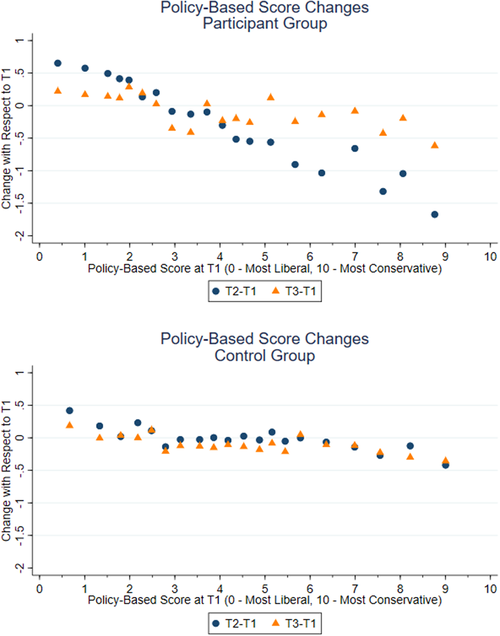
Among the treatment group, deliberation produced significant, short-term depolarization on 20 of the 26 (polarized) policy proposals. In other words, the averages for participants who identified with each party moved closer together (though not necessarily toward the center). These changes were large, sometimes 40 percentage points, as in the case of Republicans abandoning extreme positions on immigration. Meanwhile, the control group’s policy positions changed hardly at all — pointing to the key role played by deliberation. Within the five issue areas, averages among deliberators shifted leftward on all but the economy.


Image
Figure 1. Policy-Based Score (PBS) Changes over Time


Figure 1. Policy-Based Score (PBS) Changes over Time
Note: Policy-based score (PBS) is constructed for each individual based on responses to 26 questions identified as the most polarizing. The upper chart shows the participant group, and the lower chart shows the control group. T1 is the survey wave prior to the deliberations, T2 is right after the deliberations, and T3 is 10 months after, in July 2020.


By late 2020, however, the treatment group’s policy positions mostly reverted to their pre-deliberation levels. The differences between these two points in time were still significant compared with the control group, yet relatively small in absolute terms. These policy reversions are perhaps unsurprising: deliberators returned to an environment of heightened polarization and aggressive campaigning during the 2020 election cycle. (To be sure, and from the standpoint of finding solutions to collective problems, policy reversion is not especially concerning — the aim of deliberation is to bring citizens together to reason and compromise, which the experiment accomplished.)

A Civic Awakening?


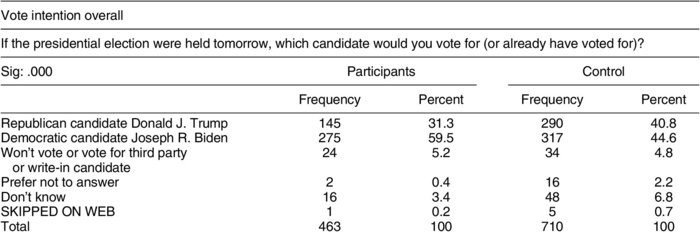
The lack of long-term policy effects suggests that three-day deliberations may be limited in their ability to create a more encompassing, participatory society. However, the treatment group demonstrated large and persistent changes in their intention to vote (i.e., turnout) and their candidate of choice. Among the control group, Joe Biden was favored over Donald Trump by about four percentage points — very close to Biden’s actual margin in the popular vote. Among the treatment group, however, Biden was favored by 28 percentage points. The gaps in turnout were similarly large. (Note that these are intentions, not reports of actual decisions. However, Tables 6 and 7 in the article show similar effects for recollected votes after the election.)


Image
Table 2. Voting Intention for Participant and Control Groups, Time 4


Table 2. Voting Intention for Participant and Control Groups, Time 4


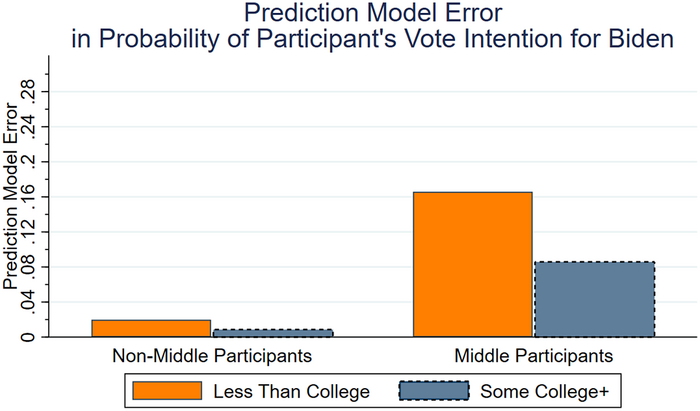
These civic outcomes are especially surprising because (a) voting behavior is thought to be stable and deeply rooted in one’s psychology and social context, and (b) experimental efforts to increase turnout have been most successful when undertaken shortly before elections, as opposed to one whole year prior. The effects were most pronounced among political moderates and those without college degrees — perhaps pointing to the educative effects of deliberation.


Image
Figure 5. Effects on Vote Intention Captured by Predictive Modeling, by Education


Figure 5. Effects on Vote Intention Captured by Predictive Modeling, by Education
Note: Middle are those participants who have Policy-Based Scores between 3 and 5 (inclusive) at Time 1. Non-middle participants are all other participants. Positive prediction error shows that, on average, participants were more likely to vote for Biden than predicted by the model. Vote intention data are collected at Time 4, in October, 2020. Full calibrated model used to construct this figure can be found in the APSR Dataverse.


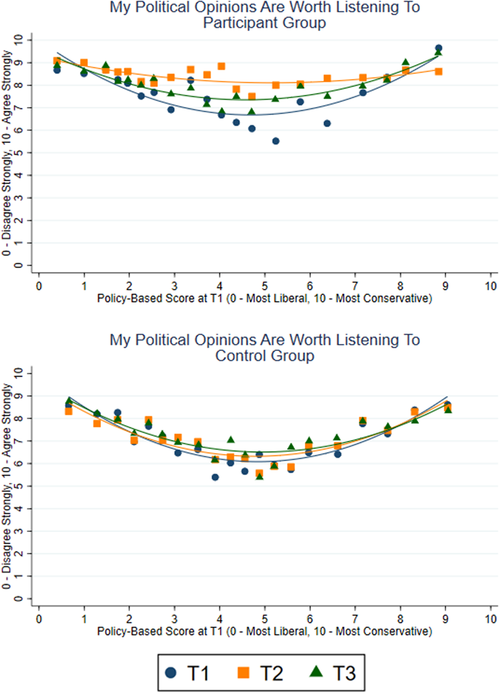
Why did deliberation produce only short-term policy effects but long-term effects on voting behavior? The authors posit that deliberation caused an “awakening of civic capacities.” They reason that deliberation was a transformative experience in terms of stimulating political engagement and a sense of efficacy. And indeed, the treatment group was, in the long term, more likely than the control group to follow the 2020 election campaign, believe their political opinions mattered, and acquire general information about American politics. (The latter is measured in terms of knowing which party controlled the House and Senate.)


Image
Figure 9. Having “Political Opinions Worth Listening to”


Figure 9. Having “Political Opinions Worth Listening to”
Note: Policy-based score is constructed for each individual based on responses to 26 questions identified as the most polarizing. Responses to the question “How strongly would you disagree or agree with the following statement?”[I have opinions about politics that are worth listening to.] were collected at T1 (just before deliberations), T2 (just after), and T3 (10 months later, July 2020).


The authors close by discussing efforts to scale up civic engagement, such as the Stanford Online Deliberation Platform. In all, “Can deliberation have lasting effects?” provides a rigorous case for the value of deliberation in strengthening democratic participation.

*Brief prepared by Adam Fefer.

Hero Image
Group of people deliberating around a table
A group deliberating during the America in One Room national Deliberation Poll in Dallas, TX, 2019
All News button
1
Subtitle

CDDRL Research-in-Brief [4-minute read]

Terms
Image
Group of people deliberating around a table
Caption A group deliberating during the America in One Room national Deliberation Poll in Dallas, TX, 2019
Aria Label
Read More The Lasting Effects of Deliberation on Civic Engagement
Date Label
Display Hero Image Wide (1320px)
No
Authors
News Type
News
Date
Paragraphs

Introduction and Contribution:


Indigenous peoples constitute at least 8% of Latin America's population, well over 40 million in total, depending on whether one measures this by self-identification or proficiency in an indigenous language. Over the five centuries since Latin America’s colonization, indígenas have been subjected to myriad injustices, from genocide and linguicide to dispossession, forced assimilation, and political exclusion. However, during the last two decades, indigenous identities have entered Latin America’s political mainstream, indigenous candidates and parties have grown in popularity, and traditional political debates — for example, over fair economic development — have been increasingly addressed using the language of indigenous rights and autonomy.

Social scientific knowledge about indigenous peoples has improved considerably, and in ways that reflect many of these ongoing processes. Yet gaps persist, partly owing to the neglect of scholarship written by indigenous peoples (and in non-English languages) as well as the shoehorning of indigenous life into categories such as “peasants” or “poor masses.” The time is thus ripe for a critical examination.

In “Original Peoples Count,” Alberto Díaz-Cayeros and Irma Alicia Velasquez Nimatuj systematically review current scholarship on indigenous peoples in Latin America. The authors demonstrate how much has been learned about trends in indigenous language use, the virtues of indigenous political institutions, the dangers of indigenous environmental activism, and much more. Looking ahead, the authors call for greater attention to the threats posed by the rapid growth of artificial intelligence, as well as to the persistence of disparities in indigenous health outcomes.

Counting Indigenous Peoples and Languages:


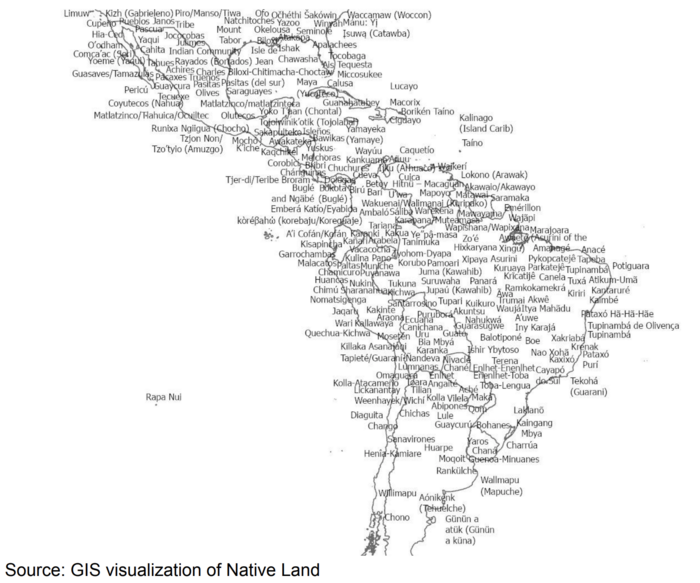
One important cause of indigenous marginalization is that many colonial and post-colonial governments simply refused to recognize their existence. Nation-building elites privileged Spanish and Portuguese and made deliberate choices about which identities to include in censuses. Relatedly, the very category “indigenous” reflects colonial efforts to homogenize millions of diverse peoples, and many indigenous peoples do not identify as such. There is tremendous variation in terms of the languages that indigenous peoples speak and the demographics of where they live. Not only do these territories cut across national borders, but many indigenous peoples have a distinctive understanding of borders, as representing sacred — rather than merely administrative — divisions.


Image
Figure 2. Unceded Territories of Indigenous Peoples in Latin America


Figure 2. Unceded Territories of Indigenous Peoples in Latin America


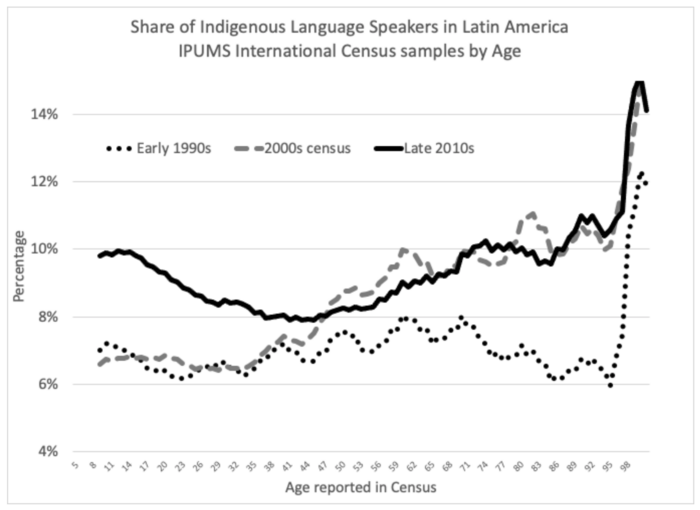
Despite the visibility of language loss and extinction, panel data collected since the 1990s paint a more nuanced picture. Diaz-Cayeros and Nimatuj highlight several important trends along these lines. For one, the number of indigenous language speakers has increased across every age cohort. Second, there was a dramatic increase in indigenous language speakers around age 40 in the 2000s, followed by an increase in speakers under 40 in the 2010s. What this suggests is not that more people are learning indigenous languages, but that more speakers are willing to reveal their identities to surveyors. The latter is itself a political phenomenon that reflects growing indigenous consciousness.


Image
Figure 1. Identity Revelation in Latin American Census Data


Figure 1. Identity Revelation in Latin American Census Data


Indigenous Politics and Economics:


Over the last two decades, indigenous politics has moved from street protests to the highest levels of government, with Evo Morales winning Bolivia’s presidency. Yet these improvements in indigenous peoples’ descriptive representation have not always produced substantive reductions in poverty and discrimination. This is one reason why indigenous parties cannot automatically rely on indigenous vote blocs; understanding why these parties enjoy more or less consistent support is a key question for future research.

Outside of mainstream politics, traditional institutions such as indigenous assemblies have grown in number and prominence. Scholars have documented cases where these institutions exhibited highly democratic properties. These include high competitiveness and turnout, which arguably produce greater accountability to ordinary people. Indigenous governance may thus provide insights into how Latin American politics can become more encompassing and participatory, moving beyond simply electing and removing candidates once every few years.

In terms of socioeconomic trends, indigenous rates of poverty, infant mortality, and school enrollment lag behind the rest of the population. These outcomes are usually worse for women, partly owing to the persistence of indigenous patriarchal norms. Meanwhile, indigenous economies have been substantially reshaped by large-scale industrial activity, especially mining and logging. The authors caution, however, against assuming that indigenous peoples uniformly oppose these activities. At the same time, local efforts to rein in industrial activity are often met with extremely punitive state action — leading to the imprisonment or death of key indigenous leaders. Latin America is now the world’s most dangerous region for environmental activism.

Directions for Future Research:


One likely cause of indigenous marginality is ‘historical trauma,’ or rather the ways that colonialism and post-colonial discrimination have transmitted social and psychological harm across generations. The authors call for greater attention to the varied political effects of historical trauma, including depressed indigenous participation, lower levels of trust in political institutions, and worse life outcomes. Similarly, despite visible efforts by Latin American governments to undertake health interventions, substantial gaps persist within indigenous communities, particularly in mental health.

Another topic for further research concerns the lives of indigenous youth, especially those who migrate to urban centers for work. Migration generates multiple overlapping challenges, including cultural adjustment, political marginality, and economic precarity. Finally, the growth of ‘digital colonialism’ demands greater attention. Artificial intelligence has generated a host of injustices, such as environmental degradation, algorithmic discrimination against indigenous languages, and the nonconsensual extraction of indigenous knowledge. The authors close by noting that indigenous peoples may use AI to make their histories ever more visible. In all, “Original Peoples Count” is an ambitious review that will likely inform the next generation of scholarship on indigenous politics.

*Brief prepared by Adam Fefer.

Hero Image
Woman working on a loom wearing traditional dress in Peru.
Adrian Dascal
All News button
1
Subtitle

CDDRL Research-in-Brief [4-minute read]

Date Label
Display Hero Image Wide (1320px)
No
Subscribe to The Americas