-

* Please note all CISAC events are scheduled using the Pacific Time Zone.


Register in advance for this webinar: https://stanford.zoom.us/webinar/register/8416226562432/WN_WLYcdRa6T5Cs1MMdmM0Mug


About the Event: Is there a place for illegal or nonconsensual evidence in security studies research, such as leaked classified documents? What is at stake, and who bears the responsibility, for determining source legitimacy? Although massive unauthorized disclosures by WikiLeaks and its kindred may excite qualitative scholars with policy revelations, and quantitative researchers with big-data suitability, they are fraught with methodological and ethical dilemmas that the discipline has yet to resolve. I argue that the hazards from this research—from national security harms, to eroding human-subjects protections, to scholarly complicity with rogue actors—generally outweigh the benefits, and that exceptions and justifications need to be articulated much more explicitly and forcefully than is customary in existing work. This paper demonstrates that the use of apparently leaked documents has proliferated over the past decade, and appeared in every leading journal, without being explicitly disclosed and defended in research design and citation practices. The paper critiques incomplete and inconsistent guidance from leading political science and international relations journals and associations; considers how other disciplines from journalism to statistics to paleontology address the origins of their sources; and elaborates a set of normative and evidentiary criteria for researchers and readers to assess documentary source legitimacy and utility. Fundamentally, it contends that the scholarly community (researchers, peer reviewers, editors, thesis advisors, professional associations, and institutions) needs to practice deeper reflection on sources’ provenance, greater humility about whether to access leaked materials and what inferences to draw from them, and more transparency in citation and research strategies.

View Written Draft Paper


About the Speaker: Christopher Darnton is a CISAC affiliate and an associate professor of national security affairs at the Naval Postgraduate School. He previously taught at Reed College and the Catholic University of America, and holds a Ph.D. in Politics from Princeton University. He is the author of Rivalry and Alliance Politics in Cold War Latin America (Johns Hopkins, 2014) and of journal articles on US foreign policy, Latin American security, and qualitative research methods. His International Security article, “Archives and Inference: Documentary Evidence in Case Study Research and the Debate over U.S. Entry into World War II,” won the 2019 APSA International History and Politics Section Outstanding Article Award. He is writing a book on the history of US security cooperation in Latin America, based on declassified military documents.

Virtual Seminar

Christopher Darnton Associate Professor of National Security Affairs Naval Postgraduate School
Seminars
Authors
Daphne Keller
News Type
Blogs
Date
Paragraphs

I am a huge fan of transparency about platform content moderation. I’ve considered it a top policy priority for years, and written about it in detail (with Paddy Leerssen, who also wrote this great piece about recommendation algorithms and transparency). I sincerely believe that without it, we are unlikely to correctly diagnose current problems or arrive at wise legal solutions.

So it pains me to admit that I don’t really know what “transparency” I’m asking for. I don’t think many other people do, either. Researchers and public interest advocates around the world can agree that more transparency is better. But, aside from people with very particular areas of interest (like political advertising), almost no one has a clear wish list. What information is really important? What information is merely nice to have? What are the trade-offs involved?

That imprecision is about to become a problem, though it’s a good kind of problem to have. A moment of real political opportunity is at hand. Lawmakers in the USEurope, and elsewhere are ready to make some form of transparency mandatory. Whatever specific legal requirements they create will have huge consequences. The data, content, or explanations they require platforms to produce will shape our future understanding of platform operations, and our ability to respond — as consumers, as advocates, or as democracies. Whatever disclosures the laws don’t require, may never happen.

It’s easy to respond to this by saying “platforms should track all the possible data, we’ll see what’s useful later!” Some version of this approach might be justified for the very biggest “gatekeeper” or “systemically important” platforms. Of course, making Facebook or Google save all that data would be somewhat ironic, given the trouble they’ve landed in by storing similar not-clearly-needed data about their users in the past. (And the more detailed data we store about particular takedowns, the likelier it is to be personally identifiable.)

For any platform, though, we should recognize that the new practices required for transparency reporting comes at a cost. That cost might include driving platforms to adopt simpler, blunter content rules in their Terms of Service. That would reduce their expenses in classifying or explaining decisions, but presumably lead to overly broad or narrow content prohibitions. It might raise the cost of adding “social features” like user comments enough that some online businesses, like retailers or news sites, just give up on them. That would reduce some forms of innovation, and eliminate useful information for Internet users. For small and midsized platforms, transparency obligations (like other expenses related to content moderation) might add yet another reason to give up on competing with today’s giants, and accept an acquisition offer from an incumbent that already has moderation and transparency tools. Highly prescriptive transparency obligations might also drive de facto standardization and homogeneity in platform rules, moderation practices, and features.

None of these costs provides a reason to give up on transparency — or even to greatly reduce our expectations. But all of them are reasons to be thoughtful about what we ask for. It would be helpful if we could better quantify these costs, or get a handle on what transparency reporting is easier and harder to do in practice.

I’ve made a (very in the weeds) list of operational questions about transparency reporting, to illustrate some issues that are likely to arise in practice. I think detailed examples like these are helpful in thinking through both which kinds of data matter most, and how much precision we need within particular categories. For example, I personally want to know with great precision how many government orders a platform received, how it responded, and whether any orders led to later judicial review. But to me it seems OK to allow some margin of error for platforms that don’t have standardized tracking and queuing tools, and that as a result might modestly mis-count TOS takedowns (either by absolute numbers or percent).

I’ll list that and some other recommendations below. But these “recommendations” are very tentative. I don’t know enough to have a really clear set of preferences yet. There are things I wish I could learn from technologists, activists, and researchers first. The venues where those conversations would ordinarily happen — and, importantly, where observers from very different backgrounds and perspectives could have compared the issues they see, and the data they most want — have been sadly reduced for the past year.

So here is my very preliminary list:

  • Transparency mandates should be flexible enough to accommodate widely varying platform practices and policies. Any de facto push toward standardization should be limited to the very most essential data.
  • The most important categories of data are probably the main ones listed in the DSA: number of takedowns, number of appeals, number of successful appeals. But as my list demonstrates, those all can become complicated in practice.
  • It’s worth taking the time to get legal transparency mandates right. That may mean delegating exact transparency rules to regulatory agencies in some countries, or conducting studies prior to lawmaking in others.
  • Once rules are set, lawmakers should be very reluctant to move the goalposts. If a platform (especially a smaller one) invests in rebuilding its content moderation tools to track certain categories of data, it should not have to overhaul those tools soon because of changed legal requirements.
  • We should insist on precise data in some cases, and tolerate more imprecision in others (based on the importance of the issue, platform capacity, etc.). And we should take the time to figure out which is which.
  • Numbers aren’t everything. Aggregate data in transparency reports ultimately just tell us what platforms themselves think is going on. To understand what mistakes they make, or what biases they may exhibit, independent researchers need to see the actual content involved in takedown decisions. (This in turn raises a slough of issues about storing potentially unlawful content, user privacy and data protection, and more.)

It’s time to prioritize. Researchers and civil society should assume we are operating with a limited transparency “budget,” which we must spend wisely — asking for the information we can best put to use, and factoring in the cost. We need better understanding of both research needs and platform capabilities to do this cost-benefit analysis well. I hope that the window of political opportunity does not close before we manage to do that.

Daphne Keller

Daphne Keller

Director of the Program on Platform Regulation
BIO

Read More

Daphne Keller QA
Q&As

Q&A with Daphne Keller of the Program on Platform Regulation

Keller explains some of the issues currently surrounding platform regulation
Q&A with Daphne Keller of the Program on Platform Regulation
Hero Image
getty image of person holding transparent phone
Getty Images
All News button
1
Subtitle

In a new blog post, Daphne Keller, Director of the Program on Platform Regulation at the Cyber Policy Center, looks at the need for transparency when it comes to content moderation and asks, what kind of transparency do we really want?

-

Please note: the start time for this event has been moved from 3:00 to 3:15pm.

Join FSI Director Michael McFaul in conversation with Richard Stengel, Under Secretary of State for Public Diplomacy and Public Affairs. They will address the role of entrepreneurship in creating stable, prosperous societies around the world.

Richard Stengel Undersecretary of State for Public Diplomacy and Public Affairs Special Guest United States Department of State

Encina Hall
616 Jane Stanford Way
Stanford, CA 94305-6055

0
Senior Fellow, Freeman Spogli Institute for International Studies
Ken Olivier and Angela Nomellini Professor of International Studies, Department of Political Science
Peter and Helen Bing Senior Fellow, Hoover Institution
mcfaul_headshot_2025.jpg PhD

Michael McFaul is the Ken Olivier and Angela Nomellini Professor of International Studies in Political Science, Senior Fellow at the Freeman Spogli Institute for International Studies, and the Peter and Helen Bing Senior Fellow at the Hoover Institution, all at Stanford University. He joined the Stanford faculty in 1995 and served as FSI Director from 2015 to 2025. He is also an international affairs analyst for MSNOW.

McFaul served for five years in the Obama administration, first as Special Assistant to the President and Senior Director for Russian and Eurasian Affairs at the National Security Council at the White House (2009-2012), and then as U.S. Ambassador to the Russian Federation (2012-2014).

McFaul has authored ten books and edited several others, including, most recently, Autocrats vs. Democrats: China, Russia, America, and the New Global Disorder, as well as From Cold War to Hot Peace: An American Ambassador in Putin’s Russia, (a New York Times bestseller) Advancing Democracy Abroad: Why We Should, How We Can; and Russia’s Unfinished Revolution: Political Change from Gorbachev to Putin.

He is a recipient of numerous awards, including an honorary PhD from Montana State University; the Order for Merits to Lithuania from President Gitanas Nausea of Lithuania; Order of Merit of Third Degree from President Volodymyr Zelenskyy of Ukraine, and the Dean’s Award for Distinguished Teaching at Stanford University. In 2015, he was the Distinguished Mingde Faculty Fellow at the Stanford Center at Peking University.

McFaul was born and raised in Montana. He received his B.A. in International Relations and Slavic Languages and his M.A. in Soviet and East European Studies from Stanford University in 1986. As a Rhodes Scholar, he completed his D. Phil. in International Relations at Oxford University in 1991. 

CV
Date Label
Moderator
Panel Discussions
Authors
News Type
News
Date
Paragraphs

The United States has a growing inventory of spent nuclear fuel from commercial power plants that continues to accumulate at reactor sites around the country.

In addition, the legacy waste from U.S. defense programs remains at Department of Energy sites around the country, mainly at Hanford, WA, Savannah River, SC, and at Idaho National Laboratory.

Image
But now the U.S. nuclear waste storage program is “frozen in place”, according to Rod Ewing, Frank Stanton professor in nuclear security at Stanford’s Center for International Security and Cooperation.

“The processing and handling of waste is slow to stopped and in this environment the pressure has become very great to do something.”

Currently, more than seventy thousand metric tons of spent nuclear fuel from civilian reactors is sitting in temporary aboveground storage facilities spread across 35 states, with many of the reactors that produced it shut down.  And U.S. taxpayers are paying the utilities billions of dollars to keep it there.

Meanwhile, the deep geologic repository where all that waste was supposed to go, in Yucca Mountain Nevada, is now permanently on hold, after strong resistance from Nevada residents and politicians led by U.S. Senator Harry Reid.

The Waste Isolation Pilot Plant in Carlsbad New Mexico, the world’s first geologic repository for transuranic waste, has been closed for over a year due to a release of radioactivity.

And other parts of the system, such as the vitrification plant at Hanford and the mixed oxide fuel plant at Savannah River , SC, are way behind schedule and over budget.

It’s a growing problem that’s unlikely to change this political season.

“The chances of dealing with it in the current Congress are pretty much nil, in my view,” said former U.S. Senator Jeff Bingaman (D-NM).

“We’re not going to see a solution to this problem this year or next year.”

The issue in Congress is generally divided along political lines, with Republicans wanting to move forward with the original plan to build a repository at Yucca Mountain, while Democrats support the recommendations of the Blue Ribbon Commission on America’s Nuclear Future to create a new organization to manage nuclear waste in the U.S. and start looking for a new repository location using an inclusive, consent-based process.

“One of the big worries that I have with momentum loss is loss of nuclear competency,” said David Clark, a Fellow at the Los Alamos National Laboratory.

Image
“So we have a whole set of workers who have been trained, and have been working on these programs for a number of years. When you put a program on hold, people go find something else to do.”

Meanwhile, other countries are moving ahead with plans for their own repositories, with Finland and Sweden leading the pack, leaving the U.S. lagging behind.

So Ewing decided to convene a series of high-level conferences, where leading academics and nuclear experts from around the world can discuss the issues in a respectful environment with a diverse range of stakeholders – including former politicians and policy makers, scientists and representatives of Indian tribes and other effected communities.

“For many of these people and many of these constituencies, I’ve seen them argue at length, and it’s usually in a situation where a lot seems to be at stake and it’s very adversarial,” said Ewing.

“So by having the meeting at Stanford, we’ve all taken a deep breath, the program is frozen in place, nothing’s going to go anywhere tomorrow, we have the opportunity to sit and discuss things. And I think that may help.”

Former Senator Bingaman said he hoped the multidisciplinary meetings, known at the “Reset of Nuclear Waste Management Strategy and Policy Series”, would help spur progress on this pressing problem.

“There is a high level of frustration by people who are trying to find a solution to this problem of nuclear waste, and there’s no question that the actions that we’ve taken thus far have not gotten us very far,” Bingaman said.

“I think that’s why this conference that is occurring is a good thing, trying to think through what are the problems that got us into the mess we’re in, and how do we avoid them in the future.”

The latest conference, held earlier this month, considered the question of how to structure a new nuclear waste management organization in the U.S.

Speakers from Sweden, Canada and France brought an international perspective and provided lessons learned from their countries nuclear waste storage programs.

“The other…major programs, France, Switzerland, United Kingdom, Canada, they all reached a crisis point, not too different from our own,” said Ewing.

“And at this crisis point they had to reevaluate how they would go forward. They each chose a slightly different path, but having thought about it, and having selected a new path, one can also observe that their programs are moving forward.”

France has chosen to adopt a closed nuclear cycle to recycle spent fuel and reuse it to generate more electricity.

Image
“It means that the amount of waste that we have to dispose of is only four percent of the total volume of spent nuclear fuel which comes out of the reactor,” said Christophe Poinssot of the French Atomic and Alternative Energy Commission.

“We also reduce the toxicity because…we are removing the plutonium. And finally, we are conditioning the final waste under the form of nuclear glass, the lifetime of which is very long, in the range of a million years in repository conditions.”

Clark said that Stanford was the perfect place to convene a multidisciplinary group of thought leaders in the field who could have a real impact on the future of nuclear waste storage policy.

“The beauty of a conference like this, and holding it at a place like Stanford University and CISAC, is that all the right people are here,” he said.

“All the people who are here have the ability to influence, through some level of authority and scholarship, and they’ll be able to take the ideas that they’ve heard back to their different offices and different organizations.  I think it will make a difference, and I’m really happy to be part of it.”

Ewing said it was also important to include students in the conversation.

“There’s a next generation of researchers coming online, and I want to save them the time that it took me to realize what the problems are,” Ewing said.

“By mixing students into this meeting, letting them interact with all the parties, including the distinguished scientists and engineers, I’m hoping it speeds up the process.”

Professor Ewing is already planning his next conference, next March, which will focus on the consent-based process that will be used to identify a new location within the U.S. for a repository.

Hero Image
10856482103 d60b9556a9 o
U.S. Department of Energy
All News button
1
News Type
News
Date
Paragraphs

Russ Feingold, the former U.S. senator perhaps best known for pushing campaign finance reform, will spend the spring quarter at Stanford lecturing and teaching.

Feingold will be the Payne Distinguished Lecturer and will be in residence at the Freeman Spogli Institute for International Studies while teaching and mentoring graduate students in the Ford Dorsey Program in International Policy Studies and the Stanford Law School.

Feingold was recently the State Department’s  special envoy to the Great Lakes Region of Africa and the Democratic Republic of Congo. He will bring his knowledge and longstanding interest in one of the most challenging, yet promising, places in Africa to campus with the cross-listed IPS and Law School course, “The Great Lakes Region of Africa and American Foreign Relations: Policy and Legal Implications of the Post-1994 Era.”

Feingold, a Wisconsin Democrat who served three terms in the Senate between 1993 and 2011, co-sponsored the Bipartisan Campaign Reform Act of 2002. Better known as the McCain-Feingold Act, the legislation regulated the roles of soft money contributions and issue ads in national elections.

Hero Image
rdf headshot
Courtesy Russ Feingold
All News button
1
Paragraphs

Critics have warned that Chinese projects could chip away at democracy in Latin America. Our research suggests the opposite may be happening.

This article is based on Ibáñez and Schläpfer's working paper on how exposure to Chinese development projects shapes democratic attitudes in Latin America.

All Publications button
1
Publication Type
Journal Articles
Publication Date
Journal Publisher
Development + Cooperation
Authors
Alain Schläpfer
Number
pp. 54-56
-
In the Realm of the Last Man by Francis Fukuyama book launch event

The Center on Democracy, Development and the Rule of Law (CDDRL) invites the Stanford community to a book talk with Francis Fukuyama in celebration of his new book, In the Realm of the Last Man: A Memoir, which traces his own intellectual and personal journey against the backdrop of the last fifty years of global political history.

Fukuyama's work has shaped how a generation of scholars, students, and policymakers think about the trajectory of democratic governance, from The End of History and the Last Man through The Origins of Political Order and Political Order and Political Decay. In this memoir, he turns that same analytical lens on himself, reflecting on how his thinking about liberalism, state-building, and democratic decay has evolved alongside the events he lived through and helped interpret. Fukuyama's book offers a rare firsthand account of his research, reflection and understanding of the crisis of liberal democracy in our current political climate.

Fukuyama, Olivier Nomellini Senior Fellow at Stanford's Freeman Spogli Institute for International Studies and former Mosbacher Director of CDDRL, will be joined by Kathryn Stoner, current Mosbacher Director of CDDRL, for a wide-ranging conversation about the memoir, his career, and what the last half-century of political change means for the future of democracy. The conversation will be followed by a brief audience Q&A.

This event continues CDDRL's tradition of bringing leading voices in democracy and development scholarship into direct dialogue with the Stanford community, and is open to faculty, students, and members of the public with an interest in comparative politics, democratic governance, and global affairs. A book signing and reception will follow the talk, offering attendees the opportunity to purchase signed copies of the memoir.

SPEAKERS

Francis Fukuyama is the Olivier Nomellini Senior Fellow at Stanford University's Freeman Spogli Institute for International Studies (FSI), and a faculty member of FSI's Center on Democracy, Development and the Rule of Law (CDDRL). He is also Director of Stanford's Ford Dorsey Master's in International Policy, and a professor (by courtesy) of Political Science. Dr. Fukuyama has written widely on issues in development and international politics. His 1992 book, The End of History and the Last Man, has appeared in over twenty foreign editions. His newest book, In the Realm of the Last Man: A Memoir, will be published in fall 2026.

Kathryn Stoner is the Mosbacher Director of the Center on Democracy, Development and the Rule of Law (CDDRL) and the Satre Family Senior Fellow at the Freeman Spogli Institute for International Studies (FSI). From 2017 to 2021, she served as FSI's Deputy Director. She is Professor of Political Science (by courtesy) at Stanford and teaches in the Department of Political Science, the Program on International Relations, and the Ford Dorsey Master's in International Policy Program. She is also a Senior Fellow (by courtesy) at the Hoover Institution.

Kathryn Stoner
Kathryn Stoner

This is a hybrid event, with limited in-person availability. Guests may also attend virtually via Zoom. Registration is required.

Encina Hall, C148
616 Jane Stanford Way
Stanford, CA 94305

0
Olivier Nomellini Senior Fellow at the Freeman Spogli Institute for International Studies
Director of the Ford Dorsey Master's in International Policy
Research Affiliate at The Europe Center
Professor by Courtesy, Department of Political Science
yff-2021-14290_6500x4500_square.jpg

Francis Fukuyama is the Olivier Nomellini Senior Fellow at Stanford University's Freeman Spogli Institute for International Studies (FSI), and a faculty member of FSI's Center on Democracy, Development and the Rule of Law (CDDRL). He is also Director of Stanford's Ford Dorsey Master's in International Policy, and a professor (by courtesy) of Political Science.

Dr. Fukuyama has written widely on issues in development and international politics. His 1992 book, The End of History and the Last Man, has appeared in over twenty foreign editions. His book In the Realm of the Last Man: A Memoir will be published in fall 2026.

Francis Fukuyama received his B.A. from Cornell University in classics, and his Ph.D. from Harvard in Political Science. He was a member of the Political Science Department of the RAND Corporation, and of the Policy Planning Staff of the US Department of State. From 1996-2000 he was Omer L. and Nancy Hirst Professor of Public Policy at the School of Public Policy at George Mason University, and from 2001-2010 he was Bernard L. Schwartz Professor of International Political Economy at the Paul H. Nitze School of Advanced International Studies, Johns Hopkins University. He served as a member of the President’s Council on Bioethics from 2001-2004. He is editor-in-chief of American Purpose, an online journal.

Dr. Fukuyama holds honorary doctorates from Connecticut College, Doane College, Doshisha University (Japan), Kansai University (Japan), Aarhus University (Denmark), the Pardee Rand Graduate School, and Adam Mickiewicz University (Poland). He is a non-resident fellow at the Carnegie Endowment for International Peace. He is a member of the Board of Trustees of the Rand Corporation, the Board of Trustees of Freedom House, and the Board of the Volcker Alliance. He is a fellow of the National Academy for Public Administration, a member of the American Political Science Association, and of the Council on Foreign Relations. He is married to Laura Holmgren and has three children.

(October 2025)

CV
Date Label
Francis Fukuyama
Lectures
News Feed Image
frank_book_talk_2026.jpg
Date Label
Authors
News Type
News
Date
Paragraphs

Introduction and Contribution


Nearly half of the world (46%) lives in authoritarian regimes that hold regular elections — compared to 28% who live in autocracies without elections and 26% who live under democracy. In these “electoral autocracies,” the ruling party can theoretically lose power, but its ability to repress and co-opt its opponents makes defeat unlikely. Incumbent executives and parties in electoral autocracies have become increasingly sophisticated in their repressive techniques and increasingly connected to other regimes that share similar fears of democracy. “How can electoral authoritarianism be resisted?” is thus a pressing question for domestic opposition parties and civil society organizations (CSOs) as well as international actors seeking to promote democracy, including governments, nonprofits, think tanks, and academics. 

In “Opposition strategies and electoral challenges under autocracy,” Oren Samet analyzes five strategies opposition parties use to fight electoral authoritarianism during campaigns, on election day, and after polls have closed. These are: joining multiparty coalitions, strengthening their party organization, mobilizing mass protests, boycotting elections, and seeking international assistance. Samet shows that each strategy entails tradeoffs, increasing opposition competitiveness while making authoritarian repression more likely or efficient. For example, joining a multiparty coalition can both increase the incumbent’s likelihood of defeat and increase his propensity to repress — insofar as he perceives the opposition as popular and threatening.

Samet shows that each strategy entails tradeoffs, increasing opposition competitiveness while making authoritarian repression more likely or efficient.

Samet offers several prescriptions for international democracy promoters. First, they must collaborate with domestic opposition parties, because only they — and not CSOs — can win elections. Yet many international actors avoid this approach; for instance, some opposition parties may care more about power than democracy, or collaborating with them may invite criticism that democracy promotion is partisan. While these risks cannot be ignored, neither can political parties.

A second prescription follows from the fact that oppositions have at least five tools at their disposal: there can be no single “best practice” in democracy promotion; it requires flexibility, adaptability, and an integrated approach. Finally, because autocrats continue to become more sophisticated, democracy promoters must take steps to prepare for the repression of their partners. 

Five Approaches and Their Pitfalls


Otherwise effective strategies for winning democratic elections — such as running savvy campaigns on primetime television that are informed by public opinion polling — will not work for opposition parties under electoral autocracy. This is because the system is structurally biased toward incumbents. As such, one common approach has been for individual opposition parties to join together in a coalition: sharing policy platforms, endorsing joint candidates, and merging their party organizations. And indeed, multiparty coalitions are statistically associated with higher vote shares and a higher likelihood that autocrats are defeated. At the same time, however, such coalitions are difficult to form and sustain due to ideological differences and polarization. In especially repressive electoral autocracies, such as Ethiopia or Cambodia, incumbent parties are often able to neutralize or eliminate coalitions. Finally, when coalitions pose a serious challenge on election day but without winning, autocrats may repress even harder.

A second strategy involves strengthening party organization, for example, by improving its geographic reach or recruiting more professional candidates. These efforts can increase competitiveness and popular appeal, but they risk providing the incumbent with a large amount of information that he can use to more efficiently target his opponents. This includes formal lists of members, candidates, and party branch locations. Meanwhile, more organized opposition parties may inadvertently legitimize the system by affording it some semblance of democracy.

Encouraging mass protests is a third strategy available to opposition parties. As the number of protesters grows, authoritarian repression becomes more costly and more likely to backfire, while the incumbent’s allies become more likely to defect and join the opposition. Parties help with this process by translating protester demands into coherent party platforms. However, and especially after the 2010-12 Arab Uprisings, electoral authoritarian regimes have become highly sensitive to and ready to combat protests. This may be accomplished via surveillance or assistance from powerful third parties such as China or Russia.

A fourth, common strategy has been for parties to boycott the autocrat’s electoral facade. Doing so signals to the international community that the playing field is skewed and the system illegitimate. Yet boycotts can lead to missed opportunities for the opposition to build electoral strength, influence policy change as legislative minorities, or monitor the autocrat from inside government. In addition, they rob oppositions of the chance to take advantage of the autocrat’s miscalculations, which may even lead to his defeat. 

Finally, opposition parties can reach out to international actors for support. This may involve requesting that they sanction the regime or intervene in the name of democracy. International pressure can indeed encourage political openings and is especially useful for oppositions with low visibility. However, autocrats are adept at demonizing those who use this strategy as agents of malign foreign influence. These appeals can strengthen the autocrat’s domestic support base among those who see him as protecting the nation. In all, these tradeoffs suggest that effective democracy promotion requires a deep understanding of the political context in which oppositions operate.

*Brief prepared by Adam Fefer.

Hero Image
A crowd of people gathers at a protest, holding handmade signs. A cardboard sign in the center reads “WE CAN DO BETTER.”
Sandra Seitamaa
All News button
1
Subtitle

CDDRL Research-in-Brief [3.5-minute read]

Date Label
Display Hero Image Wide (1320px)
No
Authors
News Type
News
Date
Paragraphs

Introduction and Contribution


Democracies face a host of ongoing challenges, including the rise of elected autocrats, income inequality, mainstreamed forms of xenophobic nationalism, and political apathy. All of these challenges pose threats to democratic participation — elected autocrats restrict it, inequality makes it easier for oligarchs to sway election outcomes, and xenophobia can discourage cultural outsiders from voting.

Apart from practical threats to democratic participation, an established intellectual tradition has viewed participation with deep skepticism. In this view, democracy is good simply because it ensures peaceful transfers of power and protects individual rights. Collective decisions, however, cannot be meaningfully viewed as representing the “will of the people” owing to manipulation, apathy, and the high costs of acquiring political knowledge. Is this “realist” vision the best one can hope for in democratic life?

In “Can deliberation have lasting effects?,” James FishkinValentin Bolotnyy, Joshua Lerner, Alice Siu, and Norman Bradburn show how a three-day deliberative experiment in late 2019 had large and long-term effects on turnout and voting behavior. Those most likely to exhibit these civic behaviors nearly a year later had come to follow politics more closely and see their political opinions as valuable. At the same time, the experiment’s effects on participants’ policy views were significant only in the short term — most deliberators eventually reverted to their previously held policy positions.

That three days of deliberation had such lasting civic effects suggests that efforts to create more inclusive forms of democratic participation are both possible and scalable. Moreover, it suggests that academic skepticism about democratic participation is not an argument against citizens’ capacities for reasonable decision-making; rather, it is an argument against our imperfect contexts of participation. Deliberative experiments may offer hope for improving these contexts.

Academic skepticism about democratic participation is not an argument against citizens’ capacities for reasonable decision-making; rather, it is an argument against our imperfect contexts of participation.

The Deliberative Experiment and Its Effects on Policy Views


In September 2019 — one week prior to the experiment — a treatment group (i.e., those who would deliberate) of 523 registered voters from around the US and a control group of 844 voters were surveyed on their political attitudes. Members of the treatment group then deliberated on five issue domains (the economy, environment, immigration, health care, foreign policy) in small groups and on 47 policy proposals (e.g., redistributing wealth in some way). 26 of these proposals were characterized by extreme partisan polarization, meaning significant numbers of those who identified as Democrats or Republicans held the most extreme views. After the deliberations ended, both the treatment and control groups were surveyed. Then, three subsequent surveys were conducted in late 2020.

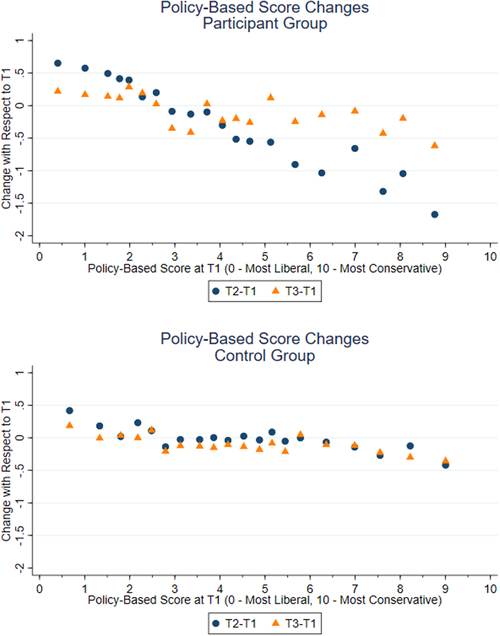
Among the treatment group, deliberation produced significant, short-term depolarization on 20 of the 26 (polarized) policy proposals. In other words, the averages for participants who identified with each party moved closer together (though not necessarily toward the center). These changes were large, sometimes 40 percentage points, as in the case of Republicans abandoning extreme positions on immigration. Meanwhile, the control group’s policy positions changed hardly at all — pointing to the key role played by deliberation. Within the five issue areas, averages among deliberators shifted leftward on all but the economy.


Image
Figure 1. Policy-Based Score (PBS) Changes over Time


Figure 1. Policy-Based Score (PBS) Changes over Time
Note: Policy-based score (PBS) is constructed for each individual based on responses to 26 questions identified as the most polarizing. The upper chart shows the participant group, and the lower chart shows the control group. T1 is the survey wave prior to the deliberations, T2 is right after the deliberations, and T3 is 10 months after, in July 2020.


By late 2020, however, the treatment group’s policy positions mostly reverted to their pre-deliberation levels. The differences between these two points in time were still significant compared with the control group, yet relatively small in absolute terms. These policy reversions are perhaps unsurprising: deliberators returned to an environment of heightened polarization and aggressive campaigning during the 2020 election cycle. (To be sure, and from the standpoint of finding solutions to collective problems, policy reversion is not especially concerning — the aim of deliberation is to bring citizens together to reason and compromise, which the experiment accomplished.)

A Civic Awakening?


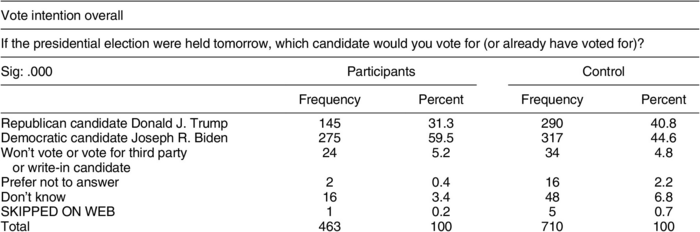
The lack of long-term policy effects suggests that three-day deliberations may be limited in their ability to create a more encompassing, participatory society. However, the treatment group demonstrated large and persistent changes in their intention to vote (i.e., turnout) and their candidate of choice. Among the control group, Joe Biden was favored over Donald Trump by about four percentage points — very close to Biden’s actual margin in the popular vote. Among the treatment group, however, Biden was favored by 28 percentage points. The gaps in turnout were similarly large. (Note that these are intentions, not reports of actual decisions. However, Tables 6 and 7 in the article show similar effects for recollected votes after the election.)


Image
Table 2. Voting Intention for Participant and Control Groups, Time 4


Table 2. Voting Intention for Participant and Control Groups, Time 4


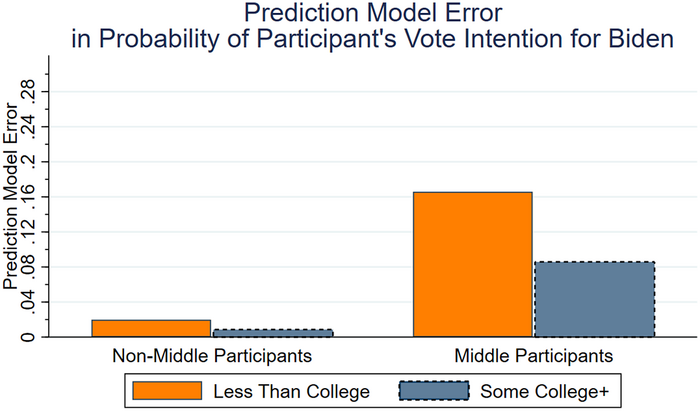
These civic outcomes are especially surprising because (a) voting behavior is thought to be stable and deeply rooted in one’s psychology and social context, and (b) experimental efforts to increase turnout have been most successful when undertaken shortly before elections, as opposed to one whole year prior. The effects were most pronounced among political moderates and those without college degrees — perhaps pointing to the educative effects of deliberation.


Image
Figure 5. Effects on Vote Intention Captured by Predictive Modeling, by Education


Figure 5. Effects on Vote Intention Captured by Predictive Modeling, by Education
Note: Middle are those participants who have Policy-Based Scores between 3 and 5 (inclusive) at Time 1. Non-middle participants are all other participants. Positive prediction error shows that, on average, participants were more likely to vote for Biden than predicted by the model. Vote intention data are collected at Time 4, in October, 2020. Full calibrated model used to construct this figure can be found in the APSR Dataverse.


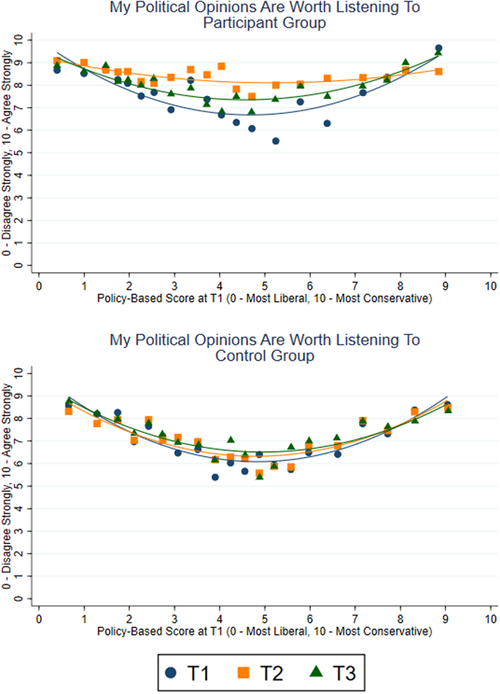
Why did deliberation produce only short-term policy effects but long-term effects on voting behavior? The authors posit that deliberation caused an “awakening of civic capacities.” They reason that deliberation was a transformative experience in terms of stimulating political engagement and a sense of efficacy. And indeed, the treatment group was, in the long term, more likely than the control group to follow the 2020 election campaign, believe their political opinions mattered, and acquire general information about American politics. (The latter is measured in terms of knowing which party controlled the House and Senate.)


Image
Figure 9. Having “Political Opinions Worth Listening to”


Figure 9. Having “Political Opinions Worth Listening to”
Note: Policy-based score is constructed for each individual based on responses to 26 questions identified as the most polarizing. Responses to the question “How strongly would you disagree or agree with the following statement?”[I have opinions about politics that are worth listening to.] were collected at T1 (just before deliberations), T2 (just after), and T3 (10 months later, July 2020).


The authors close by discussing efforts to scale up civic engagement, such as the Stanford Online Deliberation Platform. In all, “Can deliberation have lasting effects?” provides a rigorous case for the value of deliberation in strengthening democratic participation.

*Brief prepared by Adam Fefer.

Hero Image
Group of people deliberating around a table
A group deliberating during the America in One Room national Deliberation Poll in Dallas, TX, 2019
All News button
1
Subtitle

CDDRL Research-in-Brief [4-minute read]

Terms
Image
Group of people deliberating around a table
Caption A group deliberating during the America in One Room national Deliberation Poll in Dallas, TX, 2019
Date Label
Display Hero Image Wide (1320px)
No
Subscribe to The Americas