-

Second Conference on "The Political Economy of Japan under the Abe Government"

March 1 - 2, 2019

Philippines Conference Room

Sponsored by: Japan Society for Promotion of Science, Japan Foundation Center for Global Partnership, and Freeman Spogli Institute for International Studies (Stanford University)

Organizers: Takeo Hoshi and Phillip Lipscy


Program

3/1/2019

8:45am   Breakfast

9:05am    Welcome Remark     Toru Tamiya (JSPS San Francisco Office)
                                                   Osamu Honda (Japan Foundation Center for Global Partnership)

9:15am  "Abenomics and Japan's Entrepreneurship and Innovation: Is the Third Arrow Pointed in the Right Direction for Global Competition in the Silicon Valley Era?", Kenji Kushida (Stanford University)

Discussant:
Yong Suk Lee (Stanford University)

10:15am  Break

10:30am  "Abe’s Womanomics Policy: Did it have Effect on the closing of Gender Gap in Managers?", Nobuko Nagase (Ochanomizu University)

Discussant:
Curtis Milhaupt (Stanford University)

11:30am  Move to SIEPR Building for Lunch and Keynote Speech

11:45am  Lunch to conference participants

12:15pm  Lunch and Panel Discussion on Abenomics at SIEPR Building

Moderator: Takeo Hoshi
Panelists: Joshua Hausman
                   Takatoshi Ito
                  Nobuko Nagase
                  Steve Vogel

1:45pm   Panel ends and walk back to Encina Hall

2:00pm    "Abenomics, the Exchange Rate, and Markup Dynamics in Japanese Industries", Kyoji Fukao (Hitotsubashi University) and Shuichiro Nishioka (West Virginia University)

Discussant:
Yuhei Miyauchi (Stanford University and Boston University)

3:00pm  Break

3:30pm   "Abe's Reverse Course: How a Labor Shortage Transformed Labor Politics and Policy", Steven Vogel (University of California, Berkeley)

Discussant:
Kenji Kushida (Stanford University)


4:30pm   "The Crisis that Wasn’t: How Japan Has Avoided a Bond Market Panic", Mark T. Bamba and David E. Weinstein (Columbia University)

Discussant:
Johannes Wieland (University of California, San Diego)

5:30pm     Adjourn


3/2/2019

8:30am   Breakfast

9:00am   Welcome Remark
                 Moto Ono (Japan Foundation Center for Global Partnership)

9:10am   "The Enduring Challenges of History Issues", Mary McCarthy (Drake Univesity)

Discussant:
Phillip Lipscy (Stanford University)

10:10am  Break

10:25am "Expansion of the Prime Minister's Power in the Japanese Parliamentary System", Harukata Takenaka (National Graduate Institute for Policy Studies)

Discussants:
Patricia Maclachlan (University of Texas)

11:25pm  "Abenomics: Est. in 2013, or 2007?", Takatoshi Ito (Columbia University)

                   Discussants:
                  Takeo Hoshi (Stanford University)

12:25pm  Lunch

1:30pm  "Abenomics, Monetary Policy, and Consumption", Joshua Hausman (University of Michigan), Takashi Unayama (Hitotsubashi University), and Johannes Wieland (University of California, San Diego)

Discussant:
Thuy Lan Nguyen (Santa Clara University)

2:30pm   "The Great Disconnect: The Decoupling of Wage and Price Inflation in Japan", Takeo Hoshi (Stanford University) and Anil Kashyap (University of Chicago)

Discussant:
Takashi Unayama (Hitotsubashi University)

3:30pm  Break

4:00pm   "Introduction", Takeo Hoshi (Stanford University) and Phillip Lipscy (Stanford University)

5:30pm  Adjourn


Conferences
-

Resolution of economic disputes are well established in East Asia where economic growth and prosperity are common goals among the nations. However, other types of disputes have long plagued among East Asian countries. These include conflicts that have deep historical roots, or ones that involve state sovereignty, territorial disputes, and claims deriving from historical wrongs. These issues have harmed the regional security in East Asia for a long time, threatened its peace and security and hindered further progress, thus putting tension on the diplomatic relations among the East Asian countries. Attempts to resolve these disputes via politics or diplomacy have not been much successful. Compliance of the outcome of the dispute might prove to be challenging if the losing party decides that the benefit of resisting the unfavored outcome outweighs the cost of reputational harm.

Image
eyp 3x2web small crop
Eun-Young Park will present that, despite the difficulty, such disputes can be resolved fairly, provided that an independent neutral dispute resolution mechanism is securely in place. In this model, the states themselves voluntarily submit their disputes to a neutral third party capable of making fair and equitable decisions on the merits of the cases before it. There are advantages in opting for the region-wide system of independent and neutral dispute resolution in handling the Gordian Knot that is the complex and difficult problem of sovereignty and history of conflicts in East Asia. He will explore the possibility of establishing an inter-state arbitration system based on the fact that the East Asian countries already possess a good deal of social and legal capital that is readily applicable in resolving sensitive transnational disputes. He will also touch upon a permanent arbitral or claims tribunal in East Asia to deal with claims arising out of the Korean Unification; a monumental event after which much chaos—legal and otherwise—will most certainly ensue. Establishing a system of international dispute resolution system in East Asia is certain to pave the way in forming the East Asian legal community in which claims and grievances may be adjudicated fairly and brought without escalating political tensions among countries.

Eun-Young Park is Vice President of the London Court of International Arbitration and currently a visiting scholar at Stanford Asia-Pacific Research Center. Previously, he served as a Judge in the Seoul District Court of Republic of Korea. After leaving the bench, he has advised Korean Financial Supervisory Commission in establishing governance system in the public and private sector under the auspices of the World Bank and the IMF as a result of IMF bail-out of Korea during the Asian Financial Crisis. He has practiced law at Kim & Chang as a partner and Co-Chair of the International Arbitration and Litigation Practice Group, and focused on international dispute resolution including trade sanctions, transnational litigation, and international arbitration. He has served as a board member of the Singapore International Arbitration Centre (SIAC) and is currently a member of the Court of Arbitration of the SIAC. He has taught in various universities including Sungkyunkwan University School of Law as an adjunct professor. He holds a J.S.D. and L.L.M. from NYU School of Law, and is admitted to the New York Bar, the Korean Bar, and the Singapore International Commercial Court.


Eun Young Park Visiting Scholar, Shorenstein APARC, Stanford University
Seminars
-


EMERGING ISSUES IN CONTEMPORARY ASIA

A Special Seminar Series


RSVP required by Tuesday, May 7, 2019

RSVP Now


ABSTRACT: Why have the three most salient minority groups in Japan - the politically dormant Ainu, the active but unsuccessful Koreans, and the former outcaste group of Burakumin - all expanded their activism since the late 1970s despite the unfavorable domestic political environment? My investigation into the history of the three groups finds an answer in the galvanizing effects of global human rights on local social movements. Drawing on interviews and archival data, I document the transformative impact of global human rights ideas and institutions on minority activists, which changed the prevalent understanding about their standing in Japanese society and propelled them to new international venues for political claim making. The global forces also changed the public perception and political calculus in Japan over time, catalyzing substantial gains for the minority movements. Having benefited from global human rights, all three groups repaid their debt by contributing to the consolidation and expansion of international human rights principles and instruments. The in-depth historical comparative analysis offers rare windows into local, micro-level impact of global human rights - complementing my other projects on the relationship between international human rights and local politics, which employ cross-national quantitative analyses - and contributes to our understanding of international norms and institutions, social movements, human rights, ethnoracial politics, and Japanese society. 
 
Image
Kiyoteru Tsutsui
PROFILE:
  Kiyoteru Tsutsui is Professor of Sociology, Director of the Center for Japanese Studies, and Director of the Donia Human Rights Center at the University of Michigan, Ann Arbor. His research on globalization of human rights and its impact on local politics has appeared in American Sociological Review, American Journal of Sociology, Social Forces, Social Problems, Journal of Peace Research, Journal of Conflict Resolution, and other social science journals. His book publications include Rights Make Might: Global Human Rights and Minority Social Movements in Japan (Oxford University Press 2018), and a co-edited volume (with Alwyn Lim) Corporate Social Responsibility in a Globalizing World (Cambridge University Press 2015). He has been a recipient of National Endowment for the Humanities Fellowship, National Science Foundation grants, the SSRC/CGP Abe Fellowship, Stanford Japan Studies Postdoctoral Fellowship, and other grants as well as awards from American Sociological Association sections on Global and Transnational Sociology (2010, 2013), Human Rights (2017), Asia and Asian America (2018), and Collective Behavior and Social Movements (2018).


McClatchy Hall, Building 120, Studio 40
450 Serra Mall
Stanford University

Kiyoteru Tsutsui Professor of Sociology, University of Michigan
Seminars
News Type
News
Date
Paragraphs


Faculty Fellow:

  • Gerald Fuller - Professor, School of Engineering, Chemical Engineering, July-August, 2019

Pre-Doctoral Fellows:

  • Yunxin Li - History, August – September, 2019
  • Kyueun Lee – Medicine/Health Research and Policy, July – September, 2019
  • Jaemin Jee – Political Science, March 2019 – March 2020
  • Robert Xu - Linguistics, March – April, 2019


Graduate Seminars:

Title: " Chinese Corporations:  A Case Study Workshop "

  • Dates: June 17-July 5, 2019
  • Instructor: Andrew Walder, Professor of Sociology and FSI Senior Fellow
  • Eligibility: Enrolled Stanford University students in good academic standing
  • Stanford student application deadline: April 15, 2019
  • Read more and apply here

 Title: " Rheology of Complex Liquids"

  • Dates: July 15- August 2, 2019
  • Instructor: Gerald Fuller, Professor of Chemical Engineering, the School of Engineering
  • Eligibility:  Enrolled Stanford University students in good academic standing (class is full)
  • Read more here
Hero Image
[photo of a class]
All News button
1
-


EMERGING ISSUES IN CONTEMPORARY ASIA

A Special Seminar Series


RSVP required by Friday, April 29, 2019

RSVP Now


ABSTRACT:  Japan’s population is the oldest in the world and will continue to shrink for the foreseeable future. My first goal in this talk is to provide an overview of Japan’s distinctive demographic landscape, focusing on rapid population aging and its policy implications while also emphasizing the role that declining rates of marriage have played in accelerating population aging via their impact on fertility. After describing the centrality of marriage behavior to our understanding of demographic and societal trends in Japan, my second goal is to present results of new research documenting an unexpected reversal in educational differences in women’s marriage. For decades, highly-educated women have married later and more often remained unmarried than their less-educated counterparts – a pattern thought to reflect the high opportunity costs of marriage in Japan’s gender inegalitarian society. However, my analyses of recent data show that women with a university degree are now more likely than high school graduates to marry, a shift that hints at the possibility of changing norms and expectations regarding women’s employment and economic contributions to the family. Concurrent trends toward continued decline in marriage among low-educated men and women are consistent with emphases on the deteriorating economic circumstances of this group.
 
Image
James Raymo
PROFILE:
  Jim Raymo is Professor and Chair of the Department of Sociology at the University of Wisconsin-Madison. He is also the current Director of Graduate Training of the Center for Demography of Health and Aging and the former Director of the Center for Demography and Ecology. Raymo’s research focuses primarily on evaluating patterns and potential consequences of major demographic changes in Japan. He has published widely on key features of recent family change, including delayed marriage, extended co-residence with parents, and increases in premarital cohabitation, shotgun marriages, and divorce. In other lines of research, he has examined health outcomes at older ages in Japan and their relationship with family, work, and local area characteristics and has examined multiple dimensions of well-being among the growing population of single mothers and their children in Japan. He is currently involved in a new project that explores explanations for low fertility in Japan and another that examines inequalities in children’s development in Japan. His research has been published in top U.S. journals such as American Sociological Review, American Journal of Sociology, Demography, and Journal of Gerontology: Social Sciences as well as in Japanese journals. 


McClatchy Hall, Building 120, Studio 40
450 Serra Mall
Stanford University

James Raymo <i>Professor and Chair of the Department of Sociology at the University of Wisconsin-Madison</i>
-

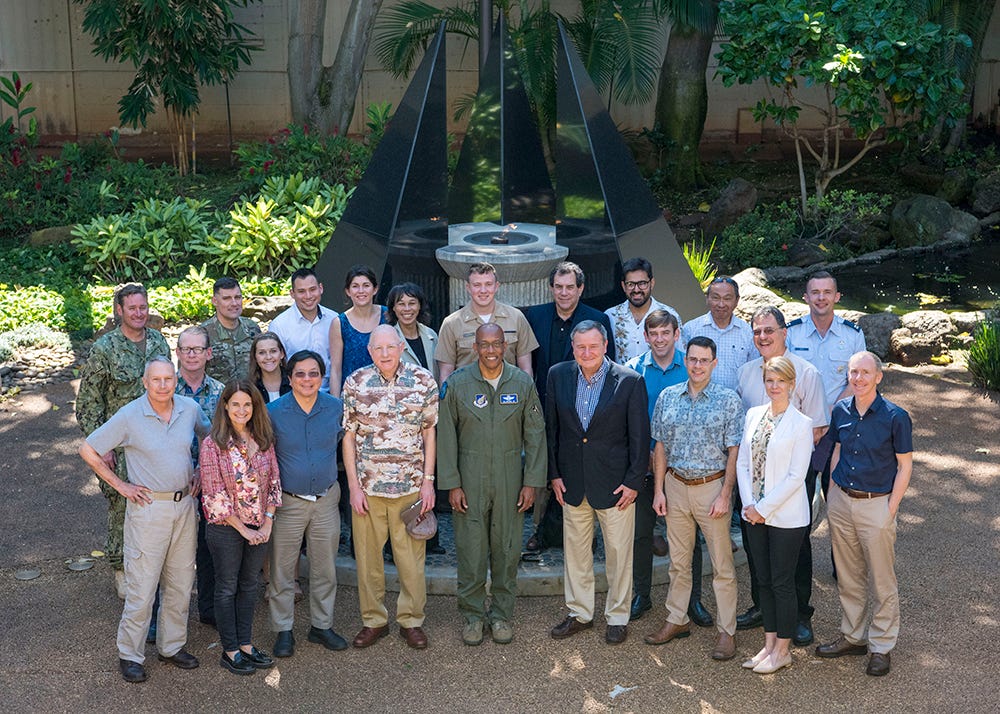
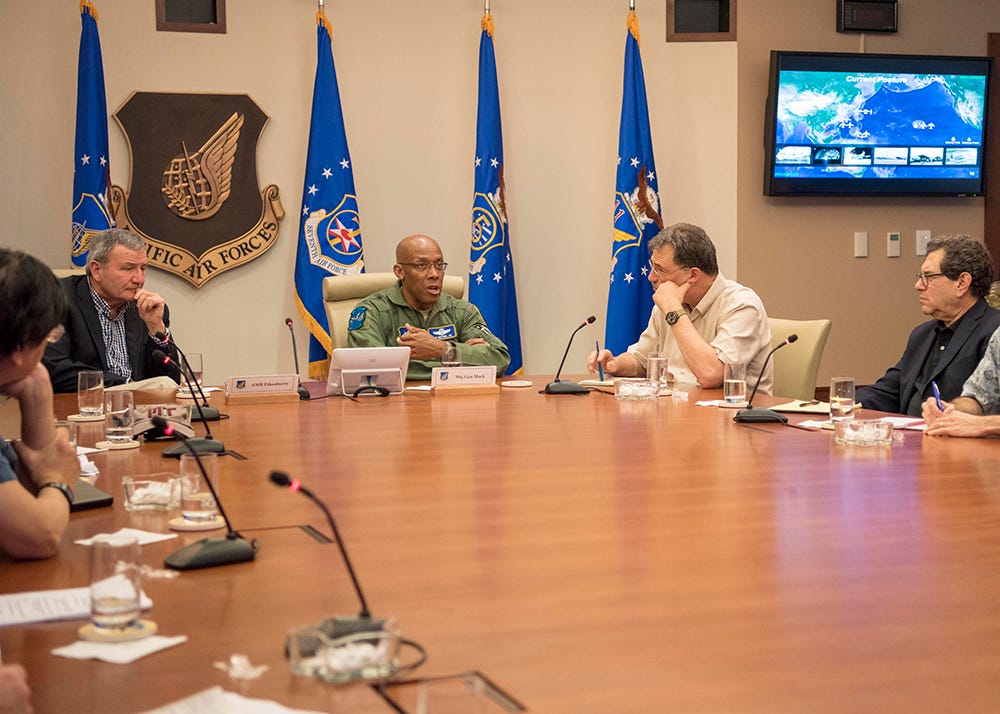
General Charles Brown, Commander, Pacific Air Forces, will discuss the strategic importance and complexity of the vast Indo-Pacific Region, and the increasing interstate competition for position and influence.  He will also address how U.S. national security priorities shape the development the Pacific Air Forces strategy and operational concepts.  Last, he will explain how his Command attempts to balance the requirements of U.S. joint forces and allied nations to produce combined airpower, and the importance of partner relationships in achieving comprehensive regional security.

Image
General Charles Brown
General Charles Q. Brown Jr. is the Commander, Pacific Air Forces (PACAF); Air Component Commander for U.S. Indo-Pacific Command; and Executive Director, Pacific Air Combat Operations Staff, Joint Base Pearl Harbor-Hickam, Hawaii.  PACAF is responsible for Air Force activities spread over half the globe in a command that supports more than 46,000 Airmen serving principally in Japan, Korea, Hawaii, Alaska and Guam.

Philippines Conference Room
Encina Hall, 3rd Floor, Central (C330)
616 Serra Mall, Stanford, CA 94305

Lectures
-

China possesses a large amount of historical demographic data showing that it has been a population giant in the world for at least two thousand years. Partly for this reason, a number of conclusions or suggestions about China’s past fertility regime have been widely accepted. Recent historical demographic investigations, however, have shown that many of these conclusions or suggestions are incorrect and need further consideration. This presentation reports these research findings and briefly examines China’s recent fertility changes. On the basis of that it makes some comments on major characteristics of China’s current fertility patterns and factors affecting fertility changes in the near future.

Image
zhongwei
Zhongwei Zhao graduated from University of Cambridge with a PhD in 1993. Since then he has worked at the East-West Center, Hawaii, University of New South Wales, Australian National University, and University of Cambridge. Since 2008, he has been a professor at the School of Demography at the ANU. Zhao has been doing research in the following research areas: Historical demography, Computer microsimulation, Fertility, Mortality, Changes in kinship structure and household composition, Famine demography, Inequality in population health, Environmental impacts on mortality changes, and Population changes in Asia. He has co-edited three books (including recent Routledge Handbook of Asian Demography) and published many articles and book chapters by leading demography journals and academic publishers.  

Zhao, Zhongwei Professor, The School of Demography at the Australian National University
Seminars
Authors
Ketian Zhang
News Type
Commentary
Date
Paragraphs

On March 31, Taiwan’s Ministry of Foreign Affairs reported that two Chinese Air Force (PLAAF) J-11 jets crossed the median line of the Taiwan Strait. This violated the long-held tacit agreement between China and Taiwan that neither side should cross the median line.

Taiwan deemed this “an intentional, reckless & provocative action,” which triggered “a 10-minute standoff” in the air. As Asia security expert Bonnie S. Glaser notes that, if intentional, this would be the first PLAAF crossing of the median line in about 20 years. In this case, it’s likely that Taiwan, not the South China Sea, prompted Beijing’s actions.

An unresolved issue from the Chinese civil war, Taiwan has always been a “core interest” to party leaders in Beijing. Here are some key takeaways from my research on China-Taiwan relations…

Read the full article in The Washington Post.


To hear more from Ketian, don't miss her recently posted video Q&A. In addition, be sure to RSVP for her April 16 seminar "Killing the Chicken to Scare the Monkey: Explaining Coercion by China in the South China Sea."

Hero Image
The marines of China navy participate in the annual military training on January 3, 2018 in Zhanjiang,
ZHANJIANG, CHINA - JANUARY 03: The marines of China navy participate in the annual military training on January 3, 2018 in Zhanjiang, Guangdong Province of China.
Pu Haiyang/VCG via Getty Images
All News button
1
-

The 3rd Asia-Pacific Geo-Economic Strategy Forum
 

May 2, 2019

Hauck Auditorium, Hoover Institution, Stanford University

Sponsored and organized by Nikkei Inc., The Hoover Institution, and the Freeman Spogli Institue of International Studies (FSI)


RSVP REQUIRED: https://www.global-nikkei.com/19apgeo/
(RSVP starts from April 10)


Agenda

1:00pm - 1:05pm
Welcome Remark:
Adm. Gary Roughead, Hoover Institution, Stanford University


1:005pm - 1:25pm
Keynote Speech:
Itsunori Onodera, Former Minister of Defense, Japan
 

1:30pm - 2:20pm
Panel I: Indo-Pacific Strategy vs Belt & Road Initiative

Chair: Akihiko Tanaka, President, National Graduate Institute for Policy Studies

Panelists:
Masahisa Sato, State Minister for Foreign Affairs of Japan
Akio Takahara,  Tokyo University
Donald Emmerson, Freeman Spogli Institue for International Studies, Stanford University
 

2:20pm - 2:30pm
Coffee Break


2:30pm - 2:50pm
Special Speech
:
Gen. H.R. McMaster,
Hoover Institution


2:55pm - 3:50pm
Panel Discussion II: US-Japan Strategic Collaboration: Technology, Trade and Economics

Chair: Satoru Mori, Hosei University

Panelists:
Kenji Wakamiya, Former State Minister of Defense, Japan
Hideaki Watanabe, Former Commissioner of Acquisition, Technology & Logistics Agency (ATLA)
Janis Pamiljans, President, Northrop Grumman Aerospace Systems
Nelson Pedeiro, Vice President, Advanced Technology Center, Lockheed Martin
 

3:50pm - 4:00pm
Coffee Break


4:05pm - 4:55pm
Panel Discussion III: Japan`s Defense/Security Strategy

Chair: Satoshi Morimoto, Former Minister of Defense of Japan

Panelists:
Gen Nakatani, Former Minister of Defense, Japan
Itsunori Onodera, Former Minister of Defense, Japan
James Fearon, Freeman Spogli Institute for International Studies, Stanford University
 

4:55pm - 5:00pm
Closing Remark:

Adm. Gary Roughead, Hoover Institution, Stanford University


Everett and Jane Hauck Auditorium
David and Joan Traitel Building of Hoover Institution
435 Lasuen Mall, Stanford, CA 94305
Stanford University


Symposiums
-
Image
Stanford University landscape with Memorial Church and the Main Quad at the center.

The JIIA-Stanford Symposium

"The Past, Present, and Future International Order in East Asia"

May 10, 2019

Bechtel Conference Center, Encina Hall, Stanford University

Sponsored and organized by the Japan Institute for International Affairs (JIIA) and Japan Program and the US-Asia Security Initiative of the Walter H. Shorenstein Asia-Pacific Research Center (APARC) of the Freeman Spogli Institue of International Studies (FSI) at Stanford University 
 

Interstate relations in East Asia are at a critical juncture.  The post-World War II regional order, shaped by the San Francisco Treaty of 1951, underpinned by a common commitment to a liberal trade system, and led by the United States, is under stress.  The end of the Cold War, rise of China, and recent changes in America’s foreign policy orientation have transformed the environment that sustained “the San Francisco System.”  It is unclear if this system will be maintained, and if not, what will replace it.  The lineage of the San Francisco System itself reaches back to the post-World War I Versailles-Washington System.  An examination of the success and shortcomings of each of these systems can offer insights on the rise and fall of international systems, especially in an Asian context.  In this symposium, we explore the circumstances that shaped the establishment and evolution of the East Asian political, economic, and security architectures from post-WWI to present; discuss the forces that built and undermined the past and existing architecture; and debate possible regional futures.  We will emphasize the perspectives and roles of the U.S., Japan, and China, and focus on major influencing factors including historical legacies, the changing distribution of global power, alliance structures, and political ideologies.


Agenda

9:00am - 9:30am 
Registration and Breakfast 
 

9:30am - 9:45am 
Welcome Remarks: 
Gi-Wook Shin, Director, APARC, Stanford University 
Kenichiro Sasae, President, JIIA 
Takeo Hoshi, Director, Japan Program, APARC, Stanford Univeristy 
 

9:45am - 11:30am 
Panel I: Comparing “the Versailles-Washington System” and “San Francisco System”: Lessons from the Rise and Fall of International Orders in East Asia

Chair: Daniel Sneider, FSI, Stanford University

Panelists: 
Shin Kawashima, University of Tokyo 
Masaya Inoue,  Seikei University 
Lin Hsiao-ting, Hoover Institution, Stanford University 
David Kennedy, Center for International Security and Cooperation (CISAC), FSI, Stanford University 
 

11:30am - 1:15pm 
Lunch 

Keynote Speaker: Ambassador Michael Armacost


1:15pm - 3:00pm 
Panel Discussion II: Japanese, U.S. and Chinese Interests and Security

Chair: Kenichiro Sasae, JIIA 

Panelists: 
Ken Jimbo, Keio University 
Tetsuo Kotani, JIIA 
Mike Lampton, APARC, Stanford University 
Jim Schoff, Carnegie Endowment for International Peace (CEIP) 
 

3:00pm - 3:30pm 
Coffee Break 
 

3:30pm - 5:15pm 
Panel Discussion III: Alternative Future East Asia Systems

Chair: Phillip Lipscy, FSI, Stanford University 

Panelists: 
Jim Fearon, FSI, Stanford University 
Ryo Sahashi, University of Tokyo 
Kenichiro Sasae, President, JIIA 
Tom Christensen, Columbia University 
 

5:15pm - 5:35pm 
Rapporteurs' review of symposium discusisons 
 

5:35pm - 5:45pm 
Closing Remarks: 
Karl Eikenberry, Director, US-Asia Security Initiative, APARC, Stanford University 
Kenichiro Sasae, President, JIIA 
 

5:45pm - 6:30pm 
Reception (Encina Lobby)

Bechtel Conference Center
616 Serra Mall
Encina Hall, Central, 1st Floor
Stanford, CA 94305

Symposiums
Subscribe to Asia-Pacific