News Type
News
Date
Paragraphs

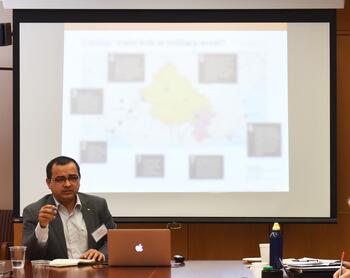
APARC's China Program recently hosted Center Fellow Thomas Fingar for the webinar "Was America’s China Policy a Foolish Failure? The Logic and Achievements of Engagement." In this talk, Fingar examines the longtime U.S. strategy of engagement with China as well as the potential shift toward a strategy of decoupling. "Much recent commentary on U.S. relations with China claims that the policy of 'Engagement' was a foolish and failed attempt to transform the People’s Republic into an American style democracy that instead created an authoritarian rival," he says. "This narrative mocks the policies of eight U.S. administrations to justify calls for 'Decoupling' and 'Containment 2.0.'” Fingar argues that the policy of Engagement has been fruitful and that Decoupling is not only inadvisable but also unattainable. Watch:

Read More

An empty Pennsylvania Avenue in Washington, D.C. seen with the United States Capitol  in the background.
News

APARC Fellow Thomas Fingar on the U.S. Intelligence Report that Warned of a Coronavirus Pandemic

In our online conversation, Fingar discusses the 2008 National Intelligence Council report he oversaw and that urged action on coronavirus pandemic preparedness, explains the U.S. initial failed response to the COVID-19 outbreak, and considers the implications of the current crisis for U.S.-China relations.
APARC Fellow Thomas Fingar on the U.S. Intelligence Report that Warned of a Coronavirus Pandemic
Quote from Thomas Fingar and Jean Oi from, "China's Challeges: Now It Gets Much Harder"
Commentary

Now It Gets Much Harder: Thomas Fingar and Jean Oi Discuss China’s Challenges in The Washington Quarterly

Now It Gets Much Harder: Thomas Fingar and Jean Oi Discuss China’s Challenges in The Washington Quarterly
BEIJING, CHINA - Workers sit near a CRH (China Railway High-speed) "bullet train" at the Beijing South Railway Station under reconstruction.
News

High-Speed Rail Holds Promise and Problems for China, Explains David M. Lampton

In a new audio interview, Lampton discusses some of the challenges, uncertainties, and decisions that loom ahead of China's Belt and Road Initiative.
High-Speed Rail Holds Promise and Problems for China, Explains David M. Lampton
All News button
1
Subtitle

Decoupling, according to Fingar, is not only inadvisable but also unattainable. 

News Type
News
Date
Paragraphs

While Wuhan, China was the first epicenter of the COVID-19 pandemic, every nation in Asia has been deeply affected by the spread of the virus. In a virtual seminar convened by the Freeman Spogli Institute, APARC experts discuss the social and economic impacts of COVID-19 and the various policy responses to the pandemic across Asian nations.

Senior Fellow Xueguang Zhou focuses on the phases of crisis response taken by the PRC in the early stages of the unfolding coronavirus outbreak. Center Fellow and Korea Program Deputy Director Yong Suk Lee discusses the policy responses of the South Korean government. Southeast Asia Program Director Don Emmerson offers a comparison of different governance strategies and actions implemented across Southeast Asian countries, while Karen Eggelston, APARC's deputy director and director of the Asia Health Policy Program, addresses the response of health systems in Japan and South Asia.

Watch the full discussion and Q&A below. You can also read the Stanford Daily's coverage of the event.

Read More

An empty Pennsylvania Avenue in Washington, D.C. seen with the United States Capitol  in the background.
News

APARC Fellow Thomas Fingar on the U.S. Intelligence Report that Warned of a Coronavirus Pandemic

In our online conversation, Fingar discusses the 2008 National Intelligence Council report he oversaw and that urged action on coronavirus pandemic preparedness, explains the U.S. initial failed response to the COVID-19 outbreak, and considers the implications of the current crisis for U.S.-China relations.
APARC Fellow Thomas Fingar on the U.S. Intelligence Report that Warned of a Coronavirus Pandemic
BEIJING, CHINA - Workers sit near a CRH (China Railway High-speed) "bullet train" at the Beijing South Railway Station under reconstruction.
News

High-Speed Rail Holds Promise and Problems for China, Explains David M. Lampton

In a new audio interview, Lampton discusses some of the challenges, uncertainties, and decisions that loom ahead of China's Belt and Road Initiative.
High-Speed Rail Holds Promise and Problems for China, Explains David M. Lampton
Portrait of Tom Wright, winner of the 2020 Shoresntein Journalism Award
News

Tom Wright, Coauthor of Bestseller 'Billion Dollar Whale' and Longtime Asia Reporter, Wins 2020 Shorenstein Journalism Award

Tom Wright, Coauthor of Bestseller 'Billion Dollar Whale' and Longtime Asia Reporter, Wins 2020 Shorenstein Journalism Award
Hero Image
Michael McFaul, Xueguang Zhou, Karen Eggleston, Gi-Wook Shin, Don Emmerson, and Yong Suk Lee
All News button
1
Subtitle

Scholars from each of APARC's programs offer insights on policy responses to COVID-19 throughout Asia.

News Type
Blogs
Date
Paragraphs

WATARU FUKUDA
Chief Representative of the Shizuoka Prefectural Government in Singapore
Global Affiliates Program Fellow, 2014-16

Image
Wataru Fukuda
In Singapore, the government is strongly restricting our business activities and daily life. Foreign companies like the one I work for worry about receiving penalties from the government for violating COVID-19 prevention measures. In Japan, the government is asking people to self-isolate in their communities. It seems like there is a big difference between Japan and Singapore in how the authorities are handling COVID-19.


TSUYOSHI KOSHIKAWA
Chief Advisor, Japan International Cooperation Agency Expert for the Ministry of Planning, Finance, and Industry in Myanmar
Global Affiliates Program Fellow, 2014-15

Tsuyoshi KoshikawaI currently live in Naypyitaw, Myanmar, though I am originally from Japan. Naypyitaw is currently not under shelter-in-place, though the city of Yangon is. In Naypyitaw, restaurants are serving only take-out meals, and most amusement facilities like movie theaters, karaoke boxes, bars, and beauty salons have been closed. There are still a few big department stores open, as well as the public golf course and tennis courts.

At the time of this writing, the number of known COVID-19 cases in Myanmar is nearly 150, and I am worried about the potential risks because the healthcare and medical information systems here are not as organized as in countries like Japan, the UK, or the United States.

Anyone with a fever of 37.5 degrees C (99.5 F) or higher is being kept from entering Yangon. The Ministry of Health is taking all traveler’s temperatures at the airport, railways stations, and the exits of all highway interchanges throughout Yangon. Foreigners with a fever of 38 degrees C (100.4 F) have been told that they will not be permitted into private hospitals anywhere in Myanmar at present. Isolation wards in general hospitals will accommodate foreigners. The situation is frightening, but with frequent handwashing and hygiene, we are trying to take care of each other.

XIAOYUAN SHI
Deputy General Manager in the Internal Audit Bureau at the Industrial and Commercial Bank of China
Global Affiliates Program Fellow, 2012-13

Image
Xiaoyuan Shi
In China, we’ve been dealing with COVID-19 since last December. The government locked down Wuhan City starting in January and asked all people to avoid gatherings or unnecessary trips out. Wearing masks in public and frequently washing hands have also been required. We've strictly followed these directives. As manufacturing, entertainment, social activities, and travel have been suspended, society has slowed down and the economy has experienced significant losses.

Thankfully, our efforts have worked. The new confirmed cases are mostly coming in from foreign travel. Big cities like Beijing and Shanghai have low infection rates, and people feel much less stressed. Social life, work, and production are recovering, and the lockdown of Wuhan City has been lifted. Most schools will continue to use online classes for the time being and restaurants are still not fully open, but I think the most difficult time is behind us.

It’s impossible to spot all of the potential virus carriers, and therefore precautionary measures like avoiding going out unnecessarily, wearing masks in public, and handwashing are still recommended. I’ve not heard of COVID-19 cases or deaths among my acquaintances, thankfully, but the conditions here have proven that this virus is highly infectious and death is possible. I hope our practices here can provide some references for other places where it is spreading.

Read More

Ancient and modern buildings in Beijing.
Q&As

China’s Incentives to Work Within the U.S.-led International Order Remain Compelling, Argues Thomas Fingar

In a video Q&A, Fingar discusses the challenges for the U.S.-China relationship and the principles that shape China’s foreign policy and international behavior.
China’s Incentives to Work Within the U.S.-led International Order Remain Compelling, Argues Thomas Fingar
Michael McFaul, Xueguang Zhou, Karen Eggleston, Gi-Wook Shin, Don Emmerson, and Yong Suk Lee
News

FSI Hosts APARC Panel on COVID-19 Impacts in Asia

Scholars from each of APARC's programs offer insights on policy responses to COVID-19 throughout Asia.
FSI Hosts APARC Panel on COVID-19 Impacts in Asia
Elderly Chinese citizens sit together on a park bench.
Q&As

Karen Eggleston Examines China’s Looming Demographic Crisis, in Fateful Decisions

Karen Eggleston Examines China’s Looming Demographic Crisis, in Fateful Decisions
Hero Image
Various buildings and structures from across Asia Photos by: Hu Chen; bckfwd; Max Van den Oetelaar; Kenneth Bastian; Brady Bellini, via Unsplash
All News button
1
Subtitle

We've asked some of our former scholars how COVID-19 is changing life in the many places around the world they call home.

-

This event is via Zoom Webinar. Please register in advance for the webinar by using the link below.

REGISTRATION LINKhttps://bit.ly/3cCbcfU

Since March, a series of escalations have heightened tensions in the South China Sea. From the sinking of a Vietnamese fishing boat to an ongoing standoff with the Malaysian navy, China has been accused of taking advantage of the COVID-19 pandemic to further its control of the South China Sea. Beijing’s actions on the water are not all that different than what it was doing just a few months ago. But having them continue amid a global health crisis has sparked a new level of outrage. And the nationalistic response from Chinese authorities has only added fuel to the fire. These developments highlight the new normal in the South China Sea, which will continue long after COVID-19 fades.

Image
poling headshot


Gregory B. Poling is Senior Fellow for Southeast Asia and Director of the Asia Maritime Transparency Initiative at CSIS. His research interests include the South China Sea disputes, democratization in Southeast Asia, and Asian multilateralism. Mr. Poling’s writings have been featured in Foreign Affairs, the Wall Street JournalNikkei Asian Review, and Foreign Policy, among others. He has authored or coauthored multiple works including The Thickening Web of Asian Security Cooperation (RAND Corporation, 2019), Building a More Robust U.S.-Philippines Alliance (CSIS, August 2015), and A New Era in U.S.-Vietnam Relations (CSIS, June 2014). Mr. Poling received an M.A. in international affairs from American University and a B.A. in history and philosophy from St. Mary’s College of Maryland.

Via Zoom Webinar

Register at https://bit.ly/3cCbcfU

Gregory B. Poling Senior Fellow for Southeast Asia and Director, Asia Maritime Transparency Initiative, Center for Strategic and International Studies
Panel Discussions
Authors
News Type
Blogs
Date
Paragraphs

FSI: Can you tell me more about your background?

AN: My story is rather unusual. I am half-Vietnamese and half-Chinese. My hometown was nicknamed “the foggy sleepy town” as it was high up on a mountain, veiled with a thick layer of fog, and surrounded by forest and waterfalls. Back then, hardly anyone ever left to go overseas. When I was 15 years old, I was awarded the ASEAN scholarship by the Singapore Ministry of Education. My parents were concerned, but I was eager to explore the world beyond my small town and decided to move to Singapore. I completed my high school education and subsequently was awarded the Temasek Education Foundation’s Sunburst Scholarship to complete my bachelor’s degree at the National University of Singapore. I got my first job as a management consultant at Accenture Consulting. I was based in Singapore but had many opportunities to travel and work on projects all around the Asia-Pacific region. I spent eleven years in Singapore, which were my formative years, and thus I consider Singapore as my second home.

Subsequently, I embarked on a journey to explore and learn about other continents — I became a Canadian permanent resident and moved to Vancouver, British Columbia in 2018. I then worked and travelled full-time for about two and a half years, all over Latin America and Europe. During the same period of time, I was planning my next career move: switching from the private sector to the policy world. This was the reason why I applied to the MIP program.

I believe my international exposure contributes significantly to my future career in international policy as these first-hand experiences help me to understand the beautiful diversity of cultures; to develop an appreciation for the nuanced differences between cities, regions, countries and continents; to listen, observe, and empathize with the challenges faced by the people; and to reflect on how effective policy-making can have a positive, sustainable, and scalable impact on their daily lives.

What was your work experience like?

Upon graduation in 2015, I joined Accenture as a management consultant. I helped the company launch the Internet of Things (IoT) Centre of Excellence Innovation Lab in Singapore, the first of its kind in Asia Pacific. My job allowed me to be a generalist, a strategist, and to gain exposure to multidisciplinary fields. I travelled extensively and the learning curve was steep, which was perfect for a fresh graduate to accumulate meaningful working experience rapidly.

After three years, I started strategizing my long-term plan and spent more time reflecting on my passion for education. I have a vision that one day, the international community will have an integrated universal education system that is accessible to every child around the world. I believe that a career in international policy can enable me to make a scalable and sustainable impact, while capitalizing on the power of digital technology, to work towards making my vision a reality. That’s why I decided to apply for a master’s degree in international policy with a focus on digital technology.

"I have a vision that one day, the international community will have an integrated universal education system that is accessible to every child around the world. I believe that a career in international policy can enable me to make a scalable and sustainable impact."
Anna Nguyen
1st year MIP student

Why did you apply to the MIP program, and why did you choose it over other programs?

During my time working as a management consultant, I had the chance to deep dive into the most innovative developments and learn about their potential applications in improving educational opportunities for children around the globe. I realize that digital technology has tremendous potential for transcending education, becoming the driving force behind a future where education is universal and accessible to all children worldwide. However, there is still much more to be done, and we need to take actions at a faster speed on a larger scale, especially with an active involvement of international organizations on the legislative level. Many ongoing efforts did not receive sufficient support, either legally or financially. This is particularly true with the most innovative technologies – where laws, regulations, and public sectors are still lagging behind. Given the immense potential that these technologies have in solving the existing issues, this area must be a top priority on our action list.

In order to turn this ambition into a reality, my first step is to establish my credentials in the policy space. The MIP program not only has strong international policy core courses that equip us with essential skills for policymakers, but also has a great specialization in cyber policy and technology policy. Furthermore, we have the chance to take cross-faculty courses in law, business, and computer science, among others. In addition, I appreciate the fact that Stanford University is situated at the heart of Silicon Valley with a booming technological ecosystem, which works perfectly because I want to keep digital technology close to my heart. Last but not least, I was awarded a full two-year fellowship from Stanford University’s Asia Pacific Scholars Fund, which empowers me to fully focus on my academic pursuit.

If you could describe your experience in the MIP program in one or two words, what words would you use?

It’s been a transformative experience. My knowledge repertoire, my world view, and my perspective are being expanded and transformed every single day in meaningful ways. I had an ambitious vision for a better world, but I did not know exactly how to get there yet. The experience at Stanford has helped me get clearer ideas and shape my strategies to achieve that vision.

The second word I would use is connectivity. The most amazing feature of being at Stanford is the chance to meet, connect, and exchange ideas with outstanding talents. We, MIP students, are so fortunate to be part of the Freeman Spogli Institute. The Institute houses world-class researchers, policymakers, thinkers and doers with impressive portfolio and experience working in international organizations, or for various government administrations, countries and continents. As the class size is relatively small, we have direct access to these professors and their knowledge repertoire. My classmates, from MIP and other faculties, never fail to impress me with their talents, hard work, resilience, and kindness. The diversity of the class is mind-blowing, our cohort has 25 students representing 12 different countries. As an international student myself, I love this diversity because we have many refreshing perspectives in every conversation.

And I’ve had the chance to participate in a long list of exciting activities since arriving on campus: I was the chair of the Cybersecurity Committee during the Stanford Model United Nations Conference last November. I participated in a learning immersion trip to Israel with Stanford Law School last December. I met and conversed with Ambassador Susan Rice and Michèle Flournoy. I took a course taught by Colin Kahl, the former National Security Advisor to former Vice President Joe Biden. I am now in a working group led by Marietje Schaake – former Member of the European Parliament. In the next year, I am looking forward to learning, innovating, connecting, and participating in many other initiatives and creating many more beautiful memories at Stanford.  

Anna’s Contact: LinkedIn | Email

Read More

maffy fernanda
Blogs

MIP Feature Friday: Maffy Porras

Maffy is a student in the Ford Dorsey Master’s in International Policy (MIP) program specializing in governance and development. She is originally from Mexico and graduated from Centro de Investigación y Docencia Económicas with a degree in economics. Before coming to Stanford, Maffy worked on financial inclusion policies and financial regulation at the Central Bank of Mexico.
MIP Feature Friday: Maffy Porras
picture1
Blogs

MIP Feature Friday: Keunwang Nah

MIP Feature Friday: Keunwang Nah
1 msw3kloyzrkimtjyyve8gw
Q&As

MIP Feature Friday: Isabelle Foster

MIP Feature Friday: Isabelle Foster
Hero Image
anna nguyen min
Courtesy of Anna Nguyen
All News button
1
Subtitle

Anna Nguyen is a student in the Ford Dorsey Master’s in International Policy (MIP) program specializing in cyber policy and security. Before coming to Stanford, Anna worked as a management consultant in Singapore and around the Asia-Pacific region. She earned her bachelor’s degree in business administration from the National University of Singapore.

Authors
Noa Ronkin
News Type
News
Date
Paragraphs

In 2008, the U.S. National Intelligence Council (NIC) published the fourth installment in its effort to identify “megatrends” likely to shape world events a decade or more into the future. Shorenstein APARC Fellow and China expert Thomas Fingar, the then chairman of the NIC, oversaw that report, Global Trends 2025. The unclassified report uses scenarios to illustrate some of the ways in which the factors driving world events – from climate change to demographic decline to changing geopolitical powers – may interact to generate challenges and opportunities for future decisionmakers. One of these scenarios is the emergence of a global pandemic that bears a chilling resemblance to COVID-19.

We sat down with Fingar for an online conversation about the NIC report and its pandemic scenario, the government action it spurred, the United States’ failed initial response to the COVID-19 outbreak, and the implications of the current crisis for U.S.-China relations. Watch:

Twelve years after its publication, the NIC’s "Potential Emergence of a Global Pandemic" scenario (p. 75) has proven to be woefully accurate:

“The emergence of a novel, highly transmissible, and virulent human respiratory illness for which there are no adequate countermeasures could initiate a global pandemic. If a pandemic disease emerges by 2025, […] it probably will first occur in an area marked by high population density and close association between humans and animals, such as many areas of China and Southeast Asia […] Slow public health response would delay the realization that a highly transmissible pathogen had emerged […] Despite limits imposed on international travel, travelers with mild symptoms or who were asymptomatic could carry the disease to other continents. Waves of new cases would occur every few months. The absence of an effective vaccine and near-universal lack of immunity would render populations vulnerable to infection.”

[To get more stories like this delivered to your inbox sign up for our newsletters]

It was not a prediction, recalls Fingar, but rather an attempt to urge policymakers to think “beyond tomorrow,” past the end of their administration, and to stimulate strategic thinking about how to reinforce positive trends and change or ameliorate negative ones. If the report and its global pandemic scenario are precise, he notes, it is because the NIC’s effort involved the best specialists within the U.S. intelligence community and engaged numerous and varied groups of non-U.S. Government experts.

Yet the United States has been unprepared for the COVID-19 pandemic and the crisis is now worsening U.S.-China tensions. To address the crisis, however, argues Fingar, both countries must cooperate in the international fora. “Let that be the way that builds towards a better bilateral relationship.”

Headshot of Thomas Fingar
Thomas Fingar is a Shorenstein APARC Fellow in the Freeman Spogli Institute for International Studies at Stanford University. From 2005 through 2008, he served as the first deputy director of national intelligence for analysis and, concurrently, as chairman of the National Intelligence Council. His forthcoming edited volume is 'Fateful Decisions: Choices That Will Shape China's Future' (Stanford University Press, May 2020).
Full Biography

Read More

BEIJING, CHINA - Workers sit near a CRH (China Railway High-speed) "bullet train" at the Beijing South Railway Station under reconstruction.
News

High-Speed Rail Holds Promise and Problems for China, Explains David M. Lampton

In a new audio interview, Lampton discusses some of the challenges, uncertainties, and decisions that loom ahead of China's Belt and Road Initiative.
High-Speed Rail Holds Promise and Problems for China, Explains David M. Lampton
Quote from Thomas Fingar and Jean Oi from, "China's Challeges: Now It Gets Much Harder"
Commentary

Now It Gets Much Harder: Thomas Fingar and Jean Oi Discuss China’s Challenges in The Washington Quarterly

Now It Gets Much Harder: Thomas Fingar and Jean Oi Discuss China’s Challenges in The Washington Quarterly
Adam Segal lectures at APARC
News

Technology Tensions Redefining U.S.-China Relations, Says Security Expert Adam Segal

Technology Tensions Redefining U.S.-China Relations, Says Security Expert Adam Segal
Hero Image
An empty Pennsylvania Avenue in Washington, D.C. seen with the United States Capitol  in the background.
Vehicle traffic is almost non-existent on Pennsylvania Avenue as the United States Capitol is reflected in a rainwater puddle during the novel coronavirus pandemic April 13, 2020 in Washington, DC. COVID-19 has sent lawmakers home and brought the business of the nation’s capital to a near-total halt.
Chip Somodevilla/ Getty Images
All News button
1
Subtitle

In our online conversation, Fingar discusses the 2008 National Intelligence Council report he oversaw and that urged action on coronavirus pandemic preparedness, explains the U.S. initial failed response to the COVID-19 outbreak, and considers the implications of the current crisis for U.S.-China relations.

-

This event is via Zoom Webinar. Please register in advance for the webinar by using the link below.

REGISTRATION LINKhttps://bit.ly/2Kpjiww

A Discussion between Matthew Kohrman and Gan Quan, co-editors of Poisonous Pandas: Chinese Cigarette Manufacturing in Critical Historical Perspectives (Stanford University Press, 2018).

Image
gan quan


Gan Quan (PhD, Berkeley) is the director of Tobacco Control of the International Union Against Tuberculosis and Lung Disease. His research tackles various topics pertaining to tobacco control in China.


Image
mathew kohrman


Matthew Kohrman (PhD, Harvard) is an associate professor in Stanford’s Department of Anthropology and senior fellow by courtesy at APARC/FSI. His research brings anthropological methods to bear on the ways health, culture, and politics are interrelated.


Via Zoom Webinar.

Register at https://bit.ly/2Kpjiww

Gan Quan Director of Tobacco Control of the International Union Against Tuberculosis and Lung Disease
Matthew Kohrman Associate Professor of Anthropology, Stanford University
Panel Discussions
Authors
News Type
Commentary
Date
Paragraphs

Former Russian President Dmitry Medvedev, who signed the New Strategic Arms Reduction Treaty (New START) with Barack Obama on April 8, 2010, called last week for the United States to agree to extend the treaty. On Friday, a Department of State spokesperson told the Russian news agency TASS in response:  “The President has directed us to think more broadly than New START…  We stand ready to engage with both Russia and China on arms control negotiations that meet our criteria.”

Unfortunately, nothing suggests President Trump will achieve anything on nuclear arms control.


Read full article at The Hill.

Hero Image
trumpdonald putinvladimir 020720getty split arms
All News button
1
Authors
News Type
News
Date
Paragraphs

The coronavirus — officially known as COVID-19 — has infected more than 75,000 people and killed more than 2,000 since it was first identified in Wuhan, China, in late December. Freeman Spogli Institute for International Studies (FSI) experts Karen Eggleston and David Relman joined host Michael McFaul on the World Class podcast to discuss what you should know about the virus, its impact on China and the world, and whether there is any truth to the rumors about its origins. 

What is COVID-19? 
COVID-19 comes from the same family as severe acute respiratory syndrome (SARS), a respiratory illness first identified in southern China in 2003 that killed more than 700 people; and Middle East respiratory syndrome (MERS), which emerged in Saudi Arabia in 2012. Scientists still aren’t sure how humans first became infected with COVID-19, but suspect that the virus arose from bats, Relman said.

“That’s the best guess, simply because all of the most closely related viruses we know of in the world are ‘bat viruses,’” said Relman, who is a senior fellow at FSI and an expert on emerging infectious diseases.

Where Did the Virus Come From?
While many of the first cases of COVID-19 have been linked to the Huanan Seafood Market in Wuhan, recent data suggests that about half of the earliest cases appear to have no obvious connection to the market.

“Could they have been indirectly connected somehow, or could they too have been exposed through the movement of animals that ended up in the market? These are things that are unknown,” Relman said. 

Meanwhile, there has been speculation that the virus did not originate at the market and was instead created in a laboratory. Relman acknowledged that while he thinks it’s possible that scientists in China could have been studying the virus and let it out by mistake, he doesn’t think that’s what happened in this case.

I personally still believe that it most likely came out of bats and got into people, and then because it was either pre-positioned to spread in people right away or evolved quickly, it did so. And it got out of control before people were willing to admit they had a problem.
David Relman

Why Has COVID-19 Spread So Quickly?
The rapid transmission of the virus likely has to do with how it interacts with the human host. Most likely, it is growing to large numbers in the upper parts of the respiratory tract, and is therefore primed to be transmitted more easily, Relman noted.

“One of the biggest questions is whether people are contagious before they have symptoms,” Relman said. “And that is perhaps the most critical question as to whether this is going to be contained in the very near term or not.” 

What’s Been the Effect on China?
China was much better prepared for this epidemic than it was 17 years ago for SARS, said Eggleston, who is also a senior fellow at FSI and director of the Stanford Asia Health Policy Program. Still, China’s economy and connectivity within the global economy mean that this time around, it’s even more of a crisis, Eggleston said.

Many of the people who have died from the virus were healthcare workers who weren’t properly protected, due to a combination of strained resources and a shortage of testing kits and protective gear, she added. 

Excellent performance under pressure takes preparation and investment in the days and months and years ahead of time. And that can put pressure on a system that’s already strained in some respects.
Karen Eggleston
Director of the Asia Health Policy Program, FSI

How Damaging is COVID-19 Going to Be?
If COVID-19 can be transmitted before people are exhibiting symptoms, it’s much more likely that the virus will spread broadly within China and be passed on to more people in other countries, said Eggleston.

Relman predicted that the number of new cases of the virus will decline over the next few months into the summer, but that it will continue to pop up in certain parts — or “hotspots” — around the world.

“We’re probably looking at a future that now includes the persistence of this virus periodically, especially in winters for the next several years,” he warned.  

michael mcfaul 2

Michael A. McFaul, PhD

Director of the Freeman Spogli Institute for International Studies
Professor of International Studies in Political Science at FSI.
Full Profile
karen 0320 cropprd

Karen Eggleston, PhD

Director of the Asia Health Policy Program, APARC
Senior Fellow at the Freeman Spogli Institute for International Studies
Full Profile

Read More

Hero Image
coronavirus cropped
FSI Senior Fellows Karen Eggleston and David Relman joined host Michael McFaul on the World Class podcast to discuss all things COVID-19 — also known as the coronavirus. Photo: Alice Wenner
All News button
1
Subtitle

FSI Senior Fellows Karen Eggleston and David Relman joined host Michael McFaul on the World Class podcast to discuss all things COVID-19 — also known as the coronavirus.

-

This is a virtual event. Please click here to register and generate a link to the talk. 
The link will be unique to you; please save it and do not share with others.

Much recent commentary on US relations with China claims that the policy of “Engagement” was a foolish and failed attempt to transform the People’s Republic into an American style democracy that instead created an authoritarian rival. This narrative mocks the policies of eight US administrations to justify calls for “Decoupling” and “Containment 2.0.” Fingar’s talk will challenge this narrative by examining the origins, logic, and achievements of Engagement and explain why Decoupling is neither wise nor attainable.

Image
Dr. Thomas Fingar
Thomas Fingar is a Shorenstein APARC Fellow in the Freeman Spogli Institute for International Studies at Stanford University. He was the inaugural Oksenberg-Rohlen Distinguished Fellow from 2010 through 2015 and the Payne Distinguished Lecturer at Stanford in 2009. From 2005 through 2008, he served as the first deputy director of national intelligence for analysis and, concurrently, as chairman of the National Intelligence Council. Fingar served previously as assistant secretary of the State Department’s Bureau of Intelligence and Research (2000-01 and 2004-05), principal deputy assistant secretary (2001-03), deputy assistant secretary for analysis (1994-2000), director of the Office of Analysis for East Asia and the Pacific (1989-94), and chief of the China Division (1986-89). Between 1975 and 1986 he held a number of positions at Stanford University, including senior research associate in the Center for International Security and Arms Control.

Fingar is a graduate of Cornell University (A.B. in Government and History, 1968), and Stanford University (M.A., 1969 and Ph.D., 1977 both in political science). His most recent books are The New Great Game: China and South and Central Asia in the Era of Reform, editor (Stanford, 2016), Uneasy Partnerships: China and Japan, the Koreas, and Russia in the Era of Reform (Stanford, 2017), and Fateful Decisions: Choices that will Shape China’s Future, co-edited with Jean Oi (Stanford, 2020).

Via Zoom Webinar. Register at: https://bit.ly/3ecduEe

Thomas Fingar Shorenstein APARC Fellow, Stanford University
Seminars
Subscribe to Asia-Pacific