News Type
News
Date
Paragraphs

SCPKU hosted the International Diplomacy Lecture Series this fall which focused on driving discussions to better understand U.S. and cross-cultural diplomacy between the U.S., Asia, and China.  As part of the series, Karl Eikenberry's talk, "Post-Karzai Afghanistan," addressed how the new president and his administration will face a daunting set of security, governance, and economic challenges, even as the U.S.-led NATO coalition continues the drawdown of its combat forces.  Eikenberry was former U.S. Ambassador to Afghanistan and is currently at Stanford University's Freeman Spogli Institute for International Studies (FSI) as a William J. Perry Fellow in International Security at the Center for International Security and Cooperation and Distinguished Fellow at the Shorenstein Asia-Pacific Research Center.  Terry Lautz's lecture, "Cultural Diplomacy in East Asia and U.S. China Relations," evaluated China's soft power push and compared the practice of cultural diplomacy in East Asia and the United States.  Lautz is a Visiting Professor at Syracuse University and former Henry Luce Foundation Vice President.  Thomas Fingar's talk, "U.S. China Relations and the 'Re-Balance' to Asia," analyzed the origins and objectives of the Obama Administration's "Re-Balance" to Asia as well as questions and concerns raised by the China and others in the region. Fingar is the Oksenberg-Rohlen Distinguished Fellow at FSI at Stanford University.

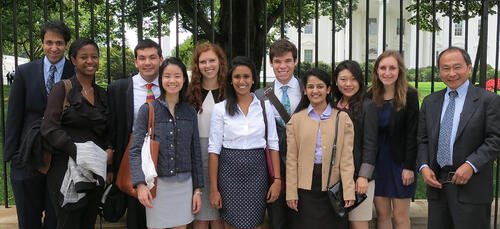
Thomas Fingar speaks at SCPKU as part of the International Diplomacy Lecture Series. Thomas Fingar speaks at SCPKU October 27, 2014, as part of the International Diplomacy Lecture Series.

Thomas Fingar speaks at SCPKU as part of the International Diplomacy Lecture Series.
Photo credit: SCPKU

Hero Image
thomas fingar 2
Thomas Fingar October 27 lecture, "US-China Relations and the Re-Balance to Asia."
SCPKU
All News button
1
Authors
News Type
News
Date
Paragraphs

The rise of China as a global and regional power has created areas where the interests of China and the United States overlap in competition, the senior U.S. military commander in the Pacific told a Stanford audience. But Admiral Samuel Locklear III, the commander of U.S. Pacific Command (USPACOM), rejected the traditional realpolitik argument, which predicts inevitable confrontation between the United States, a status quo power, and China, a rising power.

“Historians will say this will lead to conflict,” Locklear said, during an address at the Walter H. Shorenstein Asia-Pacific Research Center last Friday. “I don’t believe it has to.”

The United States and China have a “mutual skepticism of each other,” the Pacific Commander acknowledged, but he characterized the relationship as “collaborative, generally.”

He said the dangers of direct military confrontation between the two powers is low, but warned against Chinese tendencies to perceive the United States as engaged in an effort to ‘contain’ the expansion of China’s influence. Instead, Locklear urged China to work with the United States to build new security and economic structures in the region.

Economic interdependence between the countries makes it impossible for the two countries to avoid working together, he told the seminar, co-sponsored by the Center for International Security and Cooperation and the Freeman Spogli Institute for International Studies at Stanford University.

He said that China has also benefited from the security environment that the United States has helped shape and maintain in the region.

Locklear reminded the audience of the central importance of the vast area under his command, which stretches from the Indian subcontinent across the vast Pacific Ocean. More than nine out of 10 of the largest ports in the world are in the Asia-Pacific region, and over 70 percent of global trade passes through its waters. The U.S. rebalance to Asia, a policy pursued by the Obama administration as early as year 2009, largely happened because of the economic and political importance of that area.

The mutual interest in economic prosperity depends, however, on a stable security environment. Washington has an interest in maintaining the structure of security that has ensured peace for the last few decades. Beijing seeks to change the status quo, to build a regional system that reflects its growth as a power.

Locklear called on China to work with the United States and other nations in the region, such as Japan and Australia, as well as the countries of Southeast Asia, to take the current “patchwork quilt” of bilateral and multilateral alliances and build a basis to maintain economic interdependence and security. He pointed to the U.S.-led effort to form a Trans-Pacific Partnership as a 12-nation economic structure, which could eventually include China.

“We want China to be a net security contributor,” he said, “And my sense is that both the United States and the nations on the periphery of China are willing to allow China to do that – but with circumstances.” He said conditions for the United States included open access to shared domains in sea, air, space and cyberspace.

The Pacific Commander cautioned against the danger, however, of unintended conflict, fueled by territorial disputes and Chinese assertiveness that worries its neighbors. Locklear stressed the need for more dialogue, including among the militaries in the region, an effort that the U.S. Pacific Command is currently carrying out.

“There’s a trust deficit in Asia among the nations, as it relates in particular to China,” he said.

Relations have been so icy that the top political leaders of Japan and China didn’t meet for nearly two years, only breaking the divide for a 20-minute meeting at the Asia-Pacific Economic Summit (APEC) in Beijing last month.

Refusing to engage at the highest level has made it difficult for countries to work on solutions to shared problems. The region now sees a confluence of old and new challenges that could threaten global stability if ill-managed, said Locklear, who has led the U.S. military command in the Pacific since 2012.                 

For decades, China and Japan have been at odds about sovereignty claims over islands in the East China Sea. In the past, during the time of Deng Xiaoping’s rule in China, the two countries agreed to, as Deng reportedly put it, ‘kick the issue into the tall grass’ for future generations to deal with it. These disputes have resurfaced in recent years, threatening to trigger armed conflict between the air and naval forces of the two countries.

Locklear said he believed that China and Japan would avoid inadvertent escalation, thanks to improved communications and tight command and control over their forces. But he also warned  that at least seven nations have conflicting claims in the South China Sea, which could easily escalate into direct conflict.

These situations, paired with an upsurge in Chinese military spending and the growing belief that the United States is a declining power, raise doubts about China’s intentions in the region. China’s Asian neighbors increasingly question the intensions of the world’s most populous nation, and second largest economy.

“Is it a return to the old days where you had basic tributary states? Is that the model that China is looking for? Or is it a 21st century model?”

Locklear said China and other nations in the Asia-Pacific, as well as the United States, need to work harder to form shared views and consensus, particularly among those who “own the guns.”

Dialogue and interactions among the militaries are crucial, especially those who are called upon to make quick decisions during a possible flashpoint, for instance an accidental clash of boats or planes.

“Trust really does fall in many ways to military leaders to get it right and to lead, to some degree, the politicians and the diplomats,” he said. Locklear spoke of a tangible example of collaboration in the Rim of the Pacific Exercise, also known as RIMPAC, hosted by USPACOM. Twenty-two countries participate in the world’s largest maritime warfare exercise in Hawaii, which this year included naval forces from China.

“Does it fix those friction points? No, it doesn’t.” But, Locklear concluded, “We hope that this kind of thing opens the door for future interaction.”


The audio file and transcript from the event can be accessed by clicking here

Hero Image
locklear news article headline
Admiral Samuel Locklear III spoke about the future of the Asia-Pacific region at Stanford University.
Debbie Warren
All News button
1
News Type
News
Date
Paragraphs


Michael McFaul, the next director of the Freeman Spogli Institute for International Studies who recently returned from his position as U.S. Ambassador to Russia, joins Karl Eikenberry, the former U.S. Ambassador to Afghanistan and the William J. Perry Fellow in International Security at CISAC, to discuss the current state of foreign policy. The Nov. 11, 2014, talk was part of the fall course, "State of the Union,"  which examined major themes that contribute to the health, or disease, of the U.S. body politic.

Led by Rob Reich (Political Science), David Kennedy (History), and James Steyer (CEO, Common Sense Media), the course brought together distinguished analysts of American politics who noted that we live in an age of rising inequality, dazzling technological innovation, economic volatility, geopolitical uncertainty, and the accumulating impact of climate change. These conditions confront our political leaders and us as citizens of a democracy plagued by dysfunction.

Hero Image
screen shot 2014 11 24 at 12 34 43 pm
All News button
1
Authors
News Type
Commentary
Date
Paragraphs

Asia-Pacific leaders recently met in Beijing at the annual APEC summit, and after two days of discussion, concluded with some significant pledges and remarkable moments. President Xi Jinping of China and Prime Minister Shinzo Abe of Japan held a landmark meeting, and the United States and China discussed two agreements that are both symbolic, and lay groundwork for regional progress, say Stanford scholars.

High-level intergovernmental meetings are often more theatre than substance, but this year the 21-member Asia-Pacific Economic Cooperation, the oldest trans-Pacific regional organization, delivered important messages and may spur actions by member governments.

“Any summit is a ‘hurry up, get this done’ motivator,” says Thomas Fingar, the Oksenberg-Rohlen Distinguished Fellow at the Freeman Spogli Institute for International Studies. “The head of state goes to the meeting – and generally speaking – he doesn’t want to arrive and say ‘my guys were asleep for the last year.’”

Fingar says the APEC summit prodded countries to work on “deliverables,” particularly the goals and projects on the agenda from previous meetings. He recently returned from Beijing, and shared his perspectives with students in the Asia-Pacific Scholars Program.

Writing for the East Asia Forum, Donald Emmerson, director of the Southeast Asia Program at the Walter H. Shorenstein Asia-Pacific Research Center, said many of the commitments declared at the APEC summit, and at the subsequent meetings of the G20 in Australia and the Association of Southeast Asian Nations in Myanmar, will have implications for global governance, particularly as China holds a more influential role in the region.

APEC countries account for over 40 percent of the world’s population and nearly half of global trade – and true to form, the grand vision of the summit is to advance regional economic integration.

Yet, “the ancillary things – things that went on in the margins – are in many ways more important,” Fingar says, referring to areas outside of the summit’s obvious focus, and what’s discussed on the sidelines of the public talks.


Image
apec economic leaders meeting cropped


Key outcomes from the 2014 gathering include:

  • The leaders of Japan and China met for the first time since coming into office, afterward acknowledging that the two countries have “disagreements” in their official statements. Of the Xi-Abe meeting, Fingar says, “it helps clear the way for lower level bureaucrats to go to work on real issues."


  • The United States and China announced a proposal to extend visas for students and businesspeople on both sides. While the immediate effects would be helpful, the change is symbolically superior. “You don’t give 5-10 year visas to adversaries,” he says, it shows that “‘we’re in [the relationship] for the long-term.’”


  • China proposed the development of a new “Silk Road,” pledging $40 billion in resources toward infrastructure projects shared with South and Central Asian neighbors. “It’s tying the region together and creating economy-of-scale possibilities for other countries,” he says. “A real win-win situation.”


  • The United States and China, the world’s two largest energy consumers, announced bilateral plans to cut carbon emissions over the next two decades. “It’s significant because those two countries must be the ones to lead the world in this area. Unless we are seen to be in basic agreement, others will hold back.”


  • China codified the Asian Infrastructure Investment Bank (AIIB), a global financial institution intended as an alternative to institutions like the World Bank. “China has been frustrated with its role in existing international institutions,” Fingar says, explaining a likely motivation behind the AIIB’s creation.

Emmerson said the outcomes of the APEC summit from the U.S.-China standpoint were better than expected, speaking to McClatchy News. The visa and climate deals, as well as their commitment to lowering global tariffs on IT products, will lessen chances of conflict between the two countries. 

However, the summit did leave some areas unsolved. One of the most important is the Trans-Pacific Partnership (TPP), a trade pact proposed by the United States that includes 11 others countries in the region, but does not yet include China.

Leaders “made positive noises” coming out of the TPP discussions, Fingar says, but nothing was passed. The gravity and complexity of trade-related issues, especially agriculture and intellectual property, is likely to blame for slow action.

Hero Image
apec economic leaders meeting headline
Leaders pose for a group photo at the 22nd APEC Economic Leaders' Meeting in Beijing, China.
APEC/(Xinhua/Yao Dawei)
All News button
1
-

X

Center

members

and their family

are cordially invited to

Shorenstein APARC‘s

annual holiday party.

Celebrate the season and the

New Year with colleagues and friends.

Libations and heavy hors d’oeuvres

fused with festive music will tantalize

your senses and invigorate your holiday spirit.

XX

XXX

XXXXX


Stanford Faculty Club

Red & Gold Lounges

439 Lagunita Dr.

Stanford, CA

Authors
Gi-Wook Shin
News Type
Commentary
Date
Paragraphs

The city of Cupertino, California, is only about 15km from Stanford University, where I teach and live. It is home to the headquarters of Apple, a global leader in the computer and smartphone industries. It is also home to many Indian and Chinese engineers who are essential to Silicon Valley's technological innovation. One can easily find a variety of Asian restaurants and shops along the palm tree-lined streets -- an interesting Californian scene with a distinctly Asian flavor.

Many Asians -- businesspeople, officials and experts -- visit Silicon Valley hoping to unlock its secrets, to learn why it is such a hotbed of innovation. One known "secret" here, often overlooked by Asian visitors, is the importance of cultural diversity. More than half of the area's startups, including Intel, Yahoo, eBay and Google, were established by immigrants, and these companies owe much of their success to the contributions of Chinese and Indian engineers. Cultural diversity can be found throughout the schools, stores and streets, as well as the enterprises, there.

In Israel, too

The circumstances are quite similar in Israel, another economy known for technological innovation. Following the collapse of the Soviet Union in the early 1990s, Israel admitted about 850,000 immigrants. More than 40 percent of the new arrivals were college professors, scientists and engineers, many of whom had abundant experience in research and development. These people played a critical role in promoting economic development and scientific and technological innovation in Israel. Many languages besides Hebrew can be heard on the streets of Tel Aviv, one of the country's largest cities.

It is no accident that Silicon Valley and Israel have become global high-tech centers. They opened their doors to a wide range of talented immigrants. Above all, an atypical sociocultural ecosystem -- a culture that respects and promotes the value of diversity -- is alive in both places.

In the United States, diversity is a key criterion in college admissions and faculty recruitment. Although "affirmative action" has disappeared in many parts of the country, diversity has come to play a key role in American university policies. Most American colleges, including Stanford, have a "diversity office" to promote diversity among students, faculty and staff. At Stanford, white students constitute less than 40 percent of the student body, and almost a quarter of the faculty come from minority groups. Similarly, only five of the 16 staff members at our Shorenstein Asia-Pacific Research Center are Caucasian, with the rest from ethnic and national minorities.

 The same can be said of leading American corporations, many of which have institutionalized "diversity management" to capitalize on the range of individual differences and talents to increase organizational effectiveness. Of course, basic knowledge and skills are prerequisites. But Americans seem to firmly believe that having a variety of backgrounds and experiences can help hatch new ideas and innovative technologies. Perhaps this is why they say that culture accounts for 90 percent of the innovation in products from Silicon Valley, with technology claiming only 10 percent.

The power of diversity

Scott E. Page, professor of complex systems, political science and economics at the University of Michigan, shows in his book "The Difference" how "the power of diversity creates better groups, firms, schools, and societies." In his view, collections of people with diverse perspectives and heuristics outperform collections of people who rely on homogeneous ones, and the key to optimizing efficiency in a group is diversity. In this work, Page pays particular attention to the importance of "identity diversity," that is, differences in race, ethnicity, gender, social status and the like.

To be sure, Asian countries such as Japan and South Korea are different from settler societies such as the U.S. With the influx of foreigners, however, even such ethnically homogeneous Asian societies are becoming multiethnic. In addition to unskilled labor and foreign brides, the number of overseas students and professors is rising at Japanese and South Korean universities, while Japanese and South Korean companies are actively hiring foreign professionals. Both countries are opening their doors to foreigners, though in limited numbers, and have made multiculturalism a key policy objective.

Still, they fall far short of recognizing the value of diversity. While Japanese and South Korean institutes of higher learning have been trying to attract more foreign students, they have been doing so mainly to make up for the declining student population at home and because university ranking agencies use the ratio of foreign students and professors as a key yardstick for measuring internationalization. The approaches of these two countries to multiculturalism are also largely focused on assimilating foreigners into their own cultures and systems. People from abroad are seldom accepted as "permanent" members of their societies or regarded as valuable assets. Japan and South Korea may have become multiethnic, but they are not multicultural.

One of the biggest challenges facing foreign residents in Japan and South Korea is the lack of understanding of their religious and cultural beliefs. Indian engineers working in South Korea complain of the poor acceptance of Indians by the local population, and of an especially poor understanding of their religion and culture. Foreign professors teaching at Japanese universities tell me they live as "foreigners," never accepted into the "inner" circles. It is unlikely that these talented people would like to work long term for universities and enterprises that are unable to embrace differences in skin color and culture. Under these circumstances, even if some foreign professionals happen to be hired, they may not be able to realize the full potential of their abilities, let alone bring about innovation.

All these people with different ethnic and national backgrounds should no longer be regarded simply as "temporary" residents to fill particular needs. Rather, by promoting the cultural diversity of Japanese and South Korean society, they should be viewed as important assets and potential sources of innovation. It is an urgent but difficult task to institutionalize the value of diversity in societies long accustomed to the notion of a single-race nation.

Born on campuses

A country's global competitiveness can hardly be improved if its society is reluctant to respect differences and understand other groups. Universities, in particular, should help their students experience diversity through the regular curriculum and extracurricular activities. Foreign students can serve as excellent resources for promoting diversity. Universities are ideal settings for various groups of students to meet, generate new ideas and interact with one another. It is no accident that many of the innovative ideas associated with Microsoft, Yahoo, Google and Facebook were all born on American university campuses, where diversity is embraced.

Empirical research should be carried out to examine how cultural diversity can bring about technological innovation in Japanese and South Korean society. Based on such studies, governments and private enterprises should take into account diversity in personnel hiring, training, management and evaluation. These same institutions should also systematically work to create and support an organizational culture that values diversity.

Could those Indian and Chinese engineers working in Silicon Valley have brought about the same kind of technological innovation if they had remained in their own countries? Could they accomplish the same feat in Japan and South Korea? How can Asian countries create the kind of ecosystem necessary for promoting a flexible culture of accommodating a broad spectrum of talents? We first need to reflect deeply on these questions before trying to emulate the success of Silicon Valley.


Shin recently coauthored the paper, "Embracing Diversity in Higher Education: Comparing Discourses in the U.S., Europe, and Asia" with Yonsei University Professor Rennie J. Moon. It is one outcome of their research project, Diversity and Tolerance in Korea and Asia. This Nikkei Asian Review article was originally carried on Nov. 20 and reposted with permission.

Hero Image
flickr google convention
Tech enthusiasts and entrepreneurs talk with Google employees at a convention booth.
Flickr/Kevin Lim
All News button
1
Authors
Donald K. Emmerson
News Type
Commentary
Date
Paragraphs

On 10 Nov. 2014 a summit of the Asia-Pacific Economic Cooperation (APEC) forum will convene in Beijing, followed in rapid succession by the East Asia Summit in Naypyidaw and the G20 in Brisbane.

Much of what will be said and done at these events will implicate the tectonics of nascent global governance set in motion by China’s campaign for greater influence in Asia.

At the APEC summit, Chinese president Xi Jinping will stress the need for massive spending on infrastructure in Asia. He will tout China’s sponsorship of a Beijing-based Asian Infrastructure Investment Bank (AIIB) that would operate outside of, and potentially compete with, the American-led World Bank and the Japanese-led Asian Development Bank (ABD).

Many will welcome the AIIB as evidence of China’s willingness to assume responsibility for public goods in a rebalanced post-Cold War world whose needs exceed the resources of existing global institutions. But will ‘public’ goods benefit the public if their terms are not made public? In 2014 China ranked 68th of 68 donors in the Aid Transparency Index compared with the 5th-place ADB and the 7th-place World Bank. Given the commercial importance of cyberspace, it is also concerning that China is the worst violator of the rights of internet users in the latest Freedom House ranking of 60 countries on that variable.

In the ADB as of 2013, Tokyo held respective 16 and 13 per cent shares of subscribed capital and voting power. Understandably, at the AIIB’s inception, Beijing’s shares will be far larger. But how soon and by how much will China allow its initial dominance to be diluted by other contributing members? Concerns over Beijing’s intentions may already underlie the wait-and-see attitudes of Tokyo, Seoul, and Canberra as to whether to join the new bank.

Another alternative to international lending by traditional sources is the New Development Bank (NDB) recently innovated by the BRICS. Headquartered in Shanghai, it will be led first by an Indian.

In the formal sessions of APEC, lip service will be paid to its hopes for free and open trade and investment worldwide by 2020. But in the corridors delegates will debate whether China’s AIIB and the BRICS’s NDB will further ‘responsible stakeholding’ and shared governance by emerging states in a global economy no longer centred on the West. Some may fear that Xi wants to use these new institutions to tie Asia more tightly and deferentially to Beijing in a web of ‘Silk Roads’ that will disproportionally serve Chinese interests.

China’s ambitions will also be questioned at the East Asia Summit in Myanmar, especially regarding the South China Sea (SCS). China will again be asked to clarify its generously self-serving U-shaped line: Does Beijing really want to possess or control nearly all of that body of water? Southeast Asians will again urge China to implement the Document on Conduct (DOC) in the South China Sea that it signed with all ten members of ASEAN in 2002. China will again be implored to accept a future Code of Conduct (COC) regulating state behaviour in the SCS. But Beijing will likely continue to delay and demur, while ASEAN’s historic centrality to Asian region-formation continues to diminish.

It is symbolic of ASEAN’s plight that the group has been too divided to express more than ‘serious concern’ over ‘developments’ in the SCS — untethered abstractions that leave China happily uncharged. In ASEAN’s field of vision, the COC has become an entrenched mirage. Calls for a code are repetitively embedded in ASEAN’s communiqués because it is one of the few things the members can agree should happen. Thanks to Chinese foot-dragging, however, the goal keeps receding and Beijing keeps doing whatever it wants to in the SCS.

Chinese activity now includes a unilateral land-reclaiming and construction work at the specks that China already controls — actions that violate the spirit if not the letter of the DOC.

Some US$5.3 trillion in goods are shipped annually across the SCS, including US$1.2 trillion to or from the United States. China has unilaterally declared and begun to enforce a monopoly on fishing in more than half of the SCS. If multilaterally negotiated limitations are being flouted or forestalled in this key regional instance, how much confidence can one have that Xi will cooperate in Asia on behalf of a rules-based order at the global level?

None of this means denying the overdue need to restructure existing institutions to accommodate the voices and priorities of rising powers. But time is running out. Convincingly dire warnings in the just-released UN report on climate change render existential the need for concerted global action. Nationalism and nationalistic regionalism — by Beijing, Moscow or Washington — must not derail progress toward the constructive rebalancing and sharing of global governance. Shifting power to emerging actors should facilitate not frustrate that process. The twenty-fifth anniversary of the fall of one wall in Berlin should not be spent building another in Asia.

This article was originally carried by the East Asia Forum on Nov. 7 and reposted with permission.

Hero Image
flickr apec 2014
Leaders meet at the 2014 Asia-Pacific Economic Cooperation (APEC) Ministerial meeting in Beijing on Nov. 7, 2014.
Flickr/U.S. Department of State
All News button
1
Subscribe to Asia-Pacific