Non-communicable diseases such as heart and respiratory disease, cancer, obesity and diabetes are now responsible for some two-thirds of premature deaths around the world. And most of those are in low- and middle-income countries.
The United Nations has estimated that on top of the social and psychological burdens of chronic disease, the cumulative loss to the global economy could reach $47 trillion by 2030 if things remain status quo.
“That was a big whopper of a number and got a lot of attention, and that was good because it raised awareness,” said Rachel Nugent, vice president for global non-communicable diseases (NDCs) at the research institute RTI International.
“It’s an issue that is driven by a lot of different factors, “ she said. “And understanding how the larger social and economic factors affect NDCs, at a policy level, very little progress has been made — there’s been very little collaboration.”
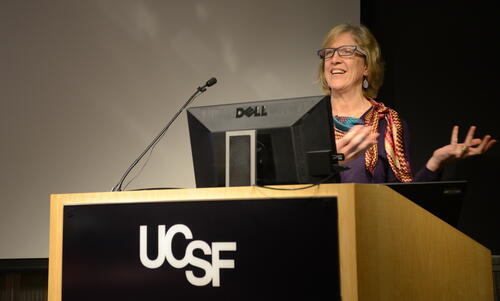
Nugent was addressing the fourth annual Global Health Economics Colloquium at University of California San Francisco, with health experts, policymakers, students and researchers from Stanford, Berkeley and UCSF who gather every year to take a deep dive into the economics of a global health issue. More than 200 experts from 10 universities and public health departments attended the conference.
The daylong gathering focused on recent developments in the economics of NDCs, looking at case studies from around the world, and new guidelines for cost-effectiveness analysis and the role of economics in reducing health inequality.
“The donors are not convinced that there are cost-effective things that we can do in these countries; a lot of them are very skeptical that this is affecting the poor,” said Nugent, a member of the World Health Organization’s expert advisory panel on the management of NCDs.
In India, for example, much of the population still defecates outdoors, contaminating water sources and agricultural products, which can lead to malnutrition and physical and cognitive disorders. Many donors would rather see funds go to building latrines as they can see tangible results; NDC prevention is a long-term slog.
“But I don’t think we should necessarily think of NDCs as either-or,” said Nugent. “I think that integration of services and programming is very much at the forefront of what is the right way to go.”
Cost-effectiveness Analyses
Nugent’s research has shown five cost-effective interventions would avert more than 5 million premature deaths from NCDs by 2030, or a reduction of 28.5 percent in projected mortality from chronic disease around the world. And the average benefit-cost ratio is 9:1, at a global cost of $8.5 billion a year.
The interventions are raising the price of tobacco products by 125 percent through taxation; providing aspirin to 75 percent of those suffering from acute myocardial infarction; reducing salt intake by 30 percent; reducing the prevalence of high blood pressure with low-cost hypertension medication; and providing preventive drug therapy to 70 percent of those at high risk of heart disease.
Gillian Sanders-Schmidler, a professor of medicine at Duke University Medical Center and former assistant professor of medicine at Stanford Health Policy’s Center for Primary Care and Outcomes Research, addressed the colloquium about recommendations of the Second Panel on Cost-Effectiveness in Health and Medicine.
“There is a continued emphasis on transparency and comparability across analyses,” said Sanders-Schmidler. “And of course the big changes are that we’re now asking for a second reference case and using an ‘impact inventory’ table to clarify the scope of the findings.”
The independent panel of non-government scientists and scholars, which also included Stanford Health Policy’s Douglas K. Owens, focused on new ways to deliver health care effectively, yet with a focus on efficiency, as health care spending in the United States has reached 18 percent of GDP, much greater than the global average of 10 percent.
The first panel that convened in 1996 recommended that all cost-effectiveness analyses of health interventions include a reference case that uses standard methodological practices to improve comparability and quality. The second panel, which published its findings in September, now recommends that in addition to the societal perspective recommended by the original panel, that CEAs include a second reference case that looks at the health-care sector impact of an intervention. Additional guidance was given on what to include in the societal perspective reference case.
The panel wrote in its JAMA “special communication” that these societal reference cases should include medical costs “borne by third-party payers and paid out-of-pocket by patients, time costs of patients in seeking and receiving care, time costs of informal (unpaid) caregivers, transportation costs, effects on future productivity and consumption, and other costs and effects outside the health-care sector.”
They found most countries, including the United States, give greater weight to clinical evidence in their cost-effectiveness analyses. The panel now recommends an “impact inventory” that helps analysts and end-users of cost effectiveness analyses look at the impact of interventions beyond the formal health-care sector.
“We’re trying to ask people to be explicit,” said Owens, director of the Center of Primary Care and Outcomes Research and Center for Health Policy at Stanford.
“We want them to look at how to value outcomes in a societal perspective, not just the health-care sector, to look at all these other sectors such as productivity consumption, criminal justice, education, housing and the environment,” he said.
Case Studies
Several case studies presented at the colloquium indicated that policy changes, government intervention and social factors are key to preventing obesity and diabetes and other NCDs.
Kristine Madsen, an associate professor of public health at UC Berkeley who focuses on childhood obesity, spoke about the nation’s first “soda tax” on sugar-sweetened beverages, which was implemented in Berkeley in March 2015.
The city has seen a 21 percent decline in the drinking of soda and other sugary drinks in low-income neighborhoods after the city levied a penny-per-ounce tax on sodas and sugary drinks. At the same time, according to a study in the American Journal of Public Health, neighboring San Francisco — where a similar soda-tax measure was defeated — and Oakland saw a 4 percent increase in the purchase of sweetened beverages.
“This decline of 21 percent in Berkeley represents the largest public health impact in an intervention that I have ever seen,” said Madsen.
Sergio Bautista of the Mexico National Institute of Public Health and UC Berkeley, said that Mexico’s sugary drinks tax implemented in January 2014 is expected to lead to a 10 percent reduction in sugary drinks consumption and prevent an estimated 189,300 cases of diabetes in a country famed for its sugary bottled cola.
William Dow, a professor of health policy management at UC Berkeley, shared his research on Costa Rica, where on average people live longer than Americans, despite the several times higher income and 10 times higher health expenditures in the United States.
Costa Rican men have a life expectancy of 77 and the women typically live until age 82; in Americans the numbers are 76 and 81, respectively. Obesity is low among Costa Rican men and few of their women smoke. Lung cancer mortality in the United States is four times higher among men and six times higher among women.
“It’s remarkable in so many ways,” Dow said, noting that deaths in the Central American country are due predominantly to infectious disease. “Does Costa Rica have any unique effective programs to emulate, or is there something going on upstream driving those health outcomes?”
He believes Costa Rica’s national health insurance and excellent access to primary care for nearly all its people are key. Having this guaranteed lifetime access to health care also reduces the stress and depression that can so badly harm physical health.
“And I would argue that probably diet is one of the most important things going on here,” said Dow, noting their diets are healthy.
Costa Ricans eat mostly unprocessed foods such as rice and black beans, corn tortilla, yam and squash, with little meat and plenty of fresh fruit.
“They also have the highest remaining life expectancy at age 80 of any country in the world, he said. “What we have learned in Costa Rica would be helpful in many other countries.”







 Damian Collins MP is a member of the House of Commons, and Chairman of the Parliamentary Select Committee for Culture, Media and Sport. He graduated in modern history from the University of Oxford, and Charmed Life, the Phenomenal World of Philip Sassoon is his first book.