The authors show that regional differences, especially between CEE and Northwestern or Southern Europe, persist and map onto climate politics. At the same time, and as populist parties in CEE such as Hungary’s Fidesz and Poland’s Law and Justice (PiS) gain power and promote climate skepticism, the reader gains a sense of why these parties depart from traditional understandings of European politics and ideology.
More generally, populist parties and movements have garnered huge followings in places as diverse as India, the United States, and Brazil. “How green is my party?” deepens our understanding of why these movements can be so unwilling to budge on addressing climate change.
Data and Findings:
The authors use data from a 2019 questionnaire of nearly 1900 European party and election experts. The three cleavages mentioned above are measured on an 11-point scale, with higher values indicating more right-wing, conservative, and populist platforms. Countries are grouped into three regions: Northwest, South, and CEE. The South Caucasus and the closed autocracies of Russia and Belarus are excluded.
Figure 1. European democratic countries covered by the Global Party Survey, 2019.
Two of the most interesting contributions in “How green is my party?” are to show that (a) populism is significant in shaping opposition to climate action and (b) CEE remains a distinctive region in respect of its climate politics. Why might this be the case?
Regarding populism, one would expect left-wing populists — who denounce a wealthy elite as standing against “the people” — to support climate action. Indeed, this elite can be easily constructed as destroying the environment in order to accumulate wealth. However, the authors note that left populists tend to deemphasize environmental issues or reframe them as purely economic. For example, such parties have been skeptical of policies such as tax breaks for electric vehicle production, on the grounds that they primarily benefit wealthy corporations.
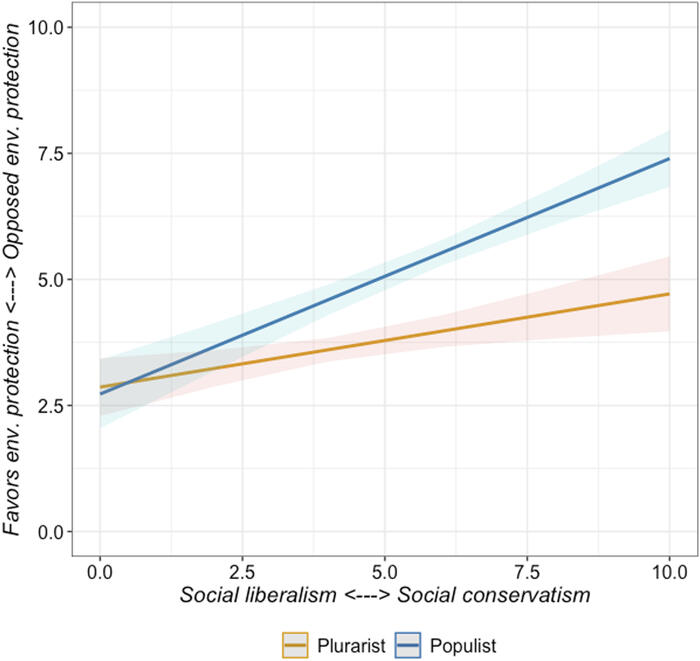
More generally, populists tend to view appeals to scientific consensus with skepticism, as “technocratic” schemes to undermine the people. This likely explains why the authors find a strong association between populism and opposition to environmental action across all three European regions (Southern, Northwest, and CEE). Interestingly, right populists are not found to be particularly likely to oppose environmental protection. Left and right populists are also more likely to oppose climate action than social conservatives.
Figure 3. Moderating effect of populism on the impact of party position on social conservatism-liberalism on the position on the environmental protection scale.
CEE is distinctive in part because right-wing populist parties have thrived there. Many of these parties view climate action as a foreign, leftist conspiracy. This has fueled skepticism and opposition to green agendas. Meanwhile, CEE’s reliance on fossil fuels has led parties to view climate action as a threat to economic growth — and thus as political suicide. For these reasons and because CEE states are relatively new, the region also lacks strong environmental civil society organizations or green parties. On the 11-point scale, median opposition to environmental action in CEE is about one point higher than in Southern Europe and nearly three points higher than in Northwestern Europe.
Figure 2. Parties’ positions on environmental issues by region of Europe.
A third notable finding is that the intuitive link between economic and cultural values is weaker in CEE. In other words, opposition to environmental protection is only associated with the economic right in South and Northwest Europe. This is because populist parties in CEE tend to support both economic redistribution and conservative cultural values. Redistribution is framed as a means of protecting people from perceived threats to their way of life, such as immigration or social liberalism. By contrast, CEE social liberals tend to support the free market, a position owing to their negative experiences with communist central planning.