-

Image
headshots of alex rice, camille francois and amit elazari

Join us on Tuesday, April 26th from 12 PM - 1 PM PT for “Bug Bounties & Bridge-Building: Lessons from Cybersecurity Vulnerability Disclosure for Addressing Socio-Technical Harms” featuring Camille François, Global Director for Trust & Safety at Niantic, Dr. Amit Elazari of Intel, and Alex Rice of HackerOne in conversation with Marietje Schaake of the Stanford Cyber Policy Center. This weekly seminar series is jointly organized by the Cyber Policy Center’s Program on Democracy and the Internet and the Hewlett Foundation’s Cyber Initiative.

About The Seminar: 

Join us for a conversation on the nascent adoption of ‘bug bounties,’ a popular bug-for-reward-style audit mechanism in the cybersecurity domain, (and related approaches, such as VDPs and pentesting) to the discovery of various social-technical harms, including those inflicted through algorithmic (or “AI”) systems. 

Following the recent publication by the Algorithmic Justice League (AJL) of a paper on the risks and opportunities presented by this shift, we are joined by one of the paper’s co-authors, Camille François, alongside practitioners with insights into these mechanisms from industry and government perspectives. Together, this group will explore these mechanisms in the context of emerging and historic practices, including as illuminated in AJL’s recent report.

Speakers:

Camille François works on the impacts of technology on society, with an emphasis on cyber conflict and information operations and currently serves as the global director of trust and safety at Niantic and is a lecturer at Columbia University’s School of International and Public Affairs. She was previously the chief innovation officer at Graphika where she oversaw its investigation, analyses and R&D teams and led the company’s work to detect and mitigate disinformation, media manipulation and harassment. François was previously a principal researcher at Google, in the “Jigsaw” team, an innovation unit that builds technology to address global security challenges and protect vulnerable users. François has advised governments and parliamentary committees on both sides of the Atlantic, investigated Russian interference in the 2016 U.S. presidential election on behalf of the U.S. Senate Select Intelligence Committee, and served as a special advisor to the chief technology officer of France. François is an affiliate scholar of the Harvard Berkman-Klein Center for Internet and Society, a Fulbright scholar and a Mozilla Fellow. She holds a masters degree in human rights from the French Institute of Political Sciences (Sciences-Po) and a masters degree in international security from the School of International and Public Affairs (SIPA) at Columbia University.

Dr. Amit Elazari is a Director, Global Cybersecurity Policy at Intel Corporation and a Lecturer at University of California (UC), Berkeley School of Information Master in Information and Cybersecurity, as well as a member of the External Advisory Committee for the Center of Long Term Cybersecurity. She holds a Doctoral Degree in the Law (J.S.D.) from UC Berkeley School of Law, the world’s leading law institution for technology law, and graduated summa cum laude three prior degrees in law and business. Her research in cybersecurity, privacy and intellectual property has appeared in leading technology law and computer science journals, presented at conferences such as RSA, Black Hat, USENIX and USENIX Security, and featured at leading news sites such as The Wall Street Journal, The Washington Post and the New York Times. She practiced law in Israel. 

Alex Rice is a founder and chief technology officer at HackerOne, the world's most popular bug bounty platform. Alex is responsible for developing the HackerOne technology vision, driving engineering efforts, and counseling customers as they build world-class security programs. Alex was previously at Facebook, where he founded the product security team, built one of the industry’s most successful security programs, and introduced new transport layer encryption used by more than a billion users. Alex also serves on the board of the Internet Bug Bounty, a nonprofit organization that enables and encourages friendly hackers to help build a more secure Internet.

Marietje Schaake
Camille François
Dr. Amit Elazari
Alex Rice
Seminars
-

Image
image of Anna-Maria Osula advertising event on april 20, 2022 on a blue background

Please join us on Wednesday, April 20th for a talk with Anna-Maria Osula, visiting scholar from TalTech. At this event co-sponsored by Stanford University Libraries, Anna-Maria will be introducing her research on private sector initiatives to develop and promote cyber norms of behavior.

Research Overview:

Given the multistakeholder nature of running the Internet and governing information and communication technologies, nation-states are not the only entities interested in shaping norms of behavior for cyberspace. Non-state actors are directly impacted by any decision on international norms in cyberspace. They are also expected to behave as responsible actors, being tied by the agreements negotiated by states at the UN platform. This means that non-state actors are involved in building and promoting norms and also playing a role in their interpretation and implementation. Anna-Maria will talk about her research project where she analyzes the private sector involvement in advancing cyber norms in international fora such as the United Nations.

Bio:

Anna-Maria Osula, currently a Global Digital Governance Fellow at Stanford University, is a senior researcher at Tallinn University of Technology and a senior policy officer at Guardtime. Her current research focus is cyber diplomacy and international law applicable to cyber operations. She also serves as a research fellow at Masaryk University under the project “Cyber Security, Cyber Crime and Critical Information Infrastructures Center of Excellence.” Previously, she worked as a legal researcher at the NATO CCDCOE, undertaking projects on national cyber security strategies, international organizations, international criminal cooperation, and norms. In addition to a Ph.D. in law from the University of Tartu, she holds an LLM degree in IT law from Stockholm University.

ENCINA HALL, ROOM E008, 616 Jane Stanford Way Stanford University Stanford, CA

Anna-Maria Osula Global Digital Governance Fellow
Seminars
-

Image
jacob ward photo with the loop book cover next to him on a blue background

Join us on Tuesday, April 19 from 12 PM - 1 PM PT for a book talk on “The Loop: How Technology is Creating a World without Choices and How to Fight Back” featuring Jacob Ward from NBC News, in conversation with Nate Persily of the Cyber Policy Center.  This weekly seminar series is jointly organized by the Cyber Policy Center’s Program on Democracy and the Internet and the Hewlett Foundation’s Cyber Initiative.

In The Loop: How Technology is Creating a World without Choices and How to Fight Back, Jake argues that AI is about to do to our ability to make decisions for ourselves what Google maps did to our ability to navigate. Drawing on interviews with over 100 scientists and 10-years of front-line reporting from the cutting edge of behavior-shaping technology, Jake’s book is a warning about our growing reliance on AI, and an encouragement to protect the best parts of being human.

Jacob Ward is a correspondent for NBC News, reporting for the TODAY show, Nightly News, MSNBC, and NBC News Now on the unanticipated consequences of science and technology in our lives. From 2018 to 2019, Jacob was a fellow at Stanford University’s Center for Advanced Study in the Behavioral Sciences, along with its partner the Berggruen Institute, which gave him space and companionship on the Stanford campus to write The Loop, his book about the effects of artificial intelligence on human decision making, with Hachette Book Group. Between 2016 and 2020, Jacob hosted a landmark four-hour television series on the science and implications of bias. Prior to that, he was a television correspondent for Al Jazeera, covering science and technology in the US and around the world. He was also editor-in-chief of Popular Science, the world’s largest science and technology publication.

Nathaniel Persily is the James B. McClatchy Professor of Law at Stanford Law School, with appointments in the departments of Political Science, Communication, and FSI.  Prior to joining Stanford, Professor Persily taught at Columbia and the University of Pennsylvania Law School, and as a visiting professor at Harvard, NYU, Princeton, the University of Amsterdam, and the University of Melbourne. Professor Persily’s scholarship and legal practice focus on American election law or what is sometimes called the “law of democracy,” which addresses issues such as voting rights, political parties, campaign finance, redistricting, and election administration. He has served as a special master or court-appointed expert to craft congressional or legislative districting plans for Georgia, Maryland, Connecticut, New York, North Carolina, and Pennsylvania.  He also served as the Senior Research Director for the Presidential Commission on Election Administration. His current work, for which he has been honored as a Guggenheim Fellow, Andrew Carnegie Fellow, and a Fellow at the Center for Advanced Study in the Behavioral Sciences, examines the impact of changing technology on political communication, campaigns, and election administration.  He is codirector of the Stanford Cyber Policy Center, Stanford Program on Democracy and the Internet, and the Stanford-MIT Healthy Elections Project, which supported local election officials in taking the necessary steps during the COVID-19 pandemic to provide safe voting options for the 2020 election. He is also a member of the American Academy of Arts and Sciences, and a commissioner on the Kofi Annan Commission on Elections and Democracy in the Digital Age.

Nathaniel Persily
Jacob Ward
Seminars
-

LECTURE RECORDING

Bechtel Conference Center
Encina Hall
616 Jane Stanford Way
Stanford, CA 94305

Congressman Ted Lieu
Seminars
-

Image
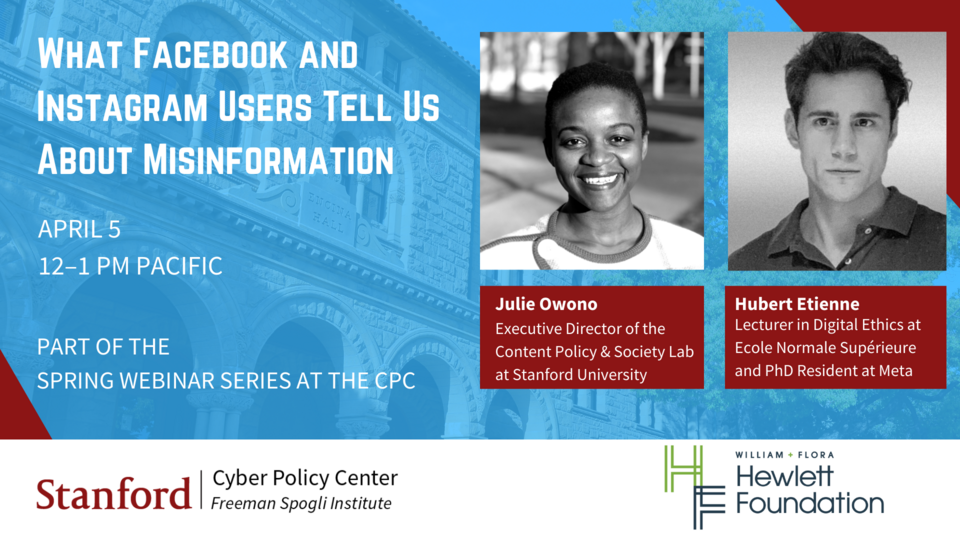
image of julie owono and hubert etienne on flyer
Join us on Tuesday, April 5th from 12 PM - 1 PM PT for “What Facebook and Instagram Users Tell Us About Misinformation” featuring Hubert Etienne, Philosopher and Researcher, Ecole Normale Supérieure and Meta AI in conversation with Julie Owono, Executive Director of the Content Policy & Society Lab. This weekly seminar series is jointly organized by the Cyber Policy Center’s Program on Democracy and the Internet and the Hewlett Foundation’s Cyber Initiative.

About The Seminar: 

Social media users who report content are key allies in the management of online misinformation. However, no research has been conducted yet to understand their role and the different trends underlying their reporting activity. Hubert Etienne presents an original approach to studying misinformation by examining it from the reporting users’ perspective at the content-level and comparatively across regions and platforms. This leads Etienne to propose the first classification of reported content pieces, resulting from a review of items reported on Facebook and Instagram in France, the UK, and the US in June 2020 to observe meaningful distinctions regarding misinformation reporting between countries and platforms as it significantly varies in volume, type, topic, and manipulation technique. Etienne identifies four reporting behaviors, from which he derives four types of noise capable of explaining the majority of the inaccuracy in misinformation reporting. He finally shows that breaking down the user reporting signal into a plurality of behaviors allows us to build a simple classifier trained on a small dataset with a combination of basic users-reports capable of identifying these different types of noise.

Speakers:

Hubert Etienne is a philosopher conducting research in AI ethics and computational philosophy at École Normale Supérieure and Meta AI. His research focuses on social interactions, especially the moderation of problematic interactions in cyberspace. He is a lecturer in AI ethics à Sciences Po, in data economics at HEC Paris and in digital regulation at the National School of Administration. He is currently a visiting fellow at Harvard University.


Julie Owono is the Executive Director of the Content Policy & Society Lab (CPSL) and a fellow of the Program on Democracy and the Internet (PDI) at Stanford University. She is also the Executive Director of digital rights organization Internet Sans Frontières, one of the inaugural members of the Facebook Oversight Board, and an affiliate at the Berkman Klein Center at Harvard University. She holds a Master’s degree in International Law from la Sorbonne University in Paris, and practiced as a lawyer at the Paris Bar.

Hubert Etienne
Seminars
0
CDDRL Honors Student, 2021-22
avalonwolfeheadshot_-_nicole_avalon_wolfe.jpeg

Major: Political Science
Minor: Computer Science; Ethics and Technology 
Hometown: Fort Worth, TX
Thesis Advisor: Francis Fukuyama

Tentative Thesis Title: Examining Why Countries With Little Histories of Privacy Enact Data Privacy Laws

Future aspirations post-Stanford: I'm not sure precisely what I want to do after college, but I hope to work at the intersection of technology and law/policy.

A fun fact about yourself: I'm a vegetarian from Texas (and my hometown is actually referred to as Cowtown).

0
CDDRL Honors Student, 2021-22
michal_skreta_-_michal_skreta.jpg

Major: Economics and Political Science   
Hometown: Warsaw, Poland
Thesis Advisor: Larry Diamond

Tentative Thesis Title: Babies, Money, and Power: Estimating Causal Effects of the “Family 500+” Child Benefit Program in Poland using the Synthetic Control Method

Future aspirations post-Stanford: I hope to ultimately pursue a career at the intersection of private and public sectors with a strong international focus as well as to continue my interdisciplinary education in graduate school.

A fun fact about yourself: I once got lost on a volcano in Guatemala.

-

Image
Jim Dempsey

Congress has just passed legislation requiring owners and operators of critical infrastructure to notify the federal government following a cyber breach. The requirement, made more urgent by fears that Russia’s war with Ukraine will spill over into attacks on America's energy, financial, and other critical infrastructure, is the latest entry to the growing catalog of cybersecurity-related laws, including new state measures and proposed Securities and Exchange Commission disclosure requirements.  

Policymakers at the state and federal level continue to search for the right balance of collaboration and enforcement. This one-hour session will explore recent developments in cybersecurity law, offering both pragmatic advice on compliance and litigation strategy as well as big picture insights on the direction of U.S. cybersecurity policy. 

Image
Travis LeBlanc
Travis LeBlanc is the vice chair of the cyber/data/privacy practice at Cooley and a Senate-confirmed member of the U.S. Privacy and Civil Liberties Oversight Board. He has guided leading tech corporations through enforcement proceedings and class action lawsuits.


Image
Alicia Lowery Rosenbaum headshot
Alicia Lowery Rosenbaum is Vice President and Associate General Counsel for Cybersecurity Technology and Trust at Salesforce, where she provides strategic counsel on risk management and governance to the company's security engineering and operations teams.

Image
James X. Dempsey
Jim Dempsey is a Senior Policy Advisor for the Program on Geopolitics, Technology and Governance at Stanford’s Cyber Policy Center. He is the author of Cybersecurity Law Fundamentals, a handbook for practitioners published in 2021 by the International Association of Privacy Professionals (IAPP). 

Image
andrew grotto
Moderating the session will be Andrew J. Grotto, Director of the Program on Geopolitics, Technology, and Governance and former Senior Director for Cyber Policy at the White House in both the Obama and Trump Administrations.

Andrew Grotto
0
James X. Dempsey large headshot

Jim Dempsey is senior policy advisor to the Stanford Program on Geopolitics, Technology and Governance and a lecturer at the UC Berkeley School of Law, where he teaches a course on cybersecurity law in the LLM program. Until May 2021, Jim was Executive Director of the Berkeley Center for Law & Technology. In 2012, after Senate confirmation, he was appointed by President Barack Obama as a part-time member of the U.S. Privacy and Civil Liberties Oversight Board, an independent agency within the federal government charged with advising senior policymakers and overseeing the nation’s counterterrorism programs. He served in that position until January 2017, while also running BCLT.

From 1997 to 2014, Dempsey was at the Center for Democracy & Technology (CDT), a non-profit public policy organization focused on privacy and other issues affecting the internet, where he held a number of leadership positions. Prior to that he was deputy director of the Center for National Security Studies (1995-1997) and assistant counsel to the House Judiciary Committee (1985-1995), focusing on privacy, FBI oversight, and surveillance issues. 

Jim graduated from Yale College and Harvard Law School.

BOOKS:


ARTICLES AND PAPERS


COMMENTARY

Senior Policy Advisor, Geopolitics, Technology, and Governance at CISAC
Lecturer at the UC Berkeley School of Law
Date Label
Senior Policy Advisor Program on Geopolitics, Technology and Governance
Travis LeBlanc
Alicia Lowery Rosenbaum
-

VIDEO RECORDINGS

Read the full transcript of President Barack Obama's keynote.

PANEL I

10:00-11:30am

THE TRUST PROBLEM: What is the role of the U.S. government in facilitating consensus and reducing polarization at home?

Renée DiResta is the Research Manager at the Stanford Internet Observatory. She investigates the spread of malign narratives across social networks, and assists policymakers in understanding and responding to the problem.
renee diresta

KEYNOTE | PRESIDENT BARACK OBAMA

12:15pm

Image
President Barack Obama

President Barack Obama will deliver a keynote speech about disinformation and challenges to democracy in the digital information realm. The Obama Foundation is co-hosting the event.

PANEL II

2:00-3:30pm

DESIGNING FOR DEMOCRATIC DISCOURSE: What is the role for media and tech companies to ensure quality, access, and participation?

Marietje Schaake is international policy director at Stanford University Cyber Policy Center and international policy fellow at Stanford’s Institute for Human-Centered Artificial Intelligence.
Marietje Schaake

PANEL III

3:45-5:15pm

THE THREAT OF DIGITAL AUTHORITARIANISM: What are the most effective ways to defend open democratic systems in a global digitized world?

Eileen Donahoe is the Executive Director of the Global Digital Policy Incubator (GDPI) at Stanford University, FSI/Cyber Policy Center. She served as U.S. Ambassador to the United Nations Human Rights Council during the Obama administration.
Photo of Eileen Donahoe

The student lottery administered by FSI is now closed. Randomly selected students have been notified via email.

Eileen Donahoe
Marietje Schaake
Renee DiResta
Barack Obama
Symposiums
Subscribe to Sub-Saharan Africa