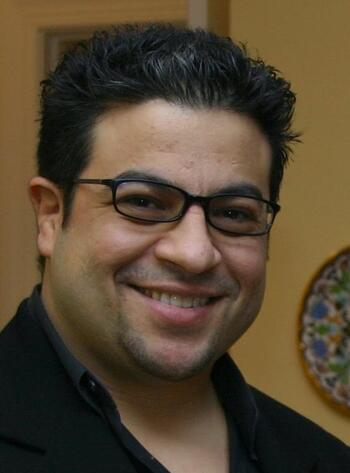
By now, those following the news on Syria have been saturated with analysis, data, information, and misinformation on developments there since 2011. Yet we observe an increasing gravitation to mutually exclusive narratives that adorn websites and publications on the situation in Syria: (a) the narrative of pure and consistent revolution versus that of (b) external conspiracy/designs on Syria. Both narratives carry grains of truth, but are encumbered by maximalist claims and fundamental blindspots that forfeit various potentials for enduring cease-fires and/or transitions, let alone mutual understanding. This talk will address these competing narratives in the context of international escalation marked by increasing US-Russian tension and continued multi-layered conflicts on the battlefield. It closes with addressing a framework for understanding and gauging potential prospects despite conflicting declarations by all parties involved.
As part of the Program on Arab Reform and Democracy's speaker series, George Mason University scholar Bassam Haddad explained the roots and dynamics of the tragic Syrian uprising, with particular attention to its background and to the recent Russian intervention, in a talk dated January 22, 2016. After nearly five years since the start of the uprising, Syria finds itself divided and embattled, with no end in sight. More significantly, more than half of the Syrian population is displaced and the death toll surpassed 300,000 by all counts. The Syrian tragedy persists and, more than any other case of mass uprising in the region, continues to be shrouded in political power-plays and contradictions at the local, regional, and international levels, Haddad explained.
Seventeen faculty members and researchers from Stanford’s Freeman Spogli Institute for International Studies were hosted at U.S. Pacific Command (USPACOM) Headquarters in Hawaii for an intensive orientation on Feb. 4-5. The visit aimed to advance collaboration and to offer a deeper understanding of USPACOM’s operations to Stanford scholars who study international security and Asia.
Admiral Harry B. Harris, Jr., Commander of USPACOM, together with his commanders and staff, welcomed the delegation. Harris’s meeting with Stanford faculty is the second in recent months. The USPACOM visit and earlier speech at Stanford Center at Peking University are part of a series of activities driven by the U.S.-Asia Security Initiative. Led by Ambassador Karl Eikenberry, the Initiative seeks to provide constructive interaction between academic and governmental experts on the many and diverse security challenges facing the Asia-Pacific region.
“Engaging deeply in conversations with those who are on the frontlines is incredibly valuable,” said trip participant Coit Blacker, FSI senior fellow and professor of international studies. “This is especially true for academics who focus much of their attention thinking about the prospects for international peace and security but not necessarily considering their direct application on a military-level.”
Top: (Left) The Stanford delegation watches a demonstration of a 2-minute drill. / (Right) Karen Eggleston boards a UH-60 Blackhawk helpcopter enroute to the Lightning Academy with her colleagues. Bottom:The delegation takes a group photo on-site.
On the first day, FSI scholars spoke with military officers about the command’s strategies and challenges it faces, such as population aging and sovereignty disputes over the South China Sea. Discussions were followed with a tour of USS Michael Murphy, a guided missile destroyer which routinely conducts operations in the Western Pacific including the South China Sea.
Karen Eggleston, FSI senior fellow and director of the Asia Health Policy Program, was one of the discussants on the USPACOM trip. Her research focuses on health policy in Asia, specifically the effects of demographic change and urbanization.
“As a health economist, the visit yielded for me a behind-the-scenes sense of how members of the military respond to pandemics and humanitarian situations, and of the ongoing dialogue with their counterparts in Asian nations,” Eggleston said. “I think that kind of military-to-military engagement provides an area rich with questions and best practices that could in some ways be shared as a model among other nations.”
Other activities on the first day included a briefing by the U.S. Pacific Fleet command, informal presentations and dialogue between the Stanford participants and the USPACOM staff, and working with senior leaders of the U.S. Pacific Air Forces command.
On the second day, the group visited the U.S. Army’s installation at Schofield Barracks. There, they observed a command post simulation and field exercise including units of the 25th Infantry Division. Graduates from the U.S. Army’s jungle survival training school also shared their impressions of applying lessons in the field. Researchers from the Asia-Pacific Center for Strategic Studies (APCSS) joined the Stanford delegation later in the day. Both sides discussed research outcomes and avenues for future exchanges. The day concluded with an extensive tour of USS Mississippi, a Virginia-class attack submarine. FSI has long engaged military officers through a senior military fellows program. Started in 2009 by the Center for International Security and Cooperation, the program remains active today with five fellows conducting research at Stanford.
Lt. Col. Jose Sumangil, a 2015-16 U.S. Air Force Senior Military Fellow, participated in the Stanford delegation at USPACOM.
“The trip was an excellent opportunity to showcase how the U.S. ‘rebalance to Asia’ strategy is implemented on a day-to-day basis – for example, providing a look into the decision-making process that could occur should a situation arise in the South China Sea,” Sumangil said. “It’s incredibly important to build this kind of understanding among experts studying Asia, and I think we helped do that here.”
USPACOM is one of the largest U.S. military commands with four major service components (U.S. Pacific Fleet, U.S. Pacific Air Forces, U.S. Army Pacific, U.S. Marine Forces); it is tasked with protecting U.S. people and interests, and enhancing stability in the Asia-Pacific Region.
Hero Image
A Stanford delegation of 17 faculty members and researchers visited U.S. Pacific Command (USPACOM) Headquarters in Hawaii, Feb. 4-5, 2016.
As part of the Program on Arab Reform and Democracy speaker series, Director of The Markaz: Resource Center Mona Damluji examined the impact of the US-led occupation of Iraq on sectarian-based urban segregation in Baghdad. In a talk held on February 3, 2016, she argued that the sectarian-based segregation that has shaped urbanism in Baghdad is a direct outcome of the 2003 U.S.-led invasion and occupation of Iraq. The "post"-occupied city is characterized by the normalization of concrete “security” blast-walls that choke urban circulation and sever communities. The notorious blast walls -- or "Bremer Walls" -- perpetuate and intensify conditions of urban segregation. As the summer's surge of anti-government protests in Baghdad demonstrate, the short-sighted nature of this militarized solution to sectarian-based violence has proven to be a superficial and unsustainable fix to the deep dilemma of sectarian segregation codified in Iraq’s political system. The presentation also examined the context for recent public dissent on the streets of Baghdad through the story of the capital city's fragmentation between 2006 and 2007.
An anti-poverty aid program that’s been implemented in the Philippines for nearly a decade is gaining attention for the progress it has made in not only helping the poor, but also for its role in decreasing political violence and insurgency.
Joe Felter, senior research scholar at Stanford’s Center for International Security and Cooperation (CISAC) and research fellow at the Hoover Institution, presented the results of his joint research on the program before senior political figures at a conference in the Philippine capital of Manila in January.
CISAC senior research scholar Joe Felter (left) joins Philippine President Benigno Aquino (right) and the Secretary of the Department of Social Welfare and Development Corazon “Dinky” Soliman (center) onstage at a conference on sustaining the gains of the conditional cash transfer program held in Manila in January, 2016.
Philippine President Benigno Aquino, and Secretary of the Department of Social Welfare and Development (DSWD) Corazon “Dinky” Soliman, were among the leaders in attendance at the Conference on Sustaining the Gains of the Conditional Cash Transfer Program.
“We worked for several years on this study and it was a privilege to provide these findings and results to senior officials in the Philippine government who are in a position to act on them,” said Felter. “It’s really gratifying to know that academic research can contribute to actual improvements in the conditions, livelihood and safety of those in need.”
The focus of the conference was on the conditional cash-transfer (CCT) anti-poverty aid program called Pantawid Pamilya. Administered by Soliman’s Department of Social Welfare and Development, the Philippines began deploying the program in 2007. It is similar to other CCT programs used in Brazil, Columbia, India, Indonesia and Mexico where households must meet certain income thresholds and basic health and education requirements to qualify for its benefits. CCT programs distribute cash payments to targeted poor households and are proving to be an increasingly popular tool for reducing poverty and improving livelihoods in poverty-affected areas.
The effect of aid on conflict
Felter and his colleagues conducted an analysis of the impact of aid on civil conflict that takes advantage of a randomized control trial (RCT) initiated in the Philippines by the World Bank in 2009 as part of an impact evaluation of the Pantawid Pamilya CCT program. Impact evaluations of CCT programs to date limit their findings to those areas the program was intended to address such as health, education, and employment. Published in the January 2016 Journal of Development Economics, the study estimates the effect of conditional cash transfer (CCT) programs on two other critical outcomes- civil conflict and insurgent influence.
CISAC senior research scholar Joe Felter shakes hands with Philippine President Benigno Aquino onstage at a conference in the Philippine capital of Manila.
Conventional wisdom might tell you that increasing developmental aid to conflict-affected nations would uniformly help reduce the violence and stabilize these areas, but there is mixed evidence on the effect of aid on conflict. In fact, recent findings show some forms of development aid and the ways they are delivered can actually exacerbate conflict by creating opportunities for looting and incentives for strategic retaliation. That’s why the new findings by Felter and his colleagues are so important. They found the type of aid, or mechanism administered, may play a critical role in reducing conflict-related incidents.
“Considering the types of conflicts taking place around the globe, it is both timely and important to study how aid can be delivered in a manner that reduces poverty without exacerbating conflict,” said Felter. “Development aid can sometimes have the unintended effect of increasing conflict in civil wars when insurgents believe the successful implementation of government-sponsored development projects will boost support for the government and undermine their position.”
Felter himself is no stranger to international conflict. He retired from the U.S. Army as a colonel in 2012 following a career as a Special Forces and foreign area officer that took him on missions to Central America, Southeast Asia, Afghanistan, and Iraq. Now in academia, he uses data and rigorous quantitative methods to help those in the field better understand and more effectively and efficiently approach the challenges of stabilizing conflict areas through development aid and economic assistance.
Despite the growing popularity of CCTs, and assessments of their effectiveness at reducing poverty and improving livelihood, there is limited evidence on how the payment programs affect the civil conflict often present in these poverty stricken areas. Felter, along with his coauthors Benjamin Crost of the University of Illinois, and Patrick Johnston of RAND Corporation, took advantage of the World Bank’s randomized experiment to identify the effect CCT programs had on conflict-related incidents and the influence of insurgent groups, even though the experiment was not originally designed to study the effect of Pantawid Pamilya on these outcomes. Their research compared these aspects of the CCT program’s impact in treatment villages to control villages in the Philippines from 2009-2011.
The Philippines is home to some of the world’s most protracted civil conflicts, including a separatist insurgency in Mindanao island with roots dating back to Spanish colonial times, and a decades long communist insurgency affecting nearly all of the country’s provinces across this archipelago.
“Studying the impact of conditional cash transfers on political violence and insurgent influence in the Philippines is especially instructive and generalizable because you have multiple, long-running insurgencies, each with distinct characteristics, and with an array of government sponsored aid programs implemented in these areas over time,” said Felter.
Two key findings resulted from the team’s analysis. First, the CCT program caused a substantial reduction in the number of conflict-related incidents in the villages where it was administered. Second, the program was effective at reducing insurgent influence in the treated villages. Significantly, their findings provide evidence that the effects of CCTs can differ from other types of aid interventions based on the type of aid provided and how it is implemented.
“That Pantawid Pamilya helped reduce the presence of rebel groups in the targeted villages is especially consequential.” Felter said. “A program that reduces violence by weakening insurgent influence is likely to have more beneficial long-term effects since insurgent influence can still undermine the rule of law and oppress citizens even without violence.”
Not all aid programs created equal
An effective aid program such as this can result in more than an economic boost for a village or community and a reduction in violence. It can also provide a psychological victory that enables the government to gain increased support from the local population – effectively “winning hearts and minds” – thus potentially enabling the government to gain better security through increased cooperation and information sharing about insurgents from the population. This is a win-win result, especially in regions where insurgents often gain support by exposing weaknesses of the government, not just through fear and coercion. Insurgents win when they are able to achieve legitimacy in the eyes of a local population whose own government is unable to provide for their basic needs.
However, a “winning hearts and minds” strategy for disbursing government aid can sometimes backfire depending on how these programs are carried out. For example, KALAHI-CIDSS, a large-scale community-driven development (CDD) infrastructure program took place in similar regions in the Philippines during the same time period as the Pantawid Pamilya experiment period. This aid program was also implemented by the DSWD, but in some cases led to different and unintended results. The CDD program was designed to empower the poorest Filipino municipalities through enhanced participation in community projects and training, but the way in which the projects were determined and the mechanisms they were delivered created incentives and opportunities for insurgents to attack the projects, resulting in increased local conflict in some cases where the program was implemented. CDD programs involve a series of public meetings and result in the implementation of widely publicized and often highly visible infrastructure projects. As a result, insurgents often attack these government “hearts and minds” initiatives that, if successful, threaten to shift popular support away from their rebel groups and towards the government.
In contrast to CDD programs, CCT programs disburse aid directly to its beneficiaries’ bank accounts, making it difficult for insurgents to anticipate when and where the transfers are occurring and inhibiting their capacity to disrupt and dismantle the program. The findings in Felter’s study provide preliminary evidence that the type of aid and mechanism in which it is delivered can be a major factor in determining its impact on civil conflict.
“The stakes are high in human and economic terms when it comes to stabilizing conflict areas and preventing a return of the deadly violence associated with civil wars and insurgency,” said Felter.
The results of this study provide rare empirical evidence that some forms of aid, and how it is implemented can reduce the intensity of civil conflict and the influence of the groups responsible for it. This evidence can help governments determine what type of aid to invest in to achieve their desired results.
“Distributing aid effectively and achieving maximum benefits from these investments is definitely a challenge and an area where more research is needed to better appreciate the many nuances and complexities of these efforts,” said Felter.
During the two-day conference in Manila, President Aquino noted how his administration had increased the CCT budget to cover close to 4.4 million poor households, up from 786,000 five years ago.
You can read Felter’s full paper in the January issue of the Journal of Development Economics.
After five years of political support for the regime of Bashar Al-Asad in its war against the opposition, Russia intervened militarily on his behalf in September 2015 and suddenly later this year Russian President Vladimir Putin announced the withdrawal of the Russian troops from Syria. While Moscow claims that its intervention was aimed at destroying ISIS and other terrorists groups, but the vast majority of its air strikes seem to target the moderate armed opposition, which has fought ISIS on the ground. This presentation assesses the outcome of Russia’s intervention, arguing that it neither achieved its goal of destroying ISIS nor did it tip the balance favor of Asad. Instead, the intervention had resulted in the killing of Syrian civilians, complicated the conflict in Syria, and constrained the prospects for a political solution by empowering Asad on the ground.
Speaker Bio
Image
Radwan Ziadeh is a senior analyst at the Arab Center in Washington D.C. He is the founder and director of the Damascus Center for Human Rights Studies in Syria and co-founder and executive director of the Syrian Center for Political and Strategic Studies in Washington, D.C. He is a Visiting Scholar at the Center for the Study of Human Rights at Columbia University, and Fellow at the Institute for Social Policy and Understanding (ISPU) in Washington D.C. Ziadeh was the managing editor of the Transitional Justice Project in the Arab World, and the Head of the Syrian Commission for Transitional Justice, which was established on November 14, 2013 by the Syrian Interim Government. He was also involved in the Syrian political opposition. He was elected in October 2011 as director of the Foreign Relations Office of the Syrian National Council until he resigned from the position in November 2012. He wrote more than twenty books in English and Arabic. His most recent book is Syria's Role in a Changing Middle East: The Syrian-Israeli Peace Talks (I.B.Tauris, 2016). Ziadeh holds a D.D.S in Dentistry from Damascus University, Diploma in international Human Rights Law from College of Law at the American University in Washington D.C, an MA in Democracy and Governance from Georgetown University in Washington D.C, and an MS in Finance from Kogod School of Business at the American University in Washington D.C.
After nearly five years since the start of the uprising, Syria finds itself divided and embattled, with no end in sight. More significantly, more than half of the Syrian population is displaced and the death toll surpassed 300,000 by all counts. The Syrian tragedy persists and, more than any other case of mass uprising in the region, continues to be shrouded in political power-plays and contradictions at the local, regional, and international levels. Defined increasingly by an absence of a clear favorable outcome, considering existing parties to the conflict, the logic of the lesser evil reigns supreme. This lecture is an attempt to understand the roots and dynamics of the tragic Syrian uprising, with particular attention to its background and to the recent Russian intervention.
Speaker Bio
Image
Bassam Haddad is Director of the Middle East Studies Program and Associate Professor in the Department of Public and International Affairs at George Mason University, and is Visiting Professor at Georgetown University. He is the author of Business Networks in Syria: The Political Economy of Authoritarian Resilience (Stanford University Press, 2011). Haddad is currently editing a volume on Teaching the Middle East After the Arab Uprisings, a book manuscript on pedagogical and theoretical approaches. His most recent books include two co-edited volumes: Dawn of the Arab Uprisings: End of an Old Order? (Pluto Press, 2012) and Mediating the Arab Uprisings (Tadween Publishing, 2013). Haddad serves as Founding Editor of the Arab Studies Journal a peer-reviewed research publication and is co-producer/director of the award-winning documentary film, About Baghdad, and director of the critically acclaimed film series, Arabs and Terrorism, based on extensive field research/interviews. More recently, he directed a film on Arab/Muslim immigrants in Europe, titled The "Other" Threat. Haddad is Co-Founder/Editor of Jadaliyya Ezine and serves on the Editorial Committee of Middle East Report. He is the Executive Director of the Arab Studies Institute, an umbrella for five organizations dealing with knowledge production on the Middle East and Founding Editor of Tadween Publishing.
[[{"fid":"221861","view_mode":"crop_870xauto","fields":{"format":"crop_870xauto","field_file_image_description[und][0][value]":"Bassam Haddad January 21","field_file_image_alt_text[und][0][value]":"","field_file_image_title_text[und][0][value]":"","field_credit[und][0][value]":"","field_caption[und][0][value]":"","field_related_image_aspect[und][0][value]":"","thumbnails":"crop_870xauto"},"type":"media","attributes":{"width":"870","class":"media-element file-crop-870xauto"}}]]
CISAC Central Conference Room Encina Hall, 2nd Floor 616 Serra St Stanford, CA 94305
Bassam Haddad
Associate Professor
George Mason University
Abstract: Why do some rebel groups use terrorism as a tactic while others do not? Why some opposition groups engage in terrorism while others do not is of obvious importance both to the study of terrorism more generally, and to policy makers. But most existing studies of terrorism are not well-equipped to answer this question as they lack an appropriate comparison category. This project examines terrorism in the context of civil war to remedy this problem. I argue that terrorism is more likely to be used when it is expected to be most effective, namely against democratic governments and those most reliant on tourism, and when the otherwise prohibitive legitimacy costs of using terrorism are expected to be lowest. I argue that legitimacy costs vary with factors such as government regime type, rebel aims, rebel funding sources, and government targeting of civilians/repression. I also explore prominent alternative arguments, including the notion that terrorism is a weapon of the weak, and that it is caused by competition among groups (outbidding).
About the Speaker: Page Fortna is Chair of the Political Science Department at Columbia University. Her research focuses on terrorism, the durability of peace in the aftermath of both civil and interstate wars, and war termination. She is the author of two books: Does Peacekeeping Work? Shaping Belligerents Choices after Civil War (Princeton University Press, 2008) and Peace Time: Cease-Fire Agreements and the Durability of Peace (Princeton University Press, 2004). She has published articles in journals such as World Politics, International Organization, International Studies Quarterly, and International Studies Review. She is currently working on a project on terrorism in civil wars.
Fortna is a member of the Saltzman Institute of War and Peace Studies at Columbia University. She received the Karl Deutsch Award from the International Studies Association in 2010. She has held fellowships at the Olin Institute at Harvard, the Center for International Security and Cooperation at Stanford, the American Academy of Arts and Sciences, and the Hoover Institution. She received her BA from Wesleyan University and her PhD from Harvard University in 1998.
Page Fortna
Professor of U.S. Foreign and Security Policy
Speaker
Columbia University
We review the emerging literature on climate and conflict. We consider multiple types of human conflict, including both interpersonal conflict, such as assault and murder, and intergroup conflict, including riots and civil war. We discuss key methodological issues in estimating causal relationships and largely focus on natural experiments that exploit variation in climate over time. Using a hierarchical meta-analysis that allows us to both estimate the mean effect and quantify the degree of variability across 55 studies, we find that deviations from moderate temperatures and precipitation patterns systematically increase conflict risk. Contemporaneous temperature has the largest average impact, with each 1σ increase in temperature increasing interpersonal conflict by 2.4% and intergroup conflict by 11.3%. We conclude by highlighting research priorities, including a better understanding of the mechanisms linking climate to conflict, societies’ ability to adapt to climatic changes, and the likely impacts of future global warming.



 CISAC senior research scholar Joe Felter (left) joins Philippine President Benigno Aquino (right) and the Secretary of the Department of Social Welfare and Development Corazon “Dinky” Soliman (center) onstage at a conference on sustaining the gains of the conditional cash transfer program held in Manila in January, 2016.
 CISAC senior research scholar Joe Felter shakes hands with Philippine President Benigno Aquino onstage at a conference in the Philippine capital of Manila.