Although development organizations agree that reliable access to energy and energy services—one of the 17 Sustainable Development Goals—is likely to have profound and perhaps disproportionate impacts on women, few studies have directly empirically estimated the impact of energy access on women's empowerment. This is a result of both a relative dearth of energy access evaluations in general and a lack of clarity on how to quantify gender impacts of development projects. Here we present an evaluation of the impacts of the Solar Market Garden—a distributed photovoltaic irrigation project—on the level and structure of women's empowerment in Benin, West Africa. We use a quasi-experimental design (matched-pair villages) to estimate changes in empowerment for project beneficiaries after one year of Solar Market Garden production relative to non-beneficiaries in both treatment and comparison villages (n = 771). To create an empowerment metric, we constructed a set of general questions based on existing theories of empowerment, and then used latent variable analysis to understand the underlying structure of empowerment locally. We repeated this analysis at follow-up to understand whether the structure of empowerment had changed over time, and then measured changes in both the levels and likelihood of empowerment over time. We show that the Solar Market Garden significantly positively impacted women's empowerment, particularly through the domain of economic independence. In addition to providing rigorous evidence for the impact of a rural renewable energy project on women's empowerment, our work lays out a methodology that can be used in the future to benchmark the gender impacts of energy projects.
Accurate measurements of crop production in smallholder farming systems are critical to the understanding of yield constraints and, thus, setting the appropriate agronomic investments and policies for improving food security and reducing poverty. Nevertheless, mapping the yields of smallholder farms is challenging because of factors such as small field sizes and heterogeneous landscapes. Recent advances in fine-resolution satellite sensors offer promise for monitoring and characterizing the production of smallholder farms. In this study, we investigated the utility of different sensors, including the commercial Skysat and RapidEye satellites and the publicly accessible Sentinel-2, for tracking smallholder maize yield variation throughout a ~40,000 km2western Kenya region. We tested the potential of two types of multiple regression models for predicting yield: (i) a “calibrated model”, which required ground-measured yield and weather data for calibration, and (ii) an “uncalibrated model”, which used a process-based crop model to generate daily vegetation index and end-of-season biomass and/or yield as pseudo training samples. Model performance was evaluated at the field, division, and district scales using a combination of farmer surveys and crop cuts across thousands of smallholder plots in western Kenya. Results show that the “calibrated” approach captured a significant fraction (R2 between 0.3 and 0.6) of yield variations at aggregated administrative units (e.g., districts and divisions), while the “uncalibrated” approach performed only slightly worse. For both approaches, we found that predictions using the MERIS Terrestrial Chlorophyll Index (MTCI), which included the red edge band available in RapidEye and Sentinel-2, were superior to those made using other commonly used vegetation indices. We also found that multiple refinements to the crop simulation procedures led to improvements in the “uncalibrated” approach. We identified the prevalence of small field sizes, intercropping management, and cloudy satellite images as major challenges to improve the model performance. Overall, this study suggested that high-resolution satellite imagery can be used to map yields of smallholder farming systems, and the methodology presented in this study could serve as a good foundation for other smallholder farming systems in the world.
Using agricultural and economic characteristics in African nations as test cases, new research by David Lobell and Marshall Burke demonstrates the use of satellite data to address the long-standing problem of accurate data collection in developing countries. An often cited challenge in achieving development goals aimed at poverty and hunger reduction is the lack of reliable on-the-ground data. Limited or insuffiient data makes it difficult to establish baseline conditions and to assess effectiveness of various aid programs. In the past, researchers and policymakers had to rely on ground surveys, which are expensive, time-consuming, and rarely conducted. This has led to large data gaps in mapping sustainable development goal progress, such as in agricultural and poverty statistics.
Adjunct Lecturer, Ford Dorsey Master's in International Policy
Adjunct Lecturer, Department of Computer Science
Former Research Affiliate
jerry_kaplan_headshot_7.jpeg
Jerry Kaplan is widely known as an Artificial Intelligence expert, serial entrepreneur, technical innovator, educator, bestselling author, and futurist. He invented several ground-breaking technologies including handheld tablet computers, online auctions, and electronic keyboard musical instruments.
A renowned Silicon Valley veteran, Jerry Kaplan founded several storied technology companies over his 35-year career, two of which became public companies. Kaplan may be best known for his key role in defining the tablet computer industry as the founding CEO of GO Corporation in 1987. Prior to GO, Kaplan co-founded Teknowledge, Inc., one of the first Artificial Intelligence companies to commercialize Expert Systems, which went public in 1986. In 1994, Kaplan co-founded Onsale, Inc., the world's first Internet auction website, which went public in 1997. In 2004, he pioneered the emerging market for social games by starting Winster.com, where he served as CEO for eight years.
Jerry Kaplan is an Adjunct Lecturer in Computer Science and the Ford Dorsey Master's in International Policy program at the Freeman Spogli Institute for International Studies at Stanford University. His research and teaching focusses on the social and economic Impact of Artificial Intelligence. He is an inventor on more than a dozen patents, and has published over twenty refereed papers in academic journals and conference proceedings. Kaplan holds a PhD in Computer and Information Science from the University of Pennsylvania, and a BA in History and Philosophy of Science from the University of Chicago.
Kaplan is the author of four books, including the best-selling classic "Startup: A Silicon Valley Adventure" (Houghton-Mifflin). Selected by Business Week as one of the top ten business books of 1995, Startup was optioned to Sony Pictures. "Humans Need Not Apply: A Guide to Wealth and Work in the Age of Artificial Intelligence” (Yale University Press) was honored by The Economist as one of the top ten science and technology books of 2015. His books "Artificial Intelligence: What Everyone Needs to Know" (Oxford University Press, 2016) and “Generative Artificial Intelligence: What Everyone Needs to Know” (Oxford University Press, 2024) were both Amazon new release #1 best sellers in Artificial Intelligence.
He is a frequent public speaker and commentary contributor to major newspapers and magazines. His opinion pieces have been published in the New York Times, Wall Street Journal, and Washington Post, among other publications. He has been profiled in The New York Times, The Wall Street Journal, Forbes, Business Week, Red Herring, and Upside. He received the 1998 Ernst & Young Emerging Entrepreneur of the Year Award, Northern California; served on the Governor's Electronic Commerce Advisory Council Member under Pete Wilson, Governor of California (1999); and received an Honorary Doctorate of Business Administration from California International Business University, San Diego, California (2004).
DUE TO THE OVERWHELMING RESPONSE FOR THIS EVENT, WE ARE NOW FULLY BOOKED AND UNABLE TO TAKE FURTHER RSVPS.
Are mass violence and catastrophes the only forces that can seriously decrease economic inequality? To judge by thousands of years of history, the answer is “Yes.” Tracing the global history of inequality from the Stone Age to today, Walter Scheidel shows that inequality never dies peacefully. Periods of increased equality are usually born of carnage and disaster and are generally short-lived, disappearing with the return of peace and stability. The Great Leveler is the first book to chart the crucial role of violent shocks in reducing inequality over the full sweep of human history around the world.
Ever since humans began to farm, herd livestock, and pass on their assets to future generations, economic inequality has been a defining feature of civilization. Over thousands of years, only violent shocks have significantly lessened inequality. The “Four Horsemen” of leveling—mass-mobilization warfare, transformative revolutions, state collapse, and catastrophic plagues—have repeatedly destroyed the fortunes of the rich. Scheidel identifies and examines these processes, from the crises of the earliest civilizations to the cataclysmic world wars and communist revolutions of the twentieth century. Today, the violence that reduced inequality in the past seems to have diminished, and that is a good thing. But it casts serious doubt on the prospects for a more equal future.
An essential contribution to the debate about inequality, The Great Leveler provides important new insights about why inequality is so persistent—and why it is unlikely to decline any time soon.
Image
Walter Scheidel is the Dickason Professor in the Humanities, Professor of classics and history, and a Kennedy-Grossman Fellow in Human Biology at Stanford University. The author or editor of sixteen previous books, he has published widely on premodern social and economic history, demography, and comparative history.
Walter Scheidel
Dickason Professor in the Humanities
Speaker
Stanford University
Encina Hall 616 Serra Street Stanford, CA 94305-6165
0
markus.tepe@uni-oldenburg.de
Visiting Scholar at The Europe Center, 2016-2017
thumbnail_website_markus_tepe_.jpg
Markus Tepe is a professor of Political Science (Political System of Germany) at the University of Oldenburg. He holds a doctoral degree from the Free University of Berlin (FU Berlin) and an MA in Political Science, Public Law and Economic Policy from the University of Münster. His research centers on public policies, political economy, and laboratory experiments in social science research. Currently, he is conducting a research project on need-based justice and redistribution (FOR2104) funded by the German Research Foundation (DFG).
The availability of accurate and reliable information on the location of impoverished zones is surprisingly lacking for much of the world. Applying machine learning to satellite images could identify impoverished regions in Africa.
One of the biggest challenges in providing relief to people living in poverty is locating them. The availability of accurate and reliable information on the location of impoverished zones is surprisingly lacking for much of the world, particularly on the African continent. Aid groups and other international organizations often fill in the gaps with door-to-door surveys, but these can be expensive and time-consuming to conduct.
Image
In the current issue of Science, Stanford researchers propose an accurate way to identify poverty in areas previously void of valuable survey information. The researchers used machine learning – the science of designing computer algorithms that learn from data – to extract information about poverty from high-resolution satellite imagery. In this case, the researchers built on earlier machine learning methods to find impoverished areas across five African countries.
“We have a limited number of surveys conducted in scattered villages across the African continent, but otherwise we have very little local-level information on poverty,” said study coauthor Marshall Burke, an assistant professor of Earth system science at Stanford and a fellow at the Center on Food Security and the Environment. “At the same time, we collect all sorts of other data in these areas – like satellite imagery – constantly.”
The researchers sought to understand whether high-resolution satellite imagery – an unconventional but readily available data source – could inform estimates of where impoverished people live. The difficulty was that while standard machine learning approaches work best when they can access vast amounts of data, in this case there was little data on poverty to start with.
“There are few places in the world where we can tell the computer with certainty whether the people living there are rich or poor,” said study lead author Neal Jean, a doctoral student in computer science at Stanford’s School of Engineering. “This makes it hard to extract useful information from the huge amount of daytime satellite imagery that’s available.”
Because areas that are brighter at night are usually more developed, the solution involved combining high-resolution daytime imagery with images of the Earth at night. The researchers used the “nightlight” data to identify features in the higher-resolution daytime imagery that are correlated with economic development.
“Without being told what to look for, our machine learning algorithm learned to pick out of the imagery many things that are easily recognizable to humans – things like roads, urban areas and farmland,” said Jean. The researchers then used these features from the daytime imagery to predict village-level wealth, as measured in the available survey data.
They found that this method did a surprisingly good job predicting the distribution of poverty, outperforming existing approaches. These improved poverty maps could help aid organizations and policymakers distribute funds more efficiently and enact and evaluate policies more effectively.
“Our paper demonstrates the power of machine learning in this context,” said study co-author Stefano Ermon, assistant professor of computer science and a fellow by courtesy at the Stanford Woods Institute of the Environment. “And since it’s cheap and scalable – requiring only satellite images – it could be used to map poverty around the world in a very low-cost way.”
Co-authors of the study, titled “Combining satellite imagery and machine learning to predict poverty,” include Michael Xie from Stanford's Department of Computer Science and David Lobell and W. Matthew Davis from Stanford's School of Earth, Energy and Environmental Sciences and the Center on Food Security and the Environment. For more information, visit the research group's website at: http://sustain.stanford.edu/
Stanford University’s Center on Democracy, Development and the Rule of Law (CDDRL) is proud to announce our four incoming fellows who will be joining us in the 2016-2017 academic year to develop their research, engage with faculty and tap into our diverse scholarly community.
The pre- and postdoctoral program will provide fellows the time to focus on research and data analysis as they work to finalize and publish their dissertation research, while connecting with resident faculty and research staff at CDDRL.
Fellows will present their research during our weekly research seminar series and an array of scholarly events and conferences.
Topics of the incoming cohort include electoral fraud in Russia, how the elite class impacts state power in China, the role of emotions in support for democracy in Zimbabwe, and market institutions in Nigeria.
Discipline and expected date of graduation:Sociology, April 2017
Research Interests: authoritarianism, state capacity, social policy, civil society, trust, Russia and post-communist countries
Dissertation Title: The State that Betrays the Trust: Infrastructural State Power, Public Sector Organizations, and Authoritarian Resilience in Putin's Russia
What attracted you to the CDDRL Pre/post-doctoral program? I study the connection between state capacity and political regimes - the topic that is at the core of many research initiatives at CDDRL. Learning more about this work and receiving feedback for my dissertation will enrich and sharpen my analysis, while helping me to place it into a comparative context. I am looking forward to discussing my work with the faculty who study the post-Soviet region. I also will explore policy implications of my work with the help of policy experts at CDDRL.
What do you hope to accomplish during your nine-month residency at the CDDRL? Besides finishing writing my dissertation, I will workshop three working papers to prepare them for publication. The first one argues that Putin's regime used the school system to administer a large-scale electoral fraud in 2012 presidential elections; the second one shows how the networks of social organizations were used by subnational autocrats to strengthen the regime; and the third one will look at the factors that make the abuse of such organizations more difficult in some regions. In addition to these papers I will continue developing my post-graduation research project exploring the relationship between social trust and distrust, institutions, political competition, and democratization.
Fun fact: I have spent 25 years of my life in Siberia, and I can tell you: Chicago winters are worse!
Research interests: political economy of development, private governance, market institutions, Sub-Saharan Africa, survey methods
Dissertation Title: The Politics of Order in Informal Markets: Evidence from Lagos
What attracted you to the CDDRL post-doctoral program? I was attracted to CDDRL largely for its community of scholars. Affiliated faculty work on the political economy of development and medieval and modern market institutions, topics that are tied to my own interests.
What do you hope to accomplish during your nine-month residency at the CDDRL? I plan to prepare a book manuscript based on my dissertation, a project that explains variation in the provision of pro-trade institutions in private market organizations through the study of physical marketplaces in Nigeria. In addition, I will continue to remotely manage an on-going project in Nigeria (with Meredith Startz) investigating whether reputation alleviates contracting frictions. I also plan to work on submitting to journals a few working papers, including one on the politics of non-compliance with polio vaccination in Nigeria (with Jonathan Phillips and Leah Rosenzweig).
Fun fact: Contrary to popular belief, not all cheese is vegetarian. I have a website to help people determine if a cheese is vegetarian or not: IsThisCheeseVegetarian.com.
Academic Institution: University of California, Berkeley
Discipline & Graduation Date: Political Science, Summer 2016
Research Interests: Governance, rule of law, state building, authoritarian politics, Chinese politics
Dissertation Title: The Social Origins of State Power: Democratic Institutions and Local Elites in China
What attracted you to CDDRL? The Center has a fantastic community of scholars and practitioners who work on the areas that I'm interested in, including governance and the rule of law. I'm excited to learn from the CDDRL community and participate in the Center's events. The fellowship also provides me with valuable time to finish my book manuscript before I start teaching.
What do you hope to accomplish during your nine-month residency at the CDDRL? While at CDDRL, I plan to prepare my book manuscript and to work on some related projects on local elites and state power in China and elsewhere.
Fun fact: I grew up on an organic farm in Vermont.
Discipline & Graduation Date: Political Science (Comparative Politics, Methods), May 2016 (defense), Oct 2016 (degree conferral)
Research Interests: political violence, political economy of development, autocratic persistence, democratization, protest, electoral violence
Dissertation Title: The Psychology of Repression and Dissent in Autocracy
What attracted you to the CDDRL post-doctoral program? As a graduate of the CISAC honors program when I was an undergraduate at Stanford, I have seen first-hand how intellectually stimulating, collaborative, and plugged into policy CDDRL is. While at the center I will be revising my dissertation work on the political psychology of participation in pro-democracy movements in Zimbabwe for submission as a book manuscript, and moving forward new projects that similarly seek to understand how different forms of violence by non-state actors affects citizens' preferences and decision-making. Because of its deep bench of experts on autocracy, narco-trafficking, and insurgency, CDDRL will add enormous value to these projects.
What do you hope to accomplish during your nine-month residency at the CDDRL? During my fellowship year, my primary goal is to revise my research on Zimbabwe into a book manuscript. I defended my dissertation as three stand-alone articles, including two experiments showing that emotions influence whether opposition supporters in Zimbabwe express their pro-democracy preferences and a descriptive paper showing that repression has a larger effect on the behavior of the poor. To prepare the book manuscript during my fellowship, I will bring in additional quantitative and qualitative descriptive evidence and tie the three papers together into a cohesive argument about how opposition supporters make decisions about participation in protest, why emotions have such a large effect on these decisions, and how this affects variation across individuals and the strategic choices of autocrats and activists.
Fun fact: During my fieldwork I took an overnight train from Victoria Falls to a southern city in Zimbabwe and hitch-hiked into a national park. It got a little nerve-wracking when night started to fall, but ended with an invitation to a barbecue!
Stanford pediatrician Paul Wise stooped below the black tarp roof of a cinderblock house in Guatemala to offer his condolences to a mother who had just lost her child.
“Doctor Pablo,” as he is known in the communities around San Lucas Tolimán, talked softly as he relayed his sympathies to the mother, whose 9-year-old son had been a patient of his.
Stanford’s Children in Crisis Initiative seeks to save the lives of children in areas of poor governance. In Guatemala, their efforts work toward eliminating death by malnutrition for children under 5.
The boy’s genetic disorder would have been terminal anywhere, but thanks to Wise and local health promoters, the boy’s family had years with him instead of months.
While Wise spoke to the heartbroken mother, his Stanford research assistant Alejandro Chavez helped the promoters set up inside a local community center to measure the weight and height of local kids to determine their nutrition level.
Chavez and the promoters had worked together for months to create an app for tablets that will make it easier to find malnourished children.
The app they designed will decrease training time for new health promoters and allow the program to expand. The goal is to distribute the app globally to help programs in other countries tackle malnutrition.
Children in crisis
As recently as 2005, about one of every 20 children in this rural area of Guatemala died before their 5th birthday. Almost half the deaths were associated with severe malnutrition.
“The death of any child is always a tragedy, but the death of any child from preventable causes is always unjust,” said Wise, a Stanford Health Policy core faculty member.
Along with other faculty from the Freeman Spogli Institute for International Studies (FSI) and the School of Medicine, Wise created the Children in Crisis Initiative to save the lives of children in areas of poor governance. The program brings together Stanford researchers and students across disciplines.
Nowhere are their efforts better illustrated than in the rural communities around San Lucas Tolimán, in the central mountains of Guatemala.
The program’s effectiveness rests on a deep respect for the local communities merged with innovation by Stanford researchers.
“It’s absolutely essential to any program that the people in need be part of the solution,” said Wise. Unlike many nongovernmental organizations and health programs, Wise believes the way to create a sustainable health system is for the locals to run it, so the health promoters manage the program’s day-to-day activities.
Image
This leaves the Stanford team free to focus on innovation – such as the new app. They believe the technology could change child health programs around the world. Wise’s team has partnered with Medic Mobile – a nonprofit that creates open-source software for health care workers – which plans to distribute the app to other areas suffering from malnutrition.
The six Android tablets purchased by Children in Crisis are enough to monitor the program’s 1,500 kids through the app.
Role of nutrition
When done well, nutrition surveillance is very effective at decreasing child mortality in poor countries.
“Nutrition contributes enormously to health and well-being,” Wise said as he walked through Tierra Santa, a small community near San Lucas, making house calls. “So the focus of our work turned to improving young child nutrition. It’s not an easy thing to do in a place that’s extremely poor.”
Wise and his colleagues – Stanford medical student Tori Bawel and Stanford professor of pediatrics Lisa Chamberlain – made their rounds during their visit in March. Evidence of poverty was everywhere.
Here, clean tap water is a dream and even the sturdier homes often lack four walls or paned windows, though the children were neatly dressed in T-shirts or colorful traje, traditional Mayan clothing.
It’s hard to provide proper nutrition when most families can’t find enough work to buy adequate food. But a little help can make a big difference.
Bawel, a first-year medical student who plans a career improving health in areas of poverty, was struck by the impact the promoter program has had on the community.
“There are children who need supplements and nutrition to stay alive,” she said. “Without this program, that infrastructure does not exist.”
With FSI’s assistance, the nutrition program distributes Incaparina, a supplement of cornmeal, soy and essential nutrients. The sweet, mealy drink helps the program’s most malnourished children get back on track.
Image
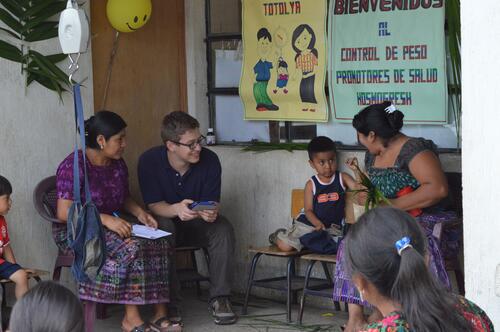
Every two months, the promoters gather each community’s children to measure their weight and height. Children and their mothers sit patiently, waiting for their turn. The children enjoy a cup of Incaparina, and their mothers eagerly listen to the promoters’ tips for keeping their children healthy.
“It’s very important to me,” said Elsira Rosibel Samayoa, who brought her 2-year-old to be measured. “There are mothers who don’t understand the importance of monitoring their children’s weight, but I do.”
Since its implementation in 2009, the Stanford program has slashed nutrition-based mortality in the participating communities by about 80 percent and decreased severe malnutrition by more than 60 percent – saving hundreds of children’s lives.
However, nutrition surveillance and intervention isn’t easy. Tracking nutrition takes training and expertise, and when the local population rarely exceeds a fourth-grade education, learning these skills is especially challenging. Detailed graphs on a standard growth chart are essential to identifying malnourished children.
“The community health workers are extremely capable and smart, but some have never seen a graph before,” said Wise. “Think about what it is to try to explain a graph to someone for the first time.”
It takes the health workers about three years to learn to graph and then interpret the results for intervention.
Wise said, “So we all got together and said, ‘How do we make this easier to do?’”
The app was the answer.
‘Let’s create an app’
Enter Alejandro Chavez, a recent Stanford computer science graduate and Stanford Health Policy research assistant. He developed the app to collect child health data, then determine the child’s degree of malnutrition and suggest intervention.
“The major goal was to lower training requirements and make programs like this simpler to start and maintain,” said Chavez, who now lives and works in Guatemala, where he gets daily feedback from the health promoters.
“I feel like they’ve been very honest with me about things I need to improve,” he said.
Cesia Lizeth Castro Chutá is a senior coordinator for the program who has worked with Chavez to ensure that the app meets the promoters’ needs.
“The tablet automatically generates the information we need to know,” she said. “It becomes easier to confirm that a child is malnourished and needs supplements.”
Looking forward
Image
With the app’s launch, it looks like training time for the promoters will be reduced from three years to less than six months. That means new communities can be incorporated into the program quickly, creating broader access to care.
Meanwhile, many health programs around the world are waiting to see how well the Stanford app works in Guatemala.
Josh Nesbit, a Stanford alumnus and Medic Mobile CEO, said, “As more health programs recognize the importance of nutrition and implement community-based interventions, screening and surveillance tools will be critical. We must learn from Dr. Wise’s success.”
In 2007, "solar market gardens" were installed in 2 villages for women’s agricultural groups as a strategy for enhancing food and nutrition security. Data were collected through interviews at installation and 1 year later from all women’s group households (30–35 women/group) and from a random representative sample of 30 households in each village, for both treatment and matched-pair comparison villages. Comparison of baseline and endline data indicated increases in the variety of fruits and vegetables produced and consumed by SMG women’s groups compared to other groups. The proportion of SMG women’s group households engaged in vegetable and fruit production significantly increased by 26% and 55%, respectively (P < .05). After controlling for baseline values, SMG women’s groups were 3 times more likely to increase their fruit and vegetable consumption compared with comparison non-women’s groups (P < .05). In addition, the percentage change in corn, sorghum, beans, oil, rice and fish purchased was significantly greater in the SMG women’s groups compared to other groups. At endline, 57% of the women used their additional income on food, 54% on health care, and 25% on education. Solar Market Gardens have the potential to improve household nutritional status through direct consumption and increased income to make economic decisions.