Health and the Environment
News Type
News
Date
Paragraphs

Program on Energy and Sustainable Development (PESD) Quantitative Research Associate Ian Hardman co-authored a paper as an undergraduate at the University of Virginia which was published in Science today.  The paper, “Disparities in PM2.5 air pollution in the United States,” analyzes 36 years of U.S. air pollution data and concludes that while we may have made significant strides in pollution control, we’ve been less successful in addressing disparities of exposure between communities. Read more 


Hero Image
air pollution
All News button
1
Paragraphs

Deforestation and landscape fragmentation have been identified as processes enabling direct transmission of zoonotic infections. Certain human behaviors provide opportunities for direct contact between humans and wild nonhuman primates (NHPs), but are often missing from studies linking landscape level factors and observed infectious diseases.

All Publications button
1
Publication Type
Journal Articles
Publication Date
Journal Publisher
Landscape Ecology
Authors
Eric Lambin
-

Join us for a talk with agricultural and development economist Christopher B. Barrett, this quarter’s visiting scholar with the Center on Food Security and the Environment. Barrett is the Stephen B. and Janice G. Ashley Professor of Applied Economics and Management and an International Professor of Agriculture with Cornell’s Dyson School of Applied Economics and Management.

Professor Barrett will discuss food systems advances over the past 50 years that have promoted unprecedented reduction globally in poverty and hunger, averted considerable deforestation, and broadly improved lives, livelihoods and environments in much of the world. He’ll share perspectives on the reasons why, despite those advances, those systems increasingly fail large communities in environmental, health, and increasingly in economic terms and appear ill-suited to cope with inevitable further changes in climate, incomes, and population over the coming 50 years. Barrett will explore the new generation of innovations underway that must overcome a host of scientific and socioeconomic obstacles.
 
Also a Professor of Economics in the Department of Economics, Barrett is co-editor in chief of the journal Food Policy, is a faculty fellow with David R. Atkinson Center for a Sustainable Future and serves as the director of the Stimulating Agriculture and Rural Transformation (StART) Initiative housed at the Cornell International Institute for Food, Agriculture and Development.
 

Lectures
Authors
Noa Ronkin
News Type
News
Date
Paragraphs

Southeast Asia, home to over 640 million people across 10 countries, is one of the world’s most dynamic and fastest growing regions. APARC just concluded the year 2019 with a Center delegation visit to two Southeast Asian capital cities, Hanoi and Bangkok, where we spent an engaging week with stakeholders in the academic, policy, business, and Stanford alumni communities.

Led by APARC Director Gi-Wook Shin, the delegation included APARC Deputy Director and Asia Health Policy Program Director Karen Eggleston, Southeast Asia Program Director Donald Emmerson, and APARC Associate Director for Communications and External Relations Noa Ronkin. Visiting Scholar Andrew Kim joined the delegation in Bangkok.

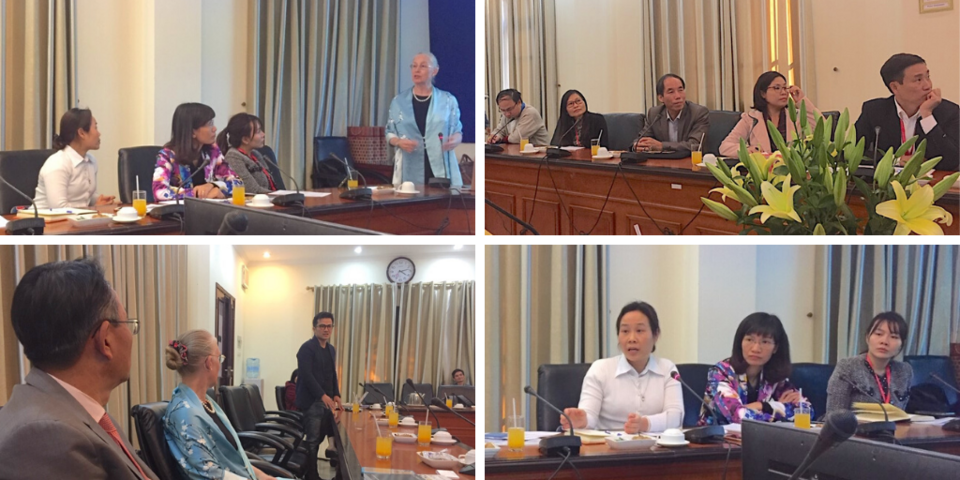
With a focus on health policy, our first day in Hanoi included a visit to Thai Nguyen University, a meeting with government representatives at the Vietnam Ministry of Health, and a seminar on healthy aging and innovation jointly with Hanoi Medical University.

Image
Collage of four images showing participants at a roundtable held at Hanoi Medical University with APARC delegation members

Karen Eggleston and participants at the roundtable held at Hanoi Medical University, December 9, 2019.

Throughout the day, Eggleston presented some of her collaborative research that is part of two projects involving international research teams: one that assesses public-private roles and institutional innovation for healthy aging and another that examines the economics of caring for patients with chronic diseases across diverse health systems in Asia and other parts of the world. We appreciated learning from our counterparts about the health care system and health care delivery in Vietnam.

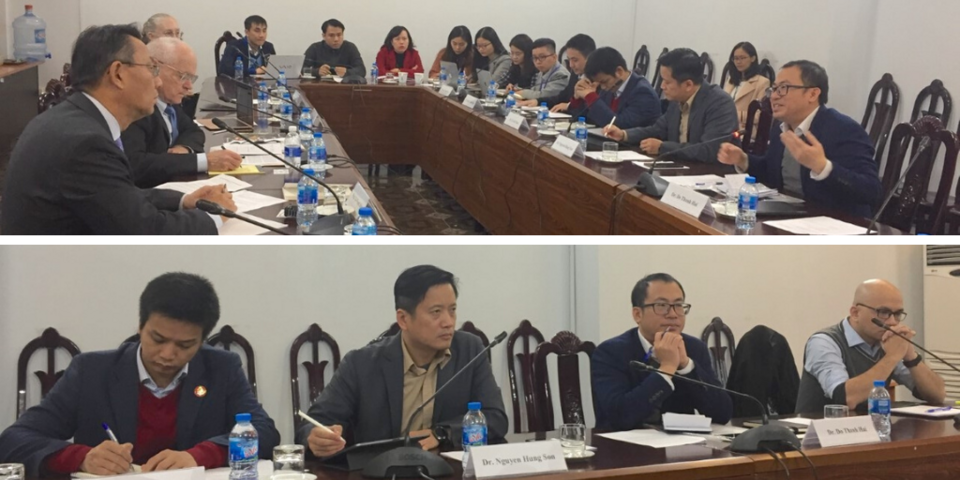
Shifting focus to international relations and regional security, day 2 in Hanoi opened with a roundtable, “The Rise of the Indo-Pacific and Vietnam-U.S. Relations,” held jointly with the East Sea Institute (ESI) of the Diplomatic Academy of Vietnam (DAV). Following a welcome by ESI Director General Nguyen Hung Son, the program continued with remarks by Shin, Emmerson, ESI Deputy Director General To Anh Tuan, and Assistant Director General Do Thanh Hai.

Image
Participants at a roundtable held at the Diplomatic Academy of Vietnam with APARC delegation members

Roundtable at the Diplomatic Academy of Vietnam, December 10, 2019.

The long-ranging conversation with DAV members included issues such as the future of the international order in Asia; the U.S. withdrawal from multilateralism; the concern about a lack of U.S. engagement in Southeast Asia, sparked by President Trump’s absence from the November 2019 summit of the Association of Southeast Asian Nations (ASEAN) at a time when China is bolstering its influence in the region and when ASEAN hopes to set a code of conduct with China regarding disputed waters in the South China Sea; the priorities for Vietnam as it assumes the role of ASEAN chair in 2020; and the challenges for the Vietnam-U.S. bilateral relationship amid the changing strategic environment in Southeast Asia.

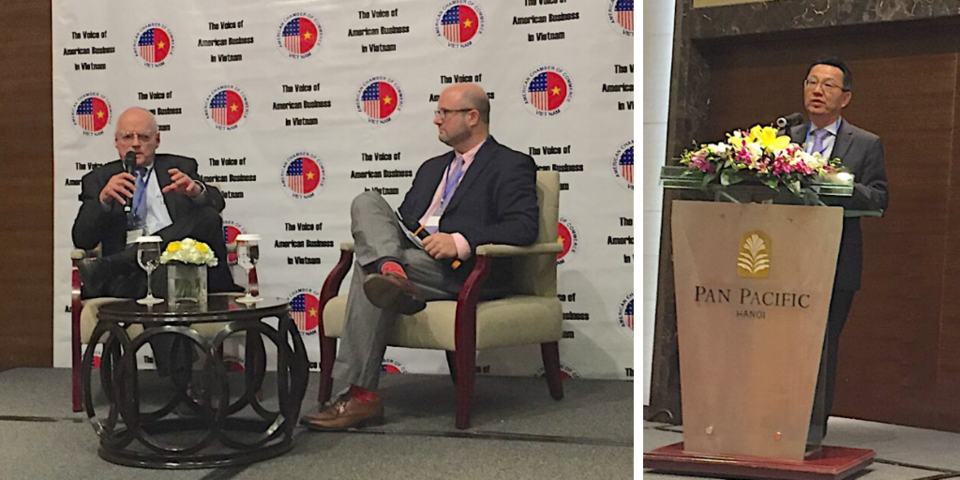
In the afternoon we were joined by members of the American Chamber of Commerce in Hanoi at an AmCham-hosted Lunch ‘n’ Learn session on Vietnam's challenges and opportunities amid the U.S.-China rivalry. The event featured Emmerson in conversation with AmCham Hanoi Executive Director Adam Sitkoff.

Image
Two men in conversation seated on stage and a man speaking at a podium

(Left) Donald Emmerson in conversation with Adam Sitkoff; (right) Gi-Wook Shin welcomes AmCham Hanoi members; December 10, 2019. 

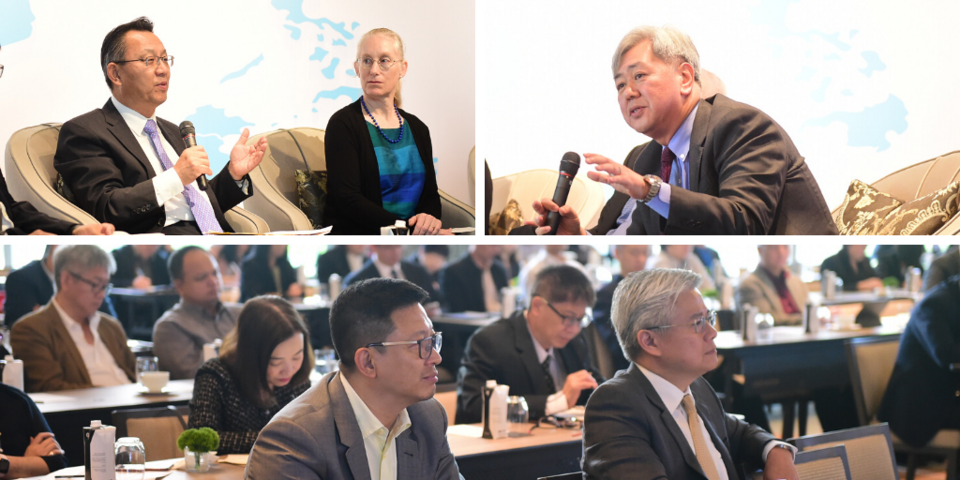
Moving to Bangkok, delegation members Shin, Eggleston, Emmerson, and Kim spoke on a panel for executives of the Charoen Pokphand Group (C.P. Group), one of Thailand’s largest private conglomerates, addressing some of the core issues that lie ahead for Southeast Asia in 2020 and beyond in the areas of geopolitics, innovation, and health.

Image
Participants at a panel discussion with APARC delegation hosted by the C.P. Group, Thailand

Top, from left to right: Gi-Wook Shin, Karen Eggleston, Andrew Kim; bottom: C.P. Group executive listening to the panel, December 12, 2019.

We also enjoyed a tour at True Digital Park, Thailand’s first startup and tech entrepreneur’s campus. Developed by the C.P. Group, True Digital Park aspires to be an open startup ecosystem that powers Thailand to become a global hub for digital innovation.

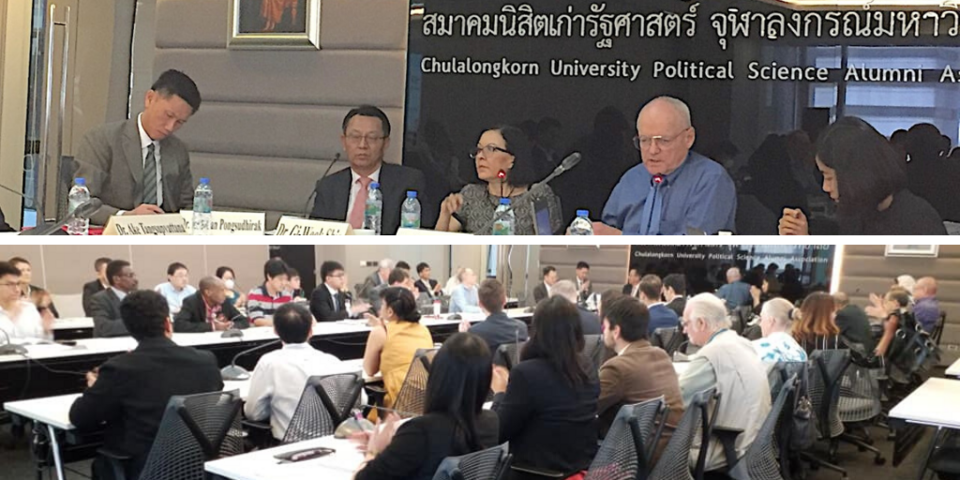
The following day, Shin and Emmerson participated in a public forum hosted by Chulalongkorn University’s Institute of Security and International Studies (ISIS Thailand), "Where Northeast Asia Meets Southeast Asia: The Great Powers, Global Disorder and Asia’s Future.” They were joined by ISIS Thailand Director Thitinan Pongsudhirak and Chulalongkorn University Faculty of Political Science Associate Dean for International Affairs and Graduate Studies Kasira Cheeppensook. The panel was moderated by Ms. Gwen Robinson, ISIS Thailand senior fellow and editor-at-large of the Nikkei Asian Review.

Image
Panelists and participants at a public forum held at Chulalongkorn University

ISIS Thailand forum participants and panelists, from left: Pngsukdhirak, Shin, Robinson, Emmerson, Cheeppensook; December 13, 2019.

As part of that discussion, Emmerson speculated that – driven by deepening Chinese economic and migrational involvement in Southeast Asia’s northern tier – Cambodia and Laos, less conceivably Myanmar, and still less conceivably Thailand could become incorporated de facto into an economically integrated “greater China” that could eventually reduce ASEAN to a more-or-less maritime membership in the region’s southern tier. Emmerson’s speculation was made in the context of his critique of ASEAN’s emphasis on its own “centrality” to the neglect of its lack of the proactivity that would serve as evidence of centrality and of a desire not to be rendered peripheral by the growing centrality-cum-proactivity of China. The event was covered by the Bangkok Post (although that report’s headline and quote of Emmerson are inaccurate, as neither the panel nor Emmerson predicted the “break-up of ASEAN.”)

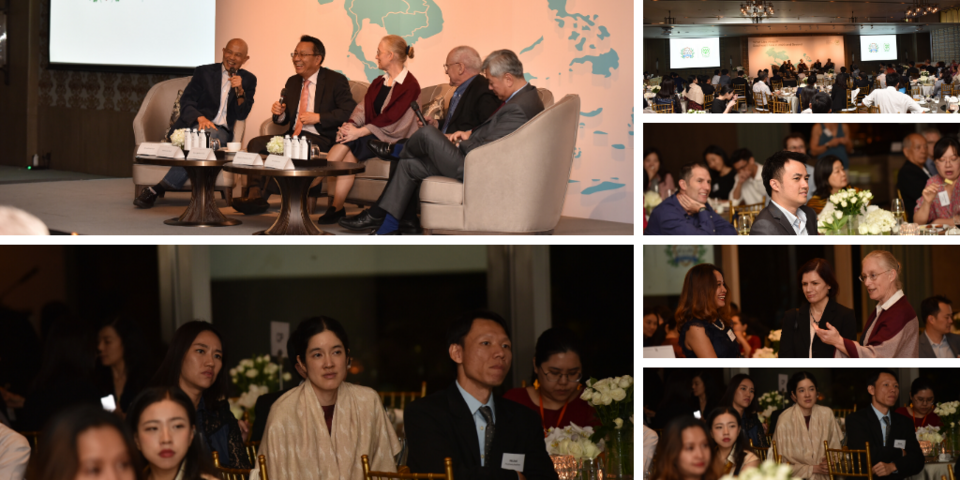
Our delegation visit in Bangkok concluded with a buffet dinner reception and panel discussion jointly with the Stanford Club of Thailand.

Image
alumni event

Stanford and IvyPlus alumni listening to the panel, December 13, 2019.

Moderated by Mr. Suthichai Yoon, a veteran journalist and founder of digital media outlet Kafedam Group, the conversation focused on the changing geopolitics of Southeast Asia, innovation and health in the region, and the opportunities and challenges facing Thailand-U.S. relations. It was a pleasure to meet many new and old friends from the Stanford and IvyPlus alumni communities.

APARC would like to thank our partners and hosts in Hanoi and Bangkok for their hospitality, collaboration, and the stimulating discussions throughout our visit. We look forward to keeping in touch!

Hero Image
APARC delegation speaking to Stanford and IvyPlus alumni, Bangkok
All News button
1
Paragraphs

The economic costs of Indonesia’s 2015 forest fires are estimated to exceed US $16 billion, with more than 100,000 premature deaths. On several days the fires emitted more carbon dioxide than the entire United States economy. Here, we combine detailed geospatial data on fire and local climatic conditions with rich administrative data to assess the underlying causes of Indonesia’s forest fires at district and village scales. We find that El Niño events explain most of the year-on-year variation in fire. The creation of new districts increases fire and exacerbates the El Niño impacts on fire. We also find that regional economic growth has gone hand-in-hand with the use of fire in rural districts. We proceed with a 30,000-village case study of the 2015 fire season on Sumatra and Kalimantan and ask which villages, for a given level of spatial fire risk, are more likely to have fire. Villages more likely to burn tend to be more remote, to be considerably less developed, and to have a history of using fire for agriculture. Although central and district level policies and regional economic development have generally contributed to voracious environmental degradation, the close link between poverty and fire at the village level suggests that the current policy push for village development might offer opportunities to reverse this trend.


  •  
All Publications button
1
Publication Type
Journal Articles
Publication Date
Journal Publisher
World Development Journal
Authors
Rosamond L. Naylor
Paragraphs

Click here to view article


Abstract: Ultrafast optical pump-probe studies of uranium dioxide (UO2) under pressure were performed in order to better understand the material's response to ionizing radiation. Photoexcitation generates oscillations in the time-resolved reflectivity at two distinct GHz-scale frequencies. The higher-frequency mode is attributed to a coherent longitudinal acoustic mode. The lower-frequency mode does not correspond to any known excitation under equilibrium conditions. The frequency and lifetime of the low-frequency mode are studied as a function of pressure. Abrupt changes in the pressure-dependent slopes of these attributes are observed at ∼10 GPa, which correlates with an electronic transition in UO2. Variation of probe wavelength reveals that the low-k dispersion of the low-frequency mode does not fit into either an optical or acoustic framework. Rather, we propose that this mode is related to the dynamical magnetic structure of UO2. The implications of these results help account for the anomalously small volume of damage known to be caused by ionizing radiation in UO2; we propose that the existence of the low-frequency mode enhances the material's transient thermal conductivity, while its long lifetime lengthens the timescale over which energy is dissipated. Both mechanisms enhance damage recovery.

All Publications button
1
Publication Type
Journal Articles
Publication Date
Journal Publisher
APS Physics
Authors
Rodney C. Ewing
Number
13
Paragraphs

Click here to view article


Abstract: To understand the chemical durability of highly radioactive cesium-rich microparticles (CsMPs) released from the Fukushima Daiichi Nuclear Power Plant in March 2011, we have, for the first time, performed systematic dissolution experiments with CsMPs isolated from Fukushima soils (one sample with 108 Bq and one sample with 57.8 Bq of 137Cs) using three types of solutions: simulated lung fluid, ultrapure water, and artificial sea water, at 25 and 37 °C for 1–63 days. The 137Cs was released rapidly within three days and then steady-state dissolution was achieved for each solution type. The steady-state 137Cs release rate at 25 °C was determined to be 4.7 × 103, 1.3 × 103, and 1. 3 × 103 Bq·m−2 s−1 for simulated lung fluid, ultrapure water, and artificial sea water, respectively. This indicates that the simulated lung fluid promotes the dissolution of CsMPs. The dissolution of CsMPs is similar to that of Si-based glass and is affected by the surface moisture conditions. In addition, the Cs release from the CsMPs is constrained by the rate-limiting dissolution of silicate matrix. Based on our results, CsMPs with ∼2 Bq, which can be potentially inhaled and deposited in the alveolar region, are completely dissolved after >35 years. Further, CsMPs could remain in the environment for several decades; as such, CsMPs are important factors contributing to the long-term impacts of radioactive Cs in the environment.

All Publications button
1
Publication Type
Journal Articles
Publication Date
Journal Publisher
Elsevier
Authors
Rodney C. Ewing
-

Fighting to End Hunger at Home & Abroad:  Ambassador Ertharin Cousin shares her journey & lessons learned

A Conversation in Global Health with Ertharin Cousin

FSI Payne Distinguished Lecturer | Former Executive Director of the World Food Programme | TIME's 100 Most Influential People

RSVP for conversation & lunch: www.tinyurl.com/CIGHErtharinCousin (please arrive at 11:45 am for lunch)

Professor Ertharin Cousin has been fighting to end global hunger for decades. As executive director of the World Food Programme from 2012 until 2017, she led the world’s largest humanitarian organization with 14,000 staff serving 80 million vulnerable people across 75 countries. As the US ambassador to the UN Agencies for Food and Agriculture, she served as the US representative for all food, agriculture, and nutrition related issues.

Prior to her global work, Cousin lead the domestic fight to end hunger. As chief operating officer at America’s Second Harvest (now Feeding America), she oversaw operations for a confederation of 200 food banks across America that served more than 50,000,000 meals per year.

Stanford School of Medicine Senior Communications Strategist Paul Costello will interview Professor Cousin about her experiences, unique pathway, and the way forward for ending the global hunger crisis.

cid:image002.png@01D509A2.91178F90cid:image003.png@01D509A2.91178F90cid:image004.png@01D509A2.91178F90cid:image005.jpg@01D50A42.AF28BEA0

Li Ka Shing Room 320 

Seminars
Paragraphs

Increased intake of fruits and vegetables (F&V) is recommended for most populations across the globe. However, the current state of global and regional food systems is such that F&V availability, the production required to sustain them, and consumer food choices are all severely deficient to meet this need. Given the critical state of public health and nutrition worldwide, as well as the fragility of the ecological systems and resources on which they rely, there is a great need for research, investment, and innovation in F&V systems to nourish our global population. Here, we review the challenges that must be addressed in order to expand production and consumption of F&V sustainably and on a global scale. At the conclusion of the workshop, the gathered participants drafted the “Aspen/Keystone Declaration” (see below), which announces the formation of a new “Community of Practice,” whose area of work is described in this position paper. The need for this work is based on a series of premises discussed in detail at the workshop and summarized herein. To surmount these challenges, opportunities are presented for growth and innovation in F&V food systems. The paper is organized into five sections based on primary points of intervention in global F&V systems: (1) research and development, (2) information needs to better inform policy & investment, (3) production (farmers, farming practices, and supply), (4) consumption (availability, access, and demand), and (5) sustainable & equitable F&V food systems and supply chains.

All Publications button
1
Publication Type
Working Papers
Publication Date
Journal Publisher
Aspen Global Change Institute
Authors
Rosamond L. Naylor

Y2E2 Bldg, 473 VIA ORTEGA
Dept. Center on Food Security - Room 349
Stanford, CA 94305


0
img_3988.jpg

Stefania joined FSE as a research data analyst in March 2018 where she works with David Lobell on designing, implementing, and applying new satellite-based monitoring techniques to study several aspects of food security. 

Her current focuses include estimates of crop yields, crop classification, and detection of management practices in Africa and India using a variety of satellite sensors including Landsat (NASA/USGS), Sentinel 1 and 2 (ESA), combined with crop modeling and machine learning techniques.

Research Data Analyst
Date Label
Subscribe to Health and the Environment