Military
-

This event is co-sponsored by the Program in History and Philosophy of Science; Program in Science, Technology, and Society; and Stanford Center for Law and History.


Livestream: This event will not be live-streamed or recorded


Abstract: How have national practices of nuclear security produced local conditions of insecurity? After World War II, the United States’ nuclear testing program transformed the Marshall Islands into an experimental site for testing both new weapons and forms of territorial governance. During the same period, the Hunters Point Shipyard in southeast San Francisco became the launching point and return site for ships, scientists, and military personnel circulating between the mainland and the Pacific tests. These activities not only incorporated the Marshall Islands and Hunters Point into networks of militarization and scientific knowledge production, but also resulted in widespread radiological contamination. Professors Mary Mitchell and Helen Kang will discuss the entangled legal, environmental, and social legacies of radiological contamination at these two sites, shedding light on the consequential damages of the Cold War and ongoing efforts to demand accountability from the United States government.


Helen Kang Biography: Helen H. Kang is Professor of Law at Golden Gate University School of Law and Director of the school’s Environmental Law and Justice Clinic, which has received recognition for its work from the American Bar Association and the Clinical Legal Education Association, among others. She has devoted most of her legal career to environmental protection, first as Trial Attorney with the Environmental Enforcement Section of the U.S. Department of Justice. Since joining the clinic in 2000, she and her students have successfully represented community and environmental groups, prevailing against agencies such as U.S. EPA and large sources of pollution, including power plants. The clinic’s work has contributed to developments in environmental law, reducing pollution in communities most affected by pollution in California and beyond, and improving public participation and regulatory accountability. Helen’s achievements include successfully arguing in the California Supreme Court to defend the California Environmental Quality Act from federal preemption and compelling California, after decades of abdication, to meaningfully regulate agricultural pollution. She graduated from Berkeley Law, University of California at Berkeley, and Yale University.


Mary Mitchell Biography: Mary X. Mitchell is an Assistant Professor of History at Purdue University where she works on issues at the intersection of environmental inequality and law. During the spring of 2020, Mitchell will be a faculty fellow at Princeton University's Shelby Cullom Davis Center. She earned her PhD in History and Sociology of Science from the University of Pennsylvania in 2016 and was an Atkinson Fellow in Sustainability at Cornell University from 2016-2018. Previously, she practiced law in Pennsylvania and served as a law clerk to Judge Anthony J. Scirica of the United States Court of Appeals for the Third Circuit.


Helen Kang Professor of Law Golden Gate University School of Law
Mary Mitchell Assistant Professor of History Purdue University
Seminars
-

DAY 1: Friday October 11


8:30 – 9:00am         Breakfast


9:00 – 9:15am         Introductory Remarks


9:15 – 11:15am       Panel 1: The Boundaries of Authoritarianism post-Arab Uprisings

Amr Hamzawy, Stanford University

“The Discourse of Authoritarianism in Egypt”

Sean Yom, Temple University

“Mobilization without Movement: The Curse of the Arab Spring in Jordan”

Samia Errazzouki, University of California, Davis

“Political and Economic Stagnation in Morocco: Twenty Years into King Mohamed VI’s Reign”

Chair: Lisa Blaydes, Stanford University


11:15-11:30am        Coffee Break


11:30-1:30pm          Panel 2: Popular Uprisings and Uncertain Transitions

Thomas Serres, University of California, Santa Cruz

“Beyond the ‘Isaba: A Political Economy of the Algerian Hirak”

Lindsay Benstead, Portland State University

“Religious Ideology or Clientelism? Explaining Voter Preferences in Tunisia’s Transitional Elections”

Khalid Medani, McGill University

"The Prospects and Challenges of Democratic Consolidation in Sudan: Understanding the Roots, Dynamics and Potential of an “Impossible” Revolution""

Chair: Hicham Alaoui, Harvard University


1:30-2:30pm             Lunch


2:30-4:30pm             Panel 3: Politics, Succession and Sectarianism in the GCC States

Toby Matthiesen, Oxford University

“Saudi Arabia and the Arab Counter-Revolution”

Michael Herb, Georgia State University

“Monarchical Institutions and the Decay of Family Rule in the Gulf”

Farah Al-Nakib, California Polytechnic State University

“Kuwait's New Urbanism: Palace Projects and the Erosion of the Public”                                   

Chair: Hesham Sallam, Stanford University


DAY 2: Saturday October 12


8:30 – 9:00am          Breakfast


9:00 – 11:00am       Panel 4: Social Strife and Proxy Conflict in the Middle East

Lina Khatib, Chatham House

“Syria’s Conflict: The Intersections of the International and the Domestic”

Stacey Philbrick Yadav, Hobart and William Smith Colleges,

“Can Allies in War Become Partners in Peace? 
Foreign Agendas, Foreign Investment, and Peacebuilding in Yemen”

David Patel, Brandeis University

“Institutions and Competition in Post-Occupation Iraq”

Chair: Amr Hamzawy, Stanford University


11:00-11:15am        Coffee Break


11:15-1:15pm          Panel 5: International Forces in the Arab Political Arena

Lisa Blaydes, Stanford University

“Will China's 'Belt and Road' Initiative Steady or Destabilize Arab Authoritarians?”  

Abbas Milani, Stanford University,

“Iran and its Role in the Prospects of Democracy in the Arab World”

Colin Kahl, FSI, Stanford University

“US Policy Toward a Changing Middle East”

Ayca Alemdaroglu, FSI, Stanford University

“The Rise and Fall of ‘neo-Ottomanism’”

Chair: Larry Diamond, Stanford University


SPEAKER BIOS


Image
hicham alaoui

Hicham Alaoui is an established voice calling for political reform in the Arab world. He is currently a research fellow based at the Weatherhead Center for International Affairs at Harvard University, and is pursuing a D.Phil. at the University of Oxford.  Previously at Stanford, he was a Consulting Professor at the Center for Democracy, Development, and Rule of Law, and advisory board member at the Freeman Spogli Institute. He has published on democratic reforms in the Middle East for journals such as Politique Internationale, Le Debat, Pouvoirs, Le Monde Diplomatique, and Journal of Democracy. He has contributed to The New York Times, Le Monde, La Nouvelle Observateur, El Pais, and Al-Quds. He also served on the MENA Advisory Committee for Human Rights Watch. He holds degrees from Princeton and Stanford. [Back to top]


Image
ayca

Ayça Alemdaroğlu (Ph. D. Cambridge, 2011) (Ph. D. Cambridge, 2011) is the associate director of the Keyman Modern Turkish Studies Program and research assistant professor of sociology at Northwestern University. Her research has engaged with a broad range of theoretical and ethnographic issues, including youth culture and politics, gender and sexuality, experiences of modernity, nationalism, eugenics and higher education. Between 2011-2015, Alemdaroğlu taught in the Anthropology Department and Introductory Studies at Stanford University. Her most publications include "Spatial Segregation and Class Subjectivity in Turkey” published in Social and Cultural Geography; and “Dialectics of Reform and Repression: Unpacking Turkey’s Authoritarian Turn” (with Sinan Erensu) in ROMES. [Back to top]


Image
lindsay b 2

Lindsay J. Benstead  is Associate Professor of Political Science in the Mark O. Hatfield School of Government and Director of the Middle East Studies Center (MESC) at Portland State University. Previously, she served as Fellow in the Middle East Program and the Women’s Global Leadership Initiative at the Woodrow Wilson International Center for Scholars in Washington, DC (2018-2019) and Kuwait Visiting Professor at SciencesPo in Paris (fall 2016). She is an Affiliated Scholar in the Program on Governance and Local Development (GLD) at the University of Gothenburg and Yale University. Benstead has conducted surveys in Morocco, Algeria, Tunisia, Libya, and Jordan and contributes to the Transitional Governance Project. Her research on women and politics, public opinion, and survey methodology has appeared in Perspectives on Politics, International Journal of Public Opinion Research, Governance, and Foreign Affairs. She holds a Ph.D. in Public Policy and Political Science from the University of Michigan in Ann Arbor and served as a doctoral fellow at Yale University and a post-doctoral fellow at Princeton University. [Back to top]


Image
lisa blaydes

Lisa Blaydes is a Professor of Political Science at Stanford University and a Senior Fellow at the Freeman Spogli Institute for International Studies. She is the author of Elections and Distributive Politics in Mubarak’s Egypt (Cambridge University Press, 2011). Her articles have appeared in the American Political Science ReviewInternational Studies QuarterlyInternational OrganizationJournal of Theoretical PoliticsMiddle East Journal, and World Politics. She holds degrees in Political Science (PhD) from the University of California, Los Angeles and International Relations (BA, MA) from Johns Hopkins University. [Back to top]


Image
Larry Diamond

Larry Diamond is a senior fellow at the Hoover Institution and at the Freeman Spogli Institute for International Studies. For more than six years, he directed FSI’s Center on Democracy, Development, and the Rule of Law, where he now leads its Program on Arab Reform and Democracy and its Global Digital Policy Incubator. He is the founding co-editor of the Journal of Democracy and also serves as Senior Consultant at the International Forum for Democratic Studies of the National Endowment for Democracy. His research focuses on democratic trends and conditions around in the world, and on policies and reforms to defend and advance democracy. His 2016 book, In Search of Democracy, explores the challenges confronting democracy and democracy promotion, gathering together three decades of his writing and research, particularly on Africa and Asia. He is author of Ill Winds: Saving Democracy from Russian Rage, Chinese Ambition, and American Complacency, published in 2019 by Penguin Press. He is now writing a textbook on democratic development. [Back to top]


Image
samia e

Samia Errazzouki is a PhD student focusing on early modern Northwest African history. Prior to UC Davis, she worked as a journalist based in Morocco reporting for the Associated Press, and later, with Reuters. Samia also worked as a research associate in Morocco with the University of Cambridge, researching the dynamics of surveillance and citizen media in light of the "Arab Spring." She is currently a co-editor with Jadaliyya. Her work and commentary has appeared in various platforms including The Washington PostBBCForeign PolicyThe GuardianAl Jazeera, the Carnegie Endowment's Sada Journal, the Journal of North African Studies, and the Middle East Institute, among others. Samia holds an MA in Arab Studies from Georgetown University and a BA in Global Affairs from George Mason University. [Back to top]


Image
amr hamzawy cropped

Amr Hamzawy is a Senior Research Scholar at CDDRL. He studied political science and developmental studies in Cairo, The Hague, and Berlin. He was previously an associate professor of political science at Cairo University and a professor of public policy at the American University in Cairo. Between 2016 and 2017, he served as a senior fellow in the Middle East program and the Democracy and Rule of Law program at the Carnegie Endowment for International Peace, Washington, DC. His research and teaching interests as well as his academic publications focus on democratization processes in Egypt, tensions between freedom and repression in the Egyptian public space, political movements and civil society in Egypt, contemporary debates in Arab political thought, and human rights and governance in the Arab world. He is currently writing a new book on contemporary Egyptian politics, titled Egypt’s New Authoritarianism. Hamzawy is a former member of the People’s Assembly after being elected in the first Parliamentary elections in Egypt after the January 25, 2011 revolution. He is also a former member of the Egyptian National Council for Human Rights. Hamzawy contributes a weekly op-ed to the Egyptian independent newspaper al-Shorouk and a weekly op-ed to the London based newspaper al-Quds al-Arabi[Back to top]


Image
michael herb square 620x620

Michael Herb is professor and chair of political science at Georgia State University. His work focuses on Gulf politics, monarchism and the resource curse. He is the author of The Wages of Oil: Parliaments and Economic Development in Kuwait and the UAE (Cornell University Press, 2014) and All in the Family: Absolutism, Revolution, and Democracy in the Middle Eastern Monarchies (SUNY ‎‎1999), in addition to numerous articles. He maintains the Kuwait Politics Database, a comprehensive and authoritative source of information on Kuwaiti elections.  He has twice won Fulbright awards to study in Kuwait. [Back to top]


Image
colin kahl

Colin H. Kahl is co-director of the Center for International Security and Cooperation, the inaugural Steven C. Házy Senior Fellow at the Freeman Spogli Institute for International Studies, and a Professor, by courtesy, in the Department of Political Science at Stanford University. He is also a Strategic Consultant to the Penn Biden Center for Diplomacy and Global Engagement. From October 2014 to January 2017, he was Deputy Assistant to the President and National Security Advisor to the Vice President. In that position, he served as a senior advisor to President Obama and Vice President Biden on all matters related to U.S. foreign policy and national security affairs, and represented the Office of the Vice President as a standing member of the National Security Council Deputies’ Committee. From February 2009 to December 2011, Dr. Kahl was the Deputy Assistant Secretary of Defense for the Middle East at the Pentagon. In this capacity, he served as the senior policy advisor to the Secretary of Defense for Egypt, Iran, Iraq, Israel and the Palestinian territories, Saudi Arabia, Syria, Yemen, and six other countries in the Levant and Persian Gulf region. In June 2011, he was awarded the Secretary of Defense Medal for Outstanding Public Service by Secretary Robert Gates. From 2007 to 2017 (when not serving in the U.S. government), Dr. Kahl was an assistant and associate professor in the Security Studies Program at Georgetown University's Edmund A. Walsh School of Foreign Service. From 2007 to 2009 and 2012 to 2014, he was also a Senior Fellow at the Center for a New American Security (CNAS), a nonpartisan Washington, DC-based think tank. From 2000 to 2007, he was an assistant professor of political science at the University of Minnesota. In 2005-2006, Dr. Kahl took leave from the University of Minnesota to serve as a Council on Foreign Relations International Affairs Fellow in the Office of the Secretary of Defense, where he worked on issues related to counterinsurgency, counterterrorism, and responses to failed states. In 1997-1998, he was a National Security Fellow at the John M. Olin Institute for Strategic Studies at Harvard University. Current research projects include a book analyzing American grand strategy in the Middle East in the post-9/11 era. A second research project focuses on the implications of emerging technologies on strategic stability. He has published numerous articles on international security and U.S. foreign and defense policy in Foreign Affairs, Foreign Policy, International Security, the Los Angeles Times, Middle East Policy, the National Interest, the New Republic, the New York Times, Politico, the Washington Post, and the Washington Quarterly, as well as several reports for CNAS. His previous research analyzed the causes and consequences of violent civil and ethnic conflict in developing countries, focusing particular attention on the demographic and natural resource dimensions of these conflicts. His book on the subject, States, Scarcity, and Civil Strife in the Developing World, was published by Princeton University Press in 2006, and related articles and chapters have appeared in International Security, the Journal of International Affairs, and various edited volumes. Dr. Kahl received his B.A. in political science from the University of Michigan (1993) and his Ph.D. in political science from Columbia University (2000). [Back to top]


Image
lina khatib

Lina Khatib is Head of the Middle East and North Africa Program at Chatham House. She was formerly director of the Carnegie Middle East Center in Beirut and co-founding Head of the Program on Arab Reform and Democracy at Stanford University’s Center on Democracy, Development, and the Rule of Law. Her research focuses on the international relations of the Middle East, Islamist groups and security, political transitions and foreign policy, with special attention to the Syrian conflict. She is a research associate at SOAS, was a senior research associate at the Arab Reform Initiative and lectured at Royal Holloway, University of London. She has published seven books and also written widely on public diplomacy, political communication and political participation in the Middle East. She is a frequent commentator on politics and security in the Middle East and North Africa at events around the world and in the media. [Back to top]


Image
toby m press photo tm

Toby Matthiesen is a Senior Research Fellow in the International Relations of the Middle East at the Middle East Centre, St. Antony’s College, University of Oxford. He was previously a Research Fellow at Pembroke College, Cambridge, and at the London School of Economics and Political Science and gained his doctorate from the School of Oriental and African Studies (SOAS). He is the author of Sectarian Gulf: Bahrain, Saudi Arabia, and the Arab Spring That Wasn't (Stanford University Press, 2013), and The Other Saudis: Shiism, Dissent and Sectarianism (Cambridge University Press, 2015). His current research focuses on Sunni-Shii relations and the legacies of the Cold War in the Middle East. [Back to top]


Image
Medani 2 sc

Khalid Medani is currently associate professor of political science and Islamic studies at McGill University, and has also taught at Oberlin College and Stanford University. Dr. Medani received an A.B. in development studies from Brown University (1987), an MA in development studies from the Center for Contemporary Arab Studies at Georgetown University (1994), and a PhD in political science from the University of California, Berkeley (2003). His research focuses on the political economy of Islamic and ethnic politics in Egypt, Sudan and Somalia. He has published widely on the roots of civil conflict and the funding of the Islamic movement in Sudan, the question of informal finance and terrorism in Somalia, the obstacles to state building in Iraq, and the role of informal networks in the rise of Islamic militancy. Dr. Medani has worked as a researcher at the Brookings Institution and at Stanford University’s Center for International Security and Cooperation (CISAC). He also served as a Homeland Security Fellow at Stanford University from 2006-2007, and has worked with a variety of international organizations including the United Nations Development Program (UNDP), and the UN Office of the Coordinator of Humanitarian Affairs. Dr. Medani has also served as a senior consultant for a variety of governments on issues such as the roots of Islamic militancy, the Darfur crisis, youth politics in Sudan, and electoral reforms in Morocco including the governments of the United States, the Netherlands, the United Kingdom, and Norway. He is a previous recipient of a Carnegie Scholar on Islam award from the Carnegie Corporation of New York. [Back to top]


Image
milani

Abbas Milani is the Hamid & Christina Moghadam Director of Iranian Studies and Adjunct Professor at the Center on Democracy, Development and Rule of Law at the Freeman Spogli Institute at Stanford University. He has been one of the founding co-directors of the Iran Democracy Project and a research fellow at the Hoover Institution. His expertise is U.S.-Iran relations as well as Iranian cultural, political, and security issues. Until 1986, he taught at Tehran University’s Faculty of Law and Political Science, where he was also a member of the Board of Directors of the university’s Center for International Relations. After moving to the United States, he was for fourteen years the Chair of the Political Science Department at the Notre Dame de Namur University. For eight years, he was a visiting Research Fellow in University of California, Berkeley’s Middle East Center. [Back to top]


Image
al nakib headshot

Farah Al-Nakib is Assistant Professor of History at California Polytechnic State University in San Luis Obispo.  She received her PhD (2011) and MA (2006) in History from the School of Oriental and African Studies in London. Her book Kuwait Transformed: A History of Oil and Urban Life (Stanford University Press, 2016) analyzes the relationship between the urban landscape, the patterns and practices of everyday life, and social behaviors and relations in Kuwait, and traces the historical transformation of these three interrelated realms in the shift from the pre-oil to oil eras. Her current research focuses on collective memory and forgetting in Kuwait, and on the Iraqi invasion and occupation of Kuwait in 1990-91.  Her articles have been published in numerous peer reviewed journals and various edited volumes. Until 2018 Al-Nakib was Associate Professor of History and Director of the Center for Gulf Studies at the American University of Kuwait. [Back to top]


Image
dspatel medium

David Siddhartha Patel is the Associate Director for Research at the Crown Center for Middle East Studies at Brandeis University. His research focuses on religious authority, social order, and identity in the contemporary Arab world. He conducted independent field research in Iraq on the role of mosques and clerical networks in generating order after state collapse, and his book, Order Out of Chaos: Islam, Information, and Social Order in Iraq, is being prepared for publication by Cornell University Press. Patel has also recently written about the Jordanian Muslim Brotherhood; ISIS in Iraq; and dead states in the Middle East. He teaches courses on Middle Eastern politics, research design, and GIS and spatial aspects of politics. Before joining the Crown Center, Patel was an assistant professor of government at Cornell University. Patel received his B.A. from Duke University in Economics and Political Science and his Ph.D. from Stanford University in Political Science, where he also was a fellow at CDDRL and CISAC. He studied Arabic in Lebanon, Yemen, Morocco, and Jordan. [Back to top]


Image
hesham sallam headshot

Hesham Sallam is a Research Associate at CDDRL and serves as the Associate-Director of the Program on Arab Reform and Democracy. He is also a co-editor of Jadaliyya ezine and a former program specialist at the U.S. Institute of Peace. His research focuses on Islamist movements and the politics of economic reform in the Arab World. Sallam’s research has previously received the support of the Social Science Research Council and the U.S. Institute of Peace. Past institutional affiliations include Middle East Institute, Asharq Al-Awsat, and the World Security Institute. He is editor of Egypt's Parliamentary Elections 2011-2012: A Critical Guide to a Changing Political Arena (Tadween Publishing, 2013). Sallam received a Ph.D. in Government (2015) and an M.A. in Arab Studies (2006) from Georgetown University, and a B.A. in Political Science from the University of Pittsburgh (2003). [Back to top]


Image
thomas

Thomas Serres is a lecturer in the Politics Department at UC Santa Cruz and a specialist of North African and Mediterranean politics and his scholarship focuses on questions of crisis, economic restructuring and authoritarian upgrading. His first book was published in French by Karthala in 2019. It studies the politics of catastrophization in post-civil war Algeria and is entitled Algeria and the Suspended Disaster: Managing the Crisis and Blaming the People under Bouteflika. He has also recently co-edited the volume North Africa and the Making of Europe: Governance, Institutions, Culture, which was published by Bloomsbury Academic Press in 2018. [Back to top]


Image
stacey philbrick yadav

Stacey Philbrick Yadav is Associate Professor and chair of the Department of Political Science at Hobart and William Smith Colleges. She has written extensively about Islamist-Leftist and intra-Islamist dynamics in Yemen, including Islamists and the State: Legitimacy and Institutions in Yemen and Lebanon, and was a contributor to the “Rethinking Political Islam” project at the Brookings Institution. Focusing increasingly on Yemen’s evolving war dynamics, she co-edited Politics, Governance, and Reconstruction in Yemen’s War for the Project on Middle East Political Science and the spring 2019 issue of Middle East Report devoted to the conflict. Philbrick Yadav serves on the executive committee of the American Institute for Yemeni Studies, and is currently a non-resident fellow at the Crown Center for Middle East Studies at Brandeis University. [Back to top]


Image
sean yom headshot closeup

Sean Yom is Associate Professor of Political Science at Temple University and Senior Fellow in the Middle East Program at the Foreign Policy Research Institute. His research explores authoritarian politics, institutional stability, and historical identity in these countries, as well as their implications for US foreign policy. His publications include From Resilience to Revolution: How Foreign Interventions Destabilize the Middle East (Columbia University Press, 2016); the Routledge textbooks Societies of the Middle East and North Africa (2019) and Government and Politics of the Middle East and North Africa (2019); and numerous articles in academic journals and popular media. He is currently writing a new book, under contract, on the history and politics of Jordan. [Back to top]

Conferences
Paragraphs

For U.S. intelligence agencies, the twenty-first century began with a shock, when 19 al Qaeda operatives hijacked four planes and perpetrated the deadliest attack ever on U.S. soil. In the wake of the attack, the intelligence community mobilized with one overriding goal: preventing another 9/11. The CIA, the National Security Agency, and the 15 other components of the U.S. intelligence community restructured, reformed, and retooled. Congress appropriated billions of dollars to support the transformation.

That effort paid off. In the nearly two decades that U.S. intelligence agencies have been focused on fighting terrorists, they have foiled numerous plots to attack the U.S. homeland, tracked down Osama bin Laden, helped eliminate the Islamic State’s caliphate, and found terrorists hiding everywhere from Afghan caves to Brussels apartment complexes. This has arguably been one of the most successful periods in the history of American intelligence.

But today, confronted with new threats that go well beyond terrorism, U.S. intelligence agencies face another moment of reckoning. From biotechnology and nanotechnology to quantum computing and artificial intelligence (AI), rapid technological change is giving U.S. adversaries new capabilities and eroding traditional U.S. intelligence advantages. The U.S. intelligence community must adapt to these shifts or risk failure as the nation’s first line of defense.


All Publications button
1
Publication Type
Commentary
Publication Date
Journal Publisher
Foreign Affairs
Authors
Amy Zegart
Number
May/June 2019
Authors
Noa Ronkin
News Type
News
Date
Paragraphs

Forty years after the establishment of diplomatic relations between the United States and China, the two superpowers are competing and contesting every arena, from trade to AI research and from space exploration to maritime rights. Instead of what Americans referred to as engagement and Chinese called reform and opening, many experts and analysts now characterize the relations between the two countries as dangerously brittle. Some see a new kind of Cold War in the making. Such assertions, however, argues Shorenstein APARC Fellow Thomas Fingar, “both ignore history and impute a level of fragility that has not existed for many years.”

Fingar reflects on the U.S.-China bilateral relationship in a new article, “Forty years of formal—but not yet normal—relations,” published in the China International Strategy Review. He claims that the relationship is resilient and not destined for conflict, albeit it is beset by a host of aspirational, perceptual, and structural differences.

A political scientist and China specialist who served over two decades in senior government positions, Fingar urges readers to remember that assertions of fragility of the U.S.-China relationship undervalue the strength, scope, and significance of interdependence, shared interests, and constituencies in both countries. These, he says, have a substantial stake in the maintenance of at least minimally cooperative relations.

U.S.-China relations are indeed highly asymmetrical: Chinese citizens and organizations have far greater access to the United States than Americans do to China, notes Fingar. He also recognizes that the troubles that have soured the relationship are more intricate and often more sensitive than those of the past. Decades ago, most of the issues that arose were handled at the governmental level. But now “the number and variety of players with stakes in the relationship and disputes with counterpart actors are much greater.” Furthermore, explains Fingar, the U.S. business community is expressing a stronger voice for government action to change Chinese behavior and is not as consistent an advocate of stability in U.S. policy toward China as it used to be. “This is an extremely important development,” he says, “because it reverses a key dynamic in the U.S.-China relationship.”

Ultimately, however, the two countries and our institutions and people are linked by myriad ties that bring mutual benefits as well as the constraints of interdependence. “I remain confident that we will continue to be able to manage the relationship,” concludes Fingar. He expresses disappointment, though, that normalization of U.S.-China relations remains a work in progress and cautions that merely managing the relationship to prevent it from deteriorating is an unsatisfactory goal that should be unacceptable to both sides. Not only does such a low bar limit what each counterpart can achieve, but it also inhibits the kind of cooperation required to address transnational challenges like climate change, infectious disease, and proliferation of dangerous technologies.


Hero Image
A display for facial recognition and artificial intelligence is seen on monitors at Huawei's Bantian campus on April 26, 2019 in Shenzhen, China.
A display for facial recognition and artificial intelligence is seen on monitors at Huawei's Bantian campus in Shenzhen, China. The U.S. government battle with the Chinese telecom giant represents multiple concerns about China's technological prowess.
Kevin Frayer/ Getty Images
All News button
1
Authors
Amy Zegart
News Type
Commentary
Date
Paragraphs

Thirty years ago this week, I watched the news from Beijing and started shredding my bedding. It was the night before my college graduation, I had been studying Chinese politics, and news had broken that college students just like us had been gunned down in Tiananmen Square after weeks of peaceful and exhilarating democracy protests—carried on international TV. In the iconic square where Mao Zedong had proclaimed the People’s Republic decades before, bespectacled students from China’s best universities had camped out, putting up posters with slogans of freedom in Chinese and English. A “goddess of democracy” figure modeled after the Statue of Liberty embodied their hopes—and ours—for political liberation in China.

On my campus back then were just a handful of students majoring in East Asian studies. Learning of the brutal crackdown in Beijing, we somehow found one another, gathered our friends, and stayed up making hundreds of white armbands for classmates to wear at commencement the next day. Grappling with the cold realities of the “real world” we were about to enter, we didn’t know what else to do. So we tore sheets and cried for what might have been.

The June 4, 1989, massacre was a horrifying spectacle that the Chinese government has sought to erase from national memory ever since. But, 30 years later, contemplating what might have been is more important than ever. In hindsight, Tiananmen Square serves as a continuing reminder about just how much China has defied, and continues to defy, the odds and predictions of experts. The fact is that generations of American policy makers, political scientists, and economists have gotten China wrong more often than they’ve gotten China right. In domestic politics, economic development, and foreign policy, China has charted a surprising path that flies in the face of professional prognostications, general theories about anything, and the experience of other nations.

Read the rest at The Atlantic

Hero Image
zegart amy cropped
All News button
1
Authors
Ketian Zhang
News Type
Commentary
Date
Paragraphs

On March 31, Taiwan’s Ministry of Foreign Affairs reported that two Chinese Air Force (PLAAF) J-11 jets crossed the median line of the Taiwan Strait. This violated the long-held tacit agreement between China and Taiwan that neither side should cross the median line.

Taiwan deemed this “an intentional, reckless & provocative action,” which triggered “a 10-minute standoff” in the air. As Asia security expert Bonnie S. Glaser notes that, if intentional, this would be the first PLAAF crossing of the median line in about 20 years. In this case, it’s likely that Taiwan, not the South China Sea, prompted Beijing’s actions.

An unresolved issue from the Chinese civil war, Taiwan has always been a “core interest” to party leaders in Beijing. Here are some key takeaways from my research on China-Taiwan relations…

Read the full article in The Washington Post.


To hear more from Ketian, don't miss her recently posted video Q&A. In addition, be sure to RSVP for her April 16 seminar "Killing the Chicken to Scare the Monkey: Explaining Coercion by China in the South China Sea."

Hero Image
The marines of China navy participate in the annual military training on January 3, 2018 in Zhanjiang,
ZHANJIANG, CHINA - JANUARY 03: The marines of China navy participate in the annual military training on January 3, 2018 in Zhanjiang, Guangdong Province of China.
Pu Haiyang/VCG via Getty Images
All News button
1
Paragraphs

What are the effects of international intervention on the rule of law after civil war? Rule of law requires not only that state authorities abide by legal limits on their power, but also that citizens rely on state laws and institutions to adjudicate disputes. Using an original survey and list experiment in Liberia, I show that exposure to the UN Mission in Liberia (UNMIL) increased citizens’ reliance on state over nonstate authorities to resolve the most serious incidents of crime and violence, and increased nonstate authorities’ reliance on legal over illegal mechanisms of dispute resolution. I use multiple identification strategies to support a causal interpretation of these results, including an instrumental variables strategy that leverages plausibly exogenous variation in the distribution of UNMIL personnel induced by the killing of seven peacekeepers in neighboring Côte d'Ivoire. My results are still detectable two years later, even in communities that report no further exposure to peacekeepers. I also find that exposure to UNMIL did not mitigate and may in fact have exacerbated citizens’ perceptions of state corruption and bias in the short term, but that these apparently adverse effects dissipated over time. I conclude by discussing implications of these complex but overall beneficial effects.

All Publications button
1
Publication Type
Journal Articles
Publication Date
Journal Publisher
International Organization
News Type
News
Date
Paragraphs

On the heels of the abrupt ending of the Hanoi summit between President Trump and North Korean leader Kim Jong Un, with the future of the diplomacy of denuclearization in question, the Korea Program at Shorenstein APARC convened the 11th Koret Workshop, appropriately titled this year “North Korea and the World in Flux.”

The workshop, an annual gathering made possible through generous funding from the Koret Foundation, brought together international experts in Korean affairs for a full day of panel discussions. Participants assessed the U.S.-DPRK summit diplomacy, examined the challenges and opportunities in media coverage related to the negotiations between the two countries, and considered the prospects and pitfalls for summitry with North Korea in the near term. A report on the workshop proceedings is forthcoming.

At a midday public keynote, General Vincent Brooks, U.S. Army (Ret.), spoke before a packed audience about the challenges and opportunities in Korea. Brooks, who recently retired from active duty as the four-star general in command of all U.S. Forces in Korea, provided his unique and very-timely assessment of the situation on the Korean peninsula, and offered his insights on where the diplomacy of denuclearization may go next.

Gen. Brooks’ public address was followed by a conversation with Karl Eikenberry, director of APARC’s U.S.-Asia Security Initative.

Watch the video recording of Gen. Brooks’ remarks:


Hero Image
U.S.-Asia Security Initiative Director Karl Eikenberry, left, questions General Vincent Brooks during 2019 Koret Workshop
Thom Holme, APARC
All News button
1
-

Abstract: How do nuclear-armed states coerce their adversaries in wars with limited aims without using nuclear weapons? I develop a theory of strategic substitution to explain why states use space, cyber and conventional missile weapons instead of nuclear weapons to maximize leverage against their adversaries. I also explain how they select space, cyber, and conventional missile force postures, defined as weapons and plans for using them. Threats to use space, cyber and conventional missile weapons are more credible sources of strategic leverage against adversaries in wars that do not threaten a state’s survival. I demonstrate the plausibility of the theory using China’s cyber force posture. China developed space, cyber and conventional missile weapons to solve a common problem: giving Beijing the leverage it could not gain from its nuclear weapons in a future war over Taiwanese independence involving the United States. Using original Chinese-language written sources and interviews conducted during extensive fieldwork, I show that Chinese leaders pursued cyber weapons to maximize their strategic leverage after the United States bombed the Chinese Embassy in Belgrade in 1999. As China’s vulnerability to cyber attacks grew during the 2000s, its appetite for risk in using cyber weapons declined, resulting in a change to its military cyber force posture in 2014.

Speaker Bio: Fiona Cunningham is a Post-Doctoral Fellow at CISAC. Her research interests lie at the intersection of technology and conflict, with an empirical focus on China. She received her PhD in September 2018 from the Department of Political Science at the Massachusetts Institute of Technology (MIT), where she was a member of the Security Studies Program. Her dissertation explained China’s development of space, cyber and conventional missile force postures as substitutes for using nuclear weapons to coerce adversaries. Her research is based on extensive fieldwork, including a year-long dissertation research fellowship at the Renmin University of China, Beijing, in 2015-6. She was a Pre-Doctoral Fellow in the Cyber Security Project at the Belfer Center for Science and International Affairs at the Kennedy School of Government, Harvard University, in 2017-8. Fiona’s research has been supported by the Smith Richardson Foundation, China Confucius Studies Program, and the MIT Center for International Studies. Her research on China's nuclear strategy has been published in the quarterly journal, International Security. Fiona holds a Bachelor of Arts in Politics and International Relations from the University of New South Wales and a Bachelor of Laws from the University of Sydney, both with first-class honors. She was a research associate at the Lowy Institute for International Policy in Sydney from 2009 until 2012, where she focused on extended nuclear deterrence in East Asia and nuclear nonproliferation. Fiona speaks Mandarin Chinese and French.

Fiona Cunningham Postdoctoral Fellow CISAC, Stanford University
Seminars
News Type
News
Date
Paragraphs
 
 
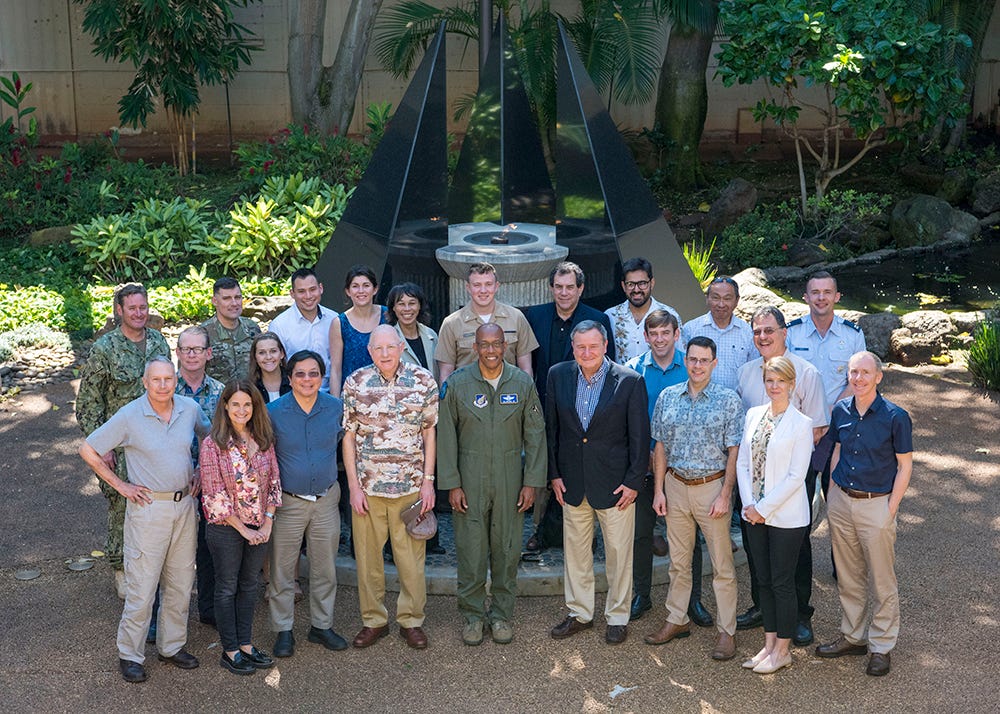
A group of 20 faculty and fellows participate in an orientation visit to Indo-Pacific Command headquarters, Honolulu, Hawaii, February 21–22, 2019, organized and sponsored by the U.S.-Asia Security Initiative. Photo courtesy of the U.S.-Asia Security Initiative

A group of 20 faculty and fellows participate in an orientation visit to Indo-Pacific Command headquarters, Honolulu, Hawaii, February 21–22, 2019, organized and sponsored by the U.S.-Asia Security Initiative. Photo courtesy of the U.S.-Asia Security Initiative

On February 21–22, faculty and fellows from Stanford University traveled to Oahu, Hawaii for an orientation visit at the United States Indo-Pacific Command (INDOPACOM), the U.S. military command responsible for the conduct of the U.S. military’s missions throughout the Indian and Pacific Oceans, and Asia.

The visit brought together scholars and researchers from Stanford, the Massachusetts Institute of Technology, the Council on Foreign Relations, and Macquarie University, Australia. Organized by the U.S.-Asia Security Initiative (USASI) and the Shorenstein Asia-Pacific Research Center at the Freeman Spogli Institute for International Studies (FSI), the visit included meetings with the commanders and staffs of INDOPACOM and five of its subordinate commands (U.S. Army Pacific, U.S. Pacific Fleet, U.S. Air Forces Pacific, U.S. Marine Forces Pacific, and U.S. Special Operations Command Pacific), and a tour of Arleigh Burke-class Aegis destroyer USS John Paul Jones (DDG-52).

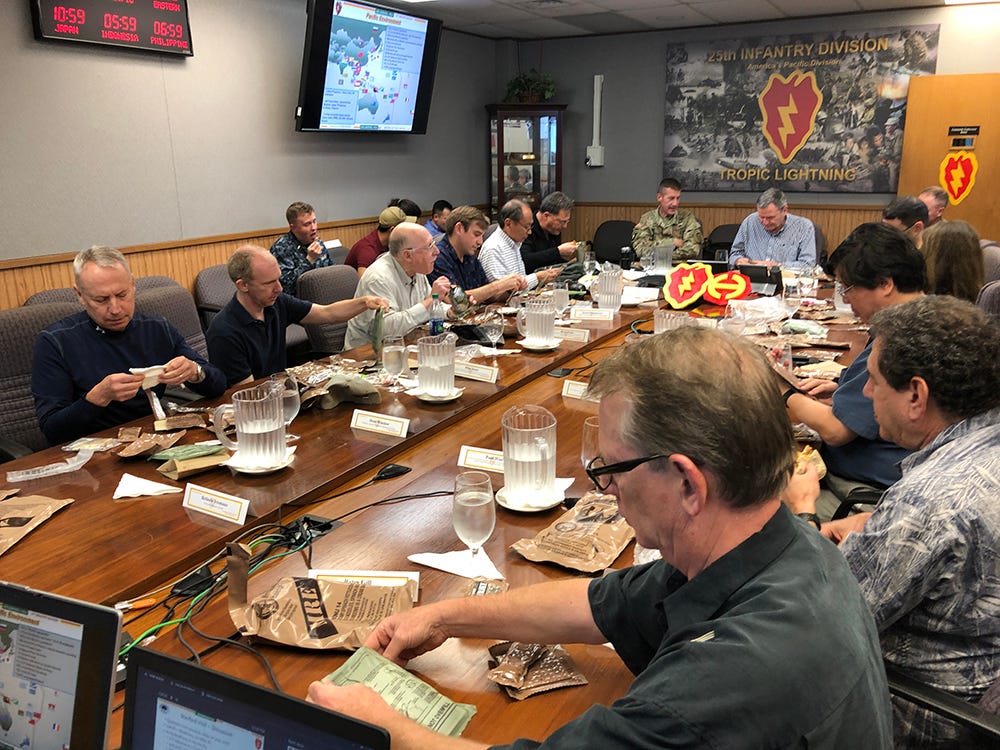
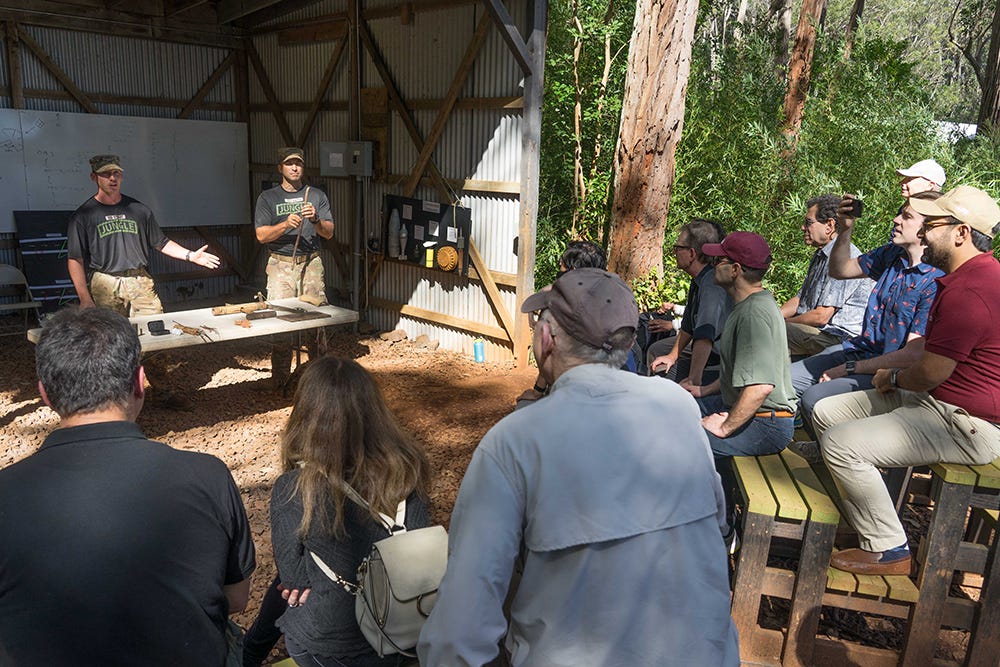
The visitors also interacted with the U.S. Army’s 25th Infantry Division’s leadership and the unit’s Jungle Training Center. The busy itinerary provided the group a superb opportunity to learn about INDOPACOM’s and its subordinate units’ threat assessments, capabilities, doctrine, regional partnerships, and readiness challenges.

These trips offer great access to America’s armed forces to those whose research focuses on or relates to national security issues, says Karl Eikenberry.

Karl Eikenberry, Director of the U.S.-Asia Security Initiative (USASI), a former U.S. ambassador to Afghanistan and himself a retired U.S. Army lieutenant general said: “USASI has over the past five years organized annual trips to U.S. military commands for Stanford FSI faculty and fellows. These trips offer great access to America’s armed forces to those whose research focuses on or relates to national security issues. The insights gained inform analysis, while the host organizations gain fresh perspectives different from those found within their commands.”

 
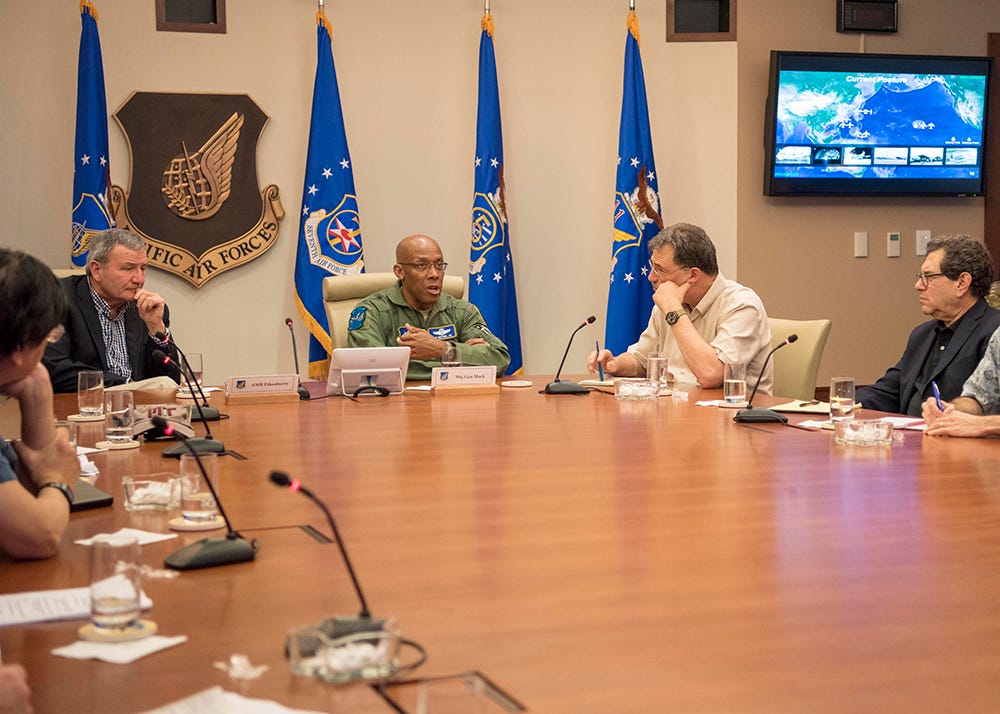
general speaks at a table
Photo courtesy of the U.S.-Asia Security Initiative

Discussions began on February 21st at Camp H.M. Smith, the Headquarters of INDOPACOM. Brigadier General Jonathan Braga, U.S. Army, SOCPAC Commander and his staff discussed his command’s unique capabilities and roles in both conventional and counterterrorist/counterinsurgency warfare operations. Major General Michael Minihan, U.S. Air Force, INDOPACOM Chief of Staff, then hosted a wide-ranging session on his organization’s implementation of the National Security Strategy and National Defense Strategy at a time of dynamic change within the region.

 
Table of attendees
Photo courtesy of Timothy R. Mungie

This was followed by a working lunch at the INDOPACOM Flag Mess with key staff members of MARFORPAC who explained U.S. Marine force posture and contingency missions throughout the Pacific Region. The Stanford group then proceeded to Hickam Field and met with General Charles Brown, Commander, PACAF, and his Deputy Commander, Major General Russell Mack. General Brown detailed the critical role played by airlift and airpower in the vast Indo-Pacific region, and the development of new concepts for the employment of U.S. Air Force capabilities in joint (inter-service) and combined (inter-allied) operations.

 
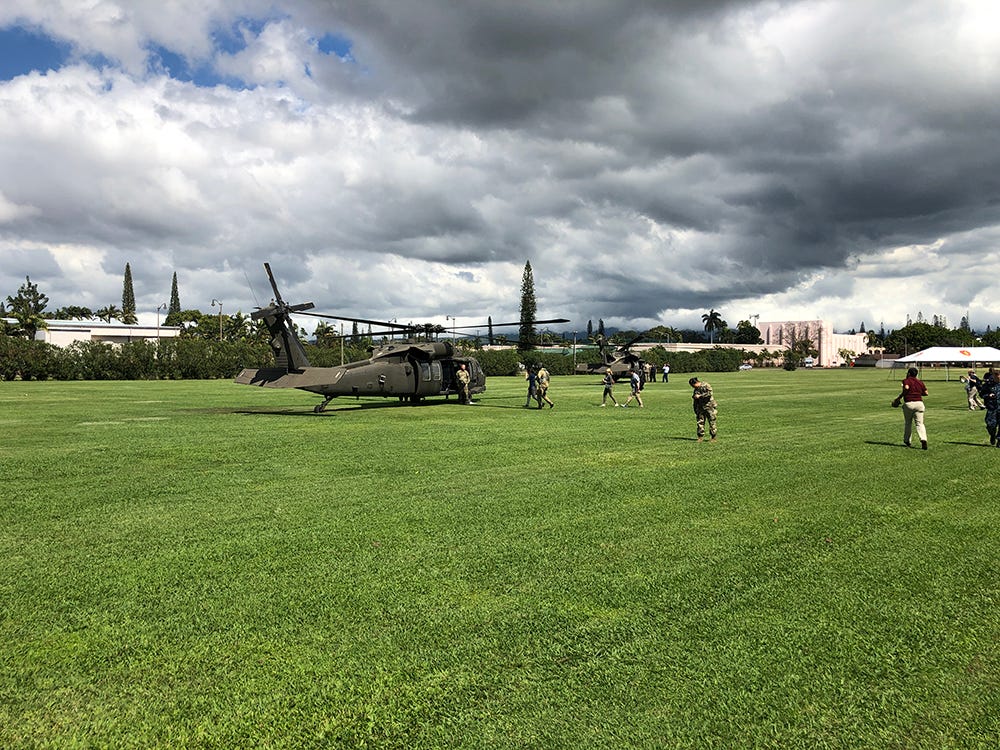
Helicopter parked in a field
Photo courtesy of Timothy R. Mungie

The visiting faculty and fellows then transited to Pearl Harbor for a tour of USS John Paul Jones led by Commanding Officer, Commander Jesse Mink, United States Navy, and Executive Officer, Commander Robert Watts, USN. Noteworthy was the destroyer’s sophisticated integrated air, surface, and underseas warfare systems, and the emphasis placed on resilience in high-end combat situations. Following the ship tour, the group attended a PACFLT command briefing chaired by the Commander, Admiral John Aquilino.

The dialogue made clear PACFLT’s emphasis on a holistic approach to deterrence and decisive operations, with an eye on future requirements. The first day of the trip ended with a working reception at the historic “Nimitz House” hosted by Admiral Aquilino, offering the attendees a chance to engage in conversations with the Commander and his staff.

The second day of the trip began with an introduction to the Daniel K. Inouye Asia-Pacific Center for Security Studies (APCSS), followed by expert presentations and breakout sessions on select topics including the Chinese One Belt One Road plan, the security of Taiwan, pandemic threats in the Indo-Pacific region, and cyber operations. The Stanford team then traveled to Fort Shafter for a meeting with Brigadier General Pete Andrysiak, U.S. Army and Chief of Staff, USARPAC. BG Andrysiak and the USARPAC staff elaborated on the evolving U.S. Army’s regional doctrine and extensive partnership activities.

A highlight of the group’s time in Oahu came with a visit to the U.S. Army’s 25th Infantry Division at Schofield Barracks, and the 25th ID Jungle Training center via UH-60 Blackhawk Helicopters. There Brigadier General J.B. Vowell, Assistant Division Commander, 25th Infantry Division and U.S. Army Hawaii (himself a former FSI Senior Military Fellow), discussed the division’s extensive missions throughout the region, including in the Korean Peninsula.

 
Atendees listen to a presenter
Photo courtesy of Francis Fukuyama

Faculty and fellows were also able to “get their boots (or at least tennis shoes) muddy” in the U.S. Army’s rugged training area in northern Oahu, with highly skilled soldiers demonstrating jungle warfare tactics and techniques. The trip ended with the participants hosting a reception at the Hale Koa Hotel Warriors Lounge for their many hosts over the past two days.

The trip to INDOPACOM Headquarters provided a rare opportunity for participants to talk directly with senior U.S. military leaders in the most important region of the world and to gain a better understanding of their perspectives and the many challenges that they are addressing. Faculty and fellows interacted with junior leaders at the tactical level, helping them gain an appreciation of the ethos of those serving at the cutting edge. The hosts all commented on the benefit of learning the views of scholars, many of whom have spent their academic careers writing about national security issues.

The trip provided fascinating insights into how the U.S. military views the rapidly evolving national security challenges in the Indo-Pacific region, says Larry Diamond.

“The trip provided fascinating insights into how the U.S. military views the rapidly evolving national security challenges in the Indo-Pacific region, and how it is organized to defend against the threats. You can read about much of this in the media and the journals, but there is just no substitute for being there, seeing our facilities on the ground, and engaging directly with the remarkable men and women (and one thing that struck me is that there are quite a number of women) who are responsible for our defense,” said Larry Diamond, senior fellow at the Hoover Institution and at the Center on Democracy, Development & the Rule of Law (CDDRL) at FSI.

FSI scholars particularly valued the opportunity to connect one-on-one.

“It was invaluable to meet and hear directly from the individuals and organizations who are working so hard to ensure our security,” said Center for International Security and Cooperation (CISAC) Senior Research Scholar Megan Palmer. For CISAC Pre-doctoral Fellow Erik Lin-Greenberg, “the opportunity to interact with decision-makers from tactical to strategic levels was incredibly valuable and helped inform my own research.”

Hero Image
pacaf hq photo Courtesy US-Asia Security Initiative
All News button
1
Subscribe to Military