Encina Hall, C143
616 Jane Stanford Way
Stanford, CA 94305-6055
650.723.9959
0
noras1@stanford.edu
nora_sulots_2023.jpg
Nora Sulots is a creative digital storyteller with over a decade of experience helping mission-driven organizations amplify their impact through digital strategy, brand development, and audience engagement. She currently serves as Communications Manager at Stanford University's Center on Democracy, Development and the Rule of Law (CDDRL), where she leads the design, creation, development, and execution of the center’s communication strategy to promote research, events, and scholarship.
Before joining Stanford, Nora spent eight years at the Jewish Community Federation and Endowment Fund in San Francisco, where she served as Senior Digital Marketing Manager. In that role, she led multi-channel campaigns across email, social media, and web platforms, expanding the organization’s reach, strengthening donor engagement, and building data-driven marketing programs to support organizational goals. Throughout her career, she has consistently focused on elevating institutional storytelling and fostering community connections.
Nora holds a Bachelor of Arts in Communication with an emphasis in media studies from the University of Puget Sound in Tacoma, WA. She is passionate about Oxford commas, karaoke, and the new and exciting ways technology can bring people together.
STANFORD, CA, April 27, 2021 — Stanford University’s Walter H. Shorenstein Asia-Pacific Research Center (APARC) announced today that Burmese journalist Swe Win is the recipient of the 2021 Shorenstein Journalism Award. An acclaimed investigative journalist and human rights defender, Swe Win is the co-founder and editor-in-chief of Myanmar Now, an independent news agency that produces features, analysis, and investigative reports on life in the country in both Burmese and English. Presented annually by APARC, the Shorenstein award is conferred upon a journalist who has contributed significantly to a greater understanding of Asia through outstanding reporting on critical issues affecting the region. Swe Win will receive the award in fall quarter 2021.
Throughout his journalistic career, Swe Win has focused on underreported cases involving physical injury, wrongdoing, and miscarriage of justice in Myanmar. Under his leadership, Myanmar Now has gained recognition for its in-depth, unflinching reports of crimes against the Rohingya and spotlights on the lives of Myanmar’s impoverished communities, for criticizing ultranationalist Buddhist monks, and for its bold coverage of Aung San Suu Kyi’s administration and the Myanmar military, the Tatmadaw. Since the February 1, 2021 military coup, the Myanmar Now team has continued its brave coverage amid physical threats, violence, police raids, and arrests. Swe Win currently leads the Yangon-based Myanmar Now 40-member editorial team from exile and his newsroom is in hiding.
Swe Win has set a shining example to others with his undaunted commitment to advancing human rights and freedom of expression in Myanmar. His work demonstrates the moral force of independent, investigative journalism to speak truth to power.
Gi-Wook Shin
Director, Shorenstein APARC
Swe Win has faced multiple encounters with the military due to his investigative journalism work. In August 2019, soon after Myanmar Now published exposés of the vast business interests of top generals including Min Aung Hlaing, the commander-in-chief of the country’s armed forces, he sustained a gunshot wound while traveling in Rakhine State, a targeted shooting attack in which both civilian and military officials seem to have been involved. Two years earlier, he was arrested and had to defend himself against defamation charges for a Facebook post critical of U Wirathu, a fundamentalist Buddhist monk known for his anti-Muslim rhetoric. In 1998, as a college student during the time of Myanmar’s military regime, he was apprehended for joining the democracy movement and held for seven years as a political prisoner on national security-related charges.
Following his release from prison, Swe Win earned a Master’s degree in journalism from the University of Hong Kong, then worked for the Irrawaddy Magazine and freelanced for international publications including The New York Times and Al Jazeera. When the junta-era media censorship was lifted in 2012, he set up an independent newspaper, The Yangon Globe, and in 2015 cofounded Myanmar Now.
“Swe Win has set a shining example to others with his undaunted commitment to advancing human rights and freedom of expression in Myanmar,” said Gi-Wook Shin, Shorenstein APARC director. “His work demonstrates the moral force of independent, investigative journalism to speak truth to power, and he now leads a courageous, resilient fight for press freedom in the face of brutal attacks on democracy and liberty. It is our honor to recognize him with the Shorenstein Journalism Award.”
Swe Win is the recipient of the 2019 Ramon Magsaysay Award for Emergent Leadership, which is regarded as Asia's equivalent of the Nobel Prize, the 2017 European Union’s Schuman Award for Human Rights, and the 2016 Presidential Certificate of Honor for Social Service through Journalism from the Myanmar Ministry of Information for his groundbreaking investigation into years-long abuse of domestic workers at a Yangon tailor shop.
The Shorenstein Journalism Award, which carries a $10,000 cash prize, honors the legacy of APARC’s benefactor, Mr. Walter H. Shorenstein, and his twin passions for promoting excellence in journalism and understanding of Asia. “This year marks the twentieth anniversary of the Shorenstein Award,” noted Shin. “At a time when the Asia-Pacific region has the biggest number of ‘Predators of Press Freedom,’ to quote Reporters Without Borders, we are grateful more than ever to the Shorenstein family for its support of our Center’s mission and the journalism award program, and to the members of the award selection committee for their expertise and service.”
The selection committee for the Shorenstein Journalism Award includes Wendy Cutler, Vice President and Managing Director, Washington, D.C. Office, Asia Society Policy Institute; James Hamilton, Hearst Professor of Communication, Chair of the Department of Communication, and Director of the Stanford Journalism Program, Stanford University; Raju Narisetti, Publisher, McKinsey Global Publishing, McKinsey and Company; Philip Pan, Weekend Editor and former Asia Editor, The New York Times; and Prashanth Parameswaran, Senior Columnist, The Diplomat.
Nineteen journalists have previously won the Shorenstein award, including most recently Tom Wright, the co-author of the bestseller Billion Dollar Whale and a long-time Asia reporter; the internationally-esteemed journalist and press freedom champion Maria Ressa, CEO and executive editor of the Philippine news platform Rappler; Anna Fifield, formerly the Washington Post’s Beijing Bureau Chief and a veteran North Korea watcher; and Siddharth Varadarajan, the founding editor of the Wire and former editor of The Hindu.
APARC will share information about the 2021 Shorenstein Journalism Award program featuring Swe Win in the fall quarter.
The Diplomat magazine features the granting of our 2021 Shorenstein Journalism Award to Swe Win along with the 2021 UNESCO/ Guillermo Cano World Press Freedom to Maria Ressa, our 2019 Shorenstein Award winner. "Two journalists’ work encapsulates both the resilience of the region’s media and the increasing threats to its survival," writes Southeast Asia Editor Sebastian Strangio.
Terms of Engagement: Ambassador Scot Marciel on U.S.-Southeast Asia Relations
The book Ambassador Marciel is writing at Stanford examines policy issues from the implications of the Myanmar crisis to the future of America’s relations with other Southeast Asian nations and the prospects for a U.S. strategic regional focus.
Using the UN to Create Accountability for Human Rights Crimes in North Korea
Experts on human rights agree that the UN needs to work through multiple channels to support ongoing investigations and build evidence for future litigations in order to create accountability and pressure the DPRK to desist in committing human rights crimes.
U.S. and Japan Gear Up for a New Era of Competition with China
The time is near when other Asian nations will have to pick a side in the great power competition between the United States and China, says Japan Program Director Kiyoteru Tsutsui.
Photograph: Thet Htoo for the Mekong Review - https://mekongreview.com/cause-and-karma
All News button
1
Subtitle
An esteemed investigative journalist and human rights defender, Swe Win is the recipient of the twentieth Shorenstein Award. He currently leads the editorial team of the independent news agency Myanmar Now from exile and his newsroom is in hiding.
In a webinar dated, February 12, 2021, a panel of Stanford University scholars shared their reflections on the legacy of the January 25, 2011 Uprising in Egypt. Marking the 10-year anniversary of the uprising and the ouster of Hosni Mubarak, the panel examined the trajectory of authoritarianism in the country over the past decade. Moderated by ARD Associate-Director Hesham Sallam, the panel included former CDDRL Visiting Scholar Nancy Okail, Stanford Professor of History Emeritus Joel Beinin, and CDDRL Senior Research Scholar Amr Hamzawy. The panelists addressed a variety questions including: How have political developments in Egypt and elsewhere in recent years informed our understanding of the January 25 Uprising and its significance? In what ways have authoritarian institutions adapted in the aftermath of the 2011 uprising and how have they shaped the prospects for political change and/or stability? Where are the sites of political contestation and resistance in today’s Egypt?
This is a virtual event. Please click here to register and generate a link to the talk.
The link will be unique to you; please save it and do not share with others.
Tuesday, April 27
6:00 pm – 7:15 pm (PST)
Wednesday, April 28
9:00 am – 10:15 am (China)
A large amount of ink has been spilled in the last few years--and even more so since COVID-19--in the U.S. regarding American perceptions of the P.R.C. Relatively little, however, has been conveyed regarding how China might view the U.S. today. In this talk, we bring together two eminent professors, Professor Jia Qingguo and Professor Wang Dong, from the School of International Studies, Peking University, to examine how policymakers, professionals, and average citizens in China might perceive the United States and what that might imply for the U.S.-China bilateral relationship. Dr. Thomas Fingar, Shorenstein APARC Fellow, will moderate the conversation.
This event is part of Shorenstein APARC's spring webinar series.
Image
Thomas Fingar is a Shorenstein APARC Fellow in the Freeman Spogli Institute for International Studies at Stanford University. He was the inaugural Oksenberg-Rohlen Distinguished Fellow from 2010 through 2015 and the Payne Distinguished Lecturer at Stanford in 2009. From 2005 through 2008, he served as the first deputy director of national intelligence for analysis and, concurrently, as chairman of the National Intelligence Council. Fingar served previously as assistant secretary of the State Department’s Bureau of Intelligence and Research (2000-01 and 2004-05), principal deputy assistant secretary (2001-03), deputy assistant secretary for analysis (1994-2000), director of the Office of Analysis for East Asia and the Pacific (1989-94), and chief of the China Division (1986-89). Between 1975 and 1986 he held a number of positions at Stanford University, including senior research associate in the Center for International Security and Arms Control. Fingar's most recent books are Fateful Decisions: Choices that will Shape China’s Future, co-edited with Jean Oi (Stanford, 2020), and From Mandate to Blueprint: Lessons from Intelligence Reform (Stanford University Press, 2021).
Image
Jia Qingguo acquired his PhD at the Department of Government, Cornell University. He has been a member of the Standing Committee of the 11th, 12th and 13th National Committees of the Chinese People’s Political Consultative Conference (CPPCC), and was elected in March 2013 as a member of the Committee of Foreign Affairs of the 13th CPPCC. He is a professor and doctoral supervisor, and the former Dean of the School of International Studies at Peking University. He is a member of the Standing Committee of the Central Committee of the China Democratic League and the Director of its Education Committee. He is the Vice Chairman of the Beijing Municipal Committee, Director of the Research Center for International Economic Strategy of China, a member of the Academic Evaluation Committee of the China Foundation for International and Strategic Studies, a member of the Academic Committee of Quarterly Journal of International Politics of Tsinghua University, as well as an adjunct professor at Nankai University and Tongji University. Jia is also a senior researcher of the Hong Kong and Macao Research Institute under the Development Research Center of the State Council. His research mainly focuses on international politics, China-U.S. relations, China’s diplomacy, Cross-Strait relations, China’s rise, and the adjustment of China’s diplomacy. His major publications include: China’s Diplomacy in the 21st Century; Unrealized Reconciliation: China-U.S. Relations in the Early Cold War; and Intractable Cooperation: Sino-U.S. Relations After the Cold War.
Image
Wang Dong obtained his PhD in Politics at the University of California, Los Angeles (UCLA). He is now a full professor and doctoral supervisor at the School of International Studies, Executive Director of the Institute for Global Cooperation and Understanding, Vice President of the Office of Humanities and Social Sciences, and Deputy Secretary-General of the American Studies Center (National and Regional Research Base of the Ministry of Education) of Peking University. In addition, he is also the Secretary-General of the Academic Committee of the Pangoal Institution, member of the Steering Committee of the East Asia Security Forum of Western Returned Scholars Association, a member of the Advisory Committee of the Global Times and The Carter Center “Forum for Young Chinese and American Scholars” and a researcher of the Peace in East Asia Program of the Department of Peace and Conflict Research at Uppsala University, Sweden. Wang has led major programs of the National Social Science Fund of China, undertaken major projects of the Ministry of Education, Ministry of Foreign Affairs, and Ministry of Science and Technology, and been funded by the National Social Science Fund of China many times. He was shortlisted for “Munich Young Leader” in 2016 and Beijing “Outstanding Young Scientist” in 2018. He is interested in research on international relations theory, the Cold War, US diplomacy, China-US relations, etc.
Thomas Fingar
<br>Shorenstein APARC Fellow, Stanford University<br><br>
Jia Qingguo (贾庆国)
<br>Former Dean and Professor, School of International Studies, Peking University<br><br>
Wang Dong (王栋)
<br>Professor, School of International Studies, Peking University; Executive Director, Institute for Global Cooperation and Understanding (iGCU), Peking University<br><br>
This talk is based on the speakers’ recently published edited volume The Unfinished Arab Spring: Micro-Dynamics of Revolts between Change and Continuity. Adopting an original analytical approach in explaining various dynamics at work behind the Arab revolts and giving voice to local dynamics and legacies rather than concentrating on debates about paradigms, we highlight micro-perspectives of change and resistance as well as of contentious politics that are often marginalized and left unexplored in favor of macro-analyses. First, we re-examine the stories of the uprisings in Tunisia, Egypt, Syria, Morocco and Algeria through diverse and novel perspectives, looking at factors that have not yet been sufficiently underlined but carry explanatory power for what has occurred. Second, rather than focusing on macro-comparative regional trends – however useful they might be – we focus on the particularities of each country, highlighting distinctive micro-dynamics of change and continuity.
SPEAKERS BIO
Image
Fatima el Issawi is a Reader in Journalism and Media Studies at the University of Essex. Her research focuses on the intersection between media, politics and conflicts in transitional contexts to democracy in North Africa. She is the Principal Investigator for the research project “Media and Transitions to Democracy: Journalistic Practices in Communicating Conflicts- the Arab Spring” funded by the British Academy Sustainable Development Programme, looking at media’s impact on communicating political conflicts in post uprisings in North Africa. Since 2012, el Issawi has been leading empirical comparative research projects on the interplay between media and political change, funded by Open Society Foundation and the Middle East Centre/LSE, covering Egypt, Tunisia, Morocco, Libya and Algeria. El Issawi’s expertise crosses journalism, public communication, policy and academia. She has over fifteen years of experience as international correspondent in conflict zones in the MENA region. She is the author of “Arab National Media and Political Change” investigating the complex intersections between traditional journalists and politics in uncertain times of transitions to democracy.
Image
Francesco Cavatorta is full professor of political science and director of the Centre Interdisciplinaire de Recherche sur l’Afrique et le Moyen Orient (CIRAM) at Laval University, Quebec, Canada. His research focuses on the dynamics of authoritarianism and democratization in the Middle East and North Africa. His current research projects deal with party politics and the role of political parties in the region. He has published numerous journal articles and books.
The 2018 blockbuster Crazy Rich Asians is many people’s first and only experience seeing Southeast Asia portrayed onscreen. Kevin Kwan’s enthralling, uber-rich characters jet-set across glittering scenes of cosmopolitan Singapore and paradisiacal beaches in Malaysia. But for Gerald Sim, APARC’s 2016-17 Lee Kong Chian Fellow at the Southeast Asia Program, the scope of cinema in Southeast Asia is much broader than the occasional Hollywood breakout success.
In a new book, Postcolonial Hangups in Southeast Asian Cinema, Sim examines how countries in Southeast Asia navigate the legacies of their unique colonial histories through film media. His writing focuses on Singapore, Malaysia, and Indonesia and how their cultural identities and postcolonial experiences are stylistically portrayed across commercial films, art cinema, and experimental works.
Sim explores the nuance of these works beyond the typical tropes of hybridity and syncretism in postcolonial identity. His analysis unpacks themes such as Singapore’s preoccupation with space, the importance of sound in Malay culture, and the ongoing investment Indonesia has made into genre and storytelling. Taken together, the book helps situate the regional cinematic traditions and local ideologies in the broader narrative of globalization.
The book builds on research Sim undertook as a fellow at APARC with support from the Lee Kong Chian NUS-Stanford Fellowship on Southeast Asia. He is currently an associate professor of Film and Media Studies at Florida Atlantic University, where he continues to teach about and research the thriving but understudied contributions of Southeast Asian film to world cinema.
The Lee Kong Chian Fellowship is the core of the Lee Kong Chian NUS-Stanford Initiative on Southeast Asia, a joint effort established in 2007 by the National University of Singapore and Stanford University to raise the visibility, extent, and quality of scholarship on contemporary Southeast Asia. The infrastructure for research pursued through the fellowship is provided by the Faculty of Arts and Social Sciences at NUS and the Southeast Asia Program in the Walter H. Shorenstein Asia-Pacific Research Center (Shorenstein APARC) at Stanford.
Call for Stanford Student Applications: APARC Hiring 2020-21 Research Assistants
To support Stanford students working in the area of contemporary Asia, the Shorenstein Asia-Pacific Center is offering research assistant positions for the fall, winter, and spring quarters of the 2020-21 academic year.
Gerald Sim, a former LKC Fellow at APARC's Southeast Asia Program and his new book 'Postcolonial Hangups in Southeast Asian Cinema.'
All News button
1
Subtitle
Gerald Sim, a former Lee Kong Chian Fellow with the Southeast Asia Program, explores how Southeast Asian identities, histories, and cultures are portrayed in film in a new book, ‘Postcolonial Hangups in Southeast Asian Cinema.’
Landy said there are two directions to go: “One is to plunge yourself deeper into misery and make yourself even more afraid, and the other is, well, not escapism exactly, but the kind of writing that keeps your mind alive, alert and active.”
STANFORD, CA, April 8, 2020 — Stanford University’s Walter H. Shorenstein Asia-Pacific Research Center (APARC) is pleased to announce that journalist and author Tom Wright is the recipient of the 2020 Shorenstein Journalism Award for excellence in coverage of the Asia-Pacific region. Wright, who over the past twenty-five years has worked mainly in South and Southeast Asia, is the coauthor of the New York Times bestseller Billion Dollar Whale, which unravels the story of one of the world's greatest financial scandals involving the multibillion-dollar looting of the Malaysian sovereign wealth fund 1Malaysia Development Bhd (1MDB). The book builds on Wright’s multiyear investigative reporting for the Wall Street Journal, where he most recently served as Asia economics editor. In the coming fall quarter, Wright will receive the award at a ceremony and headline a panel discussion at Stanford.
Wright started his career with Reuters in Indonesia in the 1990s at a time when Gen. Suharto’s military dictatorship was crumbling. During the Asian financial crisis of 1997-98, he joined Dow Jones Newswires in Bangkok, later moving to the Wall Street Journal. He has investigated corruption in Indian companies, the failure of the U.S.’s civilian aid program for Pakistan, and was one of the first journalists to arrive at the scene of the raid in which Navy SEALs killed Osama bin Laden. His 2013 award-winning series on the Rana Plaza factory disaster in Bangladesh, which killed over 1,000 people, exposed how international garment manufacturers turned a blind eye to safety violations to reduce costs.
In 2015, he began investigations into the 1MDB scandal, one of the largest financial frauds of all time in which bankers at Goldman Sachs helped a young Malaysian financier steal at least $4 billion from Malaysian state fund 1MDB. The three-year investigation revealed the degree to which Western institutions, from Wall Street banks, law firms, auditors, and even Hollywood film companies, ignore malfeasance in the pursuit of profits. Wright’s work sparked investigations by law enforcement and regulators in multiple countries and outrage in Malaysia, where the ruling coalition, after 61 years in power, suffered a landslide defeat in a shocking 2018 election.
“Throughout his career, Tom Wright’s consummate reporting and persistent investigations have repeatedly shone a light on major Asian affairs and the complicity of Western institutions in the affliction of corruption in Asia,” said Gi-Wook Shin, Shorenstein APARC director. “His work embodies an unwavering commitment to the pursuit of truth and to advancing a critical consideration of both Asian and Western societies. We are delighted to recognize him with the Shorenstein Journalism Award.”
Presented annually by APARC, the Shorenstein award, which carries a $10,000 cash prize, honors the legacy of APARC’s benefactor, Mr. Walter H. Shorenstein, and his twin passions for promoting excellence in journalism and understanding of Asia. “We are grateful to the Shorenstein family for its support of our Center and its mission and to the members of the award selection committee for their expertise and service,” noted Shin.
The selection committee for the Shorenstein Journalism Award, which unanimously chose Wright as the 2020 honoree, includes Wendy Cutler, vice president and managing director, Washington, D.C. Office, Asia Society Policy Institute; James Hamilton, Hearst Professor of Communication, chair of the Department of Communication, and director of the Stanford Journalism Program, Stanford University; Raju Narisetti, global publishing director-elect, McKinsey & Company; Philip Pan, weekend editor, former Asia editor, the New York Times; and Prashanth Parameswaran, senior editor, the Diplomat.
Eighteen journalists have previously received the Shorenstein award, including most recently Maria Ressa, CEO and executive editor of Rappler; Anna Fifield, the Washington Post’s Beijing bureau chief and long-time North Korea watcher; Siddharth Varadarajan, founding editor of the Wire; Ian Johnson, a veteran journalist with a focus on Chinese society, religion, and history; and Yoichi Funabashi, former editor-in-chief of the Asahi Shimbun.
Information about the 2020 Shorenstein Journalism Award ceremony and panel discussion featuring Wright will be forthcoming in the fall quarter.
Shorenstein APARC
Stanford University
Encina Hall E301
Stanford, CA 94305-6055
0
junwa@stanford.edu
Visiting Student Researcher at APARC, 2019-20
jun_wang.jpg
Jun Wang joined the Walter H. Shorenstein Asia-Pacific Research Center as visiting student researcher for the spring and summer quarters of 2020 from Peking University, where she serves as a Ph. D. candidate at School of Government. At APARC, she worked with Professor Gi-Wook Shin and Professor Jean Oi conducting research on Chinese nationalism in the Internet era.
Around the world, democracy is in retreat. In its Freedom in the World 2019 report, the independent watchdog organization Freedom House records the 13th consecutive year of global declines in political rights and civil liberties. “More authoritarian powers are now banning opposition groups or jailing their leaders, dispensing with term limits, and tightening the screws on any independent media that remain,” and “even long-standing democracies have been shaken by populist political forces,” shows the annual study. Internet freedom, too, continues to decline globally amid the crisis of social media, unveils Freedom House’s newly released Freedom on the Net 2019 report. Social media platforms – once considered liberation technologies – have become a conduit for surveillance, disinformation, and electoral manipulation, and “are now tilting dangerously toward illiberalism, exposing citizens to an unprecedented crackdown on their fundamental freedoms.”
These troubling developments are also manifested throughout the Asia-Pacific, where continuous scaling back in U.S. engagement and leadership is raising doubts about American power and purpose in the region, thus empowering forces that undermine democratic norms and processes.
At Shorenstein APARC, we are committed to building a solid foundation of education, knowledge, and dialogue about the critical challenges facing Asian nations and U.S.-Asia relations. That’s why we are dedicating a major portion of our programming this fall quarter and throughout the entire year to elucidating the threats to rights and liberties in the Asia-Pacific region.
The Battle for Truth and Press Freedom in the Philippines
“This is an existential moment for global power structures, turned upside down by technology. When journalists globally are under attack, democracy is under attack.” With these words, the internationally-esteemed investigative journalist and press freedom champion Maria Ressa opened her keynote address upon receiving the 2019 Shorenstein Journalism Award.
As CEO and executive editor of Rappler, she has led the Philippine independent news platform in shining critical light on the Duterte administration's drug war and unprecedented number of killings in the country. President Duterte in turn has made no secret of his dislike for Ressa and Rappler, accusing the platform for carrying "fake news." Ressa has been arrested twice this year, accused of corporate tax evasion and of violating security laws, and slapped with charges of cyber libel for a report that was published before the libel law came into effect. Since Duterte’s election in summer 2016, the Philippine government has filed at least 11 cases and investigations against Ressa and Rappler. “And all because I’m a journalist,” she says.
Ressa detailed the devastating effects that disinformation has had on press freedom, democracy, and civic discourse in the Philippines. “Our dystopian present is your dystopian future if nothing significant is done,” she cautioned. She was joined on the 18th annual Journalism Award panel by Stanford’s Larry Diamond, senior fellow at FSI and the Hoover Institution, and Raju Narisetti, director of the Knight-Bagehot Fellowship in Economics and Business Journalism and professor of professional practice at Columbia Journalism School.
Watch Ressa’s keynote and the entire panel proceedings:
North Korea continues to be one of the world’s worst human rights violators, ranking at the bottom of Freedom House’s list of countries designated as Not Free with the worst aggregate scores for political rights and civil liberties. Although North Korea has experienced some degree of social and economic change in recent years, the Kim Jong Un regime continues to tightly control access to information, suppress all dissent, heavily surveil residents, and subject political prisoners to torture, forced labor, and other atrocities.
As momentum for U.S.-DPRK diplomatic negotiations has ebbed and flowed since summer 2018, all eyes have been on the questions surrounding the North Korean nuclear problem, while the human rights problem has received little attention. However, argues APARC’s Koret Fellow in Korean Studies Robert R. King, addressing the North Korean human rights problem is essential to moving the country on denuclearization and security issues.
Ambassador King, former special envoy for North Korean human rights issues at the Department of State, recently spoke at a seminar hosted by APARC’s Korea Program. Creating pressure on the North Korean government from within by its own people is the only way we’re going to make progress on the security front, he claimed. “If we can help generate greater interest on the part of the people in what is happening with their own government, we can create the kind of constraints that democracy imposes on its leadership […] and that is why we need to focus attention, as well as on negotiating with North Korea, on access to information and human rights.”
Listen to highlights from Ambassador King’s talk:
Hong Kong: City in Turmoil
In Hong Kong, millions of people have been protesting for months against rights violations and increasing interference by the Chinese government in local affairs. On October 1, while the People’s Republic of China celebrated its 70th anniversary with a massive National Day parade in Beijing, on the other side of the border, Hong Kong experienced one of its most violent and chaotic days.
With those contrasting images still fresh on everyone’s minds, APARC and the China Program, along with FSI And the Center for East Asian Studies, co-hosted an expert panel that explained the root causes of Hong Kong’s unremitting protests, examined the future of “one country, two systems,” and considered how the United States and the international community should best respond.
Former Chief Secretary for Administration of the Hong Kong Government (1993-2001), the Honorable Anson Chan, delivered a piercing keynote address, followed by a discussion featuring Harry Harding, Professor of Public Policy at the University of Virginia, David M. Lampton, APARC/FSI Oksenberg-Rohlen Fellow, and Professor Ming Sing of Hong Kong University of Science and Technology.
Since 1997, Chan asserted, Hong Kong SAR’s successive chief executives have progressively failed to reassure the Hong Kong people that they would do their utmost to uphold “one country, two systems” and to defend Hong Kong’s autonomy. Instead, she argued, they have increasingly come across as “mouthpieces of the central government, towing the Beijing line.” Chan also suggested that “some years back, Beijing began to both lose confidence in the judgment and competence of the Hong Kong administration and to fear that growing sense of people’s identity as ‘Hong Kongers’ rather than Chinese citizens could pose a threat to the long-term, successful integration of Hong Kong into the motherland.” She closed her speech urging the Beijing leadership “to act with greater confidence and to trust us more completely with stewardship of our own future by allowing us to elect our own leaders.”
China’s mass internment of Uighurs and other Muslims in “reeducation” camps and detention facilities and its deployment of high-tech surveillance and police tactics in Xinjiang Uyghur Autonomous Region have been interpreted as a superpower’s attempt to annihilate the distinct identities of minority groups. Approximately ten million Muslim minorities in the region are under tight control, and over one million Uyghurs and other Turkic Muslims have allegedly disappeared into internment camps. While Beijing characterizes the camps as vocational training centers and has claimed that most of the detainees have been released, evidence for these claims is difficult to verify, as information dissemination regarding the region to the outside world is closely guarded.
To shed light into the crisis in Xinjiang, APARC convened a multidisciplinary panel of experts who provided historical context and critical social scientific analysis of the events unfolding in the region.
Image
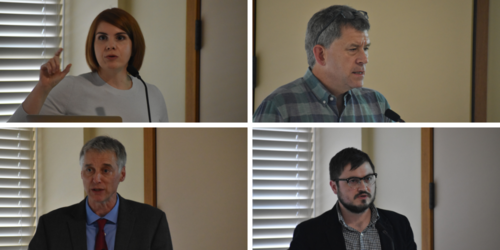
From top left, clockwise: Lauren Hansen Restrepo, James Millward,, Darren Byler and Gardner Bovingdon.
James Millward, professor of Inter-societal history at Georgetown University’s Walsh School of Foreign Service, reviewed the historical background for the PRC assault on non-Han or non-Chinese culture in Xinjiang. Beginning in the early 2000s, the assault has included the razing of old Kashgar; the discouraging and then illegalizing of Muslim symbols such as head gear, prayer, and fasting in Ramadan; the disappearance of Uyghur script; and the securitization of the province by using police patrol, surveillance technologies, facial recognition, and biodata monitoring. The PRC hasn’t applied a single, top-down ethnic policy in Xinjiang, said Millward, but rather has rolled out different tactics it experimented with on local levels in different areas.
Lauren Hansen Restrepo, assistant professor in growth and structure of cities at Bryn Mawr College and an expert on Chinese development planning and urbanization in Xinjiang, explained how we got to the current crisis in the region by connecting seemingly disparate phenomena. She described the shifts in state power in Xinjiang and how, since 2014, “regional planning has broken every logic of urban planning in China,” resulting in the isolation and subordination of Uyghur-dominated urban centers and in the ossification of cities, as control has been seized from local governments and given to socialist land masters.
Anthropologist Darren Byler, whose research focuses on Uyghur dispossession and "terror capitalism" in the city of Ürümchi, the capital of Xinjiang, explained how, amid mass migration of Han people into the resource-rich region, Uyghurs had mostly been excluded from the new economy and how their identity as contemporary Muslims supported a vibrant public sphere not controlled by the state. The Chinese state, in turn, has merged Islamism with radicalism extremism. From the Chinese state and industry perspective, Byler said, the repression of Xinjiang’s Muslims promises stability and the detention camps are used as carriers of economy and new sources of cheap labor.
Indiana University’s Gardner Bovingdon, whose research focuses on politics in contemporary Xinjiang and the region’s modern history, reverted to the question of how we got to the current crisis, which he characterized as “one of the great state-engineered human rights disasters of our time.” He argued that, in the case of Xinjiang, the Chinese party transported and exacerbated a set of policies that had previously been applied to dealing with the Tibet problem. These policies, Bovingdon suggested, “are signs of a flailing, terrified party that doesn’t know what to do with Uighurs, but also feels no constraints from the international community on its behavior. And so the biggest problem now is to find a way to put constraints on a system that has operated untrammeled with devastating consequences.”
The panel "Xinjiang’s Muslims and the PRC" was cosponsored with the Center for Democracy, Development and the Rule of Law.
Hero Image
Clockwise from upper left: Relatives of alleged extrajudicial killings wear veils as they take part in a protest versus the drug war killings outside the military and police headquarters on July 17, 2019 in Manila, Philippines (Photo credit: Ezra Acayan/Getty Image); Workers pass propaganda posters as they cycle through Hungnam Fertilizer Complex on February 4, 2019 in Hamhung, North Korea (Photo credit: Carl Court/Getty Images); Pro-democracy protesters react as police fire tear gas during a demonstration on October 20, 2019 in Hong Kong (photo credit: Anthony Kwan/Getty Images); A mix of ethnic Uyghur and Han shopkeepers hold large wooden sticks as they are trained in security measures on June 27, 2017 next to the old town of Kashgar, in the far western Xinjiang province, China (photo credit: Kevin Frayer/Getty Images).


![[Top left] Gi-Wook Shin; [top right] Roberta Cohen; [bottom left] Tomás Ojea Quintana; [bottom right] Joon Oh](https://fsi9-prod.s3.us-west-1.amazonaws.com/s3fs-public/styles/375x211_x2/public/hero/korea_un_north_korea_human_rights_hero.png?h=c4d9845d&itok=GwX4NXpL)





![[Left] Gerald Sim, [Right] the cover of 'Postcolonial Hangups in Southeast Asian Cinema'](https://fsi9-prod.s3.us-west-1.amazonaws.com/s3fs-public/styles/895x498_x2/public/hero/sim_book_hero_1.png?h=c4d9845d&itok=2jUgpQxa)