
error
- Could not retrieve the oEmbed resource.


Cyber Initiative tackles Internet technology concerns
News Type
News
Date
Paragraphs
Stanford University today launched the Stanford Cyber Initiative to apply broad campus expertise to the diverse challenges and opportunities that cybersecurity, cyberspace and networked information pose to humanity. Information security has an expanding and deepening role in virtually every facet of our personal, social, governmental and economic lives. Yet the Internet is decentralized and vulnerable to malicious use. How does society protect its core values in the face of the promise and perils of digital information? And, how does society adapt to changing technologies? These are the type of questions that Stanford researchers will study, thanks to the jumpstart given by a $15 million grant from the William and Flora Hewlett Foundation. Stanford's initiative will be highly interdisciplinary in building a new policy framework for cyber issues. It will draw on the campus' experience with multidisciplinary, university-wide initiatives to focus on the core themes of trustworthiness, governance and the emergence of unexpected impacts of technological change over time. "Our increasing reliance on technology, combined with the unpredictable vulnerabilities of networked information, pose future challenges for all of society," said Stanford President John Hennessy. "We share the Hewlett Foundation’s goal to seek a robust understanding of how new technologies affect us all at the most fundamental human levels. Stanford has a long history of fostering interdisciplinary collaborations to find thoughtful and enlightened answers to these paramount questions." Building on Stanford strengths The Stanford Cyber Initiative will build upon the university's already extensive inquiry and research into Internet security. In doing so, Stanford has drawn on connections with industry and government by establishing, for example, a "cyber boot camp" for U.S. congressional staff (a Freeman Spogli Institute for International Studies/Hoover Institution collaboration,) a conference on the "ethics of data in civil society" and an ongoing "security conundrum" speaker series on cyber issues. The initiative will work with Stanford’s existing research hubs addressing cyber issues, including those in the Computer Security Lab in the Department of Computer Science, the Freeman Spogli Institute's Center for International Security and Cooperation, the Hoover Institution and the Law School's Center for Internet and Society. FSI's Center on Democracy, Development, and the Rule of Law will also play a key role in the initiative. The initiative will launch immediately and develop faculty seminars and conferences, organize working groups of faculty and students to tackle policy-relevant problems in information security, and provide support for internal research awards, teaching and curriculum development. Collaborations with industry and government are a vital part of the initiative. The Stanford Cyber Initiative includes roles for faculty and students across a wide swath of research disciplines – computer science, law, the social sciences, engineering, political science and education, among others. And it will also enlist Stanford alumni who are leaders in the policy and technology fields. For those seeking to participate, information is available on the Stanford Cyber Initiative website. A central hub "We are deeply grateful to the Hewlett Foundation for recognizing Stanford's ongoing work and future potential in this area. With the help of their generous grant, this initiative will grow into a central presence on campus that more broadly comprehends the possibilities and perils of networked information," said Stanford law Professor George Triantis, who will chair the steering committee for the initiative. The committee currently includes professors Jeremy Bailenson (communications,) Stephen Barley (management science and engineering,) Ian Morris (classics and history,) John Mitchell (computer science and electrical engineering,) Dan Boneh (computer science and electrical engineering,) Amy Zegart (Hoover Institution and CISAC) and Barbara van Schewick (law). Mariano-Florentino Cuéllar, the director of Stanford's Freeman Spogli Institute for International Studies and a Stanford law professor, is one of the founders of the initiative. "The Stanford initiative will create vast opportunities to advance knowledge about the future of cyberspace and cybersecurity," Cuéllar said. "Faculty and students will expand existing research efforts and conversations with the goal of building a safer, better world that balances humanity's concerns with the promise of new technologies." Cuéllar noted that crucial areas of examination include how to resolve trust and security problems endemic to networked information technologies, how to govern the Internet in a world where people often disagree about what they value, and how to anticipate unexpected developments in information technologies that could affect national security, intellectual property, civil liberties and society. Ann Arvin, Stanford's vice provost and dean of research, said, "Our scholars and students will examine pressing questions about how can we ensure security and protect privacy while continuing to foster an open, innovative and entrepreneurial culture and society. We want to better understand the short- and long-term consequences and implications of the pervasiveness of digital technology in our lives." In exploring this conundrum, the initiative will encourage collaborative focus across disciplines on the challenges of trustworthiness – for example, can individuals trust that information technologies will deliver on their promise and also avoid the hazards of deliberately hostile or antisocial actions? A central goal is to create a policy framework that can generate lasting solutions not only to existing problems but also to problems that may emerge in the future. 'Profound implications' The new program is supported through the Hewlett Foundation's Cyber Initiative, which has now committed $65 million over the next five years to the study of cybersecurity, the largest amount given to date by a private donor to this topic. "Choices we are making today about Internet governance and security have profound implications for the future," said Hewlett Foundation President Larry Kramer, a former dean of the Stanford Law School. "To make those choices well, it is imperative that they be made with some sense of what lies ahead and, still more important, of where we want to go." The other universities receiving Hewlett grants of $15 million each – the Massachusetts Institute of Technology and the University of California, Berkeley – will take a complementary approach in setting up the new centers based on their particular strengths and expertise. |
Hero Image

All News button
1
Gellman talks about Snowden revelations
News Type
News
Date
Paragraphs
Journalist Barton Gellman had left his job at The Washington Post and was working on a book about surveillance and privacy in America when he was contacted last year by someone using the code-name VERAX, or “truth teller” in Latin.
So began one of the most dramatic chapters in the history of modern American journalism – and government surveillance. In the spring of 2013, Gellman began having remote, encrypted exchanges with someone who clearly had inside knowledge of the NSA's global and domestic surveillance programs.
“He was trying to figure out whether he could trust me and ... I was trying to figure out if he was for real,” Gellman told a packed Stanford audience Monday night.
Last December, he traveled to Moscow to put a face to the code-name and determine whether the information he was providing was accurate.
“All extraordinary claims require extraordinary evidence – and he was providing that.," Gellman said of former NSA contractor Edward Snowden. "I was convinced fairly early on that I was dealing with something fairly serious.”
So Gellman went back to The Washington Post, where he had been on teams that won two Pulitzer Prizes for their coverage of the 9/11 terrorist attacks and the power and influence of Vice President Dick Cheney during the Bush administration.
“I went there because I trusted them and because I wanted their resources and their advice,” he told the audience of some 600 people at the CEMEX Auditorium on Monday. The Washington Post would go on to win the 2014 Pulitzer Prize for Public Service, shared with The Guardian US, for their reporting on the Snowden materials and the NSA.
Gellman today is a senior fellow at The Century Foundation and a visiting professional specialist and author-in-residence at Princeton’s Woodrow Wilson School of Public and International Affairs. He is the author of Angler: The Cheney Vice Presidency and is currently working on a book about the Snowden affair.
Snowden’s explosive disclosures about the National Security Agency’s intelligence-collection operations have ignited an intense debate about the appropriate balance between security and liberty in America.
In a special series this academic year at Stanford University, nationally prominent experts are exploring the critical issues raised by the NSA’s activities, including their impact on our security, privacy and civil liberties.
Amy Zegart, co-director of CISAC and a senior fellow at the Hoover Institution, launched the “Security Conundrum” series in October with its first speaker, Gen. Michael Hayden, the former director of the NSA and CIA who defended the government surveillance programs. The metadata collection “is something we would have never done on Sept. 9 or Sept. 10,” Hayden told Zegart during their conversation on Oct. 8. “But it seemed reasonable after Sept. 11. No one is doing this out of prurient interests. No – it was a logical response to the needs of the moment.”
Zegart, in introducing Gellman, said: “Tonight, we move from inside the NSA to inside the newsroom, which played a key role in revealing the NSA’s secret activities over the past year.”
All Photos by Rod Searcey
Image
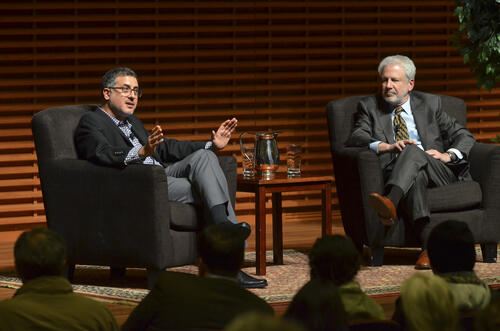
In the second lecture in the “Security Conundrum” series, Gellman was in conversation with Philip Taubman, former correspondent and Washington and Moscow bureau chief for The New York Times and a consulting professor with Stanford’s Center for International Security and Cooperation (CISAC). Taubman teaches the class Need to Know: The Tension Between a Free Press and National Security Decision Making.
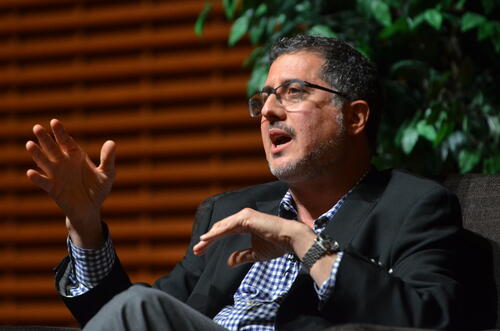
Gellman recounted his dealings with Snowden and described how he and his editors weighed the Snowden materials. Few questions are more difficult for American journalists than determining how far a free press can venture in disclosing national security secrets without imperiling the nation’s security.
“I asked him very bluntly, `Why are you doing this?’” Gellman said of Snowden.
“He gave me very persuasive and consistent answers about his motives. Whatever you think of what he did or whether or not I should have published these stories, I would claim to you that all the evidence supports his claim that he had come across a dangerous accumulation of state power that we, the people, needed to know about.”
One of the first Snowden revelations, Gellman said, was the top-secret PRISM surveillance program, in which the NSA is allowed to tap into the servers of nine large U.S. Internet companies, including Google, Microsoft, Yahoo, Facebook and Skype. Snowden believed the extent of mass data collection about American citizens was far greater than what the public knew.
The Post reported that PRISM allows the U.S. intelligence community to gain access from the Silicon Valley firms to a wide range of digital information, including audio, video chats, photographs, emails and stored data that enable analysts to track foreign targets. The program does not require individual warrants, but instead operates under the broader authorization of the federal Foreign Intelligence Surveillance Act court.
Image
The FISA Court had also been ordering a subsidiary of Verizon Communications to turn over to the NSA logs tracking all of its customers’ telephone calls.
Gellman said Snowden asked for a guarantee the Post would publish the full text of a PowerPoint presentation that he had obtained describing the PRISM program. Gellman told him that his editors would not make any guarantees about what they would publish and in the end the paper only reproduced several slides so as not to harm national security.
Taubman asked Gellman what gives any journalist the right to publish classified documents and not hand those papers back to the NSA.
“I’m not accountable to anyone for my decisions about what is in the interest or not in the interest of the national security of the United States,” Gellman said. “What happens is the government tries to keep information a secret and I try to find it out – and then when that spillage happens, well, then we talk.”
In the case of PRISM, he sent emails to two “quite senior people” in the government and told them this was the type of email he only sends once every several years, when he is onto a big story they would want to know about. But he didn’t want to do anything over email, so when the senior officials called, Gellman gave them the title of the document about which he was going to write.
Image
That started the negotiations with the government and The Washington Post. In the end, the paper only published several of the government’s PowerPoint slides that explained the PRISM program because they were concerned about harming national security.
“We had no interest in doing that; we only had an interest in writing about the public policy question on a program that had secretly expanded in ways that almost no one knew about,” Gellman said. “To the extent that it involves drawing new boundaries allowing the government to spy on its citizens and the citizens never get to know that – that is quite relevant to know when you’re trying to decide whether you like what your government is doing.”
In a statement responding to the PRISM revelations by the Post, Director of National Intelligence James Clapper said information collection under the program “is among the most important and valuable foreign intelligence information we collect, and is used to protect our nation from a wide variety of threats.”
Clapper called the Snowden leaks about the legal program “reprehensible and risks important protections for the security of Americans.”
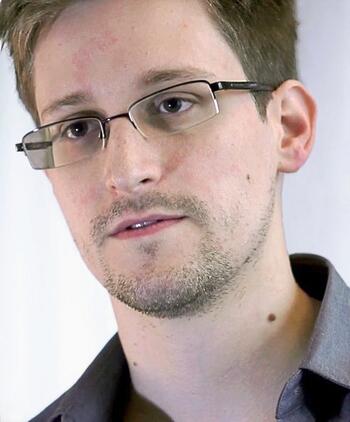
Gellman said Snowden has turned down million-dollar book and movie deals and lives in “ascetic” asylum in Russia. Snowden told NBC News earlier this year that he was on his way from Hong Kong to Latin America, via Moscow, when his passport was confiscated and that Russia then granted him a one-year asylum.
“He is fascinating to me because he’s an unusual figure,” Gellman told Taubman, who had asked him what Snowden was like. He said the 31-year-old former systems administrator for the CIA did something most Americans would not: He gave up his personal freedom and changed the course of his life to make public the government surveillance programs that he believes are a danger to the American people.
“He described himself to me once as an indoor cat,” Gellman said. “He lives in a virtual world; there’s not a whole lot of difference for Snowden whether he’s living in Moscow or Hawaii – he’s is what I would call a net native. He has an ascetic personality; he doesn’t have or want very much stuff.”
Gellman added: “He is sort of Zen-like in his confidence that he has done the right thing.”
***
The Security Conundrum series is co-sponsored by CISAC, Hoover, and the Freeman Spogli Institute for International Studies, Stanford Continuing Studies, Stanford in Government and the Stanford Law School.
Other nationally prominent speakers will include Reggie Walton, the former presiding judge of the Foreign Intelligence Surveillance Court, and U.S. Sen. Dianne Feinstein, chairman of the Senate Select Committee on Intelligence.
Hero Image

All News button
1


The Security Conundrum Series - Inside the Newsroom: The Media and Edward Snowden: An Evening with Barton Gellman
In an age of terrorism, where should a democratic society draw the line on government surveillance? Edward Snowden’s explosive disclosures about the National Security Agency’s intelligence-collection operations have ignited an intense debate about the appropriate balance between security and liberty in America. In a special series this year, nationally prominent experts will explore the critical issues raised by the NSA’s activities, including their impact on our security, privacy, and civil liberties. This timely series will address one of the most challenging questions the nation faces today as it tries to strike the right balance between safety and liberty. The Security Conundrum will look behind and beyond the headlines, examining the history and implementation of the NSA operations, the legal questions generated by them, the media’s role in revealing them, and the responsibility of Congress to oversee them. It will also address the NSA’s uneasy and evolving relationship with Silicon Valley. Each session in the series is designed to explore these issues from a different vantage point. The guest speakers, in conversation with Stanford scholars, will probe the problems, explain the political, legal, and technological contours of the NSA actions, and outline ways to preserve the nation’s security without sacrificing our freedoms.
Inside the Newsroom: The Media and Edward Snowden: An Evening with Barton Gellman
When Edward Snowden decided in 2013 that the time had come to reveal the deepest secrets of the National Security Agency, one of the first journalists he approached was Barton Gellman of The Washington Post. Snowden gave Gellman a code name: BRASSBANNER. The name he chose for himself was VERAX, “truth teller” in Latin. So began one of the most dramatic chapters in the history of modern American journalism. In the ensuing months, Gellman received dozens of top-secret documents from Snowden, traveled to Moscow to meet him, and wrestled with tough questions about what, and what not, to publish. The Washington Post shared the 2014 Pulitzer Prize for Public Service, the nation’s highest journalism honor, for Gellman’s reporting about the Snowden materials and the NSA.
In a conversation with Philip Taubman, Gellman will recount his dealings with Snowden and describe how he and his editors weighed how to handle the Snowden materials. Few questions are more difficult for American journalists than determining how far a free press can venture in disclosing national security secrets without imperiling the nation’s security.
Barton Gellman
Journalist
Barton Gellman is a three-time Pulitzer Prize–winning journalist. In 2002, he was a member of the Washington Post team that received the Pulitzer Prize for National Reporting for its coverage of the 9/11 attacks. Gellman is a senior fellow at The Century Foundation and a visiting professional specialist and author-in-residence at Princeton’s Woodrow Wilson School of Public and International Affairs. He is the author of Angler: The Cheney Vice Presidency.
Philip Taubman
Consulting Professor, Center for International Security and Cooperation, Stanford; Former Moscow and Washington Bureau Chief, The New York Times
Philip Taubman served as a reporter and editor at The New York Times for nearly thirty years, specializing in national security coverage. He is author of Secret Empire: Eisenhower, the CIA, and the Hidden Story of America’s Space Espionage, and The Partnership: Five Cold Warriors and Their Quest to Ban the Bomb.
The Security Conundrum is co-sponsored by Stanford’s Freeman Spogli Institute for International Studies, the Hoover Institution, Stanford Continuing Studies, Stanford in Government, and the Stanford Law School.
CEMEX Auditorium
Knight Management Center
641 Knight Way, Stanford University
Bart Gellman
Senior Fellow
Speaker
The Century Foundation
Philip Taubman
0
Affiliate
Philip Taubman is affiliated with the Center for International Security and Cooperation at Stanford University. Before joining CISAC in 2008, Mr. Taubman worked at the New York Times as a reporter and editor for nearly 30 years, specializing in national security issues, including United States diplomacy, and intelligence and defense policy and operations. He served as Moscow bureau chief and Washington bureau chief, among other posts. He is author of Secret Empire: Eisenhower, the CIA, and the Hidden Story of America's Space Espionage (2003), The Partnership: Five Cold Warriors and Their Quest to Ban the Bomb (2012), In the Nation's Service: The Life and Times of George P. Shultz (2023), as well as co-author (with his brother, William Taubman) of McNamara at War: A New History (2025).
Hide publication sections
Off
Lectures
Anti-Semitism surge in Europe reflects loss of values, historical awareness, says Stanford scholar
News Type
News
Date
Paragraphs
Appeared in Stanford Report, August 29, 2014
A worrying spike in anti-Semitism in Europe is a stark reminder that prejudice against Jewish people is still a reality there today, say Stanford scholars. Anti-capitalism has been a particular source of anti-Semitism, according to Professor Russell Berman.
European leaders need to speak out more strongly against the escalation of anti-Semitism, a Stanford professor says.
"They should be willing to enforce the law," said Russell Berman, a Stanford professor of German studies and of comparative literature who is affiliated with the Europe Center on campus.
In recent weeks, slogans invoking anti-Semitism have been heard during European protests against the Palestinian deaths in the Palestinian-Israeli conflict. In France and Germany, synagogues and Jewish community centers have been firebombed. In Britain, a rabbi was attacked near a Jewish boarding school.
"Protesters who storm synagogues should be arrested and prosecuted. Too often police have shown a blind eye when political protests have transformed into anti-Semitic mob actions," said Berman, the Walter A. Haas Professor in the Humanities and a senior fellow at the Hoover Institution and the Freeman Spogli Institute for International Studies.
He said that European societies in the long run have to find a way to grapple with their failed immigration policies and achieve more effective integration, he said. This includes more efficiently integrating immigrants into the cultural expectations of their new societies.
"Post–World War II Europe had as a core value a rejection of the anti-Semitism that led to the Holocaust. Europeans have to develop a pedagogy that can pass that value on to the new members of their communities," said Berman.
Roots of hatred
The recent eruption of anti-Semitism in Europe has multiple causes, according to Berman. The continent's lagging economy, the influx of immigrants from Muslim countries and the ongoing Israeli and Palestinian conflict are large factors.
And as last year's European parliament elections revealed, right-wing extremism has grown across Europe, he said.
"The far right is historically a home of anti-Semitism wrapped in nationalism and xenophobia. Some of this development can be attributed to the ongoing economic crisis, but some is certainly also a reaction against what is sometimes called the 'democracy deficit' in the European Union," Berman said.
Some Europeans believe their national political life has been subordinated to a "transnational bureaucracy" in the form of the European Union, Berman said. He added that this breeds resentment, and one expression of that is anti-Semitism, which is coinciding with traditional European nationalism.
Berman added, "Clearly this does not apply to all Muslims in Europe, but it has become an unmistakable feature in those population cohorts susceptible to radicalization as a response to a sense of social marginalization."
In Europe, immigrant populations are often clustered in de facto segregated neighborhoods, forming a parallel society, Berman said.
"While policies of multiculturalism have in the United States often contributed to productive integration, in Europe they have worked differently and undermined social cohesion. In that context, anti-Semitism has festered," he said.
Ongoing conflicts in the Middle East have also fanned the flames of European anti-Semitism, Berman said. Meanwhile, protests did not arise in Europe when Muslims and Christians were massacred in recent months in Syria and Iraq.
"A year ago, one could still make an at least conceptual distinction between anti-Zionism [criticism of Israel] and anti-Semitism [hatred of Jews]," he said.
The events in the past months in the streets of Europe have erased that distinction, Berman said.
"The politics of criticizing Israel have been fully taken over by anti-Semites, whether from the traditional European far right, the extremist left or parts of the immigrant communities," he said.
Anti-capitalism, economic downturns
When the European economy soured, leaving many young people unemployed at a time of surging globalism – all against a "residual" communist backdrop that still exists in parts of Europe – anti-Semitism was the result, according to Berman.
"That inherent anxiety and free-floating animosity in Europe turns into hostility to minorities," he said. "It can generate both anti-Jewish and anti-Muslim prejudices, but anti-capitalism is today, as it has been historically, a particular source of anti-Semitism."
Berman calls this left-wing anti-Semitism – the targeting Jews as the symbols of capitalism – which he says has a long history. "A socialist leader of the 19th century once called anti-Semitism 'the anti-capitalism of fools,' and that's part of what we still see today," Berman said.
Opportunity, education, the future
Amir Eshel, a professor of German studies and of comparative literature and affiliated faculty member of The Europe Center, said Europe needs to do a better job of integrating Muslim immigrants into their new societies. In particular, he said, more economic opportunities must be given to people from disenfranchised communities.
"Nothing is as important as giving people opportunities to make their lives better," said Eshel, the Edward Clark Crossett Professor in Humanistic Studies. He is also an affiliated faculty member at the Europe Center in the Freeman Spogli Institute for International Studies.
Eshel points to important roles for the media and educational systems to play in clamping down on anti-Semitism. There are programs in place – International Holocaust Remembrance Day, for example – to remind people about the evil inflicted on Jews in Europe more than 60 years ago.
"What has changed is that young people are less biographically connected to these crimes of the past," said Eshel.
"When this happens, as the Holocaust drifts further in time, a certain sensibility arises that one should not be bound by the lessons of the past," he said.
Anti-Semitism in Europe, he said, is the worst he's seen or known about since the end of World War II. He's especially worried about the large numbers of Muslims from Britain and France who have joined the jihadist movements in places like Syria and Iraq.
"It's not going to be easy to track them if they return," Eshel noted, "and it'll be a challenge for many years in Europe."
Fear among Jews
History Professor Norman Naimark said that some French Jews are leaving the country because of ongoing anti-Semitic violence.
"Germany has also experienced an ongoing problem on both the extreme left and right, but there the authorities and the Jewish community seem to have the situation under control," added Naimark, the Robert and Florence McDonnell Professor in Eastern European Studies.
Naimark, the director of the Stanford Global Studies Division and a senior fellow at the Hoover Institution and the Freeman Spogli Institute for International Studies, described European anti-Semitism as following an oscillating curve up and down, especially in times of Middle East crises.
"England seems particularly susceptible to these kinds of oscillations," he said.
Hero Image

All News button
1
"Divided Memories" reviewed in "China Perspectives"
News Type
News
Date
Paragraphs
Yves Russell, reviewing Shorenstein APARC's Divided Memories: History Textbooks and the Wars in Asia for the 2014/2 issue of China Perspectives, says that the volume "makes two major contributions to existing literature on the problem of history textbooks in East Asia" with its parallel excerpts from textbooks on eight controversial themes and its "inclusion of American textbooks" in the debate on historical memories in Asia. Russell continues to note that "one of the book's great strengths [is showing that] Japanese textbooks do not highlight patriotism, revisionism, or nationalism or seek to justify the war—rather the contrary."
Divided Memories is just one of the outputs of a multi-year history project on the effects of historical memories on postwar reconciliation. Most recently released was Wartime History Issues in Asia: Pathways to Reconciliation Final Report, a summary report of a Track II dialogue on the continuing impact of wartime history issues.
Hero Image

All News button
1
Ryo Wakabayashi
0
Corporate Affiliate Visiting Fellow, 2014-15
Ryo Wakabayashi is a corporate affiliate visiting fellow at the Walter H. Shorenstein Asia-Pacific Research Center (Shorenstein APARC) for 2014-15.
Ryuichiro Takeshita
0
Corporate Affiliate Visiting Fellow, 2014-15
Ryuichiro Takeshita is a corporate affiliate visiting fellow at the Walter H. Shorenstein Asia-Pacific Research Center (Shorenstein APARC) for 2014-15. Prior to joining Shorenstein APARC, Takeshita worked as a news reporter for The Asahi Shimbun, the national leading newspaper in Japan. He covered economic policy and business news, and interviewed hundreds of people from government officials to entrepreneurs. He also led the Billiomedia project in Japan during the 2012 general election, which was the first time for mainstream media in Japan to analyze public opinion using social media.