Culture
-

This is a virtual event. Please click here to register and generate a link to the talk. 
The link will be unique to you; please save it and do not share with others.


Policies implemented by the CCP in Xinjiang since c. 2016 have become a central issue in PRC international relations, leading to international determinations that those policies constitute genocide; scrutiny of global supply chains for Xinjiang cotton, textiles and polysilicon; US sanctions on companies and individuals and Congressional inquiries directed at Airbnb and other multinationals operating in Xinjiang; and diplomatic boycotts of the Olympics. The assimilationist policies, if most extreme in Xinjiang, are related to the broader Zhonghua-izing campaign against religion and non-Mandarin language and perhaps even to intensified control over Hong Kong and efforts to intimidate Taiwan—an aggressive intolerance of cultural and political diversity that is emerging as a central feature of Xi Jinping’s tenure. This talk will review the Xinjiang crisis to date and suggest how we should understand these events and trends.


Image
Portrait of James Millward
James Millward is Professor of Inter-societal History at the Walsh School of Foreign Service, Georgetown University, teaching Chinese, Central Asian and world history. He joins the Walter H. Shorenstein Asia-Pacific Research Center (APARC) as visiting scholar with the China Program for the 2022 winter quarter. He is also an affiliated professor in the Máster Oficial en Estudios de Asia Oriental at the University of Granada, Spain. His specialties include Qing empire; the silk road; Eurasian lutes and music in history; and historical and contemporary Xinjiang. He follows and comments on current issues regarding the Uyghurs and PRC ethnicity policy. Millward has served on the boards of the Association for Asian Studies (China and Inner Asia Council) and the Central Eurasian Studies Society, and was president of the Central Eurasian Studies Society in 2010. He edits the ''Silk Roads'' series for University of Chicago Press. His publications include The Silk Road: A Very Short Introduction (2013), Eurasian Crossroads: A History of Xinjiang (2007), New Qing Imperial History: The Making of Inner Asian Empire at Qing Chengde (2004), and Beyond the Pass: Economy, Ethnicity and Empire in Qing Central Asia (1998). His articles and op-eds on contemporary China appear in The New York Times, The Los Angeles Review of Books, The New York Review of Books and other media.  

Via Zoom Webinar. Register at: https://bit.ly/3zX2GoF

James Millward Visiting Scholar, APARC, Stanford University; Professor of Inter-societal History, Walsh School of Foreign Service, Georgetown University
Seminars
-

The REDI Task Force invites you to the next event in our Critical Conversations: Race in Global Affairs series; an exploration of the life of enslaved women. This panel discussion will feature experts of enslavement across the Atlantic including the U.S., Brazil, West Africa, and the West Indies.

What do we really understand about the lives and legacies of African enslaved women across the Atlantic? Enslavement is often rendered through a genderless lens, one in which the category of "race" trumps all else. However, research tells a very different story and one that requires an intimate analysis - enslaved women across the Atlantic held an experience that was shaped uniquely by their race and gender. This conversation will explore how Black women during the slave period acted and reacted to the material forces that shaped their lives in an attempt to not only survive the harsh conditions but to carve out a future for ancestors. This interdisciplinary discussion will draw from various archival sources ranging from Senegambia to Brasil's sugar plantations to articulating novel understandings of enslaved women's selfhood. 

The panel will feature perspectives from three historians to uncover the intimate lives of African women; their kinship, religious, and resistance practices. Tracing a path through different locales, from free to enslaved status, we will discuss not only the lives of enslaved women, but their legacies.

This event is free and open to the public. There will be time for a Q&A.

Note: This discussion will be recorded. 

Speaker bios:

Alexis Wells-Oghoghomeh is an Assistant Professor of Religious Studies whose teaching and research explores the intersections of race, religion, and gender in the United States. A historian of African-American religion, she specializes in the religiosity of enslaved people in the South, religion in the African Atlantic, and women’s religious histories.  Her first book The Souls of Womenfolk: The Religious Cultures of Enslaved Women in the Lower South (UNC 2021) offers a gendered history of enslaved people’s religiosity from the colonial period to the onset of the Civil War. She is currently at work on her second project, which traces the gendered, racialized history of phenomena termed “witchcraft” in the United States. Her work has been supported by the Ford Foundation, Mellon Foundation, and Forum for Theological Education, among others. She received her B.A. in English from Spelman College, and Master of Divinity and Ph.D. from Emory University.

Jessica Marie Johnson is an Assistant Professor in the Department of History at the Johns Hopkins University and a Fellow at the Hutchins Center for African and African American Studies at Harvard University. She is also the Director of LifexCode: Digital Humanities Against Enclosure. Johnson is a historian of Atlantic slavery and the Atlantic African diaspora. She is the author of Wicked Flesh: Black Women, Intimacy, and Freedom in the Atlantic World (University of Pennsylvania Press, August 2020), a winner of numerous awards including the 2021 Wesley-Logan Best Book in African Diaspora History Prize from the Association of American Historians and the 2021 Lora Romero First Book Publication Prize of the American Studies Association. Her work has appeared in Slavery & Abolition, The Black Scholar, Meridians: Feminism, Race and Transnationalism, American Quarterly, Social Text, The Journal of African American History, the William & Mary Quarterly, Debates in the Digital Humanities (2nd edition), Forum Journal, Bitch Magazine, Black Perspectives (AAIHS), Somatosphere and Post-Colonial Digital Humanities (DHPoco) and her book chapters have appeared in multiple edited collections. She is the Founding Curator of #ADPhDProjects which brings social justice and histories of slavery together. She is also Co-Kin Curator at Taller Electric Marronage.  She is also a Digital Alchemist at the Center for Solutions to Online Violence and a co-organizer of the Queering Slavery Working Group with Dr. Vanessa Holden (University of Kentucky). Her past collaborations include organizing with the LatiNegrxs Project. As a historian and Black Studies scholar, Johnson researches black diasporic freedom struggles from slavery to emancipation. As a digital humanist, Johnson explores ways digital and social media disseminate and create historical narratives, in particular, comparative histories of slavery and people of African descent.

Nohora Arrieta Fernández is a Presidential Postdoctoral Fellow at UCLA. She received her Ph.D. in Latin American Literature and Cultural Studies from Georgetown University in 2021. Her current research focuses on art history, visual studies, the history of commodities, and the intellectual traditions of the African Diaspora in the Americas. She has published essays and articles on Latin American literature and visual arts, comics, and the Afro-Latin American Diaspora, and is a collaborator of art magazines as Artishock and Contemporyand. She recently co-edited Transition. The Magazine of Africa and the Diaspora, 130. Her first co-translation project, Semantic of the World, the Poetry of Romulo Bustos, will be published by New Mexico Press (2022).


Online via Zoom

REGISTER

Alexis Wells-Oghoghomeh Assistant Professor of Religious Studies Stanford University
Jessica Marie Johnson Assistant Professor History Johns Hopkins University
Sonita Moss Research Associate Discussant REDI
Nohora Arrieta Fernandez Postdoctoral Fellow UCLA
Seminars
-

The REDI Task Force invites you to the next event in our Critical Conversations: Race in Global Affairs series; an exploration of colonialism and empire.

Capitalism and colonialism are often invoked in discussions in the social sciences and the humanities as the profound causes of racism, discrimination, human rights abuses, and the subaltern status of minority (and sometimes majority) groups in contemporary societies. These concepts are often useful more as a shorthand to describe deep historical processes. This panel seeks to elaborate on the specific mechanisms and accumulated social, political and economic events of colonialism that lead to particular outcomes of poverty, inequality or violence today. Comparative perspectives from history, political science and economics, from various regions of the world may advance our understanding of the deep forces that hinder racial equity, diversity, and inclusion.

About the Speakers:

Beatriz Magaloni is the Graham H. Stuart Professor of International Relations in the Department of Political Science, FSI Senior Fellow, and affiliated faculty at the Center on Global Poverty and Development at Stanford University. She is the current Chair of the REDI Task Force.

Her first book, Voting for Autocracy: Hegemonic Party Survival and its Demise in Mexico (Cambridge University Press, 2006), won the Best Book Award from the Comparative Democratization Section of the American Political Science Association and the 2007 Leon Epstein Award for the Best Book published in the previous two years in the area of political parties and organizations. Her second book, Strategies of Vote Buying: Democracy, Clientelism, and Poverty Relief in Mexico (co-authored with Alberto Diaz Cayeros and Federico Estévez), studies the politics of poverty relief. In 2010 she founded the Poverty, Violence and Governance Laboratory (POVGOV). The mission of  POVGOV is to develop action-oriented research through the elaboration of scientific knowledge that is anchored on state-of-the-art methodologies, multidisciplinary work, and innovative on-the-ground research and training. The Lab regularly incorporates undergraduate, masters, Ph.D. and post-doctoral students to pilot and evaluate interventions to reduce violence, combat human rights abuses and improve the accountability of law enforcement and justice systems.

Alberto Cayeros-Diaz joined the FSI faculty in 2013 after serving for five years as the director of the Center for US-Mexico studies at the University of California, San Diego. He earned his Ph.D at Duke University in 1997. He was an assistant professor of political science at Stanford from 2001-2008, before which he served as an assistant professor of political science at the University of California, Los Angeles. Diaz-Cayeros has also served as a researcher at Centro de Investigacion Para el Desarrollo, A.C. in Mexico from 1997-1999. His work has focused on federalism, poverty and violence in Latin America, and Mexico in particular. He has published widely in Spanish and English. His book Federalism, Fiscal Authority and Centralization in Latin America was published by Cambridge University Press in 2007 (reprinted 2016). His latest book (with Federico Estevez and Beatriz Magaloni) is: The Political Logic of Poverty Relief Electoral Strategies and Social Policy in Mexico. His work has primarily focused on federalism, poverty and economic reform in Latin America, and Mexico in particular, with more recent work addressing crime and violence, youth-at-risk, and police professionalization. 

Leonard Wantchekon is a Professor of Politics and International Affairs at Princeton University, as well as Associated Faculty in Economics. A scholar with diverse interests, Wantchekon has made substantive and methodological contributions to the fields of Political Economy, Economic History and Development Economics, and has also contributed significantly to the literatures on clientelism and state capture, resource curse and democratization. Wantchekon’s research includes groundbreaking studies on the long-term effects of historical events. For example, his paper “Slave Trade and the Origins of Mistrust in Africa” (AER, 2011, co-authored with Nathan Nunn) links current differences in trust levels within Africa to the transatlantic and Indian Ocean slave trade, and is widely regarded as one of the foundational papers in the emerging field of cultural economics. Similarly, his “Critical Junctures” paper (co-authored with Omar Garcia Ponce) finds that levels of democracy in post-Cold War Africa can be traced back to the nature of its anti-colonial independence movements. He is the Founder and President of the African School of Economics, which opened in Benin in 2014.


Online via Zoom

REGISTER

Encina Hall, C149
616 Jane Stanford Way
Stanford, CA 94305

(650) 725-0500
0
Senior Fellow, Freeman Spogli Institute for International Studies
Professor, by courtesy, of Political Science
alberto_diaz-cayeros_2024.jpg MA, PhD

Alberto Díaz-Cayeros is a Senior Fellow at Stanford University's Freeman Spogli Institute for International Studies (FSI), and co-director of the Democracy Action Lab (DAL), based at FSI's Center on Democracy, Development and Rule of Law (CDDRL). His research interests include federalism, poverty relief, indigenous governance, political economy of health, violence, and citizen security in Mexico and Latin America.

He is the author of Federalism, Fiscal Authority and Centralization in Latin America (Cambridge, reedited 2016), coauthored with Federico Estévez and Beatriz Magaloni, of The Political Logic of Poverty Relief (Cambridge, 2016), and of numerous journal articles and book chapters.

He is currently working on a project on cartography and the developmental legacies of colonial rule and governance in indigenous communities in Mexico.

From 2016 to 2023, he was the Director of the Center for Latin American Studies at Stanford University, and from 2009 to 2013, Director of the Center for US-Mexican Studies at UCSD, the University of California, San Diego.

Affiliated faculty at the Center on Democracy, Development and the Rule of Law
Co-director, Democracy Action Lab
Director of the Center for Latin American Studies (2016 - 2023)
CV
Date Label
Alberto Díaz-Cayeros FSI Senior Fellow Panelist CDDRL
Leonard Wantchekon Professor of Politics and International Affairs Panelist Princeton University

Dept. of Political Science
Encina Hall, Room 436
Stanford University,
Stanford, CA

(650) 724-5949
0
Senior Fellow at the Freeman Spogli Institute for International Studies
Graham H. Stuart Professor of International Relations
Professor of Political Science
beatriz_magaloni_2024.jpg MA, PhD

Beatriz Magaloni Magaloni is the Graham Stuart Professor of International Relations at the Department of Political Science. Magaloni is also a Senior Fellow at the Freeman Spogli Institute, where she holds affiliations with the Center on Democracy, Development and the Rule of Law (CDDRL) and the Center for International Security and Cooperation (CISAC). She is also a Stanford’s King Center for Global Development faculty affiliate. Magaloni has taught at Stanford University for over two decades.

She leads the Poverty, Violence, and Governance Lab (Povgov). Founded by Magaloni in 2010, Povgov is one of Stanford University’s leading impact-driven knowledge production laboratories in the social sciences. Under her leadership, Povgov has innovated and advanced a host of cutting-edge research agendas to reduce violence and poverty and promote peace, security, and human rights.

Magaloni’s work has contributed to the study of authoritarian politics, poverty alleviation, indigenous governance, and, more recently, violence, crime, security institutions, and human rights. Her first book, Voting for Autocracy: Hegemonic Party Survival and its Demise in Mexico (Cambridge University Press, 2006) is widely recognized as a seminal study in the field of comparative politics. It received the 2007 Leon Epstein Award for the Best Book published in the previous two years in the area of political parties and organizations, as well as the Best Book Award from the American Political Science Association’s Comparative Democratization Section. Her second book The Politics of Poverty Relief: Strategies of Vote Buying and Social Policies in Mexico (with Alberto Diaz-Cayeros and Federico Estevez) (Cambridge University Press, 2016) explores how politics shapes poverty alleviation.

Magaloni’s work was published in leading journals, including the American Political Science Review, American Journal of Political Science, Criminology & Public Policy, World Development, Comparative Political Studies, Annual Review of Political Science, Cambridge Journal of Evidence-Based Policing, Latin American Research Review, and others.

Magaloni received wide international acclaim for identifying innovative solutions for salient societal problems through impact-driven research. In 2023, she was named winner of the world-renowned Stockholm Prize in Criminology, considered an equivalent of the Nobel Prize in the field of criminology. The award recognized her extensive research on crime, policing, and human rights in Mexico and Brazil. Magaloni’s research production in this area was also recognized by the American Political Science Association, which named her recipient of the 2021 Heinz I. Eulau Award for the best article published in the American Political Science Review, the leading journal in the discipline.

She received her Ph.D. in political science from Duke University and holds a law degree from the Instituto Tecnológico Autónomo de México.

Director, Poverty, Violence, and Governance Lab
Co-director, Democracy Action Lab
CV
Date Label
Beatriz Magaloni FSI Senior Fellow REDI Task Force Chair REDI
Paragraphs

Air purification in Chinese contexts over the last half century has been generative for a way of being human, what the author calls “filtered life.” This is a materially, aesthetically, and even humorously mediated form of dwelling. In it, people confront ethics and anxieties under conditions of aerosolized ruination.

This article sheds special light on links between gender binaries and filtered life. It traces how, prior to the COVID‐19 pandemic, scientists, marketers, and many others residing in urban China interacted with air filters in ways textured by the male state. Notably chronicled here is a critique of ecological ruin emergent in homes of the People's Republic of China (PRC), one mutating from ire toward husbands for smoking cigarettes in the home to more recent indictments of men despoiling the environment.

All Publications button
1
Publication Type
Journal Articles
Publication Date
Subtitle
Air Purification, Gender, and Cigarettes in the People's Republic of China
Journal Publisher
Public Culture
Authors
Matthew Kohrman
Number
2 (94)
Authors
Nathaniel Persily
News Type
Commentary
Date
Paragraphs

The disclosures made by whistleblower Frances Haugen about Facebook — first to the Wall Street Journal and then to “60 Minutes” — ought to be the stuff of shareholders’ nightmares: When she left Facebook, she took with her documents showing, for example, that Facebook knew Instagram was making girls’ body-image issues worse, that internal investigators knew a Mexican drug cartel was using the platform to recruit hit men and that the company misled its own oversight board about having a separate content appeals process for a large number of influential users. (Haugen is scheduled to appear before a Congressional panel on Tuesday.)

Facebook, however, may be too big for the revelations to hurt its market position — a sign that it may be long past time for the government to step in and regulate the social media company. But in order for policymakers to effectively regulate Facebook — as well as Google, Twitter, TikTok and other Internet companies — they need to understand what is actually happening on the platforms.


Nate Persily

Nathaniel Persily

Co-director, Cyber Policy Center
FULL BIO
Hero Image
Frances Haugen 60 minutes interview
Former Facebook product manager Frances Haugen appears on “60 Minutes.” Haugen has been revealed as the source behind tens of thousands of pages of leaked internal company research. (Robert Fortunato for CBSNews/“60 Minutes") (Photo by Robert Fortunato/CBSNews/60MINUTES)
All News button
1
Subtitle

The social media company shouldn’t be able to hide information about whether and how it harms users (from the Washington Post)

All Publications button
1
Publication Type
Books
Publication Date
Subtitle
The Turkish Republic was founded simultaneously on the ideal of universal citizenship and on acts of extraordinary exclusionary violence. Today, nearly a century later, the claims of minority communities and the politics of pluralism continue to ignite explosive debate. The Reckoning of Pluralism centers on the case of Turkey's Alevi community, a sizeable Muslim minority in a Sunni majority state. Alevis have seen their loyalty to the state questioned and experienced sectarian hostility, and yet their community is also championed by state ideologues as bearers of the nation's folkloric heritage. Kabir Tambar offers a critical appraisal of the tensions of democratic pluralism. Rather than portraying pluralism as a governing ideal that loosens restrictions on minorities, he focuses on the forms of social inequality that it perpetuates and on the political vulnerabilities to which minority communities are thereby exposed. Alevis today are often summoned by political officials to publicly display their religious traditions, but pluralist tolerance extends only so far as these performances will validate rather than disturb historical ideologies of national governance and identity. Focused on the inherent ambivalence of this form of political incorporation, Tambar ultimately explores the intimate coupling of modern political belonging and violence, of political inclusion and domination, contained within the practices of pluralism.
Authors
Book Publisher
Stanford University Press
-

Image
The American Passport in Turkey
The American Passport in Turkey explores the diverse meanings and values that people outside of the United States attribute to U.S. citizenship, specifically those who possess or seek to obtain U.S. citizenship while residing in Turkey. Özlem Altan-Olcay and Evren Balta interviewed more than one hundred individuals and families and, through their narratives, shed light on how U.S. citizenship is imagined, experienced, and practiced outside of the United States. Offering a corrective to citizenship studies where discussions of inequality are largely limited to domestic frames, Altan-Olcay and Balta argue that the relationship between inequality and citizenship regimes can only be fully understood if considered transnationally. Additionally, The American Passport in Turkey demonstrates that U.S. global power not only reveals itself in terms of foreign policy but also manifests in the active desires people have for U.S. citizenship, even when they do not live in the United States. These citizens, according to the authors, create a new kind of empire with borders and citizen-state relations that do not map onto recognizable political territories.

The American Passport in Turkey has recently won the American Sociological Association, Global and Transnational Sociology Section, Best Book by an International Scholar Award.
 

Register Now


ABOUT THE AUTHORS

Image
Özlem Altan-Olcay
Özlem Altan-Olcay is an associate professor in the Department of International Relations and the associate director of the Graduate School of Social Sciences and Humanities at Koç University in Istanbul, Turkey. She is also an editor of Gender, Place, and Culture as well as an assistant editor of Citizenship Studies. She has a Ph.D. degree from New York University, Department of Politics. Her primary research interests include citizenship studies and gender and development. Her research has been supported by the New York University International Center for Advanced Studies, the UN Population Council, the Middle East Research Competition, the Scientific and Technological Research Council of Turkey, the Turkish Science Academy, and the EU Marie Curie Individual Fellowship Program. Some of her recent articles have appeared in Development and Change, Ethnic and Racial Studies, Feminist Economics, Gender, Place and Culture, International Feminist Journal of Politics, Sociology, Social Politics, and Women’s Studies International Forum. She has recently co-authored (with E. Balta) The American Passport in Turkey: National Citizenship in the Age of Transnationalism, published by the University of Pennsylvania Press (2020).
 

Image
Evren Balta
Evren Balta is a Professor of International Relations and the chair of the International Relations Department at  Özyeğin University. She holds a Ph.D. in Political Science from The Graduate Center, CUNY. Her articles have appeared in journals such as Party Politics, Ethnic and Racial Studies, Sociology, Gender Place & Culture. She is the author of The American Passport in Turkey: National Citizenship in the Age of Transnationalism (with O Altan-Olcay, University of Pennsylvania, 2020), Age of Uneasiness (İletisim, 2019), and Global Security Complex (İletisim, 2012). She is the editor of Neighbors with Suspicion: Dynamics of Turkish-Russian Relations (with G. Ozcan and B. Besgul, İletisim, 2017); Introduction to Global Politics (Iletisim, 2014) and Military, State and Politics in Turkey (with I. Akca, Bilgi University, 2010). Her research has been supported by the American Association for the University Women, Mellon Foundation, Bella Zeller Scholarship Trust Fund, the Scientific and Technological Research Council of Turkey, and the Fulbright Scholar Program. In 2018, she received the Distinguished Alumni Award of the Political Science Program at the CUNY-The Graduate Center. Balta is a senior scholar at Istanbul Policy Center, a member of Global Relations Forum, and co-editor of International Relations Journal. She is appointed as the academic coordinator of the TÜSİAD Global Politics Forum in 2021.

Online via Zoom. Register here.

Özlem Altan-Olcay Koç University
Evren Balta Özyeğin University
Seminars
-

 Register for System Error, Live!

This event will be held outside on Stanford's campus. In accordance with Santa Clara County Public Health, masks are encouraged to be worn by all at crowded outdoor events.

Join Profs. Rob Reich, Mehran Sahami, and Jeremy Weinstein — the authors of System Error: Where Big Tech Went Wrong and How We Can Reboot — for a discussion hosted by Professor Michael McFaul, director of the Freeman Spogli Institute for International Studies. The operating system of Big Tech is broken, and this panel discussion will explore the path to a reboot. Plus, it will also allow you experience Professor Sahami’s famous tradition of throwing candy into the audience!

A forward-thinking manifesto from three Stanford professors — experts who have worked at ground zero of the tech revolution for decades — System Error reveals how Big Tech’s obsession with optimization and efficiency has sacrificed fundamental human values and demands that we change course to renew our democracy and save ourselves.

Armed with an understanding of how technologists think and exercise their power, these three Stanford professors—a philosopher working at the intersection of tech and ethics, the director of the undergraduate computer science program who was also an early Google engineer, and a political scientist who served under Barack Obama—reveal how we can hold that power to account. Troubled by the values that permeate the university and Silicon Valley, these professors worked together to chart a new path forward, creating a popular course to transform how tomorrow’s technologists might better approach their profession. Now, as the dominance of Big Tech becomes an explosive societal conundrum, join us as they share their provocative insights and concrete solutions to help everyone understand what is happening, what is at stake, and what we can do to control technology instead of letting it control us.

Books will be available for purchase at the event, and the authors will be signing copies as well.

This event is hosted by Professor Michael McFaul, director of the Freeman Spogli Institute for International Studies, and it is co-sponsored by the Center on Philanthropy and Civil Society, the McCoy Family Center for Ethics in Society, the Stanford School of Engineering, and the Stanford School of Humanities and Sciences.

Rob Reich | FSI Affiliate
Mehran Sahami | Associate Chair for Education, Computer Science Department Associate Chair for Education, Computer Science Department
Jeremy Weinstein | FSI Senior Fellow at CDDRL
Lectures
All Publications button
1
Publication Type
Journal Articles
Publication Date
Subtitle
This essay examines “professions of friendship”: efforts by populations who are targeted as enemies of the state to proclaim their historical fidelity to the state's foundation and preservation. Such declarations often reinscribe a rigid and often violently statist narrative of politics. The essay argues that the retrenchment of this narrative, when reissued in the name of friendship, does not simply close down political options. It seeks to embolden sentiments of moral obligation across instituted lines of enmity. These solicitations of friendship are burdened by a particular historical task: to envision a past and a future of social cohabitation in a present where its possibilities have been violently undermined and morally devalued. The essay centers on two instances that bookend the past century: the first was delivered in Istanbul by an organization speaking on behalf of Armenians living in territories claimed by the Turkish nationalist movement in 1922; the second was issued by a Kurdish Peace Mother in Diyarbakır, as a plea for an end to state violence in late 2015.
Journal Publisher
Comparative Studies of South Asia, Africa and the Middle East
Authors
Number
2
-

For Fall Quarter 2021, CDDRL will be hosting hybrid events. Many events will be open to the public online via Zoom, and limited-capacity in-person attendance for Stanford affiliates may be available in accordance with Stanford’s health and safety guidelines.

A Conversation with Obi Felten, founder and CEO of Flourish Labs

With Additional Remarks by 66th US Secretary of State Condoleezza Rice
Moderated by Ambassador Shirin Tahir-Kheli

Register for Zoom

Open to all

Register for In-Person

Stanford affiliates only

Named in honor of former Secretary of State Condoleezza Rice, the Condoleezza Rice “Women Who Inspire” Lecture Series seeks to highlight how women are reshaping the world, confronting global challenges, and blazing trails across all walks of life that improve the human condition.
 

SPEAKERS

Image
Obi Felton
Obi Felten is the founder and CEO of Flourish Labs, a startup combining cutting edge mental health science and technology to foster flourishing and good mental health.

Previously, Obi was Head of Getting Moonshots Ready for Contact with the Real World at X (formerly Google X), Alphabet’s ‘moonshot factory’ and innovation lab. At X, Obi worked on cutting edge technology projects such as internet from balloons (Loon), air delivery by drone (Wing) and sustainable energy storage using molten salt (Malta). Most recently Obi founded and led Amber, a project using brain-based biomarkers and machine learning to measure anxiety and depression.

Obi was Director of Consumer Marketing for Google in Europe, Middle East and Africa, launching and growing Google Maps, Chrome and Android from zero to hundreds of millions of users. She founded Campus, Google’s space for tech entrepreneurs. Before Google, Obi set up the ecommerce business of a major UK retailer, worked as a strategy consultant, and led eToys.com’s (unsuccessful) expansion to Germany during the first dotcom boom.

Obi is an independent director of Springer Nature, a global academic and educational publisher. She is an advisor for mental health at the Wellcome Trust, one of the largest funders of scientific research, and Chelsea & Westminster NHS Trust’s Best For You youth mental health initiative.

Obi is an advocate for women, people of colour and other underrepresented groups in technology. At X, she founded the diversity & inclusion team, supported several employee resource groups and served on the leadership team for Women of Alphabet in the Bay Area. She mentors female startup founders and leaders getting ready for board service.

Obi grew up in Berlin and saw the wall come down. She has a BA in Philosophy and Psychology from Oxford University. She now lives in California with her husband and two children. She loves yoga, biking, paddleboarding, skiing (which she picked up at age 40), travelling, cooking, eating, and her family.


Image
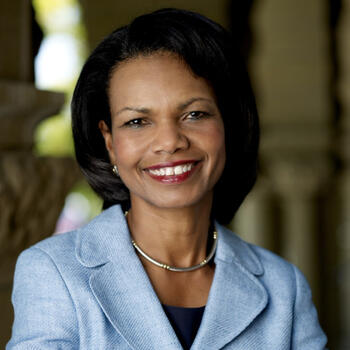
Condoleezza Rice
Condoleezza Rice is the Tad and Dianne Taube Director of the Hoover Institution and the Thomas and Barbara Stephenson Senior Fellow on Public Policy. In addition, she is a founding partner of Rice, Hadley, Gates & Manuel LLC, an international strategic consulting firm.

From January 2005 to January 2009, Rice served as the 66th Secretary of State of the United States, the second woman and first black woman to hold the post. Rice also served as President George W. Bush’s Assistant to the President for National Security Affairs (National Security Advisor) from January 2001 to January 2005, the first woman to hold the position.

Rice served as Stanford University’s provost from 1993 to 1999, during which time she was the institution's chief budget and academic officer. As provost, she was responsible for a $1.5 billion annual budget and an academic program involving 1,400 faculty members and 14,000 students. In 1997, she also served on the Federal Advisory Committee on Gender-Integrated Training in the Military.

From February 1989 through March 1991, Rice served on President George H.W. Bush’s National Security Council staff. She served as Director, then Senior Director, of Soviet and East European Affairs, as well as Special Assistant to the President for National Security Affairs. In 1986, while an International Affairs Fellow of the Council on Foreign Relations, Rice also served as Special Assistant to the Director of the Joint Chiefs of Staff. 

As Professor of Political Science, Rice has been on the Stanford faculty since 1981 and has won two of the university’s highest teaching honors – the 1984 Walter J. Gores Award for Excellence in Teaching and the 1993 School of Humanities and Sciences Dean's Award for Distinguished Teaching.

She has authored and co-authored numerous books, most recently To Build a Better World: Choices to End the Cold War and Create a Global Commonwealth (2019), co-authored with Philip Zelikow. Among her other volumes are three bestsellers, Democracy: Stories from the Long Road to Freedom (2017); No Higher Honor: A Memoir of My Years in Washington (2011); and Extraordinary, Ordinary People: A Memoir of Family (2010). She also wrote Germany Unified and Europe Transformed: A Study in Statecraft (1995) with Philip Zelikow; edited The Gorbachev Era (1986) with Alexander Dallin; and penned The Soviet Union and the Czechoslovak Army, 1948-1983: Uncertain Allegiance (1984).

In 1991, Rice co-founded the Center for a New Generation (CNG), an innovative, after-school academic enrichment program for students in East Palo Alto and East Menlo Park, California. In 1996, CNG merged with the Boys & Girls Club of the Peninsula, an affiliate club of the Boys & Girls Clubs of America (BGCA). CNG has since expanded to local BGCA chapters in Birmingham, Atlanta, and Dallas. Rice remains an active proponent of an extended learning day through after-school programs.

Since 2009, Rice has served as a founding partner at RiceHadleyGates LLC, an international strategic consulting firm based in Silicon Valley and Washington, D.C. The firm works with senior executives of major companies to implement strategic plans and expand in emerging markets. Other partners include former National Security Advisor Stephen J. Hadley and former Secretary of Defense Robert M. Gates.

Rice currently serves on the boards of Dropbox, Inc., an online storage technology company; C3.ai, an AI software company; and Makena Capital Management, a private endowment firm. In addition, she is Vice Chair of the Board of Governors of the Boys & Girls Clubs of America and a trustee of the Aspen Institute. Previously, Rice served on various additional boards, including those of: the George W. Bush Institute; the Commonwealth Club; KiOR, Inc.; the Chevron Corporation; the Charles Schwab Corporation; the Transamerica Corporation; the Hewlett-Packard Company; the University of Notre Dame; the Foundation for Excellence in Education; the John F. Kennedy Center for the Performing Arts; and the San Francisco Symphony.

In 2013, Rice was appointed to the College Football Playoff Selection Committee, formerly the Bowl Championship Series. She served on the committee until 2017.

Born in Birmingham, Alabama, Rice earned her bachelor's degree in political science, cum laude and Phi Beta Kappa, from the University of Denver; her master’s in the same subject from the University of Notre Dame; and her Ph.D., likewise in political science, from the Graduate School of International Studies at the University of Denver.

Rice is a Fellow of the American Academy of Arts & Sciences and has been awarded fifteen honorary doctorates.


Image
Ambassador Shirin Tahir-Kheli
Ambassador Shirin Tahir-Kheli is a Senior Fellow at the Johns Hopkins SAIS Foreign Policy Institute. From March 2003 to April 2005, she served as Special Assistant to the President and Senior Director for Democracy, Human Rights and International Operations at the National Security Council. From 2004 - 2006 she served as the key U.S. official in the formulation of U.S. policy toward United Nations Reform. She was appointed by Secretary Condoleezza Rice as Senior Advisor for Women’s Empowerment. She set up and oversaw the work of the Women Leaders' Working Group and spearheaded the State Department initiative for Women's Justice. Ambassador Tahir-Kheli also was Research Professor of International Relations at Johns Hopkins SAIS and served as the founding Director of the South Asia Program from 1999 to 2002. She is the author of Before the Age of Prejudice: A Muslim Woman’s National Security Work with Three American Presidents, among other books and monographs.


 

Image
CDDRL and SAIS logos

Obi Felten Founder and CEO at Flourish Labs
Condoleezza Rice Director of the Hoover Institution
Shirin Tahir-Kheli Senior Fellow at the Johns Hopkins SAIS Foreign Policy Institute
Seminars
Subscribe to Culture