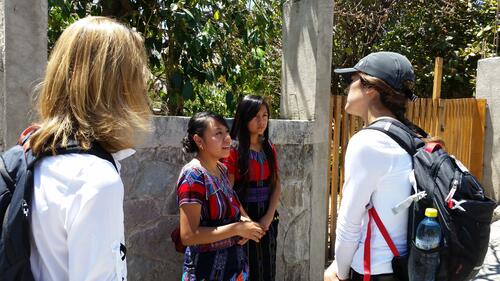
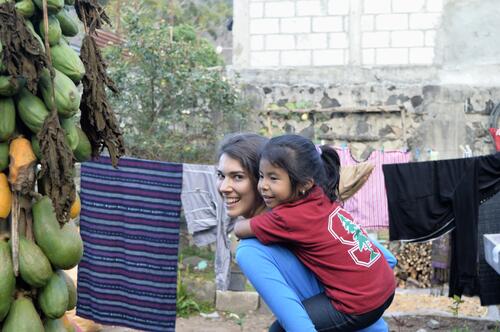
“Vic-TOR-ia!” Fátima cried, a grin lighting up her face. The 5-year-old had become fast friends with Stanford medical student Tori Bawel almost instantly after Bawel arrived in San Lucas Tolimán. After giving piggy-back rides to Fátima, a career in global pediatrics changed from a distant wish to a developing reality for Bawel.
Bawel is one of a few lucky medical students to travel with Stanford pediatrician Paul Wise, MD, MPH, to San Lucas Tolimán, a town in the mountains of rural Guatemala that serves as a base for his work to improve nutrition for local children. Once she completes her medical training, Bawel plans to devote her life to improving health in underserved areas.
“As an elementary school student, I was really compelled by issues of social justice,” she said. “I hope that over the course of my lifetime, I’m able to make a difference like physicians have done here in Guatemala and around the world.”
Every summer, Wise, a professor of pediatrics and a Stanford Health Policy core faculty member, takes a handful of undergraduates to the communities around San Lucas to learn about the Rural Guatemala Child Health and Nutrition Program. A collaboration between Stanford and a group of local health promoters, the program uses nutritional supplements and health education to save the lives of children under five. The students follow the promoters on house visits, help them measure the weight and height of children and gain an understanding of how the program helps the rural communities.
“We feel it is part of our educational mission,” said Wise. “We want to grow people who will make a difference, and part of that is providing them opportunities to do so.”
Bawel’s experience reinforced her desire to engage in global health work: “It’s inspired me and motivated me to want to give my life, like Wise, to… serving in areas of the world with the greatest need.”
Meeting Guatemalan students who overcame economic difficulties to study medicine — like Flor Julajuj — was also deeply moving for Bawel. Very few in rural Guatemala have the opportunity to pursue higher education or good health care. But with some help from Wise, Julajuj was able to attend medical school; just this month, she graduated from the University of San Carlos in Guatemala City.
Image
“It’s been a great opportunity,” said Julajuj. “It’s changed my life.”
Most, though, are not so lucky; Bawel also encountered two young women who dream of becoming physicians but cannot afford medical school. Meeting the young, ambitious women “makes me want to empower them with the education and opportunities I have had,” said Bawel.
Wise, meanwhile, will continue to each Stanford students about ways to help these communities.
“They see the poverty, but they also begin to understand why being a great doctor or a great diplomat or a great economist will serve the interests of people down here if done well,” he said. “We want them to go back to whatever field they’re interested in, committed to gaining skills and then using them to serve the needs and the rights of people in places like San Lucas.”
Stanford pediatrician Paul Wise stooped below the black tarp roof of a cinderblock house in Guatemala to offer his condolences to a mother who had just lost her child.
“Doctor Pablo,” as he is known in the communities around San Lucas Tolimán, talked softly as he relayed his sympathies to the mother, whose 9-year-old son had been a patient of his.
Stanford’s Children in Crisis Initiative seeks to save the lives of children in areas of poor governance. In Guatemala, their efforts work toward eliminating death by malnutrition for children under 5.
The boy’s genetic disorder would have been terminal anywhere, but thanks to Wise and local health promoters, the boy’s family had years with him instead of months.
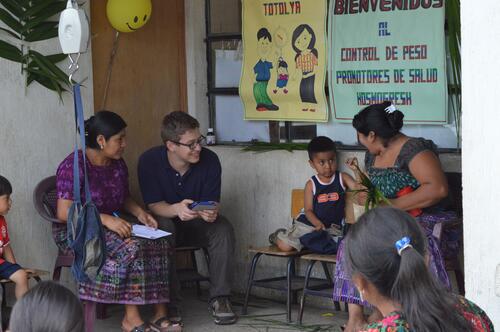
While Wise spoke to the heartbroken mother, his Stanford research assistant Alejandro Chavez helped the promoters set up inside a local community center to measure the weight and height of local kids to determine their nutrition level.
Chavez and the promoters had worked together for months to create an app for tablets that will make it easier to find malnourished children.
The app they designed will decrease training time for new health promoters and allow the program to expand. The goal is to distribute the app globally to help programs in other countries tackle malnutrition.
Children in crisis
As recently as 2005, about one of every 20 children in this rural area of Guatemala died before their 5th birthday. Almost half the deaths were associated with severe malnutrition.
“The death of any child is always a tragedy, but the death of any child from preventable causes is always unjust,” said Wise, a Stanford Health Policy core faculty member.
Along with other faculty from the Freeman Spogli Institute for International Studies (FSI) and the School of Medicine, Wise created the Children in Crisis Initiative to save the lives of children in areas of poor governance. The program brings together Stanford researchers and students across disciplines.
Nowhere are their efforts better illustrated than in the rural communities around San Lucas Tolimán, in the central mountains of Guatemala.
The program’s effectiveness rests on a deep respect for the local communities merged with innovation by Stanford researchers.
“It’s absolutely essential to any program that the people in need be part of the solution,” said Wise. Unlike many nongovernmental organizations and health programs, Wise believes the way to create a sustainable health system is for the locals to run it, so the health promoters manage the program’s day-to-day activities.
Image
This leaves the Stanford team free to focus on innovation – such as the new app. They believe the technology could change child health programs around the world. Wise’s team has partnered with Medic Mobile – a nonprofit that creates open-source software for health care workers – which plans to distribute the app to other areas suffering from malnutrition.
The six Android tablets purchased by Children in Crisis are enough to monitor the program’s 1,500 kids through the app.
Role of nutrition
When done well, nutrition surveillance is very effective at decreasing child mortality in poor countries.
“Nutrition contributes enormously to health and well-being,” Wise said as he walked through Tierra Santa, a small community near San Lucas, making house calls. “So the focus of our work turned to improving young child nutrition. It’s not an easy thing to do in a place that’s extremely poor.”
Wise and his colleagues – Stanford medical student Tori Bawel and Stanford professor of pediatrics Lisa Chamberlain – made their rounds during their visit in March. Evidence of poverty was everywhere.
Here, clean tap water is a dream and even the sturdier homes often lack four walls or paned windows, though the children were neatly dressed in T-shirts or colorful traje, traditional Mayan clothing.
It’s hard to provide proper nutrition when most families can’t find enough work to buy adequate food. But a little help can make a big difference.
Bawel, a first-year medical student who plans a career improving health in areas of poverty, was struck by the impact the promoter program has had on the community.
“There are children who need supplements and nutrition to stay alive,” she said. “Without this program, that infrastructure does not exist.”
With FSI’s assistance, the nutrition program distributes Incaparina, a supplement of cornmeal, soy and essential nutrients. The sweet, mealy drink helps the program’s most malnourished children get back on track.
Image
Every two months, the promoters gather each community’s children to measure their weight and height. Children and their mothers sit patiently, waiting for their turn. The children enjoy a cup of Incaparina, and their mothers eagerly listen to the promoters’ tips for keeping their children healthy.
“It’s very important to me,” said Elsira Rosibel Samayoa, who brought her 2-year-old to be measured. “There are mothers who don’t understand the importance of monitoring their children’s weight, but I do.”
Since its implementation in 2009, the Stanford program has slashed nutrition-based mortality in the participating communities by about 80 percent and decreased severe malnutrition by more than 60 percent – saving hundreds of children’s lives.
However, nutrition surveillance and intervention isn’t easy. Tracking nutrition takes training and expertise, and when the local population rarely exceeds a fourth-grade education, learning these skills is especially challenging. Detailed graphs on a standard growth chart are essential to identifying malnourished children.
“The community health workers are extremely capable and smart, but some have never seen a graph before,” said Wise. “Think about what it is to try to explain a graph to someone for the first time.”
It takes the health workers about three years to learn to graph and then interpret the results for intervention.
Wise said, “So we all got together and said, ‘How do we make this easier to do?’”
The app was the answer.
‘Let’s create an app’
Enter Alejandro Chavez, a recent Stanford computer science graduate and Stanford Health Policy research assistant. He developed the app to collect child health data, then determine the child’s degree of malnutrition and suggest intervention.
“The major goal was to lower training requirements and make programs like this simpler to start and maintain,” said Chavez, who now lives and works in Guatemala, where he gets daily feedback from the health promoters.
“I feel like they’ve been very honest with me about things I need to improve,” he said.
Cesia Lizeth Castro Chutá is a senior coordinator for the program who has worked with Chavez to ensure that the app meets the promoters’ needs.
“The tablet automatically generates the information we need to know,” she said. “It becomes easier to confirm that a child is malnourished and needs supplements.”
Looking forward
Image
With the app’s launch, it looks like training time for the promoters will be reduced from three years to less than six months. That means new communities can be incorporated into the program quickly, creating broader access to care.
Meanwhile, many health programs around the world are waiting to see how well the Stanford app works in Guatemala.
Josh Nesbit, a Stanford alumnus and Medic Mobile CEO, said, “As more health programs recognize the importance of nutrition and implement community-based interventions, screening and surveillance tools will be critical. We must learn from Dr. Wise’s success.”
Could out of pocket drug costs be responsible for pandemics? In this Public Health Perspectives article, Marcella Alsan discusses how copayments for antibiotics can cause people in poor areas to turn to unregulated markets.
On May 26, 2016, researchers at the Walter Reed National Military Medical Center reported the first case of what they called a “truly pan-drug resistant bacteria.” By now, the story has been well-covered in the media: a month earlier, a 49 year old woman walked into a clinic in Pennsylvania with what seemed to be a urinary tract infection. But tests revealed something far scarier—both for her and public health officials. The strain of E. Coli that infiltrated her body has a gene that makes it bulletproof to colistin, the so-called last resort antibiotic.
Most have pinned the blame for the impending doom of a “post-antibiotic world” on the overuse of antibiotics and a lack of new ones in the development pipeline. But there’s another superbug incubator that hasn’t gotten the attention it deserves: poverty.
Last month at the IMF meeting in Washington, D.C., UK Chancellor George Osborne warned about the potentially devastating human and economic cost of antimicrobial resistance. He called for “the world’s governments and industry leaders to work together in radical new ways.” But Gerry Bloom, a physician and economist at the Institute for Development Studies, argued that any measures to stop overuse and concoct new drugs must be “complemented by investments in measures to ensure universal access to effective antibiotic treatment of common infections.”
“In many countries, poor people obtain these drugs in unregulated markets,” Bloom said. “They often take a partial course and the products may be sub-standard. This increases the risk of resistance.”
For at least fifteen years, we’ve known about these socioeconomic origins of antimicrobial resistance. Other studies have revealed problems with mislabeled or expired or counterfeit drugs. But the clearest link between poverty and the rise of antimicrobial resistance is that poor people may not see a qualified health care provider or complete a course of quality antibiotics. Instead, they might turn to unregulated markets for substandard drugs.
But why do people resort to unregulated markets or take drugs that aren’t that great if they are available? Marcella Alsan, an assistant professor of medicine at the Stanford School of Medicine who studies the relationship between socioeconomic disparities and infectious diseases, led a study that answered this question. In last October’s Lancet Infectious Diseases, Alsan and her colleagues showed that it might have a lot to do with requiring copayments in the public sector. To show this, they analyzed the WHO’s 2014 Antibacterial Resistance Global Surveillance report with an eye toward the usual suspects, such as antibiotic consumption and antibiotic-flooded livestock.
Stanford University's Asian Liver Center (ALC) and the Global Business Group on Health jointly hosted the inaugural JoinJade for China Summit and Awards Ceremony at SCPKU on April 22, 2016. 29 major employers committed to a hepatitis B discrimination-free work environment were recognized at the event. Lenovo, General Electric and IBM also participated in an employer panel to discuss key strategies for a discrimination-free work environment and next steps.
Image
JoinJade for China is a joint initiative involving global organizations including the ALC in the U.S. and China, Global Business Group on Health, IBM, General Electric, Intel, Hewlett Packard Enterprise, and HP Inc. The initiative focuses on building fully inclusive workplaces free from hepatitis B discrimination.
Image
Image
The ALC at Stanford University is the first non-profit organization in the U.S. that addresses the disproportionately high rates of chronic hepatitis B infection and liver cancer in Asians and Asian Americans. Founded in 1996, the center addresses the gap in the fight against hepatitis B through a four-pronged approach of collaboration, advocacy, research, and education and outreach (CARE). The ultimate goal of the ALC is to eliminate the transmission and stigma of hepatitis B and reduce deaths from liver cancer and liver disease caused by chronic hepatitis B.
Photos courtesy of Stanford University's Asian Liver Center
The U.S. government has invested $1.4 billion in HIV prevention programs that promote sexual abstinence and marital fidelity, but there is no evidence that these programs have been effective at changing sexual behavior and reducing HIV risk, according to a new Stanford University School of Medicine study.
Since 2004, the U.S. President’s Emergency Fund for AIDS Relief, known as PEPFAR, has supported local initiatives that encourage men and women to limit their number of sexual partners and delay their first sexual experience and, in the process, help to reduce the number of teen pregnancies. However, in a study of nearly 500,000 individuals in 22 countries, the researchers could not find any evidence that these initiatives had an impact on changing individual behavior.
Although PEPFAR has been gradually reducing its support for abstinence and fidelity programs, the researchers suggest that the remaining $50 million or so in annual funding for such programs could have greater health benefits if spent on effective HIV prevention methods. Their findings were published online May 2 and in the May issue of Health Affairs.
“Overall we were not able to detect any population-level benefit from this program,” said Nathan Lo, a Stanford MD/PhD student and lead author of the study. “We did not detect any effect of PEPFAR funding on the number of sexual partners or upon the age of sexual intercourse. And we did not detect any effect on the proportion of teen pregnancy.
“We believe funding should be considered for programs that have a stronger evidence basis,” he added.
A Human Cost
Senior author Eran Bendavid, MD, said the ineffective use of these funds has a human cost because it diverts money away from other valuable, risk-reduction efforts, such as male circumcision and methods to prevent transmission from mothers to their children.
“Spending money and having no effect is a pretty costly thing because the money could be used elsewhere to save lives,” said Bendavid, an assistant professor of medicine at Stanford and a core faculty member at Stanford Health Policy.
PEPFAR was launched in 2004 by President George W. Bush with a five-year, $15 billion investment in global AIDS treatment and prevention in 15 countries. The program has had some demonstrated success: A 2012 study by Bendavid showed that it had reduced mortality rates and saved 740,000 lives in nine of the targeted countries between 2004 and 2008.
However, the program’s initial requirement that one-third of the prevention funds be dedicated to abstinence and “be faithful” programs has been highly controversial. Critics questioned whether this approach could work and argued that focusing only on these methods would deprive people of information on other potentially lifesaving options, such as condom use, male circumcision and ways to prevent mother-to-child transmission, and divert resources from these and other proven prevention measures.
Abstinence, Faithfulness Funding Continues
In 2008, when President Barack Obama came into office, the one-third requirement was eliminated, but U.S. funds continued to flow to abstinence and “be faithful” programs, albeit at lower levels. In 2008, $260 million was committed to these programs, but by 2013 by that figure had fallen to $45 million.
Spending money and having no effect is a pretty costly thing because the money could be used elsewhere to save lives.
Although PEPFAR continues to fund abstinence and faithfulness programs as part of its broader behavior-based prevention efforts, there is no routine evaluation of the success of these programs. “We hope our work will emphasize the difficulty in changing sexual behavior and the need to measure the impact of these programs if they are going to continue to be funded,” Lo said.
While many in the medical community were critical of the abstinence-fidelity component, no one had ever analyzed its real-world impact, Lo said. When he presented the results of the study in February at the Conference on Retroviruses and Opportunistic Infection, he received rousing applause from the scientists in the audience, some of whom came to the microphone to congratulate him on the work.
To measure the program’s effectiveness, Lo and his colleagues used data from the Demographic and Health Surveys, a detailed database with individual and household statistics related to population, health, HIV and nutrition. The scientists reviewed the records of nearly 500,000 men and women in 14 of the PEPFAR-targeted countries in sub-Saharan Africa that received funds for abstinence-fidelity programs and eight non-PEPFAR nations in the region. They compared changes in risk behaviors between individuals who were living in countries with U.S.-funded programs and those who were not.
The scientists included data from 1998 through 2013 so they could measure changes before and after the program began. They also controlled for country differences, including gross domestic product, HIV prevalence and contraceptive prevalence, and for individuals’ ages, education, whether they lived in an urban or rural environment, and wealth. All of the individuals in the study were younger than 30.
Number of Sexual Partners
In one measure, the scientists looked at the number of sexual partners reported by individuals in the previous year. Among the 345,000 women studied, they found essentially no difference in the number of sexual partners among those living in PEPFAR-supported countries compared with those living in areas not reached by PEPFAR programs. The same was true for the more than 132,000 men in the study.
Changing sexual behavior is not an easy thing. These are very personal decisions.
The researchers also looked at the age of first sexual intercourse among 178,000 women and more than 71,000 men. Among women, they found a slightly later age of intercourse among women living in PEPFAR countries versus those in non-PEPFAR countries, but the difference was slight — fewer than four months — and not statistically significant. Again, no difference was found among the men.
Finally, they examined teenage pregnancy rates among a total of 27,000 women in both PEPFAR-funded and nonfunded countries and found no difference in rates between the two.
Bendavid noted that, in any setting, it is difficult to change sexual behavior. For instance, a 2012 federal Centers for Disease Control analysis of U.S.-based abstinence programs found they had little impact in altering high-risk sexual practices in this country.
“Changing sexual behavior is not an easy thing,” Bendavid said. “These are very personal decisions. When individuals make decisions about sex, they are not typically thinking about the billboard they may have seen or the guy who came by the village and said they should wait until marriage. Behavioral change is much more complicated than that.”
Level of Education
The one factor that the researchers found to be clearly related to sexual behavior, particularly in women, was education level. Women with at least a primary school education had much lower rates of high-risk sexual behavior than those with no formal education, they found.
“One would expect that women who are educated have more agency and the means to know what behaviors are high-risk,” Bendavid said. “We found a pretty strong association.”
The researchers concluded that the “study contributes to the growing body of evidence that abstinence and faithfulness campaigns may not reduce high-risk sexual behaviors and supports the importance of investing in alternative evidence-based programs for HIV prevention in the developing world.”
The authors noted that PEPFAR representatives have been open to discussing these findings and the implications for funding decisions regarding HIV prevention programs.
Stanford medical student Anita Lowe was also a co-author of the study.
More than fifty experts met in Xi’an, China, for an international academic conference on demographic change and social development last week. Several scholars from the Freeman Spogli Institute for International Studies (FSI) spoke at the conference, including Karen Eggleston, Marcus Feldman, Jean Oi and Scott Rozelle.
The conference marked the 120th anniversary of Xi’an Jiaotong University’s founding and more than three decades of collaboration with Stanford scholars. Researchers at Xi’an Jiaotong University’s Institute for Population and Development Studies collaborate on policy-relevant research and educational activities with Stanford faculty at FSI as well as the Morrison Institute and Woods Institute.
For more information on FSI’s work in the areas of global health and medicine, please visit this page and the Asia Health Policy Program website.
Abstract: Industry, medical centers, academics and patient advocates have come together to create common standards for the representation and exchange of genomics information for both research and clinical use in The Global Alliance for Genomics and Health. Now GA4GH involves hundreds of organizations and individuals worldwide. The open source projects of our Data Working Group welcome participation by all individuals and organizations.
About the Speaker: David Haussler develops new statistical and algorithmic methods to explore the molecular function, evolution, and disease process in the human genome, integrating comparative and high-throughput genomics data to study gene structure, function, and regulation. As a collaborator on the international Human Genome Project, his team posted the first publicly available computational assembly of the human genome sequence. His team subsequently developed the UCSC Genome Browser, a web-based tool that is used extensively in biomedical research. He built the CGHub database to hold NCI’s cancer genome data, co-founded the Genome 10K project so science can learn from other vertebrate genomes, co-founded the Treehouse Childhood Cancer Project to enable international comparison of childhood cancer genomes, and is a co-founder of the Global Alliance for Genomics and Health (GA4GH), a coalition of the top research, health care, and disease advocacy organizations.
Haussler is a member of the National Academy of Sciences and the American Academy of Arts and Sciences and a fellow of AAAS and AAAI. He has won a number of awards, including the 2014 Dan David Prize, 2011 Weldon Memorial prize for application of mathematics and statistics to biology, 2009 ASHG Curt Stern Award in Human Genetics, and the 2008 Senior Scientist Accomplishment Award from the International Society for Computational Biology, the 2006 Dickson Prize for Science from Carnegie Mellon University, and the 2003 ACM/AAAI Allen Newell Award in Artificial Intelligence.
David Haussler
Distinguished Professor, Biomolecular Engineering
UC Santa Cruz Genomics Institute, University of California, Santa Cruz
The threat of a pandemic claiming millions of lives and devastating economies around the world is as serious as the potential perils of global climate change, renowned economist Larry Summers told a Stanford audience during a recent visit to campus.
The world is taking dramatic and costly steps to prevent the calamitous impact of climate change on the economies and national security of most countries. Yet preparations for a worldwide pandemic on the scale of the 1918 flu are vastly underfunded and ill-formed.
“My biggest fear is that the world is way short of focus on all the issues associated with pandemic,” said Summers, former treasury secretary in the Clinton administration and Harvard president emeritus, who in recent years has focused on the economics of global health care.
“We are talking about something that could kill surely tens of millions and perhaps 100 million people, and the Stanford football program is substantially more expensive than the WHO budget for pandemic flu,” he said. “It’s just crazy that we are so underinvested and underprepared.”
Summers, the Charles W. Eliot University Professor at Harvard, also served as director of the White House National Economic Council in the Obama administration. He was in conversation with Stanford Health Policy’sPaul Wise for the March 8 event co-sponsored by the Stanford Institute of Economic Policy Research for faculty and students.
The World Health Organization budget for outbreaks and crisis response has been reduced by nearly 50 percent from 2012 to 2015. Some global health experts blame these cuts in part for its slow response to the Ebola outbreak in West Africa and the ongoing Zika crisis in Brazil.
In Brazil, Zika has been linked to a spike in cases of microcephaly, a birth defect marked by small head size and underdeveloped brains. Brazil has confirmed more than 640 cases of microcephaly and is investigating an additional 4,200 suspected cases. Puerto Rico is now preparing for an expected outbreak there.
Summers said the mortality rate from the great flu pandemic was far greater than the recent Ebola outbreak in West Africa, which killed some 11,300 people mostly in Sierra Leone, Liberia and Guinea. Some 50 million people died worldwide during the 1918-1919 flu pandemic.
‘I don’t want to minimize in any way the significance of Ebola, but there are things to worry about that are vastly larger,” said Summers, who gave the keynote address for the January unveiling of the National Academy of Medicine’s report on global health risks.
That report by the Commission on a Global Health Risks Framework for the Future found that, compared with other major threats to global security, the world has “grossly underinvested” in efforts to prevent and prepare for the spread of infectious diseases. The commissioners — some 250 independent experts in health, governance and research and development — estimate $60 billion in annualized expected losses from pandemics.
“Pandemics cause devastation to human lives and livelihoods much as do wars, financial crises and climate change,” the report said. “Pandemic prevention and response, therefore, should be treated as an essential tenet of both national and global security — not just a matter of health.”
Summers estimates that pandemic flu risk is in the same range of global climate change in terms of expected costs over the next century. Yet a potential pandemic is getting only 2 percent of the attention and resources that global climate change has today.
Image
Summers also chaired the Lancet Commission on Investing in Health, an independent group of 25 leading economists and global health experts from around the world. Their landmark report, Global Health 2035, provides a specific roadmap for this achieving “a grand convergence” in health within our lifetimes. Ahead of the U.N. General Assembly last fall, Summers led a joint declaration together with economists from 44 countries calling on world leaders to prioritize investments in health.
Wise, in the Department of Pediatrics at Stanford and senior fellow at the Freeman Spogli Institute for International Studies, asked Summers how one plans for pandemics when faced with so many failed governments and conflicts around the world.
“One of the central challenges that I worry about a lot in the deliberations of pandemic control is that many of the (regions) of greatest concern are characterized by chronic political instability, conflict and very weak governance,” said Wise, who for more than 30 years has been traveling to rural Guatemala to provide medical care to children there for his Children in Crisis project.
Summers said the world has been fortunate that there are so many brave and devoted medical workers who are trained to go into these conflict regions to try and contain outbreaks.
“But I think it would be disingenuous of me to say that you can solve these problems without in some way containing the failed state,” he said.
Wise then asked Summers what sort of advice he would give to the Stanford students who were trying to decide between a career in which one might use economics to make a fortune on Wall Street, or use economics for the greater good.
“I have always believed that you can count — and you can care,” Summers said. “There is nothing about counting and using numbers and analyzing the math that means you don’t care in a moral way.”
When a physician works with a patient and saves her life, he said, that has a profound and direct impact on both the patient and physician. But working on a vaccination program that has the potential of saving thousands of lives one day comes with delayed gratification.
“But the impact of making the world a better place and enabling people to survive and avoid grieving the loss of of a family member is as great — or greater,” he said.