Energy Infrastructure
Authors
News Type
News
Date
Paragraphs

The United States has a growing inventory of spent nuclear fuel from commercial power plants that continues to accumulate at reactor sites around the country.

In addition, the legacy waste from U.S. defense programs remains at Department of Energy sites around the country, mainly at Hanford, WA, Savannah River, SC, and at Idaho National Laboratory.

Image
But now the U.S. nuclear waste storage program is “frozen in place”, according to Rod Ewing, Frank Stanton professor in nuclear security at Stanford’s Center for International Security and Cooperation.

“The processing and handling of waste is slow to stopped and in this environment the pressure has become very great to do something.”

Currently, more than seventy thousand metric tons of spent nuclear fuel from civilian reactors is sitting in temporary aboveground storage facilities spread across 35 states, with many of the reactors that produced it shut down.  And U.S. taxpayers are paying the utilities billions of dollars to keep it there.

Meanwhile, the deep geologic repository where all that waste was supposed to go, in Yucca Mountain Nevada, is now permanently on hold, after strong resistance from Nevada residents and politicians led by U.S. Senator Harry Reid.

The Waste Isolation Pilot Plant in Carlsbad New Mexico, the world’s first geologic repository for transuranic waste, has been closed for over a year due to a release of radioactivity.

And other parts of the system, such as the vitrification plant at Hanford and the mixed oxide fuel plant at Savannah River , SC, are way behind schedule and over budget.

It’s a growing problem that’s unlikely to change this political season.

“The chances of dealing with it in the current Congress are pretty much nil, in my view,” said former U.S. Senator Jeff Bingaman (D-NM).

“We’re not going to see a solution to this problem this year or next year.”

The issue in Congress is generally divided along political lines, with Republicans wanting to move forward with the original plan to build a repository at Yucca Mountain, while Democrats support the recommendations of the Blue Ribbon Commission on America’s Nuclear Future to create a new organization to manage nuclear waste in the U.S. and start looking for a new repository location using an inclusive, consent-based process.

“One of the big worries that I have with momentum loss is loss of nuclear competency,” said David Clark, a Fellow at the Los Alamos National Laboratory.

Image
“So we have a whole set of workers who have been trained, and have been working on these programs for a number of years. When you put a program on hold, people go find something else to do.”

Meanwhile, other countries are moving ahead with plans for their own repositories, with Finland and Sweden leading the pack, leaving the U.S. lagging behind.

So Ewing decided to convene a series of high-level conferences, where leading academics and nuclear experts from around the world can discuss the issues in a respectful environment with a diverse range of stakeholders – including former politicians and policy makers, scientists and representatives of Indian tribes and other effected communities.

“For many of these people and many of these constituencies, I’ve seen them argue at length, and it’s usually in a situation where a lot seems to be at stake and it’s very adversarial,” said Ewing.

“So by having the meeting at Stanford, we’ve all taken a deep breath, the program is frozen in place, nothing’s going to go anywhere tomorrow, we have the opportunity to sit and discuss things. And I think that may help.”

Former Senator Bingaman said he hoped the multidisciplinary meetings, known at the “Reset of Nuclear Waste Management Strategy and Policy Series”, would help spur progress on this pressing problem.

“There is a high level of frustration by people who are trying to find a solution to this problem of nuclear waste, and there’s no question that the actions that we’ve taken thus far have not gotten us very far,” Bingaman said.

“I think that’s why this conference that is occurring is a good thing, trying to think through what are the problems that got us into the mess we’re in, and how do we avoid them in the future.”

The latest conference, held earlier this month, considered the question of how to structure a new nuclear waste management organization in the U.S.

Speakers from Sweden, Canada and France brought an international perspective and provided lessons learned from their countries nuclear waste storage programs.

“The other…major programs, France, Switzerland, United Kingdom, Canada, they all reached a crisis point, not too different from our own,” said Ewing.

“And at this crisis point they had to reevaluate how they would go forward. They each chose a slightly different path, but having thought about it, and having selected a new path, one can also observe that their programs are moving forward.”

France has chosen to adopt a closed nuclear cycle to recycle spent fuel and reuse it to generate more electricity.

Image
“It means that the amount of waste that we have to dispose of is only four percent of the total volume of spent nuclear fuel which comes out of the reactor,” said Christophe Poinssot of the French Atomic and Alternative Energy Commission.

“We also reduce the toxicity because…we are removing the plutonium. And finally, we are conditioning the final waste under the form of nuclear glass, the lifetime of which is very long, in the range of a million years in repository conditions.”

Clark said that Stanford was the perfect place to convene a multidisciplinary group of thought leaders in the field who could have a real impact on the future of nuclear waste storage policy.

“The beauty of a conference like this, and holding it at a place like Stanford University and CISAC, is that all the right people are here,” he said.

“All the people who are here have the ability to influence, through some level of authority and scholarship, and they’ll be able to take the ideas that they’ve heard back to their different offices and different organizations.  I think it will make a difference, and I’m really happy to be part of it.”

Ewing said it was also important to include students in the conversation.

“There’s a next generation of researchers coming online, and I want to save them the time that it took me to realize what the problems are,” Ewing said.

“By mixing students into this meeting, letting them interact with all the parties, including the distinguished scientists and engineers, I’m hoping it speeds up the process.”

Professor Ewing is already planning his next conference, next March, which will focus on the consent-based process that will be used to identify a new location within the U.S. for a repository.

Hero Image
10856482103 d60b9556a9 o
U.S. Department of Energy
All News button
1
Authors
Melissa Morgan
News Type
Commentary
Date
Paragraphs

There’s no shortage of threats facing the globe, from challenges to democracy to emerging capabilities like artificial intelligence and biotechnology, to ongoing conflicts between Russia and Ukraine, the United States and Iran, and the potential for conflict between China and Taiwan.

At Stanford's 2026 Reunion Homecoming weekend, Colin Kahl led a conversation with a panel of scholars from the Freeman Spogli Institute for International Studies on some of the major challenges currently facing the globe.

Drew Endy highlighted the need to secure the biotechnology frontier, as AI makes it ever more possible for bad actors to bring bioweapons to life. Didi Kuo discussed where democracy is doing well, and what can be done to push back against authoritarianism. Abbas Milani provided personal and scholarly insights into the conflict in Iran and the country's democratic potential. Steven Pifer debunked the idea that Russia is making meaningful progress in its war of aggression against Ukraine, and outlines how the United States can be more effective as a negotiator between the two sides. And Oriana Skylar Mastro shared what people are getting wrong about competition with China, and where more nuance is needed in understanding the U.S.-China relationship. 

While each of these challenges is significant, they are not unsolvable.

“These are not inevitabilities. These are choices," reminds Colin Kahl. "We can choose to engineer a world of abundance and opportunity, or we can create a lot of dangerous things that make life worse. We can choose to defend freedom in the United States and around the world, or we can choose not to. We can choose to wield American power with wisdom and with a degree of restraint, or unwisely with hubris, like an international wrecking ball. We can keep the problems solvable.”

To learn more from these scholars, check out their books:


Watch the full panel discussion in the video above. A podcast version is available in the player below. If you like what you hear, be sure to follow, like and subscribe to World Class on your favorite podcast platform.

TRANSCRIPT:


Kahl: You're listening to World Class from the Freeman Spogli Institute for International Studies at Stanford University. I'm your host, Colin Kahl, the director of FSI.

Today I'm bringing you a discussion I had with an amazing group of FSI scholars during Stanford's 2026 Reunion Homecoming weekend. We surveyed many trends and threats facing the world today, including the development of bioweapons, challenges to democracy around the world, the war between Russia and Ukraine, Chinese ambitions against Taiwan, and the U.S.-Iran conflict.

These are complicated issues and the challenges to addressing them are real, but so are the opportunities for resolving them. We're going to hear from Drew Endy, a world-recognized expert on bioengineering and biosecurity; Didi Kuo, who specializes in comparative politics, democracy, and the role of political parties; Abbas Milani, a leading voice in Iranian studies and one of the most authoritative contemporary scholars on what's happening to Iranian society; Steven Pifer, a former U.S. ambassador to Ukraine and expert on European defense; and finally, Oriana Skylar Mastro, a scholar of the Chinese military and Indo-Pacific security.

It was a great conversation, and I hope you find it as informative as I did. Here's the panel.

[BEGIN EVENT RECORDING]

Kahl: All right, so I'm going start and we're going to go down the line, and then I'll ask another round and we'll go down the line.

So, Drew, starting with you: what's one thing that the world should understand — maybe something they currently don't understand, or maybe they think they understand, but they're getting wrong — about biosecurity, biotechnology, and how it's poised to change everything.

Endy: So let's start with what we know. Somebody died in Russia of a plague. We have soldiers coming back from the front lines in Ukraine with resistant bacteria. We have Ebola in DRC; it's going to be the worst we've seen in a while, that outbreak. And I had COVID two weeks ago for the fourth or fifth time, I've lost track. It's so last decade, but it's going to kill 50,000 Americans this year, plus or minus. You know that, right? Everybody knows that.

I'm as you mentioned from bioengineering, bioengineering is the youngest engineering department at Stanford. We're twenty some years old. The second youngest is Computer Science. When I moved here to Stanford, research was being done—you know, Karl Deisseroth, who got the Nobel Prize recently—put one gene from a bacteria into neurons to use light to control neurons. That was work he did twenty years ago in bioengineering.

What do you think we've been doing? We've been getting better at bioengineering. One thing that's changing is how we manufacture. If you can encode a way of manufacturing something in the DNA, you can grow what you want where you can operate the biology.

When you leave this room, take a look at a leaf on a tree and think about it from an engineer's perspective. It's a solar panel that makes itself and recycles itself. It's pulling 120 terawatts of net energy on the surface of the earth. We have a capability in front of us to change how we make most of the things we need. We had an internet over the last fifty years that got built for communication resilience. We're going to have a “bio net”: download and grow — download DNA code, grow what you want, you can get it encoded where you are, for manufacturing resilience.

I was flying back from Washington on Wednesday. I was on seat 20A in United, window seat exit row, and I decided to design a genome. And so I opened up Claude on my laptop and I started feeding it PDF files of different genetic sequences and we started dancing. And before I landed at SFO and before my battery went to zero, I had designed a synthetic genome for a bacteria. 

What people are sleeping on a little bit is we're making biology engineerable for good reasons. I don't wake up in the morning thinking about how am I gonna make a WMD? But it's a domain that's becoming engineerable and it's a domain we haven't secured yet. And so it's like, hmm.

In so many different dimensions, we are on this journey of profound, profound change.

Kahl: Speaking of things that are radioactive, Didi, our politics. What's one thing that the folks in this room should understand that maybe they aren't currently tracking?

Kuo: So I actually think Americans and Stanford alum really do understand what's going on. Well over 70 to 80% of Americans are concerned about the state of democracy, both at home and abroad. They're concerned about levels of corruption, about attacks on freedom of speech, on attacks on election integrity, sometimes for very different reasons. But I guess I would yes and that sentiment.

First, this is not an American story. This is happening globally. We are almost entering our twentieth year of what our colleague Larry Diamond calls the global democratic recession, which means a lot of the democratization and optimism of the 1990s has either become stagnant or even been undone.

And that is a problem because even in places that were once thought immune from problems of democracy, we see leaders pursuing the same strategies: going after their opponents, weaponizing the state, repressing civil society. So you know that people are unhappy with their governments, which is often why they elect radical leaders in the first place.

But the second thing that I would say — in addition to understanding that this is global and that that's something we need to kind of drill down and investigate — is that there are actually signs of hope from around the world.

We know that democratic backsliding can be reversed. And we've seen some of those strategies be very successful abroad. And I think we've seen signs of them start to be successful here.

First, we know that massive collective action, civil resistance, and nonviolent protest can really work to bring attention to the things that Americans care about and to stop the worst kinds of violence and repression.

The second thing is institutional defenses, when people who are suddenly finding their jobs politicized or trying to be eradicated or undone, and they try to safeguard their jobs and their roles in various positions, whether they're bureaucrats or judges, tax officers, people who work at universities, law firms, et cetera. That also has a huge effect on stopping democratic erosion. 

But the number one thing is to vote in elections. The number one antidote to democratic backsliding is baked into our very system, and that is democracy itself.

We know that leaders often try to attack elections, but that you can actually create these pro-democracy coalitions across people with very different ideological and policy values and alignments and say, we're actually going to protect this fundamental process of democracy so that we can live to fight another day in the future and try to get all of our policy issues sorted out then.

And I think that we've seen the signs of that here in Minnesota earlier this year, and certainly a lot of mobilization and excitement about the midterm elections and about elections happening in Israel and Brazil and in other places around the world, France, are going to have democracy on the line. But people, when they are threatened, will work to protect democracy.

Kahl: All right. Abbas. Few people, seriously, in the world understand the dynamics inside Iran and Iran's impact on the region in the world better than you. What is one thing we could better understand about the conflict in the Middle East or Iran more generally?

Milani: One thing you can understand is that according to some in the Iranian regime, World War Three has already started. It is between Iran and Israel and the United States, and that Iran is winning. That's their version of the reality.

What I think the world doesn't get about Iran is that it is indeed a very paradoxical society. She talked about democratic backsliding. Iran has been a democratically forward sliding society in the last twenty five years.

I would seriously say, and I've written about this several places, that Iran at the societal level is right now arguably the most democratic society in the Muslim Middle East. And every day people are more and more fighting for democracy, from women to minorities to men who are siding with women. Iran has had — in spite of having the most misogynist set of laws on the books — I think arguably has the most active, progressive, prudent women's movement. in the last thirty years.

The Life Women Liberty movement is remarkable. So I think only comparable to the African American movement for civil rights in sixties and seventies in terms of its success.

So you have a paradoxical society, a profoundly despotic society, every day becoming more organized in its despotism. Today we have virtually a military dictatorship in Iran, but at the societal level it is a very dynamic society that wants democracy, women who wants equality.

There are two Irans: the Iran of the Iranian people and the Iran of this regime. And the world policy, U.S. policy doesn't seem to get this very important schism that is at the heart of the Iranian society, the paradox that exists.

Kahl: Steve, unfortunately there's also the largest conflict in Europe since the Second World War. There's been a lot of news on Ukraine. There is always every week, but it seems like the last week has been pretty newsworthy. What should we be understanding more about the current war?

Pifer: Well, I would say Russia is not winning the war on the battlefield in Ukraine, and the campaign now is shifting to target Ukrainian cities and Ukrainian civilians. Ukraine's pretty much stabilized the battlefront.

As they developed over the last two years, drones that can strike more deeply into Russia, they focused on Russian oil refineries. And they've probably . . . I think the IAES estimate was about thirty percent of Russian refining capability now has been taken offline. Now the Russians rebuild it, the Ukrainians attack it again. But that's a legitimate military target.

I mean, those fuels go to power the drones, they go to power the planes, they go to power the Russian tanks. It hasn't yet pushed the Russians to the point where the Russians have begun to negotiate in any more serious way, but it was increasing economic pressure on Russia.

Over the last nine and a half months since January 1st, Russia's gained a net total of about a hundred square kilometers of Ukrainian territory. For perspective, that's less than the size of the city of San Francisco. Ukraine is the size of Texas.

And to do that, the Russians are paying an enormous cost. Thirty to forty thousand Russian soldiers are either killed or severely wounded every single month. And given that failure on the battlefield, what you see is that the Russians are now shifting the campaign to Ukrainian cities. And the hope is that they can weaponize winter, winter's cold against the Ukrainians and break their will. So they target electric power plants, they target large steam facilities that heat the major cities, they target water facilities.

And they do a lot that's simply harassment. So I have on my phone here when I was in Kyiv about two years ago, I downloaded an air raid app. In the last several weeks for Kyiv, they're getting six to ten air raids every single day. And when that goes off at four o'clock in the morning, somebody has to say, do I drag my family down to the bomb shelter for the third time tonight, or do I tell them to sleep and we play the odds?

Now it's going to be a difficult winner for Ukraine. But I think Ukrainians have shown they're resilient. I think the Russian effort's going to fail, and this war unfortunately is going to continue well into 2027.

And the unfortunate thing here is that President Trump has significant leverage that he could use to push the Russians to negotiate a settlement to this war. And he has chosen not to use it. In fact, we've seen even last night by waiving new sanctions on Russia, he's actually gone over to the Russian side. And I think that's going to be a very dark stain on Americans' global reputation.

Kahl: There's conflict of instability in the Middle East, horrible events in Europe. For years, folks in Washington have wanted to pivot to Asia or the Indo-Pacific to focus on the emerging challenges there.

Oriana, what could we better understand about the storm clouds that might be gathering (or not) in the Indo-Pacific, especially across the Taiwan Strait?

Mastro: So I'm gonna cheat a little bit and say everything. I do a lot of research and writing about China, Taiwan, about the Indo-Pacific security, and China is such a complex place. And we have to have nuanced understandings about what is happening there, what is happening across the Taiwan Strait. And in most of the public debate, you either get an extremely dovish view or an extremely hawkish view, and the reality is somewhere in the middle.

For example, it is true that the United States is now distracted with wars in Ukraine and Iran and elsewhere. We have spent 147% of China's full military budget on those conflicts already. So it's very hard to compete with China conventionally in the military sphere when we are being less disciplined about how we're spending our time and effort.

At the same token, it is not the case that because we are distracted today, China has a higher likelihood of taking Taiwan by force. What convinces the Chinese whether to do that or not is not so much whether the United States is distracted in another part of the world, but on their own military competency.

Xi Jinping just did a huge purge of the most senior military leaders there that are currently either missing or at house arrest. So it's not the case that they're waiting for a moment, a window of opportunity.

It's the same thing when you look at China and Russia and what that means for Taiwan. Should we be concerned about China-Russia? Of course we should, but not because these two countries are going to fight a war together. That kind of misses the mark.

Instead, they help each other in peacetime build up their militaries in ways that makes it really hard for us to deter China from using force and if there's a conflict to compel China to stop fighting. I think we see that already in Ukraine; a little bit of Chinese support can go a really long way.

And the last example I will give about this nuanced balance is about the economy. It is true that the Chinese economy is not doing well. But there's no evidence to suggest that that convinces the Communist Party that they have to do some sort of wag-the-dog maneuver to use force in a Taiwan contingency to distract the public. If anything, their strategic culture goes the opposite way; when they have problems at home, they focus inward.

So all of this is to say I'm very vocal about my concerns about the likelihood of conflict over the Taiwan Strait. I think the Chinese have been very clear that they're preparing, they're building their military, they don't want to wait forever to solve this issue. And it's an issue that cannot be solved without force.

But not for all the reasons that potentially we hear in the news for why we should be concerned.

Kahl: Thank you very much. I think one of the things, the common threads across is the urgency around all of these issues. Dynamics in Washington may change a bit, but the reality is whether one loves President Trump or doesn't particularly like what he's doing, he's the president for the next two years. And a lot of really important decisions that impact the world will happen in that two year period.

So, Drew: if you had five minutes with the president on your issue, what would you try to get the president to do that he's maybe not doing enough of, or get him to stop doing what he's doing too much of?

Endy: A couple of things I'd like him to do, but on on this topic today, I'd say, Mr. President, there's never been a better time to secure biology. We could actually know what airborne viruses are in this room right now. We'd need a little machine with a box about the size of that podium and we'd be running it and doing air sampling. Now's the time to secure biology.

I'd pick on his statement from the UNGA over a year ago, where in the middle of a speech he declared that all nations should stand together to end the scourge of bioweapons. I'll take that.

I'd like the president of China and the President of the United States to duet. If I had the magic teleprompter, they should be saying that together, because that by itself will be insufficient. We need to get a duty to notify in place, a hotline for bio threats. If you have the emergence of a pandemic potential outbreak, we talk to each other. Never again do we have the Wuhan ambiguity. And we probably need that biodefense hotline with Moscow as well.

What does that look like operationally? With nuclear security, we've got the NNSA, the National Nuclear Security Agency Administration. $30 billion dollars a year. That, through the weapons lab, gets our nuclear force ready to go.

I'd argue we should have an NBSA: a National Biosecurity Agency. It would be about $10 billion dollars a year. It's not going to run on the high side. We don't put it in the weapons lab, because that'd be really bad. We do it in the public to the greatest extent possible.

So, Mr. President, there's never been a better time to secure biology. We can do it. It can be an enduring legacy. The returns are amazing. I have some other things I need him to do, but like on this topic, we can secure biology.

Kahl: All right. Didi, five minutes with the president.

Kuo: I doubt I would have any impact, but I would make appeals to two things that seem to matter to him. One is money. Okay. So he really likes to make money off of public office. That's called corruption.

But putting that aside, I would probably say something like capitalism is a source of American entrepreneurialism and growth, and that slowing down the rate of democracy, undermining the impartiality and rule of law, and undermining our administrative state, not funding science, stopping immigration of talented PhD students are going to be bad for American capitalism in the long run.

We know that democracy and capitalism flourish and do well when they go together. And I'm not sure that that would have an impact, But I would say that the rise in patrimonialism, transactionalism, and wheeling and dealing that we see around the world is one that's going to make the world inherently less safe. There will be far less inclusive growth and rising inequality is just going to lead to massive instability around the world, as we've already seen.

The second thing I would appeal to, like Drew, is legacy. I would actually say go focus on the arch and on the ballroom because liberal democracy is the single greatest achievement of this American project over the past 250 years. Liberal democracy is historically very hard won and rare. Most people have lived and died under something like empires.

Second of all, it's the result of massive decades, if not centuries, of popular mobilization of the kind we are now seeing in Iran.

And third, it has provided tremendous hope and inspiration to people around the world who want to live in freedom and try to secure it. That is what makes America great.

We have adapted and been flexible about what our democratic values are over time to expand to become a truly multiracial democracy. And he is messing it up a little bit.

And so I would say, sir, please go golf, go enjoy your life. And your legacy can be a positive one if you just stop attacking the thing that makes us the best country in the world.

Kahl: Play more golf and it makes America great again. Abbas, five minutes with the president on Iran.

Milani: I would say that you might think you can solve other problems instinctively with the instincts of a gambler. With Iran you can't. It is an old, complicated problem. Every administration has tried to solve this problem for the last forty-five years and it is not that simple. You can't bomb your way out of Iran's nuclear problem. You cannot bomb your way into a democracy in Iran. Iranian democracy has to be made by the people of Iran.

Don't threaten to destroy the civilization of Iran, which is one of the greatest civilizations in the world. If you destroy Iranian civilization, you are destroying part of the greatest legacy that we have, which is wisdom, which is prudence, which is philosophy. So these kinds of threats work against the people of Iran ridding themselves of this regime.

The only way we are going to have peace in the Middle East is if we understand how powerful that desire for democracy, the desire for amity with the United States is amongst the people of Iran. These kinds of politics, these kind of rhetorics, placing the decisions about this into hands that know nothing about this area, who are financially involved in this area. And they are dealing with people who know all too well how to use financial weaknesses of leaders to get what they want.

Look at what that kind of money has done to soccer.

That same thing is happening to American foreign policy. That is a dead end, Mr. President. Allow the processes that have made this country what this country is, work. Otherwise, that legacy is going to be that you'd fought a regime, you brought a lot of destruction, but you left a regime that is weaker domestically, but regionally has much more power

It controls two of the choke points of the world economy: Bob al-Mandab and the Strait of Hormuz. You went in there without thinking that they would close the Strait of Hormuz. Every indication was that they would do that if you attacked them. And particularly attack killing the top leadership. They were on record that they were going to close the Strait of Hormuz.

I would have told them, read what other administrations have done. Read what Colin Kahl probably told the president when somebody suggested to Biden that they should attack. I wouldn't be surprised if Colin was in the room and said, “Don't do it.”

I would say that you can truly leave a historic legacy if you can bring about the Abrahamic Accord. But to bring about the Abrahamic Accord, you need to convince the Israelis that Palestinians also have a right to a state. Without that, the Abrahamic Accord won't happen. With Abrahamic Accord, I think you will move the needle historically in the Middle East.

Kahl: I will just say: Abbas and I have talked about this a lot. We as Americans, we are a very powerful country and we are also problem solvers and we like to believe that we can solve world problems. We often cannot. It's also the case that some problems are not solvable in the near term. You have to muddle through and manage, which is super unsatisfying. The historical record is that pretty much everything that has happened was not only predictable, it was predicted, which is I think the most unfortunate aspect around a lot of this stuff.

Steve, two years ago, Trump said if he's elected he would solve the Ukraine war in twenty four hours. So we're twenty four months since the last election. If you had five minutes with the president on the Russia Ukraine conflict, what would your advice be?

Pifer: Well, I've written a lot over the last eighteen months about the Trump policy towards Russia-Ukraine. Polls show like eighty-five percent of Americans do not trust, do not like, do not respect Putin. Polls show that Americans support Ukraine. And I think if you actually took a poll in Congress, you would find most in Congress share those views. And I would tell the president, Mr. President, your policy in terms of buying diesel from Russia, not putting more pressure on Russia, and now turning it against Ukraine by cutting off some of the intelligence sharing: it’s wrong.

It's wrong morally. It's wrong strategically. And it's wrong in terms of your effort, your proclaimed desire to try to mediate it into this war. It's wrong morally because Russia is clearly the aggressor. It was Russia that seized Crimea with military force in 2014 and then went on to get involved in fighting in Donbas. It was Russia that launched the invasion in 2022. Ukraine is the victim.

It's wrong strategically, because if Russia prevails in this war, either they win on the battlefield, or perhaps they benefit from a bad peace deal. That's going to embolden Vladimir Putin. And that means a greater Russian threat to Europe and to vital American national security interests. I don't think Mr. Trump understands that at all.

But it's also wrong in terms of his effort to try to mediate a solution. But if you look over the past year, the Ukrainians have indicated readiness to make some pretty painful concessions to achieve peace, including perhaps accepting the de facto loss of a lot of territory. The Russian position has not budged.

Recently Russian officials have said there's been no change in the Russian position since 2024. And part of the problem is Mr. Trump's failure to use his leverage to push the Russians to negotiate. And this is why the decision to start buying diesel fuel from Russia is so bad. We're now basically sending American dollars that are going to feed part of that Russian military machine by releasing some of the financial pressure on Russia that might force them otherwise to adopt a different course.

And what I worry about that is: of course it's bad implications for Russia-Ukraine, but in other places where they look at this, not only in Moscow, but in Beijing, other capitals where they see us as the adversary, they're looking at this as not a sign of American strength. They're seeing it as a sign of American weakness and they're looking at saying, “Gee, look how well people like Putin can play Trump.” That's not good for our foreign policy.

Kahl: So twice this year already, President Trump has met with Xi Jinping. Once in China, once here in the United States, they're likely to meet again at some point this year. Despite all the competition and rhetoric, there does appear to be an effort between the two leaders to have a detente or a pause, a timeout on some of the rougher edges of the relationship. If you had five minutes with the president on China issues or Taiwan issues or China Taiwan issues, what would your recommendations be?

Mastro: This is one area where I think we oversimplify. We think that China's policies are because of Xi Jinping. And that if we had a different leader in China, everything would just be rosy again. But Xi Jinping is a product of the system. So for me, it's not the case that if Xi Jinping left, the next leader would be like, you know what? I think it's better for China to just do everything the United States demands of it and be number two in the world.

I would tell the president that U.S.-China competition is not about the United States or about China. But that power is actually bestowed upon either country by the rest of the world. Whether or not the United States is a great power, whether or not China is a great power, largely depends on how the rest of the world sees these two countries and sees the benefit, or the costs, of one of them having more power than the other.

Now, the United States as a global superpower, this is largely beneficial for many countries in the system. But first, we have to be honest that it's not the best system for everybody. To Didi's point, there's a lot of autocracies out there that would prefer that it wasn't the United States that is in charge.

But secondly, there's a whole part of the world—the majority of the world, the developing world—that the United States has ignored for decades and decades and decades. And that Trump has gone even a step farther by reducing what I would say the little amount of development aid, soft power that we had in this part of the world.

Now, I can tell you one thing for sure: this is a number one priority in China. Xi Jinping wants to be the leader of the developing world. So, are the Chinese wrong or are the Americans wrong to basically decide the value? But I can say in terms of a business sense, this is the area where you're gonna have the most returns.

Now, from my own biases, I am—not here on this stage—but still in the military. I've been in the military for seventeen years. I believe in the effectiveness of the use of force at international politics. Otherwise, I wouldn't dedicate so much of my life to serving uniform.

But that being said, diplomacy, soft power, developmental assistance, all these other things that the United States used to do more of . . . having a U.S. information service . . . these make a huge difference.

And so I would tell him to invest so much more in the other tools of power. China lists twelve types of tools of power, which military power is only one of them. And they're just as serious about the other ones.

And as much as the allies and partners periodically can be annoying about stuff, they are the source of U.S. power. In many respects, the U.S. military cannot project power without them. And so this isn't a favor that the rest of the world is doing for us that over a hundred countries allow U.S. access, bases, and overflight. This is something that the United States needs to maintain its position and to protect its interests abroad.

So don't only meet with Xi Jinping and shake hands and roll out the red carpet and say, “Okay, since I met with him and we have now a comfortably tense relationship, everything is going well.”

Take a look at the rest of the world and figure out how to maintain what has historically been U.S. dominance of the international system, a U.S. led liberal order. How do we go back to being sure that that is something that my kids are going to enjoy afterwards?

Kahl: I want to ask our last lightning questions. Everybody in this room is super committed to Stanford in all sorts of ways. What do you think Stanford could be doing more of, maybe could be doing better to help the world understand or address these issues? Abbas?

Milani: I think we are in one of the most remarkable moments in history. We are in the process of not just gradual incremental change or historic change. We're in the process of what can only be called epochal change. The changes we are about to witness and are witnessing are only, in my view, comparable to Renaissance, where everything about everything changed. We are in the process of experiencing that.

In that first phase of modernity, America, I think, is the most successful example of a democratic secular society. Going into this new phase, that model needs to be saved. American democracy needs to be saved. American democracy can only be saved if it has a more global view, a more inclusive view, and a more tolerant view. We need to begin this at Stanford. We need to teach the culture of tolerance in classes.

It is increasingly difficult to discuss difficult topics in class. I'm not talking about bioengineering. You can get away with anything in bioengineering. But try to have that level of discussion about the Arab Israeli problem, the Iranian problem, American democracy problem, race problem, gender problem. You get into serious difficulties. We need to defend that. Democracy requires defending.

I come from a place that went from an authoritarian regime to a pseudo-totalitarian regime. I came from Iran in 1986, a country that was literally at war with the United States. And twenty-two years, ago I became head of the Iranian studies program at Stanford. That would not be possible anywhere else in the world. I know the value of democracy, and I don't think at Stanford we're doing enough to defend this most valuable cherished gift that we have.

We need to cultivate, strengthen that culture.

Kahl: Didi.

Kuo: Every morning when you wake up and read the news, it can be a bummer. And I will say coming to work makes me feel better. And that's because FSI is a really special place where the approach to these topics is scholarly.

Therefore, we understand, you know, this is a kind of unique historical time, but it's one that we can really try to understand with an interdisciplinary lens and an understanding that our goal is to take academic knowledge and get it out into the world: use it to try to improve outcomes, provide policy recommendations, engage with the media or with thought leaders and people who can actually shape the public understanding of these issues.

And that is something I see creating a lot of purpose among my colleagues and creating special places outside of academic disciplines for those of us who care about engaging with the world to really unite academic knowledge with public understanding.

But the second thing is also focused on students. In California, we are super far from Washington, D.C. So if you go to Georgetown, for example, you have a lot of students who know what government is, they're going to get an internship. Over here, sometimes all the students know is Silicon Valley's over there. They're going to solve the world's problems through the private sector. I don't know, man. We have governments for a reason. AI, climate change, all of these issues are going to need to be tackled through regulation, not just through the moral binds or whatever that the president thinks that we can regulate AI with.

So I think that any way of encouraging public service and engagement with government—whether that's local, national, or international, going to other countries—is super important. And once students get a taste and a flavor of that public service, they get really into it. It's just that it's far for us, geographically, to engage. And I therefore think it's really important to encourage those kinds of opportunities.

Kahl: Amen. Steve?

Pifer: Yeah, well let me start with I some things I think that Stanford does and FSI do well. I think we do a good job on Russia-Ukraine of explaining to students what's going on, why it matters. And it's not just Stanford speakers, but we bring a lot of people in.

So on Wednesday, we had an American and a Ukrainian who are based in Kyiv. They came to talk for an hour and a half on Ukraine's innovative defense culture, where under the pressure of war they're just doing incredible changes in terms of how fast they react to things and get new weapons into the field.

There's a lot of . . . I won't list everybody, but a lot [of us] write, speak, do media on this to try to educate the broader public. We have a law school professor who organized a group of his students to track down and identify American law firms that are helping Russian oligarchs hide their wealth in the United States. And that was part of a broader effort that Stanford was running with the International Working Group on Sanctions, where we did about twenty-six papers advising on how sanctions on Russians could be tightened. So I think there's a lot of things that are being done that are good.

The more difficult challenge I think we have is how do we talk to the U.S. government? When people like Colin were in during the Biden administration, I think we had a lot of access. The administration didn't agree with everything we asked them to do, but there was a dialogue there.

I'm not sure anybody FSI has on the Russia Ukraine thing any kind of contact with people who matter in the Trump administration. So it's difficult to have the kind of conversation where you might suggest here are some ways to move forward. But I think that's going to be one of the real challenges is how can we affect government policy directly?

Kahl: And I think this is a really important point because I think this can be interpreted as basically saying, well, okay, when Democrats are in, people can have access. But it's not actually about partisan politics. It's about this particular administration's approach to outside expertise and which voices they tend to listen to. One can agree with it or disagree with it. It's it just is a thing, which is traditionally places like universities and think tanks and other sources of analysis outside of government are just not prioritized in this

Pifer: After I left the government in 2004, we had lots of access as outsiders to the Bush administration. They welcomed that dialogue. I don't think this administration does.

Kahl: Oriana.

Mastro: That's a perfect segue to what I wanted to say about policy impact about how do we talk to the U.S. government? It's not only the U.S. government. As someone who works on China, the amount of which professors and students are engaging with China is less and less over time because all of these things have become politically difficult.

And to me, Stanford is an environment in which you should be able to take those risks. This is a place where you can have dialogues with the Chinese. This is a place where policy, political officials should feel like they can come and talk and engage with these issues.

And so to try to have that kind of interconnectivity in May, I launched this policy lab on the Indo-Pacific. I call it “policy-guided.” What that means is instead of sort of doing all this research and then writing an op-ed and hoping someone reads it and then maybe it has some impact, I identify the decision makers that have influence on that research area early on in the process, and I engage with them throughout the whole process so that they have a stake in making sure that they're getting the information they need when they need it.

And part of that is educating students not only on the substance on Indo-Pacific, but also skill sets. So part of that is we just launched something called the Commander Series, where I bring combatant commanders—so these are four-star generals who are in charge of every region of the world—to campus every quarter. They give a big public talk, which again, given the political environment, given everything, did come with some convincing. We now have three lined up for this year. But it's possible. It's possible to continue to engage. And then in addition to the public talks, ask them to do private master classes with the students.

Like having that exposure to students to do kind of the real world work and to have that direct policy impact, is it harder? Yes. Is it still possible at a place like Stanford? Absolutely.

Kahl: I want to really foot stomp something because at the intersection of what Oriana and Steve just said: yes, there's a degree to which we're not as plugged into Washington as maybe in previous administrations. But the flip side of that is, actually, Stanford is a safer space for conversations among those parts of Washington that want to have conversations outside of Washington because we are further away.

We are seen as less ideological. We're not seen as particularly partisan. We're seen as a font of technical knowledge because Silicon Valley plays its own role in the current ecosystem for better or worse. So that's also an opportunity, not just a constraint.

Endy: I love this question. We heard that we're in a moment of epochal change not seen since the Renaissance. That's stunning. I'm going to carry that for a long time.

I wonder what Mr. and Mrs. Stanford think of us. If they appeared today and saw what we are now, how would they react? One of the things I go back and read is the purpose they wrote in the charter of the university. And there's a sentence, this really interesting sentence. It says: “to have an influence in behalf of humanity.”

And the first time I read it, I thought it was a typo. I thought it was supposed to be “on” behalf of humanity. But it says “in behalf of,” which really means out there doing stuff. And I think we could do a lot better in that regard.

I think we're pretty good at being Stanford. I think we could do a lot better in behalf of humanity. And FSI and CISAC is very much about that. But what does that look like? And and so I'll check some things out that may seem adjacent, but I think they're important. Number one.

I used to be chair of undergraduate admissions and financial aid for the university. We're not need-blind for international applicants. We are for domestic, but not for international. We could do it, but we always manage to not do it. This would be a good year to do it.

The second thing I think we need to do is we need to bring Stanford out into the United States. I used to teach a version of Introduction to Bioengineering to five hundred high school students in Title I high schools. And they were registered as Stanford students as high school students in low income high schools throughout the country.

I think we could have a service requirement for undergraduates where they're teaching fellows in high schools as upperclassmen helping with this. We could have five thousand extra students a year as high school students. So I think there's some macro moves the university could make that would amplify what FSI and other places are doing, and we need to get on with it.

Kahl: This is such a great place to end because the panel today was global threats and essentially what we can do about them. And I think what you heard, and frankly, where I think FSI is unique, not only at Stanford, but in the world in many respects, is that so many of the things that we read about or that we watch on YouTube are at the cross currents of these huge geopolitical changes, these world changing technological developments, and contentious domestic politics in the future of democracy here and around the world. Like these are the things that all of us care about.

Just as people as Americans, we are deeply invested at FSI. And I think what you've heard is like we can choose to engineer a world of abundance and opportunity, or we can create a lot of dangerous things that make life worse. We can choose to defend freedom in the United States and around the world, or we can choose not to. We can choose to wield American power with wisdom and with a degree of restraint, or unwisely with hubris, like an international wrecking ball. 

These are choices. These are not inevitabilities. These are choices. And I think at FSI, we believe we can help empower the right choices, especially by empowering our students. The thing that keeps me most optimistic when we have conversations like this — I think everybody up here would agree — is how awesome our students are, and how much more incredible they are at, you know, as twenty-year-olds than we were as twenty year olds.

And what I often say is smart and incredible as all these people on stage and all the other people you encounter, all the people in this room are, we're not going to solve the world's problems.

The best we can do is keep the problems solvable and empower our students to solve our problems. And the good news is our students are completely capable of doing that.

So thank you very much, and thanks again to our panelists.

[END EVENT RECORDING]

Kahl: You've been listening to World Class from the Freeman Spogli Institute for International Studies at Stanford University. If you like what you're hearing, please leave us a review and be sure to subscribe on Apple, Spotify, or wherever you get your podcasts to stay up to date on what's happening in the world, and why.

Read More

Fmr Congressman and Ambassador Jeff Flake sits on stage with Professor Kathryn Stoner.
News

Does the Path to Bipartisanship Run Through Foreign Policy?

During his visit to the Freeman Spogli Institute, former Senator and Ambassador to Türkiye Jeff Flake reflected on domestic political divisions and issues where parties can come together.
Does the Path to Bipartisanship Run Through Foreign Policy?
Amy Zegart on World Class, a podcast by the Freeman Spogli Institute for International Studies at Stanford University.
Commentary

How Frontier Technology Is Rewriting the Rules of Power, Intelligence, and National Security

Amy Zegart joins Colin Kahl on the World Class podcast to discuss what's familiar and what's novel in how nations and other actors are competing politically, militarily, economically, and technologically.
How Frontier Technology Is Rewriting the Rules of Power, Intelligence, and National Security
Vladimir Putin and Donald Trump in conversation on the tarmac of the Joint Base Elmendorf-Richardson on August 15, 2025 in Anchorage, Alaska.
Commentary

Russia-Ukraine War: Trump’s Wrong-Headed Turn toward Moscow

Trump’s policy turn is wrong-headed, both morally and strategically. And, instead of bringing the war closer to an end, he undermines his mediation bid and makes peace harder to achieve.
Russia-Ukraine War: Trump’s Wrong-Headed Turn toward Moscow
Hero Image
All News button
1
Subtitle

At Stanford's 2026 Reunion Homecoming, a panel of scholars from the Freeman Spogli Institute discussed challenges to democracy, the potential and dangers of biotechnology, the Russia-Ukraine and U.S.-Iran conflicts, and the U.S.-China relationship.

Date Label
Display Hero Image Wide (1320px)
No
Authors
News Type
News
Date
Paragraphs

Introduction and Contribution


American bureaucracies are frequently criticized for impeding the delivery of both public infrastructure and private development projects, wrapping them in the “red tape” of regulatory procedures. Of course, bureaucratic oversight is necessary to ensure public accountability, enable stakeholder input, and respond to market failures. It is hard to imagine how, for example, the natural environment could be protected from exploitation without regulation. Yet disagreement persists about whether the current regulatory landscape strikes the right balance between oversight and efficiency.

The National Environmental Policy Act (NEPA) of 1970 is one of the most significant federal administrative laws and is foundational to American environmental law. Per its objective of protecting the environment, NEPA requires agencies to assess the environmental impacts of major federal projects. These include construction, energy, water, and public lands projects. 

NEPA’s highest level of review is the Environmental Impact Statement (EIS), which requires substantial time and scientific expertise to complete. Accordingly, the EIS process has been criticized for causing project delays. This critique is plausible at first glance: average EIS reviews now take over four years to complete and often produce documents over 600 pages long (over 1,000 pages including appendices). 

Despite criticism over NEPA procedures, little is known about why some EISs take longer to be approved than others. Answering this question is important for assessing whether American bureaucracies can adequately balance the oversight-efficiency tradeoff.

In “A hazard analysis of federal permitting under the National Environmental Policy Act of 1970,” Michael Bennon, Daniel De La Hormaza, and R. Richard Geddes present findings on the correlates of EIS permitting. Using a dataset of nearly 1,300 EISs, the authors show that major construction projects and those occurring in states with more restrictive environmental laws are associated with longer permitting times. By contrast, privately financed projects are permitted more quickly. These findings will likely cohere with readers’ intuitions, namely that (a) more demanding regulations increase approval times and (b) private economic interests have the resources to navigate regulatory environments.

Using a dataset of nearly 1,300 EISs, the authors show that major construction projects and those occurring in states with more restrictive environmental laws are associated with longer permitting times.

The authors’ findings are relevant not only for those interacting directly with NEPA. Indeed, as illustrated in their analysis of the 2009 American Recovery and Reinvestment Act, lengthy environmental reviews can make it difficult to quickly undertake new infrastructure projects when they are needed — as was the case following the Great Recession.

Data, Methods, and Hypotheses


The authors’ dataset includes 1,269 EIS reviews. Of these, 1,161 reached a Record of Decision (ROD), the federal agency’s final decision. The average duration of time from a Notice of Intent (NOI — i.e., the intent to undertake an EIS) to ROD was 4.5 years, and the median was 3.6 years. This underscores the time required for projects to complete environmental review under NEPA.

The authors include variables for (1) major construction and infrastructure projects, which comprise about half of the data set; (2) projects backed by private investors; (3) states with restrictive environmental laws, defined, for example, in terms of whether uninjured parties can challenge projects in court or whether private actions require environmental review; and (4) inclusion in the “federal permitting dashboard,” which was created in 2015 with the goal of improving the efficiency of large projects.

To measure the correlates of EIS permitting, the authors use a “Cox proportional hazards model,” a statistical method for estimating how different variables affect the time until an event happens. For example, hazard models are often used to measure how different medical treatments affect patient mortality. For the authors’ purposes, a lower hazard rate indicates a longer permitting duration. 

The authors first hypothesize that larger projects will take longer to approve. This may be the case because such projects tend to attract greater stakeholder engagement, opposition, and litigation. Projects in states with more restrictive environmental laws, as well as those requiring supplemental EISs, are also hypothesized to take longer to approve. In addition, private financing ought to lead to faster approvals because private funders have the incentives and resources to expedite permitting. So too should the permitting dashboard decrease permitting times, consistent with its efficiency-maximizing objectives. 

Findings


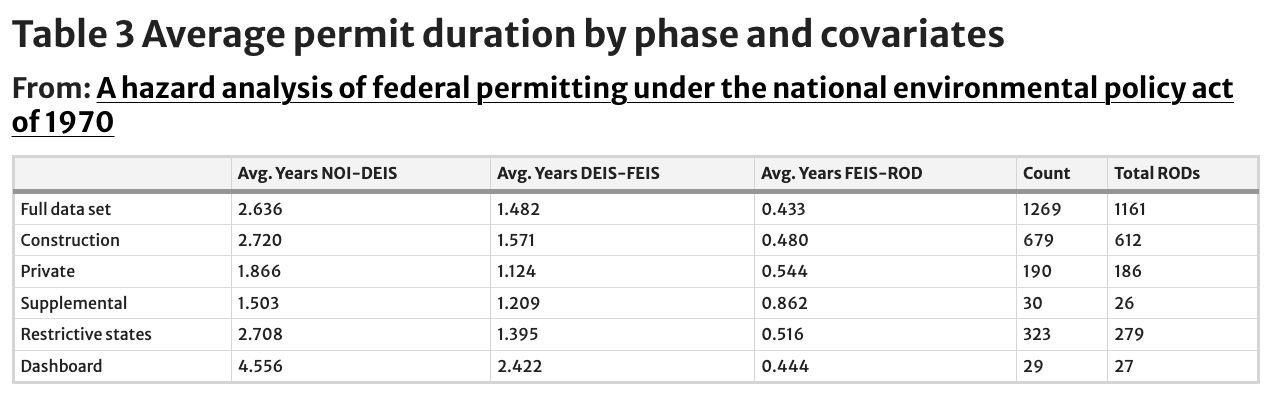
As mentioned, the authors find that major construction and infrastructure projects have significantly longer permitting times, averaging 5.2 years.


Table 3 Average permit duration by phase and covariates


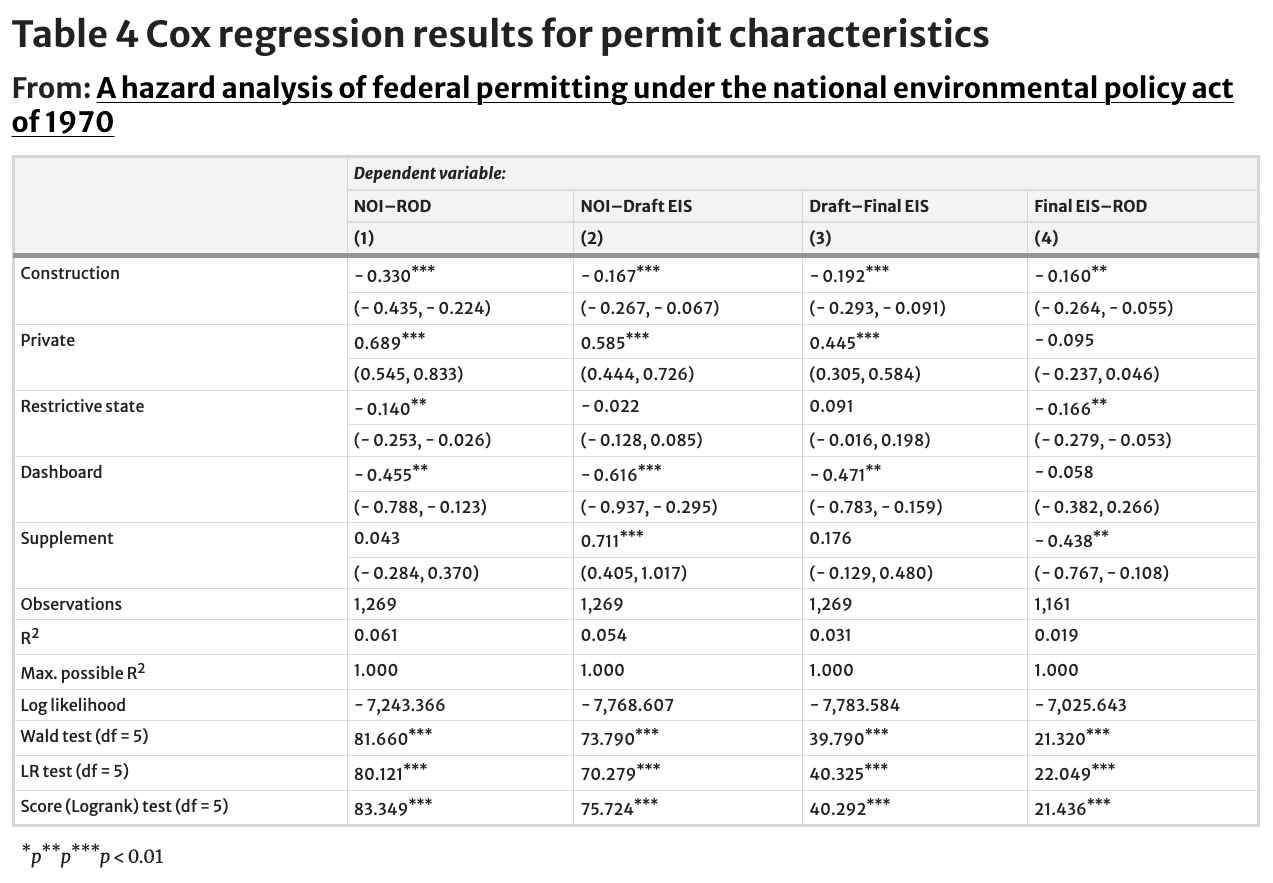
Table 4 Cox regression results for permit characteristics


Conversely, privately financed projects are indeed found to be approved more quickly, taking an average of just 3.7 years. Meanwhile, projects in states with restrictive environmental laws, such as California, New York, and Washington, are found to take longer. Contrary to the authors’ expectations, however, projects included in the federal permitting dashboard face longer permitting times. This may reflect selection bias, or the fact that projects placed on the dashboard tend to be especially large or complex. In terms of page count, longer EISs are associated with longer permitting times and longer delays. 

Finally, the authors examine permit completion rates by federal agencies, finding an average of 3 RODs per week. This rate is generally stable over time, though it spiked during Donald Trump’s election in 2016 and his inauguration in early 2017. Ultimately, the findings suggest that permitting duration is shaped not only by technical regulations but also by differences in economic resources, political conflict over projects, and federalism.

*Brief prepared by Adam Fefer.

Hero Image
Windmills on green field under white sky during daytime
Turlock Irrigation District (Turlock, CA). | American Public Power Association
All News button
1
Subtitle

CDDRL Research-in-Brief [4-minute read]

Image
Windmills on green field under white sky during daytime
Caption Turlock Irrigation District (Turlock, CA). | Photo credit American Public Power Association
Aria Label
Read More of Correlates of Federal Permitting for Environmentally Impactful Projects
Date Label
Display Hero Image Wide (1320px)
No
Authors
News Type
News
Date
Paragraphs

Introduction and Contribution


Economies depend on infrastructure: roads enable the movement of goods and workers, electricity powers businesses and factories, and communications technologies allow for the exchange of information and services. Yet in our connected world, roughly 1 billion people live more than two kilometers from an all-season road, and approximately 1.2 billion have no access to electricity.1

For decades, institutions such as the World Bank and McKinsey Global Institute have promoted the idea that closing a trillion-dollar gap between planned global infrastructure investment and the estimated level of investment needed to drive growth will alleviate poverty, harness the potential of developing nations to increase global GDP, and enrich foreign investors. But despite the fact that unrealized gains from greater infrastructure investment in emerging market and developing economies (EMDEs) outstrip those in the rich world, comparatively little capital flows into the infrastructure of poor countries.

In “The Global Infrastructure Gap: Potential, Perils, and a Framework for Distinction,” Camille Gardner and Peter Blair Henry reject the received narrative that flooding poor countries with capital simply to reach a target level of infrastructure investment will yield the desired gains. Instead, they urge investors and policymakers to move from thinking about infrastructure “gaps” to prioritizing infrastructure returns. Specifically, they propose the first “dual hurdle” framework. The framework uses cross-country differences in returns to identify efficiency in cross-country investments, incorporating the incentives that suppliers and allocators of capital must have to finance productive projects.

The authors reject the received narrative that flooding poor countries with capital simply to reach a target level of infrastructure investment will yield the desired gains.

Applying the framework to historical data, Gardner and Henry debunk the notion that poor countries offer ubiquitous opportunities for productive investment. Only 13 percent of countries in the data set cleared the dual-hurdle tests of efficiency for projects in both roads and electricity. But for countries that did clear the hurdles, the return on infrastructure was large: more than 10 times greater in some cases than the return on rich-country private capital.

This underscores the need for updated and more accessible data to drive decisions and prioritize projects. Differences across countries, sectors (e.g., roads vs. electricity), and locations (urban vs. rural) must be taken seriously to avoid a wasteful allocation of global infrastructure capital.

Gardner and Henry expand our understanding of when cross-country infrastructure investments are efficient and why poor countries have struggled to catch up. And as labor forces in poor countries grow rapidly, the problems associated with infrastructure scarcity are likely to become more acute, increasing migration pressures. Effective investment can mitigate risks while generating mutual gains for poor and rich countries alike.

When Infrastructure Investment Pays Off


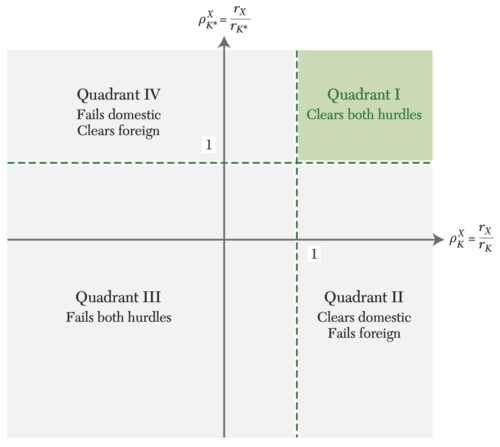
The authors’ dual hurdle framework reveals that public infrastructure investment in a poor country is efficient only if it yields higher returns than the social rate of return on private capital (a) within the country and (b) in rich countries. Countries that clear both hurdles are deemed strong candidates for more investment.


Image
Figure 4. The Dual-Hurdle Framework


Figure 4. The Dual-Hurdle Framework

Note: For a given poor country and type of infrastructure, the dual-hurdle framework sorts each country-infrastructure observation into one of four quadrants according to whether it clears the hurdle for efficient: (a) domestic investment, and (b) foreign investment.


Gardner and Henry apply their framework to 53 countries that belong to the only known data set of comprehensive cross-country estimates of the social rates of return on infrastructure (roads and electricity) in poor countries, found in a paper commissioned by the World Bank that is based on data from 1985.2 In their analysis, Gardner and Henry show that while some countries have opportunities for high returns (especially for paved roads), many others do not. In very few countries can the case be made for investing across multiple kinds of infrastructure (only 7 of 53 countries cleared the dual hurdles for both roads and electricity), and for some countries there is no case to be made.

To be clear, infrastructure investment is not generally inefficient. Indeed, worthwhile projects to increase or upgrade infrastructure in poor countries can yield much higher gains than are available from private investment in both poor and rich countries. This is because infrastructure improvements raise productivity across the economy. The problem is that these high-return opportunities are difficult to identify, especially without updated, readily accessible, quality data.

Different types of infrastructure also vary in their impact depending on the context. For example, investments in electricity often yield low returns in rural settings but high returns in urban settings (where firms are concentrated and struggle due to unreliable power). By contrast, roads more often yield higher returns because they support market activity overall. Finally, the authors show that efficient infrastructure also depends on the interaction of private capital, human capital, and good institutions. This underscores the limitations of simply building more infrastructure in isolation. 

Challenges to Infrastructure Investment


Gardner and Henry document extensive variation in efficiency when comparing private versus public capital allocation (in roads and electricity) across rich and poor countries. The social rates of return on public capital vary much more than with private capital, which is the case in both rich and poor countries, and inefficiencies in public capital allocation are greater in poor countries than in rich ones. This variation is driven not just by economic factors but also by political and institutional constraints.

The concept of “frozen capital” helpfully describes the outcome of problems facing prospective investors. For one, because infrastructure requires complementarities (e.g., electrifying an area requires the preexistence of reliable roads), individual projects may be unprofitable unless others are simultaneously financed and coordinated.

Additionally, foreign investors may distrust the governments of the countries where they invest, or they may be wary of the quality of domestic firms tasked with completing a given project. This will certainly be true where transparency and accountability are lacking. Especially in poor autocracies or semi-democracies, governments may arbitrarily change the law, fail to honor contracts, or face political and social instability, leaving investors uncertain about the prospect of repayment and return on their investments.

Ultimately, infrastructure investment offers great promise, but it must be evidence-based and approached with caution. The challenge is not to simply raise the level of investment but, as “The Global Infrastructure Gap” shows, to use cross-country differences in returns to identify the right infrastructure projects, in the right places, to maximize the efficiency of cross-country capital allocation.

*Brief prepared by Adam Fefer.

References:

1. Canning, David, and Esra Bennathan. 2000. “The Social Rate of Return on Infrastructure Investment.” World Bank Policy Research Working Paper 2390.

2. Rozenberg, Julie, and Marianne Fay, eds. 2019. Beyond the Gap: How Countries Can Afford the Infrastructure They Need While Protecting the Planet. Washington, DC: World Bank.

Hero Image
Aerial view of a multi-level highway interchange with sweeping curved overpasses crossing above one another. A few cars and a white semi-truck travel on the mostly empty concrete roads, while patches of vegetation and water are visible below the elevated ramps.
Brendan Beale
All News button
1
Subtitle

CDDRL Research-in-Brief [3.5-minute read]

Image
Aerial view of a multi-level highway interchange with sweeping curved overpasses crossing above one another. A few cars and a white semi-truck travel on the mostly empty concrete roads, while patches of vegetation and water are visible below the elevated ramps.
Photo credit Brendan Beale
Aria Label
Read More When Does Infrastructure Investment Pay Off?
Date Label
Display Hero Image Wide (1320px)
No
Paragraphs

This paper asks whether the United States and the European Union, despite divergent economic exposure and institutional design, can sustain a coherent sanctions strategy toward Russia, and how that divergence shapes the regime's effectiveness. It proceeds through a structured comparison across three policy domains — energy, finance, and immobilized sovereign assets — drawing on the literatures on economic statecraft, energy security, and financial-network theory, and on transaction-level, macroeconomic, and legal evidence from 2022 to early 2026. The analysis finds, first, that the United States' position as a net energy exporter enabled rapid embargoes, whereas the EU's import dependence produced a slower, phased decoupling. Second, US financial measures operated extraterritorially through dollar centrality and centralized OFAC enforcement, while the EU relied on regulatory jurisdiction over SWIFT but enforced through fragmented national authorities; a Gazprombank carve-out preserved the energy-export inflows that offset the intended balance-of-payments shock. Third, in the dispute over frozen assets, EU custodial institutions bear the legal and retaliatory exposure that the United States advocates from a position of relative insulation. The findings indicate that the regime's effectiveness is constrained less by the design of individual measures than by uneven enforcement and an asymmetric distribution of risk; absent institutionalized burden-sharing, its durability and credibility are likely to weaken.

All Publications button
1
Publication Type
Conference Memos
Publication Date
Authors
Paragraphs

Due to its extreme climate and low population density, the Russian Arctic region remains largely infrastructurally undeveloped. Many settlements in the Arctic area are not connected to the Unified Energy System of Russia (UES) and employ various carbon-intensive sources for local electricity generation. Currently, the Russian government has drafted a strategic development plan for the region, specifically utilizing the region's vast supply of oil and natural gas reserves for electricity generation. The Arctic ecosystem is fragile, and constructing new oil, gas, or diesel power stations may not be sustainable for the region. Additionally, the utilization of fossil fuels would exclude the current technological advancements in electricity systems. This paper offers an improved and more sustainable approach to developing electricity generation in remote localities. Given unique regional ecological and sustainability concerns, Territories of Advanced Social and Economic Development (TASED) should be created in the Arctic regions of Yamal and Murmansk in order to integrate wind electricity generation on a small scale in these regions' most remote population centers. Not only would this protect the region's ecosystem from the negative effects of new fossil fuel power stations, but it would also present new opportunities for equitable development of the region's economy.

All Publications button
1
Publication Type
Conference Memos
Publication Date
Journal Publisher
The Stanford US-Russia Journal
Authors
Number
No. 1
Paragraphs

This study focuses on the mitigation of methane emissions from large-scale oil and gas infrastructure. It is built on two complementary cases of the Russian Federation and United States, who are two of the largest oil and natural gas producers, possess the most extensive oil and natural gas pipeline networks, and both deal with the emerging problem of high-level methane emissions. The paper attempts to identify differences and similarities between the countries' approaches in mitigating methane emissions. Analyzing open data on methane emissions, legislation, corporate standards, and reports of state agencies, this research seeks to answer the question of whether there is space for cooperation and exchange of experiences and best practices between the two countries in methane leak detection and repair (LDAR). Our analysis shows a considerable lack in corresponding regulation in both countries and identifies a dramatic misalignment between international, national, and corporate actions. However, we see the opportunity to significantly reduce the existing gaps in regulation and technological adaptation through international cooperation and exchange of best practices. The paper supports corresponding policy and practical implications that rely on bilateral and multilateral initiatives and a cooperative approach between oil and gas companies and the government.

All Publications button
1
Publication Type
Conference Memos
Publication Date
Journal Publisher
The Stanford US-Russia Journal
Authors
Number
No. 1
Paragraphs

Despite five decades of administrative practice and judicial development, there is a considerable gap in legal and empirical study on the impacts of the National Environmental Policy Act of 1970 (NEPA). Proponents of NEPA reform often claim that environmental litigation is a major obstacle for important federal actions. Others have studied the same issue and concluded that NEPA litigation is not a major contributor of project cost escalation or delays. This study addresses this gap by supplementing a data set of the largest 355 transportation and energy infrastructure projects in the United States which completed a federal environmental study between 2010 and 2018.

We observe predevelopment litigation on 28% of the energy and transport projects requiring an Environmental Impact Statement, 89% of which involve a claim of a NEPA violation. Of the major sectors, the highest litigation rate is in solar energy projects, nearly two-thirds of which are litigated. Light Rail Transit projects are litigated at nearly twice the rate of new highway projects and 2.5x the rate of highway improvement projects. Other high-litigation sectors include pipelines (50%), transmission lines (31%), and wind energy projects (38%). Energy sectors with higher rates of private financing have shorter permit durations, higher rates of litigation, and higher rates of cancellation but also higher completion rates relative to transport sectors, which have higher rates of public financing and lower rates of litigation, but extremely long permit timelines. Our findings shed additional light on the ways that NEPA impacts large, environmentally impactful infrastructure projects in various sectors in the United States.

All Publications button
1
Publication Type
Working Papers
Publication Date
Journal Publisher
Environmental Law Reporter
Authors
Michael Bennon
Paragraphs
Cover of Enhancing Resilience in a Chaotic World: The Role of Infrastructure

The United States is currently undergoing a period of massive change in its economy, which is being spearheaded by three major pieces of federal infrastructure and industrial policy legislation: the Infrastructure Investment and Jobs Act (IIJA), the Creating Helpful Incentives to Produce Semiconductors (CHIPS) Act, and the Inflation Reduction Act (IRA). These new programs represent not only a massive investment in select parts of the US economy, but also significant changes in how the US invests and manages its economy through the use of industrial policy.

This chapter reviews these changes in the “how” of US industrial policy and federal investment and discusses two of the challenges that the US government faces as it attempts to orchestrate major changes to its economy. The first is a regulatory system designed to slow or otherwise constrain capital investment and growth. The second consists of unique aspects of US governance and its role in the global economy that will make state-led direct investment and other industrial policy programs challenging to implement.

All Publications button
1
Publication Type
Reports
Publication Date
Subtitle

Chapter in Enhancing Resilience in a Chaotic World: The Role of Infrastructure, an ISPI-McKinsey & Company REPORT

Authors
Michael Bennon
Book Publisher
Italian Institute for International Political Studies
Authors
Gi-Wook Shin
News Type
Commentary
Date
Paragraphs

This essay originally appeared in Korean on March 4 in Sindonga (New East Asia), Korea’s oldest monthly magazine (established 1931), as part of a monthly column, "Shin’s Reflections on Korea." Translated by Raymond Ha. A PDF version of this essay is also available to download. 

This winter, Koreans struggled with the bitter cold amidst a surge in heating costs. It has already been said many times, but climate change and the energy crisis are no longer abstract issues to be dealt with in the future. Northern California, where I live, was drenched and battered by intense storms this winter. The Midwest and the East Coast experienced brutal cold waves and heavy snow. Mount Washington in New Hampshire, close to the Canadian border, “recorded the coldest wind chill in the history of the United States” in early February at -108.4ºF.1 Europe was spared the worst due to an unusually warm winter, but the energy crisis sparked by the Russia-Ukraine War still poses a vexing challenge.

As the world emerges from the worst of the COVID-19 pandemic, it faces a series of interrelated challenges—climate change, wars, the energy crisis, inflation, Sino-U.S. tensions, a crisis of democracy, and a crisis of political leadership. Each one of these problems is formidable on its own, but they are inextricably bound together like a Gordian knot. It is hard to know where to begin. Untangling this knot will require not only cooperation between Washington and Beijing, but also broader multilateral coordination. Simply severing the knot is not a feasible solution. Reflecting this complex state of affairs, the theme of this year’s World Economic Forum at Davos, Switzerland was “Cooperation in a Fragmented World.”


The Yoon administration has put forth a vision of values-based diplomacy based on partnerships with liberal democracies, but it must also be more proactive in facilitating international cooperation on climate change and energy issues. There is no time to lose.
Gi-Wook Shin

Korea cannot afford to remain a bystander to climate change. Energy security is a critical issue for Seoul, as Korea is highly dependent on energy imports. Climate change and energy security are also at the heart of the United Nations’ emphasis on sustainability, and addressing them will require international cooperation based on coherent, consistent policies at the national level. It is encouraging to note that the Yoon Suk-Yeol administration has proclaimed carbon neutrality as a policy goal while also emphasizing Korea’s energy security. These issues transcend ideological divides and party lines. They are a matter of national survival. The Yoon administration has put forth a vision of values-based diplomacy based on partnerships with liberal democracies, but it must also be more proactive in facilitating international cooperation on climate change and energy issues. There is no time to lose, and Korea’s international stature demands that it play a greater role.

When It Rains on Greenland’s Glaciers

During a recent visit to a winery in Napa Valley, I asked the owner for his thoughts about the most serious threat or challenge that the winery would face in the next 20 to 30 years. I assumed he would mention fire, given the devastating fires the region has experienced in the past few years. Without any hesitation, however, he said it was climate change. Even a one-degree Celsius increase in the temperature would necessitate a substantial change in the variety of grapes he could grow. If current trends persist, he added, Oregon or Washington will become the center of wine production on the West Coast.

There are similar changes occurring in Europe. Grape-harvesting regions are gradually moving north, with one study concluding that the United Kingdom could have the best climate for grape production in 20 years.2 The UK currently has lower average temperatures and shorter summers than France or southern Europe, but this could change by 2040. According to Debbie Inglis, the director of the Cool Climate Oenology and Viticulture Institute in Canada, “a 2ºC global increase in temperature could remove 55% of wine growing regions worldwide and 4ºC could remove over 70% of these regions from production.”3

Coffee—beloved by many Koreans—will also be affected by climate change. A recent study by researchers at the University of Zürich reported that the regions suitable for coffee production “could be cut in half by 2050.”4 A study published by the National Academy of Sciences concluded that an increase in surface-level temperatures of 2ºC or greater could reduce coffee production in Latin America by up to 88%.5 In addition, the International Coffee Organization found that 70% of the land suitable for coffee production in Southeast Asia will disappear by 2050. Coffee beans, the most commonly traded item after oil, are presently cultivated in over 60 countries. If coffee production falls as a result of climate change, we may soon witness coffee rationing and even international disputes over coffee.

Climate change will disrupt every aspect of our daily lives, and the pace and intensity of this disruption only continues to grow. Fort Smith in Canada is located north of the 60th parallel and usually remains cool during the summer, but it reached nearly 104ºF in 2021, breaking an 80-year record.6 The Summit Station, located at the highest point of Greenland’s glaciers, saw rain for the first time in recorded history in August 2021.7 There were 97 tropical storms last year, including typhoons and hurricanes. Headlines about record flooding, unprecedented droughts, and extreme heatwaves are becoming a regular occurrence.

An annual global climate report published by the National Oceanic and Atmospheric Administration (NOAA) last year noted that atmospheric carbon dioxide levels in 2021 had reached the highest level “in at least the last million years.” Global surface temperatures were 0.21–0.28ºC higher than the 1991–2020 average, making 2021 one of the six warmest years since observation began in the 19th century. Moreover, 2015 to 2021 marked “the seven warmest years on record.”8 The latest research, utilizing artificial intelligence, concludes that temperatures will rise 1.5ºC above pre-industrial levels within the next 10 years even if action is taken to reduce emissions.9

In 2021, NOAA Administrator Rick Spinrad said at COP26 in Glasgow that the climate crisis “is not a challenge for future generations, but one we must confront today.”10 A few months later, he warned that “if we hope to have a prosperous society and economy tomorrow, it must begin with climate action and adaptation plans made today.”11 In his opening remarks to COP27 in Sharm El-Sheikh last November, UN Secretary-General António Guterres did not hold back. “We are on a highway to climate hell with our foot still on the accelerator,” he said, observing that “the deadly impacts of climate change are here and now.”12

A Global Energy Crisis

The energy problem is closely tied to climate change. Around 3 billion people, or 40% of the global population, still rely on wood, coal, charcoal, and animal waste for their energy needs. These materials are some of the main culprits of climate change, as they are responsible for approximately 60% of global greenhouse gas emissions. When the United Nations announced 17 sustainable development goals (SDGs) in 2015, the question of energy was discussed extensively. For instance, goal 7, “Affordable and clean energy,” notes that increasing the use of renewable energy and reducing greenhouse gas emissions will help address climate change and foster inclusive and sustainable communities.


International cooperation on clean and renewable energy is vital, but the Ukraine-Russia War has demonstrated how energy supplies can be weaponized for political purposes. This has exacerbated the energy crisis across the world.
Gi-Wook Shin

Despite such efforts, realizing this goal remains a distant prospect. International cooperation on clean and renewable energy is vital, but the Ukraine-Russia War has demonstrated how energy supplies can be weaponized for political purposes. This has exacerbated the energy crisis across the world. According to data from the European Commission, for instance, “in 2019 Europe relied on Russia for 41.1 percent of its gas imports, 46.7 percent of its solid fuels imports, and 26.9 percent of its crude oil imports.”13

In an October 2022 interview, Fatih Birol, the executive director of the International Energy Agency (IEA), noted that “in the 1970s, we had an oil crisis, but it was only oil. Now we have oil, natural gas, coal, [and] electricity.”14 The IEA was founded in 1974 by major energy consumers, including the United States, in response to price manipulation by oil producers in the Middle East. Its chief is now sounding the alarm about a wide-ranging energy crisis more serious than that of the 1970s.

Green Growth: The Lee Administration’s Lost Legacy

Korea experienced significant difficulties during the 1970s oil shock, even resorting to oil rationing. To this day, Korea’s economy suffers from a major vulnerability—it is completely dependent on oil and natural gas imports for its energy needs. Those in Korea should heed Birol’s warning. This summer, Koreans may have to deal with intense heat waves and a surge in electricity prices. If a conflict were to break out in East Asia, it could block the commercial sea lanes that are the lifeline of Korea’s economy. In such a scenario, Korea would be much more vulnerable than the EU is today following Russia’s invasion of Ukraine. It is vital to think ahead about how Korea can meet its energy requirements even if there is a geopolitical crisis in the region.

The Lee Myung-Bak administration (2008–13) was perhaps the first government to pay serious attention to climate change and the importance of the energy issue. Every administration has its successes and failures, but the Lee administration has not received due credit for its “green growth” agenda and its “resource diplomacy.” Worthy policy initiatives can run into errors as they are implemented, and such mistakes should be rectified. It is a great shame that the Lee administration’s policy vision on climate change and energy issues was not upheld by its successors. The Moon Jae-in administration even regarded resource diplomacy as a political target during its campaign to eradicate “deep-rooted evils.”15 In a welcome development, the current Yoon administration seems to be receptive to restoring the green growth agenda and resource diplomacy. That said, the question remains whether Korea could have done more on these issues in the past 10 years.

Green growth was at the heart of the Lee administration’s climate change policy. This is a concept that links and encompasses two issues: the green transition and economic growth. If a country seeks to achieve economic growth in a more environmentally friendly manner, this will give rise to new industries and technologies that are related to the environment and to the energy sector. To create jobs and find new sources of economic growth, the Lee administration sought to identify new industries and technologies with great economic potential and fuse them with existing industries. The Framework Act on Low Carbon, Green Growth was enacted in January 2010 as part of this effort.16 This law, commonly referred to as the “Green Growth Act,” was the first Korean law to address climate change. It provided the legal basis for setting emission reduction targets, and it catalyzed the Korean government’s response to climate change.

Furthermore, the Lee administration spurred international cooperation on these issues. For example, the Global Green Growth Institute (GGGI) was formed as a non-profit organization in Korea in June 2010. GGGI was then officially recognized as an international organization two years later, at the UN Conference on Sustainable Development in Rio de Janeiro. This institute, which has its headquarters in Seoul, is the first international organization that was created under Korea’s leadership. At COP21 in 2015, GGGI announced “the launch of the Inclusive Green Growth Partnership, a new collaboration with top multilateral development banks and United Nations regional economic and social commissions.”17 This partnership aimed to achieve “shared prosperity and equitable growth that creates employment and raises the income of the world’s poorest,” and “assist multilateral development banks and funds in identifying green growth opportunities and investments.”18 Major development banks, including the Asian Development Bank, the Inter-American Development Bank, and the African Development Bank, participated in this initiative.

Korea as a Resource-Poor Country

The Lee administration also expended great time and effort toward resource diplomacy. Korea is a resource-poor country, and its dependence on resource imports is the highest among OECD countries. Although it is a manufacturing powerhouse, Korea’s economy takes a hit whenever there is a spike in commodity prices. This is why the Lee administration—and its predecessors—sought to secure foreign resources. The Kim Dae-Jung administration (1998–2003) established a basic plan for developing overseas resources, and the Roh Moo-Hyun administration (2003–08) sought to grow Korea’s stake in mines in Mongolia and across Africa.19 However, the Lee administration was by far the most proactive on these issues. It worked through public sector companies to invest in and develop resources overseas. Recall, for example, that China has waged an aggressive campaign of its own to secure resources in Africa and Southern America.

Korea’s resource diplomacy fell behind in the 10 years following the Lee administration. According to the Ministry of Trade, Industry and Energy (MOTIE), there were 219 projects related to developing overseas mines in 2012. This number shrank to 94 in 2021.20 In many cases, the government’s stake in overseas mines was sold at a giveaway price. As mentioned above, these projects became the target of a political campaign under the Moon administration. By its very nature, resource diplomacy is a high-risk endeavor that seeks to achieve long-term strategic goals. As a resource-poor country, Korea has no choice but to assume this risk.

To date, only the negative elements of the Lee administration’s resource diplomacy have been highlighted by the press. However, there have been major successes. The Prelude floating liquefied natural gas (LNG) platform off the Australian coast is a good example. In 2012, the Korea Gas Corporation acquired a 10% stake in this project with an investment of $1.5 billion. It began production in 2019 and was in the red until 2020, but it began to turn a profit in 2021. LNG prices have skyrocketed due to Russia’s weaponization of fossil fuels, and Korea stands to benefit greatly from this investment.21

Resource nationalism is emerging once again around the globe. Korea must remember its position as a resource-poor country. Although investment in overseas resources should be spearheaded by the private sector, the government should do what it can to support these initiatives.
Gi-Wook Shin

Resource nationalism is emerging once again around the globe. Korea must remember its position as a resource-poor country. Although investment in overseas resources should be spearheaded by the private sector, the government should do what it can to support these initiatives with an eye toward achieving energy security. It is vital to maintain a long-term perspective, assuming appropriate risks when necessary. Once again, this is not a political nor an ideological issue.

Why Nuclear Energy Matters

“Sustainable development” and “ESG” (Environmental, Social, and Governance) are now widely known among the general public. The 70th Session of the UN General Assembly in 2015 adopted a resolution to achieve the SDGs by 2030. The SDGs articulate common goals for humanity as it seeks to achieve sustainable development for all. Under the slogan of “leave no one behind” and its five overarching themes of people, planet, prosperity, peace, and partnerships, the SDGs put forth 17 goals and 169 specific targets.22 Although the SDGs address broad issues, including poverty, food security, education, gender equality, socioeconomic inequality, and housing, they also propose specific goals for addressing these issues.

While stressing the need for highly developed countries, developing countries, and low-income countries to promote prosperity for all, the SDGs also call upon countries to protect the environment. To strengthen international cooperation on climate change, UN member states adopted the Paris Agreement at COP21 in December 2015. This agreement went into effect in November 2016. Under this accord, countries agreed to “substantially reduce global greenhouse gas emissions to limit the global temperature increase in this century to 2 degrees Celsius.”23 The Trump administration’s decision to withdraw from the agreement represented a setback. However, by April 2018, 175 countries had signed the agreement and ten developing countries had submitted their national adaptation plans for responding to climate change. COP27, held at Sharm El-Sheikh in 2022, added the question of “loss and damage” to its official agenda. There was also an agreement to “establish new funding arrangements, as well as a dedicated fund, to assist developing countries in responding to” damages resulting from climate disasters.24

Korea has been taking steps to align itself with these international developments. Though it was already far too late, Korea announced in October 2020 that it would achieve carbon neutrality by 2050. On September 24, 2021, it enacted the Framework Act on Carbon Neutrality and Green Growth for Coping with Climate Crisis.25 This act codified the goal of carbon neutrality by 2050 into law. Furthermore, it established the legal procedures for setting forth a national strategy, specifying medium- to long-term emission reduction targets, and formulating and monitoring the implementation of basic plans on addressing climate change. Specifically, the law codifies Korea’s nationally determined contribution (NDC) for greenhouse gas emission reduction as 35 percent relative to 2018 levels. This law went into effect on March 25, 2022, making Korea the 14th country to codify the goal of carbon neutrality by 2050 and establish a legal framework for relevant policy implementation. It took Korea 12 years to enact an enhanced version of the Framework Act on Low Carbon, Green Growth, which went into effect in April 2010.

Due to geographic factors, Korea cannot generate enough energy from renewable energy sources. Instead of phasing out nuclear power, Korea has to substantially increase its use of nuclear energy if it hopes to attain carbon neutrality.
Gi-Wook Shin

There is an important consideration on Korea’s journey toward carbon neutrality: nuclear energy. Although Korea should eventually phase out its nuclear power plants, carbon neutrality is virtually impossible without reliance on nuclear energy. Due to geographic factors, Korea cannot generate enough energy from renewable energy sources. Instead of phasing out nuclear power, Korea has to substantially increase its use of nuclear energy if it hopes to attain carbon neutrality.

Nonetheless, the Moon Jae-In administration abruptly pursued a nuclear phase-out policy for most of its term. It halted construction on nuclear power plants and prematurely shut down an operational power plant that had passed safety inspections. At the same time, it provided substantial subsidies for solar power installations. Shortly before leaving office, however, Moon stated on February 25, 2022, that Korea must “sufficiently utilize nuclear power plants as a major source of energy for the next 60 years.” He also urged relevant agencies to “take all necessary steps to hasten the operation” of four nuclear power plants whose construction had been delayed.26 In the end, Korea lost precious time due to incoherent and ill-advised policies.

The Yoon administration is right to proclaim carbon neutrality as a policy objective and emphasize the importance of energy security. It appears that the Russia-Ukraine War and global supply chain disruptions have influenced the administration’s thinking. At a June 2022 public hearing on the new administration’s energy policies, Director-General Cheon Yeong-Gil, the MOTIE official responsible for energy transition policy, stated that “it is becoming increasingly important to pursue both carbon neutrality and energy security, as Russia’s invasion of Ukraine is becoming protracted.”27 The United States, the United Kingdom, and other advanced economies are reconsidering the specifics of their energy policy, while maintaining the overarching goal of carbon neutrality. Korea must formulate a comprehensive policy that accounts for environmental concerns and energy security.

Fostering Scholarship and Leadership

Climate change and the energy crisis cannot and should not be addressed by governments alone. Academia and the private sector have important roles to play in convening groups of experts, calling upon citizens to act, and fostering international cooperation. Universities in the United States, Japan, and China are beginning to establish institutions that address climate change and energy issues. Prominent examples include Stanford’s Doerr School of Sustainability, which opened its doors last September; Tokyo University’s Center for Climate Solutions; and Tsinghua University’s Institute for Sustainable Development Goals. Several Korean universities, including Ewha Womans University and KAIST, have also taken steps in this direction. The government and the private sector should do everything they can to support these initiatives. Such institutions will prepare today’s youth to respond to the challenges posed by climate change and the energy crisis.

Korea’s companies must take a farsighted view in supporting institutions that discuss and address issues of global importance. Think tanks such as the Asan Institute for Policy Studies and the Chey Institute, both established with private support, are playing an active role in policy discussions. However, their budgets are relatively small, and they do not comprehensively engage with fundamental issues of global importance. It is hard to find Korean equivalents of the Gates Foundation or the Zuckerberg Initiative, in which a company’s founder donates a large part of their wealth toward addressing global issues—poverty, public health, education, climate change, and energy. While Samsung operates Samsung Global Research, it must do more to support research on long-term global issues in a way befitting of its status as a global company.

Moreover, Korea has Ban Ki-Moon, who oversaw the establishment of the SDGs during his tenure as UN secretary-general. He continues to actively engage with a variety of global issues abroad, but his experience and expertise are underappreciated at home. Korea can do more to play a leadership role on international issues, and climate change and energy issues present a valuable opportunity. Ban could play a meaningful role in advising, facilitating, or overseeing such efforts.

Last October, the Shorenstein Asia-Pacific Research Center partnered with the Ban Ki-Moon Foundation to launch the Trans-Pacific Sustainability Dialogue. This forum seeks to convene scientists, experts, and policy practitioners from across the Asia-Pacific for an annual discussion to identify avenues for cooperation and foster a new generation of leaders. The inaugural dialogue addressed climate change, and this year’s dialogue will be held in Seoul on the topic of energy security. It is my hope that Korea will host many such international conferences in the years to come, as a way for Korea to exercise leadership on the international stage.

Just Look Up!

A comet several miles wide is hurtling toward Earth. If nothing is done, humanity will go extinct. However, most people question or deny the existence of this comet. As the comet finally becomes visible in the sky, some begin to cry “just look up!” Anyone can look up and see the truth for themselves. Even so, others refuse to recognize this reality. They claim that this object is not a comet, and they shout “don’t look up” instead. This is the plot of the movie "Don’t Look Up," released in 2021.

The Earth will be destroyed in less than six months, but the wealthy collude with the powerful to profit from the impending extinction of humanity. They claim that the comet is full of valuable raw materials. Later on, they detonate the moon in an unsuccessful attempt to block the comet. As a means of last resort, they escape Earth to reach a faraway planet, where they die at the hands of the alien population. The vast majority of people on Earth have no choice but to hold each other’s hands and pray as they await their fate.

It cannot be emphasized enough: climate change and the energy crisis are beginning to disrupt our everyday lives in tangible ways. The truth is in front of our eyes, but we should question if we are telling ourselves to not look up. In addition, the movie reminds us of the dire consequences when politicians and the wealthy collude to pursue their narrow self-interest. There is not much time left to confront and respond to the crises that are unfolding in plain sight. Perhaps no one can undo the Gordian knot overnight, but we should—at the very least—just look up.


1 Amanda Pitts and Michael Bartiromo, “Mt. Washington Records Coldest Wind Chill in US History,” The Hill, February 6, 2023. ↩

2 Alistair Nesbitt et al., “Climate Change Projections for UK Viticulture to 2040: A Focus on Improving Suitability for Pinot Noir,” OENO One 56, no. 3 (2022). ↩

3 Clarissa Wei, “The Arctic Circle: A New Frontier for Sustainable Wine,” BBC Travel, September 1, 2022. ↩

4 Roman Grüter, Tim Trachsel, Patrick Laube, and Isabel Jaisli, “Expected Global Suitability of Coffee, Cashew and Avocado Due to Climate Change,” PLOS ONE, January 26, 2022. ↩

5 Justin Worland, “Your Morning Cup of Coffee Is in Danger. Can the Industry Adapt in Time?,” TIME, June 21, 2018. ↩

6 Walter Strong, “Fort Smith Had Its Hottest Day in 80 Years: Preliminary Data,” CBC News, June 30, 2021.↩

7 Kasha Patel, “Rain Falls at the Summit of Greenland Ice Sheet for First Time on Record,” Washington Post, August 19, 2021, https://www.washingtonpost.com/weather/2021/08/19/greenland-melt-august….↩

8 National Oceanic and Atmospheric Administration, “BAMS Report: Record-High Greenhouse Gases, Sea Levels in 2021,” August 31, 2022. ↩

9 Josie Garthwaite, “Earth Likely to Cross Critical Climate Thresholds Even if Emissions Decline, Stanford Study Finds,” Stanford University, January 30, 2023. ↩

10 National Oceanic and Atmospheric Administration, “Dr. Rick Spinrad on COP26: Climate Crisis Not a Challenge for Future, but ‘One We Must Confront Today’,” November 1, 2021. ↩

11 National Oceanic and Atmospheric Administration, “Statement from NOAA Administrator Dr. Rick Spinrad on the IPCC Climate Change 2022 Impacts Report,” February 28, 2022. ↩

12 United Nations, “Secretary-General’s Remarks to High-Level Opening of COP27,” November 7, 2022. ↩

13 Giulia Carbonaro, “EU has Paid Russia $16 Billion for Fossil Fuels Since Ukraine War Started,” Newsweek, March 18, 2022. ↩

14 Sandor Zsiros and Jorge Liboreiro, “‘Russia Will Lose the Energy Battle,’ Says IEA Chief Fatih Birol,” Euronews, October 29, 2022. ↩

15 Gi-Wook Shin, “In Troubled Waters: South Korea’s Democracy in Crisis,” Shorenstein APARC, May 3, 2022. ↩

16 An English translation of the law by the Korea Legislation Research Institute is available at “Framework Act on Low Carbon, Green Growth,” Korea Law Translation Center. ↩

17 Global Green Growth Institute, “New Global Initiative Launches at COP21 to Boost Green Growth Financing,” December 7, 2015. ↩

18 Global Green Growth Institute, “New Global Initiative Launches.” ↩

19 Kim Boo-Mi, “As the Global Resource Wars Resume, Will Korea Resume Resource Diplomacy?” [in Korean], Elec Times, February 19, 2022. ↩

20 Jeong Ui-Jin, “The Government is Selling Overseas Mines” [in Korean], Korea Economic Daily, January 17, 2022. ↩

21 Jeon Joon-Beom, “The Lee Administration’s Investment Pays Off Amidst LNG Crisis” [in Korean], Chosun BIZ, August 24, 2022. ↩

22 A detailed overview of the SDGs can be found at “The 17 Goals,” United Nations Department of Social and Economic Affairs, Sustainable Development. ↩

23 United Nations, “The Paris Agreement.” ↩

24 United Nations Climate Change, “COP27 Reaches Breakthrough Agreement on New ‘Loss and Damage’ Fund for Vulnerable Countries,” November 20, 2022. ↩

25 For an English translation of the law by the Korea Legislation Research Institute, see “Framework Act on Carbon Neutrality and Green Growth for Coping With Climate Crisis,” Korea Law Translation Center. ↩

26 Im Hyung-Seop, “President Moon Convenes Meeting on Energy Supply” [in Korean], Yonhap News, February 25, 2022.↩

27 Jeong Sang-Pil, “New Administration’s Energy Policy to Focus on Security and Carbon Neutrality” [in Korean], Energy Platform News, June 21, 2022. ↩

DOWNLOAD A PDF VERSION OF THIS ESSAY

Read More

Yoon Suk-yeol speaks during a press conference
Commentary

In Troubled Waters: South Korea’s Democracy in Crisis

Just as the United States experienced a crisis of democracy under the Trump administration, South Korea underwent a democratic recession during President Moon Jae-in’s time in office. The consequences of this decline have been evident throughout the election and the subsequent presidential transition.
In Troubled Waters: South Korea’s Democracy in Crisis
Fukushima wind power HEADLINE 2
News

Stanford dialogue brings momentum to global energy conversation

Stanford dialogue brings momentum to global energy conversation
A figure dressed as a medical personnel holding a stethoscope and a blurry image of the South Korean flag in the background.
News

How South Korea Can Become a Global Pioneer in Productivity of Health Spending

Research by Stanford health economist Karen Eggleston, the director of APARC's Asia Health Policy Program, offers evidence on the link between medical spending and health outcomes in South Korea, showing how the country can benefit from developing a “satellite account for health” to promote high-value innovations for longer, healthier lives.
How South Korea Can Become a Global Pioneer in Productivity of Health Spending
Hero Image
Sebitseom islets, on the Han River in Seoul, Korea, flooded during the 2020 monsoons.
Sebitseom islets, on the Han River in Seoul, Korea, flooded during the 2020 monsoons. | Paul Gadd / Getty Images
All News button
1
Subtitle

Seoul Must Act Now for Its Climate and Energy Future

Subscribe to Energy Infrastructure