The Walter H. Shorenstein Asia-Pacific Research Center (APARC), a Stanford hub focused on the interdisciplinary study of contemporary Asia, has been awarded a commendation from the Ministry of Foreign Affairs of Japan, the country’s official government arm that conducts its foreign policy.
The annual award recognizes individuals and organizations that have promoted mutual understanding between Japan and the United States, and among other countries and regions. Shorenstein APARC, part of the Freeman Spogli Institute for International Studies, is one of four award recipients in the Bay Area and of 173 total recipients around the world.
“It is a great honor to receive an award given on behalf of the Japanese foreign minister,” said Gi-Wook Shin, director of Shorenstein APARC and professor of sociology. “We strive to advance research and dialogue between Japan and the United States, and this commendation serves to further motivate us in our efforts.”
The research center has a program that facilitates social science-oriented research on contemporary Japan, and convenes outreach activities closely tied to its research agenda.
In the past year, the center hosted 10 visiting fellows from Japan through its corporate affiliates program; a workshop in Tokyo with scholars and former government officials focused on the U.S.-Japan security alliance; and a public panel discussion at Stanford on U.S.-Japan relations in conjunction with the conferral of the Shorenstein Journalism Award.
Faculty and students also participated in the visit of Japanese Prime Minister Shinzo Abe to Stanford in April 2015. Abe was the first prime minister of Japan to visit the university and spoke on innovation.
On Oct. 28, the award was presented to the center at a ceremony held by the Consulate General of Japan in San Francisco. Shorenstein APARC faculty and affiliates in attendance included Michael Armacost, Shorenstein APARC distinguished fellow and former U.S. ambassador to Japan; Donald Emmerson, FSI senior fellow emeritus; Thomas Fingar, Shorenstein APARC distinguished fellow; Takeo Hoshi, FSI senior fellow and director of Shorenstein APARC's Japan Program; Gi-Wook Shin; Daniel Sneider, associate director for research; Kathleen Stephens, the William J. Perry Distinguished Fellow; and Xueguang Zhou, professor of sociology.
A new course jointly taught by Stanford and Peking University brought together students and scholars in China and the United States in dialogue using videoconferencing.
Each week during the past spring quarter, students at Stanford and Peking University (PKU) gathered in a classroom to learn, just as they would for any other course. The only difference was these students were neither in the same classroom nor on the same continent.
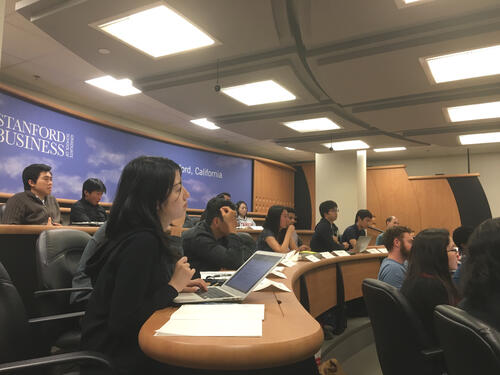
Despite being separated by nearly 6,000 miles, 18 students in Palo Alto and 28 students in Beijing held ‘face-to-face’ conversations via high definition videoconference in a course taught by American and Chinese scholars. On each side, they sat in a three-rowed amphitheater and looked directly ahead – not at a whiteboard – but at a screen that projects a video ‘wall’ of their colleagues at the other campus. The venue, known as a ‘Highly Immersive Classroom,’ enabled the distance learning experience between the two universities, using advanced software to create a cross-Pacific virtual classroom. The course titled The United States, China, & Global Security, led by former U.S. Ambassador to Afghanistan Karl Eikenberry and PKU professor Fan Shiming, was organized under the auspices of the U.S.-Asia Security Initiative whose research focuses on security challenges in Asia with teaching as one of its core activities.
“We set out to host a course that addressed topics critical to China and the United States in a new type of classroom format,” said Eikenberry, the Oksenberg-Rohlen Distinguished Fellow in the Shorenstein Asia-Pacific Research Center and director of the Initiative. “What resulted was a truly unique academic exchange that considered topics even beyond the bilateral relationship and carried a certain ‘Silicon Valley spirit’ being divided by an ocean yet connected through technology.”
“I loved the cybersecurity class because there was a lot of candor on both sides.”
-Shan Jee Chua, PKU graduate student
Over eight weeks, a select group of graduate students from the two universities explored a wide array of subjects related to international security, ranging from terrorism to trade and energy and the environment. The course aimed to provide students with a forum to discuss current issues in U.S.-China relations and to analyze areas that could be applied to other case studies.
“Because each week was a different topic, it didn’t feel like I was just thinking about the United States and China again every Wednesday night,” said Sam Ide, a Stanford graduate student who studies China’s relations with Central Asia. “Each session was very interesting to me in a different way.”
Guest-taught by prominent scholars and former senior government officials from the United States and China, the course sessions allocated thirty minutes for each lecturer to present, followed by a thirty minute question-and-answer period in which students were given the opportunity to interact with the lecturers and their peers on the other campus. Lecturers from Stanford included nuclear scientist Siegfried Hecker, former U.S. Secretary of Energy Steven Chu, and Thomas Fingar, a former deputy director at the U.S. Office of the Director of National Intelligence; and from PKU, Dean of the School of International Studies Jia Qingguo, and arms control and disarmament expert Han Hua. All discussions were off-the-record to encourage candid exchange of ideas.
Image
At Stanford's Highly Immersive Classroom in Palo Alto, students look ahead at their counterparts in Beijing.
One course session in particular resonated with students. The session, taught by Zha Daojiong, a professor of political economy at PKU and Herbert Lin, a senior research scholar at Stanford’s Freeman Spogli Institute for International Studies, focused on the changing nature and future of cybersecurity relations between China and the United States.
“I loved the cybersecurity class because there was a lot of candor on both sides,” PKU student Shan Jee Chua recalled.
Kimberly Chang, a second year Stanford graduate student in management science and engineering, noted that it was beneficial to hear the Chinese view on cyber “because most of the talk within the United States has been from an American perspective.”
“Hopefully, I'll be able to meet some of these people in real life who I've met on the 'wall.'”
-Sam Ide, Stanford graduate student
The course revealed a broader range of perspectives and provided a chance to interact first-hand with international colleagues while remaining at their home campus. Discussion amongst peers uncovered the “behind the scenes stories” and added context to media reports found online or in print, said Seung Kim, a student in Stanford’s East Asian studies program.
Besides the technology, a unique aspect of the course was its diversity. More than half of the course participants were international, representing 15 countries beyond China and the United States. That setting encouraged debate and reinforced the notion that “neither the United States nor China is the center of the universe,” said Zhu Jun Zhao, a PKU international relations student.
When students were asked what could bring about better understanding between China and the United States, continued dialogue was a common answer. The future of U.S.-China relations rests in the hands of people talking to one another: “I think we need more honest conversations,” Chang said.
And for some students, an opportunity to hold those conversations in-person may be close. Ide said he anticipates traveling to Beijing over the summer and plans to try and meet with a few of his counterparts whom he met through the course.
“Hopefully, I’ll be able to meet some of these people in real life who I’ve met on the ‘wall.’”
At the Stanford Center at Peking University in Beijing, Peking University professor Fan Shiming presents his remarks during a session of "The United States, China, & Global Security," a joint course taught by Stanford and Peking University via videoconference; Palo Alto, May 2016.
No nation is free from the charge that it has a less-than-complete view of the past. History is not simply about recording past events—it is often contested, negotiated, and reshaped over time. The debate over the history of World War II in Asia remains surprisingly intense, and Divergent Memories examines the opinions of powerful individuals to pinpoint the sources of conflict: from Japanese colonialism in Korea and atrocities in China to the American decision to use atomic weapons against Japan.
Rather than labeling others' views as "distorted" or ignoring dissenting voices to create a monolithic historical account, Gi-Wook Shin and Daniel Sneider pursue a more fruitful approach: analyzing how historical memory has developed, been formulated, and even been challenged in each country. By identifying key factors responsible for these differences, Divergent Memories provides the tools for readers to both approach their own national histories with reflection and to be more understanding of others.
"A well-written investigation on the legacy of World War II in Asia, greatly contributes to the field of cultural and military history.” —Mel Vasquez, H-War
"This book is an important counterweight to prevailing tendencies that promote uncritical nationalism and is thus an invaluable resource for this generation’s Asian and American youth to gain a critical understanding of their national histories...[T]he authors’ non-judgmental approach, coupled with persistence in pursuing the multiple interpretations and experiences of these traumatic events, provoke a reconsideration of our notions of justice, equality, and humanity within our nationalist thinking."—Grace Huang, Journal of American-East Asian Relations, Vol. 26.2
Student mobility in Asia has reached unprecedented levels. Inbound and outbound student mobility creates opportunities for Asian societies but also challenges, such as growing diversity and brain drain. This book examines these and other related, timely issues for the case of South Korea, a major player in the internationalization of higher education in Asia, and draws on the comparative experiences of other key players in the Asia-Pacific region—Japan, China, Singapore, and the United States. By doing so, it offers critical perspectives on the internationalization of Korean higher education as well as innovative, policy-relevant solutions for Asian countries undergoing similar challenges. It will be a valuable addition to the growing literature on comparative and international education in Asia and can aid university administrators and policymakers striving to internationalize their higher education systems to meet new challenges.
For four decades since 1976, the SPICE staff has worked with many centers of Stanford Global Studies (SGS)—including the Center for Russian, East European, and Eurasian Studies, Center for East Asian Studies, Center for Latin American Studies, and Center for African Studies—on innovative educational outreach efforts. The 2015–16 academic year was no exception.
During 2015–16, SGS’s Education Partnership for Internationalizing Curriculum (EPIC) Fellowship Program supported nine community college faculty from Foothill College and the College of San Mateo. The inaugural cohort of EPIC Fellows collaborated with SGS, Lacuna, and SPICE on projects aimed at internationalizing course curricula and producing innovative curricular materials for use in community college classrooms.
SPICE's Jonas Edman worked with two EPIC Fellows, Michele Titus and Tania Beliz from the College of San Mateo. As EPIC Fellows, Titus and Beliz received stipends and access to Stanford Library resources. In addition to producing the projects, they participated in monthly meetings, served as liaisons to their college, presented their work at their college, and shared their projects at the EPIC Fellows Symposium, which was held on May 14, 2016. In addition, the EPIC Fellows were invited to attend half-day seminars that featured talks by Francis Fukuyama (governance), Walter Falcon (food security), and Gordon Chang (U.S.–China relations) and curriculum demonstrations on all three topics by Edman.
The EPIC Fellows Symposium, which featured presentations by the nine EPIC Fellows, was attended by over 50 California community college instructors from as far north as Shasta College in Redding to Santa Ana College and Santa Monica College in southern California. The presentations by Beliz and Titus during the Symposium stimulated a robust discussion.
Beliz focused her EPIC project on integrating the latest research on biodiversity and food production into her biology classes. Her work in utilizing technology to infuse international perspectives on this research into her classes inspired community college instructors to take a close look at the syllabus of one of her courses. In reviewing her syllabus, she explained that since the College of San Mateo enrolls significant numbers of students of Filipino descent, she was prompted to integrate a lecture on research on biodiversity from a scholar from the Philippines in her curriculum. Reflecting upon her experience as an EPIC Fellow, Beliz noted, “There are different and varied ways, and different depths of internationalizing curriculum. It depends on our course objectives, our vision of the message we want to impart to our students, and our own experiences in the international community… EPIC made the internationalizing of my biology classes possible in providing a platform for the project to take shape and be implemented.”
Titus’ participation in the EPIC Fellowship Program provided her with the opportunity to internationalize and revitalize the curriculum for her cultural and physical anthropology courses. Specifically, “ethnicity of diet” was investigated cross-culturally and internationally, with a special emphasis on the Tongan and Tongan-American student population at College of San Mateo. Her work with a very diverse student body prompted questions from community college instructors on topics such as culturally sensitive curriculum and culturally relevant pedagogy. Titus noted, “The EPIC Symposium was a showcase of faculty presentations that reflected the evolution of courses to broader, more global perspectives. It was a great opportunity to share my own project and to enjoy feedback from others.”
Titus, Beliz, and other EPIC Fellows appreciated the importance placed upon active and collective participation in the EPIC Fellowship Program. This may have contributed to the steady growth since fall 2015 of a community of learners comprised of the EPIC Fellows and SGS, Lacuna, and SPICE. Beliz commented, “I found our exchange of ideas thought-provoking, and after every conversation I was able to come up with more ideas about possible paths to follow. It helped that I was teaching a summer class, so after our conversations I could implement one or two of our ideas.” Titus noted, “I worked most closely with Tania Beliz… but also interacted regularly at seminars with the other faculty from the colleges and university. The Stanford group was supportive and inspiring, helping me shape my ideas into something meaningful for students.”
Most of SPICE’s work with SGS over the past 40 years has focused on elementary and secondary schools. The 2015–16 collaboration with SGS on the EPIC Fellows Program and the 2011–14 focus on the promotion of human rights education at community colleges (Stanford Human Rights Education Initiative or SHREI) have helped SPICE to expand its reach to community colleges throughout California. The EPIC Fellowship Program and SHREI could serve as models for other research universities in the United States that are recipients of U.S. Department of Education Title VI grants. To receive news about the EPIC Fellows Program, please visit SGS’s “Community Engagement” webpage.
Hero Image
Gary Mukai, Tania Beliz, Michele Titus, and Jonas Edman at the EPIC Fellows Symposium. | Molly Aufdermauer
“The Friends of Beida,” a philanthropic group established in 1996 by Hong Kong entrepreneurs to support the development of Peking University, visited SCPKU on April 16 as part of their 20th anniversary celebration. The group celebrated 20 years of partnership with Peking University which includes providing Mingde Scholarships to the top two test takers on the college entrance examinations from each province who are admitted to Peking University. A number of past and current Mingde Scholars joined the celebration at SCPKU. Lead donor, David Chan and his family, also have been generous supporters of Stanford. The anniversary celebration truly used SCPKU as a bridge across the Pacific. Leveraging the teleconferencing facilities at SCPKU and at Stanford, Jean Oi, Lee Shau Kee Director of SCPKU, speaking from Stanford welcomed David Chan and his group who were in the tiered classroom at SCPKU. Mike McFaul, Director of Stanford's Freeman Spogli Institute for International Studies, and former US Ambassador to Russia, also speaking from Stanford presented “An Analysis of the Upcoming Presidential Election and the Political/Economical Implications to Asia Pacific” and then took questions from the group at SCPKU. During the highly-interactive session, Michael Chan, an alumnus of Stanford, also announced his family’s generous donation to complete SCPKU's IT facilities, an upgrade that will allow teleconferencing from even more spaces within the center.
On May 27, 2016, President Obama will become the first sitting president to visit Hiroshima. In light of this historic visit, SPICE hosted a webinar on May 23, 2016, which featured the talk, “Beneath the Mushroom Cloud,” by Clifton Truman Daniel, grandson of President Harry S. Truman and author of Growing Up with My Grandfather: Memories of Harry S Truman. Following a question and answer period with Mr. Daniel, SPICE staff shared classroom resources (Sadako’s Paper Cranes and Lessons of Peace and Divided Memories) that introduced diverse perspectives on the atomic bombing of Hiroshima.
This webinar is being offered in collaboration with the National Consortium for Teaching about Asia, which is funded by the Freeman Foundation. The NCTA is a multi-year initiative to encourage and facilitate teaching and learning about East Asia in elementary and secondary schools nationwide.
On May 27, 2016, President Obama will become the first sitting president to visit Hiroshima. This webinar will feature a talk, “Beneath the Mushroom Cloud,” by Clifton Truman Daniel, grandson of President Harry S. Truman and author of Growing Up with My Grandfather: Memories of Harry S Truman. Following a question and answer period with Mr. Daniel, SPICE staff will share classroom resources (Sadako’s Paper Cranes and Lessons of Peace and Divided Memories) that introduce diverse perspectives on the atomic bombing of Hiroshima.
To join the webinar, click on the link above and select “Enter as Guest.” Enter your name when prompted. If you are unable to "enter" the webinar, it means we have reached participant capacity. However, a video recording of this webinar will be posted on the SPICE website upon the conclusion of the event.
616 Jane Stanford Way
Encina Hall, C331
Stanford, CA 94305-6060
(650) 723-1116
(650) 723-6784
0
gmukai@stanford.edu
gary_mukai.jpeg
EdD
Dr. Gary Mukai is Director of the Stanford Program on International and Cross-Cultural Education (SPICE). Prior to joining SPICE in 1988, he was a teacher in Gunma Prefecture, Japan, and in California public schools for ten years.
Gary’s academic interests include curriculum and instruction, educational equity, and teacher professional development. He received a bachelor of arts degree in psychology from U.C. Berkeley; a multiple subjects teaching credential from the Black, Asian, Chicano Urban Program, U.C. Berkeley’s Graduate School of Education; a master of arts in international comparative education from Stanford University’s Graduate School of Education; and a doctorate of education from the Leadership in Educational Equity Program, U.C. Berkeley’s Graduate School of Education.
In addition to curricular publications for SPICE, Gary has also written for other publishers, including Newsweek, Calliope Magazine, Media & Methods: Education Products, Technologies & Programs for Schools and Universities, Social Studies Review, Asia Alive, Education About Asia, ACCESS Journal: Information on Global, International, and Foreign Language Education, San Jose Mercury News, and ERIC Clearinghouse for Social Studies; and organizations, including NBC New York, the Silk Road Project at Harvard University, the Japanese American National Memorial to Patriotism in Washington, DC, the Center for Asian American Media in San Francisco, the Laurasian Institution in Seattle, the Japanese American National Museum in Los Angeles, and the Asia Society in New York.
He has developed teacher guides for films such as The Road to Beijing (a film on the Beijing Olympics narrated by Yo-Yo Ma and co-produced by SPICE and the Silk Road Project), Nuclear Tipping Point (a film developed by the Nuclear Security Project featuring former Secretary of State George P. Shultz, former Secretary of Defense William J. Perry, former Secretary of State Henry A. Kissinger, former Senator Sam Nunn, and former Secretary of State Colin L. Powell), Days of Waiting: The Life & Art of Estelle Ishigo (an Academy Award-winning film about Japanese-American internment by Steven Okazaki), Doubles: Japan and America’s Intercultural Children (a film by Regge Life), A State of Mind (a film on North Korea by Daniel Gordon), Wings of Defeat (a film about kamikaze pilots by Risa Morimoto), Makiko’s New World (a film on life in Meiji Japan by David W. Plath), Diamonds in the Rough: Baseball and Japanese-American Internment (a film by Kerry Y. Nakagawa), Uncommon Courage: Patriotism and Civil Liberties (a film about Japanese Americans in the Military Intelligence Service during World War II by Gayle Yamada), Citizen Tanouye (a film about a Medal of Honor recipient during World War II by Robert Horsting), Mrs. Judo (a film about 10th degree black belt Keiko Fukuda by Yuriko Gamo Romer), and Live Your Dream: The Taylor Anderson Story (a film by Regge Life about a woman who lost her life in the 2011 Great East Japan Earthquake and Tsunami).
He has conducted numerous professional development seminars nationally (including extensive work with the Chicago Public Schools, Hawaii Department of Education, New York City Department of Education, and school districts in the San Francisco Bay Area and Los Angeles County) and internationally (including in China, France, Indonesia, Japan, Korea, Laos, Malaysia, Myanmar, the Philippines, Singapore, Spain, Thailand, and Turkey).
In 1997, Gary was the first regular recipient of the Franklin Buchanan Prize from the Association for Asian Studies, awarded annually to honor an outstanding curriculum publication on Asia at any educational level, elementary through university. In 2004, SPICE received the Foreign Minister’s Commendation from the Japanese government for its promotion of Japanese studies in schools; and Gary received recognition from the Fresno County Office of Education, California, for his work with students of Fresno County. In 2007, he was the recipient of the Foreign Minister’s Commendation from the Japanese government for the promotion of mutual understanding between Japan and the United States, especially in the field of education. At the invitation of the Consulate General of the Republic of Korea, San Francisco, Gary participated in the Republic of Korea-sponsored 2010 Revisit Korea Program, which commemorated the 60th anniversary of the beginning of the Korean War. At the invitation of the Nanjing Foreign Languages School, China, he participated in an international educational forum in 2013 that commemorated the 50th anniversary of NFLS’s founding. In 2015 he received the Stanford Alumni Award from the Asian American Activities Center Advisory Board, and in 2017 he was awarded the Alumni Excellence in Education Award by the Stanford Graduate School of Education. Most recently, the government of Japan named him a recipient of the Order of the Rising Sun, Gold and Silver Rays.
He is an editorial board member of the journal, Education About Asia; advisory board member for Asian Educational Media Services, University of Illinois at Urbana-Champaign; board member of the Japan Exchange and Teaching Alumni Association of Northern California; and selection committee member of the Elgin Heinz Outstanding Teacher Award, U.S.–Japan Foundation.
616 Jane Stanford Way
Encina Hall, E007
Stanford, CA 94305-6060
(650) 724-4396
(650) 723-6784
0
nfunahashi@stanford.edu
naomi_funahashi.jpg
Naomi Funahashi is the Manager of the Reischauer Scholars Program (RSP) and Teacher Professional Development for the Stanford Program on International and Cross-Cultural Education (SPICE). In addition to her work as the instructor of the RSP, she also develops curricula at SPICE. Prior to joining SPICE in 2005, she was a project coordinator at the Japanese Cultural and Community Center of Northern California and worked in technology publishing in San Francisco.
Naomi's academic interests lie in global education, online education pedagogy, teacher professional development, and curriculum design. She attended high school at the American School in Japan, received her Bachelor of Arts in international relations from Brown University, her teaching credential in social science from San Francisco State University, and her Ed.M. in Global Studies in Education at the University of Illinois, Urbana-Champaign.
Naomi has presented teacher seminars nationally at Teachers College, Columbia University, the annual Asia Society Partnership for Global Learning Conference, the National Council for Social Studies and California Council for Social Studies annual conferences, and other venues. She has also presented teacher seminars internationally for the East Asia Regional Council of Overseas Schools in Thailand, the Philippines, and Malaysia, and for the European Council of International Schools in France, Portugal, and the Netherlands.
In 2008, the Asia Society in New York awarded the 2007 Goldman Sachs Foundation Media and Technology Prize to the Reischauer Scholars Program. In 2017, the United States–Japan Foundation presented Naomi with the Elgin Heinz Teacher Award, an honor that recognizes pre-college teachers who have made significant contributions to promoting mutual understanding between Americans and Japanese. Naomi has taught over 300 students in the RSP from 35 U.S. states.
Manager, Reischauer Scholars Program and Teacher Professional Development
616 Jane Stanford Way
Encina Hall, C332
Stanford, CA 94305-6060
(650) 725-1486
0
rybo@stanford.edu
rylan_sekiguchi.jpg
Rylan Sekiguchi is Manager of Curriculum and Instructional Design at the Stanford Program on International and Cross-Cultural Education (SPICE). Prior to joining SPICE in 2005, he worked as a teacher at Revolution Prep in San Francisco.
Rylan’s professional interests lie in curriculum design, global education, education technology, student motivation and learning, and mindset science. He received his Bachelor of Science degree in Symbolic Systems at Stanford University.
In 2010, 2015, and 2021, Rylan received the Franklin Buchanan Prize, which is awarded annually by the Association for Asian Studies to honor an outstanding curriculum publication on Asia at any educational level, elementary through university.
Rylan has presented teacher seminars across the country at venues such as the World Affairs Council, the American Museum of Natural History, and the Art Institute of Chicago, and for organizations such as the National Council for the Social Studies, the International Baccalaureate Organization, the African Studies Association, and the National Consortium for Teaching about Asia. He has also conducted presentations internationally for the East Asia Regional Council of Overseas Schools in Thailand, Malaysia, and the Philippines; for the European Council of International Schools in Spain, France, and Portugal; and at Yonsei University in South Korea.
South Korea has relied on its export-oriented development model to become an economic powerhouse, but has now reached the limits of this model. Indeed, Korea’s phenomenal growth has incubated the seeds of its own destruction. Learning from the Korean developmental experience, China has adopted key elements of the Korean development model and has become a potent competitor in electronics and the heavy industries. Meanwhile, the organizational and institutional legacies of late industrialization have constrained Korean efforts to move into technology entrepreneurship and the service sector. These strategic challenges are compounded by a demographic bomb, as social development has led to collapsing birthrates in Korea, much like other developed countries in Europe and Asia. Within the next few years, the Korean workforce will start diminishing in size and aging rapidly, straining the country’s resources and curtailing its growth. In this seminar, Joon Nak Choi, 2015-16 Koret Fellow at Stanford's Shorenstein Asia-Pacific Reserach Center, will discuss innovations in business strategy, educational policy and social structure that are directly relevant to these problems, and that would alleviate or perhaps even reverse Korea’s economic malaise.
Image
A Stanford graduate and sociologist by training, Choi is an assistant professor of management at the School of Business and Management, Hong Kong University of Science and Technology. His research and teaching areas include economic development, social networks, organizational theory, and global and transnational sociology, within the Korean context. He coauthored Global Talent: Skilled Labor as Social Capital in Korea(Stanford University Press, 2015).
This public event is made possible through the generous support of the Koret Foundation.
Shorenstein APARC
Encina Hall
Stanford University
Stanford, CA 94305-6055
0
jnchoi@stanford.edu
joon_nak_choi_7_cropped.jpg
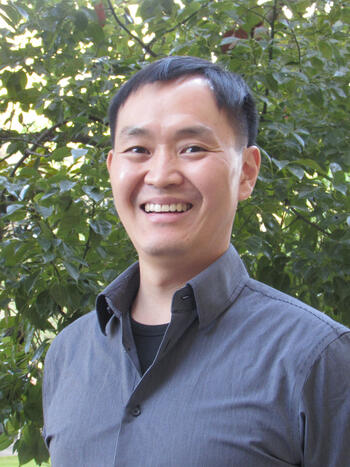
Joon Nak Choi is the 2015-2016 Koret Fellow in the Korea Program at Stanford University's Walter H. Shorenstein Asia-Pacific Research Center (Shorenstein APARC). A sociologist by training, Choi is an assistant professor at Hong Kong University of Science and Technology. His research and teaching areas include economic development, social networks, organizational theory, and global and transnational sociology, within the Korean context.
Choi, a Stanford graduate, has worked jointly with professor Gi-Wook Shin to analyze the transnational bridges linking Asia and the United States. The research project explores how economic development links to foreign skilled workers and diaspora communities.
Most recently, Choi coauthored Global Talent: Skilled Labor as Social Capital in Korea with Shin, who is also the director of the Korea Program. From 2010-11, Choi developed the manuscript while he was a William Perry postdoctoral fellow at Shorenstein APARC.
During his fellowship, Choi will study the challenges of diversity in South Korea and teach a class for Stanford students. Choi’s research will buttress efforts to understand the shifting social and economic patterns in Korea, a now democratic nation seeking to join the ranks of the world’s most advanced countries.
Supported by the Koret Foundation, the Koret Fellowship brings leading professionals to Stanford to conduct research on contemporary Korean affairs with the broad aim of strengthening ties between the United States and Korea. The fellowship has expanded its focus to include social, cultural and educational issues in Korea, and aims to identify young promising scholars working on these areas.
It’s a quintessential Silicon Valley scene. A group of tech-savvy Stanford students are delivering a passionate pitch about a product they hope is going to change the world, while a room full of venture capitalists, angel investors and entrepreneurs peppers them with questions.
But there’s a twist. This Stanford classroom is also packed with decorated military veterans and active duty officers. And a group of analysts from the U.S. intelligence community is monitoring the proceedings live via an iPad propped up on a nearby desk.
These Stanford students aren’t just working on the latest “Uber for X” app. They’re searching for solutions to some of the toughest technological problems facing America’s military and intelligence agencies, as part of a new class called Hacking for Defense.
A student team briefs the class on a wearable sensor they're developing for an elite unit of U.S. Navy SEALs – a product they're pitching as "fitbit for America's divers."
“There’s no problems quite like the kind of problems that the defense establishment faces, so from an engineering standpoint, it has the most powerful ‘cool factor’ of anything in the world,” said Nitish Kulkarni, a senior in mechanical engineering.
Kulkarni’s team is working with an organization within the US Department of Defense to devise a system that will provide virtual assistance to Afghan and Iraqi coalition forces as they defuse deadly improvised explosive devices.
“At Stanford there’s a lot of opportunities for you to build things and go out and learn new stuff, but this was one of the first few opportunities I’ve seen where as a Stanford student and as an engineer, I can go and work on problems that will actually make a difference and save lives,” said Kulkarni.
A 21st century tech ROTC
That’s exactly the kind of “21st century tech ROTC” model of national service that Steve Blank, a consulting associate professor at Stanford’s Department of Management Science and Engineering, said he had in mind when he developed the class.
“The nation is facing a set of national security threats it’s never faced before, and Silicon Valley has not only the technology resources to help, but knows how to move at the speed that these threats are moving at,” said Blank.
MBA student Rachel Moore presents for Team Sentinel, which is working with the U.S. 7th Fleet to find better ways to analyze drone and satellite imagery.
The students’ primary mission will be to produce products that can help keep Americans and our allies safe, at home and abroad, according to Blank.
Former U.S. Army Special Forces Colonel Joe Felter, who helped create the class and co-teaches it with Blank, said the American military needs to find new ways to maintain its technological advantage on the battlefield.
“Groups like ISIS, al–Qaeda and other adversaries have access to cutting edge technologies and are aggressively using them to do us harm around the world,” said Felter, who served in Iraq and Afghanistan and is currently a senior research scholar at Stanford’s Center for International Security and Cooperation (CISAC) and research fellow at the Hoover Institution.
“The stakes are high – this is literally life and death for our young men and women deployed in harm’s way. We’re in a great position here at Stanford and in Silicon Valley to help make the connections and develop the common language needed to bring innovation into the process, in support of the Department of Defense and other government agencies’ missions.”
Startup guru Steve Blank shares a light moment with a group of students.
The class is an interdisciplinary mix of undergraduate and graduate students, from freshman to fifth year PhD student.
“It’s like a smorgasbord of all these people coming together from different parts and different schools of Stanford, and so I think that’s just a really cool environment to be in,” said Rachel Moore, a first-year MBA student.
Moore’s team includes electrical and mechanical engineering students, and they’re working together to develop a system to enable the Navy’s Pacific Fleet to automatically identify enemy ships using images from drones and satellites.
Tough technological challenges
Months before the course start date, class organizers asked U.S. military and intelligence organizations to identify some of their toughest technological challenges.
Class co-teacher Pete Newell throws his hands up to celebrate a student breakthrough.
U.S. Army Cyber Command wanted to know if emerging data mining, machine learning and data science capabilities could be used to understand, disrupt and counter adversaries' use of social media.
The Navy Special Warfare Group asked students to design wearable sensors for Navy SEALs, so they could monitor their physiological conditions in real-time during underwater missions.
Intelligence and law enforcement agencies were interested in software that could help identify accounts tied to malicious “catfishing” attempts from hackers trying to steal confidential information.
And those were just a few of the 24 problems submitted by 14 government agencies.
Developing Solutions
The class gives eight teams of four students 10 weeks to actively learn about the problem they are addressing from stake holders and end users most familiar with the problem and to iteratively develop possible solutions or a “minimum viable product,” using a modified version of Steve Blank’s “lean launchpad methodology,” which has become a revered how-to guide among the Silicon Valley startup community.
Rachel Olney, a graduate student in mechanical engineering, tries on a military-grade dry suit on a visit to the 129th Rescue Wing at Moffett Field.
A key tenet of Blank’s methodology is what he calls the “customer discovery process.”
“If you’re not crawling in the dirt with these guys, then you don’t understand their problem,” Blank told the class.
One student team, which was working on real-time biofeedback sensors and geo-location devices for an elite team of Navy SEALS (a project they were initially pitching at “fitbit for America’s divers”), earned a round of applause from the class when they showed a slide featuring photos from a field trip they took to the 129th Rescue Wing at Moffett Field to find out what it felt like to wear a military-grade dry suit.
Rachel Olney, a graduate student in mechanical engineering, said the experience of squeezing into the tight suit and wearing the heavy dive gear gave her a better appreciation for the physical demands that Navy SEALs have to deal with during a mission.
“They’re diving down to like 200 feet for up to six to eight hours…and during that time they can’t eat, they can’t hydrate, they’re physically exerting a lot, because they’re swimming miles and miles and miles at depth and they can’t see and they can’t talk to each other,” Olney said.
Image
“It’s probably one of the most extreme things that humans do right now.”
Another group came in for some heavy criticism from the teaching team for failing to identify and interview enough end users.
But the next week, they were back in front of the class showing a video from a team member’s visit to an Air Force base in Fresno, where he logged some time inside the 90-pound bomb suit that explosive ordinance disposal units wear in the field.
“You can’t address a customer issue unless and until you really step into the shoes of the customer,” said Gaurav Sharma, who’s a student at Stanford's Graduate School of Business.
“That was the exact reason why I went to Fresno and wore the bomb suit, to get into the shoes of the end customer.”
Navigating the defense bureaucracy
Active duty military officers from CISAC’s Senior Military Fellows program and the Hoover Institution’s National Security Affairs Fellows program act as military liaisons for the class and help students navigate the complex defense bureaucracy.
“[The students] have really just jumped in with both feet and immersed themselves in this Department of Defense world that for so many civilians is just very foreign to them,” said U.S. Army Colonel John Cogbill, who has spent the last year as a senior military fellow at CISAC.
“I think they will come away from this experience with a much better appreciation of what we do inside the Department of Defense and Intelligence community, and where there are opportunities for helping us do our jobs better.”
Cogbill said he hoped that some of the inventions from the class, like an autonomous drone designed to improve situational awareness for Special Forces teams, could help the troops on his next combat deployment, where he will serve as the Deputy Commanding Officer of the U.S. Army’s elite 75th Ranger Regiment.
“It’s not just about making them more lethal, it’s also about how to keep them alive on the battlefield,” said Cogbill.
Students also get support from their project sponsors and personnel at the newly established Defense Innovation Unit Experimental (DIUx) stationed at Moffett Field.
Tech saves lives on the battlefield
Another key member of the teaching team is Pete Newell, who was awarded the Silver Star Medal (America’s third-highest military combat decoration), for leading a U.S. Army battalion into the Battle of Fallujah, where he survived an ambush and left the protection of his armored vehicle in an attempt to save a mortally wounded officer.
Class co-teacher and Silver Star Medal recipient Pete Newell explains some of the classic reasons why military products fail in the field.
Newell said he saw first-hand the difference that technology can make on the battlefield in his next job, when he served as director of the U.S. Army’s Rapid Equipping Force, which was tasked with creating technological solutions to the troops fighting in Afghanistan.
“What I realized is that the guys on the front edge of the battlefield who were actually fighting the fight, don’t have time to figure out what the problem is that they have to solve,” Newell said.
“They’re so involved in just surviving day to day, that they really don’t have time to step back from it and see those problems coming, and what they needed was somebody to look over their shoulder and look a little deeper and anticipate their needs.”
One of the first and most urgent problems Newell faced on the job was responding to the sudden spike in IED attacks on dismounted infantry.
The Army was still using metal detector technology from the ‘50s to find mines, but the new breed of IEDs, which were often hidden inside buried milk jugs, were virtually undetectable to the outdated technology.
Former U.S. Army Colonel Pete Newell demystifies some military jargon for the class.
“They could create an improvised explosive device and a pressure plate trigger…by using almost zero metal content,” Newell said. “It was almost impossible to find.”
Newell’s solution was a handheld gradiometer, the kind of technology used to find small wires in your backyard during a construction project, paired with a ground penetrating radar that can see objects underground.
But by the time the new technology reached troops in the field last summer, more than 4,000 had been wounded or killed in IED attacks.
Newell said he hoped the class would help get life-saving technology deployed throughout the military faster.
“I think it’s important to enable this younger generation of technologists to actually connect with some of the national security issues we face and give them an opportunity to take part in making the world a safer place,” Newell said.
Tom Byers, an entrepreneurship professor in Management Science and Engineering and faculty director of the Stanford Technology Ventures Program, rounds out the teaching team and brings his experience in innovation education and entrepreneurship to the classroom.
Inspiring the next generation
Students said the opportunity to find solutions to consequential problems was their primary inspiration for joining the class.
“When I first came to Stanford, the hype around entrepreneurship was very much around, ‘go out, make an app, do something really fun and cool, and get rich’,” said Darren Hau, a junior in Electrical Engineering.
Students share a laugh during a class break.
“In Hacking for Defense, I think you’re seeing a lot of people bring that same entrepreneurial mindset into a problem statement that seems a lot more impactful.”
Felter said he was humbled that so many students were willing to serve in this way.
“It’s encouraging to find out that students at one of our top universities are very interested and highly motivated to work very hard and use their skills and expertise and talent and focus it on these pressing national security problems,” said Felter.
The teaching team said they planned on expanding their class to other universities across the country in the coming years, to create a kind of open source network for solving unclassified national security problems.
For military officers like Cogbill, who will likely soon be leading U.S. soldiers into combat, that’s welcome news.
“Every time you run a course, that’s eight more problems,” Cogbill said.
“If this scales across 10, 20, 30, 40 more universities, you can imagine how many more problems can be solved, and how many more lives can potentially be saved.”
Hero Image
Influential startup educator Steve Blank (center) gives advice to Stanford students working on tough national security problems, while retired U.S. Army Colonels and class co-teachers Joe Felter (right) and Pete Newell (left) listen in. | Rod Searcey




 A student team briefs the class on a wearable sensor they're developing for an elite unit of U.S. Navy SEALs – a product they're pitching as "fitbit for America's divers."
 MBA student Rachel Moore presents for Team Sentinel, which is working with the U.S. 7th Fleet to find better ways to analyze drone and satellite imagery.
 Startup guru Steve Blank shares a light moment with a group of students.
 Class co-teacher Pete Newell throws his hands up to celebrate a student breakthrough.
 Rachel Olney, a graduate student in mechanical engineering, tries on a military-grade dry suit on a visit to the 129th Rescue Wing at Moffett Field.

 “[The students] have really just jumped in with both feet and immersed themselves in this Department of Defense world that for so many civilians is just very foreign to them,” said U.S. Army Colonel
  Class co-teacher and Silver Star Medal recipient Pete Newell explains some of the classic reasons why military products fail in the field.
 Former U.S. Army Colonel Pete Newell demystifies some military jargon for the class.
 Students share a laugh during a class break.
