On November 1-2, 2018, the two-day conference "Future Visions: Opportunities and Challenges of Korean Studies in North America" was convened by Shorenstein APARC's Korea Program to examine the current state of Korean studies and consider the current challenges and opportunities. This report summarizes the discussions of the six panels on history, literature, the social sciences, language education, library collections and services, and the Korean Wave.
Encina Hall East, 4th Floor, E406 Stanford, CA 94305-6055
650-498-3114
0
hrahimi@stanford.edu
Heather Rahimi_0118a small.png
MA
Heather Rahimi has worked within both the private and public sector of international education promoting cross-cultural exchange and supporting students' studies abroad. Her passion for international education was first sparked studying abroad in Buenos Aires, Argentina while completing her B.A. in Spanish and Anthropology from Northern Arizona University. Since then, she has jumped on any opportunity to travel and learn more about different cultures around the world. In addition to travels throughout the Middle East and Europe, she also spent time in Peru on an archaeological dig and a semester in South Korea working in student affairs at the University of Utah Asia Campus. Heather speaks fluent Spanish and holds a Master of Arts in International Education Management from Middlebury Institute of International Studies.
Communications Manager, Stanford Center on China's Economy and Institutions
Under the title “Political Contestation and New Social Forces in the Middle East and North Africa,” the Program on Arab Reform and Democracy convened its 2018 annual conference on April 27 and 28 at Stanford University. Bringing together a diverse group of scholars from across several disciplines, the conference examined how dynamics of governance and modes of political participation have evolved in recent years in light of the resurgence of authoritarian trends throughout the region.
Image
Delivering the opening remarks of the conference, Freeman Spogli Institute (FSI) and Hoover Institution Senior Fellow Larry Diamond reflected on the state of struggle for political change in the Middle East and North Africa (MENA) region. In a panel titled “Youth, Culture, and Expressions of Resistance,” FSI Scholar Ayca Alemdaroglu discussed strategies the Turkish state has pursued to preempt and contain dissent among youth. Adel Iskandar, Assistant Professor of Communications at Simon Fraser University, explained the various ways through which Egyptian youth employ social media to express political dissent. Yasemin Ipek, Assistant Professor of Global Affairs at George Mason University, unpacked the phenomenon of “entrepreneurial activism” among Lebanese youth and discussed its role in cross-sectarian mobilization.
The conference’s second panel, tilted “Situating Gender in the Law and the Economy,” featured Texas Christian University Historian Hanan Hammad, who assessed the achievements of the movement to fight gender-based violence in Egypt. Focusing on Gulf Cooperation Council states, Alessandra Gonzales, a Visiting Postdoctoral Fellow at the Stanford Institute for Economic Policy Research, analyzed the differences in female executive hiring practices across local and foreign firms. Stanford University Political Scientist and FSI Senior Fellow Lisa Blaydes presented findings from her research on women’s attitudes toward Female Genital Mutilation (FGM) in Egypt.
Image
Speaking on a panel titled “Social Movements and Visions for Change,” Free University of Berlin Scholar Dina El-Sharnouby discussed the 2011 revolutionary movement in Egypt and the visions for social change it espouses in the contemporary moment. Oklahoma City University Political Scientist Mohamed Daadaoui analyzed the Moroccan regime’s strategies of control following the Arab Uprisings and their impact on various opposition actors. Nora Doaiji, a PhD Student in History at Harvard University, shared findings from her research examining the challenges confronting the women’s movement in Saudi Arabia.
The fourth panel of the conference, “The Economy, the State, and New Social Actors,” featured George Washington University Associate Professor of Geography Mona Atia, who presented on territorial restructuring and the politics governing poverty in Morocco. Amr Adly, an Assistant Professor of Political Science at the American University in Cairo, analyzed the relationship between the state and big business in Egypt after the 2013 military coup. Rice University Professor of Economics Mahmoud El-Gamal shared findings from his research on the economic determinants of democratization and de-democratization trends in Egypt during the past decade.
Image
The final panel focused on the international and regional dimensions of the struggle for political change in the Arab world, and featured Hicham Alaoui, a Research Fellow at Harvard University’s Weatherhead Center for International Affairs, Georgetown University Political Scientist Daniel Brumberg, and Nancy Okail, the Executive Director of the Tahrir Institute for Middle East Policy.
The conference included a special session featuring former fellows of the American Middle Eastern Network at Stanford (AMENDS), an organization dedicated to promoting understanding around the Middle East, and supporting young leaders working to ignite concrete social and economic development in the region. AMENDS affiliates from five different MENA countries shared with the Stanford community their experiences in working toward social change in their respective countries.
Hero Image
ARD 2018 Annual Conference participants.
Front row (from left): Hanan Hammad, Hamza Arsbi, Ayca Alemdaroglu, Mahdi Lafram, Lior Lapid.
Second to front row (from left): Dina El-Sharnouby, Daniel Brumberg, Radidja Nemar, Mona Atia.
Third to front row (from left): Hesham Sallam, Joel Beinin, Nora Doaiji, Hicham Alaoui, Mohamed Daadaoui, Salma Takky, Larry Diamond, Amr Adly, Sultan Al Amer, Heba Al-Hayek.
Back row (from left): Amr Gharbeia, Mahmoud El-Gamal, Amr Hamzawy
Gi-Wook Shin, director of APARC, was quoted in South China Morning Post. “These young people spend the first 25 to 30 years of their life studying for exams, and when they finally move out of their shell into the real world and realise life is not a multiple choice test, and there isn’t always a clear-cut answer to every problem, that’s already a mid-life crisis for them in a way,” he said. “It is both physically draining and mentally not healthy to spend one’s young adulthood studying for exams after exams.”
Future Visions: Challenges and Possibilities of Korean Studies in North America — Social Science panel. From left to right: UC Berkeley's Laura Nelson, University of Michigan's Jordan Siegel, Stanford's Yong Suk Lee, USC's David Kang, Harvard's Paul Chang.
How can Korean studies faculty cultivate supportive and critical scholarly communities with graduate students? What can be done to overcome the severe constraints on Korean language training in North America? Why is there a dearth of Korea scholarship in academic literature? And how should Korean studies librarians prepare for the future in the light of new technologies and young researchers’ increasing interest in digital scholarship?
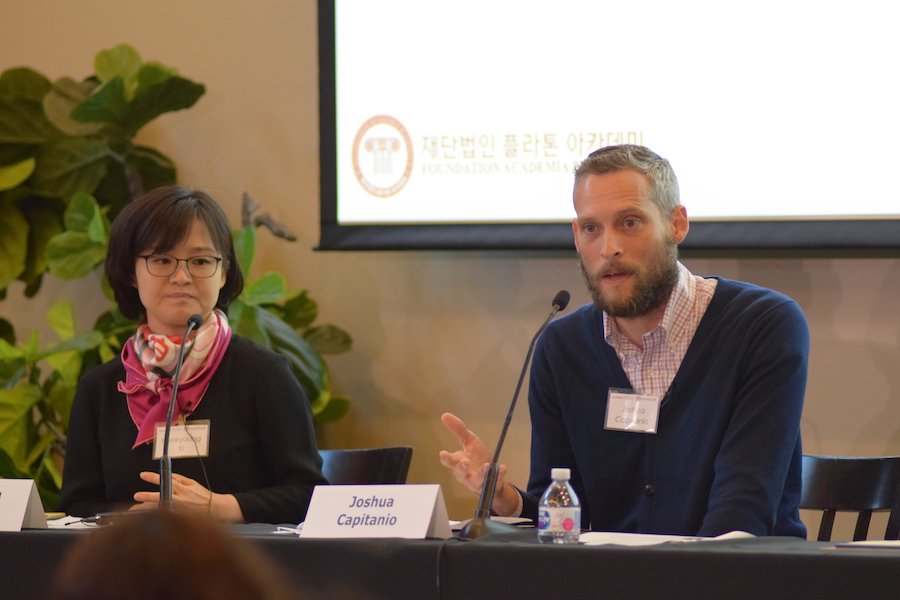
These were some of the questions examined at a two-day conference, “Future Visions: Challenges and Possibilities of Korean Studies in North America,” convened by the Korea Program of Stanford’s Shorenstein Asia-Pacific Research Center (APARC) on November 1-2. Co-sponsored by the Seoul-based Foundation Academia Platonica, the conference, the first of its kind, gathered distinguished Korean studies scholars from twelve North American institutions to consider the state of the field, assess its challenges, and carry forward a vision for its future direction and potential. Its six unique panels focused not only on the major disciplines of Korean studies—history, literature, and the social sciences—but also on language education, library collections and services, and Korean Wave.
“The presentations and discussions by our fellow experts reflected the breadth and depth of Korean studies in North America,” says APARC Director and the Korea Program Director Gi-Wook Shin. “Our program was established at Stanford in 2001 and has since become a leader in Korean studies in North America, so it is a special privilege for us to bring together colleagues from eminent institutions around the continent to further advance Korean studies education and research in the academic and policy worlds, and to build upon our track record of action and achievements.”
“The field of Korean studies, however,” notes Shin, “has significantly changed over the past seventeen years and it isn’t without its challenges. This is our opportunity to consider frankly where we go next and how we could explore the path ahead together.”
Conference participants indeed engaged in deep conversations and shared ideas and dilemmas regarding teaching in the different disciplines of Korean studies in North America. Harvard sociologist Paul Chang listed three types of challenges facing the field: publication, academic, and professional challenges. David C. Kang, professor of international relations and director of the Korean Studies Institute at the University of Southern California, emphasized the publication challenge: why is it, asked Kang, that top academic journals in the discipline of political science and international relations publish so much more scholarship about Europe than they do about Korea and Asia at large, even while the rise of Asian nations is surely one of the most consequential issues of the twenty-first century? The onus, Kang argued, comes back to East Asia scholars “to produce better and more compelling scholarship, and to better train graduate students.”
University of British Columbia's Ross King and conference participants.
Yet complex issues surround the question of how to broaden graduate coursework—and whether to do so. Korean language and linguistics expert Ross King, head of the department of Asian Studies at the University of British Columbia in Vancouver, Canada, was one of several panelists who considered the obstacles to graduate training, among different aspects of academic challenges facing the field of Korean studies. King probed into how Sinocentrism and what he called the “Mandarin conceit”—that is, the notion that training in Literary Sinitic should be predicated on a near-native proficiency in modern Mandarin Chinese—are emerging as a major stumbling block to the study of premodern Korean literary culture. He also pointed to the constraints on language training in both Korean and hanmun in North America, which, he claimed, is why we can probably anticipate continued decrease in the number of ethnically non-Korean (non-Korea-educated) graduate students undertaking graduate study in Korean literature.
University of Washington's Hyokyoung Yi (left) and Stanford's Joshua Capitanio at a panel on library collections and service.
Sung-Ock Sohn, who coordinates the Korean language program in the department of Asian languages and cultures at the University of California – Los Angeles, further shed light on King’s prediction. She explained that while enrollments in Korean language classes have shown a sharp increase in American higher education institutions in the past decade, particularly at the introductory level and among ethnically non-Korean students, there is a high attrition rate of students from an introductory to advanced Korean classes nationwide.
How should the field move forward?
Participants proposed a host of ideas to that end. These included helping graduate students collaborate with colleagues in Korea; dedicating funding for junior faculty to spend periods of time before tenure conducting research and honing language skills in Korea at appropriate institutions, and for mid-career scholars to spend a year in Korea; emphasizing the application of social science theories and methods to premodern and modern East Asia; motivating scholars to apply a comparative lens to the study of the historical and contemporary experience of East Asia; and integrating linguistic and cultural diversity in Korean language classes by, for example, incorporating service learning in authentic contexts and extending the content spectrum to include topics such as Korean popular culture.
Image
K-pop star Siwon Choi (left) highlights closing panel on Korean Wave.
Korean Wave was the focus of the conference’s widely attended closing panel that featured K-pop star Siwon Choi, a member of Korean boy band Super Junior, and multi-platinum music producer Dominique Rodriguez, managing director of SM Entertainment USA. They spoke about the global reach of Korean pop music and some of the ways in which Korean popular culture could stimulate interest in Korean studies. Dafna Zur, assistant professor in Stanford’s department of East Asian languages and cultures, who chaired the panel, challenged her students to consider “what it means not just to monetize culture but to design culture with specific markets and audience in mind.” The Stanford Daily published a detailed article on the panel.
“We are grateful to Foundation Academia Platonica for its generous support of Stanford’s Korea Program at Shorenstein APARC and for making this conference possible through our shared vision for the future of Korean studies in North America,” said Gi-Wook Shin. “Our thanks also go to our many other friends and partners, including the Korea Foundation that has helped achieve great results through its commitment to promoting understanding of Korea in academia and beyond and its support of the overseas Korean Studies Program since its establishment in 1991.”
South Korean TV company SBS NBC filmed the conference that will be featured in an upcoming documentary about Korean studies in the United States.
Read the conference report or listen to the audio recordings of the sessions, below.
Solar lanterns are promoted across rural Sub-Saharan Africa to improve both lighting in homes and educational outcomes. We undertake a randomized controlled trial in Zimba District, Zambia, to evaluate whether solar lanterns help children study more effectively and improve academic performance. Our research design accounts for potential income effects arising from the giveaways of lanterns and also “blinds” participants to the study’s purpose. We find no evidence that receipt of a lantern improved performance on important national examinations (even though an ex poststatistical power analysis demonstrates that the research should detect economically significant impacts, if present). We also do not observe impacts on self-reported study habits. Several features of Zimba District that are likely to exist in other developing regions appear to drive our results. First, flashlights are the dominant lighting source in rural Zambia rather than traditional options like kerosene lamps or candles. In such environments, solar lights may hold only limited appeal for prospective users. Second, our survey data suggests that other major barriers to educational attainment likely render improved energy access (whether through solar lanterns or otherwise) a relatively unimportant educational input.
Alex Stamos is a cybersecurity expert, business leader and entrepreneur working to improve the security and safety of the Internet. Stamos was the founding director of the Stanford Internet Observatory at the Cyber Policy Center, a part of the Freeman Spogli Institute for International Studies. He is currently a lecturer, teaching in both the Masters in International Policy Program and in Computer Science.
Prior to joining Stanford, Alex served as the Chief Security Officer of Facebook. In this role, Stamos led a team of engineers, researchers, investigators and analysts charged with understanding and mitigating information security risks to the company and safety risks to the 2.5 billion people on Facebook, Instagram and WhatsApp. During his time at Facebook, he led the company’s investigation into manipulation of the 2016 US election and helped pioneer several successful protections against these new classes of abuse. As a senior executive, Alex represented Facebook and Silicon Valley to regulators, lawmakers and civil society on six continents, and has served as a bridge between the interests of the Internet policy community and the complicated reality of platforms operating at billion-user scale. In April 2017, he co-authored “Information Operations and Facebook”, a highly cited examination of the influence campaign against the US election, which still stands as the most thorough description of the issue by a major technology company.
Before joining Facebook, Alex was the Chief Information Security Officer at Yahoo, rebuilding a storied security team while dealing with multiple assaults by nation-state actors. While at Yahoo, he led the company’s response to the Snowden disclosures by implementing massive cryptographic improvements in his first months. He also represented the company in an open hearing of the US Senate’s Permanent Subcommittee on Investigations.
In 2004, Alex co-founded iSEC Partners, an elite security consultancy known for groundbreaking work in secure software development, embedded and mobile security. As a trusted partner to world’s largest technology firms, Alex coordinated the response to the “Aurora” attacks by the People’s Liberation Army at multiple Silicon Valley firms and led groundbreaking work securing the world’s largest desktop and mobile platforms. During this time, he also served as an expert witness in several notable civil and criminal cases, such as the Google Street View incident and pro bono work for the defendants in Sony vs George Hotz and US vs Aaron Swartz. After the 2010 acquisition of iSEC Partners by NCC Group, Alex formed an experimental R&D division at the combined company, producing five patents.
A noted speaker and writer, he has appeared at the Munich Security Conference, NATO CyCon, Web Summit, DEF CON, CanSecWest and numerous other events. His 2017 keynote at Black Hat was noted for its call for a security industry more representative of the diverse people it serves and the actual risks they face. Throughout his career, Alex has worked toward making security a more representative field and has highlighted the work of diverse technologists as an organizer of the Trustworthy Technology Conference and OURSA.
Alex has been involved with securing the US election system as a contributor to Harvard’s Defending Digital Democracy Project and involved in the academic community as an advisor to Stanford’s Cybersecurity Policy Program and UC Berkeley’s Center for Long-Term Cybersecurity. He is a member of the Aspen Institute’s Cyber Security Task Force, the Bay Area CSO Council and the Council on Foreign Relations. Alex also serves on the advisory board to NATO’s Collective Cybersecurity Center of Excellence in Tallinn, Estonia.
Comedian Conan O’Brien recently announced that he will visit Hokuei City (aka “Conan Town”) in Tottori Prefecture, Japan, which is well known for its sand dunes and the manga character, Detective Conan. Detective Conan was created by artist Gosho Aoyama, who was born in Hokuei. In fact, Tottori’s main airport is called the Tottori Sand Dunes Conan Airport. Tourists from the United States and other countries are drawn to the sand dunes and the “Manga Kingdom,” a nickname for Tottori because it is the home prefecture of many famous manga artists like Aoyama.
Governor Shinji Hirai of Tottori, who leads these efforts to make Tottori a more notable tourist destination, recently met with Governor Phil Scott of Vermont to formalize a sister state relationship. Both governors hope to give their students more opportunities for exchange. These are just two examples of the increasing synergy between the United States and Tottori, the least populous prefecture in Japan. Thanks to the vision of Governor Hirai, SPICE launched a distance-learning course, Stanford e-Tottori, for high school students in Tottori Prefecture in 2016. The course instructor, Jonas Edman, hopes that the course will help to build even more bridges at the grassroots level between Tottori and the United States.
Now in its third year, Stanford e-Tottori enrolls students from public and private schools in Tottori Prefecture and is a cornerstone of Tottori Prefecture’s Global Leaders’ Campus, an initiative by the Tottori Prefectural Board of Education to internationalize the curriculum in all schools in Tottori. Governor Hirai’s vision has provided many Tottori high school students with the opportunity to study with Edman, who engages students in English with Stanford scholars and experts on topics ranging from U.S. high schools to cultural diversity in the United States.
On August 1, 2018, Edman participated in the opening ceremony for the third year of Stanford e-Tottori. He met Superintendent Hitoshi Yamamoto, Office Director Takuya Fukushima (High School Division), several others of the Tottori Prefectural Board of Education, and the new cohort of students. Edman also visited Tottori Nishi High School and gave a special lecture to students. “Though the technology that I use to teach Stanford e-Tottori has improved over the years, I have to say that it was enormously rewarding to meet my students in person,” reflected Edman. “Seeing them in their picturesque home prefecture—and some of them in their school [Tottori Nishi High School]—provided a context that cannot be replicated virtually. My online interaction with the students from now will feel different.”
I also had the chance to visit Tottori Prefecture on August 26, 2018 to give the opening lecture for the third-year offering of Stanford e-Tottori. In attendance were not only the current cohort students but also three students from last year’s cohort. Before class began, I could feel the nervousness among the students as they anxiously waited outside the presentation room. Once class commenced, however, I could sense that their nerves started to settle down. The students gave their best during class, and I was so impressed with their efforts in particular because it was the first lecture of the course. I have no doubt that their English skills and understanding of U.S. society and culture will improve under the mentorship of Edman.
High school students from Tottori Prefecture with SPICE Director Gary Mukai and Stanford Visiting Scholar Junichiro Hirata
Following the class, Fukushima took Stanford Visiting Scholar Junichiro Hirata and me to Mitaki-en, a village nestled in the mountain town of Chizu in Tottori Prefecture. While strolling around Mitaki-en, I was reminded of a different era and was pleasantly overwhelmed by my senses—most notably the sound of a babbling brook, the smell of an earthen floor of a home from the early 20th century, the taste of powdered green tea, the feel of a tatami mat, and the sight of a faint waterfall. The preservation of this village struck me as symbolic of the people of Tottori—people who seem to have a gift for successfully integrating innovation with tradition.
The Tottori Prefectural Board of Education encourages its students to appreciate Tottori’s historic ties to agriculture and fisheries and its natural beauty. Tottori is also said to be Japan’s best place for stargazing. Simultaneously, the Board of Education instills in its students a need to see the world in a grain of sand through courses like Stanford e-Tottori. To me, helping students appreciate the delicate balance of innovation and tradition lies at the heart of Tottori Prefecture’s Global Leaders’ Campus, and SPICE is honored to be a part of this initiative.
Hero Image
Jonas Edman with e-Tottori students | Takuya Fukushima
As publics and policymakers are becoming more aware of the gravity of cyber related activities and potential disruption, Stanford Center for International Security and Cooperation honors undergraduate alumni have produced cutting-edge work to address major cyber issues in their final theses.
The theses topics span computer systems design, deterrence, international cooperation, defense acquisitions, hacking, zero days, the intelligence community, big data, and special forces operations. They make an excellent back-to-school reading list for anyone interested in cyber security, policy, and foreign affairs.
Check out their work on major cyber threats, events and consequences through the links below:
Lisbonne articulates three early warning indicators suggesting that U.S. Special Operations Forces acquisitions processes have begun to look more like that of traditional branches of the armed services. He goes on to discuss the best paths forwards for mitigating root causes driving this pattern.
Sagan explains how cyber criminals are successful despite technical and well-organized efforts to defend against cyber-crime. He investigates the “art of deception” as it relates to espionage, warfare, politics, theatre, and magic. In comparing exploits and tricks, he demonstrates “how the design processes used by hackers have inherent structural similarities to those used by magicians.”
Hirshman’s recent thesis outlines the conditions necessary for the creation of a formal international agreement to regulate cyberspace. She draws on the efforts of the Reykjavik Summit and the Chemical Weapons Convention to find that the most influential factor for an agreement “is the willingness of parties to make reciprocal concessions during negotiations.”
Fisher’s thesis examines the military outfit known as DIUx intended to expedite military acquisitions from smaller tech firms outside of major defense procurement working on novel technologies for defense. She weighs how sustainable the program is given their reliance on Other Transaction Authorities over traditional U.S. Department of Defense procurement processes.
Mittelberger combines lessons of capabilities yielded by big data analytics with the mission of counterterror intelligence for the National Counterterrorism Center. He provides recommendations on how to adopt large-scale analytics exercises to benefit the intelligence community’s organizational capacity and structure.
Cirenza details where the analogies of nuclear and cyber weapons and deterrence are flawed. Although cyber weapons have potentially strategic impacts, they have thus far not reached a level of importance to cause “revolution in military affairs that developed into a strategic deterrent because of its unique characteristics” alike nuclear weapons.
Gilbert unpacks information sharing issues faced by the federal government when analyzing cyber threats related to private companies tied to U.S. critical infrastructure. An engineer by training, he applies a Computational Policy approach to bring “the power of the abstractions used in computer systems design to bear on difficult policy problems.”
Fidler reveals the trade mechanisms of zero-day vulnerabilities as they are traded and utilized by governments, militaries, intelligence operations, law enforcement agencies, and criminal organizations. Her work “demonstrates how difficult regulation of the global zero-day trade will be, signaling the pervasiveness of realpolitik in cyberspace.”





 High school students from Tottori Prefecture with SPICE Director Gary Mukai and Stanford Visiting Scholar Junichiro Hirata
