Education
Authors
News Type
News
Date
Paragraphs

Stanford Report: The First Lady of the United States, Michelle Obama, spoke at SCPKU today and said study abroad allows students to realize that countries all have a stake in each other's success.  Following her remarks, she held a conversation with students on the Stanford campu via SCPKU's Highly Immersive Classroom. Read more.


Hero Image
flotus
Courtesy of Stanford University
All News button
1
Authors
Nora Sulots
News Type
News
Date
Paragraphs

The Fisher Family Summer Fellows on Democracy and Development Program at Stanford University's Center on Democracy, Development and the Rule of Law is now accepting applications for our summer 2027 program, which will run from Sunday, July 18, to Friday, August 6, 2027. The deadline to apply is 11:59 pm PST on Tuesday, January 12, 2027.

The program brings together an annual cohort of approximately 30 mid-career practitioners from countries in political transition who are working to advance democratic practices and enact economic and legal reform to promote human development. Launched by CDDRL in 2005, the program was previously known as the Draper Hills Summer Fellows Program. The new name reflects an endowment gift from the Fisher family — Sakurako (Sako), ‘82, and William (Bill), MBA ‘84 — that secures the future of this important and impactful program.

From Afghanistan to Zimbabwe, we select our program participants from among hundreds of applicants each year for the significant contributions they have already made to their communities and their potential to make an even greater impact with some help from Stanford. We aim to give them the opportunity to join a global network of over 500 alumni from 96 countries who have all faced similar sets of challenges in bringing change to their countries.

The Fisher Family Summer Fellows Program provides an intensive 3-week on-campus forum for civil society leaders to exchange experiences and receive academic and policy training to enrich their knowledge and advance their work. Delivered by a leading Stanford faculty team composed of Michael McFaul, Kathryn Stoner, Francis Fukuyama, Larry Diamond, Erik Jensen, and more, the program allows emerging and established global leaders to explore new institutional models and frameworks to enhance their ability to promote good governance, accountable politics, and find new ways to achieve economic development in their home countries.

Prospective fellows from Ukraine are also invited to apply for our Strengthening Ukrainian Democracy and Development (SU-DD) Program, which runs concurrently with the Fisher Family Summer Fellows Program. The SU-DD program provides a unique opportunity for mid-career practitioners working on well-defined projects aimed at strengthening Ukrainian democracy, enhancing human development, and promoting good governance. Applicants to the SU-DD program will use the Fisher Family Summer Fellows Program application portal to apply and indicate their interest there. You will then be directed to a series of supplemental questions specific to the SU-DD program, including requiring a detailed description of your proposed project.

Read More

2026 Fisher Family Summer Fellows
News

Spotlight on the 2026 Summer Fellows

The Fellow Spotlight Series is an inspiring and moving series of "TED"-style talks given by each of our 2026 Fisher Family Summer Fellows to share their backstories and discuss their work.
Spotlight on the 2026 Summer Fellows
2026 Fisher Family Summer Fellows
News

Announcing the 2026 Class of the Fisher Family Summer Fellows on Democracy and Development Program

In July 2026, the Center on Democracy, Development and the Rule of Law will welcome a diverse cohort of 26 experienced practitioners from 19 countries who are working to advance democratic practices and economic and legal reform in contexts where freedom, human development, and good governance are fragile or at risk.
Announcing the 2026 Class of the Fisher Family Summer Fellows on Democracy and Development Program
People arrive to pay tribute at Maidan Square, where thousands of memorial flags are on display as a reminder of the toll of the war on February 24, 2025, in Kyiv, Ukraine.
News

Four Years After the Invasion, Ukrainian Leaders Build Foundations for Recovery

From parliament to regional government to independent media, alumni of the Center on Democracy, Development and the Rule of Law’s Strengthening Ukrainian Democracy and Development Program are implementing reform initiatives under wartime conditions.
Four Years After the Invasion, Ukrainian Leaders Build Foundations for Recovery
Hero Image
Francis Fukuyama looks on as a group of fellows works through a case study.
Francis Fukuyama looks on as a group of fellows works through a case study. | Emin Huseynov
All News button
1
Subtitle

The program will run from Sunday, July 18, to Friday, August 6, 2027. Applications are due by 11:59 pm PST on Tuesday, January 12, 2027.

Image
Francis Fukuyama looks on as a group of fellows works through a case study.
Caption Francis Fukuyama looks on as a group of fellows works through a case study. | Photo credit Emin Huseynov
Date Label
Display Hero Image Wide (1320px)
Yes
Authors
Melissa Morgan
News Type
Blogs
Date
Paragraphs

The weather is cooling down at the Farm, but the new cohort of students in the Ford Dorsey Master's in International Policy (MIP) is warmed up and ready to move full steam ahead in their studies.

The MIP Class of 2028 is 33 students strong, the largest cohort to date in the program's history. They represent 19 countries and regions including Argentina, Belarus, Brazil, Canada, Colombia, Georgia, Germany, Hong Kong, India, Japan, Mexico, Panama, the Philippines, Poland, the Republic of Korea, Singapore, Sweden, Turkey, and the United States, and are coming to us from backgrounds in civil service, government, military, industry, and academia.

The MIP program is structured broadly around four areas of specialization: Cyber Policy and Security (CYBER); Energy, Natural Resources, and the Environment (ENRE); Governance and Development (GOVDEV); and International Security (ISEC). Beyond that, students are encouraged to personalize their learning and coursework to their unique goals and interests and pursue interdisciplinary projects with scholars from across Stanford's campus. The culmination of their studies comes in the Policy Change Studio, a unique capstone project designed to give them practical experience with policymaking through in-the-field research and direct collaboration on projects with partner organizations all over the world.

Keep reading to meet five of our new students, learn more about their interests, and hear what excites them about being in the MIP program at Stanford.


Headshot of MIP student Donna Lee

Donna Lee | Cyber Policy and Security  

Gwacheon, Republic of Korea
Fun Facts: Published poet and a lover of wombats


When I was growing up, my grandfather told me stories about what it was like to be an evacuee who moved from the northern part of Korea to the south during the Korean War. His desire to live in a more democratic place changed not only his life, but also the lives of my mother and me. His experiences taught me how important democracy is, and why each citizen needs to do their part to support and protect it. My decision to work in public service comes directly from my desire to give back to the society that has given my family so much. 

Through my previous work as a diplomat in Korea, I’ve already had the opportunity to work on issues relating to human rights, culture diplomacy, Indo-Pacific strategy, and even Korea-U.S. defense cooperation. What I’ve seen is that emerging technologies are becoming core to all other aspects of international issues and policies. I want to do my best to help Korea set feasible, forward looking policies, and being here at Stanford is a rare opportunity to gain very hands-on, direct experience with these kinds of technological issues. Not only is the policy expertise here very rigorous because of how close everything is to Silicon Valley, but Stanford is also very interdisciplinary, which is an important aspect of understanding how all of these issues are connected to each other.  

With my prior experience, I am particularly interested in exploring further how AI is changing the global security landscape, and what these changes mean for the Korea-U.S. Alliance. When I worked in the Korea-U.S. Security Cooperation Division, I had the chance to learn from our military personnel about rapidly evolving defense technologies that we would not have been able to imagine even a decade ago, but are going to be a major part of future conflicts. I’m eager to take the quantitative skills and perspectives from experts that I learn here in the MIP program and apply those towards making it easier for Korea to be a stronger partner in developing, using, and coordinating with its ally and partners on these technologies and security areas.


Headshot of Serena Nanji-Totan

Serena Nanji-Totani | Energy, Natural Resources, and the Environment  

Tokyo, Japan and Nairobi, Kenya
Fun Facts: Lifelong globetrotter and international mountaineer 


Growing up, I was fortunate to live in several countries across Asia, Africa, and Europe. Everywhere we moved, I noticed similar patterns of inequality, where some regions are bloated with resources while others struggled to meet basic needs. As extreme weather and concerns about global warming became more common, I became increasingly concerned about how a changing climate will further widen these disparities. These early experiences inspired me to focus on climate mitigation and social equality, driven by an urgent question: How do we solve the climate crisis without leaving the most vulnerable behind?

My career has combined business, climate mitigation, and social impact. I spent several years in management consulting, mainly working on projects with multilateral development banks and corporate social responsibility. After that, I moved into the carbon credits market, helping to finance carbon removal projects around the world, including both engineered and nature-based solutions. Most recently, I worked at Conservation International, an NGO, where I focused on nature financing. There, I helped fund and structure forestry projects globally to sequester carbon, improve ecosystem health and biodiversity, and most importantly, prioritize local communities through payments for ecosystem services and co-benefits.

Working in the nature financing space taught me that there is a way to align financial incentives to protect and restore nature, while also benefiting people. Throughout my career, I have often wondered how we can measure the value of ecosystems and the benefits they provide in a way that encourages private sector investment. How do we get companies, investors, and policymakers to care?

But I have also grown to learn that financial tools alone are not enough without strong governance. We need well-designed policies and regulations to attract investment in solutions that help both people and the climate. That is why I came to Stanford MIP. I want to deepen my understanding of international frameworks and policies for addressing climate change fairly and inclusively. I am also eager to explore how Stanford’s innovative, entrepreneurial spirit can be applied to nature-based solutions. I believe working with nature offers a path forward for adaptation, resilience, and climate change mitigation while supporting people’s livelihoods. Nature can be just as innovative and disruptive as other climate solutions and deserves more attention. I am incredibly excited to dive into these topics more alongside my talented peers in the program! 


Headshot of Danny Vegel

Danny Vegel | Energy, Natural Resources, and the Environment  

Chagrin Falls, Ohio, U.S.A.
Fun Facts: Underwater photographer and aspiring cold-water surfer


I’m coming to MIP after nine years in the Navy as a nuclear submarine officer. Although I started my career as an engineer, I first developed an interest in international policy after receiving the opportunity to study international relations at Peking University and the London School of Economics. Being in China in particular sparked my interest in achieving a deeper understanding of international relations. From an outside perspective, it’s easy to talk about China as this monolithic competitor to the U.S., but to truly understand its role in global affairs, there is much to be appreciated about its complexities as a vast and dynamic country.

When my time in China came to an end, I left with a meaningful desire to better understand those complexities to inform policy. Moreover, during my last assignment before transitioning out of the Navy, I had the chance to work with many different governments in the East Asia region, and saw an even broader need and opportunity to work across governments to try and solve problems for the future.

When I ultimately was deciding what to do in my post-Navy career, MIP felt like the perfect place to work through that transition, build expertise, and create a new career exploring my interests in international policy. The emphasis this program has on implementation is also something that appealed to me. In the Navy, I learned that while it was always easy to come up with ideas, putting them into practice is much more difficult. With my background in nuclear engineering and international experience, I want to now learn how to implement energy policy that addresses growing energy needs in the face of climate change.

When you’re posted on a submarine, you’re privileged to work with and befriend some of the best and most driven sailors in the Navy. I already feel the same connection with this MIP cohort. Everyone here brings the strengths of their backgrounds together, and the size of the class makes it so you can really work with and learn from each other. In the next two years, I’m excited to get up to speed on international energy dynamics, embrace the policymaking framework, and get hands-on experience, so that wherever I land next, whether that’s in government or in the private sector, I'm able to work confidently and effectively to scale sustainable energy to meet global needs.


Headshot of Mariana Rozo Paz

Mariana Rozo Paz | Cyber Policy and Security  

Bogotá, Colombia
Fun Facts: Budding musical theater actor and future Donna in Mamma Mia


I'm from Colombia. I was profoundly blessed to grow up in a very loving home, but in the broader country, there was a great deal of unrest and uncertainty. I was sixteen when there was a vote on a peace deal with the FARC armed group. I was not old enough to vote, but all of my classmates and peers were so invested and hopeful that it would be adopted. It was a shock when the agreement was rejected. That became the impetus for me to become a lawyer and work on issues around human rights and the rule of law.

It was while I was in law school that I started working with a professor who was researching the impact of algorithms. I became obsessed with understanding more about how these platforms are shaping our economies, politics, and society. During the peace negotiations, I had seen how misinformation and media had contributed to the outcome, so I understood the power data could have for division and confusion. What I want to do is unlock how we can use these capabilities to improve people’s lives and make the world more equitable and inclusive.

My family, and particularly my parents and grandparents, were always reaching out to help people. Even though they have lived through very difficult things, they have always been grounded in hope and optimism. I’m trying to bring their legacy and mindset into my work. It’s true that the world is very complex and that many of the systems we’ve had in global governance and regulation are not keeping pace with how quickly the world is changing. It’s true that much of the technology being developed right now could be extremely disruptive. But we can’t let ourselves be scared of it all or retreat from it. We have to reach out and open space for those hard conversations. We have to keep having hope and optimism like my grandparents taught me. 

As a dear mentor of mine used to say, citing Antoine de Saint Exupéry, “There is no greater mission for humans than uniting humans.” Technology and digital spaces have been dividing us. Now it’s time to find ways for digital technologies to bring us together. That’s going to require new regulations, new tools, new voices, new organizations, and a willingness from governments, companies, philanthropies, and societies to try new things together. I am convinced that we can find ways to responsibly unlock the value of these technologies in a way that benefits everyone. Having the opportunity to be a Stanford and meet people who care as deeply about these things as I do is an incredible gift I’m grateful to unwrap and use fully. 


Headshot of Jonas Lindholm-Uzzi

Jonas Lindholm-Uzzi | Governance and Development  

Germantown, New York, U.S.A.
Fun Facts: Transatlantic sailor and devoted New York Jets fan


I grew up in a small town in upstate New York. By the time I was done with college and working my first job as a paralegal at the Department of Justice, I knew a couple of things:  I liked political science and political theory, and I definitely did not want to become a lawyer like I had initially thought. So I joined the Peace Corps to give myself some space to think and experience more of the world firsthand without filters.

I was deployed to Zambia to help lead a fish farming project in a rural village. It was a difficult but extremely eye opening two years. When my time in the Peace Corps was up, I applied for and was awarded a Fulbright Scholarship to go and teach English in Timor Leste in Southeast Asia. In both Zambia and Timor, what stuck with me was how bound people’s lives were by the circumstances they were born into. There were talented, gifted people in every community I lived and worked in, but the systems were not set up to help them succeed or step beyond where they already are. Whether it’s from corruption, mismanagement, or inadequate funding, there’s a shocking dearth of functional and responsive institutions in the developing world that can or will serve its citizens well.

Addressing this lack of institutional development is complex and multifaceted, and it’s not going to look the same or follow the same playbook in every single circumstance. We need to be more precise and smarter in how we plan and implement. We need to build in more accountability and feedback. We need to be much more attentive to local culture and politics and listen to the people who actually live in these communities.

I’ve been fortunate to live and work with some of those people and to be part of their lives, hard as they are. But I also had the privilege of being able to leave and go back to a country where the systems work and institutions mean something, and I’m incredibly privileged to make the choices I want about the kind of life I would like to live. I don’t take that for granted. But I also don’t want the people I’ve met and the friends I’ve made abroad to feel apathetic about their futures. The more agency we can give people, the better.

Here at Stanford, there’s such a wealth of expertise in so many areas. There’s access to technological industries, there’s amazing things happening with robotics and engineering. Some of the best scholars are here, whether that’s in history or political science, or economics. All of that is transformative, and all of it has a part to play in shaping policy and practices. I’m excited to be here and soak as much of that up as I can.


Read More

MIP Student Tyler smith posing in a suit and graduation hood in front of a Stanford building recognizable by its arches
Blogs

MIP Student Feature: Tyler Smith

Tyler Smith (‘26) came to the Ford Dorsey Master's in International Policy (MIP) as a Rangel Fellow with a clear and persistent question in mind: how does technology shape society, and who gets a voice in that future? Coming straight from Howard University, the D.C. area native specialized in Cyber Policy and Security. This summer, he is heading to Nairobi to work on digital infrastructure development, a natural next step in his journey to understand how emerging markets navigate AI sovereignty in an increasingly connected world.
MIP Student Feature: Tyler Smith
A collage of six photos showing students from the 2026 Class of the Ford Dorsey Master's in International Policy doing fieldwork around the world for their capstone projects.
Blogs

Stanford FSI Graduate Students Tackle Global Policy Challenges Through Hands-on Fieldwork

Students in the Ford Dorsey Master's in International Policy program traveled across the globe to work on policy projects addressing AI safety, climate change, public trust in local government, and more.
Stanford FSI Graduate Students Tackle Global Policy Challenges Through Hands-on Fieldwork
Image of Humzah Khan in a brown jacket, posing in front of the Grand Canyon
Blogs

MIP Student Feature: Humzah Khan

Humzah Khan's ('26) path to the Ford Dorsey Master's in International Policy (MIP) began after experiences in health security and Middle East studies, but his two years at Stanford have taken him in directions he never imagined. The graduating student from South Brunswick, New Jersey, who specialized in Cyber Policy and Security, will join the Starlink policy team at SpaceX, a career pivot that perfectly embodies MIP's emphasis on adaptable problem-solving skills.
MIP Student Feature: Humzah Khan
Hero Image
A group photo of the Class of 2028 of the Ford Dorsey Master's in International Policy on the front steps of Encina Hall at Stanford University.
The Class of 2028 of the Ford Dorsey Master's in International Policy. | Rod Searcey
All News button
1
Subtitle

The Class of 2028, the largest incoming cohort to date in the program, joins the Ford Dorsey Master's in International Policy from 19 countries and regions from around the world.

Date Label
Display Hero Image Wide (1320px)
No
Authors
Scott Rozelle
Matthew Boswell
News Type
Q&As
Date
Paragraphs

This is the first installment of a regular Q&A series with leading SCCEI-affiliated scholars about what the evidence tells us about China—and what’s missing from the debates shaping our understanding of the country. In this feature, economist Scott Rozelle explains why China's economic future may hinge on the hundreds of millions left out of its high-tech success story.


Scott Rozelle headshot

Scott Rozelle, Senior Fellow at the Freeman Spogli Institute for International Studies and Faculty Director of the Rural Education Action Program at the Stanford Center on China's Economy and Institutions, has spent decades studying China's rural and low-income populations. Author of Invisible China: How the Urban-Rural Divide Threatens China’s Rise, he examines why China's remarkable economic achievements have not translated into better opportunities for everyone, and what that means for the country's future.


1. How large is China’s low-income population, who are they, and what does economic life actually look like for them?


I think one of the things people outside China often don’t appreciate is just how many people are still struggling economically. We hear a lot about China’s growing middle class, and rightly so. But in 2020, China’s then-premier Li Keqiang pointed out that some 600 million Chinese had an average monthly income of just 1,000 yuan, or about $140. As Li himself observed, that’s barely enough to rent a room in a medium-sized Chinese city.

Who are these people? Many come from rural China. They tend to have relatively little formal education, and they work in construction, manufacturing, and increasingly, informal services. Ride-hailing drivers are one example. Many work 12-hour days or longer, amid growing competition and pressure on earnings.

The big issue is education across this workforce. One study we published shows only about 30% of China’s workforce had been to high school. Now compare that with countries that successfully moved from middle- to high-income status: on average, 72% of their workers had completed high school when they were still middle-income economies. Even countries that got stuck at middle-income levels averaged 36%. So China is starting with a less-educated workforce than many countries that never made the leap.

The big issue is education across this workforce—only about 30% of China’s workforce had been to high school.
Scott Rozelle

That’s a huge challenge for China. As the economy becomes more sophisticated, jobs increasingly require skills in math, science, computers, and language. Where are hundreds of millions of workers without those skills going to find decent jobs?

2. How have ordinary people’s views in China about opportunity and getting ahead changed?


For a long time, there was tremendous optimism in China, and for good reason. From the early 1990s through the early 2010s, the economy was growing at roughly 10% a year. Manufacturing and construction were booming, companies needed workers, and wages were rising. People could move from the countryside to the city, find work, and give their children opportunities they never had.

Here’s something interesting about inequality in China. For a long time, the gap between rich and poor was getting wider, but almost everyone was still getting ahead. Research by some of my Stanford colleagues found that between 1988 and 2018, the incomes of the poorest 10% of China’s adults increased fourfold. That’s extraordinary. Of course, people at the very top did much better—their incomes increased something like 30 times over the same period. But even people at the bottom were seeing their lives improve.

I think that helps explain why people tolerated so much inequality. If your own life is improving, you may not worry so much about how much richer someone else is getting. But what happens when that progress slows or stops?

In recent research with Martin Whyte at Harvard, we found a substantial increase in pessimism about future incomes and living standards, especially among people with less education.

Part of the explanation is what’s happened to the labor market. As wages rose, companies increasingly turned to contractors and informal workers to reduce costs. Our research found that informal employment rose from 33% of total employment in 2004 to 56% in 2017. That means fewer benefits, less job security, and more uncertainty.

Today, many less-educated workers are competing for jobs in delivery, ride-hailing, and other informal services. And when more people chase the same jobs, earnings come under pressure.

For decades, people assumed that if they worked hard, their lives would get better. Increasingly, they’re no longer so sure.

3. Are China’s high-tech successes and the struggles of its low-income population separate stories—or two sides of the same economic model?


I would say they’re both. Some of the problems facing low-income workers started long before the current push into high technology. But China’s emphasis on advanced manufacturing has intensified some of those challenges.

Think about what drove China’s growth for the first several decades of reform. China opened up to trade and foreign investment and became the world’s factory. Then came an enormous property boom, supported in part by local governments that depended on land sales for revenue and wanted to meet growth targets.

All of that created tremendous demand for relatively unskilled labor. You didn’t need a college degree to work in a factory or on a construction site. But over time, companies increasingly relied on informal labor, and wages for less-skilled workers began to stagnate.

Now add automation, robotics, and AI.

This past spring, I took a group of Stanford students to visit factories in China. We saw factories producing more than they had five years earlier, but with fewer than 20% as many workers. And nearly everyone on the factory floor had a vocational college or university degree.

We even visited a so-called dark factory. The production floor doesn’t need lights because there aren’t any workers there. Robots and AI do the manufacturing, while a handful of college graduates monitor everything from a control room.

It’s remarkable. China is becoming incredibly good at producing sophisticated goods. But these factories don’t need many workers, and the workers they do need are highly educated.

China’s technological success is real. But it doesn’t necessarily translate into better opportunities for the hundreds of millions of people who helped build the old economy.
Scott Rozelle

So China’s technological success is real. But it doesn’t necessarily translate into better opportunities for the hundreds of millions of people who helped build the old economy.

4. As China’s era of property-led growth ends, Beijing is betting on advanced manufacturing, green tech, pharma, and other new industries. Are they creating jobs for workers from the old economy?


The short answer is no—not nearly enough, and certainly not for the workers who need those jobs most.

China’s manufacturing output continues to grow, but manufacturing employment began declining in the mid-2010s. That’s what happens when factories become more automated: you can produce more with fewer people.

But the much bigger shock has come from the collapse of the property sector. For years, construction was an enormous source of employment for workers with relatively little education. Now that sector has contracted dramatically. Official figures indicate that roughly 10 million migrant workers left construction in 2022 and 2023 alone.

So where do these workers go?

You might think they could return to the countryside and start farming again. But nearly 80% of rural workers under 40 have never farmed. They don’t know how, and they have no intention of doing so.

Instead, many are moving into the informal economy—delivering food, driving cars, doing whatever work they can find. As more people enter these sectors, competition increases and earnings come under pressure.

Meanwhile, the new industries China is investing in—electric vehicles, semiconductors, pharmaceuticals—need relatively few workers, and many of those jobs require specialized skills.

The new industries China is investing in—electric vehicles, semiconductors, pharmaceuticals—need relatively few workers, and many of those jobs require specialized skills.
Scott Rozelle

So there’s a huge mismatch. China is investing heavily in the industries of the future, but those industries aren’t creating enough opportunities for workers displaced from the industries of the past.

And that matters enormously. If hundreds of millions of people see their incomes stagnate or decline, that’s going to affect consumption, economic growth, and potentially social stability.

5. Can China sustain its economic success without substantially improving the prospects of “the rest”?


I think this is really the central question.

China has accomplished extraordinary things. It’s a global leader in electric vehicles, batteries, solar panels, and increasingly robotics and AI. Nobody should underestimate those achievements.

But there’s a difference between having world-class industries and becoming a high-income economy.

Look at countries that successfully made that transition—South Korea, Singapore, Ireland, and others. They had relatively well-educated workforces. They weren’t just producing sophisticated goods; they were creating economies in which large shares of the population had the skills to participate in higher-productivity work.

China faces a much harder challenge because hundreds of millions of its workers have relatively little education.

And there’s another issue: China’s government does much less than governments in other countries to redistribute income. One study found that taxes and transfers reduce the income share of China’s richest 10% by only about 4%. In the United States, that reduction is closer to 20%, and in France it’s about 25%.

And redistribution isn't just about fairness. Lower-income households tend to spend a larger share of any additional income they receive, while wealthier households are more likely to save it. That means putting more money in the hands of poorer families could also help China boost household consumption

So could China do more through its tax system, social insurance, and public services, rather than relying so heavily on growth to lift people’s incomes?

If a large share of the population isn’t seeing meaningful income growth, household consumption will remain constrained. That makes it harder to sustain growth through domestic demand. And growing pessimism about the future creates social and political challenges as well.

The World Bank has shown that relatively few countries successfully escape the middle-income trap. Is China headed in that direction? Not inevitably. It has enormous strengths, including its technological capabilities, infrastructure, and manufacturing base.

But I don’t think China can simply innovate its way out of this problem. It also has to improve the education, skills, and economic opportunities of the hundreds of millions of people who aren’t participating in the high-tech boom.

I don’t think China can simply innovate its way out of this problem. It also has to improve the education, skills, and economic opportunities of the hundreds of millions of people who aren’t participating in the high-tech boom.
Scott Rozelle

China’s future won’t be determined just by how successful its best companies become. It will also depend on what happens to the rest of its population.


This article was edited for clarity and brevity with support from ChatGPT. All outputs were reviewed by humans and the final expression was produced by the authors.

Read More

A panel of men sit at a long table on a stage.
News

China's Innovative Capacity Is Underestimated — and the Stakes Are Growing

SCCEI brought together leading China scholars this spring for its third annual China Conference under the theme “Understanding ‘DeepSeek Moments’ and China’s Innovation Ecosystem.” Conversation centered around the idea that the world’s prevailing frameworks for assessing China’s innovative capacity often underestimate it, and the consequences of that blind spot are growing.
China's Innovative Capacity Is Underestimated — and the Stakes Are Growing
Hanming Fang presents in front of slides in a conference room.
News

What Two Decades of Data Reveal About China’s Industrial Policy

At a SCCEI Seminar economist Hanming Fang presented a sweeping new analysis of how China’s industrial policies have evolved over the past 20 years. Using LLMs, the researchers compiled, codified, and analyzed nearly 3 million documents to build one of the most detailed databases of industrial policymaking in China to date.
What Two Decades of Data Reveal About China’s Industrial Policy
Hero Image
Two delivery workers, one on a scooter, wait outside a building in an urban setting in Shenzhen, China.
gettyimages
All News button
1
Subtitle

Scott Rozelle explains why China's economic future may hinge on the hundreds of millions left out of its high-tech success story.

Image
Two delivery workers, one on a scooter, wait outside a building in an urban setting in Shenzhen, China.
Photo credit gettyimages
Date Label
Display Hero Image Wide (1320px)
No
All Publications button
1
Publication Type
Journal Articles
Publication Date
Subtitle
The emergence of artificial intelligence (AI) has heightened interest in personalizing computer assisted learning (CAL) programs to tailor their instruction to individual students. Despite the proliferation of AI-driven CAL programs, evidence for their effectiveness remains limited. We present findings from a field experiment in rural China examining whether an AI-driven personalized CAL program improves student achievement. We randomly assign 8647 students from 315 primary school classes to one of three treatment arms: (i) AI-CAL, (ii) non-personalized CAL (active control), and (iii) non-CAL educational activities (pure control). Results indicate that AI-CAL does not significantly improve achievement, with estimates precise enough to rule out non-trivial positive effects. This finding holds across the difficulty of assessment items and across the baseline achievement of students. If anything, AI-CAL might be less effective than non-personalized CAL for students in the middle tercile of baseline achievement. These findings call for caution when scaling AI-driven educational technologies.
Journal Publisher
Economics of Education Review
Authors
Tianli Feng
Prashant Loyalka
Scott Rozelle
All Publications button
1
Publication Type
Journal Articles
Publication Date
Subtitle

Background: 
Early motherhood is a critical yet vulnerable life stage shaped by intersecting individual, familial, societal and structural challenges. Existing research often overlooks the multiple everyday stressors mothers experience across ecological domains. This study explores the lived experiences of mothers in urban China, using an ecological framework to examine the multi-level challenges they face during the first three years after childbirth.

Methods: 
In-depth interviews were conducted with 50 mothers of children aged 0–3 years recruited from nine community and township health centers and one childcare program for a migrant community in Shanghai, China, during well-child visits. Interviews were guided by an ecological framework and analyzed using thematic analysis.

Results: 
Challenges clustered across ecological levels, including postpartum physical health problems, caregiving burden, limited family and social support, work–childcare tension and constrained services, and information and financial constraints. These challenges manifested as common themes that negatively affected maternal wellbeing and the child nurturing environment.

Conclusions: 
These findings highlight that the challenges mothers experience extend beyond the individual level to family and institutional contexts, underscoring the need for coordinated interventions from individual support to family- and system-level services.

Journal Publisher
International Journal for Equity in Health
Authors
Scott Rozelle
0
img_5857_-_zhanna_nemtsova.jpeg

Zhanna Nemtsova is Co-Founder of the Boris Nemtsov Foundation for Freedom, a Germany-based nonprofit that develops educational and research programs. She is also President of the Foundation for Democracy and Liberal Values (FDLV), a U.S.-based nonprofit that supports independent Russian-language media and the production of non-fiction and popular science books, and Co-Director of the Boris Nemtsov Academic Center for the Study of Russia at Charles University in Prague.

At Charles University, Nemtsova co-leads the accredited M.A. program in Russian Studies – Boris Nemtsov Educational Program, launched in 2023. The interdisciplinary program prepares a new generation of experts on contemporary Russia by combining the study of its politics, society, economy, history, and culture. The program cooperates with the Stanford U.S.-Russia Forum (SURF) and other international academic partners. At FDLV, Nemtsova oversees grantmaking to independent Russian-language media and programs supporting non-fiction books on Russia’s political and social realities and popular science books in Russian.

Nemtsova previously worked as a journalist at Deutsche Welle, Germany’s public international broadcaster, where she covered international politics and hosted the television program Nemtsova. Interview. Earlier, she was an anchor and financial journalist at RBC Television, a Moscow-based business television network. She also co-hosted and executive-produced Another Russia, an English-language narrative podcast produced with Crooked Media, and is the author of the Russian-language bestselling book My Father’s Daughter.

Nemtsova was a 2017 Draper Hills Summer Fellow at Stanford University’s Center on Democracy, Development and the Rule of Law (CDDRL), in the program now known as the Fisher Family Summer Fellows Program on Democracy and Development. Her work has been recognized with the U.S. Department of State’s International Women of Courage Award, the Polish government’s Solidarity Prize, and the Press Emblem Campaign’s Prize for the Protection of Journalists. She studied World Economics at the Moscow State Institute of International Relations (MGIMO).

Co-Director, Boris Nemtsov Academic Center for the Study of Russia, Charles University
Date Label
Authors
News Type
News
Date
Paragraphs

Stanford e-Entrepreneurship U.S. (SEUS) is an online program offered through the Stanford Program on International and Cross-Cultural Education (SPICE) to high school students in the United States. The application for the Stanford e-Entrepreneurship U.S. spring 2027 course is now open. This article will briefly explore the purpose of the course and include comments from several participants.

The generous support of anonymous donors enables SPICE to offer SEUS free of charge to its participants. The student-centered format of SEUS represents a meaningful effort to help bridge Stanford scholarship with students from different backgrounds, including those who may never have experienced programs like this before.

SEUS Instructor, Dr. Makiko Hirata, refers to SEUS as a “journey of co-learning … to co-create the most meaningful learning experience for everyone by honing our ability to communicate and to collaborate and learn from each other’s experiences, perspectives, and backgrounds.” She notes that students “will consider entrepreneurship very broadly, asking questions about each of our responsibilities and rights as global citizens, and how to increase our efficacy to create a better future for all beings.” SEUS treats entrepreneurship as a practice: to notice what moves you, sit with complexity, listen across differences, and turn reflection into meaningful actions.

Participating in lessons, reading about new issues, and discussing with peers who have radically different thoughts has made SEUS one of the best experiences I’ve had in high school.
Ved V.

Lessons begin with several days of exchanges among the students via an online discussion board and collaborative group projects, after which, in a live virtual class, SEUSers engage directly with guest speakers with decades of experience at Stanford, Silicon Valley, and beyond.
 

“SEUS is an extraordinary opportunity for high schoolers who are curious enough to question, confident enough to share their mind, and open-minded enough to change their point of views.” —Haya Y., VA
 

“[In SEUS,] entrepreneurship was never presented as a good and scalable idea. We always thought about whom we were designing solutions for … and how to create ideas that incorporate both the big picture and zoomed-in perspective.” —Gaia B., CA 
 

“I never thought an online program would have such a profound impact on how I see the world, but participating in lessons, reading about new issues, and discussing with peers who have radically different thoughts has made SEUS one of the best experiences I’ve had in high school” —Ved V., AZ 
 

“SEUS taught me that entrepreneurship is more than just a drive to create meaningful change in the world. It is about both connecting and empathizing with the people whose lives you are looking to change.” —Nate G., CA
 

Dr. Hirata noted that “The collaborative learning with ample opportunities for brainstorming with their classmates brings out the best in these already-motivated and ambitious students. I hope that many high school students will consider applying for the course.”

SEUS’ inaugural cohort from 2025—co-created by 22 students representing 16 states and regions from Puerto Rico to Hawaii—have created an alumni network to keep their conversations going beyond the course. They are looking forward to growing this community of SEUSers over the years. Here are some of their retrospective views on what SEUS has meant to them. 

“[Through SEUS,] I learned how our social context, background, and biases influence the problems we choose to solve and how we approach them. By applying design thinking and striving for balance as an entrepreneur, I feel better prepared to build impactful solutions in the future.” —Iraj S., AZ 

“[SEUS] showed me that being a teenager does not mean I have to wait to start doing meaningful things. [Since SEUS,] I have become much more comfortable with experimentation, failure, and changing an idea as I learn more.” —Komi K., MI 

For updates and application details, please visit the SEUS page on the SPICE website or sign up for announcements.

Stanford e-Entrepreneurship U.S. is one of several online courses offered by SPICE.

To stay updated on SPICE news, join our email list and follow us on Facebook, X, and Instagram.

Read More

a person giving a presentation in a classroom
Blogs

How Stanford e-Entrepreneurship Japan Shaped My Entrepreneurial Drive as a Student

Sunny Park, an alum of Stanford e-Entrepreneurship Japan and cofounder of Eidolon Therapeutics, reflects on adopting an entrepreneur’s mindset, embracing opportunity, and creating one’s own path in life.
How Stanford e-Entrepreneurship Japan Shaped My Entrepreneurial Drive as a Student
a student in front of Memorial Church during a summer program at Stanford University
Blogs

Stanford e-Entrepreneurship Japan: A Powerful Platform for the Next Generation of Social Entrepreneurs

High school student Minami Ohno, an alumna of Stanford e-Entrepreneurship Japan, reflects on her experience throughout the program and how it expanded her perspective. Minami is currently a student at the International School of the Sacred Heart in Tokyo, Japan.
Stanford e-Entrepreneurship Japan: A Powerful Platform for the Next Generation of Social Entrepreneurs
Hero Image
students gathered to brainstorm
Photo credit: Andrew Brodhead
All News button
1
Subtitle

High school students from across the United States are encouraged to apply.

Date Label
Display Hero Image Wide (1320px)
No
Authors
Gary Mukai
News Type
Blogs
Date
Paragraphs

Stanford e-Japan enrolls exceptional high school students from Japan to engage in an intensive study of U.S. society and culture. The Reischauer Scholars Program (RSP) enrolls exceptional high school students from the United States to engage in an intensive study of Japanese society and culture. Both courses underscore the importance of U.S.–Japan relations. The Yanai Tadashi Foundation is the current supporter of Stanford e-Japan, and the Japan Fund at the Freeman Spogli Institute for International Studies (FSI) is the current supporter of the RSP.

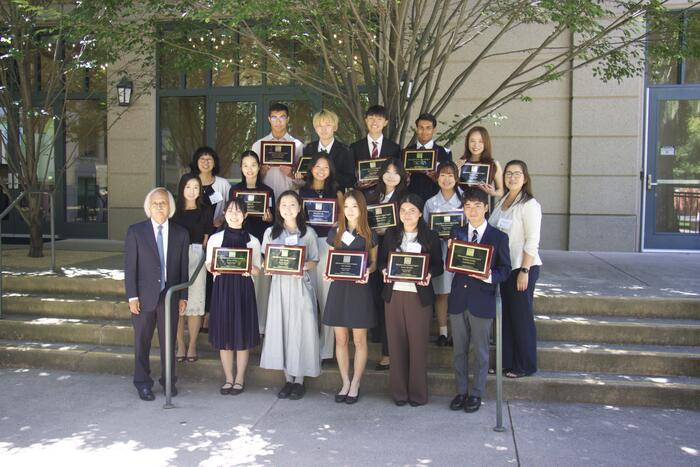
On August 3, 2026, the 2026 Japan Day award ceremony was held at Stanford University to honor SPICE’s Spring and Fall 2025 Stanford e-Japan student honorees and 2026 RSP student honorees. Stanford e-Japan instructors Waka Takahashi Brown (spring course) and Meiko Kotani (fall course), RSP instructor Naomi Funahashi, and the research paper review committees selected the honorees. The honorees are:

Spring 2025 Stanford e-Japan
Mahono Fuji, Seinan High School, “From White Flight to Gentrification: Rethinking Urban Spatial Inequality”

Nagi Matsuyama, Doshisha International High School, “Reconsidering U.S.–Japan Food Trade”

Jinichiro Taguchi, Kaijo High School, “U.S. Foreign Policy and the Monroe Doctrine”

Honorable Mentions:
Dion Munasingha, Yaizu Chuo High School, “Language Support for Children of Immigrants in Japan and the United States”

Natsuka Yamamoto, Keio Girls Senior High School, “Future of Natural Disaster Response Management in Japan and the United States”

Fall 2025 Stanford e-Japan
Sawa Ito, Iida High School, “Mental Health in the United States and Japan: Beyond the Numbers”

Yurino Ohara, Okayama Asahi High School, “Redesigning Japan’s OTC Policy: A Digital Strategy for Fiscal Sustainability and Patient Protection”

Amy Yanai, The British School in Tokyo, “Community Resilience and Soft Power: Disaster Recovery in the U.S. and Japan”

Honorable Mentions:
Takaki Okada, Musashi High School, “Anti-Globalism Sentiment in the United States: Its Causes and Effects”

Aiko Nakano, Shizuoka Futaba Senior High School, “A Comparison of Refugee Recognition Systems in Japan and the United States: The Role of Public Awareness”

2026 Reischauer Scholars Program
Emma Bouvard, The Nightingale-Bamford School, “The Unfinished Promise of Womenomics: Entrepreneurship and the Limits of Gender Equality in Japan”

Erin Tsutsui, Gunn High School, “Reaffirming Japan’s Commitment to the Three Non-Nuclear Principles”

Lisa Yoshida, Monta Vista High School, “The Architecture of Achievement: Structural Equity, Affect Valuation, and the Future of Education in Japan and the U.S.”

Honorable Mentions:
Anmol Singh Josan, Eastside Preparatory School, “The Digital Escape Hatch: Virtual Schools, Futon, and Japan’s Unfinished Educational Reform”

Mika Shimada, Hilton Head Prep, “From Stagnation to Adaptation: Japan and the Redefinition of Economic Success for Developed Nations”

Takahiro Uchida, The Wheeler School, “How Economic Policy Shaped the Soft Power Divide Between J-Pop and K-Pop”

Image
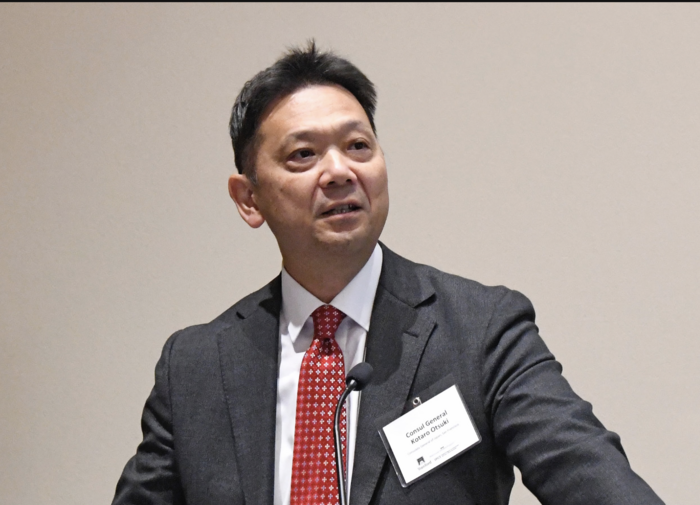
a person in a suit speaking at a podium


The program began with welcoming comments from the Honorable Kotaro Otsuki, Consul General of Japan in San Francisco. He commented that the Reischauer Scholars Program and Stanford e-Japan are very important for our two nations—given that both engage future leaders in both countries—and extended congratulatory comments on behalf of the Consulate to the honorees. SPICE was honored with his presence. 

Image
students standing outside with their plaques


Following the welcoming and opening comments, Brown, Kotani, and Funahashi gave overviews of their courses and introduced the student honorees. The student honorees made articulate presentations based on their research papers and demonstrated so much poise while answering questions from the audience. Each honoree received a plaque from their instructor. Photo above courtesy of Jonas Edman. 

The RSP will enter its 24th year in 2027, and Stanford e-Japan is about to enter its 12th year. Many of the alumni are studying U.S.–Japan relations, engaged in various fields related to U.S.–Japan relations, and continue to give back to both programs by being guest speakers and mentors to the new students. This year, honoree Amy Yanai, who will be a freshman at Yale, has agreed to meet with the Fall 2026 Stanford e-Japan cohort.

Following the formal event, the student honorees—most having just met each other in person for the first time—had the chance to enjoy lunch and a Stanford campus tour together. It is the hope of Brown, Kotani, and Funahashi that the Japanese and American student honorees will continue to stay in touch not only during their high school and college years but also beyond, into their careers. 

SPICE is grateful to President Tadashi Yanai for his generous support of Stanford e-Japan and to the staff of the Yanai Tadashi Foundation for their regular correspondence and encouragement. SPICE is thankful to the Japan Fund committee at FSI for its generous support of the Reischauer Scholars Program. These courses and the ceremony would not be possible without them. SPICE is also grateful to SPICE Event Coordinator Sabrina Ishimatsu for meticulously planning and implementing the event.

SPICE is currently accepting applications for the 2027 Reischauer Scholars Program. The deadline to apply is October 23, 2026.

The application for the 2027 spring session of Stanford e-Japan will open on November 15, 2026.

SPICE also offers online courses to U.S. high school students on China (China Scholars Program), Korea (Sejong Korea Scholars Program), and entrepreneurship (Stanford e-Entrepreneurship U.S.), to Chinese high school students on the United States (Stanford e-China), and to Japanese high school students on entrepreneurship (Stanford e-Entrepreneurship Japan).

To stay informed of SPICE news, join our email list and follow us on Facebook, X, and Instagram.

Read More

people sitting around a table
Blogs

The Yanai Tadashi Foundation and SPICE/Stanford University

Four Stanford freshmen Yanai Scholars reflect on their experiences.
The Yanai Tadashi Foundation and SPICE/Stanford University
Hero Image
a group photo of students and instructors on campus
Front row, left to right: Meiko Kotani, Takahiro Uchida, Emma Bouvard, Amy Yanai, Consul General Kotaro Otsuki, Nagi Matsuyama, Sawa Ito, Yurino Ohara, Mahono Fuji, Lisa Yoshida, Waka Takahashi Brown, Gary Mukai; back row, left to right: Naomi Funahashi, Anmol Singh Josan, Mika Shimada, Jinichiro Taguchi, Takaki Okada, Natsuka Yamamoto, Dion Munasingha | Photo credit: Jonas Edman
All News button
1
Subtitle

SPICE instructors Waka Takahashi Brown, Naomi Funahashi, and Meiko Kotani recognize their student honorees.

Date Label
Display Hero Image Wide (1320px)
No
Subscribe to Education