Children's health
Authors
Karen Eggleston
News Type
News
Date
Paragraphs

China’s recent initiatives to deepen health reform, control antimicrobial resistance, and strengthen primary health services are the topics of ongoing collaborative research by the Asia Health Policy Program (AHPP) at Stanford’s Shorenstein Asia-Pacific Research Center and Chinese counterparts. For example, with generous support from ACON Biotechnology and in partnership with the ACON Biotech Primary Care Research Center in Hangzhou, China, AHPP hosts an annual conference on community health services and primary health care reform in China.

The conference, titled Forum on Community Health Services and Primary Health Care Reform, was held in June at the Stanford Center at Peking University (SCPKU) in Beijing. It featured distinguished policymakers, providers and researchers who discussed a wide-range of topics from China’s emerging “hierarchical medical system” for referring patients to the appropriate level of care (fenji zhenliao), as well as the practice and challenges of innovative approaches to primary care and integrated medical care systems. Yongquan Chen, director of Yong’an City Hospital and representative for the mayor’s office of Sanming, talked about health reforms in Sanming City, Fujian Province, a famous example within China. He discussed the incentives and reasoning behind the reforms, which focus on removing incentives for over-prescription of medications, demonstrating government leadership for comprehensive reforms, consolidating three agencies into one, monitoring implementation and easing tensions between doctors and patients. He pointed out the feasibility and early successes of reform by comparing public hospitals in the city in terms of their revenues and costs, reduced reliance on net revenue from medication sales, and other dimensions of performance. Finally, he addressed reform implementation and future plans on both the hospital's and the government's part.

Xiaofang Han, former director of the Beijing Municipal Development and Reform Commission, shared her personal views on the challenges patients face in navigating China’s health system (kan bing nan) and the need to improve the structure of the delivery system, including a revision to the incentives driving over-prescription in China’s fee-for-service payment system. She emphasized that patients’ distrust of primary care providers can only be overcome by demonstrating improved quality (e.g. with a systematic training program for general practitioners, GPs), and that referral systems should be based on the actual capabilities of the clinicians, not their formal labels. To reach China’s goal of over 80 percent of patients receiving management and first-contact care within their local communities will require improved training and incentive programs for newly-minted MDs, a more flexible physician labor market, and innovations in e-health and patient choice regarding gatekeeping or “contract physician services” (qianyue fuwu).        

Guangde County People's Hospital Director Mingliang Xu spoke about practices and exploration of healthcare alliances and initiatives to provide transparent incentives linking medical staff bonuses to metrics of quality. Ping Zhu from Community Healthcare Service Development and Research Center in Ningbo addressed building solid relationships between doctors and residents and providing more patient-centered services.        

Professor Yingyao Chen from Fudan University School of Public Health discussed performance assessment of community health service agencies based on his research in Shanghai. He introduced the strengths and weaknesses of the incentives embedded in the assessment system for China’s primary care providers, and concluded with suggestions for future research. Dr. Linlin Hu, associate professor at Peking Union Medical College, discussed China's progress and challenges of providing universal coverage of national essential public health services.

Professor Hufeng Wang of Renmin University of China discussed China’s vision for a “hierarchical medical system”– bearing resemblance to “integrated care,” “managed care,” or NHS-like coordination of primary and specialized care – with examples of pilot reforms from Xiamen, Zhenjiang and Dalian cities. Dr. Zuxun Lu, professor of Tongji Medical College of Huazhong University of Science and Technology, also discussed hierarchical medical systems and declared that China currently had a “discounted gatekeeper system.”

Dr. Yaping Du of Zhejiang University presented his research on mobile technology for management of lipid levels and with the help of a volunteer, demonstrated “Dyslipidemia Manager,” a mobile app-based product for both patients and doctors. Innovative strategies for primary prevention of cardiovascular diseases in low- and middle-income countries were the focus of remarks by Dr. Guanyang Zou from the Institute for Global Health and Development at Queen Margaret University, including its connections to international experiences with China’s current efforts in that area.  

In sum, the 2016 Forum elicited lively, evidence-based discussions about the opportunities and challenges in improving primary care and sustaining universal coverage for China.  Plans are underway for convening the third annual ACON Biotech-Stanford AHPP Forum on Community Health Services and Primary Health Care Reform in June 2017 at SCPKU. Anyone with original research or innovative experiences with primary care in China may contact Karen Eggleston regarding participation in next year’s Forum. 

Hero Image
groupphotoscpku062216
Policymakers, healthcare providers and researchers gathered at Stanford Center at Peking University to discuss community health services and primary healthcare reform, Beijing, June 2016.
All News button
1
Authors
Beth Duff-Brown
News Type
News
Date
Paragraphs

The importance of detecting high cholesterol in older adults is well understood. But there’s still not enough evidence about lipid disorders in children and adolescents to determine whether they should be routinely screened.

The U.S. Preventive Services Task Force has concluded the evidence is insufficient to assess the balance of benefits and harms of screening for lipid disorders in children and adolescents 20 years or younger. The report appears in the Aug. 9 issue of JAMA.

High cholesterol in individuals 20 years or younger can be caused primarily by genetics, known as familial hypercholesterolemia, or from both genetic and environmental factors, such as a high-fat diet.

“We are calling for more research to better understand the benefits and harms of screening and treatment of lipid disorders in children and teens and on the impact these interventions may have on their cardiovascular health as adults,” Task Force vice chair David Grossman said in a news release.

The Task Force is an independent panel of experts who make recommendations about the effectiveness of specific preventive care services such as screenings, counseling services, and preventive medications.

The task force does, however, recommend screening children who are 6 years and older for obesity and making referrals as needed for counseling on weight management. Helping children improve diet and exercise may also improve heart health.

“Cardiovascular health in young people is important and the goal is to prevent the development of cardiovascular disease as people age,” said Douglas K. Owens, a professor of medicine at Stanford and a member of the task force when the guideline was developed. “But many important questions remain unanswered about how to do so.”

Owens, a leader at Stanford Health Policy, said that for now, physicians should use their clinical judgment when counseling young patients on lipid disorders.

“Research on screening and treatment of lipid disorders in children and teens and the impact of these interventions have on cardiovascular disease in adults should be a high priority,” he said. “The USPSTF suggests that all children and teens eat a healthy diet, maintain a normal weight, and engage in physical activity.”

Recent estimates from the National Health and Nutrition Examination Survey indicate that 7.8 percent of children age 8 to 17 years have elevated levels of total cholesterol (TC) and 7.4 percent of adolescents age 12 to 19 years have elevated LDL-C, or the “bad cholesterol” that can lead to heart disease.

Four editorials related to the recommendation accompanied the report JAMA, including one from physicians from Stanford and UCSF who suggest that the U.S. health-care system should focus more on high-value solutions to major public health concerns such as climate change, poverty, obesity and gun violence.

“The need for clinicians and leaders to focus on sustainability and health-care value has never been greater, and it is likely that policy and community-based interventions will get us there much more quickly than adding more clinic-based interventions that have low value and are wasteful of resources and clinicians’ time,” they wrote.


Hero Image
kids iStock
All News button
1
Authors
News Type
News
Date
Paragraphs

“Vic-TOR-ia!” Fátima cried, a grin lighting up her face. The 5-year-old had become fast friends with Stanford medical student Tori Bawel almost instantly after Bawel arrived in San Lucas Tolimán. After giving piggy-back rides to Fátima, a career in global pediatrics changed from a distant wish to a developing reality for Bawel.

Bawel is one of a few lucky medical students to travel with Stanford pediatrician Paul Wise, MD, MPH, to San Lucas Tolimán, a town in the mountains of rural Guatemala that serves as a base for his work to improve nutrition for local children. Once she completes her medical training, Bawel plans to devote her life to improving health in underserved areas.

“As an elementary school student, I was really compelled by issues of social justice,” she said. “I hope that over the course of my lifetime, I’m able to make a difference like physicians have done here in Guatemala and around the world.”

Every summer, Wise, a professor of pediatrics and a Stanford Health Policy core faculty member, takes a handful of undergraduates to the communities around San Lucas to learn about the Rural Guatemala Child Health and Nutrition Program. A collaboration between Stanford and a group of local health promoters, the program uses nutritional supplements and health education to save the lives of children under five. The students follow the promoters on house visits, help them measure the weight and height of children and gain an understanding of how the program helps the rural communities.

“We feel it is part of our educational mission,” said Wise. “We want to grow people who will make a difference, and part of that is providing them opportunities to do so.”

Bawel’s experience reinforced her desire to engage in global health work: “It’s inspired me and motivated me to want to give my life, like Wise, to… serving in areas of the world with the greatest need.”

Meeting Guatemalan students who overcame economic difficulties to study medicine — like Flor Julajuj — was also deeply moving for Bawel. Very few in rural Guatemala have the opportunity to pursue higher education or good health care. But with some help from Wise, Julajuj was able to attend medical school; just this month, she graduated from the University of San Carlos in Guatemala City.

Image
20160323 113515

“It’s been a great opportunity,” said Julajuj. “It’s changed my life.”

Most, though, are not so lucky; Bawel also encountered two young women who dream of becoming physicians but cannot afford medical school. Meeting the young, ambitious women “makes me want to empower them with the education and opportunities I have had,” said Bawel.

Wise, meanwhile, will continue to each Stanford students about ways to help these communities.

“They see the poverty, but they also begin to understand why being a great doctor or a great diplomat or a great economist will serve the interests of people down here if done well,” he said. “We want them to go back to whatever field they’re interested in, committed to gaining skills and then using them to serve the needs and the rights of people in places like San Lucas.”

Hero Image
26904174966 b790e2fc26 o Nicole Feldman
All News button
1
Authors
News Type
News
Date
Paragraphs

Stanford pediatrician Paul Wise stooped below the black tarp roof of a cinderblock house in Guatemala to offer his condolences to a mother who had just lost her child.

“Doctor Pablo,” as he is known in the communities around San Lucas Tolimán, talked softly as he relayed his sympathies to the mother, whose 9-year-old son had been a patient of his.

Stanford’s Children in Crisis Initiative seeks to save the lives of children in areas of poor governance. In Guatemala, their efforts work toward eliminating death by malnutrition for children under 5.

The boy’s genetic disorder would have been terminal anywhere, but thanks to Wise and local health promoters, the boy’s family had years with him instead of months.

They found the doctor through the Guatemala Rural Child Health and Nutrition Program, a collaboration between Wise and the health promoters to eliminate death by malnutrition for children under 5.

While Wise spoke to the heartbroken mother, his Stanford research assistant Alejandro Chavez helped the promoters set up inside a local community center to measure the weight and height of local kids to determine their nutrition level.

Chavez and the promoters had worked together for months to create an app for tablets that will make it easier to find malnourished children.

The app they designed will decrease training time for new health promoters and allow the program to expand. The goal is to distribute the app globally to help programs in other countries tackle malnutrition.

Children in crisis

As recently as 2005, about one of every 20 children in this rural area of Guatemala died before their 5th birthday. Almost half the deaths were associated with severe malnutrition.

“The death of any child is always a tragedy, but the death of any child from preventable causes is always unjust,” said Wise, a Stanford Health Policy core faculty member.

Along with other faculty from the Freeman Spogli Institute for International Studies (FSI) and the School of Medicine, Wise created the Children in Crisis Initiative to save the lives of children in areas of poor governance. The program brings together Stanford researchers and students across disciplines.

Nowhere are their efforts better illustrated than in the rural communities around San Lucas Tolimán, in the central mountains of Guatemala.

The program’s effectiveness rests on a deep respect for the local communities merged with innovation by Stanford researchers.

“It’s absolutely essential to any program that the people in need be part of the solution,” said Wise. Unlike many nongovernmental organizations and health programs, Wise believes the way to create a sustainable health system is for the locals to run it, so the health promoters manage the program’s day-to-day activities.

Image
26904174966 b790e2fc26 o

This leaves the Stanford team free to focus on innovation – such as the new app. They believe the technology could change child health programs around the world. Wise’s team has partnered with Medic Mobile – a nonprofit that creates open-source software for health care workers – which plans to distribute the app to other areas suffering from malnutrition.

The six Android tablets purchased by Children in Crisis are enough to monitor the program’s 1,500 kids through the app.

Role of nutrition

When done well, nutrition surveillance is very effective at decreasing child mortality in poor countries.

“Nutrition contributes enormously to health and well-being,” Wise said as he walked through Tierra Santa, a small community near San Lucas, making house calls. “So the focus of our work turned to improving young child nutrition. It’s not an easy thing to do in a place that’s extremely poor.”

Wise and his colleagues – Stanford medical student Tori Bawel and Stanford professor of pediatrics Lisa Chamberlain – made their rounds during their visit in March. Evidence of poverty was everywhere.

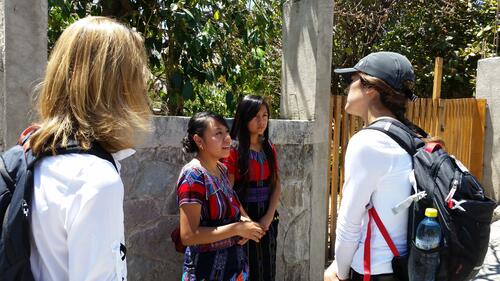
Here, clean tap water is a dream and even the sturdier homes often lack four walls or paned windows, though the children were neatly dressed in T-shirts or colorful traje, traditional Mayan clothing.

It’s hard to provide proper nutrition when most families can’t find enough work to buy adequate food. But a little help can make a big difference.

Bawel, a first-year medical student who plans a career improving health in areas of poverty, was struck by the impact the promoter program has had on the community.

“There are children who need supplements and nutrition to stay alive,” she said. “Without this program, that infrastructure does not exist.”

With FSI’s assistance, the nutrition program distributes Incaparina, a supplement of cornmeal, soy and essential nutrients. The sweet, mealy drink helps the program’s most malnourished children get back on track.

Image
dsc 0049

Every two months, the promoters gather each community’s children to measure their weight and height. Children and their mothers sit patiently, waiting for their turn. The children enjoy a cup of Incaparina, and their mothers eagerly listen to the promoters’ tips for keeping their children healthy.

“It’s very important to me,” said Elsira Rosibel Samayoa, who brought her 2-year-old to be measured. “There are mothers who don’t understand the importance of monitoring their children’s weight, but I do.”

Since its implementation in 2009, the Stanford program has slashed nutrition-based mortality in the participating communities by about 80 percent and decreased severe malnutrition by more than 60 percent – saving hundreds of children’s lives.

However, nutrition surveillance and intervention isn’t easy. Tracking nutrition takes training and expertise, and when the local population rarely exceeds a fourth-grade education, learning these skills is especially challenging. Detailed graphs on a standard growth chart are essential to identifying malnourished children.

“The community health workers are extremely capable and smart, but some have never seen a graph before,” said Wise. “Think about what it is to try to explain a graph to someone for the first time.”

It takes the health workers about three years to learn to graph and then interpret the results for intervention.

Wise said, “So we all got together and said, ‘How do we make this easier to do?’”

The app was the answer.

‘Let’s create an app’

Enter Alejandro Chavez, a recent Stanford computer science graduate and Stanford Health Policy research assistant. He developed the app to collect child health data, then determine the child’s degree of malnutrition and suggest intervention.

“The major goal was to lower training requirements and make programs like this simpler to start and maintain,” said Chavez, who now lives and works in Guatemala, where he gets daily feedback from the health promoters.

“I feel like they’ve been very honest with me about things I need to improve,” he said.

Cesia Lizeth Castro Chutá is a senior coordinator for the program who has worked with Chavez to ensure that the app meets the promoters’ needs.

“The tablet automatically generates the information we need to know,” she said. “It becomes easier to confirm that a child is malnourished and needs supplements.”

Looking forward
Image
dsc 0324

With the app’s launch, it looks like training time for the promoters will be reduced from three years to less than six months. That means new communities can be incorporated into the program quickly, creating broader access to care.

Meanwhile, many health programs around the world are waiting to see how well the Stanford app works in Guatemala.

Josh Nesbit, a Stanford alumnus and Medic Mobile CEO, said, “As more health programs recognize the importance of nutrition and implement community-based interventions, screening and surveillance tools will be critical. We must learn from Dr. Wise’s success.”


Hero Image
dsc 0266 1 Nicole Feldman
All News button
1
Authors
News Type
Blogs
Date
Paragraphs
Hero Image
paul wise Elena Cryst
All News button
1
Subscribe to Children's health