Achieving gender equality in education is an important development goal. We tested the hypothesis that the gender gap in adolescent education is accentuated by illnesses among young children in the household.
Results
In our sample of 120708 adolescent boys and girls residing in 38 countries, girls were 5.08% less likely to attend school than boys in the absence of a recent illness among young children within the same household (95% confidence interval [CI], 5.50%–4.65%). This gap increased to 7.77% (95% CI, 8.24%–7.30%) and 8.53% (95% CI, 9.32%–7.74%) if the household reported 1 and 2 or more illness episodes, respectively. The gender gap in schooling in response to illness was larger in households with a working mother. Increases in child vaccination rates were associated with a closing of the gender gap in schooling (correlation coefficient = 0.34, P = .02).
Conclusions
Illnesses among children strongly predict a widening of the gender gap in education. Investments in early childhood health may have important effects on schooling attainment for adolescent girls.
Fewer girls in low-and-middle-income countries finish secondary school, resulting in poorer health and economic outcomes for their own children — and perpetuating the vicious cycle of gender inequality worldwide.
According to The World Bank, in Sub-Saharan and South Asia, boys are 1.5 times more likely to complete secondary education than girls. Many are forced to stay at home and help their mothers with housework and childcare, particularly if a younger sibling is sick.
Yet the potential gains from increased participation of women in the global workforce over the next decade are estimated at $12 trillion. Studies show that women’s equal participation in the workforce could boost some countries’ GDP by up to 20 percent.
Stanford Health Policy’s Marcella Alsan, a physician and economist, argues in a new study in the journal Pediatrics, that identifying contributors to education disparities and making investments in early childhood health could significantly advance global health and development.
“There are so many advantages to girls staying in school,” Alsan, an assistant professor of medicine at Stanford Medicine, said in an interview. “For one thing, the longer they’re in school, the less likely they are to become young mothers or contract HIV. And the more educated the mother, their own children have better chances of survival.”
So what are some of the biggest barriers to girls completing secondary school in less developed countries?
Alsan and her co-authors found the gender gap is compounded by illness among young children in the household since adolescent girls are often tasked with childcare and domestic chores. The problem is exacerbated if the mother works outside the household.
Follow the Numbers
Along with SHP research data analyst Anlu Xing, Alsan and her team used Demographic and Health Surveys on 41,821 households in 38 low-and-middle-income countries. The surveys asked about illnesses in children under 5 in the last two weeks, and then asked the adolescent boys and girls if they had been in school in the same period.
As expected, more girls remained at home than boys. When no young children in the household are ill, adolescent girls are on average 6 percent less likely to attend school than adolescent boys within the same household.
But the gap increases to 7.8 percent if the household reports one illness episode among an under-5 child, and up to 8.5 percent if there are two or more episodes of illness.
Image
In other words, the authors write, “The gender gap in adolescent school attendance increased by around 50 percent when young children in the household became ill.”
The education gap between adolescent boys and girls jumps to 10.06 percent if the younger child has two or more episodes of illness — and the mother is working outside the home or in the fields.
“Policies that strengthen family and community supports for challenges such as sick child care will prove essential,” the authors write, “particularly as women move increasingly into the workforce outside the home.”
Alsan’s co-authors are Eran Bendavid, assistant professor of medicine and core faculty member at Stanford Health Policy; Gary Darmstadt, a professor of pediatrics and associate dean for maternal and child health at Stanford Medicine; and Paul Wise, another core faculty member at SHP and professor of pediatrics.
Vaccines Also Key
Alsan and her team also examined data on the gender gap in adolescent education in association with national vaccine rates, using the same country-year surveys.
They found that in countries where about 70 percent of all the boys and girls had the same series of eight vaccines — including polio, diphtheria, tetanus and measles — the gender gap in education approaches zero.
“We hypothesize that countries with high rates of childhood vaccination will experience lower rates of young child illness, thereby decreasing the need for adolescent girls’ to devote time to caring for sick children,” the authors write.
Given the long-term benefits of secondary school for women’s health and economic outcomes, the authors believe their study underscores the societal benefits of keeping girls in school. A combination of vaccines and early childhood interventions to keep toddlers healthy and their older sisters in school are paramount.
“The international community agrees that educating girls through secondary school has plenty of societal benefits — we show that health interventions targeting young kids are an important way to do just that,” says Alsan. “Not only the targeted little kids benefit but also their older sisters — a double dividend.”
Hero Image
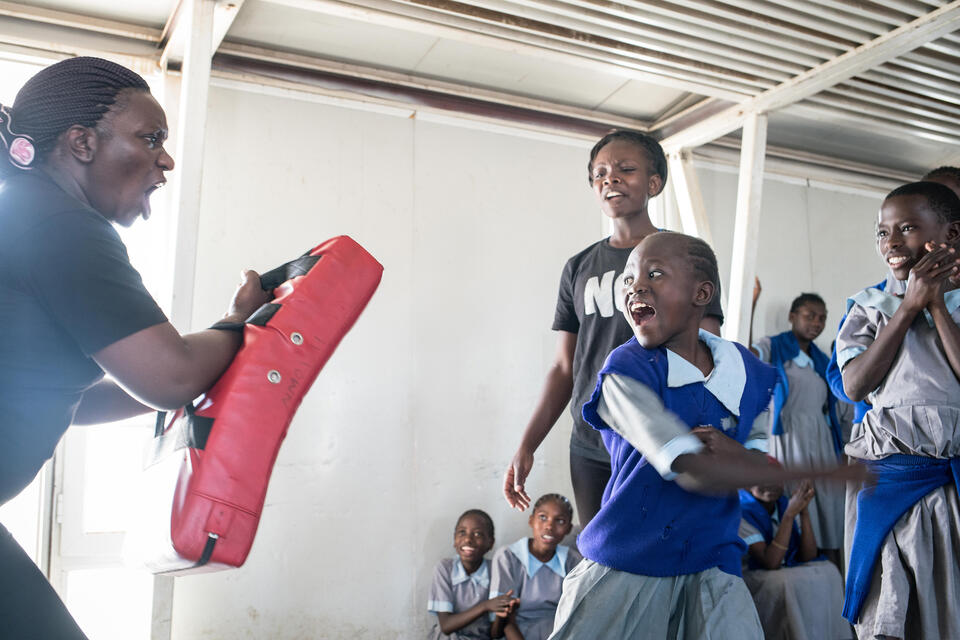
Secondary school girls responding to a speech at Jamhuri High School in Nairobi, Kenya. | Paula Bronstein/Getty Images
In the slums of Nairobi, where sexual assault is as commonplace as it is taboo to discuss, a team of Kenyan counselors is teaching kids that no means no.
The girls learn to shout — “Hands off my body!” — and throw an elbow jab or good kick to the groin. The boys are encouraged to stand up for the girls and fight against the social traditions that have normalized rape.
Perhaps most effectively, the children learn how to talk themselves out of precarious situations, use clever diversions and speak loudly when faced with potential attackers, through a series of role-playing exercises that promote healthy gender norms.
The behavioral intervention appears to be working. Observational studies have inferred that the incidence of rape has dropped dramatically — perhaps even by half.
But how do those who are devoted to protecting these girls from sexual violence prove to themselves and their donors that their efforts and dollars are making a difference?
This is where Mike Baiocchi comes in. The Stanford statistician and his team of researchers and students are conducting the largest-ever randomized trial of its kind in an effort to place rare, high-quality quantitative proof alongside the more common observational evidence.
“That’s what I specialize in: messy, real-world data where you try and prove the cause-and-effect relationship,” said Baiocchi, PhD, an assistant professor of medicine at the Stanford Prevention Research Center in the School of Medicine.
Rosenkranz Prize 2017 winner Mike Baiocchi and his partner, Clea Sarnquist, both of Stanford Medicine, conduct research on the ground in Nairobi, Kenya, to determine whether a rape prevention program is truly making a difference.
Rosenkranz Prize 2017 winner Mike Baiocchi and his partner, Clea Sarnquist, both of Stanford Medicine, conduct research on the ground in Nairobi, Kenya, to determine whether a rape prevention program is truly making a difference.
Baiocchi and his team have designed a closed-cohort study that will track the behavior of about 5,000 girls and 1,000 boys enrolled in the No Means No Worldwide project, which is training 300,000 girls and boys in Kenya and Malawi to prevent rape and teen pregnancy.
“The entire Rosenkranz selection committee was highly impressed both with the rigor of Mike’s work — which he publishes in top journals in the field of statistics — as well as his unconventional and potentially very impactful work on the prevention of gender-based violence in illegal settlements around Nairobi,” said Grant Miller, PhD, an associate professor of medicine and core faculty member at Stanford Health Policy.
Miller chairs the committee that selects the winners of Stanford Health Policy’s annual $100,000 prize, which goes to promising young Stanford researchers who are investigating ways to improve health care and health policy in developing countries.
In Kenya, national surveys reveal that as many as 46 percent of Kenyan women experience sexual assault as children.
“In the roughest part of the Nairobi slums, 20 to 25 percent of high school girls will be raped this year,” said Baiocchi. “This program, however, looks like it is having the ability to cut that in about half. Our job is to tease out the evidence through careful measurement and design of experiment.”
To do this, Baiocchi and other members of the Stanford Gender-Based Violence Collaborative have traveled to Nairobi to collect baseline data. His partner is Clea Sarnquist, DrPH, a senior research scholar for the Global Child Health Program in the Stanford Department of Pediatrics.
Several pilot evaluations of the program, published in 2014 in Pediatrics, found that more than half of 2,000 high school girls who had completed the self-defense course had used their newfound skills to fend off sexual harassment or rape.
But Lee Paiva, the San Francisco-based founder of No Means No Worldwide, wanted proof. She told Stanford Medicine magazine last year that since establishing training in 2010, she often wondered about the true effectiveness of the program.
“A little voice inside me said, `What did you teach them?’” she said. “What did those kids actually get? What is that money really going to do?”
She determined that she wasn’t going to move forward on the program until she could answer those questions. That is when she turned to Stanford.
Expanding on their initial work, Baiocchi and Sarnquist spent several months last year, working with their Kenyan partners, Ujamaa-Africa and the African Institute for Health and Development, in 90 schools in the poorest parts of Nairobi to establish the largest randomized trial of its kind.
They interviewed the girls who have taken part in the six-week empowerment and self-defense program taught by Kenyans who grew up in the same neighborhoods and are familiar with the local culture.
“It’s hard not to be extraordinarily excited when you watch these girls; they’re play-acting and just being kids, but you are also watching them evolving and creating new ways to deal with these situations,” said Baiocchi.The team is now tracking a fixed group of 5,000 girls and 1,000 boys, ages 10 to 16, over two years. This will give the researchers a better understanding of just how the girls are adopting the training and readapting to societal demands.
Image
“Doing a randomized trial is slow, expensive, and — if I’m being totally honest — anxiety-inducing because everything is laid so bare and you put things in motion today that won’t be resolved for another two years,” Baiocchi said. “But the reward is extraordinarily high-quality data that helps you understand what’s really going on. We need this level of evidence if we’re going to take on such a difficult problem.”
Since using math to measure the benefits of gender-based violence prevention interventions is a relatively new science, Baiocchi said the team is adopting the highest level of rigor, equivalent to what it would take to get their results through the FDA.
Baiocchi notes both his parents are nurses, his brother is a nurse who is married to a nurse. Public health and service runs through the family DNA.
“So, when I came out as being a math person, I knew that I also had to do good.”
Since receiving his PhD in statistics from The Wharton School at the University of Pennsylvania in 2011, Baiocchi has worked on ways to improve high-risk infant deliveries, school-based earthquake risk reduction in Nepal, bail reform in the United States, improving cardiothoracic surgical care, as well as cancer and cardiovascular disease prevention in China.
The Kenya project team, which includes eight Stanford undergraduate and graduate students, intends to share their results, putting out open-source tutorials that will explain their statistical methods and provide sample code and data.
Image
“We want to make it really easy for people in this area to start having a similar language so we can better communicate and build on this science,” he said.
The Rosenkranz funding will help to build this open-source site and support the Stanford team in their research and travel to Kenya and other countries.
The award’s namesake, George Rosenkranz, who holds a doctorate in chemistry, first synthesized cortisone in 1951, and later progestin, the active ingredient in oral birth control pills. He went on to establish the Mexican National Institute for Genomic Medicine, and his family created the Rosenkranz Prize in 2009.The award embodies Rosenkranz’s belief that young scientists hold the curiosity and drive necessary to find alternative solutions to longstanding health-care dilemmas.
Baiocchi called Rosenkranz’s work to help women take control of their reproductive health “revolutionary,” and is humbled to now be on the list of the other prizewinners, Eran Bendavid, Sanjay Basu, Marcella Alsan, Jason Andrews and Ami Bhatt.
“Our work is a continuation of the powerful changes Dr. Rosenkranz set in motion,” he said.
And what really matters, Baiocchi said, are the end results.
“There are a number of girls who are not going to get raped this year because of what we are doing,” he said. “And we know that if someone doesn’t get assaulted, that leads them to having a better life — it’s an extraordinarily virtuous cycle.”
Women empowerment (WE) is increasingly viewed as an important strategy to reduce maternal and child undernutrition,1–3 which continues to be a major health burden in low- and middle-income countries causing 3.5 million preventable maternal and child deaths, 35% of the disease burden in children younger than 5 years, and 11% of total global disability-adjusted life years.4,5Global data show that one of the worst affected regions is sub-Saharan Africa (SSA), where about 20% of children are malnourished.6,7 Benin is no exception, as the prevalence of stunting, wasting, and underweight was 37%, 5%, and 17%, respectively, among children aged 6 to 59 months in the 2006 Benin Demographic and Health Survey (DHS),8 while 9% of women had chronic energy deficiency in the 2012 DHS.9 Greater rates were observed in rural areas where stunting was found in 40% of children, underweight in 19%, and wasting in 5%, while 10% of women had chronic energy deficiency.8,9 Additionally, Beninese women and children have a limited dietary diversity score (DDS), with diets predominately composed of starchy staples with little or no animal products and few fresh fruits and vegetables.10,11 Government, United Nation agencies, and nongovernmental organizations in Benin recognize that the state of maternal and child undernutrition requires multiple types of interventions.12
However, women’s low empowerment status in Benin can hinder the improvement in women’s and children’s undernutrition. Indeed, although females accounted for 47% of the economically active population in 2014,13 social and civil legislation is strongly influenced by tradition and customs, as women continue to be required to seek their husband’s authorization in certain areas such as family planning or health services.14 Rural women provided labor to the families’ commercial plots, were responsible for household food production and processing, and also had to work in the cooperative structures set up by the state in addition to their household tasks.14 In a more recent study of productivity differences by gender in central Benin, researchers noted that female rice farmers are particularly discriminated against with regard to access to land and equipment, resulting in significant negative impacts on their productivity and income.15 As in other areas of West Africa, women also have the responsibility of caring for children and preparing food for the household,16 but they may be vulnerable to food insecurity owing to unequal intrahousehold food distribution and their willingness to forego meals in favor of children during times of scarcity.17 Finally, no study to date has examined links between women’s empowerment and nutrition in Benin.
In addition, the evidence backing the effect of women’s empowerment on maternal and child undernutrition is inconsistent.18 Using the Women’s Empowerment in Agriculture Index (WEAI), Malapit et al19 reported positive and significant association between women’s group (WG) membership, control over income, overall empowerment, and women’s health (as measured by body mass index [BMI] and DDS) in Nepal. However, in Ghana, women’s aggregate empowerment and participation in credit decisions were positively correlated with women’s DDS, but not BMI.20 Mixed findings were also observed between women’s empowerment and child anthropometry. Moestue et al21 found a positive association between maternal involvement in social groups and length-for-age z score of 1-year-old children, but De Silva and Harpham22showed a negative association in 6- to 18-month-old children. Shroff et al23 found positive association between decision-making and child weight-for-age z score (WAZ), but Begum and Sen’s24 analysis of Bangladesh DHS data did not reveal any significant associations. Therefore, information about which domains of WE are associated with nutritional status is limited,20 and this lack of knowledge constrains the set of policy options that can be used to empower women and improve nutrition.
In addition to a limited set of studies in SSA, examinations of the effects of WE on nutrition outcomes are constrained due to interstudy differences in population characteristics, settings, or methods/conceptualizations of WE.25–27 For example, despite recognition of the complex, multidimensional, and culturally defined nature and influence of empowerment on nutrition,20,26,28,29 only a few studies considered the multidimensional structure of empowerment domains in Africa or examined the varied relationships between each measure of WE and maternal and child nutrition status.30,31 Furthermore, in 2012, the International Food Policy Research Institute developed WEAI constructed from 5 prespecified domains of empowerment,32which may not be equally relevant in all areas. In contrast, in 2015, the United Nations adopted the Sustainable Development Goals (SDG), but the specific indicators for the SDG empowerment targets are largely equality metrics.33 To address the need for multidimensional and contextual examinations of WE and its influence on maternal and child health outcomes, we draw from the concepts put forward in the WEAI and the SDGs but took an approach more along the lines of the World Bank which gathers indicators, both equity and empowerment related, that can be used in contextually appropriate ways.34 The aims of this study were therefore to first explore the structure and domains of WE in Kalalé district of northern Benin and then to examine the effects of these constructs on nutritional status of women and their children in the region.
Like any energetic 7-year-old, your daughter loves running around outside, playing with her friends and kicking around a soccer ball. So you’re concerned when she starts losing energy. She looks pale and refuses to eat. You take her to the pediatrician, and her test results show the worst: she has leukemia. Once you work through the shock, you do you what any parent would do: find the best possible care to get her through it. But where do you go?
Health care for children is different from care for adults. Treating kids requires doctors who are experienced with their unique needs, and according to Stanford pediatricians Paul Wise and Lisa Chamberlain, this experience is developed and lives in children’s hospitals.
And these facilities are highly dependent on Medicaid.
“Children are the poorest segment of the United States population,” said Wise, a Stanford Health Policy core faculty member.
Nearly one out of every five children lives below the poverty line, according to the United States Census Bureau. Very few children need extensive health care, but of those that do, about 44 percent rely on Medicaid or other public insurance programs.
Because so many of their patients use Medicaid, these children’s hospitals need reimbursements from the program to support their services. Without this income, some might have to downsize or even shut down, and if they do, services would suffer for all children.
“If you want to kill rich kids, cut Medicaid,” said Wise. “If you’re a rich kid with a serious chronic problem, you’re going to want facilities that provide high-quality care. Those facilities are intensely dependent on Medicaid.”
If the American Health Care Act (the Republican replacement for Obamacare) passes Congress, Medicaid will convert to a per capita cap system. Instead of providing coverage to all who meet its criteria — which is primarily based on income and need — the federal government would cap how much money the federal government could provide each person.
Wise and Chamberlain worry that a set amount allocated for states or individuals would not be able to keep up with health industry inflation, causing payments to effectively decrease over time. They are also concerned that children would be particularly affected by these changes because their medical needs are so different from adults’.
“Caring for seriously ill children requires a wide range of services and specialists, from pediatric surgeons to speech therapists to hospital teachers who make sure kids don’t fall behind,” said Chamberlain. “In pediatrics we work as a team — and cutting Medicaid will reduce our ability to do that.”
Not only would the funds available for child health coverage erode, but according to Wise, the focus on adult health concerns in the emerging Medicaid changes could, without immediate attention, undermine 40 years of progress in developing strong, regionalized child health systems.
Providing for children’s needs should be simple because their expenditures are relatively low. Child health care makes up less than nine percent of all federal health expenditures in the United States.
But because the health policy debate in the United States focuses on older populations, children are often left out.
“I think it’s really important that we have these conversations about the unique needs of children,” said Chamberlain.
Wise and Chamberlain hope to alert policy-makers to the fiscal needs of children and how they affect care for all kids.
“Our elected officials have to cope with a wide range of issues, and they welcome engaged professionals exchanging ideas about active legislation,” said Chamberlain. “Those conversations really matter – now is the time to let them hear what we think.”
To hear more from Wise and Chamberlain about child health and Medicaid, listen to their podcast on World Class:
I remember two things about my patient, Maria, a tiny baby who was born a little early. One was her large, beautiful eyes. The other was that when I put my stethoscope on her chest, I heard an enormous heart murmur. Maria had been born with a serious heart condition that would change her life and the life of her mom.
Good patient care at a time like this involves much more than treating a child’s heart. At that first appointment, Maria (not her real name), her mother and I began a long journey punctuated by multiple hospitalizations, surgeries and procedures.
Maria was born at Lucile Packard Children’s Hospital Stanford and lived with her mom in East Palo Alto. As her general pediatrician at Ravenswood Family Health Center, I came to know them both well. I focused on helping the tiny infant gain weight, so that she would be strong enough to undergo her heart surgeries. We brought in the Women, Infants and Children program to support her nutrition. I explained to her mom what the surgeries would do. I reviewed what Maria’s medicines were for, and when her mother couldn’t pay for them I helped gain authorization from county staff, who were able to get them dispensed at the pharmacy. When I realized Maria’s mom didn’t have enough money for food (due to many absences at work), I made sure she applied for food stamps.
Image
My experience with Maria coincided with my research at Stanford involving access to care for kids in California. As a result of the research, I spent part of my time in Sacramento, working with legislators on changes to the California Children’s Services program. This program is critical to the care of low-income children with serious medical conditions. My research, which involved analyzing data on publicly insured pediatric care like Maria’s, showed that access to high-quality care for low-income kids was pretty good in California compared with other states, but that there was variation among its 58 counties.
While working on the program’s reform in Sacramento, I spent time in countless staff meetings, public hearings and hallway discussions. I often thought about Maria, whose life depended on CCS. The research data I brought to these negotiations were as important as sharing Maria’s story — how her mother lost her job because of time spent caring for her fragile daughter, how the family sank more deeply into poverty and how services needed to be more focused on families. As changes to the CCS system were being discussed, I imagined how they would benefit or hinder Maria’s care and her future.
Objective: To identify the magnitude of anaemia and deficiencies of Fe (ID) and vitamin A (VAD) and their associated factors among rural women and children.
Design: Cross-sectional, comprising a household, health and nutrition survey and determination of Hb, biochemical (serum concentrations of ferritin, retinol, C-reactive protein and α1-acid glycoprotein) and anthropometric parameters. Multivariate logistic regression examined associations of various factors with anaemia and micronutrient deficiencies.
Setting: Kalalé district, northern Benin. Subjects: Mother–child pairs (n 767): non-pregnant women of reproductive age (15–49 years) and children 6–59 months old.
Results: In women, the overall prevalence of anaemia, ID, Fe-deficiency anaemia (IDA) and VAD was 47·7, 18·3, 11·3 and 17·7%, respectively. A similar pattern for anaemia (82·4 %), ID (23·6%) and IDA (21·2%) was observed among children, while VAD was greater at 33·6%. Greater risk of anaemia, ID and VAD was found for low maternal education, maternal farming activity, maternal health status, low food diversity, lack of fruits and vegetables consumption, low protein foods consumption, high infection, anthropometric deficits, large family size, poor sanitary conditions and low socio-economic status. Strong differences were also observed by ethnicity, women’s group participation and source of information. Finally, age had a significant effect in children, with those aged 6–23 months having the highest risk for anaemia and those aged 12–23 months at risk for ID and IDA.
Conclusions: Anaemia, ID and VAD were high among rural women and their children in northern Benin, although ID accounted for a small proportion of anaemia. Multicentre studies in various parts of the country are needed to substantiate the present results, so that appropriate and beneficial strategies for micronutrient supplementation and interventions to improve food diversity and quality can be planned.
The health gap between rich and poor children in developing countires is staggeringly high, but Assistant Professor of Medicine Eran Bendavid found that it is shrinking. In his pilot project, "Empirical Evidence on Wealth Inequality and Health in Developing Countries," Bendavid discovered that since the mid-2000s, life expectancies for children under five are starting to converge. How can we continue to close the gap? Watch to find out.



 Rosenkranz Prize 2017 winner Mike Baiocchi and his partner, Clea Sarnquist, both of Stanford Medicine, conduct research on the ground in Nairobi, Kenya, to determine whether a rape prevention program is truly making a difference.