Globalization
-

This half-day symposium will bring together scholars and practitioners to reconsider Taiwan's prospects for entry into the Trans-Pacific Partnership in light of the conclusion of negotiations in October 2015 and the election of a new president and legislature in Taiwan in January 2016. It will revisit the themes and conclusions of the Taiwan Democracy Project's 2013 annual conference.

9:00-9:15am: Introductions

9:15-11:00am. Panel 1: The Politics of Trade and Development in Taiwan

Stephen Tan, Vice President of the Cross-Strait Policy Association, Taipei

Kristy Hsu, Director, Taiwan ASEAN Studies Center, Chung Hua Institution for Economic Research, Taipei

Chung-ming Kuan, Chair Professor, Department of Finance and Director of CRETA at National Taiwan University, and former Minister of the National Development Council

Hung-mao Tien, President of the Institute for National Policy Research, and former Minister of Foreign Affairs, Taiwan

11:00-11:15. Break

11:15-12:45. Panel 2: International Perspectives on the TPP: Implications for Regional Development and Geopolitics

Vinod Aggarwal, Professor of Political Science and Faculty Affiliate of the Center for East Asian Studies, UC Berkeley

Nicholas Hope, Director of the China Program at the Stanford Center for International Development

Thomas Gold, Professor of Sociology and Faculty Affiliate of the Center for East Asian Studies, UC Berkeley


Audio Recording


CISAC Central Conference Room

Conferences
News Type
News
Date
Paragraphs

Stanford students worked together to pitch marketing ideas to a major Japanese airline at an event last Tuesday. The event, called an “ideathon,” is part of a series of events seeking to strengthen the U.S.-Japan relationship through exchange of ideas.

The ideathon was the first of its kind at the Shorenstein Asia-Pacific Research Center, led by the Japan Program under the rubric of the Stanford Silicon Valley-New Japan Project (SV-NJ). The project is supported in part by All Nippon Airways (ANA), the Japanese airline featured at the event.

Nineteen students participated, from both undergraduate and graduate levels and across disciplines – including students from the Graduate School of Business, and other majors including economics, mathematics, computer science, philosophy and East Asian studies.

Placed on a team with others they had just met, students were encouraged to assemble quickly and generate solutions to the challenge: how can ANA strengthen its brand awareness in the United States?

ANA is seeking to double in size in the next three years, yet it faces a few obstacles in this endeavor, including a customer base that is mostly in Japan and low brand visibility internationally, according to a senior employee that presented at the event.

“Who had heard of ANA before this event?” asked Hiroyuki Miyagawa, a marketing executive at ANA. Few hands raised in the audience.

Organized into four teams, each student team was joined by an ANA employee who listened in and offered guidance and a chance to learn from a longtime practitioner.

One and a half hours later, with Post-it notes and scribbled diagrams sprinkled across tables, each team emerged ready to present their 3-minute pitch to a panel of judges. The panel included executives from ANA, the World Innovation Lab (WiL), a venture capital firm in Palo Alto, and bTrax, a San Francisco based design firm.

Below are a few pictures from the event.


Image
ideathon team three

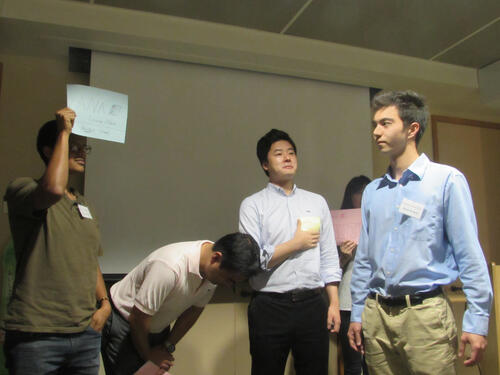
Team Three acts out a skit.  |  They proposed that ANA establish lounges for the general public to gather in and purchase goods from Uniqlo and Muji, two Japanese lifestyle retailers. The lounges would offer a place to reinforce ANA's brand outside of the airport, they said.


Image
ideathon team four

Team Four puts their heads together to generate ideas.  |  In their pitch, the team noted that baseball is a popular sport among Americans and Japanese. They recommended baseball be a focus of the marketing campaign, and said television and social media would best reach the target audience.


Image
ideathon team five

Team Five explains their marketing approach.  |  Flying can lead to some unpleasant experiences, and a way ANA can set itself apart is to make those experiences manageable, and even enjoyable, they said. Their proposal was to bring new amenities to the in-flight experience such as a care package for people who sit in the middle seat.


Image
ideathon team one

Team One poses for a picture after their presentation.  |  In their pitch, they recommended using ANA’s association with Japan to differentiate from other global airlines. Their approach included creating a film that features an American celebrity traveling on ANA.


The winning team was Team One whose concept was to use a celebrity figure – Ellen DeGeneres – in their advertising. They said that the target audience could relate to DeGeneres, and her already-established following would be an advantage.

The judges commended Team One for the creativity of their idea and its level of feasibility. Team One consisted of students Yaqian Fan, Michael Hong, Sam Ide, Lu Li and Adelbert Tan.

Kenji Kushida, a Stanford alumnus and project leader of SV-NJ, said:

“When I was a student, I craved for an opportunity to brainstorm solutions to real-world challenges and to do it in an environment that provided instant feedback,” he said, “We were able to make that happen here with the support of ANA and WiL, and are thrilled with the outcome."

Hero Image
ideathon headline cropped
All News button
1
News Type
News
Date
Paragraphs

The Korea Program at Stanford’s Walter H. Shorenstein Asia-Pacific Research Center is soliciting papers for the Koret Workshop on Globalization, Innovation and Culture in Korea at Stanford University.

South Korea has become an economic powerhouse, but faces multiple challenges. To maintain its dynamism and growth in the increasingly innovation-driven global knowledge economy, Korea needs to turn its attention to the more social, cultural and educational aspects of development.

Of paramount importance is the ability to welcome and embrace difference and creativity, upgrade pertinent social values of cultural diversity and social tolerance, promote innovation and effectively reflect and transmit such values through institutions. The conference will be interdisciplinary, problem-oriented and policy-relevant. A broad range of questions and approaches are welcomed, particularly those that address main challenges Korea will face going forward.

Possible research topics include:

• Higher education, cultural diversity and development.

• Social cohesion beyond nationalism and multiculturalism.

• Entrepreneurial culture and innovation.

• Causes and consequences of rising inequality.

• Demographic changes, skilled foreign labor and education/work culture.

The conference will be held on April 22, 2016 at Stanford University. Beyond research presentations, the conference also aims to foster connections among scholars with common interests. Travel (domestic or international economy class) and hotel costs as well as a modest honorarium will be covered for the presenters.

Papers may be submitted for consideration in a PDF file (6,000-8,000 words) to Yong Suk Lee by email at yongslee@stanford.edu. The submission deadline is Jan. 31, 2016.

The Koret Workshop is organized by the Korea Program to bring together an international panel of experts in Korean affairs. The Korea Program established the Koret Fellowship in 2008 with generous funding from the Koret Foundation

Hero Image
11513472733 8a94c8048b o
Seoul city at night.
Flickr/wwian
All News button
1
-

Image
hwy chang moon
Today, Korea is renowned for its remarkable economic growth and its globally-recognized companies that include Samsung, Hyundai and POSCO. Given that Korea was one of the world’s poorest countries a mere 50 years ago, many people call Korea’s rapid economic development “a miracle.” However, when Korea’s road to economic prosperity is analyzed, several key factors that led to this growth can be identified. Professor Moon will explain these fundamental factors and provide perspective on how Korea can sustain this growth going forward.

Hwy-Chang Moon is a visiting professor in the Korea Program for the 2015 academic year and is currently teaching a course on Korean economy and business through the Center for East Asian Studies at Stanford University. Moon is a professor at Seoul National University, where he also served as the Dean of Graduate School of International Studies. He has delivered special lectures at various institutions, and has consulted several multinational companies and governments (e.g., Malaysia, Dubai, Azerbaijan and the Guangdong Province of China).

Moon is the editor-in-chief of the Journal of International Business and Economy, and has published numerous articles and books on topics covering international business strategy, cross-cultural management and Economic Development in East Asia with a focus on South Korea.

Moon received a PhD from the University of Washington, and has previously taught at the University of Washington, University of the Pacific, State University of New York at Stony Brook, Helsinki School of Economics, Keio University, and Hitotsubashi University.

 
The Strategy for Korea's Economic Success
Download pdf
Encina Hall E301616 Serra StreetStanford, CA 94305-6055
(650) 723-6530
0
hwychangmoon_2.jpg PhD

Hwy-Chang Moon has joined the Walter H. Shorenstein Asia-Pacific Research Center (Shorenstein APARC) for the 2015-2016 academic year. During his time at Shorenstein APARC, he will be working on a research project entitled, “The Global Strategy of Korean Firms in Silicon Valley," and will also teach a course on Korean economy and business in the fall quarter.

Moon is a professor of international business strategy at the Graduate School of International Studies (GSIS), Seoul National University, where he also served as the dean of GSIS.

Professor Moon is the editor-in-chief of the Journal of International Business and Economy, and has published numerous articles and books on topics covering international business strategy, cross-cultural management and economic development in East Asia with a focus on South Korea. He frequently provides his perspectives on global economy and business through interviews and televised debates, and his writings appear regularly in South Korean newspapers. The New York Times and NHK World TV have also asked for his perspectives on these topics.

Professor Moon received a PhD from the University of Washington, and has previously taught at the University of Washington, University of the Pacific, State University of New York at Stony Brook, Helsinki School of Economics, Keio University, and Hitotsubashi University. He has also consulted several multinational companies, international organizations, and governments (e.g., Malaysia, Dubai, Azerbaijan, and the Guangdong Province of China).

Visiting Professor
<i>Professor, Seoul National University</i>
Seminars
-
This is the second meeting of the workshop series on Civility, Cruelty, Truth. A one-day event hosted by the Stanford Humanities Center, the workshop will explore the genealogies, promises, and limits of civic virtue—at the heart of which is the city, the classical polis, itself— as a universal ideal. European in its moral contours, constituted by a deep fascination with the rule of law, borders, and security, at once coercive and oblique in whom it excludes and includes, how it punishes and protects, the city held out the promise of a humane center for ethical and sovereign life, one upon which anticolonial struggles against European empires too were first conceived and mounted. This workshop will examine the ambiguous foundations and resolutions of that vision in Asia, Europe, and the fatal waters in between; a vision that has come to be marked today by extreme violence and tragic displacements, and which now presses new questions against the very limit of modern political imagination.
 
Faculty Organizer: Aishwary Kumar (Department of History)
Student Assistant: Ahoo Najafian (Department of Religious Studies)
 
Schedule (coming soon)
 

Co-sponsored by the Department of History, Department of Religious Studies, The Europe Center, The France- Stanford Center for interdisciplinary Studies, Program in Global Justice, McCoy Family Center for Ethics in Society, Stanford Global Studies, School of Humanities and Sciences, Stanford Humanities Center, Center for South Asia


Stanford Humanities Center
424 Santa Teresa St.
 

Conferences
-
Abstract 
Based on first-hand participant-observation, this talk will examine the culture, politics, and spatiality of the Sunflower Movement. Taiwan's most significant social movement in decades, the Sunflower Movement not only blocked the passage of a major trade deal with China, but reshaped popular discourse and redirected Taiwan's political and cultural trajectory. It re-energized student and civil society, precipitated the historic defeat of the KMT in the 2014 local elections, and prefigured the DPP's strong position coming into the 2016 presidential and legislative election season.
 
The primary spatial tactic of the Sunflowers-- occupation of a government building-- was so successful that a series of protests in the summer of 2015 by high school students was partly conceived and represented as a "second Sunflower Movement". These students, protesting "China-centric" curriculum changes, attempted to occupy the Ministry of Education building. Thwarted by police, these students settled for the front courtyard, where a Sunflower-style pattern of encampments and performances emerged. While this movement did not galvanize the wider public as dramatically as its predecessor, it did demonstrate the staying power of the Sunflower Movement and its occupation tactics for an even younger cohort of activists.
 
The Sunflower Movement showed that contingent, street-level, grassroots action can have a major impact on Taiwan's cross-Strait policies, and inspired and trained a new generation of youth activists. But with the likely 2016 presidential win of the DPP, which has attempted to draw support from student activists while presenting a less radical vision to mainstream voters, what's in store for the future of Taiwanese student and civic activism? And with strong evidence of growing Taiwanese national identification and pro-independence sentiment, particularly among youth, what's in store for the future of Taiwan's political culture? 
 

Speaker Bio

Ian Rowen in Legislative Yuan Ian Rowen in Taiwan's Legislative Yuan during the Sunflower Student Movement protest.

Ian Rowen is PhD Candidate in Geography at the University of Colorado, Boulder, and recent Visiting Fellow at the European Research Center on Contemporary Taiwan, Academia Sinica’s Institute of Sociology, and Fudan University. He participated in both the Sunflower and Umbrella Movements and has written about them for The Journal of Asian StudiesThe Guardian, and The BBC (Chinese), among other outlets. He has also published about Asian politics and protest in the Annals of the Association of American Geographers (forthcoming) and the Annals of Tourism Research. His PhD research, funded by the US National Science Foundation, the Fulbright Program, and the Taiwan Foundation for Democracy, has focused on the political geography of tourism and protest in China, Taiwan, and Hong Kong. 


Presentation Slides

Ian Rowen Doctoral Candidate University of Colorado Dept of Geography
Seminars
-

This event is now full, and we are unable to accept any further RSVPs.  Please email khaley@stanford.edu if you would like to be added to a wait list.


Russia's aggressive foreign policy is backed by Putin's domestic popularity ratings and his strong grip on Russia's political system. But in reality, how firmly does Putin control Russian politics? Can the ongoing economic crisis in Russia pose challenges to his system and the upcoming federal elections of 2016-2018? What impact will Russian domestic politics play in Russia's international behavior?


Vladimir Milov is a Russian opposition politician, publicist, economist & energy expert. He was the Deputy Minister of Energy of Russia (2002), adviser to the Minister of Energy (2001-2002), and head of strategy department at the Federal Energy Commission, the natural monopoly regulator (1999-2001). Milov is the author of major energy reform concepts, including the concept of market restructuring and unbundling of Gazprom, which was banned from implementation by President Vladimir Putin. He is the founder and president of the Institute of Energy Policy, a leading independent Russian energy policy think tank (since 2003). Milov is a columnist of major Russian political and business publications, including Forbes Russia, and a frequent commentator on Russian political and economic affairs in major Western media outlets (The New York Times, The Financial Times, The Washington Post, The Economist, etc.). Since leaving the Russian Government in 2002, Milov has became a vocal public critic of Vladimir Putin’s dirigiste and authoritarian course. Milov is also active in the Russian opposition politics, serving as Chairman of the “Democratic Choice” opposition party (www.en.demvybor.ru), and is also known as co-author of the critical public report on Vladimir Putin’s Presidential legacy called “Putin. The Results”, written together with Boris Nemtsov (several editions published since 2008).

Vladimir Milov former Russian Deputy Minister of Energy Speaker
Lectures
News Type
News
Date
Paragraphs

Joon Nak Choi will be the 2015-16 Koret Fellow in the Korea Program at Stanford University’s Walter H. Shorenstein Asia-Pacific Research Center (APARC), effective Jan. 1, 2016.

A sociologist by training, Choi is an assistant professor at Hong Kong University of Science and Technology. His research and teaching areas include economic development, social networks, organizational theory, and global and transnational sociology, within the Korean context.

Choi, a Stanford graduate, has worked jointly with Stanford professor Gi-Wook Shin to analyze the transnational bridges linking Asia and the United States. The research project explores how economic development links to foreign skilled workers and diaspora communities.

Most recently, Choi coauthored Global Talent: Skilled Labor as Social Capital in Korea with Shin, who is also the director of the Korea Program. From 2010-11, Choi developed the manuscript while he was a postdoctoral fellow at Shorenstein APARC.

Mark Granovetter, a professor and chair of Stanford’s sociology department, praised Choi for his work in academia.

“Joon Nak’s dissertation on social influences on hedge fund managers’ success broke important ground in our understanding of financial markets. His recent book Global Talent sheds critical new light on the challenges of Korea and other economies facing high-level labor shortages, and the potential of foreign workers to meet them. As the 2015-16 Koret Fellow, he will bring his considerable talents to bear on the study of Korean society,” Granovetter said.

During his fellowship, Choi will study the challenges of diversity in South Korea and teach a class for Stanford students. Choi’s research will buttress efforts to understand the shifting social and economic patterns in Korea, a now democratic nation seeking to join the ranks of the world’s most advanced countries.

Supported by the Koret Foundation, the fellowship brings leading professionals to Stanford to conduct research on contemporary Korean affairs with the broad aim of strengthening ties between the United States and Korea. The fellowship has expanded its focus to include social, cultural and educational issues in Korea, and aims to identify young promising scholars working on these areas.

“It will be my pleasure and honor to spend the next year at Shorenstein APARC, and have the opportunity to engage in the vibrant research community there," Choi said.

Choi holds a bachelor’s degree in economics, international relations and urban studies from Brown University, and a master’s degree and doctorate in sociology from Stanford University.

Hero Image
joon nak choi Rod Searcey
All News button
1
Subscribe to Globalization