
 FSI researchers work to understand continuity and change in societies as they confront their problems and opportunities. This includes the implications of migration and human trafficking. What happens to a society when young girls exit the sex trade? How do groups moving between locations impact societies, economies, self-identity and citizenship? What are the ethnic challenges faced by an increasingly diverse European Union? From a policy perspective, scholars also work to investigate the consequences of security-related measures for society and its values.
The Europe Center reflects much of FSI’s agenda of investigating societies, serving as a forum for experts to research the cultures, religions and people of Europe. The Center sponsors several seminars and lectures, as well as visiting scholars.
Societal research also addresses issues of demography and aging, such as the social and economic challenges of providing health care for an aging population. How do older adults make decisions, and what societal tools need to be in place to ensure the resulting decisions are well-informed? FSI regularly brings in international scholars to look at these issues. They discuss how adults care for their older parents in rural China as well as the economic aspects of aging populations in China and India.


Shorenstein APARC Introduces New Journalism Award Selection Committee, Seeks 2019 Award Nominations
News Type
News
Date
Paragraphs
STANFORD, CA, March 11, 2019 — The Walter H. Shorenstein Asia-Pacific Research Center (APARC), Stanford University’s hub for interdisciplinary research, education, and engagement on contemporary Asia and the sponsor of the Shorenstein Journalism Award for excellence in coverage of the Asia-Pacific, is pleased to introduce an all-new selection committee for the award, comprising diverse journalistic and Asia expertise. APARC now welcomes nominations for the 2019 award. The deadline for nomination submissions is 5pm Pacific time on Friday, March 29, 2019.
An annual tradition since 2002, the Shorenstein Journalism Award carries a cash prize of US $10,000 and recognizes outstanding veteran journalists who have spent their careers helping audiences around the world interpret the complexities of the Asia-Pacific region. It honors the legacy of APARC’s benefactor, Mr. Walter H. Shorenstein, and his twin passions for promoting excellence in journalism and understanding of Asia. “With this award we are committed to advancing journalism that persistently and courageously seeks accuracy, deep reporting, and nuanced U.S.-Asia dialogue,” said APARC Director Gi-Wook Shin.
Over the course of its history, the award has recognized world-class journalists who push the boundaries of coverage of the Asia-Pacific region and help advance mutual understanding between audiences in the United States and their Asian counterparts. Recent honorees include Anna Fifield, Caixin Media, Ian Johnson, Jacob Schlesinger, Siddharth Varadarajan, and Aung Zaw. The award alternates between recipients whose work has mostly been published through American news media and recipients whose work has mostly been conveyed through news media in one or more parts of the Asia-Pacific region. The 2019 award will recognize a recipient from the latter category, which oftentimes includes candidates who work at the forefront of the battle for press freedom.
APARC has recently assembled a new selection committee for the award that presides over the judging of nominees and is responsible for the selection of honorees. “I am delighted to welcome our new committee members who have all distinguished themselves in their careers and bring expertise across journalism, policy, and Asia research and reporting,” noted Director Shin.
The selection committee for the Shorenstein Journalism Award includes Wendy Cutler, Vice President and Managing Director, Washington, D.C. Office, Asia Society Policy Institute; James Hamilton, Hearst Professor of Communication, Chair of the Department of Communication, and Director of the Stanford Journalism Program, Stanford University; Raju Narisetti, Director of the Knight-Bagehot Fellowship in Economics and Business Journalism and Professor of Professional Practice at Columbia Journalism School; Philip Pan, Asia Editor, The New York Times; and Prashanth Parameswaran, Senior Editor, The Diplomat.
For the Shorenstein award, the Asia-Pacific region is defined broadly to include Northeast, Southeast, South, and Central Asia and Australasia. Both individual journalists with considerable body of work and journalism organizations are eligible for the award. Nominees’ work may be in traditional forms of print or broadcast journalism and/or in new forms of multimedia journalism. APARC is seeking 2019 award nomination submissions from editors, publishers, scholars, journalism-related associations, and entities focused on researching and interpreting the Asia-Pacific region. The award will be presented by APARC at Stanford in the Autumn quarter of 2019.
For complete details about the award, nominations and procedures, and past winners, please visit the Shorenstein Journalism Award page. Submissions are accepted electronically through 5pm Pacific time on Friday, March 29, 2019, via an online form.
Please direct all inquiries to aparc-communications@stanford.edu.
###
About the Walter H. Shorenstein Asia-Pacific Research Center
The Walter H. Shorenstein Asia-Pacific Research Center (Shorenstein APARC) addresses critical issues affecting the countries of Asia, their regional and global affairs, and U.S.-Asia relations. As Stanford University’s hub for the interdisciplinary study of contemporary Asia, APARC produces policy-relevant research, provides education and training to students, scholars, and practitioners, and strengthens dialogue and cooperation between counterparts in the Asia-Pacific and the United States. Founded in 1983, APARC today is home to a scholar community of distinguished academics and practitioners in government, business, and civil society, who specialize in trends that cut across the entire Asia-Pacific region. For more information, visit https://aparc.fsi.stanford.edu.
Hero Image

All News button
1
Discussion with General Vincent Brooks: Challenges and Opportunities in Korea
-
About the speaker: Vincent K. Brooks is a career Army officer who recently retired from active duty as the four-star general in command of all U.S. Forces in Korea, where he concurrently commanded United Nations Command – continuously serving since 1950 and initially commanded by General of the Army Douglas MacArthur; and the Republic of Korea-U.S. Combined Forces Command comprising over 625,000 Koreans and Americans under arms.Image

General Brooks, who goes by “Vince,” is a 1980 graduate of the United States Military Academy at West Point, the first class to include women, and he led the 4,000 cadets as the cadet brigade commander or “First Captain.” He is the first African American to have been chosen for this position, and he was also the first cadet to lead the student body when women were in all four classes (freshman or “plebe” to senior or “first classman”).
General Brooks is from a career military family and claims Alexandria, Virginia as home given the long roots in maternal and paternal branches of the family tree. His areas of expertise are national security, policy, strategy, international relations, military operations, combating terrorism and countering the proliferation of weapons of mass destruction, diversity and inclusion, leadership in complex organizations, crisis leadership, and building cohesive trust-based teams. He is a combat veteran and a member of the Council on Foreign Relations.
Image
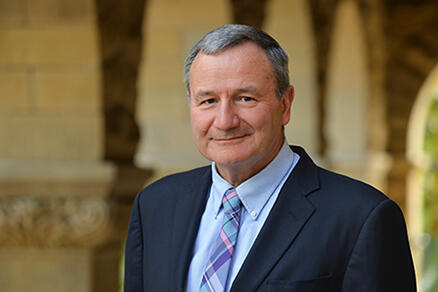
This keynote event is part of the 11th annual Koret Workshop, "North Korea and the World in Flux," and open to the general public with registration.
The event is made possible through the generous support of the Koret Foundation.
Oksenberg Conference Room
Encina Hall, 3rd floor
616 Serra Mall, Stanford University
General Vincent Brooks
<i>former Commander of U.S. Forces Korea</i>
Moderated by Ambassador Karl Eikenberry
Seminars
Winners announced for the Fall 2018 Stanford e-Japan Award
News Type
News
Date
Paragraphs
Stanford e-Japan is an online course that teaches Japanese high school students about American society and culture and U.S.–Japan relations. The course introduces students to both American and Japanese perspectives on many historical and contemporary issues. It is offered biannually by the Stanford Program on International and Cross-Cultural Education (SPICE). The Fall 2018 cohort was the seventh group of students to complete Stanford e-Japan.
In August 2019, three of the top students of the Fall 2018 Stanford e-Japan distance-learning course will be honored at an event at Stanford University. The three Stanford e-Japan Day honorees—Sakura Hayakawa (Katoh Gakuen Gyoshu Senior High School), Ryotaro Homma (Kaisei Senior High School), and Taiki Yamamoto (Ritsumeikan Uji Senior High School)—will be recognized for their coursework and exceptional research essays that focused respectively on “Importance of Youth Political Participation and Citizenship Education,” “The Abolition of the Electoral College: A Synthesis of the Positive Aspects,” and “The U.S.-Japan Alliance: Is a New Framework Necessary?”
Mayu Fujinami (Keio Girls Senior High School) and Tatsuya Sugiyama (Saitama Prefectural Urawa High School) received Honorable Mentions for their research papers on “The Importance of Paternity Leave for Gender Equality” and “Design Thinking: Lessons from the U.S.,” respectively.
Applications for the next session of Stanford e-Japan (Spring 2019) are currently being accepted through February 24, 2019. More information is available at stanfordejapan.org.
To stay informed of SPICE news, join our email list or follow us on Facebook and Twitter.
SPICE offers separate courses for U.S. high school students. For more information, please see the Reischauer Scholars Program (online course about Japan), Sejong Scholars Program (online course about Korea), or China Scholars Program (online course about China).
Related articles:
Hero Image

All News button
1
Global Populisms and their International Diffusion (2-day conference)
-
Open to Stanford faculty, students, staff and visting scholars.
This conference aims to examine the international aspects of the rise of populism across the globe: the role of international alliances, disinformation and propaganda campaigns, and the use of hacking, international institutions, and ideology as ways of building the new "illiberal international."
For more information, please visit the Conference Website.
RSVP required by email to sj1874@stanford.edu. Please specify which date(s) you plan to attend.
Conference Poster
Download pdf
Conference Program
Download pdf
Seawell Family Boardroom
Bass Center
Knight Management Center (Graduate School of Business)
Anna Grzymała-Busse
Encina Hall
616 Jane Stanford Way
Stanford, CA 94305
0
amgbusse@stanford.edu
Senior Fellow at the Freeman Spogli Institute for International Studies
Michelle and Kevin Douglas Professor of International Studies
Professor of Political Science
Senior Fellow, Hoover Institution
Anna Grzymała-Busse is a professor in the Department of Political Science, the Michelle and Kevin Douglas Professor of International Studies, senior fellow at the Freeman Spogli Institute for International Studies and the director of The Europe Center. Her research interests include political parties, state development and transformation, informal political institutions, religion and politics, and post-communist politics.
In her first book, Redeeming the Communist Past, she examined the paradox of the communist successor parties in East Central Europe: incompetent as authoritarian rulers of the communist party-state, several then succeeded as democratic competitors after the collapse of these communist regimes in 1989.
Rebuilding Leviathan, her second book project, investigated the role of political parties and party competition in the reconstruction of the post-communist state. Unless checked by a robust competition, democratic governing parties simultaneously rebuilt the state and ensured their own survival by building in enormous discretion into new state institutions.
Anna's third book, Nations Under God, examines why some churches have been able to wield enormous policy influence. Others have failed to do so, even in very religious countries. Where religious and national identities have historically fused, churches gained great moral authority, and subsequently covert and direct access to state institutions. It was this institutional access, rather than either partisan coalitions or electoral mobilization, that allowed some churches to become so powerful.
Anna's most recent book, Sacred Foundations: The Religious and Medieval Roots of the European State argues that the medieval church was a fundamental force in European state formation.
Other areas of interest include informal institutions, the impact of European Union membership on politics in newer member countries, and the role of temporality and causal mechanisms in social science explanations.
Global Populisms
A new project examining the global surge in populist movements and what it means for established democratic rules and institutions.
Read More
Director of The Europe Center
Hide publication sections
Off
Michael A. McFaul
Encina Hall
616 Jane Stanford Way
Stanford, CA 94305-6055
0
Senior Fellow, Freeman Spogli Institute for International Studies
Ken Olivier and Angela Nomellini Professor of International Studies, Department of Political Science
Peter and Helen Bing Senior Fellow, Hoover Institution
Michael McFaul is the Ken Olivier and Angela Nomellini Professor of International Studies in Political Science, Senior Fellow at the Freeman Spogli Institute for International Studies, and the Peter and Helen Bing Senior Fellow at the Hoover Institution, all at Stanford University. He joined the Stanford faculty in 1995 and served as FSI Director from 2015 to 2025. He is also an international affairs analyst for MSNOW.
McFaul served for five years in the Obama administration, first as Special Assistant to the President and Senior Director for Russian and Eurasian Affairs at the National Security Council at the White House (2009-2012), and then as U.S. Ambassador to the Russian Federation (2012-2014).
McFaul has authored ten books and edited several others, including, most recently, Autocrats vs. Democrats: China, Russia, America, and the New Global Disorder, as well as From Cold War to Hot Peace: An American Ambassador in Putin’s Russia, (a New York Times bestseller) Advancing Democracy Abroad: Why We Should, How We Can; and Russia’s Unfinished Revolution: Political Change from Gorbachev to Putin.
He is a recipient of numerous awards, including an honorary PhD from Montana State University; the Order for Merits to Lithuania from President Gitanas Nausea of Lithuania; Order of Merit of Third Degree from President Volodymyr Zelenskyy of Ukraine, and the Dean’s Award for Distinguished Teaching at Stanford University. In 2015, he was the Distinguished Mingde Faculty Fellow at the Stanford Center at Peking University.
McFaul was born and raised in Montana. He received his B.A. in International Relations and Slavic Languages and his M.A. in Soviet and East European Studies from Stanford University in 1986. As a Rhodes Scholar, he completed his D. Phil. in International Relations at Oxford University in 1991.
International Working Group on Russian Sanctions
The International Working Group on Russian Sanctions aims to provide expertise and experience to governments and companies around the world by assisting with the formulation of sanctions proposals that will increase the cost to Russia of invading Ukraine, and support democratic Ukraine in the defense of its territorial integrity and national sovereignty.
Read more
Global Populisms
A new project examining the global surge in populist movements and what it means for established democratic rules and institutions.
Read More
CV
Document
mcfaul-cv-1-25-2026.pdf
(473.05 KB)
Hide publication sections
Off
Francis Fukuyama
Encina Hall, C148
616 Jane Stanford Way
Stanford, CA 94305
0
f.fukuyama@stanford.edu
Olivier Nomellini Senior Fellow at the Freeman Spogli Institute for International Studies
Director of the Ford Dorsey Master's in International Policy
Research Affiliate at The Europe Center
Professor by Courtesy, Department of Political Science
Francis Fukuyama is the Olivier Nomellini Senior Fellow at Stanford University's Freeman Spogli Institute for International Studies (FSI), and a faculty member of FSI's Center on Democracy, Development and the Rule of Law (CDDRL). He is also Director of Stanford's Ford Dorsey Master's in International Policy, and a professor (by courtesy) of Political Science.
Dr. Fukuyama has written widely on issues in development and international politics. His 1992 book, The End of History and the Last Man, has appeared in over twenty foreign editions. His book In the Realm of the Last Man: A Memoir will be published in fall 2026.
Francis Fukuyama received his B.A. from Cornell University in classics, and his Ph.D. from Harvard in Political Science. He was a member of the Political Science Department of the RAND Corporation, and of the Policy Planning Staff of the US Department of State. From 1996-2000 he was Omer L. and Nancy Hirst Professor of Public Policy at the School of Public Policy at George Mason University, and from 2001-2010 he was Bernard L. Schwartz Professor of International Political Economy at the Paul H. Nitze School of Advanced International Studies, Johns Hopkins University. He served as a member of the President’s Council on Bioethics from 2001-2004. He is editor-in-chief of American Purpose, an online journal.
Dr. Fukuyama holds honorary doctorates from Connecticut College, Doane College, Doshisha University (Japan), Kansai University (Japan), Aarhus University (Denmark), the Pardee Rand Graduate School, and Adam Mickiewicz University (Poland). He is a non-resident fellow at the Carnegie Endowment for International Peace. He is a member of the Board of Trustees of the Rand Corporation, the Board of Trustees of Freedom House, and the Board of the Volcker Alliance. He is a fellow of the National Academy for Public Administration, a member of the American Political Science Association, and of the Council on Foreign Relations. He is married to Laura Holmgren and has three children.
(October 2025)
Global Populisms
A new project examining the global surge in populist movements and what it means for established democratic rules and institutions.
Read More
CV
Document
francis_fukuyama_cv_april_2024.pdf
(223.42 KB)
Hide publication sections
Off
Conferences
Holger Nehring
0
holger.nehring@stir.ac.uk
Visiting Scholar at The Europe Center, 2018-2019
Holger Nehring is Professor of Contemporary European History at the University of Stirling in Scotland, where he also directs the research program on human security, conflict and co-operation. He did his DPhil at Oxford University as a Rhodes Scholar on the history of peace movements in the Cold War and then worked at Oxford and Sheffield Universities before taking up the position at Stirling. While at Stanford, he is working on a new project on NATO infrastructure and the Cold War in Europe as well as on issues related to the history of nuclear-weapons proliferation.
Rediscovering Internationalism? Japan and the Liberal International Order in the Heisei Era and Beyond
-
The event is jointly sponsored by the Japan Program at the Shorenstein Asia-Pacific Research Center and the Japan Foundation Center for Global Partnership.
The Heisei era started in 1989, with high hopes for Japan to contribute to the international order. As the Heisei era draws to an end, Japan is once again expected to “step up” with increased urgency, given the current US administration’s withdrawal from, and challenge to the international order. In this talk, I will first look back at the thirty years of Heisei, and discuss why Japan did not take the “internationalist” path in a way that some had expected. Looking forward, I discuss how the domestic institutional changes, together with the geopolitical challenges in Asia, have prompted Japan to seek active leadership in the region and beyond. I will elaborate on the evolution of the “Free and Open Indo-Pacific Vision,” with focus on how exactly Japan seeks to achieve “free and open” in the region, and challenges and limitations going forward.
Takako Hikotani is Gerald L. Curtis Associate Professor of Modern Japanese Politics and Foreign Policy. She previously taught at the National Defense Academy of Japan, where she was Associate Professor, and lectured at the Ground Self Defense Force and Air Self Defense Force Staff Colleges, and the National Institute for Defense Studies. Her research focus on civil-military relations and Japanese domestic politics, Japanese foreign policy, and comparative civil-military relations. Her publications (in English) include, “The Japanese Diet and defense policy-making.” International Affairs, 94:1, July, 2018; “Trump’s Gift to Japan: Time for Tokyo to Invest in the Liberal Order,” Foreign Affairs, September/October 2017; and “Japan’s New Executive Leadership: How Electoral Rules "Japan’s New Executive Leadership: How Electoral Rules Make Japanese Security Policy" (with Margarita Estevez-Abe and Toshio Nagahisa), in Frances Rosenbluth and Masaru Kohno eds, Japan in the World (Yale University Press, 2009). She was a Visiting Professional Specialist at Princeton University as Social Science Research Council/Abe Fellow (2010-2011) and Fellow of the US-Japan Leadership Program, US-Japan Foundation (2000- ). Professor Hikotani received her BA from Keio University, MAs from Keio University and Stanford University, and PhD in Political Science from Columbia University, where she was a President’s Fellow.Image

Takako Hikotani
Associate Professor, Modern Japanese Politics and Foreign Policy, Columbia University
Seminars
Honoring Stanford e-Tottori students
News Type
News
Date
Paragraphs
Stanford e-Tottori is a distance-learning course sponsored by the Tottori Prefectural Board of Education and the Stanford Program on International and Cross-Cultural Education (SPICE), Freeman Spogli Institute for International Studies at Stanford University. Tottori Governor Shinji Hirai and Superintendent Hitoshi Yamamoto of the Tottori Prefectural Board of Education were instrumental in its establishment. Offered for the first time in 2016, Stanford e-Tottori presents a creative and innovative approach to teaching Japanese high school students about U.S. society and culture.
 Hana Hirosaka of Tottori Higashi High School with SPICE Director Gary Mukai
Stanford e-Tottori instructor Jonas Edman recently recognized three of his top performing students for their exceptional coursework. They are James Banville (Tottori Keiai High School; Principal Shigeo Nikaido), Hana Hirosaka (Tottori Higashi High School; Principal Masato Omuro), and Kosei Kamada (Tottori Nishi High School; Principal Eiju Yamamoto). Since the launching of Stanford e-Tottori, Edman has encouraged his students to think in an internationally minded manner—that is, to consider different points of view and to realize the importance of diversity and cross-cultural communication. Reflecting upon his former students over the first two years of Stanford e-Tottori, Edman noted that “James, Hana, and Kosei were always open-minded to various points of view and demonstrated strong critical thinking skills… and I was also impressed with their regular attendance in class despite their extremely busy schedules. I am so proud of all of the Tottori students’ accomplishments, but those of James, Hana, and Kosei especially stood out.”
 James Banville with Principal Shigeo Nikaido of Tottori Keiai High School
Each of the honorees received a plaque from SPICE/Stanford University, and Edman expressed his hope that this honor would help them with university admissions as well as inspire them to someday study in the United States. As part of the admissions process to Waseda University, Banville spoke about what he learned in Stanford e-Tottori during an interview. He was admitted to Waseda and will begin his freshman year this spring. Hirosaki and Kamada are now in the midst of the university application process and they, too, plan to showcase their participation in Stanford e-Tottori.
Takuya Fukushima, Office Director of the English Education Advancement Office of the High School Division at the Tottori Prefectural Board of Education, expressed his profound gratitude to Edman and feels that these honors have made Stanford e-Tottori more visible in Tottori Prefecture. “With wonderful guidance and skilled facilitation, Edman-sensei has done a great job to foster the students’ interest and participation in discussions… the students’ positive attitude and willingness to participate in lessons was something that I had been long waiting for. It was the moment when I could feel, ‘Oh, Stanford e-Tottori rose one step higher.’”
To stay informed of SPICE news, join our email list or follow us on Facebook and Twitter.
Related articles:
Hero Image

All News button
1
Abenomics in the 7th Year: Has it Worked?
-
The event is sponsored by the Japan Society for Promotion of Science and
the Japan Foundation Center for Global Partnership.
 Japanese Prime Minister Shinzo Abe speaks at Stanford about innovation in Japan and Silicon Valley. He was also joined on stage by Stanford President John Hennessy and George Shultz, the former U.S. Secretary of State and a distinguished fellow at the Hoover Institution (below).
This panel features four experts who have been closely watching Abenomics’s impacts on the Japanese economy. They evaluate what Abenomics has accomplished so far in various areas.
Panelists:
Joshua Hausman, Assistant Professor of Public Policy; Assistant Professor of Economics, University of Michigan
Takatoshi Ito, Professor of International and Public Affairs, Columbia University
Nobuko Nagase, Professor of Labor Economics and Social Policy, Ochanomizu University, Japan
Steven Vogel, Professor of Asian Studies; Professor of Political Science; Chair of the Political Economy Program, University of California, Berkeley
Takeo Hoshi (moderator), Director of the Japan Program at the Shorenstein Asia Pacific Research Center, Stanford University
Koret-Taube Conference Center
Gunn-SIEPR Building
366 Galvez Street, Stanford University
Panel Discussions
Against Identity Politics
News Type
Commentary
Date
Paragraphs
Francis Fukuyama explains to Foreign Affairs that identity politics are the "New Tribalism and the Crisis of Democracy." Read it here.
Hero Image

All News button
1