Society

FSI researchers work to understand continuity and change in societies as they confront their problems and opportunities. This includes the implications of migration and human trafficking. What happens to a society when young girls exit the sex trade? How do groups moving between locations impact societies, economies, self-identity and citizenship? What are the ethnic challenges faced by an increasingly diverse European Union? From a policy perspective, scholars also work to investigate the consequences of security-related measures for society and its values.

The Europe Center reflects much of FSI’s agenda of investigating societies, serving as a forum for experts to research the cultures, religions and people of Europe. The Center sponsors several seminars and lectures, as well as visiting scholars.

Societal research also addresses issues of demography and aging, such as the social and economic challenges of providing health care for an aging population. How do older adults make decisions, and what societal tools need to be in place to ensure the resulting decisions are well-informed? FSI regularly brings in international scholars to look at these issues. They discuss how adults care for their older parents in rural China as well as the economic aspects of aging populations in China and India.

Authors
Josh Cheng
News Type
News
Date
Paragraphs

According to a local report there are more than 600,000 students from China currently studying in the US and millions of Chinese families are planning to send their kids to pursue their education in North America.

However, the deterioration of Sino US relations in recent years, combined with uncertainties from the pandemic around the globe had had a profound impact on those students who are already studying in the US and parents who are preparing to send their kids to study in America.

Stanford Center at Peking University, along of other peer institutions in China, had been approached by various groups seeking perspectives and insights on critical issues: Is it still safe and sound to send kids to study in America? Are there indications that US universities and schools are closing their doors to Chinese students?  Should parents and students start to seek other options, perhaps study in the UK or other countries?

In response to such concerns and with a desire to serve local communities, a round table panel discussion was held at the Yale Center of China in Beijing on Dec 26, 2020.   Stanford’s Executive Director, Josh Cheng, was among the nine directors of American education institutions with Centers in China who participated in the discussion.  Others (shown in the photo) participating in person were Yale, Chicago, Cornell, Notre Dame, and Columbia.  Representatives from Harvard, Wharton and Princeton participated virtually.

The directors shared with their personal experiences as well as institutional practices to directly address many concerns expressed by Chinese parents and students.  They believe US universities and schools will continue to welcome Chinese students, both in undergraduate and post graduate programs.  Having international students is an inseparable part of the global extension effort by almost every American educational institution. 

Stanford University just issued a statement in support of Stanford's international students and scholars, explicitly including those from China.

https://news.stanford.edu/today/2021/02/08/statement-president-marc-tessier-lavigne-support-stanfords-international-students-scholars/

Josh Cheng shared his perspectives on the safety and security concerns with Chinese parents. Using practices at Stanford, and other American universities, Mr. Cheng reiterated that American universities always make the safety and security of its students, staffs and faculties top priority.

The panel discussion was well attended, and it was agreed that if the pandemic policy of limiting visitors by PKU is lifted in near future, the Stanford Center at Peking University could serve as next host of the continuing discussion on US China Education.

Image
group photo


Hero Image
Josh
All News button
1
Subtitle

On December 26th, a group of American university center directors gathered at the Yale Beijing Center to discuss the future of international higher education in China. Josh Cheng, SCPKU Executive Director, introduced Stanford’s efforts to support students, no matter what nationality or race, continuing their study and research during this turbulent year.

-

REGISTER HERE


The United States has historically played an important role in promoting democracy to countries across the globe. But is the role of the U.S. as a leading advocate for democracy now diminished following the recent U.S. election and mob attack on the U.S. Capitol? 

The panel for this event will feature democracy activists from around the world, all of whom are graduates of the Draper Hills Program at the Center for Democracy, Development and the Rule of Law (CDDRL). In a discussion moderated by Professor Francis Fukuyama, they will offer their perspectives on the need for democracy promotion in their home countries at the current moment, particularly what role the new Biden administration could constructively play. Professor Michael McFaul’s recent series of articles [https://www.americanpurpose.com/articles/sell-it-again-uncle-sam/] in American Purpose, an online magazine recently launched by Professor Fukuyama, about the need for democracy promotion, will be the starting point for the discussion. Professor McFaul will offer introductory remarks.

PANELISTS:


Image
Moussa Kondo
Kondo Moussa, Class of 2018, Mali - Director Accountability Lab Mali . Kondo founded and runs the Mali chapter of the Accountability Lab, a U.S.-based nonprofit that promotes public accountability in six African and Asian countries. Rather than condemning corrupt leaders, it works to boost the influence of their honest counterparts, running grassroots “Integrity Idol” campaigns to celebrate their good work. Communities nominate local civil servants, and the Lab then profiles the top five on TV. The movement reaches a broader audience, as viewers across the country vote for their favorite candidates. It also runs in-country incubators to train and mentor “accountrapreneurs” who launch their own accountability projects. Kondo, a journalist, started Mali’s Lab after spending six months embedded with Liberia’s team during his 2015 Mandela Washington Fellowship. While Accountability Lab is not new, Kondo has successfully adapted it to a new and challenging context.


Image
Sahili Chopra
Shaili Chopra, Class of 2019, India - An Indian journalist turned entrepreneur whose work is focused on championing real women and their stories across India. Chopra is the founder of SheThePeople.TV, which is India's only women's channel. SheThePeople.TV is a form of digital democracy where women get to choose, speak up, and set the agenda. Chopra uses the internet to spotlight issues of women's rights, their role in a democracy, and empower them in a digitally connected world. Chopra is the recipient of India's highest honor in journalism and counted among the top 50 most influential women in media in India and is a Vital Voices fellow. She holds a BA in Economics from Delhi University and a Masters diploma in Journalism from the Asian College of Journalism in Chennai.  


Image
Mohamad Najem

Mohamad Najem, Class of 2019, Lebanon - Mohamad is the executive director of the Beirut–based digital rights organization Social Media Exchange (SMEX), the Middle East and North Africa’s leading digital rights research and policy advocacy organization. His work includes local and regional advocacy campaigns, research on privacy, data protection, and freedom of expression. Najem organized “Bread & Net”, the first unconference in the Middle East and North Africa region that tackled topics related to technology and human rights. Najem’s career began in the humanitarian aid arena. Najem was a 2014 New America Foundation Fellow and an alumnus of the Arts, Sciences, and Technology University in Lebanon where he completed his Masters in Business Administration. 


Anna Dobrovolskaya

Anna Dobrovolskaya Class of 2019, Russia – is a human rights activist based in Moscow, serving as the executive director of the Memorial Human Rights Center (MHRC). The Center is the biggest Russian human rights NGO, working to provide legal aid and consultation for refugees and asylum seekers, monitoring human rights violations in post-conflict zones and advocating for a human-rights based approach in fighting terrorism; as well as raising awareness about politically-motivated repression in Russia and maintains its own list of political prisoners. Dobrovolskaya’s areas of expertise include human rights education and awareness-raising activities and programs for young people and activists since 2008. She is a member of the Council of Europe pool of trainers. Her work currently lies in NGO management and providing consultancy to various human rights groups and initiatives. Anna was the author of the first Russian play about the life of human rights defenders, which is being performed in Teatr.doc since 2017.


This event is co-sponsored by the Freeman Spogli Institute for International Studies and the Center for Democracy, Development and the Rule of Law.

Authors
Donald K. Emmerson
News Type
Commentary
Date
Paragraphs

This op-ed by Donald K. Emmerson first appeared in The Jakarta Post.

Above all, Trump wanted to be a winner. History granted his wish. He is the first president in the 245-year life of his country to have been impeached twice. By that standard, he won the title of America’s Worst President (AWP)—worse than any of the 44 presidents who preceded him.

AWP rhymes with 'gawp,' and that’s what he also wanted: to be stared at, talked about, catered to, the center of fawning attention, unforgettably present, dominating the news, astride the world in which the news is made. He wanted applause. His ravenous insecurity—narcissism—inflated his ego to continental size. In effect, in his authoritarian imagination, the “extremely stable genius” that he called himself deserved to be the indispensable “me” in “America,” without which the country’s name and the country itself would crumble.

The roars and chants of Trump’s crowds slaked his thirst for veneration. But they imprisoned him in his “base.” By satisfying his craving to be idolized, they gave him no reason to convince the unimpressed. How much more gratifying it must have been for him to bask in mass flattery at rallies than to engage in the difficult business of persuading the uncommitted. That would have taken assets he lacked: empathy, knowledge, intelligence, and a willingness not to lie.

[Subscribe to APARC's newsletters to get regular updates on our scholars.]

So how could Americans have elected such a demagogue? Trump was corrupt but charismatic. He broke the rules. He said whatever was on his mind. He appealed to the streak of individualism in American culture. He ran his campaign and his presidency as a mass entertainment featuring a lone patriot fighting a “deep state” controlled by globalist elites. Especially in rural areas between Silicon Valley and the Boston-to-Washington corridor, millions of white Americans felt threatened by the transfer of jobs from physical toward mental labor in a computerized society whose racial make-up was increasingly non-white. Globalization fed those anxieties. Trump stoked them. He promised to end them and “make America great again.”

Joe Biden defeated Trump in both the popular vote and the Electoral College—respectively by 4.4 and 13.7 percent. Biden’s margins were narrower than one might have wished, given the blatant flaws in Trump’s character, including the 30,573 false or misleading claims that he made during his presidency as tracked and noted by The Washington Post . The egregiousness of his behavior is, however, a double testament to America’s democratic system: to its failure to select a less despicable leader, yes, but also to its success in providing the lawful framework within which his desperate effort to stage what in Latin America would be called an autogolpe or “self-coup” could be and was overcome.

On 1 February 2021, watching television at his 126-room estate in Palm Beach, Florida, ex-president Trump would have learned of the coup in Myanmar and might have envied Senior General Min Aung Hlaing. Both men had been banned by Facebook for inciting violence in their respective countries—Trump in 2021, the general in 2018. Both had suffered defeats in elections held just five days apart in 2020—3 November in the US, 8 November in Myanmar. Both had rejected the voters’ verdict, claiming fraud. But whereas Trump’s frantic and deadly effort to subvert the US election and retain power failed, Min Aung Hlaing’s self-coup has succeeded, at least for now. The general quickly seized full power despite his party’s massive embarrassment at the polls in November, Aung San Suu Kyi’s party having won 83 percent of the available seats. In contrast, Trump could not reverse his exit from power despite a far slimmer margin of electoral defeat. To the extent that the ex-president was even aware of the difference, it could have fanned what angry envy of the general he may have felt.

Trump failed mainly due to the checks and balances that generally call government to account in America. Min Aung Hlaing succeeded in no small part thanks to the checks and balances in the bank accounts of the generals who have compromised Myanmar’s transition to democracy and helped make it the second most corrupted country in Southeast Asia (after Cambodia) as measured by the Corruption Perceptions Index.

Among the many reactions to the Burmese coup, several stand out for their courage and creativity. UN Secretary General António Guterres was unequivocal. "It's absolutely unacceptable,” he said, “to reverse the result of the elections and the will of the people.” Presumably speaking on behalf of the UN, its secretariat, or himself, or all three, he went further: "We'll do everything we can to mobilize all the key actors of the international community to put enough pressure on Myanmar to make sure that this coup fails." 

This notable response came from Indonesia’s former foreign minister Marty Natalegawa: “Deafening silence in the face of assaults against democratic principles [has] increasingly become the norm,” he said. He urged ASEAN to “demonstrate its relevance: It must speak urgently for the respect of constitutional process and rule of law in Myanmar, and call for the immediate release of those unlawfully detained.”

In the days immediately following the coup, ASEAN’s Bruneian secretary general said nothing about it, preferring to remain, in the Indonesian expression, “silent in a thousand tongues.” Speaking for ASEAN as its current chair, however, Brunei’s government did at least encourage a “return to normalcy in accordance with the will and interests of the people of Myanmar,” noting that the group charter’s called for adherence to “democracy, the rule of law” and “human rights and fundamental freedoms.”

As for ASEAN’s next chair, Cambodia, its strongman Hun Sen did speak, but only to say that "Cambodia does not comment on the internal affairs of any country at all.” Hun Sen’s restraint made historical sense. Had Cambodia’s old despot chosen to criticize Myanmar’s new despot, observers could have noted that Min Aung Hlaing had only done what Hun Sen himself had bloodily accomplished in 1997 by seizing full control over Cambodia in a self-coup of his own that had enabled him to become the longest-serving prime minister in the world.

Critical Southeast Asian voices, unconstrained by look-the-other-way diplomacy, have been heard. The chairman of the ASEAN Parliamentarians for Human Rights, Charles Santiago, has urged ASEAN to send a high-level delegation to Myanmar to tell Min Aung Hlaing that his coup “violates ASEAN principles and the ASEAN charter” and is “not acceptable.” “If Myanmar does not turn around,” he added, “there should be proceedings to expel Myanmar out of ASEAN.”

Who is better positioned to deal with this crisis than ASEAN’s largest and debatably least authoritarian member country? It was Indonesia’s Natalegawa who patched up ASEAN’s consensus after Hun Sen damaged it on China’s behalf in 2012. And it is Natalagewa who believes, with the Myanmar coup in mind, that “at this critical juncture for the region, Indonesia must demonstrate its leadership within ASEAN.”

Indonesia’s president Jokowi, rather than trying to rally the region against the coup, will likely continue to focus on domestic economic growth. Not to mention the existential priority that COVID-19 also warrants on his agenda.

So why not task Natalegawa with a damage-control trip around the region comparable the one he took with some success in 2012? He could start with fact-finding in Myanmar. He could then explore an intra-ASEAN understanding that would reassert the core democratic values in the ASEAN Charter while lessening, if possible, the chance that Myanmar will revert to entrenched and fully authoritarian rule. That may be a lost cause. But nothing ventured, nothing gained.

Although Donald Trump is no longer in office, America is still not safe from Trumpism. But America’s system—democracy—is working as it should. Is ASEAN really a dictators’ club? Or does it, too, when threatened from within, have a system that can at least manage and minimize the damage that is, in Myanmar as I write this, being done?

Read More

Protesters opposing the February 1 coup in Myanmar
Q&As

The Myanmar Coup Is a Major Setback, but the Story of Myanmar's Struggle for Democracy Is Not Over

According to Scot Marciel, former U.S. ambassador to Myanmar and Stanford visiting scholar at APARC, building a democracy is a difficult process that can be upended, particularly when the military is politicized and has its own agenda.
The Myanmar Coup Is a Major Setback, but the Story of Myanmar's Struggle for Democracy Is Not Over
President Biden walks past a row of Chinese and American flags.
News

APARC Experts on the Outlook for U.S.-Asia Policy Under the Biden Administration

Ahead of President-elect Biden’s inauguration and on the heels of the attack on the U.S. Capitol by a pro-Trump mob that has left America shaken, an APARC-wide expert panel provides a region-by-region analysis of what’s next for U.S. policy towards Asia and recommendations for the new administration.
APARC Experts on the Outlook for U.S.-Asia Policy Under the Biden Administration
Barack Obama addresses a crowd of young leaders from ASEAN nations.
Commentary

A Global Town Hall Welcomes America Back

Despite the reversals of the Trump era, a flurry of online diplomacy served as a reminder that the U.S. is welcome in Southeast Asia writes Donald K. Emmerson in The Diplomat.
A Global Town Hall Welcomes America Back
Hero Image
Protesters in Myanmar stand on a picture of General Min Aung Hlaing
Chung Sung-Jun, Getty Images
All News button
1
Subtitle

Southeast Asia Program Director Donald K. Emmerson compares responses across Southeast Asia to the February coup in Myanmar and reflects on the parallels and differences between the state of democracy there and in the United States.

-


4:00-5:00pm California, 18-February 2021
7:00-8:00pm Washington DC, 18-February 2021
3:00-4:00am  Kenya, 19-February 2021
11:00am-12:00pm Sydney, Australia 19-February 2021


The Bay of Bengal, while split by national boundaries and even our concepts of distinct South and Southeast Asian regions, is re-emerging as a connected geographic and demographic space. Some of Asia’s most consequential transnational policy challenges will be most starkly presented here, across the borders of India, Bangladesh, and Burma – and traditional policy-making structures are already struggling to cope with environmental disasters, the mass movement of people, and the yawning need for economic connectivity. This webinar will examine these policy challenges, from the fragility of the Sundarbans ecosystem to the transnational implications of the Burma coup, and whether existing state and multilateral institutions are capable of addressing them.

SPEAKERS:

Image
Kelley Eckels Currie
Kelley Eckels Currie served as U.S. Ambassador-at-Large for Global Women’s Issues and the U.S. Representative at the United Nations Commission on the Status of Women.  Prior to her appointment, she led the Department of State’s Office of Global Criminal Justice (2019) and served under Ambassador Nikki Haley as the United States’ Representative to the UN Economic and Social Council and Alternative Representative to the UN General Assembly (2017-2018).  Throughout her career, Ambassador Currie has specialized in human rights, political reform, development and humanitarian issues, with a focus on the Asia-Pacific region. She has held senior policy positions with the Department of State, the U.S. Congress, the Project 2049 Institute, and several international and non-governmental human rights and humanitarian organizations.  Ambassador Currie holds a Juris Doctor from Georgetown University Law Center.

Image
Tanaya D Gupta
Tanaya Dutta Gupta is a PhD Candidate in Sociology at the University of California, Davis. Tanaya’s dissertation research focuses on climate change, (im)mobilities and borders in the Bengal delta region of Bangladesh and India. Her educational background includes MA in Sociology and Geography. As visiting researcher with the International Centre for Climate Change and Development and collaborator with the Observer Research Foundation, Tanaya participates in policy conversations through her research. Her research has been funded by the National Geographic Society and UC Davis Graduate Program Fellowships. 

Image
Constantin Xavier
Constantino Xavier is a Fellow in Foreign Policy and Security Studies at the Centre for Social and Economic Progress, in New Delhi, where he leads the Sambandh Initiative on regional connectivity. He is also a non-resident fellow in the Foreign Policy program at the Brookings Institution. His research and publications focus on India’s changing role as a regional power, and the challenges of security, connectivity and democracy across South Asia and the Indian Ocean. Dr. Xavier regularly lectures at various Indian, European and American universities, as well as at civilian and military training institutions in India. He holds a Ph.D. in South Asian studies from the Johns Hopkins University, School of Advanced International Studies, and an M.A. and M.Phil. from Jawaharlal Nehru University.  

MODERATOR:

Image
Arzan Tarapore
Arzan Tarapore is the South Asia research scholar at the Shorenstein Asia-Pacific Research Center at Stanford University, where he leads the newly-restarted South Asia research initiative. He is also a senior nonresident fellow at the National Bureau of Asian Research. His research focuses on Indian military strategy and contemporary Indo-Pacific security issues. He previously held research positions at the RAND Corporation, the Observer Research Foundation, and the East-West Center in Washington. Prior to his scholarly career, he served as an analyst in the Australian Defence Department, which included operational deployments as well as a diplomatic posting to Washington, DC. Arzan holds a PhD in war studies from King’s College London.


This event is co-sponsored by: Center for South Asia 


This is a virtual event via Zoom.  Please  Register at: https://bit.ly/3txBBVq
Kelley Eckels Currie former Ambassador-at-Large for Global Women's Issues
Tanaya Dutta Gupta University of California, Davis
Constantino Xavier Centre for Social and Economic Progress- New Delhi
Seminars
News Type
News
Date
Paragraphs

The past few months have been the strangest time. It was additionally peculiar for me in that, since I was learning remotely in China, most of my classes took place from midnight to morning. Sitting in front of my laptop each night while the world slumbered around me was difficult. But I also remember the way, from time to time, glimmers of conversations on zoom would absorb me entirely and make me forget I was alone and in the dark. Having met those wonderful people saved me from the coldness of seclusion, and made my quarter so much better:’) 

-2024, ALICE

I thought online college would be a disaster, but luckily, I was wrong. The teaching teams made lots of efforts to accommodate to the challenges in online instruction, so the learning experience was still of great quality despite being a different format. Moreover, the communities are amazing! My classmates and the student orgs I joined, especially the Gaieties team, always made my day in the past quarter. Can't wait to continue my journey at Stanford! 

-2024, SHAWN

This was definitely not how I expected college to start. The empty abyss of those Zoom squares with cameras off, those awkward moments of silence in breakout rooms, those bookmarked school events I didn’t attend: all things that made up my first quarter in college scream “human_interaction == 0”. Added on to my FOMO was the decreasing motivation to talk to people online. Therefore, when I went to Beijing to see my friends for the first time, I felt relieved. “They went through the same struggles I did.” I thought, “I’m with them.” There is a silver lining after all. 

-2024 RACHEL

I always thought that waking up at 5:00am would be the biggest challenge of online learning. But that becomes trivial when I face the real challenge --- lack of partnership. I remember the many hours stuck on a coding problem, alone; the many days spent looking for online studying buddies who could match my time zone; the many weeks of struggle to keep myself energized by my sheer curiosity of knowledge. It is at the freshman in-person gathering in Beijing that I truly feel my draining energy become to restore by the laughter, compassion, and wittiness of my classmates. It is people who makes Stanford attractive. 

-2024 DAVID


Image
Group Pic

Hero Image
Group 1
All News button
1
Subtitle

On behalf of Stanford Center at Peking University, a year-end holiday gathering welcomed both undergrad and graduate students enrolled at Stanford. They had to spend their fall quarter in China due to the pandemic. Students reflected on their experiences and shared their stories about their quarter in China.

-

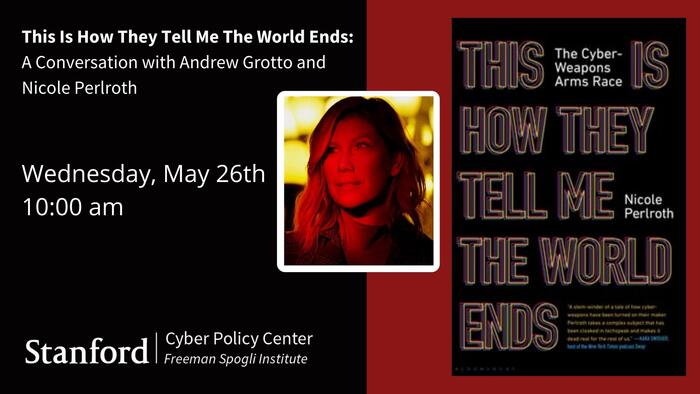
On January 27th, the Cyber Policy Center at Stanford hosted a webinar on the EU’s Digital Services Act and Digital Markets Act. The meeting was such a success that many participants asked for a follow up, allowing for more in depth conversations about the expected trajectory of these legislative proposals. On February 10th at 10 a.m. pacific, Daphne Keller, Joris van Hoboken en Guillermo Beltra will join the Cyber Policy Center for a follow up discussion. 

0
marietje.schaake

Marietje Schaake is a non-resident Fellow at Stanford’s Cyber Policy Center and at the Institute for Human-Centered AI. She is a columnist for the Financial Times and serves on a number of not-for-profit Boards as well as the UN's High Level Advisory Body on AI. Between 2009-2019 she served as a Member of European Parliament where she worked on trade-, foreign- and tech policy. She is the author of The Tech Coup.


Non-Resident Fellow, Cyber Policy Center
Fellow, Institute for Human-Centered Artificial Intelligence
Date Label
0
top_pick_rsd25_070_0254a.jpg

Daphne Keller is the Director of Platform Regulation at the Stanford Program in Law, Science, & Technology. Her academic, policy, and popular press writing focuses on platform regulation and Internet users'; rights in the U.S., EU, and around the world. Her recent work has focused on platform transparency, data collection for artificial intelligence, interoperability models, and “must-carry” obligations. She has testified before legislatures, courts, and regulatory bodies around the world on topics ranging from the practical realities of content moderation to copyright and data protection. She was previously Associate General Counsel for Google, where she had responsibility for the company’s web search products. She is a graduate of Yale Law School, Brown University, and Head Start.

SHORT PIECES


ACADEMIC PUBLICATIONS


POLICY PUBLICATIONS


FILINGS

  • U.S. Supreme Court amicus brief on behalf of Francis Fukuyama, NetChoice v. Moody (2024)
  • U.S. Supreme Court amicus brief with ACLU, Gonzalez v. Google (2023)
  • Comment to European Commission on data access under EU Digital Services Act
  • U.S. Senate testimony on platform transparency


PUBLICATIONS LIST

Director of Platform Regulation, Stanford Program in Law, Science & Technology (LST)
Social Science Research Scholar
Date Label
Guillermo Beltra
Joris van Hoboken
Seminars
Authors
News Type
Q&As
Date
Paragraphs

This article was originally written by Melissa De Witte on behalf of Stanford News.

As Monday’s coup in Myanmar demonstrates, democracy is often fragile and subject to setbacks, says former U.S. ambassador to Myanmar and Stanford visiting scholar, Scot Marciel.

Here, Marciel discusses how in a country like Myanmar (formerly Burma), which was under military rule from 1962 to 2011, establishing a democracy takes time. Despite democratic reforms over the past decade, the military in Myanmar has held onto a considerable amount of power, said Marciel, noting that it is difficult to build not only a representative parliament but other democratic institutions including an independent judicial system, a fair police force and a free press.

While Monday’s coup is a major setback in Myanmar’s fight for democracy, Marciel said that there are many people in the country who will do what they can to restore their elected government and build the foundations of democracy.

Marciel is a visiting scholar at the Walter H. Shorenstein Asia-Pacific Research Center (APARC), Stanford’s hub for interdisciplinary research, education and engagement on contemporary Asia that is run under the auspices of the Freeman Spogli Institute for International Studies. Marciel served as U.S. Ambassador to Myanmar from March 2016 through May 2020. From 2010 to 2013, Scot Marciel served as U.S. Ambassador to Indonesia.

[Subscribe to APARC's newsletters to get the latest updates from our scholars.]


What do people who have not spent extensive time studying or living in Myanmar need to know about its history to better understand Monday’s coup?

A couple of things. First, as historian Thant Myint-U has written, Myanmar is an unfinished nation, in the sense that the diverse communities that make up the country have never truly solidified as a unified nation. The country has been in near-constant conflict, mostly between the majority Bamar ethnic group and the many ethnic minority communities that inhabit much of Myanmar’s border areas. Second, the military staged a coup in 1962 and ran the country for nearly 50 years before allowing some movement toward representative democracy beginning in 2011-2012. So the military has long been a dominant force in the country, and – even after the reforms of the past decade – retained substantial power.

Is there anything that is often misunderstood about its history and its people?

In the West, many people have tended to view Myanmar mostly through the prism of a struggle for democracy between the military and the civilian opposition, led by Aung San Suu Kyi. That is a critically important part of the story, for sure. Perhaps equally important, however, has been the struggle of the many ethnic minority communities for equality, a degree of autonomy, and respect for their own histories, cultures and languages. This struggle has produced widespread conflict, significant human rights abuses, and large numbers of refugees and displaced people for decades.

What are some of the difficulties in establishing, and maintaining, democratic rule in a country like Myanmar?

First, persuading the military to give up power, depart from politics, and play a more appropriate role in the country. Second, it is very difficult to build the institutions of democracy, including not only parliament, but also a strong, independent judicial system, an effective and fair police force, and respect for the critical role of civil society and the independent media. In Myanmar, another essential aspect is to shift from historically centralized rule to a federal structure that would allow the various communities across the country to have more of a say in how they are governed.

As ambassador to Myanmar, what was it like working with not only the country’s policymakers but also its people? What did you learn from them about how democracy is established? And how did those experiences shape your perspective?

In Myanmar, I met so many people, all over the country, from many different walks of life, who had sacrificed and continued to sacrifice to try to build democracy and respect for human rights. Some operated at the national level, others at the local level. It was a good reminder that democracy isn’t just imposed from the top; it requires careful building at the community and state level, with intensive involvement by the various communities. It also takes time and, as we have seen this week, is often fragile and subject to setbacks. In other words, it is a long-term effort that requires persistence, courage, and participation by large numbers of people. Establishing a democracy is a lengthy, painstaking effort that can be upended, particularly if the armed forces are politicized and pursue their own agenda.

Is there anything else you would like to add? 

This week’s military takeover constitutes a major setback, but the story of Myanmar’s struggle for democracy is not over. Many people there will continue to do what they can to restore elected government and build, brick by brick, the foundations of democracy.

Read More

Portrait of Paul Schuler and the cover of his book, 'United Front'
Q&As

A Balance of Power: The Role of Vietnam’s Electoral and Legislative Institutions

As the 13th National Congress of Vietnam's Communist Party is selecting a new leadership team that will set the country’s course for the next five years, Vietnamese politics expert Paul Schuler discusses his new book on the state’s single-party legislature.
A Balance of Power: The Role of Vietnam’s Electoral and Legislative Institutions
President Biden walks past a row of Chinese and American flags.
News

APARC Experts on the Outlook for U.S.-Asia Policy Under the Biden Administration

Ahead of President-elect Biden’s inauguration and on the heels of the attack on the U.S. Capitol by a pro-Trump mob that has left America shaken, an APARC-wide expert panel provides a region-by-region analysis of what’s next for U.S. policy towards Asia and recommendations for the new administration.
APARC Experts on the Outlook for U.S.-Asia Policy Under the Biden Administration
Stanford campus, main quad with cloudy sky
News

APARC Offers Fellowship and Funding Opportunities to Support, Diversify Stanford Student Participation in Contemporary Asia Research

The Center has launched a suite of offerings including a predoctoral fellowship, a diversity grant, and research assistant internships to support Stanford students interested in the area of contemporary Asia.
APARC Offers Fellowship and Funding Opportunities to Support, Diversify Stanford Student Participation in Contemporary Asia Research
Hero Image
Protesters opposing the February 1 coup in Myanmar
People protest the February 1 coup in Myanmar outside the Myanmar embassy in Bangkok, Thailand.
Lauren DeCicca, Getty
All News button
1
Subtitle

According to Scot Marciel, former U.S. ambassador to Myanmar and Stanford visiting scholar at APARC, building a democracy is a difficult process that can be upended, particularly when the military is politicized and has its own agenda.

-

To watch the recording of the event, click here.

While many countries around the world have slipped toward authoritarianism, South Korea has won praise for exhibiting democratic resilience through “candlelight protests” and a presidential impeachment. But Korea's democracy has likewise begun to show signs of decay, as democratic norms and spirits have been violated under the guise of rule of law. Troublingly, this trend has been growing under the government led by former pro-democracy activists. In this panel, scholars of Korean democracy, including a former activist, will discuss whether concerns about Korea's democratic decline are warranted and whether Korean liberals are truly liberal.

Panelists:

Image
Byoungjin Ahn
Byongjin Ahn is a professor of American Studies at Kyung Hee University, where he was the rector of the Global Academy for Future Civilization. His main research area includes American presidency and its implications on Korean politics. He is currently writing a book on the rise and decline of Korean liberalism. He holds a Ph.D. from the New School for Social Research where he received Hannah Arendt Award for his doctoral dissertation, “Learning to Speak American: The Use of Values Appeals in the 1984 and 1996 Presidential Elections.” He has published several books in Korean, including The Roots of Crisis in Democracy and Conservatism after Democratization (pulbit press, 2008).

Image
Aram Hur
Aram Hur is an assistant professor of political science at the University of Missouri, where she also serves as Co-Director for the MU Institute for Korean Studies. Her research focuses on national politics and democracy, with particular focus on issues of national identity change, integration, and democratic support in East Asia. Her work is published in academic journals such as the British Journal of Political ScienceComparative Politics, and Journal of East Asian Studies, and has been cited in media outlets such as the New York Times, Washington Post, and Foreign Policy. She holds a Ph.D. from Princeton University, M.P.P. from the Harvard Kennedy School, and B.A. from Stanford University. 

Image
Gi-Wook Shin
The discussion will be led by Gi-Wook Shin, William J. Perry Professor of Contemporary Korea and director of Shorestein Asia-Pacific Research Center at Stanford University.

Via Zoom: Register at https://bit.ly/3aceTJM

Byong Jin Ahn <I>Kyung Hee University</i>
Aram Hur <I> University of Missouri</I>
Gi-Wook Shin <I>Stanford University</I>
Panel Discussions
-

A new administration and Congress provide a key opportunity to improve US cybersecurity and the governance of digital technologies. Yet the challenges appear daunting: viral disinformation, widespread privacy violations, algorithms biased by race, class and gender, ransomware running rampant, and unprecedented tech company scale and market dominance. Additionally, the US faces a persistent deficit in skilled cybersecurity workers, a lack of diversity in the field, and a public with wildly unequal broadband internet access.  Meanwhile, competition among governance regimes, specifically between the United States, Europe and China, has raised the stakes over whether democracies or authoritarian governments will set the rules for the internet. The policy choices made by the new administration will play a pivotal role in shaping our global future. On February 24 at 10am PST, join Kelly Born and Marietje Schaake of Stanford’s Cyber Policy Center, Michael Daniel of the Aspen Institute’s Cyber Group, and Karen Kornbluh for the German Marshall Fund to discuss cyber policy priorities for the new administration.


0
marietje.schaake

Marietje Schaake is a non-resident Fellow at Stanford’s Cyber Policy Center and at the Institute for Human-Centered AI. She is a columnist for the Financial Times and serves on a number of not-for-profit Boards as well as the UN's High Level Advisory Body on AI. Between 2009-2019 she served as a Member of European Parliament where she worked on trade-, foreign- and tech policy. She is the author of The Tech Coup.


Non-Resident Fellow, Cyber Policy Center
Fellow, Institute for Human-Centered Artificial Intelligence
Date Label
Karen Kornbluh
Michael Daniel
Seminars
Authors
Noa Ronkin
News Type
News
Date
Paragraphs

The Walter H. Shorenstein Asia-Pacific Research Center (APARC) has broadened its fellowship and funding opportunities to support Stanford students working in the area of contemporary Asia. The Center introduced these expanded offerings in response to the harsh impacts of the COVID-19 pandemic on student’s academic careers and their access to future jobs and valuable work experience, and in recognition of the critical need to make the field of Asian Studies more diverse and inclusive.

APARC’s diversity grant aims to encourage Stanford students from underrepresented minorities (URM) to engage in the study and research of topics related to contemporary Asia and U.S.-Asia relations, including economic, health, foreign policy, social, political, and security issues. The grant, which was first announced in June 2020, is now an ongoing offering. APARC will award a maximum of $10,000 per grant. Current  Stanford undergraduate and graduate students in the URM category from any major or discipline are eligible and encourage to apply.

APARC also invites Stanford Ph.D. candidates specializing in topics related to contemporary Asia to apply for its 2021-22 predoctoral fellowship. Up to three fellowships are available and the application deadline is May 1, 2021.

In addition, APARC continues to offer an expanded array of research assistant internships. The Center is currently seeking highly motivated Stanford undergraduate- and graduate-level students to join our team as paid research assistant interns for the spring and summer quarters of 2021. Applications for spring 2021 research assistant assignments are due on February 22, for summer 2021 assignments on March 8.

Read More

President Biden walks past a row of Chinese and American flags.
News

APARC Experts on the Outlook for U.S.-Asia Policy Under the Biden Administration

Ahead of President-elect Biden’s inauguration and on the heels of the attack on the U.S. Capitol by a pro-Trump mob that has left America shaken, an APARC-wide expert panel provides a region-by-region analysis of what’s next for U.S. policy towards Asia and recommendations for the new administration.
APARC Experts on the Outlook for U.S.-Asia Policy Under the Biden Administration
View of building roof in the Forbidden City complex and the Beijing skyline in the background
News

New Fellowship on China Policy Seeks to Strengthen U.S.-China Relations

Stanford University’s Shorenstein Asia-Pacific Center invites applications for the inaugural 2021-22 China Policy Fellowship from experts with research experience on issues vital to the U.S. China policy agenda and influence in the policymaking process.
New Fellowship on China Policy Seeks to Strengthen U.S.-China Relations
National Guard at the US Capitol
Commentary

The Soft War That America Is Losing

The US depends far more on its soft power than authoritarian China does. Once it is lost, it is hard to get back.
The Soft War That America Is Losing
Hero Image
Stanford campus, main quad with cloudy sky
All News button
1
Subtitle

The Center has launched a suite of offerings including a predoctoral fellowship, a diversity grant, and research assistant internships to support Stanford students interested in the area of contemporary Asia.

Subscribe to Society