
 FSI researchers work to understand continuity and change in societies as they confront their problems and opportunities. This includes the implications of migration and human trafficking. What happens to a society when young girls exit the sex trade? How do groups moving between locations impact societies, economies, self-identity and citizenship? What are the ethnic challenges faced by an increasingly diverse European Union? From a policy perspective, scholars also work to investigate the consequences of security-related measures for society and its values.
The Europe Center reflects much of FSI’s agenda of investigating societies, serving as a forum for experts to research the cultures, religions and people of Europe. The Center sponsors several seminars and lectures, as well as visiting scholars.
Societal research also addresses issues of demography and aging, such as the social and economic challenges of providing health care for an aging population. How do older adults make decisions, and what societal tools need to be in place to ensure the resulting decisions are well-informed? FSI regularly brings in international scholars to look at these issues. They discuss how adults care for their older parents in rural China as well as the economic aspects of aging populations in China and India.


China and the Forbidden City: A Professional Development Workshop for K-12 Educators
-
The Forbidden City housed the imperial families of China from the 1400s until the early 20th century. It was considered the embodiment of Chinese culture and power, and attracted scholars, officials, and dignitaries. Today it is the largest museum in China, attracting visitors from China and abroad.
This workshop—facilitated by the China Institute and co-sponsored by SPICE—is a unique opportunity for K–12 educators wishing to deepen their understanding of China and bring that knowledge into the classroom. Participants will learn about, and discuss, aspects related to the Forbidden City including but not limited to: architecture, philosophy, politics, Chinese history, and the transition from palace to museum. We will also discuss how to integrate China and Forbidden City-related topics into the classroom, apply critical thinking to the content discussed, and provide take-home resources to all participants.
This workshop is part of We All Live in the Forbidden City (www.walfc.org), China Institute’s unique educational program about the history, culture, architecture, and life of imperial and contemporary China as seen through the lens of this iconic structure. This program also includes books, children’s workshops, and a website with additional resources for parents and teachers.
Okimoto Conference Room
Encina Hall East, Third Floor
http://aparc.fsi.stanford.edu/directions
Workshops
Income Inequality in Japan in Comparative and Historical Perspectives
Related Multimedia


Presentation

Economists suggest how to better allocate donations for disaster relief
News Type
News
Date
Paragraphs
As people around the world look to support earthquake relief efforts in Nepal, scholars from Stanford and the London School of Economics and Political Science offer new research that can help donors make better decisions about where and how to contribute their money.
“NGO reports tend to focus on quantity in delivery, such as numbers of homes and people served—but not on quality,” write Yong Suk Lee (Stanford) and J. Vernon Henderson (LSE).
In a forthcoming paper, the coauthors evaluate reconstruction efforts in Indonesia following the 2004 earthquake and tsunami, and find two trends: aid agencies that directly execute their services—point-to-point—perform the highest quality work. And, when agencies contract their services, higher quality work is performed when a global, not domestic, implementer completes the work.
Knowing this reality, and with improved disclosure of outcomes, the coauthors hope that donors would be able to make more informed choices.
Fishing village survey
 Figure 1. A map details the survival rate of the population and flood damage within northern Indonesia in 2004. Darker shaded areas show a higher survival rate, lighter shaded areas show a lower survival rate. Striped areas denote flooding, largely on the northeastern border. Boundaries marked with thicker lines are ‘kabupaten,’ or county divisions, and lightly colored lines are ‘kecamatan,’ or sub-county units larger than a village alone. (Courtesy of Yong Lee).
Through fieldwork and three rounds of surveys – in 2005, 2007 and 2009 – Henderson and Lee investigated aid work in Aceh, an area of coastal villages in northern Indonesia (Figure 1).
Humanitarian efforts there focused on “hard aid” such as construction of houses and fishing boats. Total aid delivered amounted to $7.7 billion and was implemented by international and domestic aid agencies—some directly and some as contractors—as well as the Indonesian government.
First, Henderson and Lee conducted a pilot survey, and then with a cohort of surveyors from the University of Indonesia, held interviews with village leaders and fishing families. Participants were asked to rate their housing accommodation, and if applicable, how their fishing activity compared to before the disaster.
“Mostly, we sat with villagers to see how willing they were to talk about aspects of aid,” Lee said. “Since it was several years after the tsunami hit, people were pretty open throughout the process.”
Data from those surveys was combined with information from the Recovery Aceh-Nias relief project database maintained by the government and the U.N., as well as demographic information provided by participants.
Delivering aid: Global v. local
Empirical analysis revealed that aid agencies such as the Red Cross and Catholic Relief Services reflected higher quality aid delivery (at a mean quality near 3.00), while agencies such as Save the Children and Concern Worldwide reflected lower quality (at a mean quality between 1.0-1.5).
“What’s surprising is that reputation didn’t really line up with what was expected,” Lee said, citing a few renowned agencies that didn’t receive high marks.
Lee said this could be explained by the fact that aid agencies that specialize in disaster recovery are better equipped, while a learning curve might exist for agencies with wider missions.
Global aid agencies are more likely to have logistical experience given their reach across multiple disaster situations. And while all NGOs face reputational costs for their results, global aid agencies are greater exposed to criticism because, by size, they’re more visible.
Yet, while global aid agencies and implementers may have the raw skills, local implementers have the cultural know-how.
“Local implementers might not have the most experience – like how to construct a house or manufacture a fishing boat – but they will likely know what’s actually desired,” Lee said. “So, there are obvious tradeoffs at play.”
For example, villagers reported bad ventilation in houses. This was because some aid agencies used small windows and concrete instead of wood material more traditionally used in Indonesia. Some boats were impossible to use because of improper design; they sank upon first use or fell apart after a few months.
Image
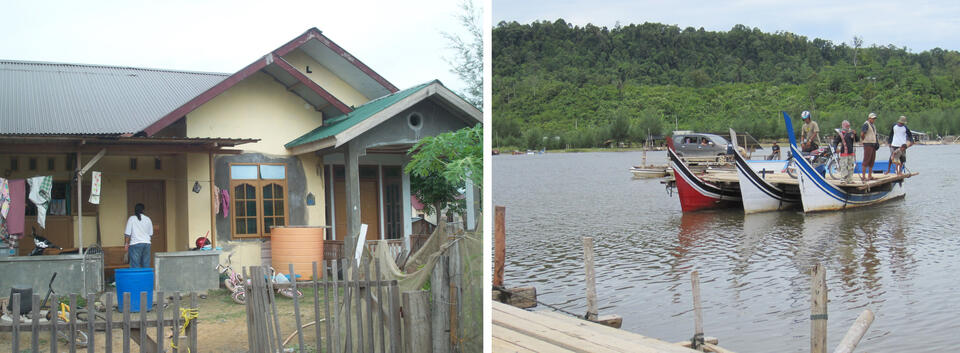
 Collection of photos from fieldwork in Aceh, Indonesia, provided courtesy of Yong Lee. Upper left: A house built in an aid project village shows windows retrofitted after initial construction. Upper right: Boats constructed by aid agencies for fishing activity are refashioned to serve as water taxis for people and cars. Lower: Fishing boats sit unused on the side of the road many of them impossible to use, according to villagers surveyed.
Logistics and oversight
Aid delivery depends in many ways on the location and scale of the disaster. But, a few main aspects can determine if an aid agency doing its own work or operating as an implementer meets or exceeds expectations.
Henderson and Lee suggest that agencies that were highly supervisory had greater positive outcomes from their workers. In the case of Aceh, better monitoring and insistence on quality by leadership is a likely corollary between construction of better quality homes and boats.
“Rather than just give money, NGOs need to really oversee the projects. Organization and management are essential facets,” Lee said. “And that requires a lot of additional effort on their part.”
Oversight is especially relevant in disaster situations because of the often-overwhelming need for reconstruction. A flood of less-skilled workers enters the market to fill this gap, and on average the quality of work degrades.
“It’s much more difficult to impose quality control at this point,” Lee said. “So the implication that comes out of it is how does the implementer effectively utilize less-skilled workers.”
Getting to know the implementers and evaluating their work in-progress would help ensure quality on behalf of the aid agency. And, better dissemination of information about aid outcomes would help assure donors that their monies are being applied in the best possible way.
Future study
Most “hard aid” delivered to Aceh’s villages had finished by 2010, but “soft aid” such as democracy promotion and women’s empowerment stayed longer.
Henderson and Lee conducted one final survey in 2011. The data has been offered as open source material for researchers along with the larger data set.
Noting this, Lee said, “We’re thrilled that people are looking into the data further. It’s exactly what we wanted.”
Research projects applying the data include the impact of the tsunami on Aceh’s local economies and health effects on the population, among other areas.
Hero Image

All News button
1
Stanford scholars offer views on Japan’s forthcoming statement on World War II
News Type
News
Date
Paragraphs
Stanford scholars are urging Japan to take advantage of an upcoming opportunity to show clear, heartfelt remorse for its actions surrounding World War II.
Making such amends will give Japan credibility as it seeks to assume a global leadership role well into the future, they say.
On Aug. 15, Prime Minister Shinzo Abe will publish a short statement to commemorate the 70th anniversary of the end of World War II, which follows similar practices of his predecessors.
Stanford's Walter H. Shorenstein Asia-Pacific Research Center (APARC), which has long advocated wartime reconciliation in Asia, recently issued a 15-page report in English and Japanese featuring eight hypothetical statements suggesting what the Japanese prime minister might say in his August address. The report, which is available in both English and Japanese, was recently made available to academics, media and the general public and has already received interest from the Japanese media.
The wording of Abe's statement will be scrutinized by governments and experts in Asia and around the world, the Stanford scholars say. During WWII, China and Korea, as well as other Asian nations, endured brutal Japanese military occupations.
"Many have been speculating what the (Abe) statement will be like," wrote Takeo Hoshi, director of the Japan Program at the Shorenstein Center, and APARC associate director for research Daniel Sneider in the report.
For example, Hoshi and Sneider asked, will Abe follow the direction set by prior Japanese prime ministers by expressing remorse for the suffering of Japan's Asian neighbors while apologizing for past aggression and colonization? Future collaboration in world affairs is also important, they added.
"We asked our colleagues what they would say in the 70th anniversary statement if they were the prime minister of Japan, and to write their own version of the statement," Hoshi and Sneider wrote.
"Our goal is to understand the diversity of reasonable views on the issue of Japan's responsibility for the cruel and violent war and Japan's role in building a peaceful and prosperous world," Hoshi and Sneider said.
The Stanford experts who wrote the statements included Hoshi and Sneider as well as Alberto Diaz-Cayeros, a senior fellow at the Freeman Spogli Institute for International Studies; Peter Duus, a professor emeritus of Japanese history; Thomas Fingar, a distinguished fellow at the Freeman Spogli Institute; David Holloway, a professor of international history and of political science; Yong Suk Lee, the SK Center Fellow at the Freeman Spogli Institute; and Harry Rowen, a professor emeritus of public policy and management.
For example, Fingar said in his version, "Let us also resolve to make the 80th anniversary of World War II the 10th anniversary of a more cooperative, more inclusive, and more secure region," and Hoshi wrote in his version, "To avoid any potential misunderstandings, Japan needs to recall past failures, remember the suffering of neighboring Asian peoples, and reaffirm the commitment to world peace more than ever."
On the subject of women, Lee's version noted, "The war and Japan's colonial rule created much suffering, but I would like to especially ask forgiveness to the women from many nations who suffered under colonial rule."
In August 2014, the Shorenstein Asia-Pacific Research Center issued a report on a Stanford-hosted dialogue on World War II memories in northeast Asia. Heightened tensions the last few years among the governments of China, Japan and South Korea have revolved around territorial disputes and the way WWII is portrayed in speeches and educational materials.
"Each nation in northeast Asia and even the U.S. has selective or divided memories of the past, and does not really understand the views of the other side," said Stanford's Gi-Wook Shin, director of the Shorenstein center, in a 2014 Stanford news release.
Clifton Parker is a writer for the Stanford News Service.
Responses to the project
Toyo Keizai, a leading Japanese business weekly, published all eight verisons in English and Japanese stating, "we hope this will provide an opportunity to bring about a wide range of discussion."
University of Tokyo professor Tetsuji Okazaki wrote about the project in the Asahi Shimbun (the article is in Japanese and also attached as a PDF below).
Hero Image

All News button
1
Shin says South Korea needs a stronger foreign policy vision
News Type
Commentary
Date
Paragraphs
In a recent interview with Korea Daily, Gi-Wook Shin, director of the Shorenstein Asia-Pacific Research Center, said that South Korea needs to be more strategic in its approach to its foreign policy agenda. The country’s leadership must aim to be more proactive in handling current diplomatic issues.
Shin suggested that South Korea should separate wartime history issues from other diplomatic priorities such as trade and security. This type of organization would allow each issue to receive the focused attention and expertise needed to understand and work toward resolution.
Recently, Japan provided a successful model for this, Shin said, referencing Japanese Prime Minister Shinzo Abe’s official state visit to the United States. Abe visited many major U.S. regions including Silicon Valley. He spoke mainly about the U.S.-Japan alliance and economic development as policy priorities for Japan. He did not address at length issues of the wartime past since the focus of his visit was U.S.-Japan relations and the economy.
Shin said he thinks it is important that South Korean President Park Geun-hye delivers a concrete foreign policy vision in her June visit to the United States. For the long-term, South Korea should find ways to boost its public diplomacy efforts to shore up support for that vision.
The full article is in Korean and available by clicking here.
Hero Image

All News button
1
Mao left China backward but, ironically, ready for reform
News Type
News
Date
Paragraphs
The damage that Mao Zedong wrought in China made it much easier for that country to move away from a Soviet-style economic model and toward a new market-oriented one, a Stanford scholar says.
In fact, China has been in full retreat for four decades from Mao's disastrous rule, according to a new book by Stanford sociology Professor Andrew Walder, a senior fellow at the Freeman Spogli Institute for International Studies and director emeritus of the Walter H. Shorenstein Asia Pacific Research Center.
"Mao ruined much of what he had built and created no viable alternative," he wrote. "At the time of his death, he left China backward and deeply divided."
Led by Mao, China's Communist Party seized power in 1949 after a long period of guerrilla insurgency followed by full-scale war. Mao launched a bloody Chinese revolution that resulted in the deaths of millions of Chinese over the next few decades.
In an interview, Walder said that Mao pushed campaign after campaign against the Chinese Communist party and bureaucracy after 1966 – "The bureaucracy was basically flat on its back at the time of his death."
By contrast, Walder noted, the Soviet bureaucracy was powerful and well-entrenched, and had enormous vested interests that thwarted genuine reforms.
"In post-Mao China, the economy was so backward and the bureaucratic interests so weak that market reform was bundled together with a program of national revival – restructuring the economy along market lines while rebuilding the party and bureaucracy," he said.
Therefore, the politics of reform were much easier for a Chinese leader like Deng Xiaoping than for a Soviet leader like Mikhail Gorbachev, who had to contend with an entrenched bureaucracy still proud of the fact that the USSR was (until the late 1980s) the second largest economy in the world and an undeniable superpower, according to Walder.
He noted that Mao's initiatives repeatedly led to unintended and unanticipated outcomes.
"What is so remarkable is that after 1956 this was a recurring pattern. His initiatives repeatedly ran into trouble, forcing him to backtrack and change direction constantly – although he always insisted that things had unfolded in ways that were according to his plans," Walder said.
Class struggle, imaginary enemies
Mao's China, he added, was defined by a harsh Communist Party rule and a socialist economy modeled after the Soviet Union. Mao himself intervened at almost every level, despite a large national bureaucracy that oversaw this authoritarian system.
"The doctrines and political organization that produced Mao's greatest achievements – victory in the civil war, the creation of China's first unified modern state, a historic transformation of urban and rural life – also generated his worst failures: the industrial depression and rural famine of the Great Leap Forward and the violent destruction and stagnation of the Cultural Revolution," Walder wrote.
He said that Mao misunderstood China's real problems in advocating a top-down "class struggle" against capitalism and imaginary enemies.
"At the time of his death (in 1976), he left China backward and deeply divided," Walder wrote.
The result was a gradual transition to the market-oriented system of today, he added. Almost immediately following Mao's death, his most fervent followers and supporters in the party were arrested and detained – all of which opened the door to reform and opportunity.
China has overcome widespread poverty to become the second largest economy in the world within the span of just a couple of decades. Still, according to Walder, China's rulers seek to cling to a sanitized version of Mao as a way to buttress their legitimacy.
"The damage of his misrule, and the incompetence on his part that it reflects, are not part of the official story anymore, and certainly this is not what is taught to school children or in party manuals in the present day," he said.
World War II and Stalinism
On two other key issues, Walder said his book challenges the conventional wisdom about China and Mao.
First, he says that Mao's forces did very little of the fighting against the Japanese in WWII.
Walder said that the victory of the Chinese Communist Party in 1949 over the Chinese nationalist forces has usually been traced to the strategy of guerrilla warfare in rural regions championed early on by Mao.
"But that was simply a strategy of survival during the Japanese invasion – and Mao's forces did very little of the fighting against the Japanese, in stark contrast to the popular myth of rural resistance." (Only 10 percent of China's military casualties were Red Army, he said.)
What Mao's Chinese Communist Party (CCP) excelled at was mass mobilization for all-out warfare during the Chinese civil war of 1945-49, Walder said.
"And this – pushing your organization and the population for all-out mobilization for war – is the real source of the CCP's success over the Chinese nationalists. This was more like the Soviet Union's war against German armies during World War II than a 'people's war' led by a party that was close to the rural people and built support by catering to their needs," he said.
Second, Walder describes Mao's thinking as frozen in Stalinist doctrine, despite the conventional view of him as an original thinker.
"In fact, Mao's core ideas were absorbed from late-1930s Soviet pamphlets put out under Stalin, and his thinking was very much frozen in that earlier era," Walder said. "The core idea that he absorbed from these pamphlets in creating 'Mao Thought' was that socialism had to be built in an all-out mobilization, like warfare, by extracting huge sacrifices from the population."
The most pernicious idea that Mao absorbed from these old Soviet pamphlets, Walder said, was that class struggle actually intensifies after the means of production are put under public ownership and former exploiting classes are liquidated.
"The sad corollary to this idea is that the Great Leader is the fount of correct ideas, and those who doubt or oppose him represent class enemies who actually oppose socialism," said Walder.
Based on this logic, Walder pointed out, the class struggle had to be waged against "incorrect ideas" as judged by the Great Leader.
"Mao's personality cult was an imitation of Stalin's own," he said.
And so, the Chinese leader held on to old Stalinist ideas long after they were rejected by the Soviet Union as crude distortions of Marxism.
"Mao was actually insisting on keeping to the old and tattered Stalinist playbook," Walder said.
Clifton Parker is a writer for the Stanford News Service.
Hero Image

All News button
1


