Human Rights
-

Located in Kenya, Kibera is one of Africaʼs largest urban slums. Homes in Kibera typically lack running water. Water shortages occur frequently, and buyers need to find new water vendors. Shortages drive prices up. This project aims to improve the welfare of Kiberans by exploiting ubiquitous, low-cost mobile access to improve limited, high-cost water access. Mixing practical purpose with field-experimental social science, the project aims to enable buyers to use mobile phones to acquire low-cost information about water, location, price, and quality. By pooling water information from multiple sources, it provides information beyond what other search methods deliver.

CISAC Conference Room

Program on Global Justice
Encina Hall West, Room 404
Stanford University
Stanford, CA 94305

(650) 723-0256
0
Marta Sutton Weeks Professor of Ethics in Society, and Professor of Political Science, Philosophy, and Law
cohen.jpg MA, PhD

Joshua Cohen is a professor of law, political science, and philosophy at Stanford University, where he also teaches at the d.school and helps to coordinate the Program on Liberation Technology. A political theorist trained in philosophy, Cohen has written extensively on issues of democratic theory—particularly deliberative democracy and the implications for personal liberty, freedom of expression, and campaign finance—and global justice. Cohen is author of On Democracy (1983, with Joel Rogers); Associations and Democracy (1995, with Joel Rogers); Philosophy, Politics, Democracy (2010); The Arc of the Moral Universe and Other Essays (2011); and Rousseau: A Free Community of Equals (2011). Since 1991, he has been editor of Boston Review, a bi-monthly magazine of political, cultural, and literary ideas. Cohen is currently a member of the faculty of Apple University.

CDDRL Affiliated Faculty
CV
Joshua Cohen Marta Sutton Weeks Professor of Ethics in Society, and Professor of Political Science, Philosophy, and Law; Director of the Program on Global Justice at FSI Stanford and CDDRL Affiliated Faculty Speaker

Encina Commons, Room 102,
615 Crothers Way,
Stanford, CA 94305-6019

(650) 723-0984 (650) 723-1919
0
Professor, Medicine
Professor, Health Policy
Senior Fellow, by courtesy, Freeman Spogli Institute for International Studies
Senior Fellow, Woods Institute for the Environment
eran_bendavid MD, MS

My academic focus is on global health, health policy, infectious diseases, environmental changes, and population health. Our research primarily addresses how health policies and environmental changes affect health outcomes worldwide, with a special emphasis on population living in impoverished conditions.

Our recent publications in journals like Nature, Lancet, and JAMA Pediatrics include studies on the impact of tropical cyclones on population health and the dynamics of SARS-CoV-2 infectivity in children. These works are part of my broader effort to understand the health consequences of environmental and policy changes.

Collaborating with trainees and leading academics in global health, our group's research interests also involve analyzing the relationship between health aid policies and their effects on child health and family planning in sub-Saharan Africa. My research typically aims to inform policy decisions and deepen the understanding of complex health dynamics.

Current projects focus on the health and social effects of pollution and natural hazards, as well as the extended implications of war on health, particularly among children and women.

Specific projects we have ongoing include:

  • What do global warming and demographic shifts imply for the population exposure to extreme heat and extreme cold events?

  • What are the implications of tropical cyclones (hurricanes) on delivery of basic health services such as vaccinations in low-income contexts?

  • What effect do malaria control programs have on child mortality?

  • What is the evidence that foreign aid for health is good diplomacy?

  • How can we compare health inequalities across countries? Is health in the U.S. uniquely unequal? 


CV
Eran Bendavid Assistant Professor of Medicine in the Division of General Medical Disciplines and CHP/PCOR Associate Speaker

Gates Computer Science 3B
Room 388
Stanford, CA 94305-9035

(650) 723-2780
0
Professor of Computer Science
founding faculty member at Hasso Plattner Institute of Design at Stanford
and CDDRL Affiliated Faculty
winograd.jpg PhD

Terry Winograd is a co-leader of the Liberation Technology program at CDDRL and Professor of Computer Science in the Computer Science Department at Stanford University. His research focus is on human-computer interaction design, especially theoretical background and conceptual models. He directs the teaching programs and HCI research in the Stanford Human-Computer Interaction Group, and is also a founding faculty member of the Hasso Plattner Institute of Design at Stanford.

Prof. Winograd was a founding member and former president of Computer Professionals for Social Responsibility. He is on a number of journal editorial boards, including Human Computer Interaction, ACM Transactions on Computer Human Interaction, and Informatica. Some of his publications includes Understanding Computers and Cognition: A New Foundation for Design (Addison-Wesley, 1987) and Usability: Turning Technologies into Tools (Oxford, 1992). 

Terry Winograd received a B.A. in Mathematics from The Colorado College in 1966 and Ph.D. in Applied Mathematics from M.I.T in 1970.

Terry Winograd Professor of computer science, Stanford University Speaker
Sangick Jeon Ph.D. candidate, Political Science Speaker
Seminars

Lou Henry Hoover Building
Stanford, CA 94305-6010

0
Visiting Scholar 2012-13
xia.jpg

Yeliang Xia is a professor in the Department of Economics at Peking University. His research fields include institutional economics, macroeconomic analysis and public policy, economic history, and labor economics. He has been teaching Principles of Economics, Labor Economics, Institutional Economics, and Western Economic History at Peking University since 2000.

He was deputy director of the institute of public policy, China Society for Restructuring Economic System (2003 –2009) and deputy director of the Center for Western Economic Theory, Peking University(2004--2009). He is also one of the founders of Cathay Institute of Public Affairs (CIPA or “Jiuding” in Chinese).

His books, the Economic Anatomy of Public Issues (2002) and the Weight that Economics Could Not Bear (2003) analyzed economic reform, institutional change and public issues in contemporary China.

-

***** NOTE: CHANGE OF LOCATION*****

Abstract

The mobile Internet — accessed through smartphones, tablets, and 4G technology — is now set to overtake the wired Net in usage and users. The implications of this shift are most obvious in Africa, where journalists have seized on mobile-driven innovations to transform newsgathering. But mobile networks also give repressive governments unprecedented powers to identify, locate, and harass journalists, their sources, and their audiences. The Committee to Protect Journalists invited a group of pioneering African journalists and entrepreneurs to Silicon Valley in October to talk about their work at the forefront of the media revolution. The group worked with executives and technologists from leading media and technology companies to find practical ways to protect free speech and privacy online. This panel will discuss their conclusions.

Erik Charas is an engineer, social entrepreneur, and founder of @Verdade, the largest-circulation newspaper in Mozambique. Hailing from northern Mozambique, Erik is passionate about his responsibility to work for his country. The inspiration to create @Verdade came from the realization that most people in Mozambique lacked access to quality information. He believes informing people about their government, country and the world is the first step toward engaging them as active participants in transforming the country. He is one of the most vocal advocates of anti-poverty activism in Africa today.Erik is also founder and CEO of Charas LDA, a company that invests in Mozambican entrepreneurs. Erik was voted a Hero of Africa in 2005 by media group MSN, named a World Economic Forum Young Global Leader in 2006, and served as an Archbishop Tutu African Leadership Initiative Fellow in 2007. He chairs several boards of companies and non-profit organizations in Mozambique and other countries. He has an engineering degree from the University of Cape Town. Follow him on Twitter @echaras.

Rafael Marques de Morais is an award-winning journalist, human rights activist, and founder of the anti-corruption watchdog website MakaAngola. The site is named for ‘maka,’ a Kimbundu world meaning "problem" or "trouble." Rafael’s writings on political economy, the diamond industry, and government corruption have earned him international acclaim, and have set the agenda for political debate in Angola by exposing the abuse of power. His most recent book, "Blood Diamonds: Corruption and Torture in Angola," published in September 2011, exposed hundreds of cases of torture and killings. Research for the book formed the basis of a criminal complaint Rafael filed against the shareholders of three private Angolan diamond mining companies for crimes against humanity. He now faces retaliatory legal action as company shareholders, including some of the country’s most influential generals, have countersued him in Portugal. Rafael was imprisoned for his work in 1999, and released after international advocacy efforts on his behalf. He was then charged with defaming the president and spent years in costly legal battles. His case was eventually taken up by the UN Human Rights Committee, which delivered a precedent-setting ruling in 2005 that Angola had violated the journalist’s fundamental rights. Born in Luanda, Rafael holds an MSc in African Studies from the University of Oxford and a BA Hons in Anthropology and Media from Goldsmiths, University of London.

Mohamed Keita is the Africa advocacy coordinator for the Committee to Protect Journalists, an international press freedom advocacy organization based in New York. Mohamed has written extensively on press freedom and social media for publications including The New York Times, The Christian Science Monitor, and Slate Afrique. He is regularly interviewed by international media including Al Jazeera, BBC, NPR, and Radio France Internationale. A native of Bamako, Mali, Mohamed also lived in Senegal before moving to New York. Prior to joining CPJ, Mohamed volunteered as a researcher with the nongovernmental World Federalist Movement-Institute of Global Policy, where he was responsible for a project on the structures and mechanisms of the African Union and helped organize outreach activities in West Africa for a project on the UN's "Responsibility to Protect" doctrine. Mohamed is a graduate of the City College of New York. Follow him on Twitter @africamedia_CPJ

Rebecca MacKinnon is a journalist and activist whose work focuses on the intersection of the Internet, human rights, and foreign policy. She serves on the board of directors of the Committee to Protect Journalists and the Global Network Initiative. As a Senior Fellow at the New America Foundation, she is developing new projects focused on holding technology companies accountable to universally recognized human rights standards on free expression and privacy. Her first book, Consent of the Networked, was published in January 2012 by Basic Books. In 2012 she was named Hearst Professional-in-residence by Columbia Journalism School and listed by the Columbia Journalism Review as one of “40 women who changed the media business in the past 40 years,” primarily due to her role as cofounder of Global Voices Online (globalvoicesonline.org) an international citizen media network. Fluent in Mandarin Chinese, MacKinnon worked as a journalist for CNN in China for nine years, including as CNN’s Beijing Bureau Chief and Correspondent from 1998-2001. MacKinnon received her AB magna cum laude from Harvard University and was a Fullbright scholar in Taiwan in 1991-92. Follow her on Twitter @rmack.

This seminar is being co-sponsored by the John S. Knight Journalism Fellowships and in collaboration with the Committee to Protect Journalists https://www.cpj.org 

Reception to follow in Mendenhall Library, McClatchy Hall, Bldg 120

History Corner
Bldg 200
Room 200-002

Rebecca MacKinnon Author,Consent of the Networked and Board Member Moderator Committee to Protect Journalists
Erik Charas Engineer, Social Entrepreneur, Founder Speaker @Verdade, largest circulation Mozambique newspaper
Rafael Marques de Morais Journalist,Human Rights Activist, Founder Speaker MakaAngola
Mohamed Keita Africa Advocacy Coordinator Speaker Committee to Protect Journalists
Seminars

Encina Hall
616 Serra Street
Stanford, CA 94305-6055

0
Fulbright Visiting Scholar 2012-13
Maclennan_HS.jpg

Christopher MacLennan is currently the Director General of Thematic and Sectoral Policy at the Canadian International Development Agency (CIDA).  He is responsible for leading the Agency’s policy development related to various sectors of international development programming including democracy promotion, food security, economic growth, governance and human rights.  Dr. MacLennan led the team that built the policy framework for the G8 Muskoka Initiative on Maternal, Newborn and Child Health in 2010 and represented Canada’s contribution to the 2012 G8 New Alliance on Food and Nutrition Security at Camp David.  Previous to working at CIDA, Christopher has held various positions in the Government of Canada, including at the Privy Council Office, the arm of the Canadian government that directly supports the Prime Minister and Cabinet.  Research interests include donor approaches to democratic assistance, international human rights development and federalism in multinational states.  Dr. MacLennan holds a Ph.D. from the University of Western Ontario specializing in constitutional development and international human rights and has numerous publications including Toward the Charter:  Canadians and the Demand for a National Bill of Rights, 1929-1960.

Encina Hall
616 Serra Street
Stanford, CA 94305-6055

0
The Governance Project Postdoctoral Fellow, 2013-15
Boittin_HS.jpg

Margaret Boittin has a JD from Stanford, and is completing her PhD in Political Science at UC Berkeley. Her dissertation is on the regulation of prostitution in China. She is also conducting research on criminal law policy and local enforcement in the United States, and human trafficking in Nepal.

The Governance Project Postdoctoral Fellow, 2013-15
CV
-

This Panel will examine Proposition 35 (the CASE Act) slated for the November 2012 California Ballot. Californians Against Sexual Exploitation (CASE) hopes to raise awareness of human trafficking and deter traffickers with higher penalties and fines. Critics of Proposition 35 argue that stiffer sentencing is not the core of this complex problem. They defend that efforts should be directed to training police and prosecutors, and funding victim-services providers to protect and enable court proceedings.

CISAC Conference Room

Helen Stacy Director Moderator Program on Human Rights
Lt. John Vanek Anti-Human Trafficking Consultant Speaker
Nancy O'Mally District Attorney of Alameda County Speaker
Cindy Liou Staff Attorney at Asia Pacific Islander Legal Outreach Speaker
Sgt. Holly Joshi Speaker Oakland Police
Kathleen Kim Speaker Professor Loyola Law School
Panel Discussions
Authors
News Type
News
Date
Paragraphs

It's the middle of the night when Maina Kiai receives an urgent plea from a human rights advocate in Russia. A recent draft law threatens to block civil society organizations from accessing foreign funding, cutting off their financial lifeline and exposing them to close monitoring by the state. Their work reporting on the government's moves to choke public dissent and suppress free speech is in jeopardy if this law is passed by the Russian legislature.

As the special rapporteur on the rights of peaceful assembly and association for the United Nations, Kiai's job is to collect first-hand information on human rights abuses and bring it to the attention of the international community.

Kiai is one of about 50 lawyers, experts and advocates around the world who volunteer their time as special rapporteurs for the U.N. Human Rights Council. With mounting case loads, a limited staff and shrinking budgets, special rapporteurs are left with little support to fight injustice and aid victims of some of the gravest human rights abuses.

In search of new tools to empower their work, the rapporteurs are now tapping the academic and innovative resources at Stanford to help them do their jobs better.

Harnessing the power of technology

Professor Jeremy Weinstein led the August workshop on new technologies and human rights monitoring.
Photo credit: Sarina Beges

Recognizing that technology can increase productivity and efficiency, Stanford’s Jeremy M. Weinstein organized a workshop to bring technologists together with the rapporteurs and other experts to explore how new technologies can help them magnify their impact.

Weinstein, an associate professor of political science and senior fellow at the Freeman Spogli Institute for International Studies (FSI) at Stanford, pushed for the use of new technologies as tools for promoting human rights and democracy when he served as the director of democracy and development on the National Security Staff of the White House.

“Special Rapporteurs occupy a unique position, with the legitimacy and mandate of the United Nations behind them as they track human rights abuses around the world," Weinstein said. "New technologies have the potential to amplify their voices, extend their reach, and ensure that citizens around the world have access to this valuable mechanism.”

Weinstein says the rapporteurs can use simple technologies such as database management systems and mobile phone applications to manage the volume of inquiries they receive, increase their response time to victims’ needs and build political support for their recommendations.

Juan Méndez, the rapporteur responsible for tracking torture and other abuses, receives upwards of 50 complaints a day from citizens and NGOs around the world. He wants a way to better organize, process and prioritize inquiries that would allow him to respond to victims in a more strategic, timely and systematic way.

"We have been self conscious of the need to apply new technologies and we are always looking for better ways of applying technology," Méndez said. "In my case, there is quite a learning curve to understand what the new technologies are and how they might work."

One of the most powerful tools for a special rapporteur is the country visit where they spend two to three weeks in a country of concern, visiting local nongovernmental organizations, meeting with government officials, holding press conferences and arranging visits with victims. Special rapporteurs must be invited by the host government to visit and countries with some of the most egregious human rights abuses on record - such as Iran and Zimbabwe - deny them access.

Due to the sensitivity of their findings, special rapporteurs are granted independence and impartiality in their jobs as they often have to say things that make governments uncomfortable. Sharing their findings is a challenge. Other than media coverage, the rapporteurs don’t have easy access to a large audience or the resources to disseminate their findings and recommendations widely in local languages.

But social media tools such as Facebook and Twitter could help heighten their profiles and improve communication with the public. During country missions, for instance, tweets and Facebook posts could easily advertise their visits to attract media and share their findings.

Tapping Stanford's technical edge

Since returning to Stanford where he is a resident faculty member at FSI's Center on Democracy, Development, and the Rule of Law (CDDRL), Weinstein has been using the university's technical edge to benefit those working to advance democratic practices.

Technologists and human rights leaders gathered at Stanford’s d.school to innovate and create new technologies for U.N. special rapporteurs.
Photo credit: Sarina Beges

Teaming up with the Brookings Institution and Google, CDDRL hosted an August workshop to bring together four special rapporteurs, civil society activists, technologists, and government donors to brainstorm how to best pair human rights monitors with the technology they need to be more effective in their work.

"What we’ve done is bring together a group of people who normally don’t talk to each other and got them to think about the subject from various users' points of view - the human rights victim, the civil society activist, the governments, and the special rapporteurs themselves,” said Ted Piccone, a senior fellow and deputy director for foreign policy at the Brookings Institution and author of a new book, Catalysts for Change: How the UN’s Independent Experts Promote Human Rights . “But we also have experts from technology, from human rights organizers, from think tanks and research organizations, so the combination of smarts and ideas in that mix is fantastic."

The second day of the workshop was held at Stanford's d. school – the Hasso Plattner Institute of Design – where participants put the needs of the user at the center of the design process. Armed with an endless supply of markers, sticky notes and whiteboards, participants divided into groups to brainstorm how technology can assist the special rapporteurs with their mounting caseloads.

The ideas laboratory

Bringing the human rights and technology communities together underscored the gap that exists between the two worlds. Few of the special rapporteurs were using or familiar with technology tools ranging from social media, database management and encryption software.

While the digital divide may be large for some, it was evident from the technologists in the room that there are an abundance of innovative technologies to validate, manage and interpret data for special rapporteurs’ use.

"I would really love a streaming analysis, so public information out there is streamed to me live," said Kiai, the special rapporteur who focuses on assembly and association rights. "I would also like to have a website that can be accessed by activists around the world as a way to communicate and send updates to me."

Sanjana Hattotuwa demonstrates a mock-up of the Web-based dashboard designed for the special rapporteurs.
Photo credit: Sarina Beges

One of the ideas presented by Sanjana Hattotuwa, a special advisor to the ICT4Peace Foundation based in Geneva, is a mobile application that would allow anyone anywhere in the world to utilize audio, video, or text to submit a report of a human rights abuse.

"They could track it with a confirmation number, and it's a very easy way of submitting information to the special rapporteurs," said Hattotuwa. This could be a very promising innovation for victims to submit reports from the ease of a mobile device, and to bring them to the attention of the special rapporteurs in real time.

Hattotuwa said data obtained through this app could be fed into a Web-based dashboard system that would feature a world map highlighting where the reports are coming from, allowing the special rapporteur to process and visualize information. The dashboard would also feature a curated news feed.

While the special rapporteurs left the workshop more informed of these new tools and with some tangible ideas of how to enhance their work, many questions remained about the costs and training required for the users, as well as how to build political support for a future with more visible and accessible special rapporteurs.

"I think that there will always be institutional constraints - political constraints - things that we need to work through," said Méndez, the rapporteur who tracks torture cases. "But the four rapporteurs that are here these two days can actually carry the message of technology's use to the U.N. and try to resolve them."

Bringing the two worlds together for this workshop helped close the digital gap and introduce the potential that technology represents to the human rights community and beyond.

"What struck me most is how much there is out there, and how hard it is for us without context, to understand the tech world and how useful it can be," said Kiai. "So that of itself was a revelation."


Hero Image
Kiai Logo
All News button
1
Authors
News Type
News
Date
Paragraphs

The demise of Moammar Gadhafi’s regime gave Abdulhafid Sidoun a second chance at life.

Six days before Sidoun was to be executed for promoting democracy in Libya, rebels toppled the government and emptied the country’s jails of its political prisoners. After more than five months of beatings and abuse on death row, Sidoun was free. Weeks later, Gadhafi was dead, gunned down by the rebels.

Sidoun’s fight to bring democracy and accountability to Libya is far from over. Qadaffi’s 40-year stranglehold starved Libya of political debate and evolution, and Sidoun knew he needed a crash-course in building an open, stable society. He received one this summer at Stanford, joining 23 other pro-democracy advocates from 22 countries in the Draper Hills Summer Fellows Program on Democracy and Development.

“Gadhafi is gone, but we still have a corrupt system we need to clean up,” says Sidoun, a Tripoli-based lawyer who waged a social media campaign to unite Gadhafi opponents. “My country needs me now. I have to work with my friends and colleagues and other lawyers and tell them what I’ve learned.”

Abdulhafid Sidoun was sentenced to death for trying to topple Moammar Gadhafi’s regime.
Photo credit: Rod Searcey

He has chronic back pain from the blows dealt by prison guards. And he winces when he talks about being torn from his family and isolated in a dark cell where he had no idea how – or even whether – the revolt against Gadhafi was unfolding until rebels broke him free.

For three weeks in late July and early August, Sidoun and the other fellows participated in faculty-led sessions on democracy, economic development, global health and hunger, human rights and the new technologies making it easier to organize and inspire reform. They took field trips to San Francisco and Monterey and met with officials at Google, Facebook and the Omidyar Network, a philanthropic investment firm that is contributing to the fellowship program.

And they spent time getting to know each other. Entrepreneurs, lawyers, journalists, politicians and civil society leaders sharing stories of overwhelming repression and the small successes they’ve had in trying to reform governments in places like Chile, China, Serbia and Zimbabwe.

“Everyone here has different stories and cultures, but we all talk about the same corruption,” Sidoun says. “We are learning that our problems are not very different.”

Fighting ignorance, encouraging debate

Now in its eighth year, the Draper Hills program – run by the Center on Democracy, Development and the Rule of Law at Stanford’s Freeman Spogli Institute for International Studies – has created and grown a worldwide network of up-and-coming leaders.

About 200 fellows from more than 60 countries have passed through the program and are now trying to craft policy and bring about political and economic reform.

“Many governments in Latin America are suffering from very strong political leaders who were elected presidents but think they are little kings or queens who own the country,” says Laura Alonso, a national representative in the Argentine Congress selected as one of this year’s fellows.

“The main problem is that the people who become so powerful distort the rule of law,” she says. “There is a rule of law for their friends and a different rule of law for their enemies. So this is what I want to go home and address – how can we have a rule of law that applies to everyone? My time at Stanford is giving me the perspective I need to go back to the basics of democracy.”

The fellowship program also addresses the overlap of business and government, and has increased its emphasis on the role entrepreneurs play in building democracy.

"We have brought a few entrepreneurs into the group of fellows," says Kathryn Stoner, an expert on Russia who lectured to the fellows about democratic transitions. "It is good for them to know how to get around corrupt practices in government. We also know that a strong middle class is the backbone of democracy. Once people have property, they tend to want to protect it as well as to demand representation for any taxes they pay. Encouraging entrepreneurship then is a good way to pursue both economic and political development worldwide."

While they’re all at Stanford to learn, the fellows are eager to share their newfound knowledge.

Kamal Siddiqi uses his position as a newspaper editor to strengthen democracy in Pakistan.
Photo credit: Rod Searcey

Bassim Assuqair was raised in Yemen by parents who forbade him from working as a teenager so he could devote all his energy to his studies. After earning a degree in English education from Sana’a University, he has worked for various development organizations. But he’s most interested in organizing Yemen’s youth and teaching them about the benefits of living in a country with free elections and the rule of law.

“There is so much ignorance, so much illiteracy in my country,” he says. “The people aren’t bad. They’re simple. They need awareness. I want them to know peace. It’s my task – I am ordering myself – to explain to others what I’m learning here.”

Kamal Siddiqi is another self-styled evangelist of democracy. As editor of The Express Tribune, an English-language daily in Pakistan, Siddiqi uses the newspaper as a check on government power while making the case that “a very bad elected prime minister is still better than a very good dictator.”

As a Draper Hills fellow, Siddiqi picked up technological tips and made connections with Stanford faculty that will help him better monitor crime, corruption and his country’s upcoming elections.

“I want to draw on the strength of the faculty and fellows of CDDRL to write for my newspaper,” he says. “They will play a part in my attempt to introduce some more ideas and issues in the general debate on elections and democracy.”

A chance to reflect

When FSI Director Coit D. Blacker and a core group of FSI’s senior fellows – including CDDRL Director Larry Diamond, Stoner-Weiss, former Stanford President Gerhard Casper and Michael A. McFaul, now Washington’s ambassador to Moscow – created the fellowship program, they wanted to give practitioners a chance to reflect and learn about democratic theory.

"We felt that practitioners from developing countries or countries in political and economic transition often feel isolated in the work that they do and they burn out," says Stoner-Weiss. "There were no such programs for international practitioners when we began eight years ago. We wanted to provide them with a sense of international community and the knowledge that they are not toiling away on their own." 

And the lessons the fellows learn from Stanford faculty can be invaluable. When it comes to building a constitution – something several of the fellows grapple with – Francis Fukuyama says there’s only a certain amount of time for a newly formed government to “get it right.”

FSI's Gerhard Casper waves a copy of the Magna Carta while speaking to the fellows about the rule of law.
Photo credit: Rod Searcey

“If you don’t, your window of opportunity slams shut,” says Fukuyama, a FSI senior fellow who lectured to the group about economic development and governance.

“But you don’t want to invite more problems by not thinking through exactly what kind of government you want," he says. "You need to have a theoretical and academic perspective.”

And the learning goes both ways.

“I’m getting the problems and issues of 22 countries downloaded onto me in a very short period of time,” says Erik Jensen, a law professor and CDDRL faculty member who also helped start the fellowship program.

“The fellows bring important insights and opinions that don’t land on the front page of The New York Times, but are integral to understanding what’s going on in the developing world,” he says. “That’s pretty great to have in one room.”

Courage, risk and magic

After building momentum and attracting a growing number of faculty who wanted to work with the fellows, the program that began in 2005 quickly caught the interest of venture capitalist Bill Draper and philanthropist Ingrid Hills. Their $1.5 million gift gave the program its name in 2007.

Draper’s interest in the program is deeply tied to his background running the United Nations Development Programme between 1986 and 1994.

“There are wonderfully courageous leaders in this world who are willing to take risks,” Draper says. “It’s magical what can happen, and I’ve seen how one person really can make an enormous difference. A lot of people selected for this fellowship program have that opportunity.”

Hills anticipates the fellows will create a network that extends beyond the three weeks they spend together at Stanford. And former fellows plan to connect in Africa later this year to explore how to combat regional corruption and increase government accountability.

“My hope is that the program will give the fellows the knowledge and tools to build an infrastructure in their respective countries based on democratic principles,” Hills said.

Diamond, whose opening day lecture on defining democracy sets the stage for the learning that unfolds over the coming weeks, says the program ultimately invests in people with the potential to expand democracy.

“It gives them skills, ideas and comparative experiences to draw on,” he says. “Some of these people will continue to work in an important and incremental way to advance and defend human rights and the rule of law. Some will go on to have very prominent roles in government and civil society.”

Life sentence

Some of them, like Ethiopia’s Birtukan Midekssa, are already renowned political leaders whose stories underscore the most extreme hardships of building democracy.

Pardoned from the lifelong prison sentence she received for opposing Ethiopia's authoritarian government, Birtukan Midekssa is still fighting for democratic reform.
Photo credit: Rod Searcey

By the second time Midekssa was in prison, her daughter was old enough to ask if her mother was going to come home.

“I’ll be back,” Midekssa told the 3-year-old. But the promise was tenuous. She was serving a life sentence, convicted of trying to overthrow Ethiopia’s constitutional order. Her actual crime was promoting honest democracy in a country run by a government intolerant of dissent and dismissive of civil liberties.

She was first sentenced to life in prison in 2005. Her daughter was 8 months old and Midekssa – then a federal judge – was just elected deputy chair of the Coalition for Unity and Democracy. Her party had won a majority in parliament, but Prime Minister Meles Zenawi cracked down on the rising opposition. Midekssa and about 30,000 others were thrown in jail. Security forces killed nearly 200 demonstrators during rallies that began peacefully.

Midekssa was pardoned 18 months later, but re-arrested in 2008 after being accused of violating the terms of that agreement. She had also recently been elected chair of a new opposition group.

“They had me in solitary confinement and cut off from the entire world,” she says. “Sometimes I felt like the whole world was forgetting about me.”

It had not. When she was pardoned again in 2010, throngs of overjoyed supporters greeted her with shouts, songs and dance when she returned to her neighborhood in Addis Ababa.

But Midekssa was drained. Her party was weakened and her political prospects were uncertain. With few options in Ethiopia, she and her daughter moved to the United States in 2011.

“There was little I could do,” she says. “I wanted to learn more, study more and figure out how to establish democracy and stability.”

Landing a Draper Hills fellowship meant the chance to tap into a deep academic perspective and think about how she might take another pass at building democracy when Ethiopia’s authoritarian system shows some sign of opening up.

“She’s not a revolutionary in favor of violence or radical change,” Diamond says. “If the regime decides it wants to negotiate a process of political reform and put the political system on the foundations of greater legitimacy, she’s one of the first people they’d need to reach out to.”

But until they do, Midekssa will wait patiently. Studying. Retooling. Sharing her experiences. And repeating the promise she made to her daughter years ago:

“I’ll be back.”

All News button
1
-

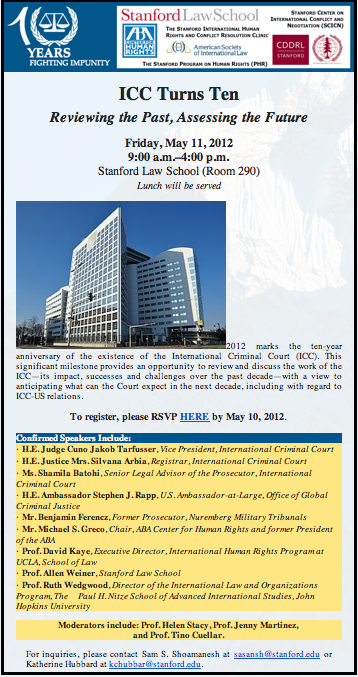
During the academic year of 2012-2013, the Program on Human Rights’ Sanela Diana Jenkins International Human Rights Series will examine the International Criminal Court (ICC) featuring debates with local, national and international experts, academics and activists. The focus will be on current challenges and possibilities for the ICC, such as how to determine reparations for victims, US and ICC relations, nation state cooperation and the still-to-be included crime of aggression.

The International Criminal Court in The Hague opened its doors 10 years ago amid buoyant optimism and sharp criticism. Supporters of the ICC hope that a permanent criminal court ensures the worst human rights offenders -- those who have committed genocide, war crimes, and crimes against humanity -- are brought to justice, and that nation states will progressively structure their own criminal systems so that genocidaires will face a fair trial before their own people and their own courts. Some critics of the ICC argue that the Court is biased against countries like the U.S., and that it jeopardizes national sovereignty through falsely claiming to be apolitical.  Other critics say that the ICC is biased against the entire region of Africa, noting that so far the ICC has indicted only Africans. Still others say that the ICC process is slow and expensive, noting that after ten years the Court has only completed one prosecution.

One decade later, how should the international community assess the ICC?  How fair are allegations against the ICC of bias and politicization? Have nation states really given over their national sovereignty to the ICC?  Have the ICC, the ad hoc tribunals (the ICTY and the ICTY) and hybrid tribunals (those in Sierre Leone, Cambodia and East Timor) had a deterrent effect on would-be genocidaires? More broadly, what are the pros and the cons of the international criminal justice system, and its less formal cousins such as truth and reconciliation commissions and gacacca?  Does the ICC present a fairer and cheaper alternative to war?

The International Speakers Series will be part of a three quarter sequence comprising a fall workshop, a winter one-unit credit course open to all Stanford students and a spring conference. The results of these conferences will be compiled in a PHR Working Paper Series on the ICC and international criminal justice.

CISAC Conference Room

Honorable Luis Moreno-Ocampo First Prosecutor of the International Criminal Court Speaker
Richard Steinberg Visiting Professor of International Relations at Stanford, Professor of Law at UCLA, Director of the Sanela Diana Jenkins Human Rights Project Host
Helen Stacy Director of the Program on Human Rights Host CDDRL
Conferences
-

The Program on Human Rights at CDDRL, the Center for African Studies and its Africa Table Lecture Series and Student Anti-Genocide Coalition STAND are honored to host Abbé Benoît Kinalegu and Ida Sawyer for this special seminar.

Congolese activist Abbé Benoît Kinalegu works to document and expose abuses by the Lord’s Resistance Army (LRA) and rehabilitate its victims.

The LRA is a rebel armed group that has terrorized civilians for years, first in Uganda and now in the Democratic Republic of Congo, the Central African Republic, and South Sudan. It is known for extreme brutality, and stands accused of killings, rapes, cutting off people’s lips and limbs, and looting. But it’s perhaps most notorious for abductions of adults and children to serve as soldiers, laborers, or sex slaves. Since 2008, the LRA has killed more than 2,600 civilians and abducted more than 4,000 others.

As head of the Catholic Church’s Peace and Justice Commission in northern Congo’s Haut-Uele District, Kinalegu helped create an Early Warning Network in which local activists report LRA attacks and movements by high-frequency radio. These offer advance warning to UN workers, humanitarians, and local communities in the LRA’s path. Kinalegu is also setting up a rehabilitation center to help some of the most traumatized children who escaped from the LRA and who now need to find their families and try to restore a normal life.

Kinalegu was one of the main advocates for the adoption in 2010 of the Obama administration’s LRA Disarmament and Northern Uganda Recovery Act, and he has become a powerful voice urging the international community to bring LRA commanders to justice.

Human Rights Watch has worked with Kinalegu on numerous joint research and advocacy projects, and his organization is a steering committee member of the Congo Advocacy Coalition, which Human Rights Watch coordinates. In October 2011, Kinalegu’s organization and Human Rights Watch co-led a workshop in Dungu, northern Congo, with more than 30 civil society activists from across the LRA-affected regions of central Africa. Participants shared experiences and developed a common position on mobilizing regional and international pressure to end LRA depredations.

Human Rights Watch honors Abbé Benoît Kinalegu for his commitment to protecting civilians and ending the threat posed by the LRA.

Ida Sawyer is Congo researcher and advocate in the Africa Division of Human Rights Watch in Kinshasa, Congo's capital, where she has been based since October 2011. Hired as Goma-based Congo researcher in January 2008, Ida has conducted research across Congo and in areas of northern Congo and neighboring countries affected by the Lord's Resistance Army (LRA). She is one of the main researchers and authors of six Human Rights Watch reports and dozens of press releases and public letters. Ida also conducts outreach with local civil society groups. Ida came to Human Rights Watch from Cairo, where she worked as a freelance journalist. Her previous Great Lakes experience includes work for Care International and the Charity for Peace Foundation in Northern Uganda, as well as research in Congo on the cross-border dynamics of natural resource exploitation. She holds a master's in International Affairs, specializing in Human Rights, from Columbia University.

CISAC Conference Room

Abbé Benoît Kinalegu Human Rights Defender Speaker
Ida Sawyer Africa Research and Advocate Speaker Human Rights Watch
Seminars
Subscribe to Human Rights