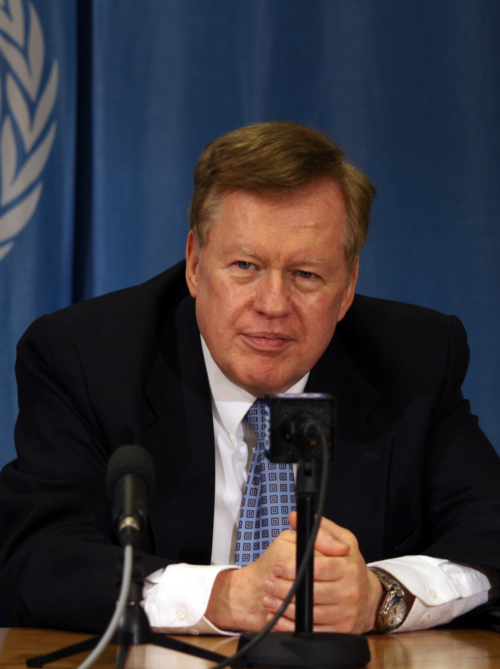
Over the last three years, the United States has done an about-face in terms of engaging North Korea on human rights. Some have argued that if we are to make progress on denuclearization with North Korea, we cannot press Pyongyang on human rights issues because we must develop a cooperative relationship. Raising human rights abuses will only make it more difficult to deal with security issues they argue. On the other hand, Ambassador King believes that human rights are not an issue that we raise after we have achieved our security goals. It is not just the right thing to do, it is an important and critical part of achieving real progress with North Korea on security issues and it is key to a better relationship between Washington and Pyongyang. Internal pressure from the North Korean elites and the public is necessary for positive change on security issues by the North, and this will only come about if there is progress on human rights. Furthermore, North Korea, like all UN member states, has agreed to observe UN human rights obligations. If the North fails to carry out its commitments on human rights, what assurance do we have that it will fulfill security obligations it accepts?
Image
Ambassador Robert King is former Special Envoy for North Korean human rights issues at the Department of State (2009-2017). Since leaving that position, he has been senior advisor to the Korea Chair at the Center for Strategic and International Studies (CSIS), a senior fellow at the Korea Economic Institute (KEI), and a board member of the Committee for Human Rights in North Korea (HRNK) in Washington, D.C. Previously, Ambassador King served for 25 years on Capitol Hill (1983-2008) as chief of staff to Congressman Tom Lantos (D-California), and staff director of the House Foreign Affairs Committee (2001-2008). Most recently, he was a 2019-20 Koret Fellow for the fall quarter at Stanford University.
The event is made possible through the generous support of the Koret Foundation.
Advisory on Novel Coronavirus (COVID-19)
In accordance with university guidelines, if you (or a spouse/housemate) have returned from travel to mainland China or South Korea in the last 14 days, we ask that you DO NOT come to campus until 14 days have passed since your return date and you remain symptom-free. For more information and updates, please refer to Stanford's Environmental Health & Safety website.
Robert R. King
Former Special Envoy for North Korean Human Right Issues
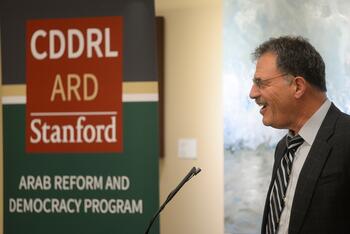
CDDRL’s Program on Arab Reform and Democracy held its annual conference at Stanford University on October 11 and 12, titled “The Struggle for Political Change in the Arab World.” The conference is an outgrowth of ARD’s efforts to support new research on the dynamics of political change in the countries of the Arab world. Scholars from across different disciplines sought to understand how social, economic, and political dynamics at the national level, as well as international and regional conflict and power rivalries, impact struggles for political and social change in the region.
Overview of Panels and Speakers
Image
Following opening remarks by FSI Senior Fellow Larry Diamond, the first panel titled “The Boundaries of Authoritarianism post-Arab Uprisings” featured CDDRL Senior Research Scholar Amr Hamzawy. His paper examined how the regime of Abdel Fattah Al-Sisi has employed discursive strategies to discredit calls for democratic change in the country. Sean Yom, Associate Professor of Political Science at Temple University, outlined how the protest strategies of Jordanian youth have limited their effectiveness in advancing meaningful political change. University of California, Davis Scholar Samia Errazzouki discussed the failure of state-led political and economic reform in Morocco.
Chaired by Harvard University Fellow Hicham Alaoui, the second panel was titled “Popular Uprisings and Uncertain Transitions.” University of California, Santa Cruz Political Scientist Thomas Serres provided an overview of the economic disruptions that contributed to Algeria’s uprising. Lindsay Benstead, who is an Associate Professor of Political Science at Portland State University, analyzed the electoral successes of Tunisia’s Ennahda Party. Khalid Medani, Professor of Political Science at McGill University, explained how Sudanese protesters leveraged new strategies of contention to force Omar Al-Bashir out of power.
Farah Al-Nakib (right) and Michael Herb (left)
The third panel, titled “Politics, Succession and Sectarianism in the GCC States,” included Oxford University Fellow Toby Matthiesen, who discussed how Saudi Arabia and the GCC states have increasingly sought to protect their regimes by actively molding the politics of their autocratic patrons in the region, and by using new technologies to upgrade the effectiveness of their surveillance states. Georgia State University Political Scientist Michael Herb explained how the aging of the Saudi line of succession contributed to the political ascendancy of Crown Prince Mohammad Bin Salman and the decay of family rule in the country. Cal Poly Historian Farah Al-Nakib described how Kuwait’s royal family has used its sponsorship of large-scale development projects to sidestep the country’s political polarization, undermine the power of the parliament, and weaken public access to spaces of political contestation.
Image
The fourth panel focused on “Social Strife and Proxy Conflict in the Middle East.” Chatham House Scholar Lina Khatib described Syria’s transformation during the civil war from a highly centralized security state to a transactional state in which the regime depends heavily on local powerbrokers. Stacey Philbrick Yadav, Associate Professor and Chair of the Department of Political Science at Hobart and William Smith Colleges, discussed differences in how local communities in Yemen have been affected by the country’s conflict. David Patel, who serves as Associate Director for Research at the Crown Center for Middle East Studies at Brandeis University, argued that Iraq’s democratic institutions have been impressively robust to a series of existential challenges, but he also highlighted a widespread feeling among the Iraqi public that its parliamentary system is failing to deliver.
Image
Finally, the fifth panel examined the topic of “International Forces in the Arab Political Arena.” Stanford University Political Scientist Lisa Blaydes suggested that China’s efforts to involve itself in the regional economy may improve its reputation among economically-frustrated Arab citizens, but that such efforts also spell trouble for democracy and human rights in the Middle East. Hamid & Christina Moghadam Director of Iranian Studies at Stanford University Abbas Milani argued that Iran’s ideological commitment to exporting the Islamic Revolution has been remarkably consistent for several decades. Colin Kahl, Co-director of the Center for International Security and Cooperation at FSI, reviewed the strategies of US administrations toward the Middle East, and posited that President Trump’s approach of pursuing maximalist objectives with minimal commitments is particularly likely to heighten instability in the region. FSI Scholar Ayca Alemdaroglu emphasized that Turkey’s neo-Ottoman foreign policy has failed to achieve its objectives in the face of mounting regional upheaval.
Common Themes of Political Change and Continuity
Image
Several themes emerged from conference presentations. First, across the panels, scholars discussed the lessons learned by autocrats and activists alike in the aftermath of the Arab Spring, and the ways in which these lessons have transformed regional politics. Hamzawy emphasized that the Sisi regime in Egypt has increasingly relied on intensive repression over cooptation to maintain stability, while at the same time refusing to grant even limited political openings as existed under Hosni Mubarak’s presidency. In part, this change appears to be rooted in the regime’s belief that relaxing the state’s authoritarian posture had contributed to the revolutionary upheaval of 2011. Likewise, Matthiesen suggested that Saudi Arabia and the Gulf Cooperation Council States have learned to become more aggressive in strengthening their surveillance apparatus and policing popular discourse transnationally. By contrast, Serres discussed how the Algerian military and bureaucracy have responded to mass protests not by intensifying repression, but instead by attempting to coopt anti-corruption initiatives and democratic reforms to limit political and economic change. Similarly, regarding Kuwait, Al-Nakib illustrated how the restructuring of urban spaces has proved itself a subtle but successful strategy for the royal family to rehabilitate its reputation while limiting geographic focal points for popular politics.
Image
Activists have also learned their own lessons from the aftermath of the Arab Spring. According to Yom, Jordanian activists continue to look to the leaderless revolutions of Tunisia and Egypt as a model to be emulated. As a result, they prioritize agility and horizontality in their protests, and they forgo the organization of formal political movements. This approach has succeeded in acquiring short-term concessions from the regime but has failed to generate broader structural changes. On the other hand, activists in Sudan appear to have been more successful at using lessons from the Arab Spring to push for systematic transformations of their political system. According to Medani, Sudanese protesters developed novel tactics to avoid the repression of the coercive apparatus, and they were effective at gradually forging a counterhegemonic discourse that clearly exposed the regime’s failures to the public. Following the overthrow of Omar Al-Bashir, activists in Sudan have also insisted on dismantling the political and economic might of the deep state to avoid following Egypt’s path.
Image
Second, the conference discussion indicated widespread dissatisfaction with formal political institutions across the region. For instance, Hamzawy suggested that Sisi’s regime has been relatively successful at discrediting civilian political institutions, including the legislature and civilian-led ministries. Errazzouki highlighted widespread dissatisfaction in Morocco with existing political institutions. Likewise, Yom’s discussion of activists in Jordan emphasized their lack of interest in entering formal politics. In Kuwait, the royal court has found an opening to pursue urban development projects outside of normal institutions in part because of the public’s frustration with gridlock in the legislature. Patel speculated that frustration with the parliament and muhasasa system in Iraq may finally prompt major changes to the country’s political process.
Image
Third, despite this disillusionment with formal politics, these political institutions have proved remarkably durable in countries across the region. For example, though current frustrations may finally prompt change in Iraq, Patel also highlighted the resilience of the parliamentary system in the face of a sectarian civil war, US troop withdrawal, the rise of ISIS, and a number of other major challenges. For both Algeria and Sudan, Serres and Medani stressed that militaries continue to exercise significant influence despite the popular uprisings. Meanwhile, for Egypt, Hamzawy noted the firm grip of the current military regime on power, and for Morocco, Errazzouki described the lack of systematic changes to the country’s ruling monarchy, even after years of popular pressure.
Image
Fourth, this durability has not precluded a number of important shifts within existing political institutions. Regarding Syria, for instance, Khatib explained how the survival of Bashar al-Asad’s presidency has depended on moving state institutions away from a centralized security state to a transactional state reliant on local actors with a degree of independence from the regime. Herb described how the consensus-based family rule of the Saudi monarchy fell victim to deaths among the aging senior princes, which opened up opportunities for the king to appoint more officials in a manner that heightened his direct influence. Herb suggested that Mohammad Bin Salman recognized this change and knew that he would likely lose relevance upon his father’s death; as a result, he was motivated to gamble on consolidating his control while his father still held the power to issue royal decrees. In Algeria, the influence of the military and bureaucracy may remain paramount for now, but Serres also pointed out that protesters have succeeded in stripping away the civilian intermediaries who used to protect these institutions. Regarding the durability of local institutions, Yadav noted how pre-conflict and even pre-unification institutions in Yemen have continued to operate effectively in a number of local communities around the country.
Image
Fifth, foreign interventions will continue to destabilize the region and impede prospects for democratization or post-conflict reconstructions in the coming years. Khatib noted that Russia has positioned itself as the agenda setter who can bring the Syrian state back to its feet, but also that Russia and Iran are competing to profit off the country’s reconstruction. For Yemen, Yadav argued that fragmentation at the local level has important implications for best practices in the international community’s reconstruction efforts, but that current actors are not well positioned to understand these trends. Kahl predicted that the Middle East strategy of the Trump administration would likely contribute to further destabilization of the region because of its emphasis on empowering allies to do what they want and go after Iran while the United States maintains its distance. Meanwhile, Blaydes’ presentation on China’s regional involvement, Milani’s discussion of Iran’s efforts to export the Islamic Revolution, and Matthiesen’s observations about the GCC States’ authoritarian coordination all illustrated how intervening states are reducing prospects for democratic political change.
Image
Sixth, even as interventionist countries have contributed to the destabilization of the region, they have also confronted major obstacles themselves – and in some cases have failed outright to achieve their primary objectives. Khatib noted that Iran has faced backlash in Syria, while Abbas Milani and David Patel pointed to backlash against Iran in Iraq. Kahl emphasized that the Trump administration’s Middle East policy was unlikely to achieve its goals. Blaydes observed that China has not acquired greater salience in the Middle East despite its more active economic involvement, and individuals in many of the region’s countries – particularly those that are more developed – do not see China’s growth as a positive force. She also stressed the reputational risks China is taking in pursuing potentially unpopular investments through the Belt and Road Initiative. The GCC States are attempting to prop up strongmen in both Libya and Sudan, but this strategy has struggled in the face of local political dynamics; furthermore, the intervention in Yemen has been a disaster for Saudi Arabia and the UAE. Finally, Alemdaroglu stressed that Turkey’s ambitious “neo-Ottoman” foreign policy, which reflects a desire to revive Turkish influence in areas ruled by the Ottoman Empire, has largely failed. In particular, the architect of the policy, former foreign minister Ahmet Davutoglu, lost his job; the country miscalculated badly in how it handled the aftermath of the Arab Spring; and Turkey’s relations with many of its neighbors have soured.
Hero Image
ARD 2019 Annual Conference participants. Front row (from left): Sean Yom, Stacey Philbrick Yadav, Lindsay Benstead, David Patel, Michael Herb. Middle row (from left): Colin Kahl, Lina Khatib, Hicham Alaoui, Larry Diamond, Samia Errazzouki, Lisa Blaydes, Hesham Sallam. Back row (from left): Toby Matthiesen, Ayca Alemdaroglu, Abbas Milani, Amr Hamzawy, Michael McFaul, Scott Williamson
In a talk dated May 31, 2019, UC Santa Cruz scholars Muriam Haleh Davis and Thomas Serres examined Algeria’s recent uprising, which led to the resignation of President Abdelaziz Bouteflika. The talk shed light on the protests, analyzing them both in a historical lens while also addressing the future prospects for democratic change and their implications for regional geopolitics. The speakers explored the role of the war of independence (1954-1962) and civil war (1992-1999) in political contestation, questions of language and national identity, and the landscape of the current political opposition.
In a talk dated October 7, 2019, Georgetown University Associate Professor of Government Daniel Brumberg analyzed the outcome of Tunisia’s legislative election and its implications for democratic consolidation in the country. Brumberg argued that the election provides a vital although not an easy opportunity to move beyond the power sharing, consensus-based political pact negotiated in 2014, to a more consolidated democracy.
Shall I tell you why we have brought you here? To cure you! To make you sane! Will you understand, Winston, that no one whom we bring to this place ever leaves our hands uncured? We are not interested in those stupid crimes that you have committed. The Party is not interested in the overt act: the thought is all we care about. We do not merely destroy our enemies, we change them. – George Orwell, 1984
Shorenstein APARC convened a multidisciplinary panel of experts on October 24, 2019, to provide historical context and critical social science analysis to the unfolding horrors in Xinjiang Uyghur Autonomous Region (XUAR). Displaying the above quote from George Orwell’s 1984, Gardner Bovingdon, associate professor in the Central Eurasian Studies Department at Indiana University, characterized the mass detentions in XUAR as “one of the great, state-engineered human rights disasters of our time” and proceeded to describe the camps in Xinjiang as both “Orwellian and Kafkaesque.”
Over ten million Muslim minorities in the region are under lock-down control, and over one million Uyghurs and other Turkic Muslims have allegedly disappeared into internment camps. Beijing has characterized the camps as vocational training centers to fight Islamic extremism and recently claimed that most of the detainees have been released. Recent New York Times exposé based on an unprecedented leak of over 400-pages of internal Party documents made clear, however, that the camps are anything but job-training centers.
Broad Assault on Non-Han Culture
James Millward, professor of inter-societal history at Walsh School of Foreign Service, Georgetown University, gave a quick overview of the worsening political situation in the XUAR, especially since 2009, when violent race riots broke out in Urumqi, ignited by a conflict between Uyghur and Han workers in Guangdong. The bloody incident marked a major turning point in Han-Uyghur relations, and Beijing’s own recalibration of its own policies towards the Uyghurs. When in early 2010 and, again, in 2013-2015, jihadist-style terrorist acts broke out in XUAR, Beijing’s response in 2014 was to launch an all-out “strike hard campaign.”
That same year, Xi Jinping also called an important Central Ethnic Work Conference where the leadership adopted a new approach to ethnic dissent in the XUAR. Instead of relying, as before, on material improvements and economic developments to placate the Uyghurs and other Turkic Muslims in the XUAR, Xi Jinping now also prescribed the need for “spiritual or psychological” means (jingshenshangde (精神上的)) to manage ethnic strife. What followed, Millward described, were new national security laws and national counterterrorism laws with vague, broad language that allowed all types of measures to be implemented. Then, in 2016, Chen Quanguo, former Party Secretary in Tibet Autonomous Region from 2011-2016, was transferred to the XUAR to apply the same draconian securitization and surveillance system he had put in place in Tibet. Millward described 2016 as a “watershed moment,” a turning point in the crack-down on ethnic dissent in XUAR. The number of criminal prosecutions in Xinjiang suddenly skyrocketed over thirteen-fold from just 27,000 to 363,000 cases between 2016-2018. The number of new security facilities, including camps, prisons and even kindergartens, also spiked in the XUAR during the same period.
In addition to such judicial and extra-judicial methods of repression in the XUAR, this all-encompassing campaign also included draconian assaults on non-Han, Islamic culture. Beginning in the early 2000s, that assault has included the razing of old Kashgar; the illegalizing of any Islamic symbols such as women’s headgear, men’s beards; prayer, and fasting on Ramadan. What earlier started as official discouragement “turned into de facto laws,” he explained: “[Y]ou get locked up in a camp for this kind of behavior.” This “broad, broad attack” on the “symbols and central aspects of Uyghur culture” has also included the erasure of Uyghur script in public places; the disappearance of Uyghur intellectual and cultural leaders, including Rahile Dawut, a renowned anthropologist; and Tashpolat Tiyip, an internationally-recognized geographer and former President of Xinjiang University. One million Han Party members and officials have also been sent to southern Xinjiang to stay in Uyghur homes to spot signs of “extremism,” such as copies of the Quran, religious DVDs, etc.
Totalitarian Politics of Land
Lauren Hansen Restrepo, assistant professor in growth and structure of cities at Bryn Mawr College and an expert on urbanization in Xinjiang next spoke from the panel. She used the lens of urban planning to describe two significant shifts in Beijing’s techniques of governance over the Uyghur population in the XUAR. From 2000-2009, before the Urumqi riots, the guiding principle for spatial development in Urumqi was that of a “dual-centered city” (shuangzhongxin; 双中心) – a relatively balanced vision with one development center located in the Uyghur heartland (Tianshan) and the other, in the Han super-majority region (Xinshi). This dual model of growth for Urumqi was abandoned in 2010, however, and a new spatial development policy called nankongbeikuo 南控北扩 or “control the south, develop the north” took its place. Construction halted in southern Urumqi where Uyghurs make up a majority of the population, and all resources were basically channeled to the northern part of the city.
In the wake of the 2014 Central Ethnic Work Conference, however, the “logic of total security” took over and there began a precipitous move towards what Restrepo called “a totalitarian politics of land.” The central government took control and began to more directly govern how development worked in XUAR. “Regional planning has broken every logic of urban planning in China,” she stated, resulting in the isolation and even greater marginalization of Uyghur-dominated urban centers. According to Restrepo, cities and larger regions in XUAR are being reconfigured to come under the direct management of central ministry-level powers and quasi-military entities called the bingtuan, respectively.
Open Air Prisons
Next, Darren Byler, an anthropologist who had recently received his Ph.D. from the University of Washington, focused on Uyghur dispossession and “terror capitalism” in the city of Urumqi. He first described the mass migration of Han people in the 1990’s into the XUAR, which caused increasing tensions with the Uyghurs.
With economic development, however, also came communications infrastructure, and in 2010, with the installment of 3G networks in Xinjiang, smartphone use began to spread. By 2012, nearly 40-50 percent of XUAR’s population were also on WeChat, China’s most popular messaging app. Uyghurs formed a vibrant, virtual public sphere on WeChat where they often formed networks centered on their religious identity. According to Byler, Uyghurs mainly focused on personal piety, rather than on political/radical forms of Islam. But after the violent jihadi-style attacks in 2013-2015, the Chinese state increasingly collapsed Islamism with radicalism extremism and equated visible signs of religiosity like beards on men, women’s veils and regular prayer with pre-terrorist tendencies. The impetus for this intense politicization of Islamism by the authorities, Byler also explained, originated with the U.S.’ war on terror.
The XUAR is a key zone of the Belt and Road Initiative and a region rich in natural resources, Byler pointed out, and control over this Northwestern area is essential to Xi Jinping’s ambitions. Byler described extensive use of cameras, digital media and biometric checkpoints, prisons, internment camps and, more recently, coerced labor to accomplish tight control over the Uyghurs. Byler also explained how, since the spring of 2017, the local police instituted a point-based ranking system for Uyghurs that assessed, for example, whether he or she owned religious tracts, his/her daily prayer practices, and ties to foreign countries.
In the internment camps themselves, the detainees undergo boot camp-style ideological and Chinese language training in conditions akin to medium security prisons. Pictures of blindfolded captives with their hands tied behind their backs, guards with tasers and weapons, all belied the Chinese government’s characterization of these camps as benign, vocational training centers. And, now, Byler described, in factories, such as textile factories, associated with these camps, detainees are coerced to provide low-cost labor at a time when average labor costs in China are rising. In a grim conclusion, Byler stated, “what's being built through this is . . . open air prisons. The whole space [of XUAR] is prison, it’s camps all the way down . . . . You can't move . . . without showing your I.D. and having your face scanned, and so it's just impossible to escape.”
State-engineered Human Rights Disaster
Indiana University’s Gardner Bovingdon, whose research focuses on politics in contemporary Xinjiang and the region’s modern history, was the last panelist to speak at the event. He first situated this “great, state-engineered human rights disaster[ ]” within the CCP’s framework of “minzu regional autonomy,” which the Party-state had established after 1949. Minzu being variously translated as “nationality” or “ethnicity,” the framework formally recognized and accorded some measure of political autonomy to people who are culturally different. In fact, however, communist ideology, Bovingdon noted, has always faced tensions between (i) “the goal of respecting and protecting cultural difference” and (ii) “the goal of integrating the land and the peoples into a unified polity.”
According to Bovingdon, prior to 2009, commercialization of Uyghur culture through tourism and consumption seemed to be the Party’s preferred way of dealing with the securitization problem in the XUAR. But the CCP’s ever-shifting attitude towards the nation’s multi-ethnicity issue went all the way back to the Soviet collapse in 1991. The paramount concern of the Chinese Communist Party ever since has been to avert the outcome that had felled their erstwhile communist neighbor and preserve the Party and the nation. Scholarly responses to the Soviet collapse in the 1990’s included an analysis that exhorted the government to “weaken the concept of minzu and minzu consciousness”; lessen “minzu centrism” and vitiate the notion of minzu independence. Exhortations to “de-politicize and culturalize” the problem of ethnic minorities continued into the 2000’s. Then, more recently, scholars have proposed moving away from policies that mimic those of the former Soviet Union and adopting “second generation minzu policies” that promote “fusion and collective flourishing” of the various peoples.
Regardless of the official academic discourse, however, Bovingdon asserted that the best explanation for policy changes in the XUAR remained the transfer of Chen Quanguo as Party Secretary from Tibet to Xinjiang in 2016. Under him, the Chinese Communist Party transported and scaled-up a set of policies that had previously been applied to the unrest in Tibet. These policies do not “weaken” minzu consciousness, Bovingdon suggested, but rather intensifies them. These policies are, in fact, “signs of a flailing, terrified Party,” Bovingdon asserted, “that doesn’t know what to do with the Uyghurs, but also feels no constraints from the international community on its behavior. And so the biggest problem now is to find a way to put constraints on a system that has operated untrammeled with devastating consequences.”
Hero Image
A mix of ethnic Uyghur and Han shopkeepers hold large wooden sticks as they are trained in security measures on June 27, 2017 next to the old town of Kashgar, in the far western Xinjiang province, China. | Kevin Frayer/Getty Image
Around the world, democracy is in retreat. In its Freedom in the World 2019 report, the independent watchdog organization Freedom House records the 13th consecutive year of global declines in political rights and civil liberties. “More authoritarian powers are now banning opposition groups or jailing their leaders, dispensing with term limits, and tightening the screws on any independent media that remain,” and “even long-standing democracies have been shaken by populist political forces,” shows the annual study. Internet freedom, too, continues to decline globally amid the crisis of social media, unveils Freedom House’s newly released Freedom on the Net 2019 report. Social media platforms – once considered liberation technologies – have become a conduit for surveillance, disinformation, and electoral manipulation, and “are now tilting dangerously toward illiberalism, exposing citizens to an unprecedented crackdown on their fundamental freedoms.”
These troubling developments are also manifested throughout the Asia-Pacific, where continuous scaling back in U.S. engagement and leadership is raising doubts about American power and purpose in the region, thus empowering forces that undermine democratic norms and processes.
At Shorenstein APARC, we are committed to building a solid foundation of education, knowledge, and dialogue about the critical challenges facing Asian nations and U.S.-Asia relations. That’s why we are dedicating a major portion of our programming this fall quarter and throughout the entire year to elucidating the threats to rights and liberties in the Asia-Pacific region.
The Battle for Truth and Press Freedom in the Philippines
“This is an existential moment for global power structures, turned upside down by technology. When journalists globally are under attack, democracy is under attack.” With these words, the internationally-esteemed investigative journalist and press freedom champion Maria Ressa opened her keynote address upon receiving the 2019 Shorenstein Journalism Award.
As CEO and executive editor of Rappler, she has led the Philippine independent news platform in shining critical light on the Duterte administration's drug war and unprecedented number of killings in the country. President Duterte in turn has made no secret of his dislike for Ressa and Rappler, accusing the platform for carrying "fake news." Ressa has been arrested twice this year, accused of corporate tax evasion and of violating security laws, and slapped with charges of cyber libel for a report that was published before the libel law came into effect. Since Duterte’s election in summer 2016, the Philippine government has filed at least 11 cases and investigations against Ressa and Rappler. “And all because I’m a journalist,” she says.
Ressa detailed the devastating effects that disinformation has had on press freedom, democracy, and civic discourse in the Philippines. “Our dystopian present is your dystopian future if nothing significant is done,” she cautioned. She was joined on the 18th annual Journalism Award panel by Stanford’s Larry Diamond, senior fellow at FSI and the Hoover Institution, and Raju Narisetti, director of the Knight-Bagehot Fellowship in Economics and Business Journalism and professor of professional practice at Columbia Journalism School.
Watch Ressa’s keynote and the entire panel proceedings:
North Korea continues to be one of the world’s worst human rights violators, ranking at the bottom of Freedom House’s list of countries designated as Not Free with the worst aggregate scores for political rights and civil liberties. Although North Korea has experienced some degree of social and economic change in recent years, the Kim Jong Un regime continues to tightly control access to information, suppress all dissent, heavily surveil residents, and subject political prisoners to torture, forced labor, and other atrocities.
As momentum for U.S.-DPRK diplomatic negotiations has ebbed and flowed since summer 2018, all eyes have been on the questions surrounding the North Korean nuclear problem, while the human rights problem has received little attention. However, argues APARC’s Koret Fellow in Korean Studies Robert R. King, addressing the North Korean human rights problem is essential to moving the country on denuclearization and security issues.
Ambassador King, former special envoy for North Korean human rights issues at the Department of State, recently spoke at a seminar hosted by APARC’s Korea Program. Creating pressure on the North Korean government from within by its own people is the only way we’re going to make progress on the security front, he claimed. “If we can help generate greater interest on the part of the people in what is happening with their own government, we can create the kind of constraints that democracy imposes on its leadership […] and that is why we need to focus attention, as well as on negotiating with North Korea, on access to information and human rights.”
Listen to highlights from Ambassador King’s talk:
Hong Kong: City in Turmoil
In Hong Kong, millions of people have been protesting for months against rights violations and increasing interference by the Chinese government in local affairs. On October 1, while the People’s Republic of China celebrated its 70th anniversary with a massive National Day parade in Beijing, on the other side of the border, Hong Kong experienced one of its most violent and chaotic days.
With those contrasting images still fresh on everyone’s minds, APARC and the China Program, along with FSI And the Center for East Asian Studies, co-hosted an expert panel that explained the root causes of Hong Kong’s unremitting protests, examined the future of “one country, two systems,” and considered how the United States and the international community should best respond.
Former Chief Secretary for Administration of the Hong Kong Government (1993-2001), the Honorable Anson Chan, delivered a piercing keynote address, followed by a discussion featuring Harry Harding, Professor of Public Policy at the University of Virginia, David M. Lampton, APARC/FSI Oksenberg-Rohlen Fellow, and Professor Ming Sing of Hong Kong University of Science and Technology.
Since 1997, Chan asserted, Hong Kong SAR’s successive chief executives have progressively failed to reassure the Hong Kong people that they would do their utmost to uphold “one country, two systems” and to defend Hong Kong’s autonomy. Instead, she argued, they have increasingly come across as “mouthpieces of the central government, towing the Beijing line.” Chan also suggested that “some years back, Beijing began to both lose confidence in the judgment and competence of the Hong Kong administration and to fear that growing sense of people’s identity as ‘Hong Kongers’ rather than Chinese citizens could pose a threat to the long-term, successful integration of Hong Kong into the motherland.” She closed her speech urging the Beijing leadership “to act with greater confidence and to trust us more completely with stewardship of our own future by allowing us to elect our own leaders.”
China’s mass internment of Uighurs and other Muslims in “reeducation” camps and detention facilities and its deployment of high-tech surveillance and police tactics in Xinjiang Uyghur Autonomous Region have been interpreted as a superpower’s attempt to annihilate the distinct identities of minority groups. Approximately ten million Muslim minorities in the region are under tight control, and over one million Uyghurs and other Turkic Muslims have allegedly disappeared into internment camps. While Beijing characterizes the camps as vocational training centers and has claimed that most of the detainees have been released, evidence for these claims is difficult to verify, as information dissemination regarding the region to the outside world is closely guarded.
To shed light into the crisis in Xinjiang, APARC convened a multidisciplinary panel of experts who provided historical context and critical social scientific analysis of the events unfolding in the region.
Image
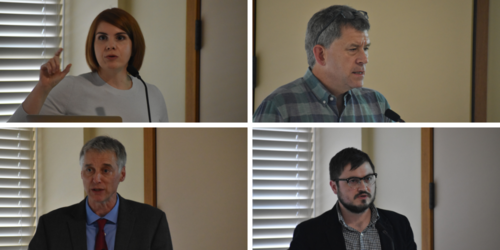
From top left, clockwise: Lauren Hansen Restrepo, James Millward,, Darren Byler and Gardner Bovingdon.
James Millward, professor of Inter-societal history at Georgetown University’s Walsh School of Foreign Service, reviewed the historical background for the PRC assault on non-Han or non-Chinese culture in Xinjiang. Beginning in the early 2000s, the assault has included the razing of old Kashgar; the discouraging and then illegalizing of Muslim symbols such as head gear, prayer, and fasting in Ramadan; the disappearance of Uyghur script; and the securitization of the province by using police patrol, surveillance technologies, facial recognition, and biodata monitoring. The PRC hasn’t applied a single, top-down ethnic policy in Xinjiang, said Millward, but rather has rolled out different tactics it experimented with on local levels in different areas.
Lauren Hansen Restrepo, assistant professor in growth and structure of cities at Bryn Mawr College and an expert on Chinese development planning and urbanization in Xinjiang, explained how we got to the current crisis in the region by connecting seemingly disparate phenomena. She described the shifts in state power in Xinjiang and how, since 2014, “regional planning has broken every logic of urban planning in China,” resulting in the isolation and subordination of Uyghur-dominated urban centers and in the ossification of cities, as control has been seized from local governments and given to socialist land masters.
Anthropologist Darren Byler, whose research focuses on Uyghur dispossession and "terror capitalism" in the city of Ürümchi, the capital of Xinjiang, explained how, amid mass migration of Han people into the resource-rich region, Uyghurs had mostly been excluded from the new economy and how their identity as contemporary Muslims supported a vibrant public sphere not controlled by the state. The Chinese state, in turn, has merged Islamism with radicalism extremism. From the Chinese state and industry perspective, Byler said, the repression of Xinjiang’s Muslims promises stability and the detention camps are used as carriers of economy and new sources of cheap labor.
Indiana University’s Gardner Bovingdon, whose research focuses on politics in contemporary Xinjiang and the region’s modern history, reverted to the question of how we got to the current crisis, which he characterized as “one of the great state-engineered human rights disasters of our time.” He argued that, in the case of Xinjiang, the Chinese party transported and exacerbated a set of policies that had previously been applied to dealing with the Tibet problem. These policies, Bovingdon suggested, “are signs of a flailing, terrified party that doesn’t know what to do with Uighurs, but also feels no constraints from the international community on its behavior. And so the biggest problem now is to find a way to put constraints on a system that has operated untrammeled with devastating consequences.”
The panel "Xinjiang’s Muslims and the PRC" was cosponsored with the Center for Democracy, Development and the Rule of Law.
Hero Image
Clockwise from upper left: Relatives of alleged extrajudicial killings wear veils as they take part in a protest versus the drug war killings outside the military and police headquarters on July 17, 2019 in Manila, Philippines (Photo credit: Ezra Acayan/Getty Image); Workers pass propaganda posters as they cycle through Hungnam Fertilizer Complex on February 4, 2019 in Hamhung, North Korea (Photo credit: Carl Court/Getty Images); Pro-democracy protesters react as police fire tear gas during a demonstration on October 20, 2019 in Hong Kong (photo credit: Anthony Kwan/Getty Images); A mix of ethnic Uyghur and Han shopkeepers hold large wooden sticks as they are trained in security measures on June 27, 2017 next to the old town of Kashgar, in the far western Xinjiang province, China (photo credit: Kevin Frayer/Getty Images).
Carly Miller is a research analyst at the Stanford Internet Observatory. She was most recently a Team Lead at the Human Rights Investigations Lab at Berkeley Law School where she worked to unearth patterns of various bad actors’ media campaigns. Carly is interested in combining investigative and digital forensic research with the power of effective policy recommendations.
Carly received her BA with honors in political science from the University of California, Berkeley in May 2019.
Former Research Analyst, Stanford Internet Observatory
The Education of an Idealist traces Power’s distinctly American journey, from Irish immigrant to human rights activist to United States Ambassador to the United Nations. Power began her career as a war correspondent and as a vocal critic of US foreign policy, and then put her ideals into practice while working with Obama in the Senate, on the campaign trail, and throughout his presidency. Power’s perspective on government is unique, as she takes us from the streets of war-torn Bosnia to the Situation Room and out into the world of high-stakes diplomacy. In her characteristically gripping prose, Power illuminates the messy and complex worlds of politics and geopolitics while laying bare the searing battles and defining moments of her life. She also reveals what it’s like to juggle the demands of a 24/7 national security job with raising two young children. And, in the face of great challenges, she shows us not just how the United States can lead, but why there is always something each of us can do to advance the cause of human dignity. The Education of an Idealist is a humorous, stirring, and ultimately unforgettable account of the world-changing power of idealism -- and of one person’s fierce determination to make a difference.
Samantha Power is a Professor of Practice at the Harvard Kennedy School and Harvard Law School. From 2013-2017, Power served as the U.S. Ambassador to the United Nations and a member of President Obama's cabinet. From 2009-2013, Power served on the National Security Council as Special Assistant to the President for Multilateral Affairs and Human Rights. Power began her career as a journalist, reporting from places such as Bosnia, East Timor, Kosovo, Rwanda, Sudan, and Zimbabwe, and she was the founding executive director of the Carr Center for Human Rights Policy at the Kennedy School. Power's book, "A Problem from Hell": America and the Age of Genocide won the Pulitzer Prize in 2003. She is also the author of the New York Times bestseller Chasing the Flame: Sergio Vieira de Melloand the Fight to Save the World. Her most recent book, The Education of an Idealist, was published by Harper Collins in September 2019. Power earned a B.A. from Yale University and a J.D. from Harvard Law School.
Shorenstein APARCStanford UniversityEncina Hall E301Stanford, CA 94305-6055
0
Koret Fellow, 2019-20
Visiting Scholar at APARC
robert_king.png
Ph.D.
Robert R. King was a Visiting Scholar, Koret Fellow at the Walter H. Shorenstein Asia-Pacific Research Center (Shorenstein APARC) during the 2019 fall term. He is the former U.S. Special Envoy for North Korean Human Rights Issues at the U.S. Department of State (2009-2017). He is Special Advisor to the Korea Chair at the Center for Strategic and International Studies (CSIS), a non-resident Fellow at the Korea Economic Institute, and a member of the board of the Committee for Human Rights in North Korea.
Ambassador King’s research interests include North Korea human rights, Northeast Asia, U.S. foreign policy, and the Congressional role in U.S. foreign affairs. During his time at Shorenstein APARC, he researched the United States efforts to promote human rights in North Korea.
Before assuming his position at the Department of State, King was Staff Director and Minority Staff Director of the Foreign Affairs Committee of the U.S. House of Representatives (2001-2009). He served as Chief of Staff to Congressman Tom Lantos of California (1983-2008). He was a White House Fellow on the staff of the National Security Council (1977-1978), and Senior Analyst and Assistant Director of Research at Radio Free Europe in Munich, Germany (1970-1977).
King holds a PhD and an MALD in international relations from the Fletcher School of Law and Diplomacy and a BA in political Science from Brigham Young University.
President Trump has stopped even mentioning North Korea’s abysmal human rights record in order to secure meetings with Leader Kim Jong-un ostensibly to make progress on serious security issues with North Korea. After 18 months of White House effort and two and a half summits, however, there has been little progress on denuclearization. Ambassador King argues that we must push North Korea on human rights in order to encourage the government in Pyongyang to respond positively the wishes of its own citizens. Unless we do this, we are unlikely to see real progress on shifting North Korea’s focus from nuclear weapons and missiles to the wellbeing of its own people.
Image
Ambassador Robert R. King is former Special Envoy for North Korean human rights issues at the Department of State (2009-2017). Since leaving that position, he has been senior advisor to the Korea Chair at the Center for Strategic and International Studies (CSIS), a senior fellow at the Korea Economic Institute (KEI), and a board member of the Committee for Human Rights in North Korea (HRNK) in Washington, D.C. Previously, Ambassador King served for 25 years on Capitol Hill (1983-2008) as chief of staff to Congressman Tom Lantos (D-California), and staff director of the House Foreign Affairs Committee (2001-2008).
Robert R. King
<i>2019-20 Koret Fellow, Shorenstein APARC, Stanford University</i>

 Farah Al-Nakib (right) and Michael Herb (left)