Trade
-

Abstract: I examine how the shift from an exam to a district based high school assignment rule impacts intergenerational mobility and residential inequality. A stylized model predicts that under district assignment, household income relative to one’s ability becomes a stronger predictor of achievement, and higher income households sort towards and increase housing prices in the better school districts. I test predictions utilizing a unique policy change from South Korea in the 1970s. High school admission had traditionally been exam based in South Korea. However, between 1974 and 1980 the central government shifted several cities to a school district based system. I find that the reform increased intergenerational income elasticity from 0.15 to 0.31, and that higher income households migrated to the reform cities. I next examine whether school districting altered residential land prices within a city using a first differenced boundary discontinuity design. By focusing on the immediate years before and after the creation of school districts in Seoul, I find that residential land prices increased by about 13% point more on average and by about 26% point across boundaries in the better school district. In sum, I find that the shift from a merit to a location based student assignment rule decreases intergenerational mobility and increases residential inequality.

Professor Lee's research intersects the fields of economic development, political economy, urban economics and public economics, and regionally focuses on Korea and East Asia. Some of his recent research on Korea examines the impact of economic sanctions on the urban elites in North Korea and the impact of education policy on intergenerational mobility in South Korea. His research also examines entrepreneurship and urban growth, the efficacy of disaster aid delivery, and the relationship between aid and trade. Professor Lee is a member of the US-Korea Scholar-Policymaker Nexus Program organized by the Mansfield Foundation and the Korea Foundation. He received his PhD in economics from Brown University, master of public policy from Duke University, and bachelor degree in architecture from Seoul National University. As he made the transition from architecture to economics, he worked as an architecture designer and real estate development consultant.

Philippines Conference Room

Yong Suk Lee Assistant Professor of Economics, Williams College Speaker
Conferences

Advanced Registration for this conference is required.  For more information and to register, please click here.


Overview

 This conference focuses on economic aspects of diabetes and its complications.


 A major focal point of the conference will be a comparison of health economic diabetes models both in terms of their structure and performance. This conference builds on six previous diabetes simulation modelling conferences that have been held since 1999. A write-up of a past conference can found by here.


A particular theme of the 2014 challenge will be how to generalise diabetes simulation models for different populations and over time. To what degree are existing models able to adjust for differences risk due to ethnic and socio-economic differences as well as any secular improvements in diabetes care?"

The conference will also have open sessions on all aspects of the health economics of diabetes.

Following previous Mount Hood Challenges, the emphasis will be on comparing model projections to real world or clinical trial outcomes, and explanation and discussion of differences seen between each model and the real world results.


Abstract submissions are invited on the following themes

(1) Modelling diabetes disease progression and its complications

(2) Effect of diabetes on society – its impact on life and work

(3) Economic approaches to measuring quality of life

(4) Quantifying the cost of diabetes and its complications

(5) Methodological aspects of diabetes modelling


Abstract Submission Requirements


ALL ABSTRACTS ARE TO BE SUBMITTED via email mthood2014@gmail.com


SUBMISSION DEADLINE: Friday 28th March 2014


ALL ABSTRACT SUBMISSIONS AND PRESENTATIONS MUST BE IN ENGLISH.

Conference registration is required for all presenters. Note if the abstract is not accepted for presentation, participants that have registered can withdraw from the conference prior to end of April 2014 without financial penalty.


The presenters of research are required to disclose financial support. Abstract review will NOT be based on this information.


The research abstracts, EXCLUDING title and author information, should be no longer than 300 words.


The use of tables, graphs and figures in your research abstract submission are not allowed.


Generic names should be used for technologies (drugs, devices), not trade names.


Research that has been published at any national or international meeting prior to this Conference is discouraged.


MULTIPLE ABSTRACTS ON THE SAME STUDY ARE DISCOURAGED.

Abstracts will be reviewed by the steering committee and notification of acceptance or rejection will be made by 15th April 2014


Bechtel Conference Center

Conferences
-

Image


Abstract:

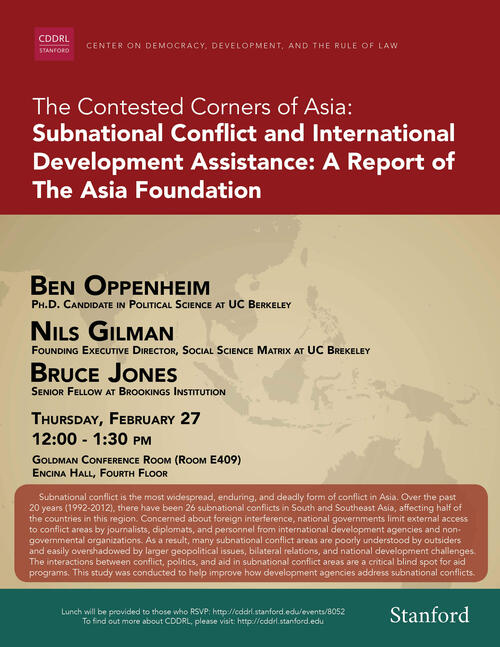
Subnational conflict is the most widespread, enduring, and deadly form of conflict in Asia. Over the past 20 years (1992-2012), there have been 26 subnational conflicts in South and Southeast Asia, affecting half of the countries in this region. Concerned about foreign interference, national governments limit external access to conflict areas by journalists, diplomats, and personnel from international development agencies and non-governmental organizations. As a result, many subnational conflict areas are poorly understood by outsiders and easily overshadowed by larger geopolitical issues, bilateral relations, and national development challenges. The interactions between conflict, politics, and aid in subnational conflict areas are a critical blind spot for aid programs. This study was conducted to help improve how development agencies address subnational conflicts.


Speaker Bios:

Ben Oppenheim is a Fellow (non-resident) at the Center on International Cooperation at New York University. His research spans a diverse set of topics, including fragile states, transnational threats (including pandemic disease risks and terrorism), and the strategic coherence and effectiveness of international assistance in fragile and conflict-affected areas.

Oppenheim has consulted for organizations including the World Bank, the United Nations, the Asia Foundation, the Institute for the Future, and the Fritz Institute, on issues including organizational learning, strategy, program design, foresight, and facilitation. In 2009, he served as Advisor to the first global congress on disarmament, demobilization, and reintegration, supported by the World Bank and the UN.

In 2013, Oppenheim was a visiting fellow at the Uppsala University Forum on Democracy, Peace, and Justice. His research has been supported by a Simpson Fellowship, and a fellowship with the Institute on Global Conflict and Cooperation. He was also a research fellow with UC Berkeley's Institute of International Studies, affiliated with the New Era Foreign Policy Project.


Nils Gilman is the Executive Director of Social Science Matrix. He holds a B.A., M.A. and Ph.D. in History from the University of California, Berkeley. Gilman’s first scholarly interest was in American and European intellectual history, with a particular focus on the institutional development of the social sciences, the lateral transfer and translation of ideas across disciplinary boundaries, and the impact of social scientific ideas on politics and policy.

Gilman is the author of Mandarins of the Future: Modernization Theory in Cold War America (Johns Hopkins University Press, 2004), the co-editor of Staging Growth: Modernization, Development, and the Global Cold War (University of Massachusetts Press, 2003) and Deviant Globalization: Black Market Economy in the 21st Century (Continuum Press, 2011), as well as the founding Co-editor of Humanity: An International Journal of Human Rights, Humanitarianism, and Development. He also blogs and tweets.

Prior to joining Social Science Matrix in September 2013, Gilman was research director at Monitor 360, a San Francisco consultancy that addresses complex, cross-disciplinary global strategic challenges for governments, multinational businesses, and NGOs. He has also worked at a variety of enterprise software companies, including Salesforce.com, BEA Systems, and Plumtree Software. Gilman has taught and lectured at a wide variety of venues, from the Harvard University, Columbia University, and National Defense University, to PopTech, the European Futurists Conference, and the Long Now Foundation.


Bruce Jones is a senior fellow and the director of the Project on International Order and Strategy in the Foreign Policy program at the Brookings Institution. He is also the director of the Center on International Cooperation at New York University.

Jones served as the senior external advisor for the World Bank’s 2011 World Development Report, Conflict, Security and Development, and in March 2010 was appointed by the United Nations secretary-general as a member of the senior advisory group to guide the Review of International Civilian Capacities. He is also consulting professor at the Center for International Security and Cooperation at Stanford University and professor (by courtesy) at New York University’s department of politics.

Jones holds a Ph.D. from the London School of Economics, and was Hamburg fellow in conflict prevention at Stanford University.

He is co-author with Carlos Pascual and Stephen Stedman of Power and Responsibility: Building International Order in an Era of Transnational Threats (Brookings Press, 2009); co-editor with Shepard Forman and Richard Gowan of Cooperating for Peace and Security (Cambridge University Press, 2009); and author of Peacemaking in Rwanda: The Dynamics of Failures(Lynne Reinner, 2001).

Jones served as senior advisor in the office of the secretary-general during the U.N. reform effort leading up to the World Summit 2005, and in the same period was acting secretary of the Secretary-General’s Policy Committee. In 2004-2005, he was deputy research director of the High-level Panel on Threats, Challenges and Change. From 2000-2002 he was special assistant to and acting chief of staff at the office of the U.N. special coordinator for the Middle East peace process. 

Richard and Rhoda Goldman Conference Room

Ben Oppenheim Ph.D. Candidate in Political Science Speaker UC Berkeley
Nils Gilman Founding Executive Director, Social Science Matrix Speaker UC Berkeley
Bruce Jones Senior Fellow Speaker Brookings Institution
Seminars
-

Abstract
The scope and complexity of global health can be overwhelming, making it difficult to form an inspiring and unified vision for the future. Mired in this complexity, the international community defines success disease by disease‹without a clear picture of what fundamental reform would actually look like. If the aspiration of global health with justice is the right goal, then answering three simple questions may pierce the haze.

First, what would global health look like? That is, given optimal priority-setting, funding, and implementation, to what level of health should we aspire, and with what provision of health-related services? Posing these three elementary questions, of course, oversimplifies a field that is fraught with tensions and trade offs. But I want to imagine a more ideal future for world health, with bold proposals to get there. After thinking about these three basic questions, I turn to an idea for innovative global governance for health‹a Framework Convention on Global Health.

Second, what would global health with justice look like? Global health seeks to improve all the major indicators of health, such as infant and maternal mortality and longevity. Global health with justice, however, requires that we look beyond improved health outcomes for the population as a whole. Although overall population health is vitally important, justice requires a significant reduction in health disparities between the well-off and the poor. Societies that achieve high levels of health and longevity for most, while the poor and marginalized die young, do not comport with social justice.

Third, what would it take to achieve global health with justice? That is, once we clearly state the goal, and meaning, of global health with justice, what concrete steps are required to reach this ambitious objective? This raises fundamental challenges, intellectually and operationally, as the response cannot be limited to ever-greater resources, but must also involve improved governance‹at the country and international level and across multiple sectors.

Lawrence O. Gostin is University Professor, Georgetown University’s highest academic rank conferred by the University President. Prof. Gostin directs the O’Neill Institute for National and Global Health Law and was the Founding O’Neill Chair in Global Health Law. He served as Associate Dean for Research at Georgetown Law from 2004 to 2008. He is Professor of Medicine at Georgetown University, Professor of Public Health at the Johns Hopkins University, and Director of the Center for Law & the Public’s Health at Johns Hopkins and Georgetown Universities.

 Prof. Gostin holds a number of international academic professorial appointments: Visiting Professor (Faculty of Medical Sciences) and Research Fellow (Centre for Socio-Legal Studies) at the University of Oxford, United Kingdom; the Claude Leon Foundation Distinguished Scholar and Visiting Professor at the University of Witwatersrand, Johannesburg, South Africa; and the Miegunyah Distinguished Visiting Fellow and Founding Fellow of the Centre for Advanced Studies (Trinity College), University of Melbourne. Prof. Gostin serves as Secretary and a member of the Governing Board of Directors of the Consortium of Universities for Global Health.

Building 200 (History Corner)
Room 205
Stanford University

Lawrence O. Gostin O'Neill Professor in Global Health Law Speaker Georgetown University
Seminars
-

Abstract:
The peoples of Burma/Myanmar have faced military rule, human rights violations, and poor health outcomes for decades. The country Is now undergoing a political liberalization, and multiple changes in political, social and economic life. The human rights and health situation of the country's many ethnic nationalities remain challenging, and represent one of the clearest threats to the prospect of successful transition to peace, and to democracy. We will explore the current health and human rights situation in the country, the ongoing threats to peace, and ways forward for this least developed nation as it emerges from 5 decades of military rule.

Chris Beyrer MD, MPH, is a professor of Epidemiology, International Health, and Health, Behavior, and Society at the Johns Hopkins University Bloomberg School of Public Health. He is the founding Director of the University¹s Center for Public Health and Human Rights, which seeks to bring the tools of population-based sciences to bear on Health and rights threats. Dr. Beyrer also serves as Associate Director of the Johns Hopkins Centers for AIDS Research (CFAR) and of the Center for Global Health. He has been involved in health and human rights work with Burmese populations since 1993. Prof. Beyrer is the author of more than 200 scientific papers, and author or editor of six books, including War in the Blood: Sex, Politics and AIDS in Southeast Asia, and Public Health and Human Rights: Evidence-Based Approaches. He has served as a consultant and adviser to numerous national and international institutions, including the National Institutes of Health, the World Bank, WHO, UNAIDS, the Open Society Foundations, the Walter Reed Army Institute for Research, amfAR The Foundation for AIDS Research, Physicians for Human Rights and Human Rights Watch. Dr. Beyrer received a BA in History from Hobart and Wm. Smith Colleges, his MD from SUNY Downstate in Brooklyn, NY, and completed his residency in Preventive Medicine, public health training, an MPH and a Infectious Diseases Fellowship at Johns Hopkins University in Baltimore. He received an honorary Doctorate (PhD) in Health Sciences from Chiang Mai University in Thailand, in 2012, in recognition of his 20 years of public health service in Thailand

Building 200 (History Corner)
Room 205
Stanford University

Chris Beyrer Director Speaker Johns Hopkins Center for Public Health & Human Rights
Seminars
-

Korea is one of the leading countries in technology-driven global markets for semiconductors, HDTVs, and mobile phones; and in shipbuilding industry, but Korea has already faced challenges in its global markets.

Dr. Dongwook Lee, 2013 Visiting Scholar in Korean Studies, will discuss Korea's industrial convergence policies that would help Park administration achieve its national agenda, a creative economy.

Dr. Lee is Director General at the Ministry of Trade, Industry and Energy in Korea, and has served as a government official for the past twenty-two years. He led and took part in developing industrial convergence policies and laws. Dr. Lee holds a BA in business administration from Yonsei University, an MA in public administration from Seoul National University, and a PhD in economics from Konkuk University, in Korea. 

Philippines Conference Room

Dongwook Lee 2013 Visiting Scholar, Shorenstein APARC Speaker
Seminars
-

At the November 2013 Third Plenum, China’s leaders committed to an ambitious program of economic reform.  Now their challenge is to convert those commitments into a realistic and sustained program of change.  Barry Naughton, just back from fall term at Tsinghua University in Beijing, examines the achievements and obstacles, and discusses how these fit in with the other initiatives of Xi Jinping’s complex emerging agenda.

Barry Naughton is a professor at the University of California, San Diego.  He is one of the world’s top experts on the Chinese economy, and a long-term analyst of Chinese economic policy. Naughton received his Ph.D. in Economics from Yale University in 1986.  Naughton was named the So Kuanlok Professor at the Graduate School of International Relations and Pacific Studies (IR/PS) of the University of California at San Diego in 1998.  He has consulted extensively for the World Bank, as well as for corporate clients.  Naughton is a member of the Council on Foreign Relations and is a non-resident fellow of the Brookings Institution in Washington, D.C.  

This event is co-sponsored with CEAS and is part of the China under Xi Jinping series.

Philippines Conference Room

Barry Naughton Professor of Chinese Economy Speaker UCSD
Seminars
Subscribe to Trade