


Human Capital and Labor Market of China
-
9:30-12:00 Session 1: Inequality of Human Capital and Labor Market Outcomes
Location: Goldman Conference Room, Encina Hall East (4th floor)
The Health and Nutrition Roots of China's Human Capital Crisis
Speaker:Scott Rozelle, Stanford University, US
Trade Liberalization, Social Policy Development and Labour Market Outcomes of
Chinese Women and Men in the Decade after China’s Accession to the World Trade
Organization
Speaker:Xiaoyuan Dong, The University of Winnipeg, Canada
Mismatch of the Boston Mechanism: Evidence from Chinese College Admission
Speaker:Binzhen Wu, Tsinghua University, China
12:00-1:00 Lunch
Location: Philippines Conference Room, Encina Hall (3rd Floor)
1:00-3:00 Session 2: Determinants for Labor Market Outcomes
Location: Philippines Conference Room, Encina Hall (3rd Floor)
Does Informal Employment Push college graduates into Low Income Trap?
Speaker:Xiaoying Li, Sun Yat-sen University, China
Cognitive Skills, Noncognitive Skills, and School-to-Work Transitions in Rural China
Speaker:Qiuqiong Huang, University of Arkansas, US
Institutional Labor Market Segmentation and Public Sector Reform in China
Speaker:Xiaohua Li, Chinese Academy of Personnel Science, China
Goldman Conference Room
Encina Hall East (4th Floor)
Workshops
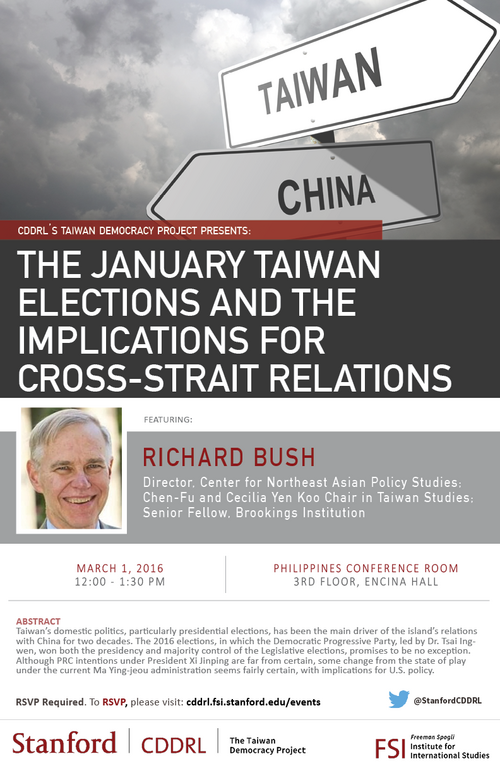
The January Taiwan Elections and the Implications for Cross-Strait Relations
-
Abstract
Taiwan’s domestic politics, particularly presidential elections, has been the main driver of the island’s relations with China for two decades. The 2016 elections, in which the Democratic Progressive Party, led by Dr. Tsai Ing-wen, won both the presidency and majority control of the Legislative elections, promises to be no exception. Although PRC intentions under President Xi Jinping are far from certain, some change from the state of play under the current Ma Ying-jeou administration seems fairly certain, with implications for U.S. policy.
Bio
Richard Bush is a Senior Fellow at the Brookings Institution and Director of its Center for Northeast Asian Policy Studies, and the Chen-Fu and Cecilia Yen Koo Chair in Taiwan Studies. He came to Brookings in July 2002 after nineteen years working in the US government, including five years as the Chairman and Managing Director of the American Institute in Taiwan. He is the author of a number of articles on U.S. relations with China and Taiwan, and of At Cross Purposes, a book of essays on the history of America’s relations with Taiwan, published in March 2004 by M. E. Sharpe. In the spring of 2005, Brookings published his study on cross-Strait relations, entitled Untying the Knot: Making Peace in the Taiwan Strait. In 2013, Brookings published his Uncharted Strait: The Future of China-Taiwan Relations.
This talk is co-sponsored by the Taiwan Democracy Project in the Center on Democracy, Development, and the Rule of Law and the U.S.-Asia Security Initiative in the Walter H. Shorenstein Asia-Pacific Research Center.
Image
Richard C. Bush
Senior Fellow and Director, Center for East Asian Policy Studies
Brookings Institution
Seminars
Taiwan and the Trans-Pacific Partnership: A Re-appraisal
-
This half-day symposium will bring together scholars and practitioners to reconsider Taiwan's prospects for entry into the Trans-Pacific Partnership in light of the conclusion of negotiations in October 2015 and the election of a new president and legislature in Taiwan in January 2016. It will revisit the themes and conclusions of the Taiwan Democracy Project's 2013 annual conference.
9:00-9:15am: Introductions
9:15-11:00am. Panel 1: The Politics of Trade and Development in Taiwan
Stephen Tan, Vice President of the Cross-Strait Policy Association, Taipei
Kristy Hsu, Director, Taiwan ASEAN Studies Center, Chung Hua Institution for Economic Research, Taipei
Chung-ming Kuan, Chair Professor, Department of Finance and Director of CRETA at National Taiwan University, and former Minister of the National Development Council
Hung-mao Tien, President of the Institute for National Policy Research, and former Minister of Foreign Affairs, Taiwan
11:00-11:15. Break
11:15-12:45. Panel 2: International Perspectives on the TPP: Implications for Regional Development and Geopolitics
Vinod Aggarwal, Professor of Political Science and Faculty Affiliate of the Center for East Asian Studies, UC Berkeley
Nicholas Hope, Director of the China Program at the Stanford Center for International Development
Thomas Gold, Professor of Sociology and Faculty Affiliate of the Center for East Asian Studies, UC Berkeley
CISAC Central Conference Room
Conferences
The Sunflower Movement and the Future of Taiwan's Political Culture
-
Abstract
Based on first-hand participant-observation, this talk will examine the culture, politics, and spatiality of the Sunflower Movement. Taiwan's most significant social movement in decades, the Sunflower Movement not only blocked the passage of a major trade deal with China, but reshaped popular discourse and redirected Taiwan's political and cultural trajectory. It re-energized student and civil society, precipitated the historic defeat of the KMT in the 2014 local elections, and prefigured the DPP's strong position coming into the 2016 presidential and legislative election season.
The primary spatial tactic of the Sunflowers-- occupation of a government building-- was so successful that a series of protests in the summer of 2015 by high school students was partly conceived and represented as a "second Sunflower Movement". These students, protesting "China-centric" curriculum changes, attempted to occupy the Ministry of Education building. Thwarted by police, these students settled for the front courtyard, where a Sunflower-style pattern of encampments and performances emerged. While this movement did not galvanize the wider public as dramatically as its predecessor, it did demonstrate the staying power of the Sunflower Movement and its occupation tactics for an even younger cohort of activists.
The Sunflower Movement showed that contingent, street-level, grassroots action can have a major impact on Taiwan's cross-Strait policies, and inspired and trained a new generation of youth activists. But with the likely 2016 presidential win of the DPP, which has attempted to draw support from student activists while presenting a less radical vision to mainstream voters, what's in store for the future of Taiwanese student and civic activism? And with strong evidence of growing Taiwanese national identification and pro-independence sentiment, particularly among youth, what's in store for the future of Taiwan's political culture?
Speaker Bio
 Ian Rowen in Taiwan's Legislative Yuan during the Sunflower Student Movement protest.
Ian Rowen is PhD Candidate in Geography at the University of Colorado, Boulder, and recent Visiting Fellow at the European Research Center on Contemporary Taiwan, Academia Sinica’s Institute of Sociology, and Fudan University. He participated in both the Sunflower and Umbrella Movements and has written about them for The Journal of Asian Studies, The Guardian, and The BBC (Chinese), among other outlets. He has also published about Asian politics and protest in the Annals of the Association of American Geographers (forthcoming) and the Annals of Tourism Research. His PhD research, funded by the US National Science Foundation, the Fulbright Program, and the Taiwan Foundation for Democracy, has focused on the political geography of tourism and protest in China, Taiwan, and Hong Kong.
Ian Rowen
Doctoral Candidate
University of Colorado Dept of Geography
Seminars
Shinzo Abe and the Reality of Japanese Democracy
Paragraphs
Writing for the National Bureau of Asian Research, Daniel Sneider examines Prime Minister Shinzo Abe’s recent attempts to revise Japan’s defense guidelines. He considers how these attempts may affect the Japanese domestic political landscape and the implications that Abe’s actions may have for key issues in the U.S.-Japan alliance, including the Trans-Pacific Partnership and U.S. military interests in Okinawa.
All Publications button
1
Publication Type
Policy Briefs
Publication Date
Journal Publisher
The National Bureau of Asian Research
Shuichiro Nishioka
Encina Hall E301616 Serra StreetStanford, CA94305-6055
(650) 723-6530
0
shuichir@stanford.edu
shuichiro_nishioka_headshot_crop.jpg
Ph.D.
Shuichiro Nishioka joins the Walter H. Shorenstein Asia-Pacific Research Center (Shorenstein APARC) during the 2015-16 academic year from the West Virginia University’s Department of Economics where he serves as an Associate Professor.
His research covers the broad issues on International Trade, Economic Development, and East Asian Economies. During his time at Shorenstein APARC, Nishioka will conduct research projects on the expanding inequality in China and Japan.
Nishioka previously affiliated for research and teaching at the Research Institute of Economy, Trade and Industry, the University of Pittsburgh and Hitotsubashi University. He contributes to articles to publications including the Journal of International Economics, the Journal of Development Economics, and European Economic Review.
Nishioka holds a PhD and an MA in Economics from the University of Colorado at Boulder, and a BA in Economics from Yokohama National University.
Visiting Scholar
Taiwan's National Security and the Trans-Pacific Partnership: The International Law Dimension
-
Abstract
The Trans-Pacific Partnership (TPP) is widely regarded as the economic component of the US strategy of “rebalance” to Asia. As a major trading partner of many of the founding members, Taiwan has obvious economic and security interests at stake and is therefore seeking to join the TPP in the next round. But an overlooked aspect of the TPP for Taiwan is its potential impact on sovereignty. Trade agreements provide a revealing window into the evolving conceptions of modern sovereignty. The way Taiwan’s unique form of statehood and international status is defined in trade agreements could strengthen its position under international law and contribute to its national security. This talk will consider how Taiwan was defined as a sui generis legal entity in its application to join the World Trade Organization (WTO) and as a party to the Cross-Straits Economic Cooperation Framework Agreement (ECFA), with lessons for future negotiations to join the TPP.
Speaker Bio
Image

This event is hosted by the Taiwan Democracy Project.
TPP and Taiwan
Download pdf
Joseph Yen-ching Chao
Visiting Fellow
Ministry of Foreign Affairs, Republic of China (Taiwan)
Seminars