
Comparative Cost of Care Recommended by LLMs vs. Treating Physicians
Comparative Cost of Care Recommended by LLMs vs. Treating Physicians
When researchers asked 24 AI systems to write treatment plans for 200 real patient visits, the AI recommended care that cost more than three times as much as the treating physicians’ plans.

Doctors and patients increasingly are turning to AI chatbots for medical advice, but no one has systematically measured what the care they recommend would actually cost.
So, Stanford Health Policy Professor Jeremy Goldhaber-Fiebert, PhD, and colleagues tested 24 AI systems on 200 real, de-identified clinical notes from outpatient and emergency visits in the United States. Each AI system reviewed the patient’s presenting information and wrote its own plan; the researchers then compared the treating physician’s documented plan.
Every test and referral was then priced at 2026 Medicare rates.
In their study published in NEJM AI, the researchers found that the AI plans were far more expensive: $314 per visit on average vs. $97 for the physicians—or more than three times more expensive. Extra diagnostic tests and extra specialist referrals contributed about equally, and the AI systems also recommended nearly twice as many new medications.
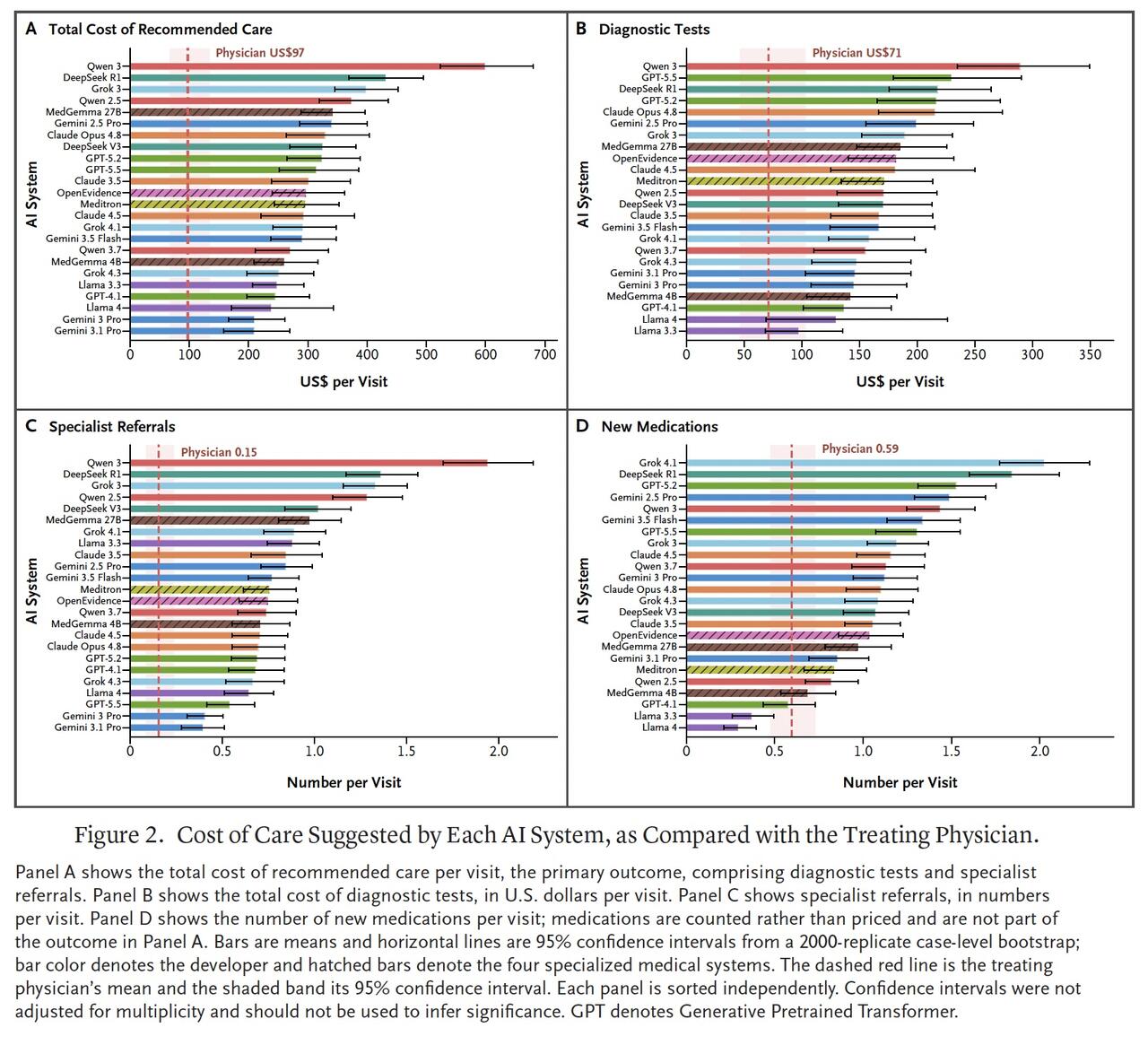
The AI systems built specifically for medicine were no more restrained in their recommendations than the general-purpose chatbots. The biggest driver was simple: in two-thirds of visits the physician ordered no tests at all, and in those visits every AI system recommended testing, which was often a boilerplate panel. Instructing the systems to be cost-conscious narrowed the gap—but didn’t close it.
“The bottom line is, left to their own judgment, today’s AI systems default to order more, and if their advice were followed at scale, it would add substantial cost to the health system,” said Goldhaber-Fiebert, adding this was chiefly because the chatbots suggested testing at visits where the physicians had ordered none.
“In its current form, these systems offer suggestions, not plans of care. They add tests by default, and the clinician has to decide what the patient actually needs,” said Dvir Aran PhD, a former postdoctoral fellow at Stanford who now is an associate professor at the Technion—Israel Institute of Technology.
“The next advance in clinical AI shouldn’t be systems that recommend more, but systems that know what is enough. Otherwise, we risk defensive medicine at scale,” said Aran, who is the study’s lead author.


