
Celebrating SPICE’s 50th: SPICE’s Africa Project, 1982–1985
Celebrating SPICE’s 50th: SPICE’s Africa Project, 1982–1985
Professor Emeritus Larry Becker reflects on the early years of SPICE’s Africa Project and how his experience with SPICE enriched and informed his academic journey and teaching practice.

This article was written by Dr. Larry Becker, Africa Project Coordinator at SPICE, 1982–1985, and Professor Emeritus of Geography at Oregon State University in Corvallis. This is the fourth of several articles—focusing on the 50-year history of SPICE—that will be posted this year. In its early years, SPICE comprised several separate area-focused projects.
Happy 50th birthday to SPICE! Those 50 years are a testament to the enduring value of the program and its ability to change with the times.
While enrolled in the Stanford Teacher Education Program (STEP) in 1982, I took David Grossman’s Global Education course and learned about the work of SPICE. It felt like a comfortable fit and welcome program following my upbringing in the integrated Berkeley public schools and undergraduate degree in geography. After the course, David approached me about the SPICE Africa Project Coordinator position. The coordinator at the time, Nebby Crawford, was leaving. Two years earlier, I had spent a summer in Mali with Operation Crossroads Africa. I gave a presentation at the Bay Area Global Education Program (BAGEP) Africa Summer Institute for teachers, plunging into the SPICE world of in-service teacher education at age 23.
Over the next three years, I had the privilege of working with the SPICE team, Stanford African Studies faculty and students, Bay Area K–12 teachers, and a network of African Studies outreach coordinators around the country. At the time, the Africa Project Coordinator position was partly funded by the Title VI Joint Center for African Studies at Stanford and U.C. Berkeley. I thus was exposed to rich academic African Studies educational resources while representing SPICE at annual conferences. I also established working relationships with members of the Stanford African Students Association. Graduate students from various countries contributed to the Summer Institute on Africa, visited precollegiate classrooms, and reviewed supplementary curriculum SPICE units that we developed with K–12 teachers.
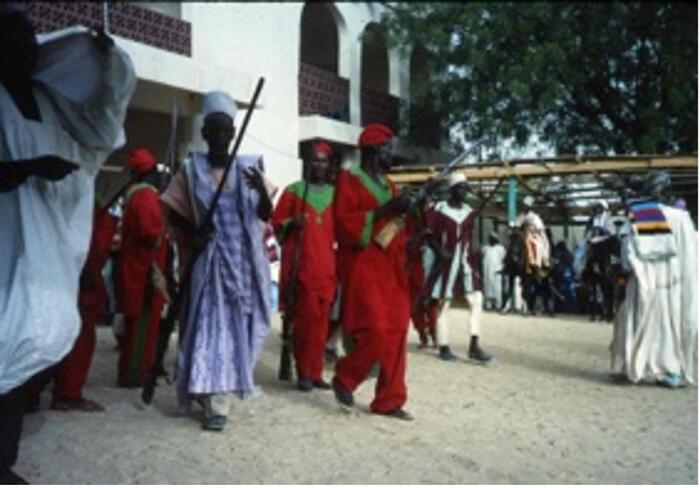
In the summer of 1984, I co-led a U.S. Department of Education-funded summer education trip for teachers to Nigeria. Together with co-leader, Dr. Faye McNair-Knox—with a background in Hausa linguistics and community organizing in East Palo Alto—we navigated a country recently under military rule with an overvalued currency on a limited budget. As the group travelled from a festival in the Gumel Emirate near the Niger border south to the metropolis of Lagos on the Gulf of Guinea, we stayed at university campuses where Bay Area teachers were exposed to Nigeria’s rich culture through professors from a variety of fields, local leaders, and artists. (Photo below of the Emir of Gumel’s entourage at the end of Ramadan, June 1984, in what is now Jigawa State, Nigeria, as seen during a summer education trip for teachers; courtesy of Larry Becker.)
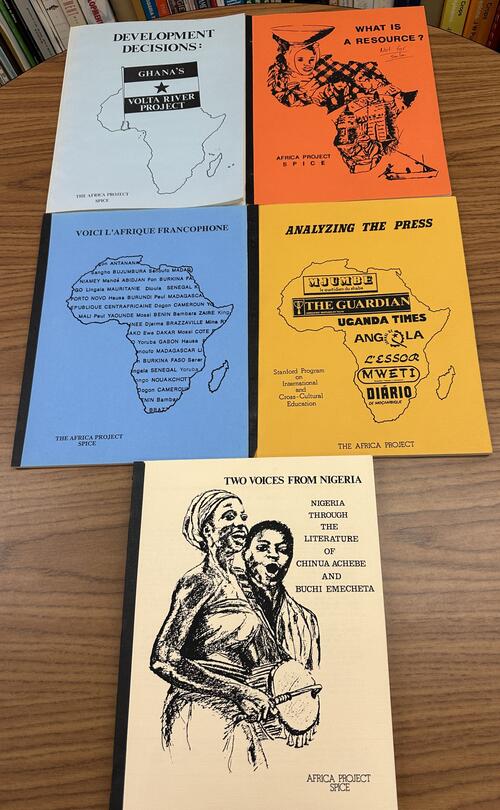
By the time I left SPICE, the Africa Project had five curriculum units: Analyzing the Press (1985), Development Decisions: Ghana’s Volta River Project (1985), What Is a Resource? (1985), Two Voices from Nigeria: Nigeria through the Literature of Chinua Achebe and Buchi Emecheta by Nigeria trip participants Lyn Reese and Rick Clarke (1985), and Voici l’Afrique Francophone with Foster City French teacher Joan Henley (1986).
Enriched by the work at SPICE, I completed a PhD in geography with research on agrarian change in Mali at the University of London’s School of Oriental and African Studies (SOAS) and a postdoc at the Africa Rice Center in Cote d’Ivoire. I had a university career teaching geography, notably large enrollment world regional geography courses, that greatly benefited from what I learned while at SPICE.
Over the years of teaching about Africa in the U.S., I saw how attention to the context, identity, and positionality of the instructor and students contributes to successful classroom strategies and curriculum development. My SPICE experience provided a base for understanding this evolving pedagogy. In touch with SPICE colleagues years later, former colleague Steve Thorpe contributed to a seminar series that I led at Oregon State University aimed at globalizing courses throughout the campus. The ideas of SPICE carry on in familiar ways in new teaching settings!
To stay informed of SPICE news, join our email list and follow us on Facebook, X, and Instagram.


