
Celebrating SPICE’s 50th: Gratitude to Dr. Daniel Okimoto, Professor Emeritus, Stanford
Celebrating SPICE’s 50th: Gratitude to Dr. Daniel Okimoto, Professor Emeritus, Stanford
Dr. Okimoto served for decades as the Principal Investigator and speaker for multiple U.S.–Japan-focused projects for SPICE.

This is the second of several articles—focusing on the 50-year history of SPICE—that will be posted this year.
As noted in the article, “Celebrating SPICE’s 50th: SPICE’s Roots in the Bay Area China Education Project (BAYCEP),” that was written by Dr. David Grossman, founding director of SPICE, SPICE was established in 1976. Professor Daniel Okimoto joined Stanford in 1977, and I met him in 1988 when I joined SPICE. I had first heard of Professor Okimoto in fall 1972 during my freshman year in college. I read an excerpt, “The Intolerance of Success,” from his book, American in Disguise, that was reprinted in Roots: An Asian American Reader. During my first meeting with him, I learned that his family was incarcerated in the same concentration camp for Japanese Americans as my family during World War II. The camp was in Poston, Arizona. Okimoto was born in 1942 at the Santa Anita Assembly Center, a temporary detention facility for Japanese Americans. The detention facility was located at the Santa Anita Racetrack in Southern California, and Okimoto was born in a horse stable. From there, his family was moved and incarcerated in Poston. Since learning about this connection between Okimoto’s family and mine, I felt a strong personal connection to him.
Since the beginning of my time at SPICE, Professor Okimoto has been unwavering in his support of SPICE’s projects on U.S.–Japan relations and the Japanese American experience. He served as the Principal Investigator for multiple U.S.–Japan relations- and Japanese American-focused curriculum projects, the Reischauer Scholars Program (an online course that has been offered to high school students in the United States since 2004), and Stanford e-Japan (an online course that has been offered to high school students in Japan since 2015). One of SPICE’s most popular multimedia offerings is “An Interpretive History of Japan,” which is based on six lectures by Okimoto. Through these projects, I also established a strong professional connection to him.
Professor Okimoto has been an incredible champion for the Reischauer Scholars Program from its inception, rallying other U.S.–Japan experts and leaders to back our mission of teaching and inspiring the next generation of young scholars to strengthen ties between the United States and Japan. Over the past 20+ years, his guidance and example as a mentor have shaped me as a teacher and profoundly strengthened a vibrant community of educators and students.—Naomi Funahashi, Reischauer Scholars Program instructor
Prof. Daniel Okimoto has championed the Stanford e-Japan Program since its inception. In addition to providing some of the lectures for the initial cohorts, Dan was also generous with his time and knowledge with high school students in Japan through guest speaking in Virtual Classrooms.—Waka Takahashi Brown and Meiko Kotani, Stanford e-Japan Program instructors
Importantly, numerous SPICE staff (past and present) have studied under Okimoto, including Dr. Mariko Yang-Yoshihara, an educational researcher and instructor for SPICE whose primary advisor was Okimoto. She noted the following: “Having Dan Okimoto as my doctoral advisor was one of the greatest blessings in my life. What I gained from his mentorship both as a student and as a person was immense, and two moments in particular stay with me today. The first was the Japanese Imperial couple’s visit to the Stanford campus in 1994. Dan’s role as Stanford’s leading Japan expert often meant welcoming distinguished visitors from around the world; and on that occasion, he chose to share something deeply personal, that he had been born in a horse stable as his family was sent to a concentration camp. And in response, Empress Michiko called him ‘another great man born in a horse stable.’ This brief exchange stayed with me through my time as a student as it felt like a real glimpse into my advisor’s life as a Japanese American scholar, carrying the weight of history while still holding onto the quiet warmth of our shared humanity. The second anecdote came shortly after 9/11, when so many of us were grappling with fear and uncertainty of the future. As I sat in his office, anxious and overwhelmed, Dan said very little except, very quietly, ‘I worry about the Muslim American community.’ In that moment, I came to understand how deeply his own experiences had shaped how he cares for the world: amid a national crisis, his heart instinctively focused on vulnerable communities. These were the moments from which I learned the most as his student: lessons in humanity and empathy. They have since become the foundation of the learning goals in the courses I teach. I hope that our work at SPICE will honor and carry forward Dan’s legacy by developing curricula that shed light on the Japanese American experience and nurture empathy and a sense of shared humanity in future generations.”
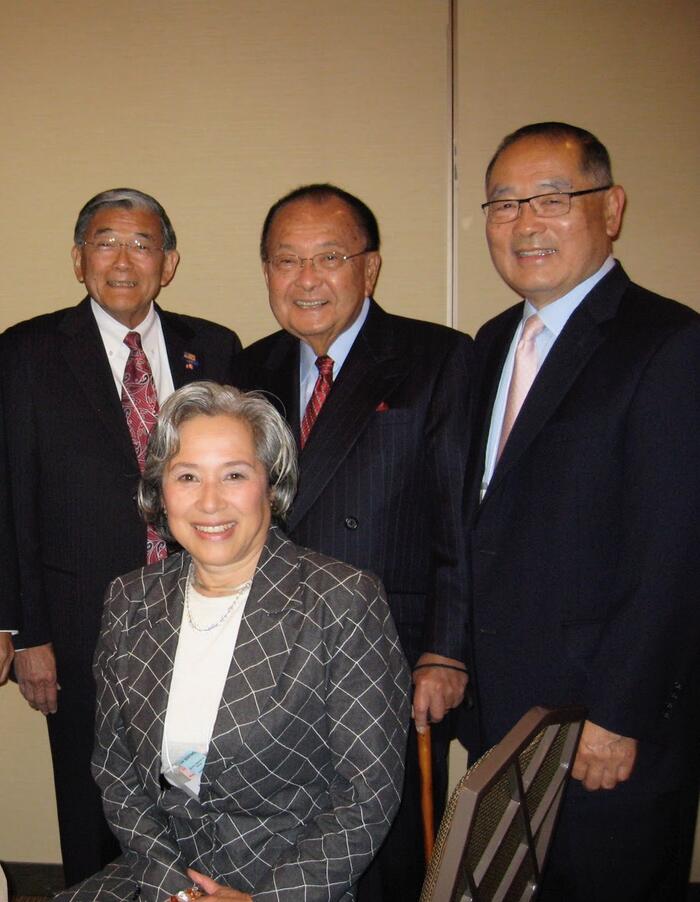
On behalf of the SPICE staff, I would like to express my heartfelt gratitude to Professor Okimoto for his unwavering support of SPICE. As someone who was born in a horse stable and unjustly incarcerated as a child without due process by his own country—along with approximately 120,000 people of Japanese descent, two thirds of whom were U.S. citizens—and is now Professor Emeritus of Stanford University, he remains a tremendous role model and inspiration to us at SPICE. He and his wife, Michiko, are still contributing greatly to U.S.–Japan relations through organizations like the Silicon Valley Japan Platform and the U.S.-Japan Council. They worked closely with the late Secretary Norman Mineta (left) and the late Senator Daniel Inouye (center); photo above courtesy of Daniel Okimoto. Like Okimoto, Secretary Mineta was also incarcerated by his country as a child during World War II. Senator Daniel Inouye was a Medal of Honor recipient for his service in the U.S. Army during World War II. Like Okimoto, Mineta and Inouye were also recipients of the Order of the Rising Sun.
To stay informed of SPICE news, join our email list and follow us on Facebook, X, and Instagram.
