
Investment
Authors
News Type
News
Date
Paragraphs

Philanthropist and software giant Bill Gates spoke to a Stanford audience last week about the importance of foreign aid and product innovation in the fight against chronic hunger, poverty and disease in the developing world.

His message goes hand-in-hand with the ongoing work of researchers at Stanford’s Freeman Spogli Institute for International Studies. Much of that work is supported by FSI’s Global Underdevelopment Action Fund, which provides seed grants to help faculty members design research experiments and conduct fieldwork in some of the world’s poorest places.

Four FSI senior fellows – Larry Diamond, Jeremy Weinstein, Paul Wise and Walter Falcon – respond to some of the points made by Gates and share insight into their own research and ideas about how to advance and secure the most fragile nations.

Without first improving people’s health, Gates says it’s harder to build good governance and reliable infrastructure in a developing country. Is that the best way to prioritize when thinking about foreign aid?

Larry Diamond: I have immense admiration for what Bill Gates is doing to reduce childhood and maternal fatality and improve the quality of life in poor countries.  He is literally saving millions of lives.  But in two respects (at least), it's misguided to think that public health should come "before" improvements in governance.  

First, there is no reason why we need to choose, or why the two types of interventions should be in conflict.  People need vaccines against endemic and preventable diseases – and they need institutional reforms to strengthen societal resistance to corruption, a sociopolitical disease that drains society of the energy and resources to fight poverty, ignorance, and disease.  

Second, good governance is a vital facilitator of improved public health.  When corruption is controlled, public resources are used efficiently and justly to build modern sanitation and transportation systems, and to train and operate modern health care systems.  With good, accountable governance, public health and life expectancy improve much more dramatically.  When corruption is endemic, life-saving vaccines, drugs, and treatments too often fall beyond the reach of poor people who cannot make under-the-table payments. 

Foreign aid has come under criticism for not being effective, and most countries have very small foreign aid budgets. How do you make the case that foreign aid is a worthy investment?

Jeremy M. Weinstein: While foreign aid may be a small part of most countries’ national budgets, global development assistance has increased markedly in the past 50 years. Between 2000 and 2010, global aid increased from $78 billion to nearly $130 billion – and the U.S. continues to be the world’s leading donor.

The challenge in the next decade will be to sustain high aid volumes given the economic challenges that now confront developed countries. I am confident that we can and will sustain these volumes for three reasons.

First, a strong core of leading voices in both parties recognizes that promoting development serves our national interest. In this interconnected world, our security and prosperity depend in important ways on the security and prosperity of those who live beyond our borders.

Second, providing assistance is a reflection of our values – it is these humanitarian motives that drove the unprecedented U.S. commitment to fighting HIV/AIDS during the Bush Administration.

Perhaps most importantly, especially in tight budget times, development agencies are learning a great deal about what works in foreign assistance, and are putting taxpayers’ dollars to better use to reduce poverty, fight disease, increase productivity, and strengthen governance – with increasing evidence to show for it.

Some of the most dire situations in the developing world are found in conflict zones. How can philanthropists and nongovernmental organizations best work in places with unstable governments and public health crises? Is there a role for larger groups like the Gates Foundation to play in war-torn areas?

Paul H. Wise: As a pediatrician, the central challenge is this: The majority of preventable child deaths in Sub-Saharan Africa and in much of the world occur in areas of political instability and poor governance. 

This means that if we are to make real progress in improving child health we must be able to enhance the provision of critical, highly efficacious health interventions in areas that are characterized by complex political environments – often where corruption, civil conflict, and poor public management are the rule. 

Currently, most of the major global health funders tend to avoid working in such areas, as they would rather invest their efforts and resources in supportive, well-functioning locations.  This is understandable. However, given where the preventable deaths are occurring, it is not acceptable. 

Our efforts are directed at creating new strategies capable of bringing essential services to unstable regions of the world.  This will require new collaborations between health professionals, global security experts, political scientists, and management specialists in order to craft integrated child health strategies that respect both the technical requirements of critical health services and the political and management innovations that will ensure that these life-saving interventions reach all children in need.

Gates says innovation is essential to improving agricultural production for small farmers in the poorest places. What is the most-needed invention or idea that needs to be put into place to fight global hunger?

Walter P. Falcon: No single innovation will end hunger, but widespread use of cell phone technology could help.

Most poor agricultural communities receive few benefits from agricultural extension services, many of which were decimated during earlier periods of structural reform. But small farmers often have cell phones or live in villages where phones are present.

My priority innovation is for a  $10 smart phone, to be complemented with a series of very specific applications designed for transferring knowledge about new agricultural technologies to particular regions.  Using the wiki-like potential of these applications, it would also be possible for farmers from different villages to teach each other, share critical local knowledge, and also interact with crop and livestock specialists.

Language and visual qualities of the applications would be key, and literacy problems would be constraining.  But the potential payoff seems enormous.

Hero Image
RTXG95C logo
Children play near a punctured water pipe in Nairobi's Kibera slums.
REUTERS/Noor Khamis
All News button
1
-

Timed between the election's first and second rounds, this discussion brings together noted scholars and authors with unique and deep insight into contemporary French political culture.

Co-sponsored by the Europe Center and the French Culture Workshop


A brief write-up of this discussion titled "French vote a rejection of Sarkozy, panelists say" can be found in the May 7, 2012 edition of the Stanford Daily.


Event Summary:

Arthur Goldhammer opens the panel by arguing that the first round of the French presidential elections, not the second, are "the real story." For the first time in the history of the Fifth Republic, divisions between left and right were less pronounced than between the top two tiers of candidates (Hollande/Sarkozy, and Melénchon/Le Pen) especially regarding their attitudes toward European integration, globalization, and the Euro. Goldhammer points out that given France's role as a top global investor as well as a leading destination for foreign investment, the anti-globalization stance of the second tier candidates is unrealistic, although it enjoyed broad support at the polls. Sarkozy responded to this show of support by attacking the Shengen agreement and other aspects of the EU in a bid to win votes, while Hollande kept a low profile on the same issues. If Hollande wins, Goldhammer predicts, he will be tested by the markets and the global financial industry. He also points out that the Socialist and UNP parties are both internally divided on important issues.  If Sarkozy loses and decides to leave politics, Goldhammer predicts a power struggle for leadership of the party.

Laurent Cohen-Tanugi predicts that if Hollande wins, the outcome will be a statement against Sarkozy more than one in favor of Hollande. He echoes Arthur Goldhammer's concern about a strong market reaction to a victory by Hollande, who has positioned himself as pro-growth and has sanctioned Sarkozy for his strict austerity measures. Cohen-Tanugi adds that Hollande's focus is on domestic politics, and that he lacks significant international experience. Whoever wins, he cautions, France is in for difficult times.

Jimia Boutouba describes the rise of the extreme right – which has invoked nostalgia for a pre-globalization era - leading up to the elections. This rise has been dominated by Marine Le Pen and the Front National, which vows to defend the "French way of life" and (like Sarkozy as the election neared) has made anti-immigration rhetoric a key component of its platform. Le Pen, however, has attracted many first time, rural, and female voters, and has been successful in setting the tone and the agenda of national politics. Boutouba sees several problems with this trend toward defining the nation by what it opposes (Islam, globalization, international finance, etc), and warns it can be very disruptive to the political system, pointing to the recent fall of the Dutch government. More significantly, the anti-immigrant tone of the discourse discourages second and third generation descendants of immigrants from voting or participating in the political process.

A question and answer session following the roundtable addressed such questions as: Have both Hollande and Sarkozy radicalized their rhetoric and proposals to win support from far right and far left voters? Will the taxes and government spending (which is already very high in France, at 57%) promised by some politicians choke private sector growth? Which candidate will be most attractive to this new generation of French college graduates? What are the main differences between the three potential leaders currently jockeying for control of Sarkozy's party? To what extent would a Hollande presidency be beholden to Communists, Greens, and other extreme left parties? How will a Hollande presidency affect France's involvement with NATO, and relations with the United States? What are the prospects for the future of the Euro?


CISAC Conference Room

Arthur Goldhammer Translator, writer, and Senior Affiliate at the Center for European Studies at Harvard University; member of the editorial boards at "French Politics, Culture, and Society", and "La Revue Tocqueville/The Tocqueville Review" Speaker
Laurent Cohen-Tanugi Visiting Lecturer at the Stanford Law School, international lawyer, policy adviser and public intellectual Speaker
Jimia Boutouba Assistant Professor of Modern Languages and Literatures Speaker Santa Clara University
Panel Discussions

In this session of the Shorenstein APARC Corporate Affiliate Visiting Fellows Research Presentations, the following will be presented:


Kazuma Fukai, "Current Situation of Shale Gas Revolution and its Impact on the U.S. and Japan"

Shale gas is called a “game changer”. According to the Energy Information Administration, shale gas will be the major source of incremental U.S. natural gas supply, increasing its share of production from 23% in 2010 to 49% in 2035. President Obama expressed even as the U.S. develops next generation energy technologies, the U.S will continue to rely on oil and gas. Due to the shale gas boom, the current price of natural gas (U.S. Henry Hub) is declining, about 1/8 of the peak price in 2005. Given the importance of environmental issues and efficiency, combined with depressed natural gas prices, the demand for natural gas in the power sector will grow rapidly. In Japan, the unprecedented nuclear disaster at the Fukushima Daiichi Nuclear Power Plant affected energy policy dramatically. While the future of nuclear power in Japan is still unclear, natural gas power plants would be one of the most important energy resources to compensate for the loss of nuclear power plants as a realistic and reliable short and middle term approach. If the abundance of natural gas in the U.S. flows to Japan, it would contribute to a choice of supplier and different price formula for Japan. Fukai will present information based on the current state of shale drilling in the U.S., environmental issues, and interviews with many key experts and professors in shale gas as well as his experience at Kansai Electric Power Company.


Katsunori Hirano, "Learning from Sustainable Energy Financing Models Operating in the U.S. Market:  A Study for Japan's Clean and Safe Energy Future after Fukushima"

The Fukushima meltdown, which followed a devastating natural disaster in March 2011, presented the Japanese citizenry clear evidence that the way to meet their energy needs had not been sustainable. They have found the value of improving their resilience and security by their own initiative, intelligence, and foresight. The growth in the energy efficiency and renewable energy market is the defining feature of Japan’s energy future.

A substantial number of financing models are being implemented to help encourage investment in energy efficiency improvements and renewable energy deployments in the United States. In his research, Hirano tries to identify the best model operating in the U.S. market to provide financing opportunities for sustainable energy.  The local authorities in Japan can swiftly and flexibly apply this model for local households and businesses in their jurisdiction.


Yuji Kamimai, "A New Business Model for the Media Industry"

For a long time, it has been said that media is the mirror of the times we live in.  In his research, Kamimai tries to understand the ascent of and vast changes of media through a historical backdrop to help explain and recognize new service and technological innovation in the Silicon Valley.  Additionally, he examines some trends other than media that could help provide a deeper understanding.  From the rise of media and the latest IT business model, Kamimai learns what is important for the media to do, and explains what the next action steps are.  


Masami Miyashita, "A Study about the Ecosystem that Creates and Develops Global Start-ups"

Innovation is critical to economic growth, and entrepreneurship and startups are pivotal ingredients of innovation. After Japan’s economic bubble bursting in 1990, there was much talk about the lack of entrepreneurship in Japan as a driver of creative destruction and economic revival. The “Silicon Valley model” of entrepreneurship was heavily studied. Beginning in the late 1990s, the Japanese government rapidly developed institutional and social frameworks for startups in Japan. In the early 2000s, however, few Japanese startups were global in scale, and the presence in Silicon Valley of Japanese entrepreneurs and startup were still very limited. After the first decade of the 21st century, there are preliminary indications of a new wave of startups by Japanese entrepreneurs making inroads in Silicon Valley. Compared to other groups, such as Chinese or Indians, the number of Japanese entrepreneurs in Silicon Valley still remains miniscule. However, for the Japanese entrepreneurs to take advantage of the Silicon Valley entrepreneurial and innovation opportunities, lessons from the experiences and challenged faced by Japanese based in Silicon Valley are important.  In his research, Miyashita provides some of the key factors that are feeding this new wave of startups.


Philippines Conference Room

Kazuma Fukai Speaker Kansai Electric Power Company
Katsunori Hirano Speaker Shizuoka Prefectural Government
Yuji Kamimai Speaker Sumitomo Corporation
Masami Miyashita Speaker Ministry of Economy, Trade & Industry, Japan
-

In this session of the Shorenstein APARC Corporate Affiliate Visiting Fellows Research Presentations, the following will be presented:


Kazuma Fukai, "Current Situation of Shale Gas Revolution and its Impact on the U.S. and Japan"

Shale gas is called a “game changer”. According to the Energy Information Administration, shale gas will be the major source of incremental U.S. natural gas supply, increasing its share of production from 23% in 2010 to 49% in 2035. President Obama expressed even as the U.S. develops next generation energy technologies, the U.S will continue to rely on oil and gas. Due to the shale gas boom, the current price of natural gas (U.S. Henry Hub) is declining, about 1/8 of the peak price in 2005. Given the importance of environmental issues and efficiency, combined with depressed natural gas prices, the demand for natural gas in the power sector will grow rapidly. In Japan, the unprecedented nuclear disaster at the Fukushima Daiichi Nuclear Power Plant affected energy policy dramatically. While the future of nuclear power in Japan is still unclear, natural gas power plants would be one of the most important energy resources to compensate for the loss of nuclear power plants as a realistic and reliable short and middle term approach. If the abundance of natural gas in the U.S. flows to Japan, it would contribute to a choice of supplier and different price formula for Japan. Fukai will present information based on the current state of shale drilling in the U.S., environmental issues, and interviews with many key experts and professors in shale gas as well as his experience at Kansai Electric Power Company.


Katsunori Hirano, "Learning from Sustainable Energy Financing Models Operating in the U.S. Market:  A Sutdy for Japan's Clean and Safe Energy Future after Fukushima"

The Fukushima meltdown, which followed a devastating natural disaster in March 2011, presented the Japanese citizenry clear evidence that the way to meet their energy needs had not been sustainable. They have found the value of improving their resilience and security by their own initiative, intelligence, and foresight. The growth in the energy efficiency and renewable energy market is the defining feature of Japan’s energy future.

A substantial number of financing models are being implemented to help encourage investment in energy efficiency improvements and renewable energy deployments in the United States. In his research, Hirano tries to identify the best model operating in the U.S. market to provide financing opportunities for sustainable energy.  The local authorities in Japan can swiftly and flexibly apply this model for local households and businesses in their jurisdiction.


Yuji Kamimai, "A New Business Model for the Media Industry"

For a long time, it has been said that media is the mirror of the times we live in.  In his research, Kamimai tries to understand the ascent of and vast changes of media through a historical backdrop to help explain and recognize new service and technological innovation in the Silicon Valley.  Additionally, he examines some trends other than media that could help provide a deeper understanding.  From the rise of media and the latest IT business model, Kamimai learns what is important for the media to do, and explains what the next action steps are.


Masami Miyashita, "A Study about the Ecosystem that Creates and Develops Global Start-ups"

Innovation is critical to economic growth, and entrepreneurship and startups are pivotal ingredients of innovation. After Japan’s economic bubble bursting in 1990, there was much talk about the lack of entrepreneurship in Japan as a driver of creative destruction and economic revival. The “Silicon Valley model” of entrepreneurship was heavily studied. Beginning in the late 1990s, the Japanese government rapidly developed institutional and social frameworks for startups in Japan. In the early 2000s, however, few Japanese startups were global in scale, and the presence in Silicon Valley of Japanese entrepreneurs and startup were still very limited. After the first decade of the 21st century, there are preliminary indications of a new wave of startups by Japanese entrepreneurs making inroads in Silicon Valley. Compared to other groups, such as Chinese or Indians, the number of Japanese entrepreneurs in Silicon Valley still remains miniscule. However, for the Japanese entrepreneurs to take advantage of the Silicon Valley entrepreneurial and innovation opportunities, lessons from the experiences and challenged faced by Japanese based in Silicon Valley are important.  In his research, Miyashita provides some of the key factors that are feeding this new wave of startups.


Philippines Conference Room

Kazuma Fukai Speaker Kansai Electric Power Company
Katsunori Hirano Speaker Shizuoka Prefectural Government
Yuji Kamimai Speaker Sumitomo Corporation
Masami Miyashita Speaker Ministry of Economy, Trade & Industry, Japan
Seminars
-

In this session of the Shorenstein APARC Corporate Affiliate Visiting Fellows Research Presentations, the following will be presented:


Minoru Aosaki, "Banking System and Sovereign Risk in Japan"

After the financial crisis of 2008, European financial markets have experienced sharp increases of sovereign risk. This adversely affected the solvency of banking institutions as they suffered losses from their sovereign holdings and deterioration in their funding conditions. Meanwhile, Japan's sovereign market remained stable, but market participants were cautious as the country’s debt-to-GDP ratio is the highest in the world, and its banking sector holds as much as 44% of domestic sovereign debt. The question is how Japanese policy makers should address the sovereign risk in the banking system. In pursuit of this question, Aosaki compares the market environment in Japan and the Euro Area, examining the reasons banks hold sovereign bonds and the channels that connect sovereign risk with the banking system.

Prashant Pandya, "Cell-based Therapies -- Current Trends and Future Prospects"

Stem cells have been the subject of considerable excitement and debate over the last decade. Stem cell therapy is emerging as a potentially revolutionary new way to treat disease and injury, with wide-ranging medical benefits. Stem cell research provides the opportunity to advance our understanding of human biology and treatment of various diseases. In Pandya’s research, he shares his experience about major challenges related to the commercial development of stem cell therapies and key technology drivers. This research is based on consultations with several prestigious regulatory agencies—including the U.S. Food and Drug Administration, European Medicines Agency, and Therapeutic Goods Administration of Australia—as well as interviews with 45 CEOs and senior scientists of large and small biotech companies and professors from leading universities across five countries. Pandya’s research reveals that there are many intriguing aspects of stem cells still remaining to be elucidated. Stem cells have the potential to treat an enormous range of diseases and conditions that plague millions of people and offer exciting promise for future therapies. But significant technical hurdles remain that will only be overcome through years of intensive research, and successful commercialization of cell-based therapies requires more than proving safety and efficacy to regulators. Ultimately the therapy must be commercially viable.

Ramnath Ramanathan, "Designing Toxicology Studies for Small Interfering Ribo Nucleic Acid"

The field of medicine has improved drastically over the period of time. Medical treatment has evolved from using plant extracts to chemical drugs to stem cell and gene therapies. Discovery of small interfering Ribo Nucleic Acid (siRNA) was one of the most important recent breakthroughs in the field of medicine. This was due to siRNA’s capability of posttranscriptional gene silencing by destruction of mRNA and thereby reducing the protein synthesis. Though the efficacy studies conducted in vitro and in animal models are promising, there have also been circumstances where there were adverse effects including mortality of animals treated with siRNA. Since RNA interference is a relatively new technique, it is very important to understand the toxicity involved before using it as a therapy. For this purpose, toxicology studies have to be designed in order to address all questions on the safety aspects of siRNA. In addition to the traditional toxicity studies, several other tests will have to be conducted. These additional studies will have to address issues specific to siRNA therapy such as immune activation, formation of tetraplex DNA, down regulation of non-target mRNA, interaction with cellular proteins, etc. Through Ramanathan’s work, he has designed a battery of toxicology studies to understand the side effects so that only relatively safe therapy is tried on humans during clinical trials. Ramanathan will present his findings.


Philippines Conference Room

Minoru Aosaki Speaker Ministry of Finance, Japan
Prashant Pandya Speaker Reliance Life Sciences
Ramnath Ramanathan Speaker Reliance Life Sciences
Seminars
Authors
News Type
Q&As
Date
Paragraphs

After stirring international media attention and drawing criticism from its neighbors and the United States, North Korea’s controversial launch of a rocket under the guise of installing an “Earth observation” satellite in orbit took place on Apr. 13.

David Straub, associate director of Stanford’s Korean Studies Program, assesses the likely responses of the United States and other concerned countries, and provides historical context for the actions of North Korea’s leadership.

How is the launch going to impact North Korea’s relations with the United States and other countries?

We have already “been there, done that.” This will be the third North Korean test of a long-range rocket in six years. Shortly after the launches in 2006 and 2009, the North Koreans tested their first nuclear devices. The concern is that they will again use the expected international condemnation of their launch as a pretext for conducting another nuclear test.

But sometimes experience changes perspective. The United States and other countries will want to try to respond to the rocket test in a way that complicates any North Korean effort to justify a new nuclear test.

The international community really cannot remain silent, because United Nations Security Council (UNSC) Resolution 1874, which was passed in 2009, forbids North Korea from conducting precisely this kind of launch. I anticipate the UNSC will meet to discuss the situation but will not be able to issue a formal resolution. It will probably wind up issuing only a UNSC presidential statement criticizing the launch. China is the main obstacle. It does not approve of North Korea’s activities, but it is more concerned that putting great pressure on North Korea will result in instability. 

The United States, South Korea, and Japan will continue to consult and coordinate closely with one another. They may take additional measures to collect intelligence about North Korea’s nuclear and missile programs. They may also look to bolster their cooperation on missile defense, and take further steps to restrict North Korea’s access to nuclear- and missile-related materials and technology. They may apply additional economic sanctions to show their disapproval of North Korea’s actions.

Do you think the launch is going make it more difficult for North Korea to conduct trade and obtain aid and development assistance?

North Korea’s behavior now is part and parcel of its behavior over the past several decades. For the North Korean regime, the wellbeing of its people is clearly a secondary priority compared to its own survival.

At least since the end of the cold war, North Korea has faced a dilemma: Open up or fail, or open up and fail. In other words, it needs to open up to receive outside investment and technology if it is ever to have a successful economy. If it does not do that, the regime is unsustainable over the long run. But North Korea’s leaders fear that opening to the outside world would bring down their regime because it will expose the country’s weaknesses to its people. In order to get out of this dilemma, they have reached for weapons of mass destruction—particularly nuclear devices and the missiles they hope eventually can carry them. That is why there is no indication the North Korean leadership is prepared to completely give up those programs, at least on any terms that the United States, Japan, or South Korea could accept.

This is a long-term challenge for the United States and its allies. We have to see the situation for what it is, and deal with it accordingly. That means we must never “accept” North Korea’s possession of nuclear weapons and long-range missiles. As long as North Korea maintains these programs, we must make it clear that we will not establish diplomatic relations or ease sanctions. But that also does not mean that we should not continue to hold out to North Korea the possibility of a negotiated settlement, should it really be prepared to completely give up these programs.  

What are some of the key things to keep in mind about North Korea’s recent actions and about the country in general?

To understand what North Korea is doing, we have to get back to basics. The fundamental situation stems from the 1945 division of the Korean Peninsula into two separate states. North Korea’s Stalinist-style system developed into a totalitarian dictatorship with a personality cult, and it has been spectacularly unsuccessful, especially compared to its rival state South Korea.

The leaders in North Korea are reasonably well-informed and intelligent people. They saw what happened to the Soviet Union and its satellite states in the late 1980s and early 1990s, and decided it would not happen to them. For them, the lesson was: Do not open up or even receive aid, unless it is completely controlled to minimize outside influences. Most of the North Korean elite believes their regime is the legitimate Korean regime. They also understand that regime collapse could well mean absorption of the North by the South, and the possibility that they could go on trial for crimes against their own people. I anticipate that most of the elite will try very hard to hold the regime together in the coming years, even if it means continuing to pursue nuclear and missile programs and threatening and even attacking South Korea again.

But sooner or later major change is inevitable in such a rigid system. This requires the concerned countries to have a clear-headed analysis of the situation, take a long-term perspective, and consistently implement a principled policy. It is very challenging to do this with so many countries involved. But it can be done. Over the long term, the strengths of democracies far outweigh their weaknesses in dealing with countries like North Korea.  

Hero Image
NK Celebrate NEWSFEED
Kim Il Sung leads a cheering crowd in a North Korea propaganda painting, Aug. 2011.
Flickr/Joseph Ferris III
All News button
1
Authors
Scott Rozelle
Karen Eggleston
Jean C. Oi
Xueguang Zhou
Ang Sun
News Type
News
Date
Paragraphs

Full text available at YaleGlobal.

Children of China's Future – Part II

 
Aging population and poverty require stronger investment in China’s rural youth
Karen Eggleston, Jean Oi, Scott Rozelle, Ang Sun, Xueguang Zhou
YaleGlobal, 14 March 2012
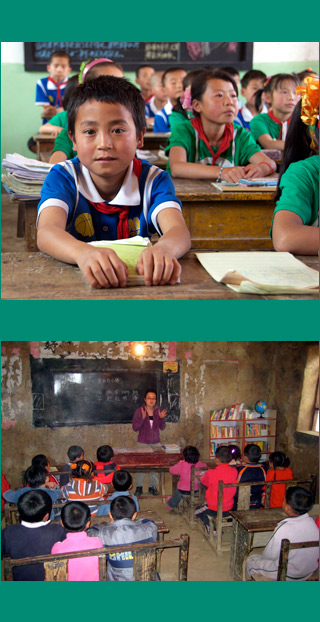
Poor education mortgaging the future? Students in a Gansu province school, where many are anemic (top); another class room in Loess Plateau. (Top Photo: Adam Gorlick)

DINGXI PREFECTURE: Wang Hongli, 8 years old, lives in a remote rural village on the Loess Plateau in one of China’s poorest and most agricultural provinces, Gansu. His prospects for living the good life are as bleak as the landscape. He is not on track to become part of China’s emerging middle class, the free-spending, computer-savvy, person-of-the-world often featured in the western media.

Hongli is a pseudonym. His parents work in a faraway industrial zone, coming home for only three weeks at Chinese New Year. His grandmother takes care of him and his siblings on the weekends, and during the week he lives in a dorm, three to a bed with 36 other students in an unheated room 4 by 4 meters.

Hongli suffers from iron-deficient anemia, but neither his family nor his teacher knows he is sick. Even if his anemia is discovered and treated by the researchers who have documented 30 percent anemia among children in poor rural areas, it likely will recur after he finishes the study, with furnished dietary supplements. Despite educational pamphlets, he’ll likely revert to a diet of staple grains and bits of pickled vegetables.

Unsurprisingly, Hongli’s grades are not good. In China’s competitive school system, he has only a slight chance of attending high school, much less college. In China’s future high-wage economy, all Hongli can hope for is a menial job in the provincial capital, Lanzhou, or as a temporary migrant elsewhere. Without urban permanent residency, hukou, he will have limited access to urban social services. He may suffer chronic unemployment, or resort to the gray economy or crime. He also may never marry – one of the millions of “forced bachelors” created by China’s large gender imbalance.

In China’s future high-wage economy, 
all the rural poor can hope for is menial jobs in a provincial capital.

Hongli is not alone. In fact, he’s one of 50 million school-age youth in China’s vast poor rural hinterlands. Recent studies by Stanford and Chinese collaborators show that 39 percent of fourth-grade students in Shaanxi Province are anemic, with similarly high rates elsewhere in the northwest; up to 40 percent of rural children in the poor southwest regions, e.g., Guizhou, are infected with intestinal worms. Millions of poor rural students throughout China are nearsighted, but do not wear glasses.

Because China’s urbanites have fewer children, poor rural kids like Hongli represent almost a third of China’s school-aged children, a large share of the future labor force. These young people must be healthy, educated and productive if China is to have any chance of increasing labor productivity to offset the shrinking size of its aging workforce.

Many observers presume that China’s growth will continue unabated, drawing upon a vast reservoir of rural labor to staff manufacturing plants for the world. In fact, to a considerable extent, China’s rural areas have already been emptied out, leaving many villages with only the old and the very young. The growth of wages for unskilled workers exceeds GDP growth.

Better pay should be good news for poverty alleviation. However, rising wages push up the opportunity cost of staying in school – especially since high school fees, even at rural public schools, are among the highest in the world.

It’s myopic to allow rural students to drop out of junior high and high school – mitigating the current labor shortage, but mortgaging their futures. Recent studies demonstrate that eliminating high school tuition – or reducing the financial burden on poor households – improves junior high achievement and significantly increases continuation on to high school. Yet unlike many other developing countries, China does not use incentives to keep children in school, such as conditional cash transfers. The public health and educational bureaucracies also do not proactively cooperate to remedy nutritional and medical problems – including mental health – that school-based interventions could address cost effectively.

Less than half of youth in China’s poor rural areas go to academic high school; less than 10 percent head to college.

The educational system, based on rote memory and drill, doesn’t teach children how to learn. The vocational education system is ineffective. Instead, China’s schools tend to focus resources on elite students. Tracking starts early, and test scores are often the sole criterion for success. A recent comparative study documents that China’s digital divide, with lower access to computers in poor rural areas, is among the widest in the world.

China’s government is increasing expenditures for school facilities and raising teacher salaries. However, these steps are far from adequate. During South Korea’s high growth, almost all Korean students finished high school. Today, less than half of youth in China’s poor rural areas go to academic high school, and the percent going to college remains in the single digits.

Greater investment in public health and education for the young people in China’s poor rural areas is urgent. If the government waits 10 years, it may be too late to avert risks for China’s stability and sustained economic growth.

Surely China could easily address this problem? A third of Chinese were illiterate in the early 1960s; now, fewer than 5 percent are. By 2010, about 120 million Chinese had completed a college degree. Chinese also enjoy a relatively long life expectancy compared to India and many other developing countries, and basic health insurance coverage is almost universal.

But the pace of change and citizens’ expectations are higher as well. Most Chinese assume that basic nutritional problems and intestinal worms were eradicated in the Mao era. China’s mortality halved in the 1950s; fertility halved in the 1970s. As a result, China will get old before it gets rich. Population aging, rapid urbanization and a large gender imbalance represent intertwined demographic challenges to social and economic governance. The policy options are complicated, the constraints significant, the risks of missteps real and ever-present.

China’s prosperity depends on youth mastering skills to thrive in a technology-driven world.

Timely policy response is complicated by competition for resources – pensions, long-term care, medical care for the elderly and more – as well as significant governance challenges arising from a countryside drained of young people. The well-intentioned programs for what government regards a “harmonious society” create large unfunded mandates for local authorities. Attempts to relocate rural residents to new, denser communities provoke anger at being uprooted and skepticism that local authorities simply want to expropriate land for development.

Millions of migrant workers – like Wang Hongli’s parents – return to their rural homes during economic downturns. Urbanization weakens this capacity to absorb future economic fluctuations. Government efforts at “social management” – strengthening regulatory control of informal social groups and strategies for diffusing social tensions – expand the bureaucratic state, a central target of popular discontent.

Premier Wen Jiabao’s announcement of a 7.5 percent growth target – the lowest in two decades – has been expected. Future economic growth will moderate partly because of demographics, but mostly because productivity gains slow as an economy runs out of surplus rural labor and converges on the technological frontier. Costly upgrading of industrial structure will squeeze the government’s ability to deliver on its promise of a better future for all, stoking social tensions.

China’s stability and prosperity, and that of the region and the globe, depends on how well today’s youth master the knowledge and skills that enable them to thrive in the technology-driven globalized world of the mid-21st century. Resilient public and private sector leaders of the future must be able to think creatively. Therefore, China’s government should respond to population aging by acting now to invest more in the health and education of youth, especially the rural poor.



Hero Image
5734696609 a3b10b4c8f z
All News button
1
Authors
News Type
News
Date
Paragraphs

The cloud offers game-changing opportunities for start-ups to large enterprises, if entrepreneurs and enterprise leaders know how best to harness its power. A panel of cloud computing experts shared their wealth of experience to a full house at the special event on Innovation in the Cloud: How Cloud Computing is Changing the Landscape of Entrepreneurship and Innovation, organized by the Stanford Program on Regions of Innovation and Entrepreneurship (SPRIE) in partnership with China America Innovation Network (CHAIN).

In this featured panel discussion at the Stanford Graduate School of Business for Stanford's Entrepreneurship Week 2012, the panel shared insights on cloud computing technology changes, enterprise transformation, business model innovation, investor strategies, and market opportunities, with more than 200 Stanford students, faculty, entrepreneurs and Valley professionals.

The panel was composed of serial entrepreneur Jim Dai, CEO of CalmSea, IT expert Sam Ghods, vice president of technology at Box.com, marketing expert Ken Oestreich, senior director of cloud and virtualization marketing at EMC, and investor Cindy Padnos, founder and managing director of Illuminate Ventures. Robert Scoble, startup liaison officer at Rackspace and a technical evangelist, moderated the discussion.

The panelists acknowledged that users had grown to accept everything could be virtual, and cloud is radically changing the face of enterprise strategy, processes, and outcomes. Cloud computing can dramatically decrease timelines and investment costs which encourages flexible growth and experimentation by rapid iteration. This shift, together with cloud computing’s cost effectiveness, strongly favors the way start-ups work.

For entrepreneurs, one piece of good news is that cloud allows smaller firms to compete with big players in new ways. This trend has also prompted the rise of micro VCs, with typical investments of $100,000 to $500,000. While SMEs continue to embrace cloud-based services, how large enterprises adapt and evolve the cloud market will remain interesting.


Stanford Entrepreneurship Week 2012 takes place February 27 through March 7. This collection of over 30 events is hosted by the Stanford Entrepreneurship Network (SEN), a federation of programs, student groups and organizations supporting entrepreneurship in the Stanford community.

All News button
1
-

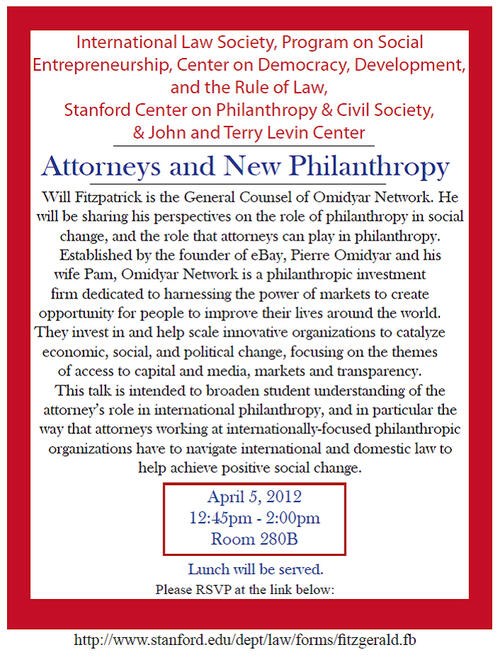
Will Fitzpatrick is the General Counsel of Omidyar Network.  He will be sharing his perspectives on the role of philanthropy in social change, and the role that attorneys can play in philanthropy.  Established by the founder of eBay, Pierre Omidyar and his wife Pam, Omidyar Network is a philanthropic investment firm dedicated to harnessing the power of markets to create opportunity for people to improve their lives around the world.  They invest in and help scale innovative organizations to catalyze economic, social, and political change, focusing on the themes of access to capital and media, markets and transparency.  This talk is intended to broaden student understanding of the attorney's role in international philanthropy, and in particular the way that attorneys working at internationally-focused philanthropic organizations have to navigate international and domestic law to achieve positive social change.

Please RSVP to the link below:

http://www.stanford.edu/dept/law/forms/fitzgerald.fb

Lunch will be provided

Image

Room 280B

Will Fitzpatrick General Counsel Speaker Omidyar Network
Conferences
Subscribe to Investment