
Innovation
Authors
News Type
Q&As
Date
Paragraphs

This week the World Education Forum convenes in Incheon, South Korea. Drawing leaders from UNESCO member states and heads of international organizations and NGOs, the 4-day gathering will examine global education priorities and discuss a framework for action and implementation of shared goals and targets.

The Forum, which last met in Dakar in 2000, will explore five major themes: equity, inclusion, quality education and lifelong learning, and also set out an agenda on global citizenship education—how to cultivate in youth the attitudes, values and skills needed in today’s world.

As the Forum approaches, the Walter H. Shorenstein Asia-Pacific Research Center asked Stanford professor Gi-Wook Shin to offer his perspectives on global education and his vision for South Korea. He is Korean and an expert on South Korea’s higher-education system, politics and society. He also advises some universities in Asia such as the Center for Asia-Pacific Future Studies at Kyushu University in Japan.

Shin leads two multi-year research projects—one focused on diversity and tolerance in Asia, and another on global social capital, delving into the linkages between innovation, economic globalization and diaspora communities. He recently published key findings in Global Talent with coauthor Joon Nak Choi, a Stanford graduate now professor at Hong Kong University of Science and Technology.

Education has played an important role in the social and economic development of South Korea. Can you explain?

Over the past fifty years, South Korea has gone from being one of the least developed countries to one of the most developed—an “economic miracle,” as it is often referred. The country rose from periods of wartime, poverty and social unrest to become a stable high-income developed country, all in an incredibly short time span. Education has played a substantial role in South Korea’s emergence. Nearly 70 percent of Koreans between the ages of 25 and 34 years of age hold an equivalent of a bachelors degree. This is the highest ranking in all Organization for Economic Co-operation and Development (OECD) countries. Investment in its own people, as well as areas of technology and the sciences, catapulted South Korea toward such success. Its education system is lauded globally. President Obama has referred to its system on multiple occasions, saying the respect and level of support given to teachers there helps to empower student learning. Teaching is a very highly respected profession in South Korea.

In pursuit of the “creative economy,” South Korea has sought to capitalize on the knowledge value of its population. How does diversity fit into this context?

South Korea, like many advanced nations, is driving toward a “creative economy,” a policy objective that President Park Geun-hye set out in Feb. 2013. It’s a strategy to move South Korea away from its manufacturing past toward a future of a service-oriented economy. The latter requires greater creative thinking, and human and social capital are necessary ingredients in that process. Many people look to Silicon Valley as a model of success, a place that continues to harness ideas and investment in those ideas. As I say, there is one known “secret” that has contributed to Silicon Valley’s success, and that’s cultural diversity. In fact Japanese Prime Minister Shinzo Abe visited Stanford recently on his state visit to the United States in a bid to underscore his commitment to building a creative economy in Japan. He convened with leaders of major technology firms like Apple and Twitter, and one of the main messages shared with Abe was the scale to which immigrants contributed to the workforce here. So, South Korea, like many Asian nations, would benefit from recognizing the connection between diversity and the economy, and take it one step further and actively encourage a society who accepts foreigners—this, of course, comes with inherent hurdles in any ethnically homogeneous country like South Korea.

How can a society cultivate globally responsible citizens?

Shifting a society to truly respect and value diversity can be an especially difficult task for countries steeped in nationalism and traditional values. In the case of South Korea, policies supporting values of diversity are just starting to appear, but full social integration of minorities remains a distant future. If the government acts to support diversity over the long-term, though, hopefully change is in the closer future. The challenge is for South Korea to strike the right balance between embracing the nation’s historical legacy, while also recognizing what it means to be a “global citizen” in today’s world. I’ve been working with Rennie Moon, a professor at Yonsei University, on this research question. Teachers play a definitive role in the development of students. Providing curriculum that is balanced is an important factor. This means teaching materials—from textbooks to videos—must provide a neutral stance, or even better, show information in a comparative perspective. Teachers themselves must also commit to being facilitators. Encouraging pride in one’s own country, while also showing respect and value toward others’ is a key message that teachers can help reinforce.

Why do foreign students in Korea matter? And, what role can Korean students have when abroad?

Foreign students in Korea represent a positive-sum game. For one, foreign students diversify Korea, and also help fill the national labor shortfall. In my study with Choi, we found that three groups of students prove to be more beneficial to Korean society. “Focused instrumentalists,” students who are pursuing advanced degrees in technical subjects, “focused Koreaphiles,” students who view Korea as special but focus mainly on their studies, and “youthful Koreaphiles,” students who view Korea as special but focus mainly on exploring their social environments. Instrumentalists grow an affinity to Korea by likely working for a firm in Korea upon graduation. Someone who is a Koreaphile will show affinity for Korea because of an admiration for pop culture and other aspects of Korean society—K-pop, hallyu, Korean dramas and so forth.

Increasingly, Korean students are choosing to study abroad. Just over 123,000 Korean students pursued an undergraduate degree abroad in year 2011; 29% of whom studied in the United States. We see chogi yuhak, a trend of Koreans sending their children overseas to avoid the secondary education system, which is often cited for its rigor and stressful entrance exams. Yet, even if Korean students do not return home, they still have an opportunity to contribute back to South Korea. They form a global network and serve as “transnational bridges” between South Korea and their host countries. As a result, information, innovation and other opportunities bounce between and among people on both sides. This same lesson could be applied to any country really.

What policy implications will transnational bridges have in South Korea?

The affects on policy are largely two-fold. First, South Korean universities, companies and the government must seek to promote values of diversity. The Korean government has taken steps to recognize the strategic value of recruiting foreigners. But, the push isn’t big enough yet. For example, we hosted former Seoul National University President Yeon-Cheon Oh as a visiting fellow this year. He voiced that while Korean universities are orienting some of their policies toward ‘internationalization,’ they still aren’t totally committed to the idea. Better support systems should be developed for foreign students, and tenure should be more accessible to foreign faculty members. Second, for Koreans overseas, diaspora networks could be strengthened. About 10 percent of all ethnic Koreans live outside the Korean Peninsula. Creating codified social and cultural forums for diasporans will help instill a sense of the homeland, so that they want to stay engaged.

Are aspects of South Korea’s model translatable in neighboring countries in Asia and elsewhere?

The Korean model is relevant in other developed, nonimmigrant societies. Different from settler societies like the United States or Canada, for instance, who have heterogeneous populations. Germany and Japan provide the closest comparison study; both their national identities are based on shared ethnicity. Japan has in many ways successfully leveraged its diaspora. Ethnic Japanese who left have been recruited back, and foreign unskilled workers, particularly from Asia, infuse the labor market. A large number of foreign students study in Japan. Germany also sees an substantial amount of foreign students each year. Japan now allows students to stay up to one year to search for a job after graduation, and in Germany, the same for six months. But both countries have trouble retaining graduates. Applying the case of South Korea, seeking benefits from transnational bridges could also benefit both societies. Assimilation of diasporans—like ethnic Koreans in Japan and Turkish people in Germany—should be a long-term goal.

Gi-Wook Shin wrote in Nikkei Asian Review about aspects of Silicon Valley that Asian countries should consider adopting to emulate its success, and how foreign skilled workers can provide social capital. He also contributed a post to Stanford University Press blog about steps South Korea could take to counter the "brain drain" phenomenon. Later, Shin and Rennie Moon wrote a piece for The Conversation, expanding upon the challenges that foreign faculty and students face in South Korea and other Asian nations.

All News button
1
Authors
News Type
News
Date
Paragraphs

Governments must do more to diversify the types of crops grown throughout the world. If they don’t, climate change may jeopardize the global food supply, a leading agriculture researcher told a Stanford audience.

Cary Fowler, a senior advisor and former executive director of the Global Crop Diversity Trust, was a driving force behind the creation of the Svalbard Global Seed Vault in Norway. Commonly known as the “doomsday vault,” the repository of ancient and modern seeds from around the world ensures that future generations will have access to a wide enough range of crop traits to adapt global agriculture to a changing climate.

7307140126 7a3ca02f37 k Dr. Cary Fowler in Svalbard, Norway, the home of the Svalbard Global Seed Vault.
During a May 6 talk sponsored by FSE as part of the center’s Food and Nutrition Policy Symposium, Fowler warned that increasingly high temperatures and water shortages interfere with the natural growing cycles of many crops and can even reduce the nutritional quality of some plants. Higher temperatures also give way to new pests, diseases, and soil microorganisms that threaten yields.

 “The biggest impacts from climate change will be in sub-Saharan Africa,” Fowler said, a region where many people already suffer serious poverty and hunger, and where crop yields lag behind the rest of the world. Fowler said that as climate pressure on agriculture intensifies, the world can expect to see an uptick in civil conflict, restrictive trade policies, and suffering among the world’s poorest people.

“Crops are going to be facing new combinations of conditions for which there is no historical experience,” said Fowler. “They will require new combinations of traits” that can only be developed by preserving genetic diversity and proactively breeding new varieties.

 “There are 1.3 billion people living on subsistence farms today,” said Dr. Cary Fowler to a Stanford audience on May 6. “How will they adapt to climate change without access to diversity?”

Fowler called for the U.S. and foreign governments to embrace their “inherited evolutionary responsibility” for preserving the huge diversity of crops grown by farmers throughout human history.

The United States is the ideal candidate to lead the world in using crop genetic diversity to adapt agriculture to climate challenges, he said. “The U.S. is well-positioned to research diversity, model future climate and assemble seed packages,” enlisting farmers in the U.S. and abroad in “another mass adaptation experiment” like the one American agriculture undertook in the 18th and 19th centuries.

 “I know that sounds like a wild and crazy idea,” Fowler said. “But I haven’t heard any alternatives to it. If we’re assuming we’re going to have development without diversity, that would really be a historically unprecedented experiment.”

 “If agriculture doesn’t adapt,” he added, “neither will we.”

A diverse history

In the late 1700s the United States food system lacked diversity and infrastructure. “Very few of the crops we grow now in the U.S. are native,” said Fowler. Early on, “it wasn’t always evident what crops from abroad would grow well in the U.S.”

The government soon set out to expand and diversify American agriculture. U.S. Navy ships collected seeds on overseas voyages, and U.S. diplomats brought back new crops from postings abroad. Government-sponsored expeditions sought out foreign plants with specific disease-resistant traits. The U.S. signed two dozen seed-exchange agreements with other countries, and lowered taxes on imported seeds to boost global crop exchange.

Image
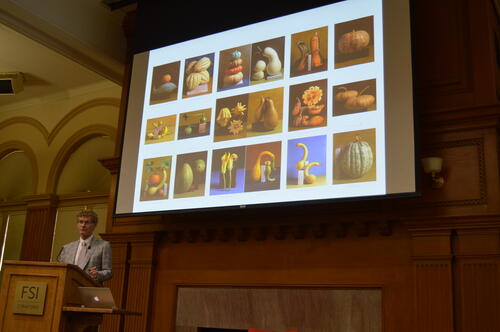
fowler squash slide

“The United States amassed a much more diverse array of seeds and crops as a result,” said Fowler. One program introduced 600 new apple varieties, 700 new types of pears, and 353 new varieties of mangoes to American farmers.

But the United States did not simply collect new crops. It also invested in research to develop new varieties, including through plant breeding.

Genetic erosion

Research into plant breeding quickly yielded many of the modern varieties of crops we grow today in the United States.

“With plant breeding came the rise of modern varieties that had useful traits like disease resistance,” said Fowler. A small handful of new varieties quickly gained popularity with American farmers, who now had a choice about whether or not to save seeds and grow many varieties of a crop at once. Most farmers chose not to, instead relying on the same few mainstream varieties their neighbors were growing.

This shift has led to what Fowler described as the “genetic erosion” of agriculture, a trend that can only be reversed by reviving the tradition of seed saving and plant breeding on a global scale.

Seed banks

“I have probably been to more seed banks than any other person,” said Fowler. Seeds from most crops can survive hundreds or even thousands of years in storage, but most storage facilities lack the physical security to provide lasting safe haven. Many seed banks are poorly built, too warm or humid for long-term storage, and vulnerable to natural disasters. Other facilities suffer damaged during civil wars and uprisings.

Even if banks are physically secure, said Fowler, most simply do not operate on a large enough scale to protect global crop diversity. “Most crops in the world have between one and 10 total seed samples in storage, and most have no plant breeders working on them at all,” said Fowler.

The doomsday vault

In 2005 Fowler was chosen to lead an international coalition to build the Svalbard Global Seed Vault. The Norwegian government owns the facility, and it is also managed by the Global Crop Diversity Trust and the Nordic Genetic Resource Center. 


The vault is built into the side of a mountain in the far north of Norway, said Fowler, because the ideal temperature for storing seeds is minus 18 degrees Celsius.

Inside the frozen walls of the vault are shelves full of boxes holding duplicate seeds from smaller seed banks around the world. Foreign governments that contribute samples pay nothing for storage, and the seed packages are never opened by vault staff, said Fowler.

 “The vault now houses seeds from over 864,000 varieties of plants,” said Fowler, adding that not a single sample has ever been lost.

img004531 Seed storage boxes at the Svalbard Global Seed Vault.

The facility’s nickname, “the doomsday vault,” comes not only from its rugged physical location but from its capacity to withstand disasters – something its planners took great care to design. “We calculated how high the water would go if all ice in the world melted and we had the world’s largest ever tsunami,” said Fowler. “The vault is five stories above that.”

“Not a solution”

Fowler emphasized that no doomsday vault, no matter how secure its walls or how ample its seed collection, can solve the problem of crop genetic erosion. Building a vault “doesn’t mean that we as a society are getting serious about adapting agriculture to climate change,” Fowler said. Plant breeding and crop research programs focused on developing new climate-resilient varieties are just as crucial as saving seeds.

Although a few major staple crops like rice, wheat and corn are continually bred and improved in research labs around the world, most crops are largely ignored by researchers. For example, there are only six breeders of yams worldwide.

“Why conserve it if you’re not going to use it?” Fowler asked. “We are acting like crops are going to adapt by themselves, and we are assuming all but a handful of crops are unimportant.”

Quoting Charles Darwin, Fowler added that “it is not the strongest of the species that survives, nor the most intelligent, but the one most responsive to change.”


Full video and audio recordings of Dr. Fowler's May 6 lecture, and his interview with FSE director Roz Naylor, are available here. 

Hero Image
2673734934 262a3c22c0 o
Kris Krug
All News button
1
Authors
News Type
News
Date
Paragraphs

Japan must transform its economy in a way that mirrors the innovation ethos in places like Silicon Valley and Stanford University, Japanese Prime Minister Shinzo Abe said Thursday during a speech on campus.

As an example of how to encourage such creativity, Abe hailed a new partnership starting this fall with Stanford that will train the next generation of biomedical experts. In doing so, he urged a "fundamental change" in how Japanese society views the process of innovation, from how ideas originate to competition in the marketplace.

Japan Biodesign will be launched in collaboration with the Stanford Biodesign program and five higher education and research institutions in Japan. Faculty members will work together to create new interdisciplinary systems based on Stanford Biodesign. Stanford leaders will train and mentor their Japanese colleagues.

Abe, who is the first Japanese prime minister to visit Stanford, marveled at how the tech sector in the United States has "consistently evolved at top speed."

He said, "I want the best and brightest Japanese talent" to learn about Silicon Valley.

Image
The Japanese leader also announced more plans to connect Japanese companies, employees and networking events with Silicon Valley and places like Stanford. He said it was important for the participants to emerge "reborn" with a well-honed sense of how to succeed in a highly competitive global marketplace.

Abe shared the Bing Concert Hall stage with Stanford President John Hennessy and George Shultz, the former U.S. Secretary of State and distinguished fellow at the Hoover Institution. Abe's talk, titled "Innovation, Japan and Silicon Valley Symposium," included an introduction and remarks by Hennessy and Shultz. The event drew a full house of invited guests and members of the Stanford community.

"It is a great honor" to be at Stanford, Abe said in beginning his remarks.

He noted that Japan is revisiting its regulatory and tax systems in order to encourage more economic dynamism and competition. "The Japanese people will benefit from innovation," he said.

The challenge, he acknowledged, has been the slow pace of innovation in Japan. Today, however, the Internet economy and big data are creating "enormous changes" in his country's economic approach, he said. "We have to catch up, or otherwise Japan will lose vitality," Abe added.

Cultural connections

In his introduction of Abe, Hennessy chronicled Stanford's long history and friendship with Japan and its people.

Japan, he said, is home to more Stanford alumni than any other Asian country, and when the university's doors first opened in 1891, the pioneer class included a Japanese student. Currently, 139 students from Japan are enrolled at Stanford.

Hennessey described Abe as focused on revitalizing Japan's economy and stewarding it toward a greater global role.

Shultz, who knew Abe's parents, shared recollections of poignant moments between Abe's politically prominent family and his own.

Abe joined a roundtable discussion after his speech with Michael McFaul, director of the Freeman Spogli Institute for International Studies; Stanford Board of Trustees Chair Steve Denning; Stanford School of Medicine Dean Lloyd Minor; Stanford political science Professor Emeritus Daniel Okimoto; Yahoo co-founder Jerry Yang; and Twitter co-founder Jack Dorsey, among other scholars and dignitaries. He also met with Stanford students before leaving campus.

Afterward, McFaul wrote in an email, "I think it is fantastic that Prime Minister Abe came to Stanford and Silicon Valley after his very successful visit to Washington. He demonstrated that deepening U.S.-Japanese relations requires not only strong government-to-government ties, but also deepening ties between our societies, including educational institutions like Stanford."

Abe's state visit to the United States this week included the first address by a Japanese leader to a joint session of Congress. Abe served as prime minister of Japan in 2006-07 and returned to the position in 2012.

'Working together'

On Tuesday, U.S. President Barack Obama said after a meeting with Abe that the two countries had made progress in trade talks on a massive 12-nation trade deal that would open markets around the Pacific Rim to U.S. exports. Both nations face domestic political obstacles to concluding the Trans-Pacific Partnership agreement.

"This agreement would expand the coverage of the free trade agreements for both Japan and the U.S. substantially," said Stanford economist Takeo Hoshi, director of the Japan Program at the Shorenstein Asia-Pacific Research Center, in an interview. "The U.S. and Japan have been working together to maintain peace and sustain economic growth in the Pacific Asia."

Hoshi said that Abe's visit to the Silicon Valley confirms that Japan is serious about transforming its economy from one based on exports to one focused on innovations.

"Going forward, we can learn a lot from Japanese experience and their reform attempts," said Hoshi, who is also a senior fellow at the Freeman Spogli Institute.

Hoshi spoke with The Associated Press just before Abe’s arrival to California, citing Silicon Valley as the ideal place for Japan to learn about innovation. He also joined KQED’s Forum to discuss the current state of the U.S.-Japan alliance. Later, he was interviewed by BBC Business about Abe's visit to Stanford.

Stanford Biodesign

Founded in 2001, Stanford Biodesign has pioneered a new training methodology in which interdisciplinary teams of engineers and physicians go through a rigorous process of carefully characterizing unsolved clinical needs before jumping to technology solutions.

For the Japan Biodesign program, the bulk of the educational activities will take place at the campuses of the partner Japanese universities.

Clifton Parker is a writer for the Stanford News Service.

Hero Image
abe 6364
Japanese Prime Minister Shinzo Abe speaks at Stanford about innovation in Japan and Silicon Valley. He was also joined on stage by Stanford President John Hennessy and George Shultz, the former U.S. Secretary of State and a distinguished fellow at the Hoover Institution (below). | L.A. Cicero
All News button
1
-

The Stanford Silicon Valley-New Japan Project
Public Forum Series with Networking


Casey Wahl is the CEO and founder of Wahl & Case K.K., a Tokyo-based global recruitment firm with a focus on startups and cross border expansion.  Mr. Wahl has many years of experience in the Japan and is also the founder of Red Brick Ventures, an angel investment and incubation platform.  He recently published a book in Japanese (english version to come), containing the stories of several Japanese entrepreneurs, giving insights into the challenges they face and their journeys to success.  He will be discussion characteristics of the labor market for startups in Japan and how Japanese companies can best hire talent in Silicon Valley.


Thursday, May 14, 2015
4:15 – 5:30 pm Lecture
5:30pm - 6:00pm Networking
Cypress Semiconductor Auditorium (CISX Auditorium)

Public Welcome • Light Refreshments

The Silicon Valley - New Japan Project

Cypress Semiconductor Auditorium (CISX Auditorium)
Paul G. Allen Building, Stanford University
330 Serra Mall, Stanford CA 94305
**Entrance is the Serra Mall side of the building**
https://www.google.com/maps?q=CISX+Cypress+Semiconductor+Auditorium@37.4295793,-122.1748332

Casey Wahl CEO and founder of Wahl & Case K.K
Seminars
-

In this session of the Shorenstein APARC Corporate Affiliate Visiting Fellows Research Presentations, the following will be presented:

Yoshihiro Kaga, Ministry of Economy, Trade & Industry, Japan, "The Roles of University-Industry Collaboration for Promoting Innovation"

The existence of top class universities, especially those ties with industry, is regarded as one of the key characteristics of the Silicon Valley ecosystem, where the most successful innovation-based economic growth in the world is observed today.  Kaga has conducted a literature review of previous research on this topic and research on Stanford organizations facilitating university-industry ties.  Kaga will present his findings and share implications for policies in Japan.  His research is in cooperation with Shingo Nakano.

Feng Lin, ACON Biotechnology, "Innovations in China Primary Healthcare Reform: Development and Characteristics of the Community Health Services in Hangzhou"

One of the five major tasks for China’s health reforms launched in 2009 was to promote the development of a primary healthcare system.  Hangzhou is one of the cities with a long history in China for developing community health services.  Lin has studied the model of community health services in Hangzhou, which is characterized as government-led, guaranteed with enough funding, personnel, space and regulation; supported by a unified information platform; and the assigned central role of general practitioners as health “gatekeepers”.  His data collection and analysis have indicated that the basic health status of residents in Hangzhou is comparable to that in Western developed countries.  Based on these findings, Lin proposes that the primary healthcare level in Hangzhou will be further developed and promoted with the indexed performance evaluations and more effective implementation of additional measures.

Shingo Nakano, Ministry of Economy, Trade & Industry, Japan, "Policy Implications for Increasing the Number of Start-ups in Japan"

As mentioned in “Japan Revitalization Strategy (Revised in 2014),” it is critical for Japan to develop an environment where venture businesses are launched one after another.   The Japanese government has taken some measures to this end, but significant obstacles - such as institutional, human, financial, etc. - remain for venture businesses.  Nakano's research looks at how to eliminate these obstacles, while focusing on increasing the number of start-ups in Japan.  Based on his findings, Nakano will discuss some policy implications for improving the Japanese start-up ecosystem.  His research was conducted in collaboration with Yoshihiro Kaga. 


Philippines Conference Room

Encina Hall, 3rd Floor, Central

Yoshihiro Kaga Ministry of Economy, Trade & Industry, Japan
Feng Lin ACON Biotechnology
Shingo Nakano Ministry of Economy, Trade & Industry, Japan
Seminars
-

Image
ctd banner2015v2

For more information and to register, visit tomkat.stanford.edu/ctd.

Each year Stanford experts from a range of disciplines meet to discuss the interconnections and interactions among humanity's needs for and use of food, energy, water and the effect they have on climate and conflict.  These experts will illustrate and evaluate some of the ways in which decisions in one resource area can lead to trade-offs or co-benefits in others, and discuss opportunities to make decisions that can have positive benefits in one area while avoiding negative or unintended consequences in other areas.  This year, in celebration of our 5th anniversary of Connecting the Dots, we return to the food nexus. 
 

Confirmed Speakers

  • Keynote Speaker: Karen Ross, Secretary of California Department of Food and Agriculture
  • Professor Stacey Bent, TomKat Center for Sustainable Energy, Precourt Institute for Energy, Chemical Engineering
  • Professor Roz Naylor, Center on Food Security and the Environment, Environmental Earth System Science, Stanford Woods Institute for the Environment, Freeman Spogli Institute for International Studies
  • Professor David Lobell, Center on Food Security and the Environment, Environmental Earth System Science, Freeman Spogli Institute for International Studies, Stanford Woods Institute for the Environment 
  • Professor Marshall Burke (food - conflict nexus), Environmental Earth System Science, Center on Food Security and the Environment
  • Professor Steve Luby (food - health nexus), Stanford Medicine, Stanford Woods Institute for the Environment, Freeman Spogli Institue for International Studies
  • Professor Scott Rozelle (food, education and development nexus), Co-director, Rural Education Action Program, Freeman Spogli Institute for International Studies, Stanford Institute for Economic Policy Research, Center on Food Security and the Environment


Student-led Breakout Sessions

  • Christopher Seifert, Graduate Student, Environmental Earth System Science
    "Boondoggle or Risk Reducer? Crop insurance as the farm subsidy of the 21st century"
  • William Chapman, Graduate Student, CEE-Atmosphere and Energy
    "No Red Meat or a New Electric Vehicle, Food Choices and Emissions"
  • Priya Fielding-Singh, PhD Candidate, Sociology
    Maria Deloso, Coterminal B.S/M.A. Candidate, Environmental Earth System Science  
    "From Farm to Lunch Tray: Toward a Healthy and Sustainable Federal School Lunch Program"
  • Rebecca Gilsdorf, PhD Candidate, Civil & Environmental Engineering
    Angela Harris, PhD Candidate, Civil & Environmental Engineering
    "Poop and Pesticides: Looking beyond production to consider food contamination"
Event Poster
Download pdf

Frances C. Arrillaga Alumni Center
326 Galvez Street
Stanford University

MAP

Conferences
Authors
News Type
News
Date
Paragraphs

A new study by Center on Food Security and the Environment researchers finds that smallholder irrigation systems - those in which water access (via pump or human power), distribution (furrow, watering can, sprinkler, drip lines, etc.), and use all occur at or near the same location - have great potential to reduce hunger, raise incomes and improve development prospects in an area of the world greatly in need of these advancements. Financing is crucial, as even the cheapest pumps can be prohibitively expensive otherwise.

These systems have the potential to use water more productively, improve nutritional outcomes and rural development, and narrow the income disparities that permit widespread hunger to persist despite economic advancement. Only 4 percent of agricultural land in sub-Saharan Africa is currently irrigated.

"Success stories can be found where distributed systems are used in a cooperative setting, permitting the sharing of knowledge, risk, credit and marketing as we've seen in our solar market garden project in Benin," said Jennifer Burney, lead author of the study published in the Proceedings of the National Academy of Sciences.

Moving forward development communities and sub-Saharan African governments need a better understanding of present water resources and how they will be affected by climate change.

"Farmers need access to financial services—credit and insurance—appropriate for a range of production systems," said co-author and Stanford Woods Institute Senior Fellow Rosamond Naylor. "Investments should start at a smaller scale, with thorough project evaluation, before scaling up."

FSE continues to contribute to these evaluations and added eight new villages to our project in Benin last year.

Hero Image
benin kids
All News button
1
Subscribe to Innovation