Diplomacy
-
Distressed flags of China, South Korea, and the United States

The intensifying strategic competition between the United States and China has put substantial pressure on South Korea concerning several strategic issues. The U.S.-China rivalry is only likely to continue with the upcoming American presidential election in 2024.

As the South Korean government has recently tilted toward the United States, China wants South Korea to take a more balanced approach in its policies between the two countries. China is also expressing concern on matters of interest to it, such as the THAAD deployment, supply chain reset, and issues of the Taiwan Strait and the regional status of Xinjiang.

As Ambassador Jung-Seung Shin will argue, South Korean foreign policies should be based on its national interests and reflect its identity and the values its people share. Therefore, according to Shin, South Korea should not only make efforts to further strengthen the KORUS alliance for the peace and stability of the Korean Peninsula and the region, but to properly manage its relations with China.

Featured Speaker

Ambassador Shin

Ambassador Jung-Seung Shin joins the Freeman Spogli Institute for International Studies (FSI) and the Walter H. Shorenstein Asia-Pacific Research Center (Shorenstein APARC) as Visiting Scholar and Payne Distinguished Fellow for the 2023 winter quarter. He previously served as Ambassador for the Republic of Korea to the People's Republic of China from 2008 to 2010, and currently serves as Chair Professor at the East Asia Institute at Dongseo University. While at Stanford, he will be conducting research on the strategic relationships between Korea, China, and the United States.

Discussant

Ambassador Shin

Oriana Skylar Mastro is a Center Fellow at Stanford University’s Freeman Spogli Institute for International Studies, where her research focuses on Chinese military and security policy, Asia-Pacific security issues, war termination, nuclear dynamics, and coercive diplomacy. She is also a Non-Resident Senior Fellow at the American Enterprise Institute and continues to serve in the United States Air Force Reserve, for which she works as a strategic planner at INDOPACOM.

She has published widely, including in International Security, Foreign Affairs, the New York Times, International Studies Review, Journal of Strategic Studies, The Washington Quarterly, Survival, and Asian Security. Her book, The Costs of Conversation: Obstacles to Peace Talks in Wartime, (Cornell University Press, 2019), won the 2020 American Political Science Association International Security Section Best Book by an Untenured Faculty Member.

Moderator

Gi-Wook Shin

Gi-Wook Shin is the director of the Walter H. Shorenstein Asia-Pacific Research Center; the William J. Perry Professor of Contemporary Korea; the founding director of the Korea Program; a senior fellow of the Freeman Spogli Institute for International Studies; and a professor of sociology, all at Stanford University. As a historical-comparative and political sociologist, his research has concentrated on social movements, nationalism, development, and international relations. 

Shin is the author/editor of more than twenty books and numerous articles. His recent books include South Korea's Democracy in Crisis (2022); The North Korean Conundrum: Balancing Human Rights and Nuclear Security (2021); Demographics and Innovation in the Asia-Pacific (2021); and Shifting Gears in Innovation Policy from Asia (2020). His new research initiative examines potential benefits of talent flows in the Asia-Pacific region, where countries, cities, and corporations have competed with one another to enhance their stock of "brain power" by drawing on the skills of both their own citizens and those of foreigners.

This event is part of the Frank E. and Arthur W. Payne Lecture Series. 

The Payne Lectureship is named for Frank E. Payne and Arthur W. Payne, brothers who gained an appreciation for global problems through their international business operations. Their descendants endowed the annual lecture series at the Freeman Spogli Institute for International Studies to raise public understanding of the complex policy issues facing the global community today and to increase support for informed international cooperation.

The Payne Distinguished Lecturer is chosen for his or her international reputation as a leader, with an emphasis on visionary thinking, a broad, practical grasp of a given field, and the capacity to clearly articulate an important perspective on the global community and its challenges.

Gi-Wook Shin
Gi-Wook Shin

In-Person at Philippines Conference Room, Encina Hall 3rd Floor
616 Jane Stanford Way, Stanford Campus

Ambassador Jung-Seung Shin

Stanford CISAC
Stanford University
Encina Hall
Stanford,  CA  94305-6055

0
Center Fellow at the Freeman Spogli Institute for International Studies
Courtesy Assistant Professor of Political Science
Faculty Affiliate at the Walter H. Shorenstein Asia-Pacific Research Center
OrianaSkylarMastro_2023_Headshot.jpg PhD

Oriana Skylar Mastro is a Center Fellow at the Freeman Spogli Institute for International Studies and Courtesy Assistant Professor of Political Science at Stanford University, where her research focuses on Chinese military and security policy, Asia-Pacific security issues, war termination, and coercive diplomacy. She is also a nonresident scholar at the Carnegie Endowment for International Peace and a member of the Council on Foreign Relations. She was previously an assistant professor of security studies at Georgetown University. Mastro continues to serve in the United States Air Force Reserve, for which she currently works at the Pentagon as Deputy Director of Reserve Global China Strategy. For her contributions to U.S. strategy in Asia, she won the Individual Reservist of the Year Award in 2016 and 2022 (FGO).

She has published widely, including in International Security, Security Studies, Foreign Affairs, the Journal of Strategic Studies, The Washington Quarterly, the Economist, and the New York Times. Her most recent book, Upstart: How China Became a Great Power (Oxford University Press, 2024), evaluates China’s approach to competition. Her book, The Costs of Conversation: Obstacles to Peace Talks in Wartime (Cornell University Press, 2019), won the 2020 American Political Science Association International Security Section Best Book by an Untenured Faculty Member.

She holds a B.A. in East Asian Studies from Stanford University and an M.A. and Ph.D. in Politics from Princeton University.

Her publications and commentary can be found at orianaskylarmastro.com and on Twitter @osmastro.

Selected Multimedia

CV
Date Label
Oriana Skylar Mastro
Lectures
-
Illustration of a splintering chain draped in U.S. and China flags with text "Avoiding Disaster: U.S.-China Relations"

For many years now, U.S.-China relations could reasonably be described as strained. Frequent public and private talks and bilateral communications that were once a normal part of the relationship are challenging with public rebukes and mutual recriminations becoming increasingly frequent. Was this inevitable? How do we explain this development? And are the U.S. and China destined for a cold war?

Professor Jia Qingguo, Visiting Scholar and Payne Distinguished Fellow for the 2022 fall quarter at Stanford, will address these points, present a vision for the bilateral relationship in the foreseeable future, and discuss what can be done to avoid a disastrous confrontation between the two powers.

Featured Speaker

Image
Jia Qingguo Headshot
Jia Qingguo is a Professor and former Dean of the School of International Studies at Peking University. He received his Ph.D. from the Department of Government at Cornell University in 1988. He is a member of the Standing Committee of the National Committee of the Chinese People’s Political Consultative Conference. He is vice president of the China American Studies Association, vice president of the China Association for International Studies, and vice president of the China Japanese Studies Association. He has published extensively on US-China relations, relations between the Chinese mainland and Taiwan and Chinese foreign policy.

Discussants

Image
Tom Fingar Headshot
Thomas Fingar is a Shorenstein APARC Fellow in the Freeman Spogli Institute for International Studies at Stanford University. He was the inaugural Oksenberg-Rohlen Distinguished Fellow from 2010 through 2015 and the Payne Distinguished Lecturer at Stanford in 2009. From 2005 through 2008, he served as the first deputy director of national intelligence for analysis and, concurrently, as chairman of the National Intelligence Council. Fingar served previously as assistant secretary of the State Department’s Bureau of Intelligence and Research (2000-01 and 2004-05), principal deputy assistant secretary (2001-03), deputy assistant secretary for analysis (1994-2000), director of the Office of Analysis for East Asia and the Pacific (1989-94), and chief of the China Division (1986-89). Between 1975 and 1986 he held a number of positions at Stanford University, including senior research associate in the Center for International Security and Arms Control.

Image
Michael McFaul Headshot
Michael McFaul is Director at the Freeman Spogli Institute for International Studies, the Ken Olivier and Angela Nomellini Professor of International Studies in the Department of Political Science, and the Peter and Helen Bing Senior Fellow at the Hoover Institution. He joined the Stanford faculty in 1995. Dr. McFaul also is as an International Affairs Analyst for NBC News and a columnist for The Washington Post. He served for five years in the Obama administration, first as Special Assistant to the President and Senior Director for Russian and Eurasian Affairs at the National Security Council at the White House (2009-2012), and then as U.S. Ambassador to the Russian Federation (2012-2014). 

This event is part of the Frank E. and Arthur W. Payne Lecture Series. 

The Payne Lectureship is named for Frank E. Payne and Arthur W. Payne, brothers who gained an appreciation for global problems through their international business operations. Their descendants endowed the annual lecture series at the Freeman Spogli Institute for International Studies to raise public understanding of the complex policy issues facing the global community today and to increase support for informed international cooperation.

The Payne Distinguished Lecturer is chosen for his or her international reputation as a leader, with an emphasis on visionary thinking, a broad, practical grasp of a given field, and the capacity to clearly articulate an important perspective on the global community and its challenges.

Jean C. Oi

In-Person at Oksenberg Room, Encina Hall 3rd Floor
616 Jane Stanford Way, Stanford Campus

Qingguo Jia
Tom Fingar
Michael McFaul
Lectures
-
Event flyer with portraits of speakers Jude Blanchette, Emily Feng, Qingguo Jia, Alice L. Miller, and moderator Jean Oi.

The 20th National Congress of the Chinese Communist Party is scheduled to begin on October 16, 2022. Its outcomes will determine the country’s trajectory for years to come. Join APARC’s China Program for an expert panel covering the Congresses’ context, coverage, and policy implications for the future. This panel discussion will provide expert analyses of what was expected, what was unexpected, how the policies announced may play out over the coming years, and some lesser-covered policy changes that may herald implications for China and the world.

Speakers 


Jude Blanchette holds the Freeman Chair in China Studies at the Center for Strategic and International Studies (CSIS). Previously, he was engagement director at The Conference Board’s China Center for Economics and Business in Beijing, where he researched China’s political environment with a focus on the workings of the Communist Party of China and its impact on foreign companies and investors. Prior to working at The Conference Board, Blanchette was the assistant director of the 21st Century China Center at the University of California, San Diego. 


Emily Feng is NPR’s Beijing correspondent. Feng joined NPR in 2019. She roves around China, through its big cities and small villages, reporting on social trends as well as economic and political news coming out of Beijing. Feng contributes to NPR’s news magazines, newscasts, podcasts, and digital platforms. Emily is the recipient of the 2022 Shorenstein Journalism Award for excellence in coverage of the Asia-Pacific region. 


Qingguo Jia is professor of the School of International Studies of Peking University. Currently, he is a Payne Distinguished Fellow at the Freeman Spogli Institute for International Studies at Stanford University. He received his Ph.D. from Cornell University in 1988. He is a member of the Standing Committee of the National Committee of the Chinese People’s Political Consultative Conference. He is vice president of the China American Studies Association,vice president of the China Association for International Studies, and vice president of the China Japanese Studies Association. He has published extensively on US-China relations, relations between the Chinese mainland and Taiwan and Chinese foreign policy.


Alice L. Miller is a historian and a research fellow at the Hoover Institution. From 2001 to 2018, she was editor and contributor to Hoover’s China Leadership Monitor. 

Jean C. Oi

Virtual event via Zoom

Jude Blanchette
Emily Feng
Qingguo Jia
Alice L. Miller
Panel Discussions
Paragraphs
Book cover for "Imperfect Partners"

Watch our interview below with Scot Marciel about Imperfect Partners. You can also read a summary news article of the conversation.

Listen to a conversation with Marciel on the Insight Myanmar podcast, below.

About the book

Scot Marciel is widely considered the State Department’s top Southeast Asia hand, the result of decades of experience working in and on the region and the key role he has played in shaping and implementing U.S. policy. He was on the ground in the Philippines during the historic People Power revolt in the 1980s, became the first U.S. diplomat to serve in Hanoi in the early 1990s, was appointed the first U.S. ambassador to ASEAN in the 2000s, and spent the last 15 years twice serving as the State Department’s point person on Southeast Asia policy, and as U.S. ambassador to Indonesia and then to Myanmar during that country’s democratic experiment and its horrific ethnic cleansing of the Rohingya.

Imperfect Partners encapsulates Marciel’s experiences, providing the perspective of an American diplomat who has dealt with the dual challenges of working with foreign governments and also within the U.S. government. Noting that the United States “has a history of not quite knowing how to engage with Southeast Asia,” he highlights the ups and downs of critical U.S. relationships in the region. Marciel explores not only diplomatic successes, but challenges faced, missteps made, and opportunities missed in U.S. diplomacy with Southeast Asia. His on-the-ground witness account of the normalization of U.S.-Vietnam relations is essential reading, as is his passionate analysis of the gains and the failures of Myanmar’s decade-long opening.

While China’s rise has re-injected a long-absent strategic element into U.S. policy toward Southeast Asia, Marciel warns against making China the focus of that policy. He argues that the United States can best advance its own interests—and support the freedom of maneuver of Southeast Asia—through a strategy of consistent engagement based on a positive agenda and by focusing on the region’s dynamic younger generation.


Virtual Book Talks

"What we have in this very readable book are the reflections of an eminent American diplomat on issues of particular significance for Australia as it continues to ponder how it should be responding to China’s rise, and how those responses are likely to affect its alliance with the US." — Dr. Allan Patience

Read the complete review at the Australian Institute for International Affairs >    

Praise for the Book

"For the United States, Southeast Asia is one of the most important and least understood parts of the world. Scot Marciel draws on his vast diplomatic experience to bring a wealth of illuminating stories, hard-earned insights, and wise analysis to bear on a region that will help determine our capacity to deal with the most pressing issues of the 21st century. . . . Imperfect Partners is an indispensable resource for anyone seeking to understand Southeast Asia and America’s relationship with its countries and people."
—Ben Rhodes, former deputy national security advisor and author of After the Fall

"Drawing on his 35 years of diplomatic experience, Scot Marciel has written an illuminating survey of the United States' relations with Southeast Asia. . . . This is an excellent primer on a part of the world whose significance has grown substantially in recent years with the rise of neighboring China."
—John Negroponte, career diplomat, former U.S. Permanent Representative to the United Nations and the first director of national intelligence

"Ambassador Scot Marciel has written a gem of a book. His thoughtfully researched account is brought to life with fascinating insights and captivating, on-the-scene anecdotes. . . . Imperfect Partners is a must-read for U.S. policymakers, business leaders, academics, humanitarians, and everyday Americans engaging with the nations of Southeast Asia."
—Kristie Kenney, former State Department counselor and U.S. ambassador to Thailand, the Philippines, and Ecuador

"A master practitioner has provided us with a ring-side view of how our diplomats pursue American interests in Southeast Asia.  This is must reading for aspiring Southeast Asia hands who want to familiarize themselves with American regional diplomacy.  It’s also indispensable reading for American strategists, who will ignore Ambassador Marciel’s policy prescriptions at their peril."
—Dave Shear, former assistant secretary of defense for Asian and Pacific Security Affairs and U.S. ambassador to Vietnam

All Publications button
1
Publication Type
Books
Publication Date
Subtitle

The United States And Southeast Asia

Authors
Scot Marciel
Book Publisher
Shorenstein APARC
Authors
Noa Ronkin
News Type
News
Date
Paragraphs

We are pleased to share that Professor of Sociology Kiyoteru Tsutsui, the Henri H. and Tomoye Takahashi Professor and Senior Fellow in Japanese Studies at the Walter H. Shorenstein Asia-Pacific Research Center (APARC), is the recipient of the 2022 Ishibashi Tanzan Award for his book Human Rights and the State: The Power of Ideas and the Realities of International Politics (Iwanami Shinsho, 2022).

Established in 1980 and presented by the Ishibashi Tanzan Memorial Foundation, the annual award recognizes excellence in the fields of politics, economics, international relations, society, and culture. It honors individuals who have contributed to advancing the legacy of former Japanese Prime Minister Ishibashi Tanzan and his ideas on liberalism, democracy, and international peace. Tsutsui’s book explores the paradox underlying the global expansion of human rights, examines Japan’s engagement with human rights ideas and instruments, and assesses their impacts on domestic politics around the world.

“I’m deeply honored to receive this prestigious award, especially in this historical moment in which commitment to the international liberal order is ever more critical,” says Tsutsui, who is also director of APARC’s Japan Program, APARC’s deputy director, a senior fellow at the Freeman Spogli Institute for International Studies, and the co-director of the Center for Human Rights and International Justice. “Among all the Japanese Prime Ministers in history, no one demonstrated a more unwavering commitment to liberalism than Ishibashi Tanzan, and I’m especially pleased that my book on global human rights has received this recognition bearing his name. There’s also a personal connection for me, as my father is the author of the first social science book on Ishibashi Tanzan and I helped with his research as a middle school student, making copies of relevant newspapers.”


Sign up for APARC newsletters to receive our experts' commentary and analysis.


In an APARC interview about the book, Tsutsui explains the tension inherent in the diffusion of global human rights, which is rooted in states’ embracing these universal rights although they are grounded in principles that constrain their sovereignty. “The end of the Cold War enabled the United Nations to engage in human rights activities free from Cold War constraints, and now those states that committed to human rights without thinking about the consequences have to face a world in which their violations can become a real liability for them,” he notes.

Tsutsui believes that Japan has an opportunity to become a global leader in human rights. “The more inwardly oriented United States is creating a vacuum in promotion and protection of liberal values, especially with China’s influence surging, and Japan should carry the torch taking the mantle of human rights, democracy, and rule of law,” he argues.

Tsutsui’s research interests lie in political and comparative sociology, social movements, globalization, human rights, and Japanese society. His current projects examine issues including changing conceptions of nationhood and minority rights in national constitutions and in practice, populism and the future of democracy, the global expansion of corporate social responsibility, and Japan’s public diplomacy and perceptions of Japan in the world.

Read More

Protesters hold signs and chant slogans during a Black Lives Matter peaceful march in Tokyo.
Q&As

New Book by Stanford Sociologist Kiyoteru Tsutsui Probes the Decoupling of Policy and Practice in Global Human Rights

In his new book, Shorenstein APARC’s Japan Program Director Kiyoteru Tsutsui explores the paradox underlying the global expansion of human rights and Japan’s engagement with human rights ideas and instruments. Japan, he says, has an opportunity to become a leader in human rights in Asia and in the world.
New Book by Stanford Sociologist Kiyoteru Tsutsui Probes the Decoupling of Policy and Practice in Global Human Rights
Shinzo Abe speaking from a lectern
Commentary

Reflections on the Assassination of Former Prime Minister of Japan Shinzo Abe

Abe was one of the most transformative political leaders in modern Japanese history, and his passing will change Japanese politics in a number of ways, most immediately shaking up internal politics within the ruling Liberal Democratic Party. To honor Abe’s legacy, we all need to reassert our resolve to protect our democracy in Japan, the United States, and all over the world.
Reflections on the Assassination of Former Prime Minister of Japan Shinzo Abe
Stanford campus archway and text about call for applications for APARC 2023-24 fellowships
News

APARC Invites Fall 2023 Asia Studies Fellowship Applications

The Center offers a suite of fellowships for Asia researchers to begin fall quarter 2023. These include postdoctoral fellowships on contemporary Japan and the Asia-Pacific region, inaugural postdoctoral fellowships and visiting scholar positions with the newly launched Stanford Next Asia Policy Lab, and fellowships for experts on Southeast Asia.
APARC Invites Fall 2023 Asia Studies Fellowship Applications
Hero Image
Kiyoteru Tsutsui and book cover of Human Rights and the State
All News button
1
Subtitle

The Ishibashi Tanzan Memorial Foundation recognizes Tsutsui, the Henri H. and Tomoye Takahashi Professor and Senior Fellow in Japanese Studies at the Shorenstein Asia-Pacific Research Center, for his book 'Human Rights and the State.'

Date Label
-

Image
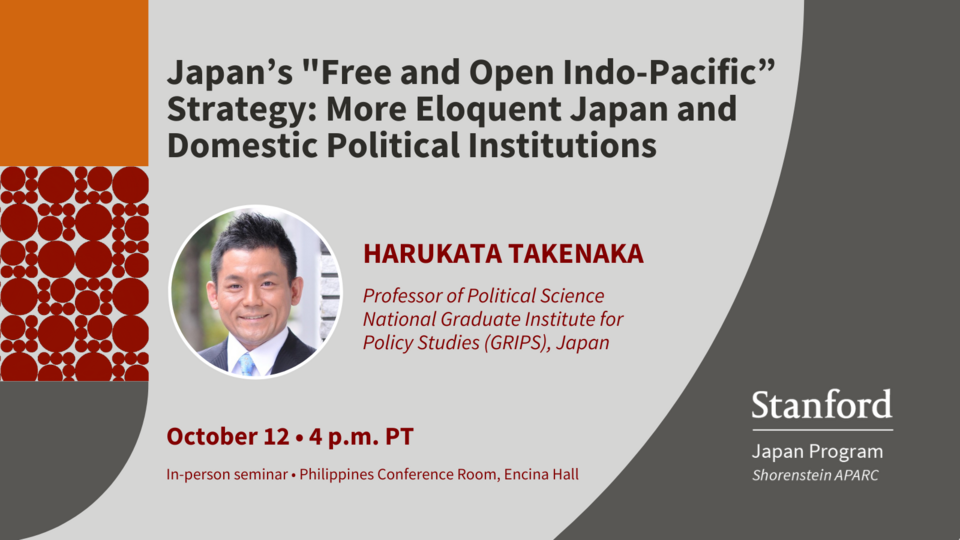
Visually banner card with the event title "Japan’s "Free and Open Indo-Pacific” Strategy: More Eloquent Japan and Domestic Political Institutions", and featuring a circle photo portrait of speaker Professor Harukata Takenaka

Since Prime Minister Shinzo Abe has advocated “Free and Open Indo-Pacific (FOIP)” Vision in 2016, various scholars have analyzed policy formulation process of FOIP. Most of them refer to the rise of China as an influential power in the Indo-Pacific region with its own initiative, namely, the Belt and Road Initiative as a major factor which prompted the Second Abe Administration to launch FOIP.

It is the contention of this presentation that the current configuration of the Japanese political institutions has made it possible for the Second Abe administration to launch and pursue such a comprehensive strategy while an international factor is important. It demonstrates that a series of political reforms since 1990s have strengthened the power of the prime minister as an institution to initiate key cabinet policies and coordinate policy formulation among different ministries. The strong institutional foundation of the Japanese prime ministerial power has made it possible for the Abe administration to effectively pursue such a broad vision, engaging various ministries and organizations.

The existing research on Japan's diplomacy often evaluates Japan as a passive state. It considers that in the past Japan only responded to foreign pressure while it did not proactively push forward its own policies. The presentation suggests that Japan has changed and become more eloquent as a result of changes in domestic political institutions.

Speaker

Image
Square photo portrait of Harukata Takenaka
Harukata Takenaka is a professor at the National Graduate Institute for Policy Studies (GRIPS) in Tokyo. He holds a PhD from Stanford University and a Bachelor of Laws from the University of Tokyo.

His key research areas are the role the prime minister in Japanese politics, changes in Japanese external policy, and democratization in Pre-war Japan.

Prof. Takenaka’s recent publications include: “Kyokoku Chugoku” to Taijisuru Indo-Taiheiyo Shokoku [Indo-Pacific Nations facing China aspiring to be a “Great Country”](edited) (Tokyo: Chikura Shobo, 2022), “Evolution of Japanese security policy and the House of Councilors,” Japanese Journal of Political Science, 22:2, (June 2021), 96-115, Korona Kiki no Seiji [Politics of Covid 19 Crisis](Tokyo: Chuo Koron Shinsha, 2020), “Expansion of the Japanese prime minister’s power in the Japanese parliamentary system: Transformation of Japanese politics and the institutional reforms,”Asian Survey,59:5:844-869 (September 2019); Futatsu no Seiken Kotai [Two Changes of Government] (edited) (Tokyo: Keiso Shobo, 2017); Failed Democratization in Prewar Japan (Stanford University Press 2014),

Harukata Takenaka Professor of Political Science National Graduate Institute for Policy Studies, Japan
-

Webinar recording: https://youtu.be/OuqgZCnXyo4 

When the U.S. government incarcerated over 120,000 people of Japanese descent during World War II (most of whom were U.S. citizens), Japanese Americans struggled to find a sense of normalcy behind the barbed wire. For some, this was achieved by playing baseball. 

Using baseball as a lens to explore the history of Japanese Americans and the U.S.–Japan relationship, this webinar offers K–12 educators a virtual tour of “Baseball’s Bridge to the Pacific,” a special exhibit currently on display at Dodger Stadium. The tour will be led by Kerry Yo Nakagawa, the founder and director of the Nisei Baseball Research Project (NBRP). The exhibit celebrates the 150th anniversary of U.S.–Japan diplomacy (1872–2022) and chronicles the introduction and development of baseball in Japan since the early 1870s. The exhibit’s photos, memorabilia, and artifacts offer a unique glimpse into key milestones of Japanese and Japanese Americans in baseball over the past 150 years. 

Join Nakagawa as he brings the legacy of Japanese Americans and baseball to life, live from Dodger Stadium! Attendees will receive a PDF of free curriculum materials on teaching about baseball and Japanese American incarceration, developed by SPICE and NBRP for high school and community college teachers.

This webinar is sponsored by the Stanford Program on International and Cross-Cultural Education (SPICE), the Nisei Baseball Research Project (NBRP), the National Consortium for Teaching about Asia (NCTA), and the USC U.S.-China Institute.

Kerry Yo Nakagawa is the author of "Through a Diamond: 100 Years of Japanese American Baseball." He is the founder and director of the non-profit Nisei Baseball Research Project (NBRP) and curator of “Diamonds in the Rough: Japanese Americans in Baseball,” an exhibition that was displayed at the Japanese American National Museum in 2000. He is also a consultant to the prestigious Baseball Hall of Fame tour entitled “Baseball in America” and an independent producer/filmmaker, actor, researcher, and writer.
portrait of a man
Naomi Funahashi

Online via Zoom.

Kerry Yo Nakagawa Founder and Director Nisei Baseball Research Project
Workshops
Authors
Scot Marciel
News Type
Commentary
Date
Paragraphs

This article originally appeared in The Jerusalem Strategic Tribune.


One often hears that China is “winning” the competition with the United States in Southeast Asia. This strategically important region is home to 650 million people, and collectively is the world’s fifth-largest economy and the US’s fourth-largest export market.

While serious competition is indeed a reality, it is not particularly useful to think of it in terms of one side “winning,” as if it were a sporting match. Southeast Asia is not a prize to be won. Countries there want to have good relations with both China and the US, but do not want to be dominated by either. They are strongly committed to their own independence and sovereignty. The American goal should not be to “win” but rather to maintain sufficiently strong relationships and influence to advance its many goals. The US should also provide the gravitational pull needed to help Southeast Asians maintain maximum independence and freedom of maneuver in the face of a rising China that sees the region as its sphere of influence.

To achieve this goal, Washington needs to engage consistently at all levels—starting with the president—and with that engagement, the US should bring a positive agenda that is not all about China. Even that, however, will not be enough should the US fail to bolster its economic game. In an area of the world that prioritizes economics, the US has steadily lost ground to China, especially on trade and infrastructure. This trend has reached the point that it is common to hear Southeast Asians say they view the US as their security partner and China as their economic partner. The harsh reality is that, even with still-strong security partnerships, it is hard to imagine the US being able to sustain its overall influence in the region if it continues to lose ground economically.

Southeast Asia is not a prize to be won. Countries there want to have good relations with both China and the US, but do not want to be dominated by either.

Interested in this article? Subscribe to APARC newsletters to receive our experts' analysis.


The numbers tell part of the story. While US merchandise trade with the Southeast Asian region grew by a respectable 62.4% from 2010 to 2019 (the last pre-pandemic year), China’s trade increased by an impressive 115% during the same period, according to the statistics of the Association of Southeast Asian Nations (ASEAN). Over a longer period, the US share of the region’s total merchandise trade fell from 16.1% in 2000 to 11.6% in 2020, while China’s share rose from 4.3% to 19.4%. Although infrastructure investment numbers are harder to come by, there is no question that China is playing a much more significant role in Southeast Asian infrastructure development than the US.

Some of the relative decline in the US economic role in the region is the inevitable result of China’s dramatic economic growth and the resulting increased trade and investment. That trend, however, only partly explains the US predicament. Over the past 10–20 years, Beijing has been much more aggressive in its economic statecraft than Washington. Beijing signed a Free Trade Agreement with ASEAN, then joined a new multilateral trade agreement—the Regional Cooperation and Economic Partnership (RCEP)—and more recently asked to join the high-standard Comprehensive and Progressive Agreement for Trans-Pacific Partnership (CPTPP) free trade accord. On infrastructure, China established the Asian Infrastructure Investment Bank and the high-profile Belt and Road Initiative (BRI), which aims to funnel billions of dollars into infrastructure projects in Southeast Asia and elsewhere.

The BRI initiative generally has been welcomed in the region for one simple reason: Southeast Asia has huge and urgent infrastructure needs—estimated by the Asian Development Bank to be $210 billion per year through 2030—that it cannot meet by mobilizing domestic resources. Through BRI, Beijing is offering to meet a portion of those needs with greater speed and fewer conditions than other would-be partners. Southeast Asian governments have lined up for BRI projects, with outgoing Philippine President Rodrigo Duterte, Indonesian President Joko Widodo, and former Malaysian Prime Minister Najib Razaq having signed on for more than $20 billion of BRI-funded infrastructure projects in the 2015–2018 period. Although the BRI has been the subject of substantial criticism for overpromising, project delays, quality problems, employing Chinese rather than local labor, and raising the host government’s debt obligations, the initiative still dominates the discussion of infrastructure in the region.

The US, meanwhile, has underperformed in terms of its economic diplomacy. Most importantly, in 2017 it summarily withdrew from its primary economic initiative in the region, the Trans-Pacific Partnership (TPP) free trade agreement. President Trump’s decision to pull out of that accord was a severe geostrategic and economic blunder, as TPP would have bound the US into the broader region for a generation or more, as well as facilitated greater US trade with a number of fast-growing economies. With the US out of the TPP and China joining RCEP, the prospects are for a growing percentage of ASEAN trade to be with China (and other RCEP partners) and for the US and American businesses to lose further ground.


The US does not need to match Chinese numbers. It does, however, need to find a way to become a more significant player in Southeast Asian infrastructure.

The US also has struggled to compete on infrastructure. The US is not going to match China, particularly in areas such as road, rail, and port development, but it could do more. The Trump administration launched several initiatives—including the Blue Dot Network, Clean EDGE Asia, and the establishment of the Development Finance Corporation (DFC), a larger, more ambitious version of the Overseas Private Investment Corporation (OPIC), a federal entity that helps insure US ventures abroad—all of which sought to leverage private sector funding to offer high-quality projects. The Biden administration has followed up with the Partnership for Global Infrastructure and Investment, announced in June in coordination with G-7 partners, and promised via the Quad $50 billion in infrastructure funding. To date, however, these initiatives generally have not significantly changed the overall infrastructure picture in the region.

The US failure to engage in the region’s burgeoning free trade networks—combined with the big splash that China’s BRI initiative is making and the lack of a countervailing American initiative—is fueling the perception in the region that the US is a declining economic player. In an ASEAN 2021 survey of regional opinion leaders, 76% believed China was the most influential economic partner in the region, compared to less than 10% who felt that way about the US. Even more telling, I recall asking a senior Myanmar economic minister in 2017 why he had led private-sector roadshows to China, Japan, and South Korea but not the US, and he replied: “We didn’t even think of the US.”

Thus, the US faces a problem of both reality and perception. To address this, the US does not need to match Chinese numbers. It does, however, need to find a way to re-energize its trade engagement and to become a more significant player in Southeast Asian infrastructure, and to do so in ways that change the narrative in the region.

Recognizing this reality, the Biden administration recently launched the Indo-Pacific Economic Framework (IPEF), which is expected to result in negotiations on trade, supply chains, clean energy, and decarbonization, as well as on tax and corruption issues. The administration touted this initiative as reflecting the needs and realities of the 21st-century global economy. The good news is that seven of the ten ASEAN member nations signed onto IPEF, presumably reflecting their interest in greater US economic engagement and their hope that IPEF can produce just that. Skeptics say the initiative does not offer the promise of greater access to the US market via tariff reductions, which normally would be the carrot to entice other governments into adopting the high standards Washington wants. Also, as Matthew Goodman of the Center for Strategic and International Studies has pointed out, the fact that the administration is unwilling to take any negotiated agreement to Congress for ratification is likely to raise doubts in the minds of Asian partners about the IPEF’s durability, since a future administration can easily toss it aside.

Despite or maybe because of these doubts, the US needs to do all it can to turn the IPEF into something that is economically meaningful. Can it produce a digital trade agreement, real substance on strengthening supply chains, or can it possibly even use trade facilitation tools to enhance market access as former senior US trade official Wendy Cutler has suggested in a recent podcast hosted by the Center for Strategic and International Studies? It is too early to say, but the bottom line is that many in the region—and indeed even in the US—will remain privately doubtful until and unless the IPEF shows that it can result in tangible business and economic benefits.

The US will have to make it easier for Southeast Asian governments to say “yes” to deals. That means offering the full project package, including financing, and accelerating the project preparation and approval timeline to come closer to matching that of the Chinese.

The White House put the IPEF forward because it believes it lacks the political support either to join the Comprehensive and Progressive Agreement for Trans-Pacific Partnership or to launch another significant trade initiative. The domestic politics of trade might be tough right now, but that is not an excuse that is going to go very far in Southeast Asia. The region is not going to say “no problem, we understand.” Instead, it will go ahead without the US. If Washington wants to maintain influence, it needs to find a way to make the domestic politics on trade work. That almost certainly will entail appealing to bipartisan concern about Chinese geostrategic dominance, as trade alone probably will not sell.

On infrastructure, the various US initiatives to date have disappointed to some extent, although the Development Finance Corporation has been a step in the right direction. They do little other than offer the prospect of quality to give the US a competitive edge over Chinese-funded projects. The Chinese offer relatively speedy approval processes, low or zero conditionality deals, and complete project packages, including financing. Chinese state companies often are willing to undertake projects that do not appear to be commercially viable. Plus, Chinese political leaders weigh in personally to push the projects forward. I have seen this on the ground, in Indonesia and Myanmar, countless times. The Chinese pull out all of the stops, with intensive lobbying and full financing, and they often win.

asean flags
Flags of ASEAN member states

Economic officials in the region complain that the multilateral development banks and Japan, which also offer substantial infrastructure deals, move much more slowly and laboriously than China. The design, discussion, and approval process often takes many years. With the US, it is almost always the private sector taking the lead, and private American companies have a hard time finding well-developed, “bankable” infrastructure projects in the region. Plus, US companies often come to the table without full financing or even all the pieces of the project. Government lobbying and financing usually lags, if it is there at all.

If the US is going to compete effectively for infrastructure projects in the region, it is going to have to change the way it does business. To begin with, the US will have to make it easier for Southeast Asian governments to say “yes” to deals. That means offering the full project package, including financing, and accelerating the project preparation and approval timeline to come closer to matching that of the Chinese. It also means more government funding for project development along with heavy US government lobbying, including by the president when appropriate, for major projects. The US is not going to engage in bribery or support projects that destroy communities or the environment, nor should it. But it needs to use just about all the other available tools to compete.

The US should consider establishing an overseas infrastructure czar in Washington who can lead and oversee government-business teams that identify potential projects where the US can compete, put together a full project package, including private and public financing, and then aggressively lobby the host government for approval. I often hear that the US does not work that way on overseas business. Perhaps, but if Washington wants to win some victories—and more significant projects—it needs to be willing to adopt new thinking.

Re-engaging on trade and winning more infrastructure deals are essential, but there is one more thing the US needs to do to reverse the perception that it is a declining economic player in Southeast Asia. It needs to do a much better job of telling its economic story. For example, the US remains the largest foreign investor in Southeast Asia, but I am willing to bet few people in the region know that. Similarly, America remains a huge market for Southeast Asian exports, just slightly smaller than China, but again that is not well known or much talked about in the region. The US should devote more resources and time to telling this story and to reminding the region of the incredible power of American private sector innovation and the US commitment to quality investment. Better communications alone will not solve the problem, but combined with trade and infrastructure initiatives it can help the US persuade the governments and people of Southeast Asia that it remains a major economic partner.

Read More

Enze Han with background of Encina hall colonade
News

Rethinking China’s Influence in Southeast Asia: The Role of Non-State Actors and Unintended Consequences

Departing from international relations scholarship and popular media accounts that tend to portray China as a great power intent on establishing a sphere of influence in Southeast Asia, Lee Kong Chian NUS-Stanford Fellow on Southeast Asia Enze Han argues for conceptualizing China as an unconventional great power whose diverse actors, particularly non-state ones, impact its influence in the region.
Rethinking China’s Influence in Southeast Asia: The Role of Non-State Actors and Unintended Consequences
ASEAN leaders during a Summit discussion.
Q&As

ASEAN’s Five-Point Consensus ‘Not Appropriate’ for Myanmar: Ex-US Ambassador

The Irrawaddy spoke to Scot Marciel, former United States ambassador to Myanmar and currently a visiting scholar at APARC, about the current state of regional and international efforts to tackle the Myanmar crisis.
ASEAN’s Five-Point Consensus ‘Not Appropriate’ for Myanmar: Ex-US Ambassador
Hero Image
Flanked by Sultan of Brunei Haji Hassanal Bolkiah (L) and President of Indonesia Joko Widodo (R), U.S. President Joe Biden points towards the camera.
Flanked by Sultan of Brunei Haji Hassanal Bolkiah (L) and President of Indonesia Joko Widodo (R), U.S. President Joe Biden reacts to a reporters questions during a family photo for the U.S.-ASEAN Special Summit on the South Lawn of the White House on May 12, 2022 in Washington, DC. | Drew Angerer/ Getty Images
All News button
1
Subtitle

The harsh reality is that, even with still-strong security partnerships, it is hard to imagine the US being able to sustain its overall influence in the region if it continues to lose ground economically.

Authors
Gi-Wook Shin
Kelsi Caywood
News Type
Commentary
Date
Paragraphs

This article first appeared in The Diplomat magazine.


U.S. President Joe Biden will first meet new South Korean President Yoon Suk-yeol in Seoul on May 21. It will be an important meeting for both leaders – not only to strengthen the South Korea-U.S. alliance but also to collaborate on a range of pressing issues, from North Korea to the Russia-Ukraine War to the protection of liberal democracy. The summit, to be held just 11 days after Yoon was inaugurated as president, will be his debut as a political leader on the international stage. Unlike political veteran Biden, Yoon formally entered politics only last summer and has yet to develop a policy track record. What should we expect from the new South Korean president at this first summit?

During the hotly contested campaign, Yoon’s opponents criticized him as South Korea’s Donald Trump. Western media and pundits also tended to portray him in a similar vein as an “anti-feminist political novice” with a “Trump-style brand of very divisive identity politics.” To be sure, he is not a conventional democratic leader who values negotiation and compromise; he envisions a strong South Korea that can stand up to China and North Korea, echoing Trump’s “America First.” Yet such a characterization risks setting off a false alarm that can badly mislead the United States and other allies in how they approach his administration.


Subscribe to our newsletters to receive our experts' commentary and analysis


First and foremost, Yoon is not a “political outsider” in the same sense as Trump. While Yoon, unlike every South Korean president since democratization, has no legislative experience in the National Assembly, he served as prosecutor-general during the Moon Jae-in administration, a leadership position often requiring sound political judgment as well as legal expertise. Yoon built his reputation as a fierce fighter against abuse of power and corruption, shifting public opinion in his favor. This degree of legal, policy, and political experience is a far cry from starring on “The Apprentice.”

Crucially, Yoon curried strong support among conservatives, successfully mobilizing diverse factions to create an anti-Moon coalition and win the election, similar to Biden’s victory in the 2020 election. Whereas the Trump administration was filled with individuals offering only limited policy experience, and many critical appointed positions were left vacant, Yoon is supported by the seasoned conservative establishment joining his administration. In this respect, Yoon recalls George W. Bush, whose first formal foray into Washington politics came after serving as governor of Texas and who relied on the close network of the Republican establishment, such as Dick Cheney and Donald Rumsfeld, for policy and political guidance.

At the upcoming summit, Yoon will have the opportunity to assure global audiences that he is not South Korea’s Trump but a reliable partner of the United States and other allies with shared democratic values.
Gi-Wook Shin and Keli Caywood

Yoon’s key cabinet and presidential office nominees are well-known figures with extensive policy backgrounds. New Unification Minister Kwon Young-se is a four-time member of the National Assembly and served as Seoul’s envoy to Beijing during the Park Geun-hye administration. Yoon’s national security advisor, Kim Sung-han, is a professor at Korea University who served as the vice minister of foreign affairs and trade during the Lee Myung-bak administration. Yoon is also supported by a powerful group of South Korean elites who attended Seoul National’s law school, his alma mater. Such heavy reliance on experienced hands of the conservative establishment reduces uncertainty for the Biden administration.

Yoon is expected to adopt a largely conventional conservative stance on major policy issues, both domestic and foreign. His economic policy is likely to be market-led and minimize state intervention, replacing Moon’s policies such as “income-driven growth” that Korean conservatives branded as socialist. On foreign policy, Yoon seeks to strengthen the U.S. alliance and restore relations with Japan, which, under Moon, were the most precarious they have been since the normalization of relations in 1965.

It is noteworthy that, as president-elect, Yoon sent his special delegation to the United States and Japan followed by the European Union, but not to China and Russia, departing from past precedent. Yoon is expected to take a firm stance against Beijing and Pyongyang rather than embrace appeasement.

At the upcoming summit, Yoon will have the opportunity to assure global audiences that he is not South Korea’s Trump but a reliable partner of the United States and other allies with shared democratic values. In his inaugural speech, he repeatedly stressed the importance of “freedom” to clearly signal his resolve to protect liberal democracy both at home and abroad. This is great news for Biden, who badly needs support from allies like South Korea in his fight against global autocracy.

Just as Yoon will be tested, the summit presents a chance for Biden to demonstrate he is prepared to work closely together with the new South Korean president, overcoming the concerns unearthed during his campaign, in order to bolster the alliance and democracy.

Read More

Yoon Suk-yeol speaks during a press conference
Commentary

In Troubled Waters: South Korea’s Democracy in Crisis

Just as the United States experienced a crisis of democracy under the Trump administration, South Korea underwent a democratic recession during President Moon Jae-in’s time in office. The consequences of this decline have been evident throughout the election and the subsequent presidential transition.
In Troubled Waters: South Korea’s Democracy in Crisis
South Korean President-elect Yoon Suk-Yeol
Commentary

South Korean Democracy Under Stress: Yoon Suk-yeol’s Victory Likely to Increase Domestic Polarization

On CNBC's "Squawk Box Asia," APARC Director Gi-wook Shin shares insights about the potential for democratic backsliding and further domestic tension after Yoon Suk-yeol’s victory in the contentious presidential election in South Korea.
South Korean Democracy Under Stress: Yoon Suk-yeol’s Victory Likely to Increase Domestic Polarization
Xion, Seoho, Ravn, Keonhee, Leedo, and Hwanwoong of OneUs visit the Empire State Building
Commentary

It’s Time for K-pop Stars to Speak Out on Human Rights

With few exceptions, South Korea’s K-pop idols have been conspicuously silent on controversial subjects – including the Russian invasion of Ukraine.
It’s Time for K-pop Stars to Speak Out on Human Rights
Hero Image
South Korea's President Yoon holds a champagne glass
South Korean President Yoon Suk-yeol attends the 20th Presidential inauguration reception at the National Assembly on May 10, 2022 in Seoul, South Korea. | Lee Jin-Man /Getty Images
All News button
1
Subtitle

Yoon has been compared to Biden’s own nemesis, Donald Trump, but he is far from a political iconoclast.

News Type
News
Date
Paragraphs

In a talk hosted by the Program on Arab Reform and Democracy on April 19, 2022, Erin A. Snider, Assistant Professor at Texas A&M University’s Bush School of Government and Public Service, discussed his latest book Marketing Democracy: The Political Economy of Democracy Aid in the Middle East (Cambridge University Press 2022).

During the event, co-sponsored by Stanford’s Abbasi Program in Islamic Studies and the Center for African Studies, Snider examined the construction and practice of democracy aid in Washington, D.C., and in Egypt and Morocco — two of the highest recipients of US democracy aid in the region. Her research shows how democracy aid can work to strengthen rather than challenge authoritarian regimes.

You can purchase the book online, and watch a recording of the event below:

Hero Image
Erin A. Snider
All News button
1
Subtitle

The Program on Arab Reform and Democracy (ARD) at CDDRL hosted a talk featuring Erin A. Snider, Assistant Professor at Texas A&M University’s Bush School of Government and Public Service, who discussed her latest book – Marketing Democracy: The Political Economy of Democracy Aid in the Middle East (Cambridge University Press 2022).

Subscribe to Diplomacy