Karl Eikenberry, a distinguished fellow at Stanford’s Freeman Spogli Institute for International Studies, will serve on the Commission on Language Learning at the American Academy of Arts and Sciences (AAAS). The new commission is part of a national effort to examine the state of American language education.
The commission will work with scholarly and professional organizations to gather research about the benefits of language instruction and to initiate a national conversation about language training and international education.
Eikenberry joins eight other commissioners, including: Martha Abbott, executive director of the American Council on the Teaching of Foreign Languages; Nicholas Dirks, chancellor of the University of California at Berkeley; and Diane Wood, chief judge, of the 7th U.S. Circuit Court of Appeals. The group is led by Paul LeClerc, director of Columbia University’s Global Center in Paris.
Eikenberry, who is also a member of the AAAS Commission on Humanities and Social Sciences, contributed to “The Heart of the Matter,” a 2013 report that aims to advance dialogue on the importance of humanities and social sciences for the future of the United States.
FSI Director and SCPKU Mingde Distinguished Faculty Fellow Mike McFaul shares with SCPKU intern Nathalie Chun key insights during his month-long academic residence at the Stanford Center at Peking University (SCPKU) this summer.
What is the purpose of your current visit? Could you tell us about your experiences and findings?
Michael McFaul: My main intellectual interest was to understand more about Chinese foreign policy and in particular the bilateral relationship between China and the US but also the bilateral relationship between China and Russia. I’m thinking of writing something, a new project, about this trilateral relationship. And so I spent the most of my time over the last several weeks speaking to two sets of people that are very different: those that focus on United States and those that focus on Russia. In addition, I have an interest in the politics of economic reform and the politics of political reform so I’ve also been speaking to academics, business people, and a few journalists to talk about the change that is going on here in China both on the political and economic dimensions
Is there in particular that you’ve learned about here in China that has surprised you? You’ve mentioned that you’ve talked to many different people so I was wondering if there was anything in particular that made you go ‘Oh that’s really interesting!’
MM: That’s good question. In terms of my subject matter, the thing that was most interesting to me as a concept of dual rising powers. So, the conventional wisdom is that China is rising and the rest are fading. But one academic, and it actually came up more than once, reformulated that idea. It’s not that China is rising and everybody else is fading, it’s actually that the United States is rising with China, just at a slower pace. And so maybe eventually they catch up, but it’d be incorrect to say that one is declining and that one is rising, and vis-á-vis the rest of the countries in the world. I also think that’s a better formulation because actually the United States continues to grow at a higher rate. It still has the largest military in the world; in terms of soft power [it still] has great reach and that has not been declining, that’s still rising. It’s just that when we look at this rate of change relative to the rate of change in China, the United States feels like it’s falling behind. Or China is catching up is a better way to put it. I thought that was interesting.
Second interesting point is, you know I just spent two years as Ambassador to Russia from the United States, and there I would say there is a feeling of… envy towards the United States. Like we have wronged them or that we are guilty for some of the difficult periods that they have had, kind of like a chip on their shoulder. Here I don’t feel that. Here I see a kind of self-confidence that people have, wanting to work with United States. Most certainly when I met with officials there was a very strong sense of wanting to have cooperative relations with the United States and in particular it jumped out at me when I was at the Ministry of Foreign affairs yesterday, they kept using the phrase ‘win-win outcomes’ for China and the United States. Well that’s exactly what we’re trying to do with Russia when I was in the government; during the early period of the Obama administration we used that phrase too. And I find it interesting that here the bilateral relationship with China, the Chinese still talk about that, and most certainly do the Americans too. I met with Ambassador Baucus and his team, and they most certainly talk that way. I find it kind of tragic that in the bilateral relationship with Russia, we no longer talk that way.
You’ve just mentioned the whole idea of zero-sum perspective of looking at the world and I guess in IR theory that would be a more realist perspective, as opposed to a liberalist perspective. So do you think that this sort of liberalist perspective should the future of looking at and that this ‘win-win’ perspective is one that future diplomats should hold?
MM: I worked on the Obama campaign in 2008 and one time on a flight with him when I was briefing him, I started to talk about these two camps, realist and liberal camps, as a way to understand foreign policy and you know how he responded to me? He said “Come on, the real world, requires you to use both of those theories depending on the issue and the country and the bilateral relationship” and when I was in the government, I most certainly felt that way. These are useful paradigms to kind of clarify arguments but I wouldn’t want to be labeled in one camp or the other and I think it’s analytically distorting, not revealing, to say the world is either realist or liberal. That said, I lean towards liberalism personally. I do believe in the 21st Century, maybe not early centuries it was possible, but in the 21st Century it is possible to construct outcomes that are good for both countries especially through the use of treaties and institutions. And I come away from my month here in China feeling that there are real challenges in the bilateral relationship, complicated issues, but they’re not irreconcilable issues. Even South China sea right, even Taiwan, I see the possibility, with smart diplomacy, that we can find ways to manage these issues so that it doesn’t lead to conflict between the United States and China
While you were here at SCPKU you have given talks on both the upcoming US elections and current US-Russia relations. Putting those two themes together, what do you think are the implications of the current US-Russia relations on the upcoming elections in 2016 and the way the next president will tackle these issues?
MM: I would say, I predict continuity, more or less. That is to say, that the policy that you see now was a reaction to Russia annexation of Ukraine, of Crimea, and intervention in Eastern Ukraine, is one of deterrence and punishment. There are three dimensions to it: sanctions to punish Putin’s bad behavior, strengthening of NATO to deter him from going further and third, shoring up Ukraine to try and make the economy there recover from this very difficult period. And I basically think those three main policy trajectories will continue, I don’t see a change. But in each one of them, you might see more or less the same paths. I predict that if a Republican candidate is elected, the ones who’s policies I know, or even Secretary Clinton, you would see for instance maybe military assistance to Ukraine, which is something the Obama administration has so far been reluctant to do, but I don’t foresee major change. And that disappoints people here in China. When I say that they are disappointed, it is because they are hopeful after an election there might be a new president that may try to reset relations with Russia again. I’m not optimistic.
What roles, in your opinion, is SCPKU playing in China, and what do you hope the Center will achieve in the future?
MM: Well what I hope the Center will achieve for the future is to create greater connectivity between hundreds of Stanford scholars working in all fields. This is an incredible place, I’ve never seen it before until this trip, absolutely beautiful, 21st century technology, and the second thing is, Peking University is an incredible university, beautiful campus, really all of my interactions with scholars here have been very positive, they’ve been very warm in greeting me as a fellow scholar and I’ve been impressed by the students as well. So that is my hope, over the coming years and decades, that this serves as a bridge between PKU, but also all of China, and Stanford University because there are many difference issues in all different fields of study where there’s room to cooperate. In my field, I also see a very concrete role to help develop what we call Track II dialogues, with China scholars, in terms of helping to manage US-China bilateral relationships. It’s very clear to me there’s a close relationship between senior scholars here at PKU and the government and the Party and the business community and the People’s Congress. I’ve met many people and they know all the people here and we have those connections in terms of Washington as well at Stanford. So my hope is that in a concrete way, and for me personally, that I might be involved in that, and we have an incredible platform here to be able to do so.
The Trans-Pacific Partnership (TPP) is widely regarded as the economic component of the US strategy of “rebalance” to Asia. As a major trading partner of many of the founding members, Taiwan has obvious economic and security interests at stake and is therefore seeking to join the TPP in the next round. But an overlooked aspect of the TPP for Taiwan is its potential impact on sovereignty. Trade agreements provide a revealing window into the evolving conceptions of modern sovereignty. The way Taiwan’s unique form of statehood and international status is defined in trade agreements could strengthen its position under international law and contribute to its national security. This talk will consider how Taiwan was defined as a sui generis legal entity in its application to join the World Trade Organization (WTO) and as a party to the Cross-Straits Economic Cooperation Framework Agreement (ECFA), with lessons for future negotiations to join the TPP.
Speaker Bio
Image
Joseph Yen-ching Chao is an Executive Officer in the Department of International Cooperation and Economic Affairs. A member of Taiwan’s Ministry of Foreign Affairs (MOFA) diplomatic corps since 2005, he has previously served as a German-language interpreter for the Presidential Office, an officer in the Department of Treaty and Legal Affairs, and as a deputy secretary of Taiwan’s permanent mission to the World Trade Organization in Geneva, Switzerland. He holds an LL.M. from Ruprecht-Karls University in Heidelberg and a Doctor juris from Albert-Ludwige University, Frieberg, Germany. Dr. Chao is in residence at Stanford from May-July 2015, where his research examines Taiwan’s prospects for entry into the Trans-Pacific Partnership (TPP).
As people around the world look to support earthquake relief efforts in Nepal, scholars from Stanford and the London School of Economics and Political Science offer new research that can help donors make better decisions about where and how to contribute their money.
“NGO reports tend to focus on quantity in delivery, such as numbers of homes and people served—but not on quality,” write Yong Suk Lee (Stanford) and J. Vernon Henderson (LSE).
In a forthcoming paper, the coauthors evaluate reconstruction efforts in Indonesia following the 2004 earthquake and tsunami, and find two trends: aid agencies that directly execute their services—point-to-point—perform the highest quality work. And, when agencies contract their services, higher quality work is performed when a global, not domestic, implementer completes the work.
Knowing this reality, and with improved disclosure of outcomes, the coauthors hope that donors would be able to make more informed choices.
Fishing village survey
Figure 1. A map details the survival rate of the population and flood damage within northern Indonesia in 2004. Darker shaded areas show a higher survival rate, lighter shaded areas show a lower survival rate. Striped areas denote flooding, largely on the northeastern border. Boundaries marked with thicker lines are ‘kabupaten,’ or county divisions, and lightly colored lines are ‘kecamatan,’ or sub-county units larger than a village alone. (Courtesy of Yong Lee).
Through fieldwork and three rounds of surveys – in 2005, 2007 and 2009 – Henderson and Lee investigated aid work in Aceh, an area of coastal villages in northern Indonesia (Figure 1).
Humanitarian efforts there focused on “hard aid” such as construction of houses and fishing boats. Total aid delivered amounted to $7.7 billion and was implemented by international and domestic aid agencies—some directly and some as contractors—as well as the Indonesian government.
First, Henderson and Lee conducted a pilot survey, and then with a cohort of surveyors from the University of Indonesia, held interviews with village leaders and fishing families. Participants were asked to rate their housing accommodation, and if applicable, how their fishing activity compared to before the disaster.
“Mostly, we sat with villagers to see how willing they were to talk about aspects of aid,” Lee said. “Since it was several years after the tsunami hit, people were pretty open throughout the process.”
Data from those surveys was combined with information from the Recovery Aceh-Nias relief project database maintained by the government and the U.N., as well as demographic information provided by participants.
Delivering aid: Global v. local
Empirical analysis revealed that aid agencies such as the Red Cross and Catholic Relief Services reflected higher quality aid delivery (at a mean quality near 3.00), while agencies such as Save the Children and Concern Worldwide reflected lower quality (at a mean quality between 1.0-1.5).
“What’s surprising is that reputation didn’t really line up with what was expected,” Lee said, citing a few renowned agencies that didn’t receive high marks.
Lee said this could be explained by the fact that aid agencies that specialize in disaster recovery are better equipped, while a learning curve might exist for agencies with wider missions.
Global aid agencies are more likely to have logistical experience given their reach across multiple disaster situations. And while all NGOs face reputational costs for their results, global aid agencies are greater exposed to criticism because, by size, they’re more visible.
Yet, while global aid agencies and implementers may have the raw skills, local implementers have the cultural know-how.
“Local implementers might not have the most experience – like how to construct a house or manufacture a fishing boat – but they will likely know what’s actually desired,” Lee said. “So, there are obvious tradeoffs at play.”
For example, villagers reported bad ventilation in houses. This was because some aid agencies used small windows and concrete instead of wood material more traditionally used in Indonesia. Some boats were impossible to use because of improper design; they sank upon first use or fell apart after a few months.
Image
Collection of photos from fieldwork in Aceh, Indonesia, provided courtesy of Yong Lee. Upper left: A house built in an aid project village shows windows retrofitted after initial construction. Upper right: Boats constructed by aid agencies for fishing activity are refashioned to serve as water taxis for people and cars. Lower: Fishing boats sit unused on the side of the road many of them impossible to use, according to villagers surveyed.
Upper left: A house built in an aid project village shows windows retrofitted after initial construction. Upper right: Boats constructed by aid agencies for fishing activity are refashioned to taxi people and cars. Lower: Fishing boats sit unused on the side of the road many of them impossible to operate, according to villagers surveyed. (Courtesy of Yong Lee).
Logistics and oversight
Aid delivery depends in many ways on the location and scale of the disaster. But, a few main aspects can determine if an aid agency doing its own work or operating as an implementer meets or exceeds expectations.
Henderson and Lee suggest that agencies that were highly supervisory had greater positive outcomes from their workers. In the case of Aceh, better monitoring and insistence on quality by leadership is a likely corollary between construction of better quality homes and boats.
“Rather than just give money, NGOs need to really oversee the projects. Organization and management are essential facets,” Lee said. “And that requires a lot of additional effort on their part.”
Oversight is especially relevant in disaster situations because of the often-overwhelming need for reconstruction. A flood of less-skilled workers enters the market to fill this gap, and on average the quality of work degrades.
“It’s much more difficult to impose quality control at this point,” Lee said. “So the implication that comes out of it is how does the implementer effectively utilize less-skilled workers.”
Getting to know the implementers and evaluating their work in-progress would help ensure quality on behalf of the aid agency. And, better dissemination of information about aid outcomes would help assure donors that their monies are being applied in the best possible way.
Future study
Most “hard aid” delivered to Aceh’s villages had finished by 2010, but “soft aid” such as democracy promotion and women’s empowerment stayed longer.
Henderson and Lee conducted one final survey in 2011. The data has been offered as open source material for researchers along with the larger data set.
Noting this, Lee said, “We’re thrilled that people are looking into the data further. It’s exactly what we wanted.”
Research projects applying the data include the impact of the tsunami on Aceh’s local economies and health effects on the population, among other areas.
Hero Image
A United Nations Humanitarian Air Service helicopter offloads relief supplies from the World Food Programme in Gorkha District, Nepal. Villagers help distribute tents and food.
On June 2, 2015, the Taiwan Democracy Project at Stanford's Center on Democracy, Development and the Rule of Law (CDDRL) will host a special panel session featuring the President of the Republic of China (Taiwan), Ma Ying-jeou. President Ma will speak via live video feed to commemorate the 70th anniversary of the end of World War II and the long history of the U.S.-R.O.C. relationship. Following his prepared remarks, the president will engage in a question-and-answer session with the audience and a distinguished panel of leading Stanford faculty and fellows, chaired and moderated by the former Secretary of Defense of the United States, William J. Perry.
About the Speaker
Ma Ying-jeou has served as the President of the Republic of China (Taiwan) since May 2008. As president, Ma Ying-jeou has worked to address the repercussions of the global financial crisis, stepping up efforts to bring about a more diversified industrial structure and to jump-start new engines for economic growth in Taiwan. President Ma has also attached great importance to promoting energy conservation and carbon reduction, which has helped Taiwan’s energy efficiency to exceed two percent. In addition, his administration worked to craft a response to regional economic integration, successfully negotiating the landmark Economic Cooperation Framework Agreement (ECFA) with the People's Republic of China in 2010. President Ma's creative diplomacy has brought a significant improvement in cross-Strait relations while putting an end to a long and vituperative standoff between the two sides in the diplomatic sphere.
About the Panelists
William J. Perry is the Michael and Barbara Berberian Professor (emeritus) and a senior fellow at the Freeman Spogli Institute and the Hoover Institution, and serves as the director of the Preventive Defense Project at Stanford University. He was the Secretary of Defense for the United States from 1994-1997.
Lanhee J. Chen is the David and Diane Steffy Research Fellow at the Hoover Institution, as well as Lecturer in Public Policy and Law at Stanford University. He served as the chief policy adviser to 2012 U.S. presidential candidate Mitt Romney.
Karl Eikenberry is the William J. Perry Fellow in International Security at the Center for International Security and Cooperation at Stanford University. He served as the U.S. Ambassador to Afghanistan and is a Lieutenant General, Retired, U.S. Army.
Thomas Fingar is the Oksenberg-Rohlen Distinguished Fellow in the Freeman Spogli Institute for International Studies at Stanford University. He served as the first deputy director of national intelligence for analysis and as chairman of the National Intelligence Council from 2005-2008.
Event Details
The live panel will take place in the Bechtel Conference Room of the Freeman Spogli Institute at Stanford University, at 616 Serra Street, from 5:45-7:00pm on June 2, 2015. An informal reception in the lobby of Encina Hall will follow.
Due to the high interest in this event, we have moved it to a larger room. It is now in the Oksenberg Conference Room, Encina Hall, 3rd floor.
The February Minsk II agreement introduced a fragile ceasefire in eastern Ukraine, following a year of crisis and conflict between Kyiv and Moscow. Ukrainian President Poroshenko needs to grapple with a daunting list of critical economic and political reforms. Russian President Putin, however, appears intent on destabilizing the Ukrainian government and has the means, including military force, to do so. What can we expect next in the Ukraine-Russia stand-off, and how should the West respond?
Image
Steven Pifer is a senior fellow at the Brookings Institution, where his work focuses on arms control, Ukraine and Russia. A retired Foreign Service officer, his more than 25 years with the State Department included assignments as deputy assistant secretary of state with responsibilities for Russia and Ukraine (2001-2004), ambassador to Ukraine (1998-2000), and special assistant to the president and senior director for Russia, Ukraine and Eurasia on the National Security Council (1996-1997).
Co-sponsored by the Freeman Spogli Institute for International Studies and The Europe Center.
Steven Pifer
Senior Fellow
Speaker
the Brookings Institution
Ambassador David Lane was nominated by President Barack Obama to serve as the U.S. Representative to the United Nations Agencies for Food and Agriculture and confirmed by the U.S. Senate on May 24, 2012.
Ambassador Lane has more than twenty years of experience working in leadership positions across sectors. Before coming to Rome, he served at the White House as Assistant to the President and Counselor to the Chief of Staff.
Prior to joining the Obama Administration, he served as President and CEO of the ONE Campaign, a global advocacy organization focused on extreme poverty, development, and reform. Before that, as Director of Foundation Advocacy and the East Coast Office of the Bill & Melinda Gates Foundation, he helped lead that organization’s advocacy and public policy efforts.
During the Clinton Administration, he served as Executive Director of the National Economic Council at the White House and Chief of Staff to the U. S. Secretary of Commerce. He served as Vice-Chair of Transparency International USA, and he is a member of the Council on Foreign Relations
Ambassador Lane earned his B.A. from the University of Virginia and his M.P.A. from the Princeton University Woodrow Wilson School of Public and International Affairs.



 Figure 1. A map details the survival rate of the population and flood damage within northern Indonesia in 2004. Darker shaded areas show a higher survival rate, lighter shaded areas show a lower survival rate. Striped areas denote flooding, largely on the northeastern border. Boundaries marked with thicker lines are ‘kabupaten,’ or county divisions, and lightly colored lines are ‘kecamatan,’ or sub-county units larger than a village alone. (Courtesy of Yong Lee).
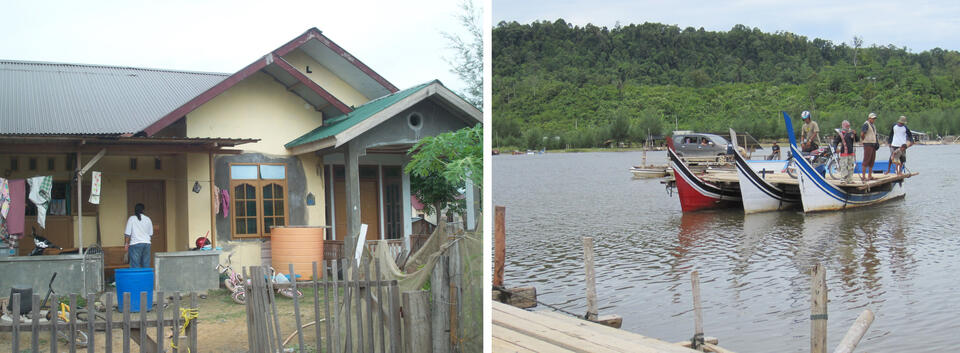
 Collection of photos from fieldwork in Aceh, Indonesia, provided courtesy of Yong Lee. Upper left: A house built in an aid project village shows windows retrofitted after initial construction. Upper right: Boats constructed by aid agencies for fishing activity are refashioned to serve as water taxis for people and cars. Lower: Fishing boats sit unused on the side of the road many of them impossible to use, according to villagers surveyed.


