
 FSI scholars approach their research on the environment from regulatory, economic and societal angles. The Center on Food Security and the Environment weighs the connection between climate change and agriculture; the impact of biofuel expansion on land and food supply; how to increase crop yields without expanding agricultural lands; and the trends in aquaculture. FSE’s research spans the globe – from the potential of smallholder irrigation to reduce hunger and improve development in sub-Saharan Africa to the devastation of drought on Iowa farms. David Lobell, a senior fellow at FSI and a recipient of a MacArthur “genius” grant, has looked at the impacts of increasing wheat and corn crops in Africa, South Asia, Mexico and the United States; and has studied the effects of extreme heat on the world’s staple crops.
Accountability at a time of Crisis: the case of Covid-19 in Egypt
-
Image

Nancy Okail is a visiting scholar at CDDRL. She has 20 years of experience working on issues of democracy, rule of law, human rights, governance and security in the Middle East and North Africa region. She analyzes these issues and advocates in favor of human rights through testimony to legislative bodies, providing policy recommendations to senior government officials in the U.S. and Europe. She is currently the president of the board of advisors of The Tahrir Institue for Middle East Policy (TIMEP), previously she was the Institute’s executive director since its foundation. Dr. Okail was the director of Freedom House’s Egypt program. She has also worked with the Egyptian government as a senior evaluation officer of foreign aid and managed programs for several international organizations. Dr. Okail was one of the 43 nongovernmental organization workers convicted and sentenced to prison in a widely publicized 2012 case for allegedly using foreign funds to foment unrest in Egypt. She holds a Ph.D. from the University of Sussex in the UK; her doctoral research focused on the power relations of foreign aid.
Online, via Zoom: REGISTER
Visiting Scholar at Center on Democracy, Development and the Rule of Law
Seminars
India's Transition: Was Coleridge Right?
Related Multimedia

Researchers present their work at AGU 2019
News Type
News
Date
Paragraphs
Each year, thousands of scientists from across the globe come together at the American Geophysical Union (AGU) annual fall meeting to share new findings and research on pressing topics facing our world, including climate change, extreme events, environmental pollution, groundwater resources and more. On December 9 – 13, in San Francisco, Stanford faculty, students and scholars joined scientists from various disciplines in the earth and planetary sciences and engaged in interdisciplinary collaborations and discussions across fields to learn more about and create solutions to the world’s most pressing environmental challenges.
Investigating the Yield Impacts of Conservation Tillage in the US Corn Belt using Landsat — Jillian M Deines
Food-water-energy for Urban Sustainable Environments (FUSE): Integrated Analyses Focused on Pune, India and Amman, Jordan — Steven M. Gorelick
Using Observational Data to Understand Climatic Constraints on Economic Output — Marshall Burke
Insights into Effective Satellite Crop Yield Estimation from an Extensive Ground Truth Dataset in the US Corn Belt — Jillian M Deines
Using satellite imagery to understand and promote sustainable development — Marshall Burke
Measuring and unpacking smallholder agricultural risks using fine resolution satellite data — David B Lobell
Verifying single-event attribution results for unprecedented hot, wet and dry events — Noah S Diffenbaugh
Hero Image

All News button
1
Cost-effectiveness of Interventions to Control Cardiovascular Diseases and Diabetes in Low- and Middle- Income Countries
-
More than 80% of cardiovascular diseases (CVD) and diabetes mellitus (DM) burden now lies in low and middle-income countries. Thus, there is an urgent need to identify and implement the most cost-effective interventions, particularly in the resource-constraint South Asian settings. A 2018 systematic review evaluated the cost-effectiveness of individual-level, group-level and population-level interventions to control CVD and DM in South Asia. Of the 2949 identified studies through a search of 14 electronic databases up to 2016, 42 met full inclusion criteria. Critical appraisal of studies revealed 15 excellent, 18 good and 9 poor quality studies. Most studies were from India (n=37), followed by Bangladesh (n=3), Pakistan (n=2) and Bhutan (n=1). The economic evaluations were based on observational studies (n=9), randomised trials (n=12) and decision models (n=21). Together, these studies evaluated 301 policy or clinical interventions or combination of both. We found a large number of interventions were cost-effective aimed at primordial prevention (tobacco taxation, salt reduction legislation, food labelling and food advertising regulation), and primary and secondary prevention (multidrug therapy for CVD in high-risk group, lifestyle modification and metformin treatment for diabetes prevention, and screening for diabetes complications every 2–5 years). Significant heterogeneity in analytical framework and outcome measures used in these studies restricted meta-analysis and direct ranking of the interventions by their degree of cost-effectiveness. The cost-effectiveness evidence for CVD and DM interventions in South Asia is growing, but most evidence is from India and limited to decision modelled outcomes. There is an urgent need for formal health technology assessment and policy evaluations in South Asia and other low- and middle- income countries using local research data.
Image

Kavita Singh
2019-2020 Walter H. Shorenstein Asia-Pacific Research Center Visiting Scholar
Seminars
Good Science and Silenced Security: On Anticipatory Governance in Biobanking
-
Seminar Recording: https://youtu.be/P1-Q0OSo4yM
About this Event: The governance of big data and the prevention of their misuse is among the most topical issues in current debates among security experts. But what does it mean when security is not an issue for the stakeholders governing big biomedical data? This paper answers this question by looking at what it describes as a peculiar omission of the issue of security in the biggest harmonization cluster of biomedical research in Europe - BBMRI-ERIC. While it does treat personal data, the risks and threats are constructed through a language of anticipation and self-governance rather than security. The analysis explains why: based on document analysis, interviews, and field research, it studies (1) how are risks and threats constructed in the research with big biomedical data, (2) what regime of their governance is established in this area, and (3) what are the implications for the practices of science and the politics of security. The paper argues that this silence is a by-product of bureaucratization and responsibilization of security, which is in biobanking characteristic by discourse and practices of responsible research, ethics, and law. The paper suggests that this regime of governance precludes the prospects of addressing bigger questions that biobanks may need to deal with in the future, such as regarding the access to the biomedical data by state or private actors and their use for policing, surveillance, or other types of population governance.
Speaker's Biography: Dagmar Rychnovská is Marie Sklodowska-Curie Fellow at the Techno-science and societal transformation group at the Institute for Advanced Studies in Vienna. She holds a PhD in International Relations (Charles University in Prague), an MA in Comparative and International Studies (ETH Zurich and University of Zurich), and an LLM in Law and Politics of International Security (VU University Amsterdam). Her research interests lie at the intersection of international relations, security studies, and science and technology studies. Her current research explores security controversies in research and innovation governance, with a focus on bioweapons, biotechnologies, and biobanks.
Dagmar Rychnovská
Institute for Advanced Studies
Seminars
Yvonne Franz
Encina Hall
616 Jane Stanford Way
Stanford, CA 94305
0
yvonne.franz@univie.ac.at
Visiting Postdoctoral Scholar at The Europe Center, 2019-2020
Yvonne Franz studied geography at the University in Cologne and the University of Vienna where she also received her doctorate in urban geography in 2013. As a university assistant (prae-doc) at University of Vienna she coordinated the Erasmus Mundus Masters in Urban Studies 4CITIES and conducted extensive fieldwork on gentrification and urban rejuvenation policies in New York City, Vienna and Berlin. After the completion of her doctorate, the successful approval of research proposals within the Joint Programming Initiative Urban Europe allowed her to join the Institute of Urban and Regional Research (ISR) at the Austrian Academy of Sciences as a post-doc researcher. Currently, she is affiliated to the University of Vienna, Department of Geography and Regional Research as a postdoc university assistant. Her research projects include the INTERREG Central Europe (funded by the European Regional Development Fund) on “Integrating Refugees in Society and the Labour Market Through Social Innovation - SIforREF” as well as research projects on arrival spaces and housing transition in Vienna. She teaches courses within the fields of urban geography and urban studies both at the University of Vienna and other universities. In addition, she is the local coordinator of the Erasmus Mundus Joint Master in Urban Studies (4CITIES). Her research interests lie in the fields of urban geography with a special focus on neighbourhood development, urban revitalisation and gentrification as well as urban planning and governance. Comparative analyses with Berlin, Bologna and Ljubljana are part of her ongoing research collaborations.
During her visit as Visiting Postdoctoral Scholar at The Europe Center, Yvonne will continue analysis and writing on spaces of encounter and social innovation in neighbourhood development.
APARC Delegation Visits Hanoi and Bangkok
News Type
News
Date
Paragraphs
Southeast Asia, home to over 640 million people across 10 countries, is one of the world’s most dynamic and fastest growing regions. APARC just concluded the year 2019 with a Center delegation visit to two Southeast Asian capital cities, Hanoi and Bangkok, where we spent an engaging week with stakeholders in the academic, policy, business, and Stanford alumni communities.
Led by APARC Director Gi-Wook Shin, the delegation included APARC Deputy Director and Asia Health Policy Program Director Karen Eggleston, Southeast Asia Program Director Donald Emmerson, and APARC Associate Director for Communications and External Relations Noa Ronkin. Visiting Scholar Andrew Kim joined the delegation in Bangkok.
With a focus on health policy, our first day in Hanoi included a visit to Thai Nguyen University, a meeting with government representatives at the Vietnam Ministry of Health, and a seminar on healthy aging and innovation jointly with Hanoi Medical University.
Image
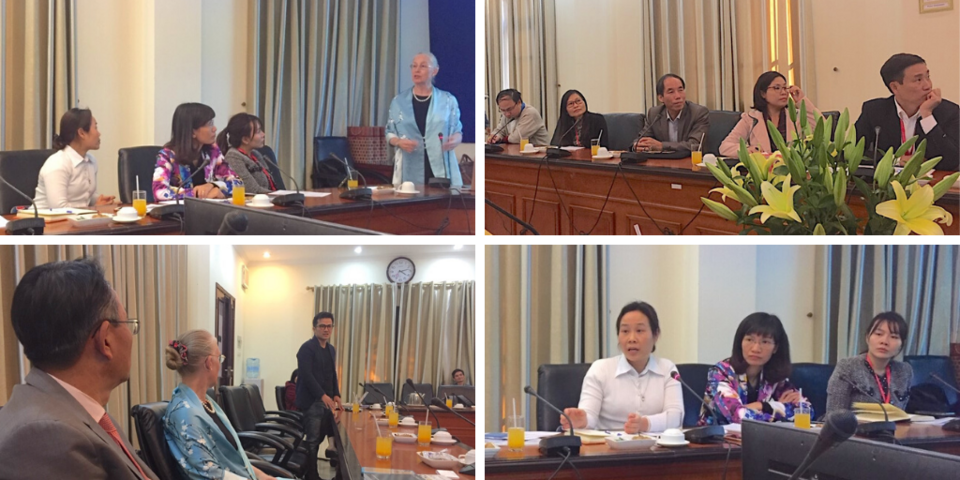
Karen Eggleston and participants at the roundtable held at Hanoi Medical University, December 9, 2019.
Throughout the day, Eggleston presented some of her collaborative research that is part of two projects involving international research teams: one that assesses public-private roles and institutional innovation for healthy aging and another that examines the economics of caring for patients with chronic diseases across diverse health systems in Asia and other parts of the world. We appreciated learning from our counterparts about the health care system and health care delivery in Vietnam.
Shifting focus to international relations and regional security, day 2 in Hanoi opened with a roundtable, “The Rise of the Indo-Pacific and Vietnam-U.S. Relations,” held jointly with the East Sea Institute (ESI) of the Diplomatic Academy of Vietnam (DAV). Following a welcome by ESI Director General Nguyen Hung Son, the program continued with remarks by Shin, Emmerson, ESI Deputy Director General To Anh Tuan, and Assistant Director General Do Thanh Hai.
Image
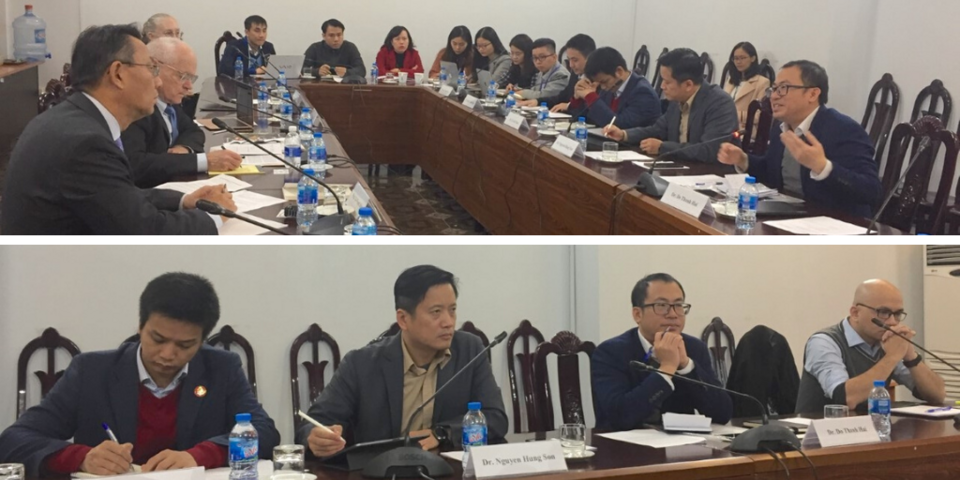
Roundtable at the Diplomatic Academy of Vietnam, December 10, 2019.
The long-ranging conversation with DAV members included issues such as the future of the international order in Asia; the U.S. withdrawal from multilateralism; the concern about a lack of U.S. engagement in Southeast Asia, sparked by President Trump’s absence from the November 2019 summit of the Association of Southeast Asian Nations (ASEAN) at a time when China is bolstering its influence in the region and when ASEAN hopes to set a code of conduct with China regarding disputed waters in the South China Sea; the priorities for Vietnam as it assumes the role of ASEAN chair in 2020; and the challenges for the Vietnam-U.S. bilateral relationship amid the changing strategic environment in Southeast Asia.
In the afternoon we were joined by members of the American Chamber of Commerce in Hanoi at an AmCham-hosted Lunch ‘n’ Learn session on Vietnam's challenges and opportunities amid the U.S.-China rivalry. The event featured Emmerson in conversation with AmCham Hanoi Executive Director Adam Sitkoff.
Image
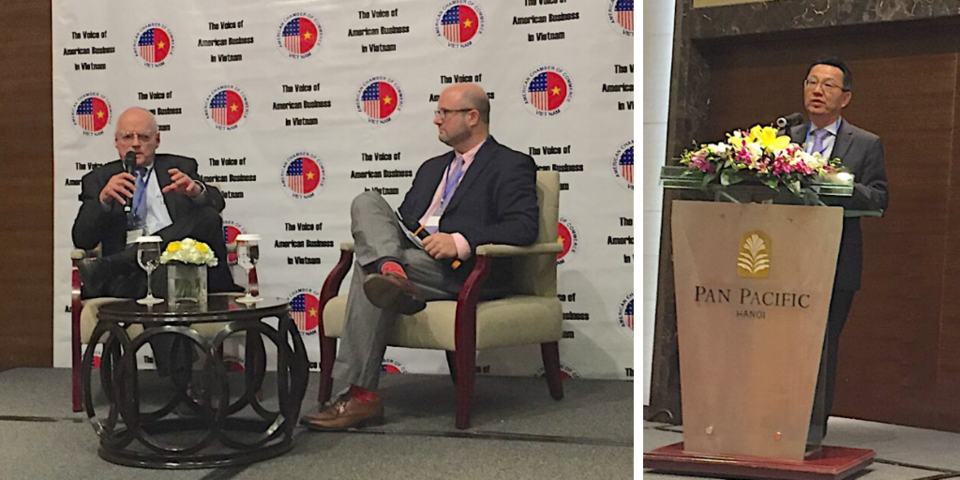
(Left) Donald Emmerson in conversation with Adam Sitkoff; (right) Gi-Wook Shin welcomes AmCham Hanoi members; December 10, 2019.
Moving to Bangkok, delegation members Shin, Eggleston, Emmerson, and Kim spoke on a panel for executives of the Charoen Pokphand Group (C.P. Group), one of Thailand’s largest private conglomerates, addressing some of the core issues that lie ahead for Southeast Asia in 2020 and beyond in the areas of geopolitics, innovation, and health.
Image
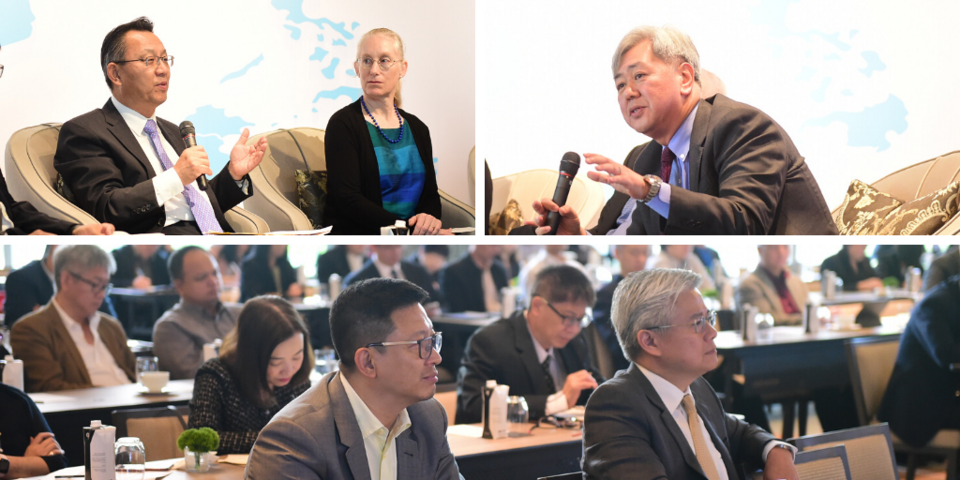
Top, from left to right: Gi-Wook Shin, Karen Eggleston, Andrew Kim; bottom: C.P. Group executive listening to the panel, December 12, 2019.
We also enjoyed a tour at True Digital Park, Thailand’s first startup and tech entrepreneur’s campus. Developed by the C.P. Group, True Digital Park aspires to be an open startup ecosystem that powers Thailand to become a global hub for digital innovation.
The following day, Shin and Emmerson participated in a public forum hosted by Chulalongkorn University’s Institute of Security and International Studies (ISIS Thailand), "Where Northeast Asia Meets Southeast Asia: The Great Powers, Global Disorder and Asia’s Future.” They were joined by ISIS Thailand Director Thitinan Pongsudhirak and Chulalongkorn University Faculty of Political Science Associate Dean for International Affairs and Graduate Studies Kasira Cheeppensook. The panel was moderated by Ms. Gwen Robinson, ISIS Thailand senior fellow and editor-at-large of the Nikkei Asian Review.
Image
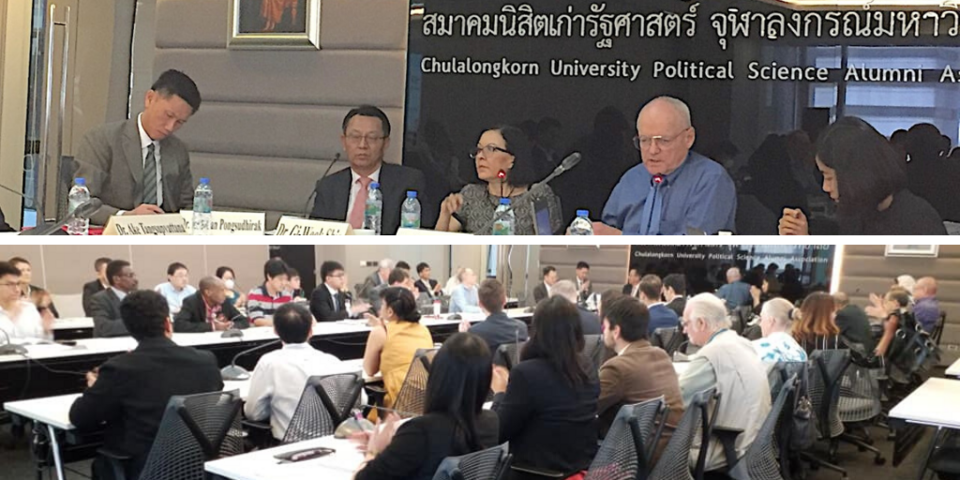
ISIS Thailand forum participants and panelists, from left: Pngsukdhirak, Shin, Robinson, Emmerson, Cheeppensook; December 13, 2019.
As part of that discussion, Emmerson speculated that – driven by deepening Chinese economic and migrational involvement in Southeast Asia’s northern tier – Cambodia and Laos, less conceivably Myanmar, and still less conceivably Thailand could become incorporated de facto into an economically integrated “greater China” that could eventually reduce ASEAN to a more-or-less maritime membership in the region’s southern tier. Emmerson’s speculation was made in the context of his critique of ASEAN’s emphasis on its own “centrality” to the neglect of its lack of the proactivity that would serve as evidence of centrality and of a desire not to be rendered peripheral by the growing centrality-cum-proactivity of China. The event was covered by the Bangkok Post (although that report’s headline and quote of Emmerson are inaccurate, as neither the panel nor Emmerson predicted the “break-up of ASEAN.”)
Our delegation visit in Bangkok concluded with a buffet dinner reception and panel discussion jointly with the Stanford Club of Thailand.
Image
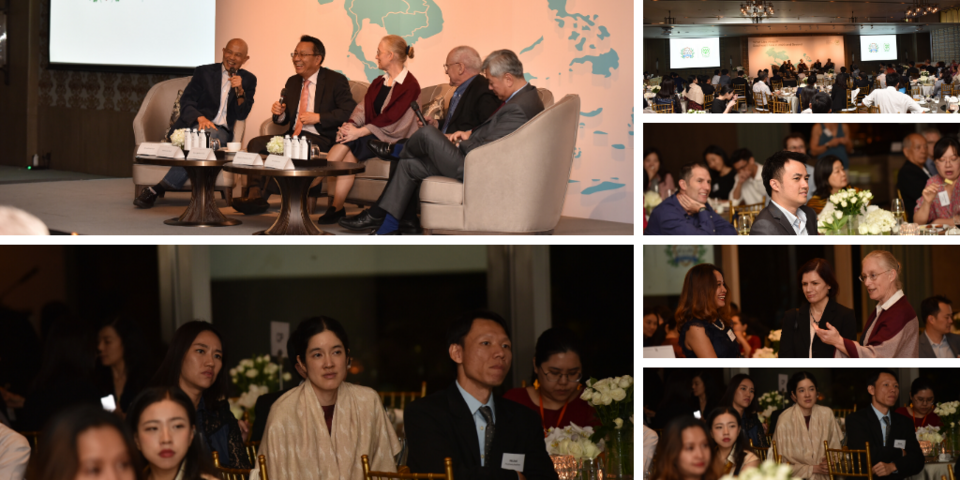
Stanford and IvyPlus alumni listening to the panel, December 13, 2019.
Moderated by Mr. Suthichai Yoon, a veteran journalist and founder of digital media outlet Kafedam Group, the conversation focused on the changing geopolitics of Southeast Asia, innovation and health in the region, and the opportunities and challenges facing Thailand-U.S. relations. It was a pleasure to meet many new and old friends from the Stanford and IvyPlus alumni communities.
APARC would like to thank our partners and hosts in Hanoi and Bangkok for their hospitality, collaboration, and the stimulating discussions throughout our visit. We look forward to keeping in touch!
Hero Image

All News button
1
The Modernization of Rural East Asia
-
Abstract:
Kristen Looney will be discussing her forthcoming work, Mobilizing for Development: The Modernization of Rural East Asia (Cornell U. Press 2020). This book tackles the question of how countries achieve rural development and offers a new way of thinking about East Asia’s political economy that challenges the developmental state paradigm. Through a comparison of Taiwan (1950s–1970s), South Korea (1950s–1970s), and China (1980s–2000s), the research shows that different types of development outcomes—improvements in agricultural production, rural living standards, and the village environment—were realized to different degrees, at different times, and in different ways. Looney argues that rural modernization campaigns played a central role in the region and that divergent development outcomes can be attributed to the interplay between campaigns and institutions. Relevant to political science, economic history, rural sociology, and Asian studies, the book enriches our understanding of state-led development and agrarian change.
Speaker Bio:
Image

Kristen Looney
Assistant Professor of Asian Studies and Government at Georgetown University
Seminars