
“Doctor Pablo’s” Children in Crisis Initiative creates app to improve child health
Stanford pediatrician Paul Wise stooped below the black tarp roof of a cinderblock house in Guatemala to offer his condolences to a mother who had just lost her child.
“Doctor Pablo,” as he is known in the communities around San Lucas Tolimán, talked softly as he relayed his sympathies to the mother, whose 9-year-old son had been a patient of his.
Stanford’s Children in Crisis Initiative seeks to save the lives of children in areas of poor governance. In Guatemala, their efforts work toward eliminating death by malnutrition for children under 5.
The boy’s genetic disorder would have been terminal anywhere, but thanks to Wise and local health promoters, the boy’s family had years with him instead of months.
They found the doctor through the Guatemala Rural Child Health and Nutrition Program, a collaboration between Wise and the health promoters to eliminate death by malnutrition for children under 5.
While Wise spoke to the heartbroken mother, his Stanford research assistant Alejandro Chavez helped the promoters set up inside a local community center to measure the weight and height of local kids to determine their nutrition level.
Chavez and the promoters had worked together for months to create an app for tablets that will make it easier to find malnourished children.
The app they designed will decrease training time for new health promoters and allow the program to expand. The goal is to distribute the app globally to help programs in other countries tackle malnutrition.
Children in crisis
As recently as 2005, about one of every 20 children in this rural area of Guatemala died before their 5th birthday. Almost half the deaths were associated with severe malnutrition.
“The death of any child is always a tragedy, but the death of any child from preventable causes is always unjust,” said Wise, a Stanford Health Policy core faculty member.
Along with other faculty from the Freeman Spogli Institute for International Studies (FSI) and the School of Medicine, Wise created the Children in Crisis Initiative to save the lives of children in areas of poor governance. The program brings together Stanford researchers and students across disciplines.
Nowhere are their efforts better illustrated than in the rural communities around San Lucas Tolimán, in the central mountains of Guatemala.
The program’s effectiveness rests on a deep respect for the local communities merged with innovation by Stanford researchers.
“It’s absolutely essential to any program that the people in need be part of the solution,” said Wise. Unlike many nongovernmental organizations and health programs, Wise believes the way to create a sustainable health system is for the locals to run it, so the health promoters manage the program’s day-to-day activities.
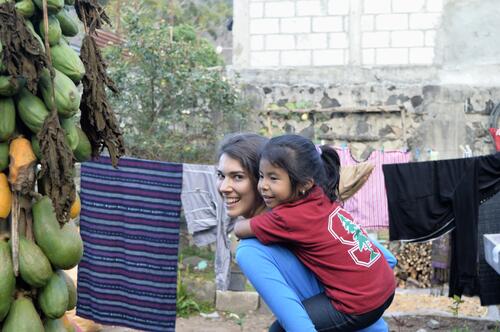
This leaves the Stanford team free to focus on innovation – such as the new app. They believe the technology could change child health programs around the world. Wise’s team has partnered with Medic Mobile – a nonprofit that creates open-source software for health care workers – which plans to distribute the app to other areas suffering from malnutrition.
The six Android tablets purchased by Children in Crisis are enough to monitor the program’s 1,500 kids through the app.
Role of nutrition
When done well, nutrition surveillance is very effective at decreasing child mortality in poor countries.
“Nutrition contributes enormously to health and well-being,” Wise said as he walked through Tierra Santa, a small community near San Lucas, making house calls. “So the focus of our work turned to improving young child nutrition. It’s not an easy thing to do in a place that’s extremely poor.”
Wise and his colleagues – Stanford medical student Tori Bawel and Stanford professor of pediatrics Lisa Chamberlain – made their rounds during their visit in March. Evidence of poverty was everywhere.
Here, clean tap water is a dream and even the sturdier homes often lack four walls or paned windows, though the children were neatly dressed in T-shirts or colorful traje, traditional Mayan clothing.
It’s hard to provide proper nutrition when most families can’t find enough work to buy adequate food. But a little help can make a big difference.
Bawel, a first-year medical student who plans a career improving health in areas of poverty, was struck by the impact the promoter program has had on the community.
“There are children who need supplements and nutrition to stay alive,” she said. “Without this program, that infrastructure does not exist.”
With FSI’s assistance, the nutrition program distributes Incaparina, a supplement of cornmeal, soy and essential nutrients. The sweet, mealy drink helps the program’s most malnourished children get back on track.
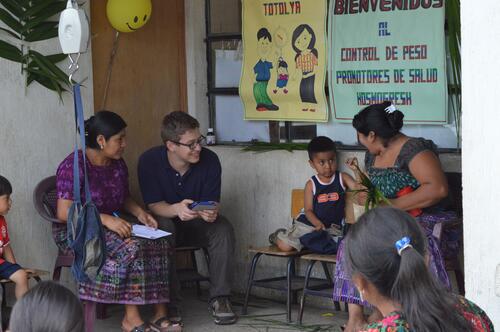
Every two months, the promoters gather each community’s children to measure their weight and height. Children and their mothers sit patiently, waiting for their turn. The children enjoy a cup of Incaparina, and their mothers eagerly listen to the promoters’ tips for keeping their children healthy.
“It’s very important to me,” said Elsira Rosibel Samayoa, who brought her 2-year-old to be measured. “There are mothers who don’t understand the importance of monitoring their children’s weight, but I do.”
Since its implementation in 2009, the Stanford program has slashed nutrition-based mortality in the participating communities by about 80 percent and decreased severe malnutrition by more than 60 percent – saving hundreds of children’s lives.
However, nutrition surveillance and intervention isn’t easy. Tracking nutrition takes training and expertise, and when the local population rarely exceeds a fourth-grade education, learning these skills is especially challenging. Detailed graphs on a standard growth chart are essential to identifying malnourished children.
“The community health workers are extremely capable and smart, but some have never seen a graph before,” said Wise. “Think about what it is to try to explain a graph to someone for the first time.”
It takes the health workers about three years to learn to graph and then interpret the results for intervention.
Wise said, “So we all got together and said, ‘How do we make this easier to do?’”
The app was the answer.
‘Let’s create an app’
Enter Alejandro Chavez, a recent Stanford computer science graduate and Stanford Health Policy research assistant. He developed the app to collect child health data, then determine the child’s degree of malnutrition and suggest intervention.
“The major goal was to lower training requirements and make programs like this simpler to start and maintain,” said Chavez, who now lives and works in Guatemala, where he gets daily feedback from the health promoters.
“I feel like they’ve been very honest with me about things I need to improve,” he said.
Cesia Lizeth Castro Chutá is a senior coordinator for the program who has worked with Chavez to ensure that the app meets the promoters’ needs.
“The tablet automatically generates the information we need to know,” she said. “It becomes easier to confirm that a child is malnourished and needs supplements.”
Looking forward
Image

With the app’s launch, it looks like training time for the promoters will be reduced from three years to less than six months. That means new communities can be incorporated into the program quickly, creating broader access to care.
Meanwhile, many health programs around the world are waiting to see how well the Stanford app works in Guatemala.
Josh Nesbit, a Stanford alumnus and Medic Mobile CEO, said, “As more health programs recognize the importance of nutrition and implement community-based interventions, screening and surveillance tools will be critical. We must learn from Dr. Wise’s success.”


 In March 2015, the first biosimilar product was approved in the U.S. as per the Biologics Price Competition and Innovation Act (BPCI Act) of 2009, section 351(k) biologics license application (BLA). Five years after the enactment of the BPCI Act and following its first biosimilar approval, the U.S. Food and Drug Administration (U.S. FDA) finalized its initial guidance describing the scientific and regulatory expectations for biosimilar approval under the 351 (k) pathway. Biologic manufacturers are provided with regulatory guidance in the form of scientific considerations, quality considerations and questions & answers regarding the implementation of the BPCI Act. With this new regulation, many BLA applications are under review by the U.S. FDA.
 According to the National Tax Bureau in Japan, there were over three million Japanese family businesses in 2013. Additionally, companies in Japan are more sustainable than companies in the U.S. However, U.S. companies continue to find ways to be innovative. In her research, Takahashi attempts to answer the following questions – What is needed for sustainable management in the case of U.S-family businesses? and How have U.S. family businesses overcome external circumstances to become successful? Takahashi took over her family’s driving school business from her father in 2009. Based on her experiences owning a family business in Japan, she explored the successes and failures of family-owned businesses and how innovation of family business can sustain longevity in the U.S. Takahashi believes the conditions of management in Japan are rapidly changing, making companies unable to keep up with effective management. As a result, Takahashi offers suggestions to Japanese family businesses to help improve sustainable management in Japan.
 The IT industry is producing many new types of internet-connected devices for consumers, including wearable devices, such as glasses and watches. Such devices may be more convenient than traditional devices because they are small and wearable and thus, literally always at hand. Every day, we receive many notifications on these devices making them very important connecting points for the media. Publishers prefer to distribute short texts for notifications, but this is not easily done. Because there are so many different types of devices available and no unified screen size, publishers cannot decide on the best format and length for these notifications. In his research, Tamori discusses suitable formats for notifications on small devices. By using a natural language processing method for automatic text summarization, Tamori developed an application that produces various formats of notifications for news depending on the display size. He also evaluated which form is best for small devices.
 In his research, Fukuda investigates the possibilities of expanding the inbound tourism market in Japan, especially in the Shizuoka prefecture, a local area of Japan. He provides an overview of the online travel industry and how they are expanding their market with new technologies and innovations. After reviewing how software services for international travelers is currently being used in Japan, he focuses on specific applications with the highest potential to make Shizuoka more accessible and attractive for international travelers. Additionally, he reviews regulations and obstacles that could prevent these new technologies and innovations from being implemented. As a result, Fukuda suggests that the suppliers of local tourism provide their services with a holistic utilization of the applications.
 China is slowing down its pace for development, facing the so-called “middle income trap”. While the attention to the macroeconomic picture is necessary, it is not sufficient. Extraordinary monetary policies buy time, but they do not solve the fundamental problem. The focus needs to be on the structural reforms – the microeconomic entities, to which the capital market acts like a lifeline, will drive future growth. The productivity, competition and innovation in all sectors – all of which are largely fueled by an efficient, healthy and accessible capital market – ensure a productive supply-side growth. In her research, Huang explores the culture, participants and regulatory system of the U.S. capital market and tries to figure out what China’s capital market development can learn from this system.
 The Internet of Things (IoT) is major technology that connects devices and cloud service. Cloud service computes device data and returns meaningful results for abnormal detection, performance improvement and prediction. One key component of IoT is big data analysis. Japan’s Ministry of Economy, Trade and Industry’s 2015 Whitepaper states that innovation in the manufacturing industry by using IoT and big data analysis is about to launch, but few cases exist in Japan. Innovative companies like Netflix, Uber and AirBnB are data driven companies and the manufacturing industry is also expected to have smart factories with big data analysis. In his research, Muramatsu investigates the use of big data analysis on IoT and identifies useful cases of business efficiency and the methodology that supports big data analysis.
 In most East Asian countries, including Japan, South Korea and Taiwan, private hospitals are the majority in the market. In China, even though private hospitals have been in fast growth for the past 10 years, their size remains small and the market is still dominated by large public hospitals. In the most recent move of healthcare reform in China, the government emphasized and encouraged the entry of private-non-profit hospitals into the market.