Health and Medicine

FSI’s researchers assess health and medicine through the lenses of economics, nutrition and politics. They’re studying and influencing public health policies of local and national governments and the roles that corporations and nongovernmental organizations play in providing health care around the world. Scholars look at how governance affects citizens’ health, how children’s health care access affects the aging process and how to improve children’s health in Guatemala and rural China. They want to know what it will take for people to cook more safely and breathe more easily in developing countries.

FSI professors investigate how lifestyles affect health. What good does gardening do for older Americans? What are the benefits of eating organic food or growing genetically modified rice in China? They study cost-effectiveness by examining programs like those aimed at preventing the spread of tuberculosis in Russian prisons. Policies that impact obesity and undernutrition are examined; as are the public health implications of limiting salt in processed foods and the role of smoking among men who work in Chinese factories. FSI health research looks at sweeping domestic policies like the Affordable Care Act and the role of foreign aid in affecting the price of HIV drugs in Africa.

Authors
Callista Wells
News Type
News
Date
Paragraphs

To celebrate its May Release, the Stanford China Program hosted a virtual book launch event for Fateful Decisions: Choices That Will Shape China’s Future (Stanford University Press) on June 2nd. Joining co-authors Thomas Fingar (Shorenstein APARC Fellow, Stanford University) and Jean C. Oi (Director, Stanford China Program; William Haas Professor of Chinese Politics, Stanford University) were contributors Karen Eggleston (Senior Fellow at FSI; Director of the Asia Health Policy Program, Shorenstein APARC, Stanford University), Barry Naughton (Sokwanlok Chair of Chinese International Affairs, School of Global Policy and Strategy, UC San Diego), and Andrew Walder (Senior Fellow at FSI; Denise O'Leary and Kent Thiry Professor, Stanford University). As Fingar and Oi point out in their volume, despite China’s extraordinary growth over the past 40 years, the country’s future is uncertain. China has enjoyed optimal conditions for development since the 1980s, but new hurdles including an aging populace, the loss of comparative economic advantage, a politically entrenched elite, and a population with rising expectations will test the country’s leaders. With each focusing on a different facet of China’s challenges, the panelists gathered to share their expertise and provide the audience with a glimpse into what the future might hold for this important country.

Following an introduction from Professor Jean Oi, the program kicked off with Professor Barry Naughton of University of California, San Diego, who discussed his chapter entitled “Grand Steerage.” Professor Naughton argued that, as it plans for the future, China’s policymaking is becoming increasingly technology-focused, particularly in the realm of economic policy. Naughton further notes that China’s economy is becoming simultaneously more state-guided and more centered around technology. This decision is a gamble, though: China is investing heavily in high-tech industries, advancing massive, centrally steered projects like the Greater Bay Area initiative and the Xiong’an New District. If they are successful, says Naughton, this will indeed be an incredible success. But, if they are not, China’s losses will be major: “There’s not really a middle ground.”

After Professor Naughton was Professor Karen Eggleston, an expert on health policy in Asia. Professor Eggleston’s chapter, “Demographic and Healthcare Challenges,” deals with emerging obstacles for China’s healthcare system, including population aging and the problems that come with it, like chronic diseases and elder care. Although China’s healthcare system has improved dramatically in recent decades, it has done so unevenly, notes Eggleston: life expectancy has greatly increased, but with disparities according to income, region, and urban vs. rural status; universal healthcare is available, but the benefit level is low, effectively limiting the standard of care many can receive. The ratio of health spending to GDP is also increasing, yet it is still modest compared to high-income countries. The COVID-19 crisis has, of course, introduced even more challenges: Will China be able to distribute future vaccines equitably? Will this crisis negatively affect young people’s decisions to choose healthcare as a career? Will telemedicine, which has seen a surge under the pandemic, improve or exacerbate existing disparities? China faces a multitude of constraints and choices going forward if it hopes to meet its population’s healthcare needs.

The audience then had a chance to hear from co-editor Thomas Fingar, speaking on his chapter, “Sources and Shapers of China’s Foreign Policy.” Fingar noted three key takeaways from both his chapter and his talk: Firstly, China’s foreign policy is a fundamental part of its national policy. Secondly, the global political environment plays an important role in shaping both foreign and domestic policy which, thirdly, plays an important role in shaping foreign policy. The conditions that allowed China to flourish over the past 40 years, emphasized Fingar, are very different from those of the present. In the 1970s and 80s, China was able to take advantage of Cold War bipolarity, globalization was in its infancy, and “China was the only significant developing country willing to embark, at that time, on the export-led path of development.” In recent years, though, China’s behavior internationally has alienated other countries; there are many competitors pursuing its style of development; and its needs and aspirations have changed, requiring more raw materials and depending upon multi-national economic agreements. Fingar suggests two potential foreign policy options: China could continue with its wolf warrior diplomacy, which has “alienated essentially all China’s neighbors to some degree,” or it could return to a style more similar to that of the 1980s and 90s Reform and Opening era. It remains to be seen which style will win out.

Finally, Professor Andrew Walder concluded the program with his discussion of China’s political future at large. His chapter, “China’s National Trajectory,” follows China’s remarkable advancement in recent years and “tr[ies] to divine what a lower growth era will mean for China’s political future.” The last 40 years of rapid growth have generated support for China’s political system, more patriotism, the near eradication of democracy movements, and an elite unity not seen in the 1970s and 80s. However, low growth rates could mean a reversal for many of these trends, says Walder. While the aforementioned support for and stability of the Chinese government was maintained by ever-improving living standards and upward mobility, a low growth period (coupled with an aging population) means the government will no longer be able to rely on these trends for popular support. Rather, it will need to improve its provision of public services to address present-day challenges. Regardless, argues Walder, the low growth era will undoubtedly lead to “dynamic changes underneath the façade of stability of Chinese politics….”

For more insights on the modern obstacles China faces and what they mean for the country’s future, check out Fateful Decisions: Choices That Will Shape China's Future, available for purchase now.

Read More

Elderly Chinese citizens sit together on a park bench.
Q&As

Karen Eggleston Examines China’s Looming Demographic Crisis, in Fateful Decisions

Karen Eggleston Examines China’s Looming Demographic Crisis, in Fateful Decisions
Quote from Thomas Fingar and Jean Oi from, "China's Challeges: Now It Gets Much Harder"
Commentary

Now It Gets Much Harder: Thomas Fingar and Jean Oi Discuss China’s Challenges in The Washington Quarterly

Now It Gets Much Harder: Thomas Fingar and Jean Oi Discuss China’s Challenges in The Washington Quarterly
Hero Image
Fateful Decisions book cover
All News button
1
-

Image
towards cyber peace

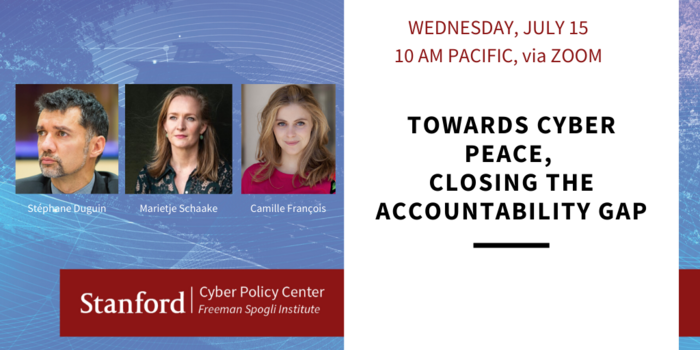
Please join the Cyber Policy Center for Towards Cyber Peace, Closing the Accountability Gap, hosted by Cyber Policy Center's Marietje Schaake, along with guests Stéphane Duguin, CEO of the Cyber Peace Institute and Camille François, CIO of Graphika and Mozilla Fellow. The discussion will focus on the challenges to cyber peace, and the work being done to chart a path forward. The session is open to the public, but registration is required. 

Marietje Schaake is the international policy director at Stanford University’s Cyber Policy Center and international policy fellow at Stanford’s Institute for Human-Centered Artificial Intelligence. She was named President of the Cyber Peace Institute. Between 2009 and 2019, Marietje served as a Member of European Parliament for the Dutch liberal democratic party where she focused on trade, foreign affairs and technology policies. Marietje is affiliated with a number of non-profits including the European Council on Foreign Relations and the Observer Research Foundation in India and writes a monthly column for the Financial Times and a bi-monthly column for the Dutch NRC newspaper. 

Camille François works on cyber conflict and digital rights online. She is the Chief Innovation Officer at Graphika, where she leads the company’s work to detect and mitigate disinformation, media manipulation and harassment. Camille was previously the Principal Researcher at Jigsaw, an innovation unit at Google that builds technology to address global security challenges and protect vulnerable users. Camille has advised governments and parliamentary committees on both sides of the Atlantic on policy issues related to cybersecurity and digital rights. She served as a special advisor to the Chief Technology Officer of France in the Prime Minister’s office, working on France’s first Open Government roadmap. Camille is a Mozilla Fellow, a Berkman-Klein Center affiliate, and a Fulbright scholar. She holds a masters degree in human rights from the French Institute of Political Sciences (Sciences-Po) and a masters degree in international security from the School of International and Public Affairs (SIPA) at Columbia University. François’ work has been featured in various publications, including the New York Times, WIRED, Washington Post, Bloomberg Businessweek, Globo and Le Monde.

Stéphane Duguin is the Chief Executive Officer of the CyberPeace Institute. His mission is to coordinate a collective response to decrease the frequency, impact, and scale of cyberattacks by sophisticated actors. Building on his hands-on experience in countering and analyzing cyber operations and information operations which impact civilians and civilian infrastructure, he leads the Institute with the aim of holding malicious actors to account for the harms they cause. Prior to this position, Stéphane Duguin was a senior manager and innovation coordinator at Europol. He led key operational projects to counter both cybercrime and online terrorism, such as the setup of the European Cybercrime Centre (EC3), the Europol Innovation Lab, and the European Internet Referral Unit (EU IRU). A leader in digital transformation, his work focused on the implementation of innovative responses to a large-scale abuse of the cyberspace, notably on the convergence of disruptive technologies and public-private partnerships.


Authors
News Type
News
Date
Paragraphs

Dust sweeping across the Southeast U.S. in recent days warns of a growing risk to infants and children in many parts of the world. A Stanford-led study focuses on this dust, which travels thousands of miles from the Sahara Desert, to paint a clearer picture than ever before of air pollution’s impact on infant mortality in sub-Saharan Africa. The paper, published on June 29 in Nature Sustainability, reveals how a changing climate might intensify or mitigate the problem, and points to seemingly exotic solutions to reducing dust pollution that could be more effective and affordable than current health interventions in improving child health.

“Africa and other developing regions have made remarkable strides overall in improving child health in recent decades, but key negative outcomes such as infant mortality remain stubbornly high in some places,” said study senior author Marshall Burke, an associate professor of Earth system science in Stanford’s School of Earth, Energy & Environmental Sciences. “We wanted to understand why that was, and whether there was a connection to air pollution, a known cause of poor health.”

Understanding airborne danger

Children under 5 are particularly vulnerable to the tiny particles, or particulate, in air pollution that can have a range of negative health impacts, including lower birth weight and impaired growth in the first year of life. In developing regions, exposure to high levels of air pollution during childhood is estimated to reduce overall life expectancy by 4-5 years on average.

Quantifying the health impacts of air pollution – a crucial step for understanding global health burdens and evaluating policy choices – has been a challenge in the past. Researchers have struggled to adequately separate out the health effects of air pollution from the health effects of activities that generate the pollution. For example, a booming economy can produce air pollution but also spur developments, such as lower unemployment, that lead to better healthcare access and improved health outcomes.

To isolate the effects of air pollution exposure, the Stanford-led study focuses on dust carried thousands of miles from the Bodélé Depression in Chad – the largest source of dust emissions in the world. This dust is a frequent presence in West Africa and, to a lesser extent, across other African regions. The researchers analyzed 15 years of household surveys from 30 countries across Sub-Saharan Africa covering nearly 1 million births. Combining birth data with satellite-detected changes in particulate levels driven by the Bodélé dust provided an increasingly clear picture of poor air quality’s health impacts on children.

Sobering findings and surprising solutions

The researchers found that a roughly 25 percent increase in local annual mean particulate concentrations in West Africa causes an 18 percent increase in infant mortality. The results expand on a 2018 paper by the same researchers that found exposure to high particulate matter concentrations in sub-Saharan Africa accounted for about 400,000 infant deaths in 2015 alone.

The new study, combined with previous findings from other regions, makes clear that air pollution, even from natural sources, is a “critical determining factor for child health around the world,” the researchers write. Emissions from natural sources could change dramatically in a changing climate, but it’s unclear how. For example, the concentration of dust particulate matter across Sub-Saharan Africa is highly dependent on the amount of rainfall in the Bodélé Depression. Because future changes in rainfall over the Bodélé region due to climate change are highly uncertain, the researchers calculated a range of possibilities for sub-Saharan Africa that could result in anywhere from a 13-percent decline in infant mortality to a 12-percent increase just due to changes in rainfall over the desert. These impacts would be larger than any other published projections for climate change impact on health across Africa.

Safeguarding children against air pollution is nearly impossible in many developing regions because many homes have open windows or permeable roofs and walls, and infants and young children are unlikely to wear masks. Instead, the researchers suggest exploring the possibility of dampening sand with groundwater in the Bodélé region to stop it from going airborne – an approach that has been successful at a small scale in California.

The researchers estimate that deploying solar-powered irrigation systems in the desert area could avert 37,000 infant deaths per year in West Africa at a cost of $24 per life, making it competitive with many leading health interventions currently in use, including a range of vaccines and water and sanitation projects.

“Standard policy instruments can’t be counted on to reduce all forms of air pollution,” said study lead author Sam Heft-Neal, a research scholar at Stanford’s Center on Food Security and the Environment. “While our calculation doesn’t consider logistical constraints to project deployment, it highlights the possibility of a solution that targets natural pollution sources and yields enormous benefits at a modest cost.”

Additional co-authors include Eran Bendavid, an associate professor of medicine at Stanford, member of the Maternal andChild Health Research Institute and an affiliate of the Stanford Woods Institute for the Environment; Jennifer Burney and Kara Voss of the University of California San Diego. Burke is also deputy director of the Center on Food Security and the Environment; and a fellow at the Stanford Woods Institute for the Environment, the Freeman Spogli Institute for International Studies and the Stanford Institute for Economic Policy Research.

The research was supported by the National Science Foundation and the Robert Wood Johnson Foundation.

Hero Image
 A man walks through a sandstorm in Chad

A man walks through a sandstorm in Chad, home of the Bodélé Depression – the largest source of dust emissions in the world.
George Steinmetz
All News button
1
Subtitle

The study of sub-Saharan Africa finds that a relatively small increase in airborne particles significantly increases infant mortality rates. A cost-effective solution may lie in an exotic-sounding proposal.

Image
Tech and Wellbeing in the Era of Covid-19
Please join the Cyber Policy Center for Tech & Wellbeing in the Era of Covid-19 with Jeff Hancock from Stanford University, Amy Orben from Emmanuel College, and Erica Pelavin, Co-Founder of My Digital TAT2, in conversation with Kelly Born, Executive Director of the Cyber Policy Center. The session will explore the risks and opportunities technologies pose to users’ wellbeing; what we know about the impact of technology on mental health, particularly for teens; how the current pandemic may change our perceptions of technology; and ways in which teens are using apps, influencers and platforms to stay connected under Covid-19.


Dr. Amy Orben is College Research Fellow at Emmanuel College and the MRC Cognition and Brain Sciences Unit. Her work using large-scale datasets to investigate social media use and teenage mental health has been published in a range of leading scientific journals. The results have put into question many long-held assumptions about the potential risks and benefits of ’screen time'. Alongside her research, Amy campaigns for the use of improved statistical methodology in the behavioural sciences and the adoption of more transparent and open scientific practices, having co-founded the global ReproducibiliTea initiative. Amy also regularly contributes to both media and policy debate, having recently given evidence to the UK Commons Science and Technology Select Committee and various governmental investigations.

Jeff Hancock is founding director of the Stanford Social Media Lab and is a Professor in the Department of Communication at Stanford University. Professor Hancock and his group work on understanding psychological and interpersonal processes in social media. The team specializes in using computational linguistics and experiments to understand how the words we use can reveal psychological and social dynamics, such as deception and trust, emotional dynamics, intimacy and relationships, and social support. Recently Professor Hancock has begun work on understanding the mental models people have about algorithms in social media, as well as working on the ethical issues associated with computational social science.

Erica Pelavin, is an educator, public speaker, and Co-Founder and Director of Teen Engagement at My Digital TAT2. Working from a strength-based perspective, Erica has expertise in bullying prevention, relational aggression, digital safety, social emotional learning, and conflict resolution. Dr. Pelavin has a passion for helping young people develop the skills to become their own advocates and cares deeply about helping school communities foster empathy and respect. In her role at My Digital TAT2, Erica leads all programming for high schoolers including the youth led podcast Media in the Middle, the teen advisory boards and an annual summer internship program. Her work with teens directly impacts and informs the developmental school based curriculum. Erica is also a high school counselor at Eastside College Prep in East Palo Alto, CA.

Watch the recorded session

Authors
News Type
Commentary
Date
Paragraphs

President Volodymyr Zelensky and his government in Ukraine face two fundamental challenges: ending the conflict with Russia and implementing domestic reform. Overcoming these challenges appeared hard enough at the start of 2020. COVID-19 is only making that more difficult.

Ukraine finds itself in the seventh year of a war imposed on it by the Kremlin. Russian troops seized Crimea in March 2014, and Russian and Russian proxy forces have sustained a conflict in the eastern Ukrainian region of Donbas, which has claimed some 13,000 lives.

While Moscow has sought to draw Ukraine back into Russia’s orbit, there is little reason to believe that it will succeed. Nothing has done more than Kremlin policy over the past six years to push Ukraine toward the West and away from Russia. Moscow thus has used the Donbas conflict to destabilise Kyiv—to make it more difficult for Ukraine to succeed and pursue its goal of integrating with Europe.

As COVID-19 hit both Ukraine and Russia in March, some (this author included) hoped it might change some of the calculations in the Kremlin. Faced with a pandemic, falling prices for its energy exports, and an economy tumbling into recession, might Moscow rethink its policy in Donbas? A settlement would ease Russia’s political isolation and lead to a lifting of Western sanctions, which some economists estimate have cut Russian gross domestic product by 1.0-1.5% per year over the past six years.

As of June, however, Moscow’s policy appears unchanged. Russian and Russian proxy forces continue low-intensity fighting in Donbas. The appointment of a new Kremlin point-person on Ukraine did not visibly affect policy, which is determined by Vladimir Putin.

German Chancellor Angela Merkel and French President Emmanuel Macron, both grappling with COVID-19 and its economic consequences, have not followed up on the December ‘Normandy format’ summit with Zelensky and Putin. As the pandemic consumes the leaders’ attention, they and others – such as senior U.S. officials – show little bandwidth or readiness to press to change the cost-benefit calculation in the Kremlin and persuade Moscow to take up a different course that might bring peace in Donbas.

Therefore there is little reason to expect a diplomatic breakthrough, a fact that Zelensky and his team increasingly seem to recognise. The Ukrainian president has raised the idea of a “Plan B” if no progress is made by the end of the year. One suggested variant for a “Plan B” would entail virtually walling off the occupied part of Donbas and pushing the entire economic and social burden on to Russia.

The sad reality is the likely near-term scenario for Donbas is continuing simmering conflict. (As for Crimea, while not a hot conflict, it will burden Ukrainian-Russian and West-Russian relations for years if not decades to come.)

COVID-19 has made matters more complex, both for Zelensky politically on the domestic front as well as sinking the economy into recession. Kyiv recognised the need for an IMF stand-by program and access to low-interest credits. The Rada (parliament) enacted legislation to lift the moratorium on the sale of agricultural land and safeguard nationalised banks from efforts by former owners to regain control—both key conditions for an IMF stand-by agreement worth up to $5 bn. On June 9, the IMF executive board approved the agreement.

While the long-needed reforms on agricultural land and banking were most welcome, it was not clear whether their adoption reflected a genuine commitment to dramatic reform or, as with past Ukrainian leaders, the need to secure IMF credits. Both Ukrainians and the country’s friends in the West are looking for signs Zelensky will carry out the transformational agenda that carried him to an electoral landslide in April 2019, particularly with respect to curbing corruption.

Zelensky attaches priority to ending the conflict and restoring Ukrainian sovereignty in Donbas. But Kyiv cannot do that by itself. Moscow gets a vote, and the vote thus far favours keeping the conflict simmering. Whether Ukraine’s Western partners can mobilise additional pressure to change the Kremlin’s cost-benefit calculation at this point appears doubtful, at least in the near term.

If stalemated by Russia on Donbas, Zelensky can still take action on anti-corruption measures and other reforms to position the Ukrainian economy for strong growth as the pandemic eases. These are measures that he and his government control. To do so would deliver on the promises made to Ukrainian voters last year and solidify his reform credentials with his Western partners. Moreover, a more robust economy would bolster Zelensky’s position vis-à-vis the Kremlin, which hopes that domestic weakness will force him to compromise key Ukrainian principles and settle the Donbas conflict on Moscow’s terms.

Originally for Europe's World

Hero Image
steven pifer 0
All News button
1
Subtitle

President Volodymyr Zelensky and his government in Ukraine face two fundamental challenges: ending the conflict with Russia and implementing domestic reform. Overcoming these challenges appeared hard enough at the start of 2020. COVID-19 is only making that more difficult.

Authors
Noa Ronkin
News Type
News
Date
Paragraphs

The Walter H. Shorenstein Asia-Pacific Research Center (APARC) condemns the systemic nature and brutal expression of racism in the United States, and we stand in full support of protestors and civil rights organizations in their calls for social justice, equal access to basic rights, and accountability. Beyond reaffirming our commitment to these values, we recognize the imperative to do better as an institution and the urgent need to take concrete action to build a more inclusive community here at our Stanford home. We have joined our colleagues at the Freeman Spogli Institute for International Studies in developing specific steps towards that goal. But we also want to take initial, immediate action in moving from protest to progress.

That’s why we are announcing today a new diversity grant to support Stanford students from underrepresented minorities with an interest in studying issues related to contemporary Asia. The field of Asian studies suffers from an extreme paucity of students, scholars, and experts who self-identify as Black/African American or as affiliated with other underrepresented minority groups. “The path towards a more diverse and inclusive field isn’t easy or straightforward, but we must get on it,” says APARC Director and FSI Senior Fellow Gi-Wook Shin. “We believe that we can tackle the existing disparity if relevant stakeholders across institutes of higher learning all work together. APARC is looking to start this change at Stanford.”

Lowering Barriers to Diversity in Asian Studies

The purpose of the APARC Diversity Grant is to encourage Stanford students from underrepresented minorities (URM) to engage in study and research of topics related to contemporary Asia and U.S.-Asia relations, including economic, health, foreign policy, social, political, and security issues. We follow the University’s definition of the URM category as encompassing “all U.S. citizens and permanent residents who have self-identified as American Indian/Alaska Native, Black/African American, Hispanic/Latino, Native Hawaiian/Other Pacific Islander.” This grant opportunity is open to current Stanford undergraduate and graduate students in the URM category from any major or discipline. “This is just a small step to start lowering disciplinary, cultural, and funding barriers that hinder broader student participation in Asian studies,” notes Shin.

APARC will award a maximum of $10,000 per grant to support a wide range of research expenses such as travel to/from research sites, academic conferences, and workshops (dependent on COVID-19 restrictions); conference registration fees; professional development training programs; purchase of physical and digital books or other required materials; and access to relevant online resources. APARC will review grant applications for projects taking place in winter/spring 2021 on a rolling basis starting on September 1, 2020. Reviews of the second round of applications, for projects taking place in summer/fall 2021, will begin on April 1, 2021.

Examples of research topics, in addition to those that Asia scholars typically study, could include China’s growing activities in Africa; understanding the evolving relations between Asian Americans and African Americans in the United States; and comparative examinations of issues such as the treatment of minorities in Asia and the United States or policies that promote anti-discriminatory practices in schools, the workplace, and other settings in Asian countries and the United States.

Application Guidelines

  • Complete the application form and submit it along with these three (3) attachments:
    • A statement (no more than three pages) describing the proposed research activity or project;
    • A current CV;
    • An itemized budget request explaining research expense needs.
  • Arrange for a letter of recommendation from a faculty to be sent directly to APARC. Please note: the faculty members should email their letters directly to Kristen Lee at kllee@stanford.edu.

We will consider only applications that include all supporting documents.

Read More

Portrait of Young Kyung Do, Winner of the 2020 Rothman Epidemiology Prize
News

Asia Health Policy Program Alum Wins Rothman Epidemiology Prize

Dr. Young Kyung Do, an expert in health policy and management at the Seoul National University College of Healthy Policy and the inaugural postdoctoral fellow in Asia health policy at APARC, has been awarded the 2020 prize for his outstanding publication in the journal Epidemiology last year.
Asia Health Policy Program Alum Wins Rothman Epidemiology Prize
Cover image of the book "Healthy Aging in Asia", showing a smiling elderly Chinese woman with a cane standing in a small village.
News

New Book Highlights Policy Initiatives and Economic Research on Healthy Longevity Across Asia

Asia health policy expert Karen Eggleston’s new volume, ‘Healthy Aging in Asia,’ examines how diverse Asian economies – from Singapore and Hong Kong to Japan, India, and China – are preparing for older population age structures and transforming health systems to support patients who will live with chronic disease for decades.
New Book Highlights Policy Initiatives and Economic Research on Healthy Longevity Across Asia
Hero Image
A look at the front of Encina Hall, Stanford
All News button
1
Subtitle

To encourage Stanford students from underrepresented minorities to engage in study and research of topics related to contemporary Asia, the Shorenstein Asia-Pacific Research Center is offering a new Diversity Grant opportunity. Application reviews begin on September 1, 2020.

Authors
David Studdert
News Type
Commentary
Date
Paragraphs

Millions of Americans have experienced the coronavirus pandemic directly, as they or their loved ones suffered through infection. But for most of us, the experience is defined by weeks and months on end stuck at home. The shut-ins are testing the safety of our home environments. Stress and isolation combined with another feature of American life — easy access to firearms — could form a deadly brew.

Last week we released results of a new study — the largest ever on the connection between suicide and handgun ownership — in The New England Journal of Medicine revealing that gun owners were nearly four times as likely to die by suicide than people without guns, even when controlling for gender, age, race and neighborhood.

In this New York Times OpEd piece by myself, Matthew Miller and Garen Wintemute, we write that suicide attempts are often impulsive, prompted by fleeting crises. A vast majority of people who attempt suicide survive and do not go on to die in a future suicide. But whether attempters get that second chance at life depends a lot on the method they use, which in turn depends on what is readily at hand. Firearms afford few second chances. In sum, methods matter.

Our study compiled information on 26 million Americans over 12 years. We tracked handgun acquisitions in a large sample of California residents and then compared the frequency of death among those who did and didn’t own them.

The elevated suicide rates among handgun owners were driven by their higher rates of suicide by firearm — eight times higher for men and 35 times higher for women, compared with non-owners of the same gender. By contrast, handgun owners did not have higher rates of suicide from other methods or higher rates of death by other causes. These results are consistent with those from every serious study that has examined the relationship between gun access and suicide in the United States. If anything, we find a stronger connection than most others have.

Read the Editorial

David Studdert

David Studdert, LLB, ScD, MPH

Professor of Medicine and Law
David M. Studdert is a leading expert in health law.
David Studdert

Read More

gettyimages run illustration
News

Owning Handgun Associated With Dramatically Higher Risk of Suicide

Men who own handguns are eight times more likely to die of suicide by handgun than men who don’t have one — and women who own handguns are 35 times more likely than women who don’t, according to startling new research led by SHP's David Studdert.
Owning Handgun Associated With Dramatically Higher Risk of Suicide
getttyimages civil liberties
Commentary

Covid-19 Crisis: Is a Showdown Between Public Health Imperatives and Civil Liberties Inevitable?

David Studdert addresses the tradeoff between basic liberties and societal health in the current coronavirus pandemic in a New England Journal of Medicine perspective.
Covid-19 Crisis: Is a Showdown Between Public Health Imperatives and Civil Liberties Inevitable?
gettyimages immunitypassport
Commentary

The Ethics and Law Behind So-Called Immunity Passports

David Studdert writes in this JAMA Viewpoint that, ideally, a clear scientific understanding and careful deliberation would precede any public or private policy that selectively relaxes restrictions based on positive tests for COVID-19 antibodies. But a measured, evidence-based approach to policymaking is likely to be overrun by hopes and demands for antibody testing.
The Ethics and Law Behind So-Called Immunity Passports
Hero Image
gettyimages suicide woman Getty Images
All News button
1
Subtitle

Several myths cloud public understanding of the connection between guns and suicide. Perhaps the most pernicious is the idea that people who really want to end their lives will find a way to do it, making the presence or absence of a gun somewhat irrelevant. Decades of research on suicide tell a different story.

Subscribe to Health and Medicine