Science and Technology
-

In 2012, as giants such as Facebook, Twitter, and Google began to position themselves as the go-to places to read news, a little-known news app called SmartNews emerged and started gaining popularity in Japan. The SmartNews app has since been dubbed “App of the Year” on Google Play and won the “Best of” award in Apple’s App store, launched US operations in 2014, and now has over 10 million monthly active users in US and Japan.

In the age of fake news and information polarization, SmartNews is working to deliver to users a balanced diet of quality information from trusted journalism sources. The SmartNews news app uses machine learning to deliver curated news from more than 3000 sources and identify fake news. The SmartNews Delivery Algorithm not only considers users’ likes and clicks and other behavior on the app to generate suggestions, but also applies political balancing algorithms to ensure multiple viewpoints are expressed on important topics, and diversification algorithms to help break the filter bubble.

In this public forum, SmartNews Director of Product Management Yuhei Nishioka will talk about SmartNews’ story and growth trajectory, competing in the current news app landscape, and finally, discuss the process and considerations in creating the SmartNews News Delivery Algorithm. Introduction by Rich Jaroslovsky Vice President for Content and Chief Journalist of SmartNews and former Wall Street Journal White House correspondent.

MAIN SPEAKER:

Yuhei Nishioka, Director of Product Management, SmartNews

INTRODUCTION BY:

Rich Jaroslovsky, Vice President for Content and Chief Journalist, SmartNews and former Wall Street Journal White House correspondent

AGENDA:

4:15pm: Doors open
4:30pm-5:30pm: Main Content, followed by discussion
5:30pm-6:00pm: Networking

RSVP REQUIRED:

Register to attend at http://www.stanford-svnj.org/101618-public-forum

For more information about the Silicon Valley-New Japan Project please visit: http://www.stanford-svnj.org/

PARKING ON CAMPUS:

Please note there is significant construction taking place on campus, which is greatly affecting parking availability and traffic patterns at the university. Please plan accordingly.

Yuhei Nishioka, Director of Product Management, SmartNews
Seminars
Paragraphs

The digital transition of the world economy is now entering a phase of broad and deep societal impact. While there is one overall transition, there are many different sectoral transformations, from health and legal services to tax reports and taxi rides, as well as a rising number of transversal trends and policy issues, from widespread precarious employment and privacy concerns to market monopoly and cybercrime. This Research Handbook offers a rich and interdisciplinary synthesis of some of the recent research on the digital transformations currently under way.

This comprehensive study contains chapters covering sectoral and transversal analyses, all of which are specially commissioned and include cutting-edge research. The contributions featured are global, spanning four continents and seven different countries, as well as interdisciplinary, including experts in economics, sociology, law, finance, urban planning and innovation management. The digital transformations discussed are fertile ground for researchers, as established laws and regulations, organizational structures, business models, value networks and workflow routines are contested and displaced by newer alternatives.

This book will be equally pertinent to three constituencies: academic researchers and graduate students, practitioners in various industrial and service sectors and policy makers.

Chapter 17 of this book, The Impact of Digital Technologies on Innovation Policy, was written by Shorenstein APARC Research Scholar Kenji Kushida.

All Publications button
1
Publication Type
Books
Publication Date
Authors
Kenji E. Kushida
Paragraphs

Highly readable yet deeply researched, this book serves as an essential guide to the many ways in which Japan has risen to become one of the world's most creative and innovative societies.


• Challenges conventional views of Japan as mired in two unproductive "lost decades" by documenting the myriad ways in which the nation has embraced creativity and innovation

• Describes the ways in which Japan has transformed our lives and explains the guiding principles of one of the world's least understood, most vibrantly creative societies

• Explains how Japan, as the world's first non-Western developed nation, can inspire other nations at a time when America's economic and social models are being challenged as never before

• Argues that, in a world that seems to have lost its direction in the face of threats ranging from terrorism to angry populism, Japan can assume greater leadership in preserving global peace and prosperity

Chapter 4 of this book, Departing from Silicon Valley: Japan's New Startup Ecosystem, was written by Shorenstein APARC Research Scholar Kenji Kushida.

All Publications button
1
Publication Type
Books
Publication Date
Authors
Kenji E. Kushida
Paragraphs

Under what we call Abenergynomics, Japanese Prime Minister Abe Shinzō has used energy policy to support the growth objectives of Abenomics, even when the associated policies are publicly unpopular, opposed by utility companies, or harmful to the environment. We show how Abenergynomics has shaped Japanese policy on nuclear power, electricity deregulation, renewable energy, and climate change.

All Publications button
1
Publication Type
Journal Articles
Publication Date
Journal Publisher
Asian Survey
Authors
Phillip Lipscy
Number
4
0
Former Lecturer in History
Former Mellon Postdoctoral Fellow of the Stanford Humanities Center
luca_scholtz_image.jpg

I work on the history of early modern Europe, combining social, legal and intellectual history with spatial and digital methods. My research explores how old-regime societies negotiated freedom of movement and its restriction, how they justified and denounced phenomena like serfdom, and to what extent the spatial make-up of their world differed from ours.

My first book, Porous Order, retraces the history of the modern state’s grasp over flows of goods and people, particularly during the early modern period. After having dug through more than twenty archives between the Alps and the North Sea, I am able to show how travelers, jurists and officials negotiated passage and obstruction on the roads and rivers of the Old Reich, one of the pre-modern world’s most fragmented regions. I do this with particular reference to safe-conduct, that is, the quasi-sovereign right to escort travelers and to levy duties on passing goods and people. My book challenges conventional conceptions of pre-modern statehood, and offers a new account of how early modern polities claimed and disputed rights of passage.

My second project explores the history of the atmosphere in early modernity. With the rise of global history, historians have continuously expanded the spatial scope of their studies in a horizontal movement. In recent decades, however, a growing body of literature has begun to discuss the human exploration of the atmosphere and outer space in a distinctly vertical dynamic. A widespread assumption in this literature is that the history of airspace begins with the history of aviation. My project combines archival research, text mining, and GIS to show to that the human engagement with airspace has a longer history.

I use geospatial and distant reading approaches to explore phenomena that escape the grasp of conventional scholarship. I have completed statistical, GIS, and computational training at Heidelberg, Columbia, and Stanford. Within Stanford’s Spatial History Project, I lead a digital mapping project that uses GIS and other digital tools to create new maps of old-regime Europe. I also participate in a collaborative digital history project on mobility in the early modern world. My digital research uses advanced computing to gain a more adequate understanding of pre-modern political geography, to retrace the ways in which goods and people travelled through the physical landscape, and to uncover broad spatial and temporal trends in intellectual history. I am excited about how digital tools facilitate, complement and transform scholarship in the humanities.

I have designed and taught numerous lecture and seminar classes for undergraduate, graduate, and doctoral students at Stanford, Berlin, and Florence, on different aspects of of early modern history, on spatial history and on the digital humanities. I also acted as co-director of Stanford’s Digital Humanities Graduate Fellowship Program.

I am a Mellon Postdoctoral Fellow and a lecturer at Stanford University. I earned a PhD in History from the European University Institute, a MA in History from the École des hautes études en sciences sociales and University of Heidelberg, as well as a BA in Economics from that same university. Before moving to California, I taught at the Free University of Berlin. I have also been a visiting scholar at the University of Saint Andrews and at Columbia University.


Affiliated Lecturer at The Europe Center
Paragraphs

Given that much of the global leadership in value creation over the past couple of decades has been driven by the Silicon Valley model – not only a geographic region but a distinct ecosystem of complementary characteristics – the basic question this paper asks is how far Japan’s Abenomics reforms are pushing Japan towards being able to compete in an era dominated by Silicon Valley firms. 

To answer this, the first section of this paper looks at content of the third arrow of Abenomics. The second section then distills the Silicon Valley ecosystem into its key characteristics, sorts each of these characteristics according to the underlying institutions to put forth a model, and briefly evaluates whether third arrow reforms move Japan closer to a Silicon Valley model of entrepreneurship and innovation.


All Publications button
1
Publication Type
Working Papers
Publication Date
Authors
Kenji E. Kushida
Paragraphs

Artificial Intelligence (AI) is rapidly becoming one of the underlying drivers of the next wave of industrial transformations. There is every reason to believe that we are on the cusp of a sea change in how human activities and decision-making are transformed by abundant computing power. This research note will provide the basis for understanding the conceptual building blocks and paradigmatic examples of how the development of AI is accelerating, and how its deployment will be transformative. 

All Publications button
1
Publication Type
Working Papers
Publication Date
Authors
Kenji E. Kushida

Y2E2 Bldg, 473 VIA ORTEGA
Dept. Center on Food Security - Room 349
Stanford, CA 94305


0
img_3988.jpg

Stefania joined FSE as a research data analyst in March 2018 where she works with David Lobell on designing, implementing, and applying new satellite-based monitoring techniques to study several aspects of food security. 

Her current focuses include estimates of crop yields, crop classification, and detection of management practices in Africa and India using a variety of satellite sensors including Landsat (NASA/USGS), Sentinel 1 and 2 (ESA), combined with crop modeling and machine learning techniques.

Research Data Analyst
Date Label
-

Large Japanese firms have a long history of having offices in Silicon Valley, mostly starting in the 1980s and 1990s in the heyday of semiconductors, early computing, software, and communications industries. In the past couple decades, as the Silicon Valley ecosystem produced firms that become global giants with new technologies and disruptive business models, the question has become how to most effectively “harness” the Silicon Valley ecosystem. There is currently a surge of large Japanese companies into Silicon Valley, the latest of several surges and retreats. This time around, most firms are aiming to identify new opportunities to collaborate with the startup ecosystem in order to understand future technological and industry trajectories, to facilitate new forms of “open” innovation within the company, and in some cases to even redefine how to add value to their core offerings. However, given a vast differently economic context from their core operations in Japan, many of the large Japanese firms’ initial forays tend to fall into patterns of “worst practices” that are ineffective. Yet, a small but growing number of innovative Japanese companies are producing novel and valuable collaborations with a variety of Silicon Valley firms, investors, and ecosystem players. This talk will introduce the strategies, structures, and activities of Komatsu, Honda, Yamaha, and several other Japanese companies that are undertaking new forms of collaboration with Silicon Valley companies. The talk will survey a range of strategic options available to Japanese companies, with implications for how to better adapt companies from Japan to Silicon Valley, and more broadly from different political economic systems.

SPEAKER:

Kenji Kushida, Research Scholar, Shorenstein APARC Japan Program and Stanford Silicon Valley-New Japan Project Leader

BIO:

Kenji E. Kushida is the Japan Program Research Scholar at the Shorenstein Asia-Pacific Research Center at Stanford University (APARC), Project Leader of the Stanford Silicon Valley – New Japan Project (Stanford SV-NJ), research affiliate of the Berkeley Roundtable on the International Economy (BRIE), International Research Fellow at the Canon Institute for Global Studies (CIGS), and Visiting Researcher at National Institute for Research Advancement (NIRA). He holds a PhD in political science from the University of California, Berkeley, an MA in East Asian studies and BAs in economics and East Asian studies, all from Stanford University.

Kushida’s research streams include 1) Information Technology innovation, 2) Silicon Valley’s economic ecosystem, 3) Japan’s political economic transformation since the 1990s, and 4) the Fukushima nuclear disaster. He has published several books and numerous articles in each of these streams, including “The Politics of Commoditization in Global ICT Industries,” “Japan’s Startups Ecosystem,” “Cloud Computing: From Scarcity to Abundance,” and others. His latest business book in Japanese is “The Algorithmic Revolution’s Disruption: a Silicon Valley Vantage on IoT, Fintech, Cloud, and AI” (Asahi Shimbun Shuppan 2016).

He has appeared in media including The New York Times, Washington Post, Nihon Keizai Shimbun, Nikkei Business, NHK, PBS NewsHour, and NPR.

He is also a trustee of the Japan ICU Foundation, a fellow of the US-Japan Leadership Program, an alumni of the Trilateral Commission David Rockefeller Fellows, and a member of the Mansfield Foundation Network for the Future.

AGENDA:

4:15pm: Doors open
4:30pm-5:30pm: Talk and Discussion
5:30pm-6:00pm: Networking

RSVP REQUIRED:

Register to attend at http://www.stanford-svnj.org/92719-public-forum

For more information about the Silicon Valley-New Japan Project please visit: http://www.stanford-svnj.org/

PARKING ON CAMPUS:

Please note there is significant construction taking place on campus, which is greatly affecting parking availability and traffic patterns at the university. Please plan accordingly.

0
Former Research Scholar, Japan Program
kenji_kushida_2.jpg MA, PhD
Kenji E. Kushida was a research scholar with the Japan Program at the Walter H. Shorenstein Asia-Pacific Research Center from 2014 through January 2022. Prior to that at APARC, he was a Takahashi Research Associate in Japanese Studies (2011-14) and a Shorenstein Postdoctoral Fellow (2010-11).
 
Kushida’s research and projects are focused on the following streams: 1) how politics and regulations shape the development and diffusion of Information Technology such as AI; 2) institutional underpinnings of the Silicon Valley ecosystem, 2) Japan's transforming political economy, 3) Japan's startup ecosystem, 4) the role of foreign multinational firms in Japan, 4) Japan's Fukushima nuclear disaster. He spearheaded the Silicon Valley - New Japan project that brought together large Japanese firms and the Silicon Valley ecosystem.

He has published several books and numerous articles in each of these streams, including “The Politics of Commoditization in Global ICT Industries,” “Japan’s Startup Ecosystem,” "How Politics and Market Dynamics Trapped Innovations in Japan’s Domestic 'Galapagos' Telecommunications Sector," “Cloud Computing: From Scarcity to Abundance,” and others. His latest business book in Japanese is “The Algorithmic Revolution’s Disruption: a Silicon Valley Vantage on IoT, Fintech, Cloud, and AI” (Asahi Shimbun Shuppan 2016).

Kushida has appeared in media including The New York Times, Washington Post, Nihon Keizai Shimbun, Nikkei Business, Diamond Harvard Business Review, NHK, PBS NewsHour, and NPR. He is also a trustee of the Japan ICU Foundation, alumni of the Trilateral Commission David Rockefeller Fellows, and a member of the Mansfield Foundation Network for the Future. Kushida has written two general audience books in Japanese, entitled Biculturalism and the Japanese: Beyond English Linguistic Capabilities (Chuko Shinsho, 2006) and International Schools, an Introduction (Fusosha, 2008).

Kushida holds a PhD in political science from the University of California, Berkeley. He received his MA in East Asian Studies and BAs in economics and East Asian Studies with Honors, all from Stanford University.
Kenji Kushida Research Scholar Shorenstein APARC Japan Program
Seminars
Authors
Beth Duff-Brown
News Type
News
Date
Paragraphs

Malaria claims nearly half-a-million lives worldwide each year — and yet we still know so little about the immunology of the disease that has plagued humanity for centuries.

There were 216 million cases in 2016, according to the World Health Organization. Sub-Saharan Africa carries 80 percent of the global burden of the mosquito-borne infectious disease which devastates families, disrupts education, and promotes the vicious cycle of poverty.

It is particularly brutal to pregnant women, who are three times more likely to suffer from a severe form of the disease, leading to lower birthweight among their newborns and higher rates of miscarriage, premature and stillborn deliveries.

“Pregnant women and their unborn children are more susceptible to the adverse consequences of malaria, so we are working to investigate new strategies and even lay the foundation for a vaccine to prevent malaria in pregnancy,” said Prasanna Jagannathan, MD, an assistant professor of medicine who is this year’s recipient of the Rosenkranz Prize.

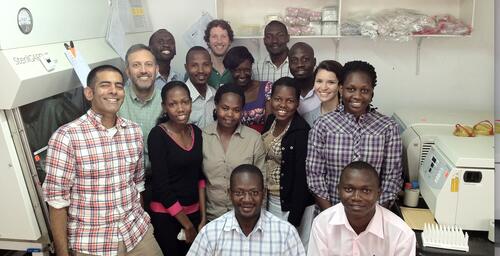
Jagannathan, an infectious disease physician who is also a member of Stanford’s Child Health Research Institute, said the $100,000 stipend that comes with the prize will allow his lab members to ramp up their research in Uganda. A member of the nonprofit Infectious Disease Research Collaboration in Kampala, his team is particularly interested in how strategies that prevent malaria might actually alter the development of natural immunity to malaria.

“With support from the Rosenkranz Prize, we hope to identify maternal immune characteristics and immunologic targets that are associated with protection of malaria in pregnancy and infancy,” Jagannathan said.

The Dr. George Rosenkranz Prize for Health Care Research in Developing Countries is awarded each year by the Freeman Spogli Institute for International Studies and Stanford Health Policy to a young Stanford researcher who is trying to improve health care in underserved countries. It was established in 2009 by the family or Dr. George Rosenkranz, a chemist who first synthesized cortisone in 1951, and later progesterone, the active ingredient in oral birth control pills.

“My father has held a lifelong commitment to scientific research as a way to improve the lives and well-being of communities around the world,” said Ricardo T. Rosenkranz, MD. “In particular, he has always sought to improve the health of at-risk populations. Dr. Jagannathan’s work offers the very sort of innovative ingenuity that characterized my father’s early research, as well as his vision towards the future.”

Jagannathan and his collaborators at UCSF and in Uganda are currently conducting a randomized control trial of 782 Ugandan women who are receiving intermittent preventive treatment with a fixed dose of dihydroartemisinin-piperaquine(or IPTp-DP), a medication that has dramatically reduced the risk of maternal parasitemia, anemia, and placental malaria. Their preliminary data suggests that among 684 infants born to these women, maternal receipt of IPTp-DP may lead to a reduced incidence of malaria in the first year of life.

Image

“Having the discretionary support of the Rosenkranz Prize will allow us to generate some preliminary ideas from this trial that could lead to larger studies, to push this agenda further along,” Jagannathan said.

That agenda is to create a vaccine that targets pregnant women to prevent malaria both during pregnancy — but also potentially preventing malaria in infants, giving them a better start in life.

“We’re not the first ones to think of this, but we have the opportunity to test these hypotheses in incredibly unique settings, with really well-studied cohorts that have real-world implications in terms of what we find,” Jagannathan said. “I’m hopeful that the data that’s generated over the new few years will allow us to keep moving forward.”

Jagannathan has been traveling to Uganda for a decade to study malaria. He’s seen firsthand the relentless, gnawing impact the disease has on daily life.

“Before I went to Uganda I really didn’t understand the burden that malaria causes in communities — and it’s just incredible,” he said. His first study was on children aged 5 and under who had on average six episodes of malaria a year.

“They just get it over and over again, and the toll on society is enormous,” he said. The clinics are overwhelmed and a parent or sibling must miss work or school to stay home with that child.

Yet, in highly endemic settings, children eventually develop an immunity that protects against the adverse outcomes from malaria. If he and his colleagues can understand how pregnant women and children develop this clinical immunity to malaria, it could lead to better treatments and preventative strategies.

“If we understand the mechanisms that underlie naturally acquired immunity, that would offer some clues as to how we can develop a vaccine that actually allows either that immunity to occur more quickly or prevents us from developing immunity that allows for the parasite to persist without symptoms,” he said.

There is currently a malaria vaccine undergoing testing in Africa. The vaccine, known as RTS,S, was developed by GlaxoSmithKline and the PATH Malaria Vaccine Initiative, with support from the Bill and Melinda Gates Foundation. Decades in the making, four doses of the vaccine are required to reduce malaria infection in humans.

“It’s a remarkable vaccine in that it’s effective in the beginning, but the problem is that the efficacy wanes very rapidly,” Jagannathan said, noting that some studies show that beyond three years, the effectiveness drops to 15-20 percent.

“That’s the big issue and why people are really interested in trying to find new strategies and new approaches for a next-generation malarial vaccine,” he said. “That’s the overarching aspect of what motivates my work.”

Hero Image
Prasanna Jagannathan Rosenkranz
Beth Duff-Brown
All News button
1
Subtitle

Prasanna Jagannathan and his lab members intend to ramp up their research in Uganda. A member of the nonprofit Infectious Disease Research Collaboration in Kampala, his team is particularly interested in how strategies that prevent malaria might actually alter the development of natural immunity to malaria.

Subscribe to Science and Technology