
Science and Technology
Authors
News Type
Q&As
Date
Paragraphs

Pilot program was designed to first ground students in the basics of empirical research, then provide an opportunity to apply that knowledge while conducting fieldwork in an international setting.


The Freeman Spogli Institute for International Studies (FSI) and Office of International Affairs (OIA) launched a pilot collaboration last year to provide a rigorous, immersive teaching and training program for students interested in international fieldwork.  The result was a program that included a quarter-long course in the spring of 2015 followed by three weeks in Mexico during the summer to design and conduct a field research study. OIA spoke with Frank Wolak, the Holbrook Working Professor of Commodity Price Studies in Economics and Senior Fellow at FSI, to learn more about the project, titled International Field Research Training: Energy Reform in Mexico.

What was the impetus for designing a program for students with a field research component?

While students at Stanford have many opportunities to pursue independent research projects, they rarely have the opportunity to receive first-hand training in conducting interviews, research design and field implementation. With that in mind, we set out to design a program that would carry the students through the basics of empirical research and then give them the opportunity to apply that knowledge under close faculty supervision. Taking students out of the classroom and giving them the opportunity to see textbook methods in action is invaluable.

Our hope is that this training equips the students with the academic and logistical skills they need to execute their own robust research, be that for an honors thesis, a capstone project or an advanced degree.

How did the prerequisite course prepare students for working in the field? 

The Stanford course taught the basics of the design, implementation and interpretation of social science field research. Building on a basic knowledge of statistical methods and economics, the course first introduced observational field research and compared it with experimental field research. Significant attention was devoted to explaining what can and cannot be learned through each type of field research.

Topics covered included sample size selection, power and size of statistical hypothesis tests, sample selection bias and methods for accounting for it. Examples of best practice field research studies were presented as well as examples of commonly committed experimental design and implementation errors. Practical aspects of fieldwork were also covered, including efficient and cost-effective data collection, data analysis, teamwork and common ethical considerations.

After completing the quarter-long course on statistical research methods, the students, under the guidance of the Program on Energy and Sustainable Development's research team, adapted an education-based research intervention for the Mexican electricity sector. The purpose was to see if providing individuals with information about how their energy bill was calculated and simple ways to reduce household electricity consumption would cause household energy bills to go down.

What was a typical day for the students gathering research?

Research was carried out in the city of Puebla, a city of 1.5 million people about 150 kilometers (93 miles) southeast of Mexico City. The Stanford students collaborated with students from the Universidad Popular Autónoma del Estado de Puebla (UPAEP). For the first few days, the students all met at an UPAEP classroom space to design and review the survey tool, making revisions and conducting practice interviews.

Once oriented in Puebla, the students set out daily in research teams to interview randomly selected households in middle-income neighborhoods in Puebla. The students branched out from a central meeting place in teams of three, pairing two Stanford students with one UPAEP student.

In the field, the students all wore nametags and UPAEP baseball caps to make themselves identifiable as surveyors to households. They worked in the field for eight to 10 hours a day, taking about an hour break for lunch. In the first few days, they were able to collect 15-20 surveys a day, but as they became more comfortable with their pitch and knocking on doors, they were able to increase their yield to a high of 44 surveys in one day. At the end of two weeks, they completed over 260 surveys in just 10 days of fieldwork.

The students were also active on social media documenting their daily activities. For more on the student perspective, their activities and impressions of the project, check out their blog on the FSI website. 

What are the benefits for getting in-country field research experience?

There are a variety of situation-specific problems that are hard for any researcher to know fully without being immersed in the field. For example, one of the students' recommendations to improve energy efficiency was to switch household light bulbs from incandescent to compact fluorescents (CFL). This is a valid recommendation in the United States where most people still use incandescent bulbs in their homes, but – surprisingly to the team – most of the people interviewed had already converted to all CFLs in their home.

I was amazed with the students; the level of intellectual curiosity and engagement was impressive with ongoing discussions into the evening at times. The students were not only getting an in-country immersive experience while conducting research, but they were also developing critical thinking skills along the way.

Research aside, the in-country experience gave the students a keen understanding of how local residents live. The methodology employed for gathering data allowed the students to connect with many types of families, ranging from senior citizens living alone to multi-generational families living under one roof. Through direct contact with the community, the students developed an understanding of the local culture and learned local customs. 

Conducting international research at Stanford can be challenging. Where did you turn to for advice on how to structure your activity?

At FSI, we have a great wealth of experiential knowledge on conducting field research all over the world. In addition to consulting with faculty and research managers at FSI, OIA had been enormously helpful in connecting us with resources across campus and facilitating some of the trickier logistics, such as processing stipend payments to our international collaborators and navigating the human subjects approval process. OIA was also able to discern that Puebla was a viable option as a research site.

How would you characterize the success of the pilot program? 

The pilot program exceeded our expectations in the best possible ways. Much of its success was due to the work of Elena Cryst ,'10, program manager for FSI's Global Student Fellows Program, who also accompanied us on our trip. She was an invaluable team leader and organizer and worked tirelessly to ensure that both the research and logistical aspects of the trip ran smoothly.

We will definitely be offering the field research course and research project again. We hope to go to another part of Latin America next, such as Chile or Colombia. We are also still active in Mexico, with three of the students that went on the trip working for us as research assistants this academic year, analyzing the data as it comes in and developing a self-administered online version of the survey instrument with which we hope to reach thousands of households in Puebla.

In addition, Elena will be using our experiences from the Mexico pilot to inform other FSI field research programs in China, Guatemala, India and potentially new sites for next year.


This article was originally published in The Stanford Report on October 27, 2015.

Hero Image
dscf6452
All News button
1
News Type
News
Date
Paragraphs

Speaking at the Stanford Center at Peking University (SCPKU) on September 22, Condoleezza Rice, the Denning Professor in Global Business and the Economy at the Stanford Graduate School of Business; the Thomas and Barbara Stephenson Senior Fellow on Public Policy at the Hoover Institution; and a professor of Political Science at Stanford University, said that technology and education are key drivers in achieving sustainable urban development and cited opportunities for China and other developing countries to harness this innovation and mobilize human potential.

Rice’s remarks were part of her keynote address during SCPKU’s inaugural Lee Shau Kee World Leaders Forum.  Welcome remarks were given by Jean C. Oi, the Lee Shau Kee Director of SCPKU and Senior Fellow at Stanford University’s Freeman Spogli Institute for International Studies (FSI), and Peking University (PKU) Prof. Min Weifang and former PKU Chairman.  Michael McFaul, Director and FSI Senior Fellow and former U.S. Ambassador to Russia, introduced Rice who highlighted the opportunities of technology and innovation as well as the governance challenges they can bring.

“If we remember technology is the application of knowledge to a problem, we can begin to address some of the problems of governing with the application of technology.” Rice said. “It is really a question of whether we can marry human potential and technological possibilities to solve our problems. Human potential is key to innovation, and in that regard, the most urgent tasks are around education.”

Rice spoke before an audience of 150 government and academic leaders, scholars, and students at SCPKU.  Following her keynote address, she participated in a roundtable discussion with policy and thought leaders. The discussion was chaired by Karl Eikenberry, Director of the U.S.-Asia Security Initiative at Stanford’s Asia-Pacific Research Center and former U.S. Ambassador to Afghanistan.  Panelists also included Dr. Wang Yiming, Deputy Director General and Senior Research Fellow at China’s State Council Development and Research Center, and Prof. Tong Zhu, Dean of the College of Environmental Science and Engineering at PKU.

“This was a unique opportunity to convene thought leaders on a topic of significant importance to China and the world,” said  Prof. Oi.  “China’s urbanization has been one of the most rapid in history. Technology innovation can help address the challenges of urban governance where people’s lives have changed in one generation.”

Hero Image
5
Courtesy of Stanford University
All News button
1
-
RSVP Required


Agenda
4:15pm: Doors open
4:30pm-5:30pm: Lecture, followed by discussion
5:30pm-6:00pm: Networking


For more information about the Silicon Valley-New Japan Project please visit: http://www.stanford-svnj.org/

3rd Floor, Encina Hall616 Serra StreetStanford, CA 94305
Kenji Kushida, Stanford Japan Program Research Associate
Lectures
-

[[{"fid":"220174","view_mode":"crop_870xauto","fields":{"format":"crop_870xauto","field_file_image_description[und][0][value]":"Toomas Hendrik Ilves. Reception at the 36th Annual Conference of the Association of Philosophy and Literature.","field_file_image_alt_text[und][0][value]":"","field_file_image_title_text[und][0][value]":"","field_credit[und][0][value]":"Rene Riisalu","field_caption[und][0][value]":"Toomas Hendrik Ilves. Reception at the 36th Annual Conference of the Association of Philosophy and Literature.","field_related_image_aspect[und][0][value]":"","thumbnails":"crop_870xauto","pp_lightbox":false,"pp_description":false},"type":"media","attributes":{"width":"870","class":"media-element file-crop-870xauto"}}]]


Please RSVP. We will close registration once the attendance list reaches 250 people. 


Abstract:


On September 24, Stanford’s Center on Democracy, Development and the Rule of Law in partnership with The Atlantic Council will present a public address by President Toomas Ilves of Estonia on the future of technology in elections. Elections are set to take center stage in the coming year, in this country and abroad. As technology plays an increasingly large role in people’s lives, the discussion—moderated by CDDRL Director Francis Fukuyama— will explore its role in elections worldwide. President Ilves of Estonia—the only country in the world to use Internet voting for national elections— will discuss how technology can promote transparency, inclusion, and stronger democracies.

This event is a partnership between Stanford’s Center on Democracy, Development and the Rule of Law and The Atlantic Council, a DC-based think-tank committed to promoting constructive leadership and engagement in international affairs.


Bio:


Toomas Hendrik Ilves was elected President of the Republic of Estonia in 2006 and re-elected in 2011. He served as Chairman of the EU Task Force on eHealth from 2011 to 2012, and since November 2012 he became Chairman of the European Cloud Partnership Steering Board. His interest in computers stems from an early age – he learned to program at the age of 13 - and he has been promoting Estonia’s IT-development since the country restored its independence. Prior to his presidency, he served as Ambassador of Estonia to the United States of America and Canada (1993 -1996). In this position, he initiated the Tiger Leap initiative to computerize and connect all Estonian schools online. He also served as Minister of Foreign Affairs (1996-1998; 1998-2002) and Member of the Estonian Parliament (2002-2004). In recent years, President Ilves has spoken and written extensively on integration, transatlantic relations, e-government, and cyber security. He graduated from Columbia University in 1976 and received his Master’s degree in Psychology from the University of Pennsylvania in 1978. 


President Toomas Hendrik Ilves President Republic of Estonia
Lectures
News Type
News
Date
Paragraphs

A three-week seminar focused on digital health innovation and entrepreneurship in China came to a close last week, culminating in the final pitch presentations from four cross-cultural, entrepreneurial student teams. The winning team, LiveBright, presented a way to improve access to personal counseling in China using digital, peer-to-peer methods, with the mission of reducing stress among students and young professionals.

Sponsored by the Stanford Center at Peking University (SCPKU), the course was developed by Dr. Robert Chang, digital health inventor and Assistant Professor of Ophthalmology at Stanford University, and Ravi Pamnani, medical technology executive and alumnus of Stanford’s Biodesign Innovation Fellowship, a pioneering training program in biomedical innovation.

The hands-on course paired Stanford students with Peking University students in collaborative teams and immersed them in the Chinese healthcare system. Students shadowed physicians and interviewed patients to identify unmet needs and market opportunities. Students then brainstormed solutions and developed rapid prototypes to test their ideas and obtain user feedback. Next, they selected business models to ensure the sustainability of their solutions. Along the way, students got feedback from physicians, digital health entrepreneurs, and investors who evaluated their ideas in real-world contexts.


rob and ravi compressed SCPKU seminar instructors, Dr. Robert Chang and Ravi Pamnani.

SCPKU seminar instructors, Dr. Robert Chang and Ravi Pamnani
Courtesy of Stanford University


Other teams focused on a telemedicine approach to physical therapy, a more convenient way to obtain eyeglasses prescriptions at home, and a novel subscription box service to promote women’s health education.

“We have been really impressed with the outside-the-box thinking that the students have employed to identify new opportunities,” said Dr. Chang. “China has seen tectonic changes in the mobile and consumer internet sectors. With this in mind and given the unique characteristics of the Chinese healthcare system, a digital health revolution is inevitable, and in many ways has already begun. The rest of the world can learn a lot by observing how digital technologies will transform healthcare here in China over the next five years.”

For more information about the seminar, visit http://www.dhealthchina.com/.

Hero Image
group photo resized
Courtesy of Stanford University
All News button
1
(650) 725-6934
0
Frank Lee and Carol Hall Professor of Biology at Stanford University
Professor of Genetics at the Stanford School of Medicine
CISAC Affiliated Faculty Member
Chair of the Department of Biology
tim_stearns.jpeg

Tim Stearns is the Frank Lee and Carol Hall Professor of Biology at Stanford University and Professor of Genetics at Stanford School of Medicine. He is the chair of the Department of Biology. Dr. Stearns’ lab studies the structure and function of the centrosome and cilium in animal cells and the relationship of defects in these important signaling centers to human disease. He has been recognized for his teaching of undergraduates and graduate students at Stanford, and internationally in Chile, Ghana, South Africa and Tanzania. Dr. Stearns is a member of JASON, an independent group of scientists which advises the United States government on matters of science and technology.

Authors
News Type
News
Date
Paragraphs

Governments must do more to diversify the types of crops grown throughout the world. If they don’t, climate change may jeopardize the global food supply, a leading agriculture researcher told a Stanford audience.

Cary Fowler, a senior advisor and former executive director of the Global Crop Diversity Trust, was a driving force behind the creation of the Svalbard Global Seed Vault in Norway. Commonly known as the “doomsday vault,” the repository of ancient and modern seeds from around the world ensures that future generations will have access to a wide enough range of crop traits to adapt global agriculture to a changing climate.

7307140126 7a3ca02f37 k Dr. Cary Fowler in Svalbard, Norway, the home of the Svalbard Global Seed Vault.
During a May 6 talk sponsored by FSE as part of the center’s Food and Nutrition Policy Symposium, Fowler warned that increasingly high temperatures and water shortages interfere with the natural growing cycles of many crops and can even reduce the nutritional quality of some plants. Higher temperatures also give way to new pests, diseases, and soil microorganisms that threaten yields.

 “The biggest impacts from climate change will be in sub-Saharan Africa,” Fowler said, a region where many people already suffer serious poverty and hunger, and where crop yields lag behind the rest of the world. Fowler said that as climate pressure on agriculture intensifies, the world can expect to see an uptick in civil conflict, restrictive trade policies, and suffering among the world’s poorest people.

“Crops are going to be facing new combinations of conditions for which there is no historical experience,” said Fowler. “They will require new combinations of traits” that can only be developed by preserving genetic diversity and proactively breeding new varieties.

 “There are 1.3 billion people living on subsistence farms today,” said Dr. Cary Fowler to a Stanford audience on May 6. “How will they adapt to climate change without access to diversity?”

Fowler called for the U.S. and foreign governments to embrace their “inherited evolutionary responsibility” for preserving the huge diversity of crops grown by farmers throughout human history.

The United States is the ideal candidate to lead the world in using crop genetic diversity to adapt agriculture to climate challenges, he said. “The U.S. is well-positioned to research diversity, model future climate and assemble seed packages,” enlisting farmers in the U.S. and abroad in “another mass adaptation experiment” like the one American agriculture undertook in the 18th and 19th centuries.

 “I know that sounds like a wild and crazy idea,” Fowler said. “But I haven’t heard any alternatives to it. If we’re assuming we’re going to have development without diversity, that would really be a historically unprecedented experiment.”

 “If agriculture doesn’t adapt,” he added, “neither will we.”

A diverse history

In the late 1700s the United States food system lacked diversity and infrastructure. “Very few of the crops we grow now in the U.S. are native,” said Fowler. Early on, “it wasn’t always evident what crops from abroad would grow well in the U.S.”

The government soon set out to expand and diversify American agriculture. U.S. Navy ships collected seeds on overseas voyages, and U.S. diplomats brought back new crops from postings abroad. Government-sponsored expeditions sought out foreign plants with specific disease-resistant traits. The U.S. signed two dozen seed-exchange agreements with other countries, and lowered taxes on imported seeds to boost global crop exchange.

Image
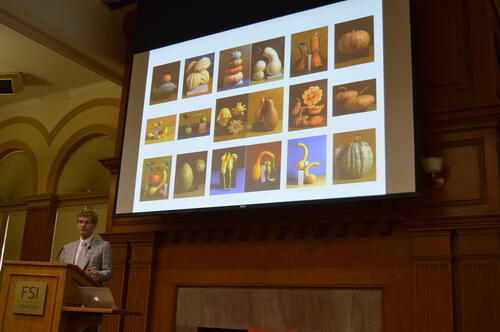
fowler squash slide

“The United States amassed a much more diverse array of seeds and crops as a result,” said Fowler. One program introduced 600 new apple varieties, 700 new types of pears, and 353 new varieties of mangoes to American farmers.

But the United States did not simply collect new crops. It also invested in research to develop new varieties, including through plant breeding.

Genetic erosion

Research into plant breeding quickly yielded many of the modern varieties of crops we grow today in the United States.

“With plant breeding came the rise of modern varieties that had useful traits like disease resistance,” said Fowler. A small handful of new varieties quickly gained popularity with American farmers, who now had a choice about whether or not to save seeds and grow many varieties of a crop at once. Most farmers chose not to, instead relying on the same few mainstream varieties their neighbors were growing.

This shift has led to what Fowler described as the “genetic erosion” of agriculture, a trend that can only be reversed by reviving the tradition of seed saving and plant breeding on a global scale.

Seed banks

“I have probably been to more seed banks than any other person,” said Fowler. Seeds from most crops can survive hundreds or even thousands of years in storage, but most storage facilities lack the physical security to provide lasting safe haven. Many seed banks are poorly built, too warm or humid for long-term storage, and vulnerable to natural disasters. Other facilities suffer damaged during civil wars and uprisings.

Even if banks are physically secure, said Fowler, most simply do not operate on a large enough scale to protect global crop diversity. “Most crops in the world have between one and 10 total seed samples in storage, and most have no plant breeders working on them at all,” said Fowler.

The doomsday vault

In 2005 Fowler was chosen to lead an international coalition to build the Svalbard Global Seed Vault. The Norwegian government owns the facility, and it is also managed by the Global Crop Diversity Trust and the Nordic Genetic Resource Center. 


The vault is built into the side of a mountain in the far north of Norway, said Fowler, because the ideal temperature for storing seeds is minus 18 degrees Celsius.

Inside the frozen walls of the vault are shelves full of boxes holding duplicate seeds from smaller seed banks around the world. Foreign governments that contribute samples pay nothing for storage, and the seed packages are never opened by vault staff, said Fowler.

 “The vault now houses seeds from over 864,000 varieties of plants,” said Fowler, adding that not a single sample has ever been lost.

img004531 Seed storage boxes at the Svalbard Global Seed Vault.

The facility’s nickname, “the doomsday vault,” comes not only from its rugged physical location but from its capacity to withstand disasters – something its planners took great care to design. “We calculated how high the water would go if all ice in the world melted and we had the world’s largest ever tsunami,” said Fowler. “The vault is five stories above that.”

“Not a solution”

Fowler emphasized that no doomsday vault, no matter how secure its walls or how ample its seed collection, can solve the problem of crop genetic erosion. Building a vault “doesn’t mean that we as a society are getting serious about adapting agriculture to climate change,” Fowler said. Plant breeding and crop research programs focused on developing new climate-resilient varieties are just as crucial as saving seeds.

Although a few major staple crops like rice, wheat and corn are continually bred and improved in research labs around the world, most crops are largely ignored by researchers. For example, there are only six breeders of yams worldwide.

“Why conserve it if you’re not going to use it?” Fowler asked. “We are acting like crops are going to adapt by themselves, and we are assuming all but a handful of crops are unimportant.”

Quoting Charles Darwin, Fowler added that “it is not the strongest of the species that survives, nor the most intelligent, but the one most responsive to change.”


Full video and audio recordings of Dr. Fowler's May 6 lecture, and his interview with FSE director Roz Naylor, are available here

Hero Image
2673734934 262a3c22c0 o
Kris Krug
All News button
1
Subscribe to Science and Technology