International Development

FSI researchers consider international development from a variety of angles. They analyze ideas such as how public action and good governance are cornerstones of economic prosperity in Mexico and how investments in high school education will improve China’s economy.

They are looking at novel technological interventions to improve rural livelihoods, like the development implications of solar power-generated crop growing in Northern Benin.

FSI academics also assess which political processes yield better access to public services, particularly in developing countries. With a focus on health care, researchers have studied the political incentives to embrace UNICEF’s child survival efforts and how a well-run anti-alcohol policy in Russia affected mortality rates.

FSI’s work on international development also includes training the next generation of leaders through pre- and post-doctoral fellowships as well as the Draper Hills Summer Fellows Program.

Authors
News Type
Blogs
Date
Paragraphs

On Saturday, May 22, 2021, Stanford Global Studies (SGS) hosted the 2021 Education Partnership for Internationalizing Curriculum (EPIC) Symposium, which featured presentations by 11 2020–21 EPIC Fellows. SPICE, along with the Center for Spatial and Textual Analysis, is SGS’s EPIC Partner. The following reflection is a guest post by EPIC Fellow Maiya Evans, assistant professor at Skyline College, who gave a presentation on “Reimagining Public Health.”


“I’m telling you, professor. I’m telling you, something’s going on.” I listened intently with curiosity as one of my Skyline College students made her case. Another chimed in, “They’re saying it’s killing old people and that the doctor who discovered it died, too.” Sensing the palpable anxiety in their shares, I decided to pivot the following week’s lesson on epidemiology to focus on what was then called the novel coronavirus and its spread in China.

At the time these conversations took place, we were in late January of 2020, so the coronavirus was still novel to the United States, indeed. Every class session thereafter, we watched the Johns Hopkins Center for Systems Science and Engineering’s global map of new and existing COVID-19 cases grow. As the numbers increased from hundreds to thousands, and subsequently thousands to millions over the course of mere weeks, it became clear that looking at every country’s approach to controlling the spread of COVID-19 was essential. Without knowing it, my students and I were planting the seeds of the Reimagining Public Health (RPH) Roundtable series.

When I made the decision to apply to the Stanford EPIC Fellowship, which aims at internationalizing the community college curriculum, I knew that I wanted to work on a project that expanded the borders of public health in the United States. The purpose of the RPH Roundtable series was to invite students to reshape and rethink our approaches to health and health care in the United States by borrowing from public health methodologies from other nations. This pilot for the RPH Roundtable series was implemented in the Spring of 2021 in my Introduction to Public Health course at Skyline College in San Bruno, California.

My hope for the RPH Roundtable series was simple: to challenge students to gain an understanding of how public health systems function in the United States and abroad. Students were invited to observe the following in other nations: (1) public health approaches to controlling the spread of disease, (2) the connection between economics and health resources, and (3) the influence of health policy on public health interventions. The students gathered virtually throughout the semester to engage in podcast-style conversations around three relevant public health topics that impact the United States: communicable and non-communicable disease, mental health, and substance use.  

Students had powerful insights about current approaches to public health issues in the United States and abroad. For example, one group discussed the societal impact of unfair and punitive drug policy in the United States vs. gentler harm reductionist drug policy in the Netherlands. Students also brainstormed innovative community health solutions, such as implementing holistic, non-Western approaches to addressing mental health issues (as is common in China), or creating mental health programs within the workplace, which is done in some parts of Canada.

All in all, I was extremely satisfied with the outcome of the RPH Roundtable series, and I am incredibly proud of the students for challenging themselves to think critically about making positive, meaningful change in public health. Though there were many lessons learned with regards to the challenges of doing a project of this caliber in the virtual space, I thought the students did an incredible job of having deep, meaningful, and well-informed discussions about the potential of a brighter future in our public health system.

Read More

Zoom screenshots of EPIC fellows
Blogs

2021 Education Partnership for Internationalizing Curriculum Symposium

On Saturday, May 22, 2021, SPICE’s Jonas Edman moderated two panels during the 2021 EPIC Fellowship Program Symposium for community college educators.
2021 Education Partnership for Internationalizing Curriculum Symposium
image of six fellows
News

Collegiality and the 2020–21 EPIC Fellows

On August 13 and 14, 2020, Stanford Global Studies welcomed 12 new Education Partnership for Internationalizing Curriculum (EPIC) Fellowship Program community college instructors as members of its 2020–21 cohort.
Collegiality and the 2020–21 EPIC Fellows
Webinar poster with three speakers
Blogs

Training for the Olympics During COVID-19

For episode 4 of the CoviDB Speaker Series, TeachAids Founder and CEO Dr. Piya Sorcar provides a glimpse into how the pandemic has impacted the lives of two of the world’s greatest athletes.
Training for the Olympics During COVID-19
Hero Image
Maiya Evans at the Van Gogh Museum, Amsterdam, Netherlands
Maiya Evans at the Van Gogh Museum, Amsterdam, Netherlands; photo courtesy Maiya Evans
All News button
1
Subtitle

Guest author Maiya Evans reflects on her EPIC project, which challenges students to reimagine public health.

Authors
Gary Mukai
News Type
Blogs
Date
Paragraphs

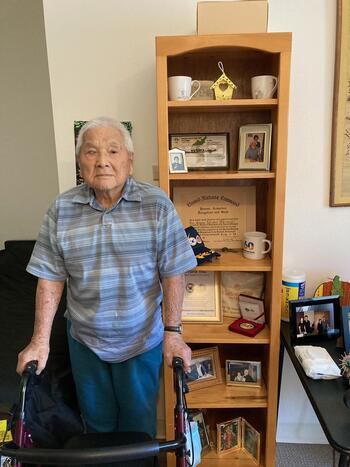
Last week, I had the chance to visit one of my uncles, George Mukai (92), who is a veteran of the Korean War. He recently moved into an assisted-living facility and had very few items delivered from his home to his new residence. One thing that he did have delivered was a curio cabinet that contains Korean War-related items including medals, a cap, a United Nations Command certificate, and a piece of wire from the DMZ.

Image
United Nations Command Certificate
As he has in the past, he shared recollections of his experiences during the Korean War, but unlike when he was young, his recollections felt more poignant. He is a very proud veteran. Another one of my uncles, Roy Mukai (deceased), was also a Korean War veteran, and a third, Toichi Mukai, was stationed in Korea after the Korean Armistice Agreement was signed in 1953.

This month marks the 71st anniversary of the beginning of the Korean War on June 25, 1950. After my visit with George, I started to reflect on the work that my colleagues (past and present) at SPICE have done to promote the study of Korea in U.S. schools and directly to students in the United States. They are:

They have developed extensive curriculum on Korea. The offerings can be found on this webpage and includes offerings such as the following:

  • Colonial Korea in Historical Perspective
  • Divided Memories: Comparing History Textbooks
  • Dynamics of the Korean American Experience
  • Economic Development: The Case of South Korea
  • Inter-Korean Relations: Rivalry, Reconciliation, and Reunification
  • Traditional and Contemporary Korean Culture
  • Uncovering North Korea
  • U.S.–South Korean Relations
     

In addition, the Sejong Korea Scholars Program, an online course for high school students in the United States, has been offered by SPICE since 2013. The SKSP annually selects 20–25 exceptional high school students from throughout the United States and engages them in an intensive study of Korea and U.S.–Korea relations. Selected students participate in the online course on Korea from February to June of each year. The current instructor is Jang.

Lastly, SPICE offers annual summer institutes to middle school and high school teachers in partnership with the National Consortium for Teaching about Asia, and also the East Asia Seminars for Teachers in Hawaii. These are facilitated respectively by Edman, Naomi Funahashi, and Sekiguchi. These programs focus in part on Korea and are funded by the Freeman Foundation.

Image
George Mukai 2021
I wish that I could inform veterans of the Korean War about programs such as these that help to promote a greater understanding of Korea and U.S.–Korea relations among students in the United States, and also to encourage students to reflect upon the sacrifices that were made by the veterans.

Read More

High school student with a diploma standing in front of a banner
Blogs

My Experience with the Sejong Korea Scholars Program in the Midst of a Global Pandemic

The following reflection is a guest post written by Jason Lu, an alumnus of the Sejong Korea Scholars Program, which is currently accepting applications for the 2021 course.
My Experience with the Sejong Korea Scholars Program in the Midst of a Global Pandemic
Student in a red dress presenting at a podium with Stanford signage
Blogs

Coming Full Circle: The Sejong Korea Scholars Program and Stanford

The following reflection is a guest post written by Sandi Khine, an alumna of the Reischauer Scholars Program and the Sejong Korea Scholars Program, which are currently accepting applications for the 2021 courses.
Coming Full Circle: The Sejong Korea Scholars Program and Stanford
5thbuchanan banner
News

SPICE Wins Buchanan Prize for Fifth Time

SPICE Wins Buchanan Prize for Fifth Time
Hero Image
George Mukai in Munsan, a town south of the Imjin River near Panmunjom, during the Korean War, 1951
George Mukai in Munsan, a town south of the Imjin River near Panmunjom, during the Korean War, 1951; image courtesy George Mukai
All News button
1
Subtitle

SPICE offers a series of Korea-focused lesson plans, an online course for U.S. high school students, and teacher professional development opportunities.

-

* Please note all CISAC events are scheduled using the Pacific Time Zone.


Seminar Recording: https://youtu.be/Mip2dRr2w7o


About the Event: With the rapid rise of China, power transitions and the possibility of great power conflict are the focus of popular and scholarly attention. The discipline of International Relations offers many insights on why violent power transition conflicts occur, yet few substantive treatments exist on why and how peaceful change happen in world politics. The Oxford Handbook of Peaceful Change in International Relations (co-edited by T.V. Paul, Deborah Larson, Harold Trinkunas, Anders Wivel and Ralf Emmers) is the first comprehensive treatment of the subject of peaceful change in the field. It contains some 41 chapters, written by scholars from different theoretical and conceptual backgrounds examining the multi-faceted dimensions of this subject. Chapters in the volume examine this issue through the lens of different approaches in international relations theory, through a focus on key challenges in the international system, and from regional and state-level perspectives on the prospects for peaceful change. This panel with Handbook editors and contributors will discuss the conceptual framework, substantive contributions, and key findings of the project.


About the Speakers:


T.V. Paul is James McGill Professor of International Relations in the Department of Political Science at McGill University, Montreal, Canada and a Fellow of the Royal Society of Canada. He served as the President of International Studies Association (ISA) for 2016-17. He is the Founding Director of the Global Research Network on Peaceful Change (GRENPEC). Paul is the author or editor of 21 books and over 80 scholarly articles/book chapters including: Restraining Great Powers: Soft Balancing from Empires to the Global Era (Yale University Press, 2018); The Warrior State: Pakistan in the Contemporary World (Oxford University Press, 2013); Globalization and the National Security State (with N. Ripsman, Oxford University Press, 2010); The Tradition of Non-use of Nuclear Weapons (Stanford University Press, 2009); India in the World Order: Searching for Major Power Status (with B.R. Nayar Cambridge University Press, 2002). Paul currently serves as the editor of the Georgetown University Press book series: South Asia in World Affairs.


Deborah Welch Larson is professor of political science at the University of California, Los Angeles. She received her Ph.D. at Stanford University. Her publications include Origins of Containment: A Psychological Explanation (Princeton: Princeton University Press, 1985); Anatomy of Mistrust: US-Soviet Relations during the Cold War (Ithaca: Cornell University Press, 1997); and “Status Seekers: Chinese and Russian Responses to U.S. Primacy,” International Security 34, no. 4 (Spring 2010): 63-95 (with Alexei Shevchenko). She has most recently published Quest for Status: Chinese and Russian Foreign Policy (New Haven: Yale University Press, 2019), with Alexei Shevchenko.


Alexandra Gheciu is a Professor at the Graduate School of Public and International Affairs, and Associate Director of the Centre for International Policy Studies. Her research interests are in the fields of international security, international institutions, Euro-Atlantic relations, global governance and the liberal order, the Global Right, state (re)building, and International Relations theory.

Alexandra's publications include, in addition to articles in leading academic journals, several books: NATO in the ‘'New Europe': The Politics of International Socialization After the Cold War: (Stanford University Press, 2005); Securing Civilization? (Oxford University Press, 2008),  The Return of the Public in Global Governance (co-edited with Jacqueline Best, Cambridge University Press, 2014 and 2015);  and, more recently, Security Entrepreneurs: Performing Protection in Post-Cold War Europe (Oxford University Press, 2018); and  The Oxford Handbook of International Security (co-edited with William Wohlforth, Oxford University Press, 2018).


Virtual Seminar

T.V. Paul Professor McGill University
Deborah Welch Larson Professor UCLA
Alexandra Gheciu Professor Centre for International Policy Studies
Seminars
Authors
Gary Mukai
News Type
Blogs
Date
Paragraphs

On Saturday, May 22, 2021, Stanford Global Studies (SGS) hosted the 2021 Education Partnership for Internationalizing Curriculum (EPIC) Symposium which featured presentations by the 12 2020–21 EPIC Fellows. SPICE along with the Center for Spatial and Textual Analysis are SGS’s EPIC partners. Jonas Edman worked with six of the EPIC Fellows during the academic year as they sought to increase the international, intercultural, and global dimensions in their curriculum.

During the EPIC Symposium, Edman moderated two panels that featured the following six instructors. The “pitches” for their talks can be found here.

Panel One

  • Sravani Banerjee, Evergreen Valley College, San Jose, California; “Incorporating Social Justice and Global Issues in Freshman Composition”
  • Maiya Evans, Skyline College, San Bruno, California; “Reimagining Public Health: Expanding the Borders of Public Health Curriculum”
  • Joanna Sobala, Mission College, Santa Clara, California; “Women and Feminism in the World”
     

Panel Two

  • Julia diLiberti, College of DuPage, Glen Ellyn, Illinois; “The Need for Globalizing Curriculum Post Pandemic”
  • Melissa King, San Bernadino Valley College, San Bernadino, California; “Defining Moments in Global Studies Education”
  • Rebecca Nieman, San Diego Mesa College, San Diego, California; “Internationalizing Business Law Curriculum in Community Colleges Through Experiential Learning Activities”


The EPIC Fellows not only conceptualized and developed ways to globalize their curriculum through the incorporation of new subject matter knowledge but also carefully considered the importance of pedagogical content knowledge, which was popularized by Stanford scholar Lee Shulman. Shulman argued that subject matter knowledge and pedagogical content knowledge—teachers’ interpretations and transformations of subject-matter knowledge in the context of facilitating student learning—should not be treated as mutually exclusive. Edman commented, “While moderating the two panels, I was struck by how each embraced this notion.”

In panel one, Banerjee introduced her project, which focused on incorporating social justice and global issues in freshman composition, and spoke about how her thematic units on topics like human rights not only introduced students to subject matter knowledge such as the Universal Declaration of Human Rights but also engaged them in an inquiry-based learning pedagogical approach. Similarly, Sobala described how she internationalized her social justice course by including the critical viewing of documentaries that focus on women from around the world among her pedagogical approaches. Evans introduced her Reimaging Public Health Roundtable Series, which invites students to reshape and rethink approaches to health and health care in the United States by borrowing from public health methodologies from other countries. She not only introduced students to topics like international perspectives on mental health (including stigma) but also spoke about how she engaged students in creating podcasts as a pedagogical approach.

In panel two, King described her project, which crystalized around the question, “How can San Bernadino Valley College students learn about the world from a different perspective?” Her project engaged students with a podcast that she created called “Within a Grain of Sand” and focused on topics such as migration and refugees as she sought to encourage her students to seek connections between the local and global. Nieman and diLiberti focused their projects on faculty professional development. For Nieman, she challenged faculty to think about how to teach an unfamiliar topic, which happens to be a learning objective of the course, to students. She recommended the engagement of students in experiential learning activities as she internationalized her law courses in areas such as tort law, dispute resolution, and corporate governance. diLiberti developed an eight-week professional development course that has the goal of having the participants gain a more concrete understanding of globalization in tangible ways. As an example, she recommended the use of narrative maps, which she learned from EPIC guest speaker Professor Kären Wigen, as a pedagogical tool.

During the question-and-answer period, 2018–19 EPIC Fellow Dave Dillon, Grossmont College, El Cajon, California, asked how the projects of the 2020–21 EPIC Fellows evolved especially given the pandemic. Evans and Sobala noted that they felt the need to keep strict parameters around the scope of their EPIC projects, and throughout the 2020–21 EPIC Program, the EPIC Fellows expressed the challenges they faced as they transitioned to teaching online. After the Symposium, Edman commented, “despite the enormous challenges that the pandemic posed to the EPIC Fellows, they produced very engaging and meaningful globally focused projects that had direct outcomes on faculty and students, and will continue to have an impact in the years to come.” Edman was especially struck by a comment from one of King’s students who commented on a lesson on refugees: “… I was very unaware of the global refugee situation, and still feel like I do not understand the entire scope of it… when doing more research for the assignment, I found a refugee resettlement tracker that actually showed me how many refugees had resettled in my area historically… That was something I had not previously considered, and the questions asking what my community is doing to help refugees and immigrants really made me think about this issue and how much more there is that we can do at a community level.”

After hearing this student reflection, Edman commented that “perhaps a silver lining to the pandemic is that students began to vividly see the connection between the local and global not only in terms of health but also in other areas that the EPIC Fellows touched upon… for example, refugees, climate, hunger, feminism, immigration, and law as well.”

To stay informed of SPICE-related news, join our email list and follow us on Facebook, Twitter, or Instagram.

Read More

image of six fellows
News

Collegiality and the 2020–21 EPIC Fellows

On August 13 and 14, 2020, Stanford Global Studies welcomed 12 new Education Partnership for Internationalizing Curriculum (EPIC) Fellowship Program community college instructors as members of its 2020–21 cohort.
Collegiality and the 2020–21 EPIC Fellows
Stanford EPIC Fellowship for community college instructors
Blogs

The Education Partnership for Internationalizing Curriculum: Reflections on Collaborating with Community College Educators

The Education Partnership for Internationalizing Curriculum: Reflections on Collaborating with Community College Educators
Hero Image
Zoom screenshots of EPIC fellows
Top row, left to right: Jonas Edman, Gary Mukai, Maiya Evans; second row, left to right: Melissa King, Rebecca Nieman, Julia diLiberti; third row, left to right: Joanna Sobala, Sravani Banerjee; screenshot courtesy Stanford Global Studies
All News button
1
Subtitle

On Saturday, May 22, 2021, SPICE’s Jonas Edman moderated two panels during the 2021 EPIC Fellowship Program Symposium for community college educators.

News Type
News
Date
Paragraphs

SPICE currently runs four regional programs for high school students in Japan: Stanford e-Hiroshima, Stanford e-Kawasaki, Stanford e-Oita, and Stanford e-Tottori. These online courses are coordinated in collaboration with school and government officials at the city and prefectural levels, with the goal of presenting creative and innovative approaches to teaching Japanese high school students about U.S. society and culture and global themes.

All four courses recently finished their 2020–21 term. This summer, two top students from each course will be honored through a virtual event hosted by SPICE, Stanford University. Congratulations to the eight honorees below on their academic excellence!

Stanford e-Hiroshima (Instructor Rylan Sekiguchi)

Student Honoree: Sara Arakawa
School: Hiroshima Prefectural Hiroshima Kokutaiji Senior High School
Project Title: Silicon Valley: Secrets Behind Success

Student Honoree: Chika Isone
School: Hiroshima Prefectural Hiroshima Senior High School
Project Title: Making Innovation by Design Thinking in Silicon Valley

Stanford e-Kawasaki (Instructor Maiko Tamagawa Bacha)

Student Honoree: Eric Silang
School: Kawasaki High School
Project Title: Humor and America

Student Honoree: Shunya Tani
School: Kawasaki High School
Project Title: Possible Ways to Promote Renewable Energy in Japan and the U.S.

Stanford e-Oita (Instructor Kasumi Yamashita)

Student Honoree: Hana Burkart
School: Hofu High School
Project Title: Social Discrimination Against Foreigners in Japan

Student Honoree: Yayano Okuda
School: Usa High School
Project Title: Environmental Education

Stanford e-Tottori (Instructor Jonas Edman)

Student Honoree: Eri Tamura
School: Tottori Nishi High School
Project Title: Teachers’ Treatment in the U.S.

Student Honoree: Hinata Yonemura
School: Yonago Higashi High School
Project Title: Veganism: How Japanese Society Can Promote It


The SPICE staff is looking forward to honoring these eight students in a virtual ceremony on August 23, 2021 (August 24 in Japan). Each student will be given the opportunity to make a formal presentation to members of the Stanford community and the Japanese community in the San Francisco Bay Area.


SPICE also offers online courses to U.S. high school students on Japan (Reischauer Scholars Program), China (China Scholars Program), and Korea (Sejong Korea Scholars Program), and online courses to Chinese high school students on the United States (Stanford e-China) and to Japanese high school students on the United States and U.S.–Japan relations (Stanford e-Japan).

To stay informed of SPICE news, join our email list and follow us on Facebook, Twitter, and Instagram.

Read More

Honorees of SPICE’s regional programs in Japan
News

Ceremony Honors Top Students from SPICE’s Regional Programs in Japan

Congratulations to the eight honorees of SPICE’s 2019–2020 regional programs in Japan.
Ceremony Honors Top Students from SPICE’s Regional Programs in Japan
Victoria Tsai in Kyoto
Blogs

Stanford e-Kawasaki Guest Speaker: Victoria Tsai, Founder and CEO, Tatcha

The entrepreneur and businesswoman spoke to students about how certain key experiences in her life influenced her path.
Stanford e-Kawasaki Guest Speaker: Victoria Tsai, Founder and CEO, Tatcha

Read More

Sumire Hirotsuru performing in Tokyo; photo courtesy Sumire Hirotsuru
Blogs

Giving Back to One’s Hometown: Stanford e-Oita Guest Speaker, Sumire Hirotsuru

The accomplished young violinist, who was born and raised in Oita Prefecture, encouraged students to think about their strengths and emphasized the importance of balancing academics and extracurricular activities.
Giving Back to One’s Hometown: Stanford e-Oita Guest Speaker, Sumire Hirotsuru
Two students holding diplomas with a principle in a room
Blogs

Stanford e-Tottori: An Oasis of Promise

Stanford e-Tottori: An Oasis of Promise
Hero Image
Cherry blossoms in bloom in Karuizawa, Japan
Cherry blossoms in bloom in Karuizawa, Japan; photo courtesy Naoaki Mashita.
All News button
1
Subtitle

Congratulations to the eight student honorees from Hiroshima Prefecture, Kawasaki City, Oita Prefecture, and Tottori Prefecture.

-

Please note that the event end time has changed to 1 PM (PT) due to a last-minute schedule conflict for our speakers.


This is a virtual event. Please click here to register and generate a link to the talk. 
The link will be unique to you; please save it and do not share it with others.


Kurt Campbell, Deputy Assistant to the President and Coordinator for Indo-Pacific Affairs, United States National Security Council (NSC); and Laura Rosenberger, Special Assistant to the President and Senior Director for China and Taiwan, NSC, will discuss President Biden’s China strategy, how it might differ from that of the Trump administration, and how the US can best pursue its values and interests amidst China’s rise in the Indo-Pacific. 

The Oksenberg Conference, held annually honors the legacy of the late Professor Michel Oksenberg (1938–2001) who was a senior fellow at Shorenstein APARC and the Freeman Spogli Institute for International Studies. Professor Oksenberg also served as a key member of the National Security Council when the United States normalized relations with China, and consistently urged that the United States engage with Asia in a more considered manner. In tribute, the Oksenberg Lecture recognizes distinguished individuals who have helped to advance understanding between the United States and the nations of the Asia-Pacific.


Speakers 
 

Image
Portrait of Kurt Campbell
Kurt M. Campbell serves as Deputy Assistant to the President and Coordinator for Indo-Pacific Affairs on the United States National Security Council. He was previously Chairman and CEO of The Asia Group, LLC, a strategic advisory and capital management group. From 2009 to 2013, he served as the Assistant Secretary of State for East Asian and Pacific Affairs, where he is widely credited as being a key architect of the “pivot to Asia.” For advancing a comprehensive US strategy that took him to every corner of the Asia-Pacific region, Secretary Hillary Clinton awarded him the Secretary of State’s Distinguished Service Award (2013) — the nation’s highest diplomatic honor. Campbell was formerly the CEO and Co-Founder of the Center for a New American Security and concurrently served as the Director of the Aspen Strategy Group and Chairman of the Editorial Board of the Washington Quarterly. He is the author or editor of ten books including Difficult Transitions: Why Presidents Fail in Foreign Policy at the Outset of Power and Hard Power: The New Politics of National Security. He received his BA from UC San Diego and his Doctorate in International Relations from Brasenose College at Oxford University.
 

Image
Portrait of Laura Rosenberger
Laura Rosenberger serves as Special Assistant to the President and Senior Director for China and Taiwan on the United States National Security Council (NSC). Rosenberger was most recently the director of the Alliance for Securing Democracy and a senior fellow at The German Marshall Fund (GMF) of the United States. Before she joined GMF, she was foreign policy advisor for Hillary for America, where she coordinated development of the campaign’s national security policies, messaging, and strategy. Prior to that, she served in a range of positions at the State Department and the NSC. As chief of staff to Deputy Secretary of State Anthony Blinken and later as then-Deputy National Security Advisor Blinken’s senior advisor, she counseled on the full range of national security policy. In her role at the NSC, she also managed the interagency Deputies Committee, the U.S. government’s senior-level interagency decision-making forum on our country’s most pressing national security issues. Rosenberger also has extensive background in the Asia-Pacific region, particularly Northeast Asia. She served as NSC director for China and Korea, managing and coordinating U.S. policy on China and the Korean Peninsula, and in a variety of positions focused on the Asia-Pacific region at the Department of State, including managing U.S.–China relations and addressing North Korea’s nuclear programs. She also served as special assistant to Under Secretary of State for Political Affairs Bill Burns, advising him on Asia-Pacific affairs and on nonproliferation and arms control issues. Rosenberger first joined the State Department as a presidential management fellow.
 

Portrait of Michael McFaulMichael McFaul is Director at the Freeman Spogli Institute for International Studies, the Ken Olivier and Angela Nomellini Professor of International Studies in the Department of Political Science, and the Peter and Helen Bing Senior Fellow at the Hoover Institution. He joined the Stanford faculty in 1995. McFaul also is an International Affairs Analyst for NBC News and a columnist for The Washington Post. He served for five years in the Obama administration, first as Special Assistant to the President and Senior Director for Russian and Eurasian Affairs at the National Security Council at the White House (2009-2012), and then as U.S. Ambassador to the Russian Federation (2012-2014). He has authored several books, most recently the New York Times bestseller From Cold War to Hot Peace: An American Ambassador in Putin’s Russia. Earlier books include Advancing Democracy Abroad: Why We Should, How We Can; Transitions To Democracy: A Comparative Perspective (eds. with Kathryn Stoner); Power and Purpose: American Policy toward Russia after the Cold War (with James Goldgeier); and Russia’s Unfinished Revolution: Political Change from Gorbachev to Putin.

Via Zoom. Register at: https://bit.ly/3vWF2Wa

Kurt M. Campbell <br><i>Deputy Assistant to the President and Coordinator for Indo-Pacific Affairs, National Security Council</i><br><br>
Laura Rosenberger <br><i>Special Assistant to the President and Senior Director for China and Taiwan, National Security Council</i><br><br>
Michael McFaul, moderator <br><i>Director, Freeman Spogli Institute for International Studies; Ken Olivier and Angela Nomellini Professor of International Studies, Department of Political Science, Stanford University</i><br><br>
Conferences
-

Image
csa-aparc_may_12

Abstracts

Navyug Gill: Despite government repression and a resurgent pandemic, the farmer and laborer struggle in India remains a potent force of transformative politics. It has been ongoing for nearly six months at the Delhi borders, eleven months in Panjab, and many decades in the making. This struggle has captured the attention of millions of people in India and across the world. And it has unsettled a variety of assumptions as well as thrown up profound questions for understandings of societal change and collective wellbeing. Why did this struggle emerge in Panjab at this time? What are its internal faultlines and fissures as well as potential sutures? And how does it challenge the common sense of capitalist progress? By offering new insights into agriculture, hierarchy and neoliberalism, this struggle has become one of global dimensions as much as of imaginations.
Mallika Kaur: The massive agrarian protest in Punjab is unprecedented, but the underlying agrarian plight is not. Over the past several decades, this plight has manifested in a downward social spiral. Yet the protestors today seem to be insisting on the return to a status quo in which thousands kill themselves out of desperation every year. Discussing this seeming paradox, the presentation will focus on how agrarian distress has been decidedly gendered and how the current protests have in fact also become a site of feminist action and challenge to the gender status quo. Women’s participation, contribution, and leadership, cannot be ignored just because it might not meet dominant feminist rhetoric or frameworks. 
Protesting women are demanding ‘others’ stop expecting them to play weeping subjects when they've always been agents of change, stop peddling women’s lack of independent political astuteness. At the same time, they demand ‘their’ men listen—to stories of victimhood & survivorship and build respectful partnerships with no place for sexual discrimination and harassment. The protesting women are raising important questions and illustrating essential ways of organizing, relating, and strengthening inside-out—thus making an undeniable contribution to women’s empowerment across India, South Asia and beyond.
 
Speakers:
Navyug Gill
 is a scholar of modern South Asia and global history. He is Assistant Professor in the Department of History at William Paterson University. He received a PhD from Emory University, and a BA from the University of Toronto. His research explores questions of agrarian change, labor politics, caste hierarchy, postcolonial critique and global capitalism. Currently, he is completing a book on the emergence of the peasant and the rule of capital in colonial Panjab. His academic and popular writings have appeared in venues such as the Journal of Asian Studies, Economic and Political Weekly, Al Jazeera, Law and Political Economy Project, Borderlines and Trolley Times.
Mallika Kaur is a lawyer and writer who focuses on gender and racial justice. She is the co-founder and Acting Executive Director of the Sikh Family Center, the only Sikh American organization focused on gender-based violence. Her book, Faith, Gender, and Activism in the Punjab Conflict: The Wheat Fields Still Whisper, was recently published by Palgrave MacMillan. Kaur holds a Master in Public Policy from Harvard and a Juris Doctorate from UC Berkeley School of Law where she now teaches skills-based and experiential social justice classes, including "Negotiating Trauma, Emotions and the Practice of Law."

This virtual event is sponsored by:  Center for South Asia, Shorenstein Asia-Pacific Research Center, and Institute for South Asia Studies, UC Berkeley
 
 
On-Line via Zoom webinar    REGISTER    
                         
Navyug Gill William Paterson University
Mallika Kaur Sikh Family Center
Authors
News Type
Blogs
Date
Paragraphs

¿Para qué son estas cajas?  As my grandma and I stuffed Home Depot boxes full of food and hygiene products, I thought of this question (“What are these boxes for?”) and drew the connection to the catastrophic news stories playing in the background of the humanitarian and political crisis in Venezuela. Ever since I was young, I would have seemingly endless conversations with family members over what I would see on TV. I was really scared for my family suffering the brunt of the crisis.

So how does this relate to the China Scholars Program (CSP)? The Venezuelan crisis being my catalyst, I was propelled to research international relations and policy to understand the internal political systems that were failing the Venezuelan people. At the same time, I joined my school’s debate team, where China became a major focus in many of my topics, ranging from whether the European Union should join the Belt and Road Initiative to if the United States should join the United Nations Convention for the Law of the Sea (UNCLOS) to limit Chinese military posturing in the South China Sea. 

When applying, I believed the CSP would deepen my prior understanding and create new areas of interest in the study of China. I was most definitely right. I knew the program was going to be a challenge, yet with each reading, lecture, and discussion, I would find myself hungry for more. The diversity of talent SPICE brought together was quite enlightening, and the structure of the program encouraged the diffusion of complex ideas, ranging from “urban and rural inequality” to “technology and social control,” across all of its students in an inclusive and entertaining environment that extended beyond the individual Zoom sessions. Something the CSP offered, unparalleled to any high school experience I have had, is access to professors on a biweekly basis to answer my pressing questions about their lectures or other readings I went through; this particularly helped me grasp unfamiliar concepts and confirm any prior knowledge I had in certain subject areas. 

One of my favorite experiences in the program by far was learning about the Chinese American experience, especially since our discussion took place right as the COVID-19 pandemic was ramping up in intensity. This discussion in particular helped me understand my Chinese American peers, along with the experiences of discrimination they have experienced as well as their ancestors—something difficult to intellectually grasp without the program’s unique instruction. 

Finally, the program’s flexibility is shown in its culmination, as students are given the opportunity to write a research paper regarding any Chinese social, political, or economic issue. I chose to write about the political and economic implications of Chinese telecommunications investments in Sub-Saharan Africa, through which I practiced all the skills of analysis I learned through the program. I was especially pleased when we could collaboratively share our work on a website and give presentations to share our findings with others.

Ultimately, the CSP has furthered my interest in international relations, motivating me to pursue Chinese studies in college and hopefully visit the country one day. The CSP has completely changed my perspective on evaluating the key drivers for China’s domestic and international policymaking. It is an invaluable experience that interested students should 100 percent take advantage of.

Read More

Stanford University Hoover Tower
News

China Scholars Program Online Course Now Accepting Applications for Fall 2021

China Scholars Program Online Course Now Accepting Applications for Fall 2021
Valerie Wu at Stanford University, August 10, 2018
Blogs

China Scholars Program Instructor Dr. Tanya Lee Interviewed by US-China Today

Lee shares her experience teaching the CSP and discusses an upcoming cross-cultural collaboration between American and Chinese high school students.
China Scholars Program Instructor Dr. Tanya Lee Interviewed by US-China Today
Hero Image
Santiago Calderon at Harvard University for debate tournament
Santiago Calderon at Harvard University for debate tournament; photo courtesy Santiago Calderon
All News button
1
Subtitle

The following reflection is a guest post written by Santiago Calderon, an alumnus of the China Scholars Program, which is currently accepting applications for the Fall 2021 course.

Authors
Callista Wells
News Type
News
Date
Paragraphs

On April 21, 2021, the APARC China Program hosted Professor Erin Baggott Carter, Assistant Professor in the Department of Political Science and International Relations, University of Southern California, and Visiting Scholar at the Stanford Center on Democracy, Development and the Rule of Law. Her program, "When Beijing Goes to Washington: Autocratic Lobbying Influence in Democracies," explored how lobbying from China and China-based companies can affect policy in the United States. Professor Jean Oi, William Haas Professor of Chinese Politics and director of the APARC China Program, moderated the event.

Professor Baggot Carter based her talk on a dataset drawn from the public records of the US Foreign Agents Registration Act, which includes over 10,000 lobbying activities undertaken by the Chinese government between 2005 and 2019. According to Baggot Carter, the evidence suggests that Chinese government lobbying makes legislators at least twice as likely to sponsor legislation that is favorable to Chinese interests. Moreover, US media outlets that participated in Chinese-government sponsored trips subsequently covered China as less threatening. Coverage pivoted away from US-China military rivalry and the CCP’s persecution of religious minorities and toward US-China economic cooperation. These results suggest that autocratic lobbying poses an important challenge to democratic integrity. Watch now: 

Read More

National Emblem of the People's Republic of China on the Great Hall of the People
News

What’s ‘Communist’ about the Communist Party of China?

Is the Chinese Communist Party really communist at all? Expert Jude Blanchette, Freeman Chair in China Studies at the Center for Strategic and International Studies, weighs in.
What’s ‘Communist’ about the Communist Party of China?
American and Chinese flags
News

U.S.-China Relations in the Biden Era

Dr. Thomas Wright examines the recent history of US-China relations and what that might mean for the new administration.
U.S.-China Relations in the Biden Era
Hero Image
United States Capitol Building from an angle Photo by Harold Mendoza on Unsplash
All News button
1
Subtitle

Professor Erin Baggot Carter tells us how autocratic lobbying affects political outcomes and media coverage in democracies.

Subscribe to International Development