International Development

FSI researchers consider international development from a variety of angles. They analyze ideas such as how public action and good governance are cornerstones of economic prosperity in Mexico and how investments in high school education will improve China’s economy.

They are looking at novel technological interventions to improve rural livelihoods, like the development implications of solar power-generated crop growing in Northern Benin.

FSI academics also assess which political processes yield better access to public services, particularly in developing countries. With a focus on health care, researchers have studied the political incentives to embrace UNICEF’s child survival efforts and how a well-run anti-alcohol policy in Russia affected mortality rates.

FSI’s work on international development also includes training the next generation of leaders through pre- and post-doctoral fellowships as well as the Draper Hills Summer Fellows Program.

Paragraphs

Frontiers in Food Policy: Perspectives on sub-Saharan Africa is a compilation of research stemming from the Global Food Policy and Food Security Symposium Series, hosted by the Center on Food Security and the Environment at Stanford University and funded by the Bill and Melinda Gates Foundation. The series, and this volume, have brought the world's leading policy experts in the fields of food and agricultural development together for a comprehensive dialogue on pro-poor growth and food security policy. Participants and contributing authors have addressed the major themes of hunger and rural poverty, agricultural productivity, resource and climate constraints on agriculture, and food and agriculture policy, with a focus on sub-Saharan Africa.

All Publications button
1
Publication Type
Books
Publication Date
Journal Publisher
Stanford Center on Food Security and the Environment
Authors
Rosamond L. Naylor
Number
978-1497516557

The Empirical Studies of Conflict Project (ESOC) addresses critical challenges to international security through methodologically rigorous, evidence-based analyses of insurgency, civil war and other sources of politically motivated violence. The project is comprised of leading scholars from across the country from a variety of academic disciplines. ESOC aims to empower high quality of conflict analysis by creating and maintaining a repository of micro-level data across multiple conflict cases and making these data available to a broader community of scholars and policy analysts.

Not in residence

0
Affiliate

James O. Ellis Jr. retired as president and chief executive officer of the Institute of Nuclear Power Operations (INPO), in Atlanta, Georgia, on May 18, 2012. He became an affiliate of CISAC in Fall 2013. For 2013-2014, he is the Annenberg Distinguished Visiting Fellow and member of the Arctic Security Initiative at the Hoover Institution. 

INPO, sponsored by the commercial nuclear industry, is an independent, nonprofit organization whose mission is to promote the highest levels of safety and reliability--to promote excellence--in the operation of nuclear electric-generating plants.

In 2004, Admiral Ellis completed a distinguished thirty-nine-year navy career as commander of the United States Strategic Command during a time of challenge and change. In this role, he was responsible for the global command and control of United States strategic and space forces, reporting directly to the secretary of defense.

A 1969 graduate of the US Naval Academy, Admiral Ellis was designated a naval aviator in 1971. His service as a navy fighter pilot included tours with two fighter squadrons and assignment as commanding officer of an F/A-18 strike/fighter squadron. In 1991, he assumed command of the USS Abraham Lincoln, a nuclear-powered aircraft carrier. After selection to rear admiral, in 1996 he served as a carrier battle group commander leading contingency response operations in the Taiwan Straits.

His shore assignments included numerous senior military staff tours including commander in chief, US Naval Forces, Europe, and commander in chief, Allied Forces, Southern Europe, during a time of historic NATO expansion. He led United States and NATO forces in combat and humanitarian operations during the 1999 Kosovo crisis.

Ellis holds a master’s degree in aerospace engineering from the Georgia Institute of Technology and, in 2005, was inducted into the school’s Engineering Hall of Fame. He completed United States Navy Nuclear Power Training and was qualified in the operation and maintenance of naval nuclear propulsion plants. He is a graduate of the Navy Test Pilot School and the Navy Fighter Weapons School (Top Gun). In 2013, Ellis was elected to the National Academy of Engineering.

In 2009 he completed three years of service as a presidential appointee on the President’s Intelligence Advisory Board and, in 2006, was a member of the Military Advisory Panel to the Iraq Study Group.

-
The Year of the Horse will run (so to speak) from 31 January 2014 to 18 February 2015.  Many domestic, regional, and global issues will occupy the attention of Southeast Asian leaders and societies and their counterparts in the US, China, and Japan among other countries.  In conversation with SEAF director Don Emmerson, Ernie Bower will highlight the most important of these policy issues and their implications.  Possible topics may include the repercussions of Chinese muscle-flexing over the East and South China Sea, political strife in Thailand, quinquennial elections in Indonesia, and Myanmar's leadership of ASEAN including the plan to declare an ASEAN Community in 2015. 
 
Ernest Z. Bower is one of America's leading experts on Southeast Asia, founding president and CEO of the business advisory firm BowerGroupAsia, a former president of the US-ASEAN Business Council, and a policy adviser to many private- and public-sector organizations in the US interested in Southeast Asia.  
 

Daniel and Nancy Okimoto Conference Room

Ernest Z. Bower Senior Adviser and Sumitro Chair for Southeast Asian Studies Speaker Center for Strategic and International Studies, Washington, DC
Seminars

Teaching is a core element of the educational process and a significant body of literature demonstrates that good teachers matter a lot for improving student academic achievement. However, research is inconclusive about what can be done to improve teacher effectiveness. What kind of training enhances content knowledge and teaching skills? What type of teacher incentives can improve their teaching practice and outcomes? What are the best ways to evaluate teachers? These type of questions are a pressing issue in developing countries where educational performance is generally inadequate.

-

Image


Abstract:

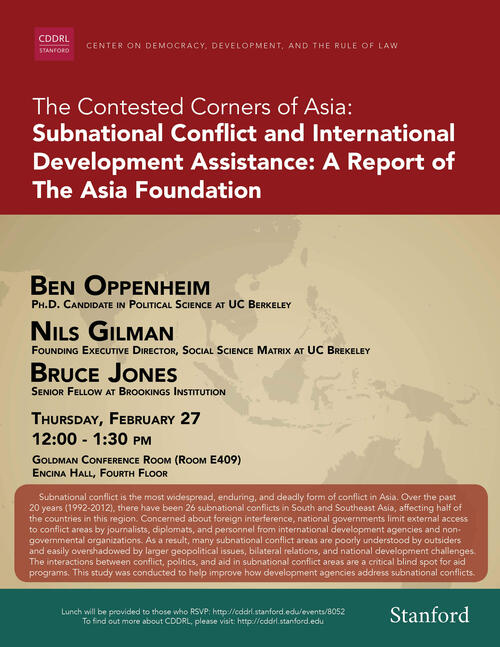
Subnational conflict is the most widespread, enduring, and deadly form of conflict in Asia. Over the past 20 years (1992-2012), there have been 26 subnational conflicts in South and Southeast Asia, affecting half of the countries in this region. Concerned about foreign interference, national governments limit external access to conflict areas by journalists, diplomats, and personnel from international development agencies and non-governmental organizations. As a result, many subnational conflict areas are poorly understood by outsiders and easily overshadowed by larger geopolitical issues, bilateral relations, and national development challenges. The interactions between conflict, politics, and aid in subnational conflict areas are a critical blind spot for aid programs. This study was conducted to help improve how development agencies address subnational conflicts.


Speaker Bios:

Ben Oppenheim is a Fellow (non-resident) at the Center on International Cooperation at New York University. His research spans a diverse set of topics, including fragile states, transnational threats (including pandemic disease risks and terrorism), and the strategic coherence and effectiveness of international assistance in fragile and conflict-affected areas.

Oppenheim has consulted for organizations including the World Bank, the United Nations, the Asia Foundation, the Institute for the Future, and the Fritz Institute, on issues including organizational learning, strategy, program design, foresight, and facilitation. In 2009, he served as Advisor to the first global congress on disarmament, demobilization, and reintegration, supported by the World Bank and the UN.

In 2013, Oppenheim was a visiting fellow at the Uppsala University Forum on Democracy, Peace, and Justice. His research has been supported by a Simpson Fellowship, and a fellowship with the Institute on Global Conflict and Cooperation. He was also a research fellow with UC Berkeley's Institute of International Studies, affiliated with the New Era Foreign Policy Project.


Nils Gilman is the Executive Director of Social Science Matrix. He holds a B.A., M.A. and Ph.D. in History from the University of California, Berkeley. Gilman’s first scholarly interest was in American and European intellectual history, with a particular focus on the institutional development of the social sciences, the lateral transfer and translation of ideas across disciplinary boundaries, and the impact of social scientific ideas on politics and policy.

Gilman is the author of Mandarins of the Future: Modernization Theory in Cold War America (Johns Hopkins University Press, 2004), the co-editor of Staging Growth: Modernization, Development, and the Global Cold War (University of Massachusetts Press, 2003) and Deviant Globalization: Black Market Economy in the 21st Century (Continuum Press, 2011), as well as the founding Co-editor of Humanity: An International Journal of Human Rights, Humanitarianism, and Development. He also blogs and tweets.

Prior to joining Social Science Matrix in September 2013, Gilman was research director at Monitor 360, a San Francisco consultancy that addresses complex, cross-disciplinary global strategic challenges for governments, multinational businesses, and NGOs. He has also worked at a variety of enterprise software companies, including Salesforce.com, BEA Systems, and Plumtree Software. Gilman has taught and lectured at a wide variety of venues, from the Harvard University, Columbia University, and National Defense University, to PopTech, the European Futurists Conference, and the Long Now Foundation.


Bruce Jones is a senior fellow and the director of the Project on International Order and Strategy in the Foreign Policy program at the Brookings Institution. He is also the director of the Center on International Cooperation at New York University.

Jones served as the senior external advisor for the World Bank’s 2011 World Development Report, Conflict, Security and Development, and in March 2010 was appointed by the United Nations secretary-general as a member of the senior advisory group to guide the Review of International Civilian Capacities. He is also consulting professor at the Center for International Security and Cooperation at Stanford University and professor (by courtesy) at New York University’s department of politics.

Jones holds a Ph.D. from the London School of Economics, and was Hamburg fellow in conflict prevention at Stanford University.

He is co-author with Carlos Pascual and Stephen Stedman of Power and Responsibility: Building International Order in an Era of Transnational Threats (Brookings Press, 2009); co-editor with Shepard Forman and Richard Gowan of Cooperating for Peace and Security (Cambridge University Press, 2009); and author of Peacemaking in Rwanda: The Dynamics of Failures(Lynne Reinner, 2001).

Jones served as senior advisor in the office of the secretary-general during the U.N. reform effort leading up to the World Summit 2005, and in the same period was acting secretary of the Secretary-General’s Policy Committee. In 2004-2005, he was deputy research director of the High-level Panel on Threats, Challenges and Change. From 2000-2002 he was special assistant to and acting chief of staff at the office of the U.N. special coordinator for the Middle East peace process. 

Richard and Rhoda Goldman Conference Room

Ben Oppenheim Ph.D. Candidate in Political Science Speaker UC Berkeley
Nils Gilman Founding Executive Director, Social Science Matrix Speaker UC Berkeley
Bruce Jones Senior Fellow Speaker Brookings Institution
Seminars
-

Philippines Conference Room

U.S.-Asia Technology Management Center
School of Engineering
Stanford, CA

(650) 724-0096 (650) 725-9974
0
Consulting Professor
richard-lg0001-200x300.jpg PhD

At Stanford University, Dr. Dasher has directed the US-Asia Technology Management Center since 1994, and he has been Executive Director of the Center for Integrated Systems since 1998. He holds Consulting Professor appointments at Stanford in the Departments of Electrical Engineering (technology management), Asian Languages and Cultures (Japanese business), and at the Asia-Pacific Research Center for his work with the Stanford Program on Regions of Innovation and Entrepreneurship. He is also faculty adviser to student-run organizations such as the Asia-Pacific Student Entrepreneurship Society and the Forum for American/Chinese Exchange at Stanford.

From 2004, Dr. Dasher became the first non-Japanese person ever asked to join the governance of a Japanese national university, serving a term as a Board Director (理事) of Tohoku University . He continued as a member of the Management Council (経営協議会) until March 2010, and he now serves as Senior Advisor to the President (総長顧問) of Tohoku University. Dr. Dasher has been a member of the high-profile Program Committee of the World Premier International Research Center Initiative (WPI) of the Japanese Ministry of Education (MEXT) since 2007. He has served on the Multidisciplinary Assessment Committee of the C$500 million Canada Foundation for Innovation Leading Edge Fund in 2007 and again in 2010, and as a member of the Phase I and Phase II Review Panels of the C$200 million Canada Excellence Research Chairs Program in 2008 and again in 2010. He was a distinguished reviewer of the Hong Kong S.A.R. study on innovation in 2008–09, and since 2007 he has been a member of the Foresight Panel of the German Ministry of Education and Research. From 2001–03, Dr. Dasher was on the International Planning Committee advising the Japanese Minister of State for Science and Technology Policy in regard to the formation of the Okinawa Institute of Science and Technology.

As allowed by Stanford policy, Dr. Dasher maintains an active management consulting practice, through which he is an advisor to start-up companies and large firms in the U.S., Japan, and China. He has been a board director of Tokyo-based ZyCube Inc. since 2006, and he is founder and chairman of Pearl Executive Shuttle in Valdosta, Georgia, U.S.A. In the non-profit sector, he is a Board Director of the Japan Society of Northern California and the Keizai Society U.S. – Japan Business Forum, and he is an advisor to organizations such as the Chinese Information and Networking Association, the Silicon Valley – China Wireless Technology Association, and the International Foundation for Entrepreneurship in Science and Technology (iFEST). In 2010 he served as a consultant to The Indus Entrepreneurs (TiE) in regard to their establishment of a worldwide remote mentoring program for entrepreneurs. Dr. Dasher frequently gives speeches and seminars throughout Japan and Asia, as well as in the U.S. Recent appearances include the Nikkei Shimbun Business Innovation Forum, the Foreign Correspondents Club of Japan, speaking tours of Japan co-sponsored by METI and the U.S. Embassy in Tokyo, and guest lectures at Chubu University, Kochi University of Technology, Ritsumeikan Asia Pacific University, and the University of Tokyo.

From 1990–93, Dr. Dasher was a board director of two privately-held Japanese companies in Tokyo, at which he developed new business in international licensing of media rights packages and other intellectual properties. From 1986–90, he was Director of the U.S. State Department’s Foreign Service Institute advanced field schools in Japan and Korea, which provide full-time language and area training to U.S. and select Commonwealth country diplomats assigned to those countries. He received M.A. and Ph.D. degrees in Linguistics from Stanford University and, along with Prof. Elizabeth Closs Traugott, he is co-author of the often-cited book Regularity in Semantic Change (Cambridge University Press, 2002). He received the Bachelor of Music degree in clarinet and orchestra conducting from the San Francisco Conservatory of Music, where he served on the faculty from 1978-85.

Richard Dasher Speaker
Seminars
-

Zainab Hawa Bangura of Sierra Leone is Special Representative on Sexual Violence in Conflict at the level of Under-Secretary-General at the United Nations.

Prior to this appointment, Ms. Bangura was the Minister of Health and Sanitation for the Government of Sierra Leone, and brings to the position over 20 years of policy, diplomatic and practical experience in the field of governance, conflict resolution and reconciliation in Africa. She was previously the second female Minister of Foreign Affairs and International Cooperation, including Chief Adviser and Spokesperson of the President on bilateral and international issues. Ms. Bangura has been instrumental in developing national programmes on affordable health, advocating for the elimination of genital mutilation, managing the country’s Peace Building Commission and contributing to the multilateral and bilateral relations with the international community. She is experienced in meeting with interlocutors in diverse situations, including rebel groups, and familiar in dealing with State and non-State actors relevant to issues of sexual violence while fighting corruption and impunity.

Ms. Bangura has on-the-ground experience with peacekeeping operations from within the United Nations Mission in Liberia (UNMIL), where she was responsible for the management of the largest civilian component of the Mission, including promoting capacity-building of government institutions and community reconciliation. She is an experienced results-driven civil society, human and women’s rights campaigner and democracy activist, notably as Executive Director of the National Accountability Groups, Chair and Co-founder of the Movement for Progress Party of Sierra Leone, as well as Coordinator and Co-founder of the Campaign for Good Governance.

Ms. Bangura is a former fellow of the Chartered Insurance Institute of London, possessing Diplomas in Insurance Management from the City University Business School of London and Nottingham University. She received her Bachelor of Arts from the Fourah Bay College, University of Sierra Leone.

Building 200 (History Corner)
Room 205
Stanford University

Zainab Bangura United Nations Special Representative on Sexual Violence in Conflict Speaker
Seminars
Subscribe to International Development