International Development

FSI researchers consider international development from a variety of angles. They analyze ideas such as how public action and good governance are cornerstones of economic prosperity in Mexico and how investments in high school education will improve China’s economy.

They are looking at novel technological interventions to improve rural livelihoods, like the development implications of solar power-generated crop growing in Northern Benin.

FSI academics also assess which political processes yield better access to public services, particularly in developing countries. With a focus on health care, researchers have studied the political incentives to embrace UNICEF’s child survival efforts and how a well-run anti-alcohol policy in Russia affected mortality rates.

FSI’s work on international development also includes training the next generation of leaders through pre- and post-doctoral fellowships as well as the Draper Hills Summer Fellows Program.

-

This study analyzes the effects of Indonesia's conditional cash transfer program on the local health care market in terms of price, utilization, and quality of care. The CCT program is associated with increased delivery fees and increased utilization of prenatal care and trained attendants for delivery assistance. Consequently, program participants experience improvements in prenatal care quality. 

Margaret Triyana is the Asia Health Policy Post-doctoral fellow. Her main interests are inequality and human capital investments, particularly early health investments in developing countries.

Philippines Conference Room
Encina Hall 3rd Floor Central
616 Serra Street,
Stanford University

Shorenstein APARC
Encina Hall C331
616 Serra Street
Stanford, CA 94305-6055

(650) 724-5656 (650) 723-6530
0
2013-2014 Asia Health Policy Postdoctoral Fellow
triyana_photo.jpg PhD

Margaret (Maggie) Triyana’s main research interests are inequality and human capital investments in developing countries. In particular, she is interested in the effects social policy changes on children’s health outcomes. As a Postdoctoral Fellow, she will analyze the effects of rural-urban migration in Indonesia and China, as well as the impact of health insurance expansion in Indonesia and Vietnam.

Triyana received a PhD in Public Policy from the University of Chicago in 2013.


Working Papers

“Do Health Care Providers Respond to Demand-Side Incentives? Evidence from Indonesia“

“The Effects of Community and Household Interventions on Birth Outcomes: Evidence from Indonesia”

“The Longer Term Effects of the ‘Midwife in the Village’ Program in Indonesia”

“The Sources of Wage Growth in a Developing Country” (with Ioana Marinescu)

Margaret Triyana Postdoctoral Fellow in Asia Health Policy Speaker Stanford University
Seminars
Authors
News Type
News
Date
Paragraphs

Eyeglasses boosted the standardized test scores of rural Chinese schoolchildren as much as 18 percent in just six months, according to a large-scale, ongoing study led by Stanford researchers.

"The evidence is overwhelming," said Scott Rozelle, co-director of the Rural Education Action Program (REAP), a coalition of Chinese universities and Stanford's Freeman Spogli Institute for International Studies that works to improve education and health in rural China.

The initial test scores for nearsighted students hovered around 68 percent. After receiving glasses, average scores soared to 86 percent. "You do these simple interventions and a child's whole life changes," Rozelle said. "It's fantastic."

REAP scholars partnered with Chinese ophthalmologists and scores of graduate students to orchestrate the massive project, the first to examine vision problems in rural China.

In 2012 and 2013, the team screened the vision of approximately 20,000 fourth and fifth graders in rural Shaanxi and Gansu provinces and doled out more than 4,000 pairs of eyeglasses. They discovered that 25 percent of the students were nearsighted, but only one in seven of those nearsighted students had the glasses they needed.

"There's a huge amount of unmet need," said Matthew Boswell, a REAP project manager based at Stanford.

The results may seem intuitive. Yet, helping the millions of nearsighted children in rural China is anything but easy, the REAP team discovered. Few of these rural children (and adults) know they are nearsighted – the world, to them, is naturally blurry. In addition, eye doctors are concentrated in the populous coastal corridors or regional "county towns," often dozens of miles by bus from the homes of rural Chinese families, Boswell said.

Basic eyeglasses cost between 200 and 500 yuan ($30 to $80), a price out of reach for many, he said.

The researchers also struggled to counter pervasive superstitions about eyeglasses.

For example, many rural Chinese residents believe that glasses make children's' vision deteriorate, relying on the observation that vision generally worsens with age, Boswell said. In addition, many Chinese do "eye exercises" by rubbing their eyes, cheeks and temples each morning, a practice they believe improves vision, he said.

They also face political struggles: China's rural health care program doesn't pay for vision care. "We could tell health or education officials until we were blue in the face there was a high level of need for vision care in rural communities," Boswell said. "But if your findings are not attached to something they care about, it's hard to make them listen."

Hence the connection to the test scores, a highly valued measurement by Chinese policymakers. The REAP team taps its large network of Chinese academic collaborators to translate its research results into policy reform, a process that is often successful, Rozelle said.

REAP is currently analyzing alternative ways to boost the delivery and acceptance of eye care, Boswell said. The original study assigned nearsighted students into six groups.  Researchers gave one-third of the students glasses; one-third received a voucher to purchase glasses; and another third remained untreated. Then, half of the students in each group received training about the causes and treatments for vision problems.

The training failed to significantly affect whether students wore the glasses, Boswell said.  The students who had to invest time to acquire glasses using a voucher demonstrated similar usage rates as students who received free glasses, he said.

Among a variety of other initiatives currently underway, the REAP team is training Chinese teachers to conduct simple vision tests, Boswell said.

"It's an extreme feel–good example," Rozelle said. "You put the first pair of glasses on a kid … and then a huge smile lights up their face."

Becky Bach is a writer for the Stanford News Service.

Hero Image
Glasses logo
All News button
1
-

This project focuses on intestinal roundworms, a neglected disease in China.  These infections may have a devastating effect on a population, siphoning valuable nutrients away from the host, leading to malnutrition, stunted growth and poorer school performance. In the study, the researchers aim to contribute to the literature by conducting a Randomized Controlled Trial (RCT) in rural China to measure the impact of worm infection on school children.

CISAC Conference Room

Encina Hall East, E404
Stanford, CA 94305-6055

0
Faculty Co-director of the Stanford Center on China's Economy and Institutions
Helen F. Farnsworth Endowed Professorship
Senior Fellow at the Freeman Spogli Institute for International Studies
Senior Fellow at the Stanford Institute for Economic Policy Research
scott_rozelle_new_headshot.jpeg PhD

Scott Rozelle is the Helen F. Farnsworth Senior Fellow and the co-director of Stanford Center on China's Economy and Institutions in the Freeman Spogli Institute for International Studies and Stanford Institute for Economic Policy Research at Stanford University. He received his BS from the University of California, Berkeley, and his MS and PhD from Cornell University. Previously, Rozelle was a professor at the University of California, Davis and an assistant professor in Stanford’s Food Research Institute and department of economics. He currently is a member of several organizations, including the American Economics Association, the International Association for Agricultural Economists, and the Association for Asian Studies. Rozelle also serves on the editorial boards of Economic Development and Cultural Change, Agricultural Economics, the Australian Journal of Agricultural and Resource Economics, and the China Economic Review.

His research focuses almost exclusively on China and is concerned with: agricultural policy, including the supply, demand, and trade in agricultural projects; the emergence and evolution of markets and other economic institutions in the transition process and their implications for equity and efficiency; and the economics of poverty and inequality, with an emphasis on rural education, health and nutrition.

Rozelle's papers have been published in top academic journals, including Science, Nature, American Economic Review, and the Journal of Economic Literature. His book, Invisible China: How the Urban-Rural Divide Threatens China’s Rise, was published in 2020 by The University of Chicago Press. He is fluent in Chinese and has established a research program in which he has close working ties with several Chinese collaborators and policymakers. For the past 20 years, Rozelle has been the chair of the International Advisory Board of the Center for Chinese Agricultural Policy; a co-director of the University of California's Agricultural Issues Center; and a member of Stanford's Walter H. Shorenstein Asia-Pacific Research Center and the Center on Food Security and the Environment.

In recognition of his outstanding achievements, Rozelle has received numerous honors and awards, including the Friendship Award in 2008, the highest award given to a non-Chinese by the Premier; and the National Science and Technology Collaboration Award in 2009 for scientific achievement in collaborative research.

Faculty affiliate at the Center on Democracy, Development, and the Rule of Law
Faculty Affiliate at the Walter H. Shorenstein Asia-Pacific Research Center
Date Label
Scott Rozelle Senior Fellow Speaker
Scott Smith Adjunct Assistant Professor Speaker
Seminars
-


*This event is free and open to the public.*


Image

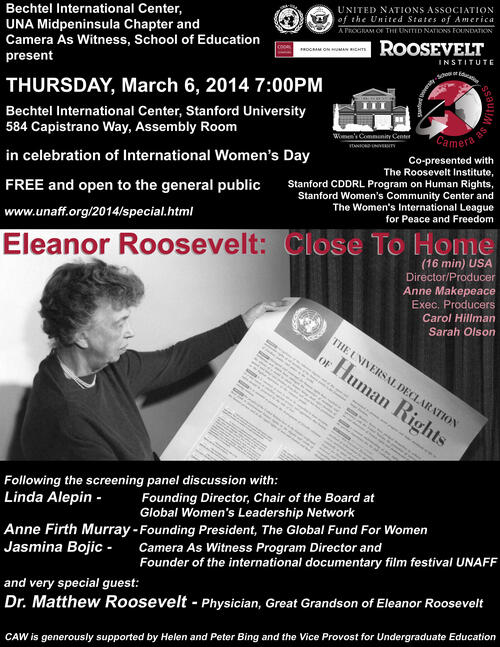
Eleanor Roosevelt: Close to Home is an overview of the inspirational life of Eleanor Roosevelt and highlights her dedication as champion of social justice and racial equality. The film introduces viewers to Val-Kill, the home of this extraordinary American who became a world leader in human rights and creator of the Universal Declaration of Human Rights. The remarkable modesty, independence and humanitarian leadership that made Eleanor Roosevelt the "First Lady of the World" are reflected in the Cottage's rooms, furnishings and surroundings. No other place allows visitors to connect with, rediscover and appreciate anew this woman whose influence is still so widely felt.

Following the screening, there will be a panel discussion.

This event is co-presented with the CDDRL Program on Human Rights, Roosevelt Institute, Stanford Women's Community Center and Women's International League for Peace and Freedom and sponsored by the Bechtel International Center, UNA Midpeninsula Chapter and Camera As Witness, Stanford Graduate School of Education in celebration of International Women's Day. 

Bechtel International Center
Assembly Room
Stanford University
584 Capistrano Way

Linda Alepin Founding Director, Chair of the Board Speaker Global Women's Leadership Network
Anne Firth Murray Founding President Speaker The Global Fund For Women
Jasmina Bojic Camera As Witness Program Director and Founder of the international documentary film festival UNAFF Speaker
Dr. Matthew Roosevelt Physician Speaker Great Grandson of Eleanor Roosevelt
Conferences
-

About the topic: Products developed using recombinant DNA methods account for over $300 billion in annual U.S. domestic revenues, underlying a so-called “bioeconomy” that has grown 10-15% annually since the invention of genetic engineering ~40 years ago. Yet most of biotechnology has not been imagined let alone made true.  I will review the last decade of work to make biology easier to engineer, from basic science to applied tools.  Particular attention will be given to two underlying trends that are having policy impacts beyond research labs: (i) interconversion of physical genetic material and digital sequence information via advancing DNA sequence and synthesis tools, (ii) coordination of labor across time and place via technical standards supporting composition, measurement, and data exchange.

About the speaker: Drew works on “synthetic biology.”  His group invented genome refactoring to both study and extend the utility of bacteriophage.  His team also realized non-volatile chromosomal digital data storage, amplifying genetic logic gates, and cell-cell communication via engineered DNA messaging.  He led the BIOFAB team that engineered a professional collection of reliably reusable standard biological parts and started the BioBricks Foundation (BBF) as a charity supporting development of a free-to-use language for programming life to benefit all people and the planet.  In 2013 Drew was recognized by the White House for the BBF’s contributions to “open science” and received the Seymour Benzer lectureship from the US NAS. 

CISAC Conference Room

Drew Endy Assistant Professor of Bioengineering; CISAC Affiliated Faculty Member Speaker
Seminars
-

SCID and SCP present a special seminar with Professor Xiaonian Xu

The Chinese economy has grown so fast and for so long. But the “miracle” has started fading in recent years.  Why?  Prof. Xu argues that the reform era can be divided into two fundamentally different phases.  Phase I, from 1978 to the mid-1990s, is characterized by market-oriented reforms, whereas Phase II, from the mid-1990s onward, is dominated by government-led investment and interventions. Though China’s growth performance looks identical in numbers over the two phases, the source of growth has changed from efficiency gains to increased use of resources. Phase II growth is thus unsustainable, and worse, it has brought about structural distortions that severely undermine the economy’s growth potential. To maintain growth even at a moderate level, China needs to go beyond what the leadership has promised and planned.

Dr. Xiaonian Xu is Professor of Economics and Finance at CEIBS. He worked for China International Capital Corporation Limited (CICC) since 1999 as Managing Director and Head of Research. The research team under Dr. Xu was ranked No. 1 in 2002 among domestic brokerage firms by Chinese institutional investors. And Dr. Xu himself was voted in the same survey as the best in economics research. Prior to CICC, Dr. Xu was Senior Economist with Merrill Lynch Asia Pacific based in Hong Kong from 1997 to 1998. He worked as a consultant of the World Bank in Washington DC in 1996. Dr. Xu was appointed Assistant Professor of Amherst College, Massachusetts, from 1991 to 1995, teaching Economics and Financial Markets. He was employed by the State Development Research Center of China as a research fellow from 1981 to 1985.
 
Dr. Xu obtained Ph.D. in Economics, University of California, Davis, in 1991, and MA in Industrial Economics in 1981 from People's University of China . He received Sun Yefang Economics Prize in 1996, the highest Chinese award in the field, for his research on China 's capital markets. His research interests include: Macroeconomics, Finance, Financial Institutions and Financial Markets, Transitional Economies, and China 's Economic Reform. Dr. Xu is the recipient of the 2005 and 2006 CEIBS Teaching Excellence Award. Dr. Xu received the prestigious CEIBS Medal for Teaching Excellence in 2010. 

Philippines Conference Room

Xiaonian Xu Professor of Economics and Finance Speaker CEIBS
Seminars
-

Due to venue capacity,

RSVP's for this event have been closed. 

See the livestream here


Image


This event is co-sponsored with

The Stanford Institute

for Economic Policy Research


Doors open at 11:30a.m.

Complimentary valet parking available


For security reasons:
   ~No backpacks or oversized purses will be allowed
   ~All persons subject to search
   ~No food or beverages allowed inside the room

   ~RSVPs for this event are required and will be strictly enforced at check-in


Born in Paris in 1956, Christine Lagarde completed high school in Le Havre and attended Holton Arms School in Bethesda (Maryland, USA). She then graduated from law school at University Paris X, and obtained a Master’s degree from the Political Science Institute in Aix en Provence.

After being admitted as a lawyer to the Paris Bar, Christine Lagarde joined the international law firm of Baker & McKenzie as an associate, specializing in Labor, Anti-trust, and Mergers & Acquisitions. A member of the Executive Committee of the Firm in 1995, Christine Lagarde became the Chairman of the Global Executive Committee of Baker & McKenzie in 1999, and subsequently Chairman of the Global Strategic Committee in 2004.

Christine Lagarde joined the French government in June 2005 as Minister for Foreign Trade. After a brief stint as Minister for Agriculture and Fisheries, in June 2007 she became the first woman to hold the post of Finance and Economy Minister of a G-7 country. From July to December 2008, she also chaired the ECOFIN Council, which brings together Economics and Finance Ministers of the European Union.

As a member of the G-20, Christine Lagarde was involved in the Group's management of the financial crisis, helping to foster international policies related to financial supervision and regulation and to strengthen global economic governance. As Chairman of the G-20 when France took over its presidency for the year 2011, she launched a wide-ranging work agenda on the reform of the international monetary system.

In July 2011, Christine Lagarde became the eleventh Managing Director of the IMF, and the first woman to hold that position.

Christine Lagarde was named Officier in the Légion d'honneur in April 2012. A former member of the French national team for synchronized swimming, Christine Lagarde is the mother of two sons.

Bechtel Conference Center

Christine Lagarde Managing Director Speaker International Monetary Fund
Seminars
Subscribe to International Development