Foreign Policy
Paragraphs

This volume collects 22 articles by Masahiko Aoki, selected from writings published over the course of his 45-year academic career. These fascinating essays cover a range of issues, including mechanism design, comparative governance, corporate governance, institutions and institutional change, but are tied together by a focus on East Asia and a comparative institutional framework.

Specific topics include the early stages of mechanism design theory, comparative analysis of vertical, horizontal and modular industrial coordination and its applications, cooperative game-theoretic approaches to the diversity of corporate government structure, the endogenous nature of institutions, and comparative and historical analysis of institutions in Japan, China and Korea.

Students, professors and scholars with an interest in comparative institutional studies and East Asian studies will find this book a useful and illuminating resource.

All Publications button
1
Publication Type
Books
Publication Date
Journal Publisher
Edward Elgar Pub
Authors
Masahiko Aoki
Number
978 1 78254 839 3
Paragraphs
Image
AsiaMiddlePowersCover front

South Korea and Vietnam established diplomatic relations only twenty years ago. Today these former adversaries enjoy unexpectedly cordial and rapidly expanding bilateral ties. Leaders of the two nations—perceiving broadly shared interests and no fundamental conflicts—seek to leverage their subregional influence on behalf of common or complementary policy goals. Today they often profess a “middle power” identity as they explain their foreign policy in terms of such classical middle power goals as regional peace, integration, and common goods.

Broadly similar in many respects, South Korea and Vietnam are nonetheless sufficiently different that a comparison can yield interesting insights—yet there is a dearth of systematic comparative work on the two. While holding a range of views on the contentious concepts of middle power and national identity, the contributors to Asia’s Middle Powers? help readers, both academic and policy practitioners, to gain an enhanced appreciation of South Korea and Vietnam’s regional behavior and international strategies

The publication of Asia's Middle Powers was made possible by the generosity of the Koret Foundation of San Francisco, CA.

Desk, examination, or review copies can be requested through Stanford University Press.


All Publications button
1
Publication Type
Books
Publication Date
Subtitle

The Identity and Regional Policy of South Korea and Vietnam

Authors
Joon-woo Park
Gi-Wook Shin
Don Keyser
Book Publisher
Shorenstein APARC
-

Image


Abstract:

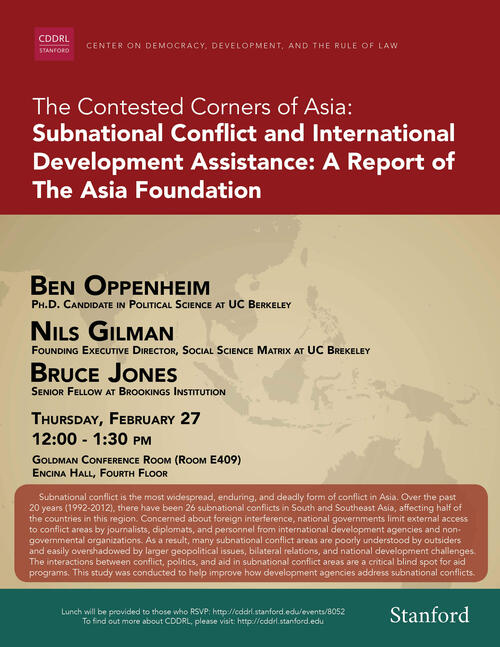
Subnational conflict is the most widespread, enduring, and deadly form of conflict in Asia. Over the past 20 years (1992-2012), there have been 26 subnational conflicts in South and Southeast Asia, affecting half of the countries in this region. Concerned about foreign interference, national governments limit external access to conflict areas by journalists, diplomats, and personnel from international development agencies and non-governmental organizations. As a result, many subnational conflict areas are poorly understood by outsiders and easily overshadowed by larger geopolitical issues, bilateral relations, and national development challenges. The interactions between conflict, politics, and aid in subnational conflict areas are a critical blind spot for aid programs. This study was conducted to help improve how development agencies address subnational conflicts.


Speaker Bios:

Ben Oppenheim is a Fellow (non-resident) at the Center on International Cooperation at New York University. His research spans a diverse set of topics, including fragile states, transnational threats (including pandemic disease risks and terrorism), and the strategic coherence and effectiveness of international assistance in fragile and conflict-affected areas.

Oppenheim has consulted for organizations including the World Bank, the United Nations, the Asia Foundation, the Institute for the Future, and the Fritz Institute, on issues including organizational learning, strategy, program design, foresight, and facilitation. In 2009, he served as Advisor to the first global congress on disarmament, demobilization, and reintegration, supported by the World Bank and the UN.

In 2013, Oppenheim was a visiting fellow at the Uppsala University Forum on Democracy, Peace, and Justice. His research has been supported by a Simpson Fellowship, and a fellowship with the Institute on Global Conflict and Cooperation. He was also a research fellow with UC Berkeley's Institute of International Studies, affiliated with the New Era Foreign Policy Project.


Nils Gilman is the Executive Director of Social Science Matrix. He holds a B.A., M.A. and Ph.D. in History from the University of California, Berkeley. Gilman’s first scholarly interest was in American and European intellectual history, with a particular focus on the institutional development of the social sciences, the lateral transfer and translation of ideas across disciplinary boundaries, and the impact of social scientific ideas on politics and policy.

Gilman is the author of Mandarins of the Future: Modernization Theory in Cold War America (Johns Hopkins University Press, 2004), the co-editor of Staging Growth: Modernization, Development, and the Global Cold War (University of Massachusetts Press, 2003) and Deviant Globalization: Black Market Economy in the 21st Century (Continuum Press, 2011), as well as the founding Co-editor of Humanity: An International Journal of Human Rights, Humanitarianism, and Development. He also blogs and tweets.

Prior to joining Social Science Matrix in September 2013, Gilman was research director at Monitor 360, a San Francisco consultancy that addresses complex, cross-disciplinary global strategic challenges for governments, multinational businesses, and NGOs. He has also worked at a variety of enterprise software companies, including Salesforce.com, BEA Systems, and Plumtree Software. Gilman has taught and lectured at a wide variety of venues, from the Harvard University, Columbia University, and National Defense University, to PopTech, the European Futurists Conference, and the Long Now Foundation.


Bruce Jones is a senior fellow and the director of the Project on International Order and Strategy in the Foreign Policy program at the Brookings Institution. He is also the director of the Center on International Cooperation at New York University.

Jones served as the senior external advisor for the World Bank’s 2011 World Development Report, Conflict, Security and Development, and in March 2010 was appointed by the United Nations secretary-general as a member of the senior advisory group to guide the Review of International Civilian Capacities. He is also consulting professor at the Center for International Security and Cooperation at Stanford University and professor (by courtesy) at New York University’s department of politics.

Jones holds a Ph.D. from the London School of Economics, and was Hamburg fellow in conflict prevention at Stanford University.

He is co-author with Carlos Pascual and Stephen Stedman of Power and Responsibility: Building International Order in an Era of Transnational Threats (Brookings Press, 2009); co-editor with Shepard Forman and Richard Gowan of Cooperating for Peace and Security (Cambridge University Press, 2009); and author of Peacemaking in Rwanda: The Dynamics of Failures(Lynne Reinner, 2001).

Jones served as senior advisor in the office of the secretary-general during the U.N. reform effort leading up to the World Summit 2005, and in the same period was acting secretary of the Secretary-General’s Policy Committee. In 2004-2005, he was deputy research director of the High-level Panel on Threats, Challenges and Change. From 2000-2002 he was special assistant to and acting chief of staff at the office of the U.N. special coordinator for the Middle East peace process. 

Richard and Rhoda Goldman Conference Room

Ben Oppenheim Ph.D. Candidate in Political Science Speaker UC Berkeley
Nils Gilman Founding Executive Director, Social Science Matrix Speaker UC Berkeley
Bruce Jones Senior Fellow Speaker Brookings Institution
Seminars
Paragraphs

Karl Eikenberry, former ambassador to Afghanistan and retired U.S. Army Lieutenant General, argues that although successful, the American All-Volunteer Force has developed liabilities due to weak political oversight and internal accountability of its senior leadership. These liabilities ultimately weaken the insitution by making the U.S. military the go-to solution for foreign policy problems and insulating defense spending and preventing economically sustainable cuts to the military. Additionally, elilminating mandatory military service has also weakened American civic virtue by pushing civic responsiblities on others. All these liabilities warrant a critical look. 

All Publications button
1
Publication Type
Journal Articles
Publication Date
Journal Publisher
The Washington Quarterly, Winter 2013
Authors
-

Hon.Agnes Binagwaho has served as Permanent Secretary of the Ministry of Health in Rwanda since October 2008. She specialized in emergency pediatrics, neonatology, and the treatment of HIV/AIDS; and she chairs the Rwandan Pediatric Society. From 1986 to 2002, she practiced medicine in public hospitals in Rwanda and several other countries before joining Rwanda's National AIDS Control Commission as Executive Secretary. She is a member of the Editorial Board of Public Library of Science, and the Harvard University Health and Human Rights Journal. Dr. Binagwaho co‐chaired the Millennium Development Goal Project Task Force on HIV/AIDS and Access to Essential Medicines for the Secretary‐General of the United Nations under the leadership of Professor Jeffrey Sachs. She was the global co‐chair of the Joint Learning Initiative on Children and HIV/AIDS. In addition to her medical degree and Master in Peadiatry, she received an Honorary Doctor of Sciences from Dartmouth College. Dr. Binagwaho serves as a visiting lecturer in the Department of Global Health and Social Medicine of Harvard Medical School.

Building 200 (History Corner)
Room 205
Stanford University

Hon. Agnes Binagwaho Minister of Health Speaker Rwanda
Seminars
-

Abstract
Preventing tobacco addiction is one of the leading ways to prevent fatal disease, yet many nations have declined to take steps against it. In recent years an international legal effort has begun to fill this void. In this lecture Professor Koh, formerly Legal Adviser of the U.S. State Department, will review the various dimensions of the legal campaign that is now underway.

Harold Hongju Koh is Sterling Professor of International Law at Yale Law School. He returned to Yale Law School in January 2013 after serving for nearly four years as the 22nd Legal Adviser of the U.S. Department of State.

Professor Koh is one of the country’s leading experts in public and private international law, national security law, and human rights. He first began teaching at Yale Law School in 1985 and served as its fifteenth Dean from 2004 until 2009. From 2009 to 2013, he took leave as the Martin R. Flug ’55 Professor of International Law to join the State Department as Legal Adviser, service for which he received the Secretary of State's Distinguished Service Award. From 1993 to 2009, he was the Gerard C. & Bernice Latrobe Smith Professor of International Law at Yale Law School, and from 1998 to 2001, he served as U.S. Assistant Secretary of State for Democracy, Human Rights and Labor.

Building 200 (History Corner)
Room 205
Stanford University

Harold Hongju Koh Sterling Professor of International Law Speaker Yale Law School
Seminars
-

Speaker bio:

Karl Eikenberry is the William J. Perry Fellow in International Security at the Center for International Security and Cooperation and a faculty member of the Shorenstein Asia-Pacific Research Center at Stanford University.  He is also an affiliated faculty member with the Center for Democracy, Development, and Rule of Law, and researcher with The Europe Center.

Prior to his arrival at Stanford, he served as the U.S. Ambassador to Afghanistan from May 2009 until July 2011, where he led the civilian surge directed by President Obama to reverse insurgent momentum and set the conditions for transition to full Afghan sovereignty.

Before appointment as Chief of Mission in Kabul, Ambassador Eikenberry had a thirty-five year career in the United States Army, retiring in April 2009 with the rank of Lieutenant General.  His military operational posts included commander and staff officer with mechanized, light, airborne, and ranger infantry units in the continental U.S., Hawaii, Korea, Italy, and Afghanistan as the Commander of the American-led Coalition forces from 2005-2007. 

He has served in various policy and political-military positions, including Deputy Chairman of the North Atlantic Treaty Organization (NATO) Military Committee in Brussels, Belgium; Director for Strategic Planning and Policy for U.S. Pacific Command at Camp Smith, Hawaii; U.S. Security Coordinator and Chief of the Office of Military Cooperation in Kabul, Afghanistan; Assistant Army and later Defense Attaché at the United States Embassy in Beijing, China; Senior Country Director for China, Taiwan, Hong Kong and Mongolia in the Office of the Secretary of Defense; and Deputy Director for Strategy, Plans, and Policy on the Army Staff.

He is a graduate of the U.S. Military Academy, has master’s degrees from Harvard University in East Asian Studies and Stanford University in Political Science, and was a National Security Fellow at the Kennedy School of Government at Harvard.

Ambassador Eikenberry earned an Interpreter’s Certificate in Mandarin Chinese from the British Foreign Commonwealth Office while studying at the United Kingdom Ministry of Defense Chinese Language School in Hong Kong and has an Advanced Degree in Chinese History from Nanjing University in the People’s Republic of China. 

His military awards include the Defense Distinguished and Superior Service Medals, Legion of Merit, Bronze Star, Ranger Tab, Combat and Expert Infantryman badges, and master parachutist wings.  He has received the Department of State Distinguished, Superior, and Meritorious Honor Awards, Director of Central Intelligence Award, and Chairman of the Joint Chiefs of Staff Joint Distinguished Civilian Service Award.  He is also the recipient of the George F. Kennan Award for Distinguished Public Service and Harvard University Graduate School of Arts and Sciences Centennial Medal.  His foreign and international decorations include the Canadian Meritorious Service Cross, French Legion of Honor, Afghanistan’s Ghazi Amir Amanullah Khan and Akbar Khan Medals, and the NATO Meritorious Service Medal.

Ambassador Eikenberry serves as a Trustee for the International Institute for Strategic Studies, The Asia Foundation, and the National Committee on American Foreign Policy, and is a Fellow of the American Academy of Arts and Sciences.  He is a member of the Council on Foreign Relations, the American Academy of Diplomacy, and the Council of American Ambassadors, and was previously the President of the Foreign Area Officers Association.  His articles and essays on U.S. and international security issues have appeared in Foreign Affairs, The Washington Quarterly, American Foreign Policy Interests, The New York TimesThe Washington Post, Foreign Policy, and The Financial Times.  He has a commercial pilot’s license and instrument rating, and also enjoys sailing and scuba diving.

Reuben W. Hills Conference Room

Karl Eikenberry William J. Perry Fellow in International Security at CISAC, CDDRL, TEC, and Shorenstein APARC Distinguished Fellow; and Former U.S. Ambassador to Afghanistan and Retired U.S. Army Lt. General Speaker FSI
Seminars
-

Speaker bio:

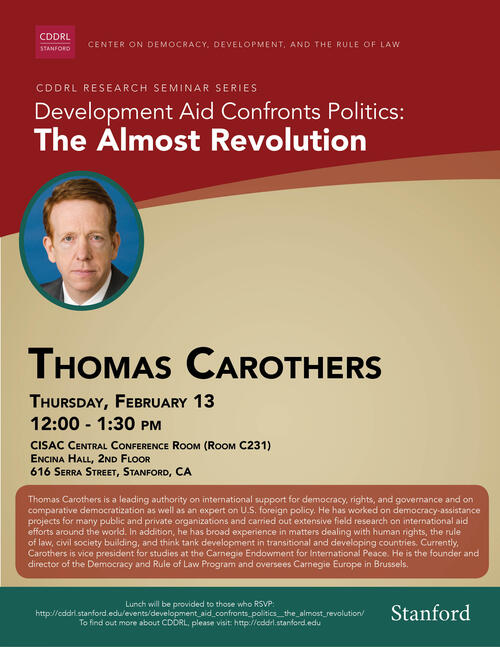
Thomas Carothers is vice president for studies at the Carnegie Endowment for International Peace. He is the founder and director of the Democracy and Rule of Law Program and oversees Carnegie Europe in Brussels.

Carothers is a leading authority on international support for democracy, rights, and governance and on comparative democratization as well as an expert on U.S. foreign policy. He has worked on democracy-assistance projects for many public and private organizations and carried out extensive field research on international aid efforts around the world. In addition, he has broad experience in matters dealing with human rights, the rule of law, civil society building, and think tank development in transitional and developing countries.

He is the author of six critically acclaimed books as well as many articles in prominent journals and newspapers. Carothers has also worked extensively with the Open Society Foundations (OSF), including currently as chair of the OSF Think Tank Fund and previously as chair of the OSF Global Advisory Board. He is an adjunct professor at the Central European University in Budapest and was previously a visiting faculty member at Nuffield College, Oxford University, and Johns Hopkins SAIS.

Prior to joining the Endowment, Carothers practiced international and financial law at Arnold & Porter and served as an attorney adviser in the Office of the Legal Adviser of the U.S. Department of State.

Carothers is the co-author (with Diane de Gramont) of Development Aid Confronts Politics: The Almost Revolution (Carnegie, 2013) and author of Confronting the Weakest Link: Aiding Political Parties in New Democracies (Carnegie, 2006); Promoting the Rule of Law Abroad: In Search of Knowledge (Carnegie, 2006); Uncharted Journey: Promoting Democracy in the Middle East, co-edited with Marina Ottaway (Carnegie, 2005); Critical Mission: Essays on Democracy Promotion (Carnegie, 2004); Funding Virtue: Civil Society Aid and Democracy Promotion, co-edited with Marina Ottaway (Carnegie, 2000); Aiding Democracy Abroad: The Learning Curve (Carnegie, 1999); and Assessing Democracy Assistance: The Case of Romania (Carnegie, 1996).

Image

CISAC Conference Room

Thomas Carothers Vice President for Studies Speaker Carnegie Endownment for International Peace
Seminars
Subscribe to Foreign Policy