Foreign Policy
-

President Xi Jinping is scheduled to pay a state visit to Japan this spring. How have the relations between Japan and China been evolving during the last several years? How has the U.S.-China “trade war” been affecting the Japan-China relations? What is the best way for us to address China’s trade issues? The U.S. and Japan have been promoting cooperation under the Free and Open Indo Pacific (FOIP). Will Japan cooperate with China’s Belt and Road Initiative? How can the U.S. and Japan expand the cooperation under the FOIP?

Image
shitaka headshot

Speaker:

Noriyuki Shikata, Former Envoy Extraordinary and Minister Plenipotentiary, Deputy Chief of Mission, Embassy of Japan in Beijing

Bio:

Noriyuki Shikata holds a B.A. in Law from Kyoto University and Master of Public Policy (MPP) from Harvard Kennedy School of Government. Most recently, he was the Envoy Extraordinary and Minister Plenipotentiary, Deputy Chief of Mission, Embassy of Japan in China. His other prior positions include: Deputy Director General, Asian and Oceanian Affairs Bureau; Director, Economic Treaties Division, International Legal Affairs Bureau; and Director, Second North America Division, North America Bureau. Mr. Shikata has also been a Visiting Professor at Kyoto University’s Graduate School of Law/Public Policy. He is currently at Harvard conducting research on an emerging U.S. policy toward China and the Indo-Pacific region. His Twitter handle is: @norishikata.

Noriyuki Shikata, Former Envoy Extraordinary and Minister Plenipotentiary, Deputy Chief of Mission, Embassy of Japan in Beijing
Seminars
News Type
Commentary
Date
Paragraphs

In a recent interview with People's Daily Online, APARC Fellow Thomas Fingar reflects on some of the milestones in the developing and diversifying relationship between the United States and China over the past forty years. The interview is part of a series of short documentaries produced by People's Daily Online West USA to commemorate the 40th anniversary of the establishment of formal diplomatic relations between the United States and China in 1979. The series was premiered at the San Francisco Public Library on January 18, 2020.

"So much of my career has been devoted to this relationship, [to] making this relationship work," says Fingar. He recounts how his own interest in China was sparked as a student in an anthropology class, where he began trying to understand why China and the United States "did things differently."

That initial question led him to a lifetime of building connections between the two countries, both in academia and government. Fingar was instrumental in launching Stanford's U.S.-China Relations Program in 1975, which promoted the exchange of learning, technology, and training between U.S. academics and students and their Chinese counterparts.

The focus on promoting U.S.-China engagement continues to inform Fingar’s perspectives today. "I'm concerned about the relationship [between the U.S. and China], but I'm not worried about it. I'm confident that both sides understand the stakes, [and] both sides understand the pressures to make this work".

Watch the interview below:


Hero Image
Thomas Fingar in a People's Daily documentary
All News button
1
Authors
News Type
Commentary
Date
Paragraphs

Speaking on Monday about Donald Trump’s impeachment trial, Ukraine’s foreign minister said “please don’t drag us into your [America’s] internal political processes.”  Unfortunately, Republicans appear intent on doing precisely that, as they repeat the false Russian claim that the Ukrainian government interfered in the 2016 US election.

Republicans see this as part of their effort to defend President Trump. In doing so, they put at risk America’s long-standing support for its Ukrainian partner.

The US government and large bipartisan majorities in Congress have backed Ukraine since the early 1990s, when it regained independence following the Soviet Union’s collapse. By the end of the decade, Congressionally-approved assistance for Ukraine had reached USD 300-400 million per year.

When Ukrainians took to the streets in the 2004 Orange Revolution and the 2013-2014 Revolution of Dignity, their striving for democracy won interest and support from both sides of the aisle on Capitol Hill.

Such Congressional support offered Kyiv grounds for comfort when Trump became president in 2017. Candidate Trump had suggested he might recognize the illegal 2014 annexation of Crimea by Russia. He also questioned the sanctions imposed on Moscow for its seizure of Crimea and subsequent aggression in eastern Ukraine.

Despite Trump’s apparent skepticism about Ukraine and his reluctance to criticize Vladimir Putin (or Russian actions), Congress continued to back Ukraine. It regularly voted by wide margins to approve funding for reform and military assistance for Kyiv while pressing the administration to bolster sanctions on Russia.

Things took a turn last September with the revelation of Trump’s effort to extort Ukraine’s president into investigating his possible 2020 political opponent by withholding an Oval Office visit and military assistance. The president’s alleged abuse of power led to his impeachment by the House of Representatives in December.

I visited Kyiv in late October during the period between the private depositions of US officials about Trump’s actions and the public House hearings. While in Kyiv, I spoke with a number of Ukrainians including senior officials. Developments in Washington make them nervous about the depth and resilience of US support, especially as Kyiv sees the United States as the only geopolitical counterweight to its aggressive Russian neighbor.

I tried to assure my Ukrainian interlocutors that, whatever President Trump did, they had an ace in the hole: the bipartisan support their country enjoyed from both Democrats and Republicans in Congress. This was support that, if necessary, would produce veto-proof votes to aid Ukraine. Today, I am not so sure.

It has long been clear that Trump buys Moscow’s disinformation line that Ukraine, not Russia, interfered in the 2016 US election. It is true that individual Ukrainian officials criticized candidate Trump, just as officials from many European countries did. But it was Russian intelligence agencies, with Putin’s approval, that hacked the Democratic National Committee’s e-mails and gave them to Wikileaks. It is Russia’s Internet Research Agency that used social media to sow division among Americans.

However, in November and December as they sought to defend Trump against impeachment, Republicans began to make the Russian argument that Ukraine had interfered. There were many examples of this from Republicans who will sit in judgment as the Senate conducts the impeachment trial. Senator John Kennedy (R-LA) commented, “I think both Russia and Ukraine meddled in the 2016 election.” Meanwhile, Senator Richard Burr (R-NC) argued, “There’s no difference in the way Russians put their finger early on, on the scale and how Ukrainian officials did it,” and Senator Ted Cruz (R-TX) stated bluntly, “Ukraine blatantly interfered in our election.”

We can expect more such charges in the coming days. Republicans have put themselves on a slippery slope as regards support for Ukraine.


Will Republicans who assert that the Ukrainian government interfered in the US election vote in the future to approve assistance for Ukraine? And, if they can separate their espousal of the Kremlin’s talking point from their votes on assistance, how do they defend to constituents and others less sympathetic to Ukraine a vote to assist the country that they say interfered in the 2016 US election?

This is dangerous ground that could undermine US support for a country whose success is in America’s national interest.

Steven Pifer, a William Perry research fellow at Stanford’s Center for International Security and Cooperation, is a former US ambassador to Ukraine.


Read the Rest at The Atlantic Council

Hero Image
gettyimages 951695684
All News button
1
-
 
 
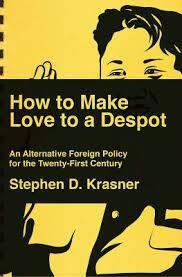
"How to Make Love to a Despot" by Stephen D. Krasner
Please note this book launch event will be virtual over zoom 
 
Image
krasners book cover


Stephen D. Krasner, MA, PhD

Senior Fellow at the Freeman Spogli Institute for International Studies
Graham H. Stuart Professor of International Relations
Senior Fellow at the Hoover Institution
 

Online, via Zoom: REGISTER

CDDRL
Stanford University
Encina Hall
Stanford, CA 94305-6055

(650) 723-0676 (650) 724-2996
0
Senior Fellow at the Freeman Spogli Institute for International Studies, Emeritus
Graham H. Stuart Professor of International Relations
Senior Fellow at the Hoover Institution, Emeritus
krasner.jpg MA, PhD

Stephen Krasner is the Graham H. Stuart Professor of International Relations. A former director of CDDRL, Krasner is also an FSI senior fellow, and a fellow of the Hoover Institution.

From February 2005 to April 2007 he served as the Director of Policy Planning at the US State Department. While at the State Department, Krasner was a driving force behind foreign assistance reform designed to more effectively target American foreign aid. He was also involved in activities related to the promotion of good governance and democratic institutions around the world.

At CDDRL, Krasner was the coordinator of the Program on Sovereignty. His work has dealt primarily with sovereignty, American foreign policy, and the political determinants of international economic relations. Before coming to Stanford in 1981 he taught at Harvard University and UCLA. At Stanford, he was chair of the political science department from 1984 to 1991, and he served as the editor of International Organization from 1986 to 1992.

He has been a fellow at the Center for Advanced Studies in the Behavioral Sciences (1987-88) and at the Wissenschaftskolleg zu Berlin (2000-2001). In 2002 he served as director for governance and development at the National Security Council. He is a fellow of the American Academy of Arts and Sciences and a member of the Council on Foreign Relations.

His major publications include Defending the National Interest: Raw Materials Investment and American Foreign Policy (1978), Structural Conflict: The Third World Against Global Liberalism (1985), Sovereignty: Organized Hypocrisy (1999), and How to Make Love to a Despot (2020). Publications he has edited include International Regimes (1983), Exploration and Contestation in the Study of World Politics (co-editor, 1999),  Problematic Sovereignty: Contested Rules and Political Possibilities (2001), and Power, the State, and Sovereignty: Essays on International Relations (2009). He received a BA in history from Cornell University, an MA in international affairs from Columbia University and a PhD in political science from Harvard.

CV

Encina Hall, C148
616 Jane Stanford Way
Stanford, CA 94305

0
Olivier Nomellini Senior Fellow at the Freeman Spogli Institute for International Studies
Director of the Ford Dorsey Master's in International Policy
Research Affiliate at The Europe Center
Professor by Courtesy, Department of Political Science
yff-2021-14290_6500x4500_square.jpg

Francis Fukuyama is the Olivier Nomellini Senior Fellow at Stanford University's Freeman Spogli Institute for International Studies (FSI), and a faculty member of FSI's Center on Democracy, Development and the Rule of Law (CDDRL). He is also Director of Stanford's Ford Dorsey Master's in International Policy, and a professor (by courtesy) of Political Science.

Dr. Fukuyama has written widely on issues in development and international politics. His 1992 book, The End of History and the Last Man, has appeared in over twenty foreign editions. His book In the Realm of the Last Man: A Memoir will be published in fall 2026.

Francis Fukuyama received his B.A. from Cornell University in classics, and his Ph.D. from Harvard in Political Science. He was a member of the Political Science Department of the RAND Corporation, and of the Policy Planning Staff of the US Department of State. From 1996-2000 he was Omer L. and Nancy Hirst Professor of Public Policy at the School of Public Policy at George Mason University, and from 2001-2010 he was Bernard L. Schwartz Professor of International Political Economy at the Paul H. Nitze School of Advanced International Studies, Johns Hopkins University. He served as a member of the President’s Council on Bioethics from 2001-2004. He is editor-in-chief of American Purpose, an online journal.

Dr. Fukuyama holds honorary doctorates from Connecticut College, Doane College, Doshisha University (Japan), Kansai University (Japan), Aarhus University (Denmark), the Pardee Rand Graduate School, and Adam Mickiewicz University (Poland). He is a non-resident fellow at the Carnegie Endowment for International Peace. He is a member of the Board of Trustees of the Rand Corporation, the Board of Trustees of Freedom House, and the Board of the Volcker Alliance. He is a fellow of the National Academy for Public Administration, a member of the American Political Science Association, and of the Council on Foreign Relations. He is married to Laura Holmgren and has three children.

(October 2025)

CV
Date Label
-

THIS EVENT HAS BEEN CANCELED
In keeping with Stanford University's guidance to event hosts


Over the last three years, the United States has done an about-face in terms of engaging North Korea on human rights. Some have argued that if we are to make progress on denuclearization with North Korea, we cannot press Pyongyang on human rights issues because we must develop a cooperative relationship. Raising human rights abuses will only make it more difficult to deal with security issues they argue. On the other hand, Ambassador King believes that human rights are not an issue that we raise after we have achieved our security goals. It is not just the right thing to do, it is an important and critical part of achieving real progress with North Korea on security issues and it is key to a better relationship between Washington and Pyongyang. Internal pressure from the North Korean elites and the public is necessary for positive change on security issues by the North, and this will only come about if there is progress on human rights.  Furthermore, North Korea, like all UN member states, has agreed to observe UN human rights obligations. If the North fails to carry out its commitments on human rights, what assurance do we have that it will fulfill security obligations it accepts?

Image
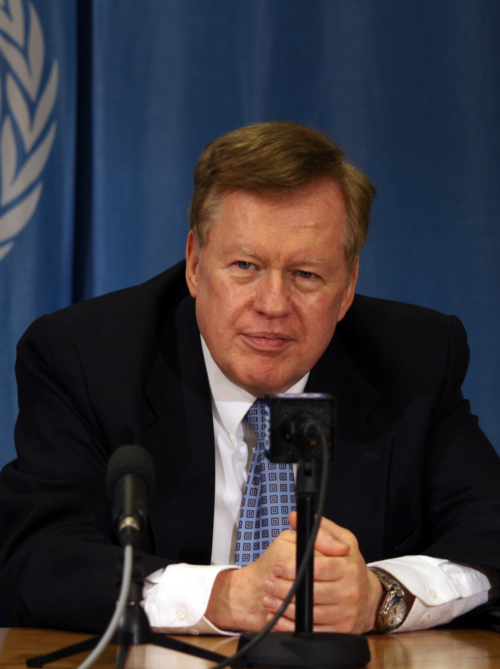
robert king
Ambassador Robert King is former Special Envoy for North Korean human rights issues at the Department of State (2009-2017).  Since leaving that position, he has been senior advisor to the Korea Chair at the Center for Strategic and International Studies (CSIS), a senior fellow at the Korea Economic Institute (KEI), and a board member of the Committee for Human Rights in North Korea (HRNK) in Washington, D.C.  Previously, Ambassador King served for 25 years on Capitol Hill (1983-2008) as chief of staff to Congressman Tom Lantos (D-California), and staff director of the House Foreign Affairs Committee (2001-2008). Most recently, he was a 2019-20 Koret Fellow for the fall quarter at Stanford University.

This public event is part of the 12th annual Koret Workshop, "The Role of Human Rights in Policy Toward North Korea," and open to the general public with registration.

The event is made possible through the generous support of the Koret Foundation.

Advisory on Novel Coronavirus (COVID-19)

In accordance with university guidelines, if you (or a spouse/housemate) have returned from travel to mainland China or South Korea in the last 14 days, we ask that you DO NOT come to campus until 14 days have passed since your return date and you remain symptom-free. For more information and updates, please refer to Stanford's Environmental Health & Safety website.


Robert R. King Former Special Envoy for North Korean Human Right Issues
Seminars
Shorenstein APARCStanford UniversityEncina Hall E301Stanford, CA 94305-6055
0
Koret Fellow, 2019-20
Visiting Scholar at APARC, Winter 2020
victor_cha-koret_fellow.jpg Ph.D.

Victor Cha, professor of government and international affairs at Georgetown University, joined the Walter H. Shorenstein Asia-Pacific Research Center and the Korea Program as the Koret Fellow for the winter quarter of 2020. He is the author of five books, including The Impossible State: North Korea, Past and Future (Harper Collins, 2012) and Powerplay: Origins of the American Alliance System in Asia (Princeton University Press, 2016). He holds Georgetown's Dean's Award for teaching for 2010, the Distinguished Research Award for 2011, and a Distinguished Principal Investigator Award for 2016.

Professor Cha left the White House in 2007 after serving since 2004 as Director for Asian Affairs at the National Security Council, where he was responsible for Japan, the Korean peninsula, Australia/New Zealand, and Pacific Island affairs. He serves as Senior Advisor at CSIS, and is a non-resident Fellow in Human Freedom at the George W. Bush Institute in Dallas, Texas. He received a Ph.D. from Columbia University, M.A. from the University of Oxford, and MIA and B.A. from Columbia University.

-

WE HAVE REACHED VENUE CAPACITY AND ARE NO LONGER ACCEPTING RSVPS


Image
Portrait of Nicholas Lardy
China has grown faster for longer than any country in recorded history.  Is it market-oriented reform, state industrial policy, or some sophisticated blend of the two that explains this success?  In this talk, Dr. Nicholas Lardy will also further examine what might explain China’s slowdown of recent years.  Is China falling into the frequently fatal middle-income trap?  Or have domestic policy choices led to the slowdown?  Have trade frictions with the United States also contributed to China’s slowing growth?  In addition, what should U.S. policy stance be towards China?  Should the United States continue to ramp up restrictions on two-way flows of technology to try to further slow China’s growth?  How successful is such a strategy likely to be and what costs to the United States would be inherent in such an approach?

Nicholas R. Lardy is the Anthony M. Solomon Senior Fellow at the Peterson Institute for International Economics.  He joined the Institute in March 2003 from the Brookings Institution, where he was a senior fellow from 1995 until 2003.  Before Brookings, he served at the University of Washington, where he was the director of the Henry M. Jackson School of International Studies from 1991 to 1995.  From 1997 through the spring of 2000, he was also the Frederick Frank Adjunct Professor of International Trade and Finance at the Yale University School of Management.  He is an expert on the Chinese economy.  Lardy's most recent books are The State Strikes Back: The End of Economic Reform in China? (2019), Markets over Mao: The Rise of Private Business in China (2014), Sustaining China's Economic Growth after the Global Financial Crisis (2012), The Future of China's Exchange Rate Policy (2009), and China's Rise: Challenges and Opportunities (2008). 


Image of red flag over the Shanghai Bund

This event is part of the 2020 Winter/Spring Colloquia series, The PRC at 70: The Past, Present – and Future?, sponsored by APARC's China Program.


Nicholas Lardy Anthony M. Solomon Fellow Peterson Institute for International Economics
Seminars
Authors
Noa Ronkin
News Type
News
Date
Paragraphs

Southeast Asia, home to over 640 million people across 10 countries, is one of the world’s most dynamic and fastest growing regions. APARC just concluded the year 2019 with a Center delegation visit to two Southeast Asian capital cities, Hanoi and Bangkok, where we spent an engaging week with stakeholders in the academic, policy, business, and Stanford alumni communities.

Led by APARC Director Gi-Wook Shin, the delegation included APARC Deputy Director and Asia Health Policy Program Director Karen Eggleston, Southeast Asia Program Director Donald Emmerson, and APARC Associate Director for Communications and External Relations Noa Ronkin. Visiting Scholar Andrew Kim joined the delegation in Bangkok.

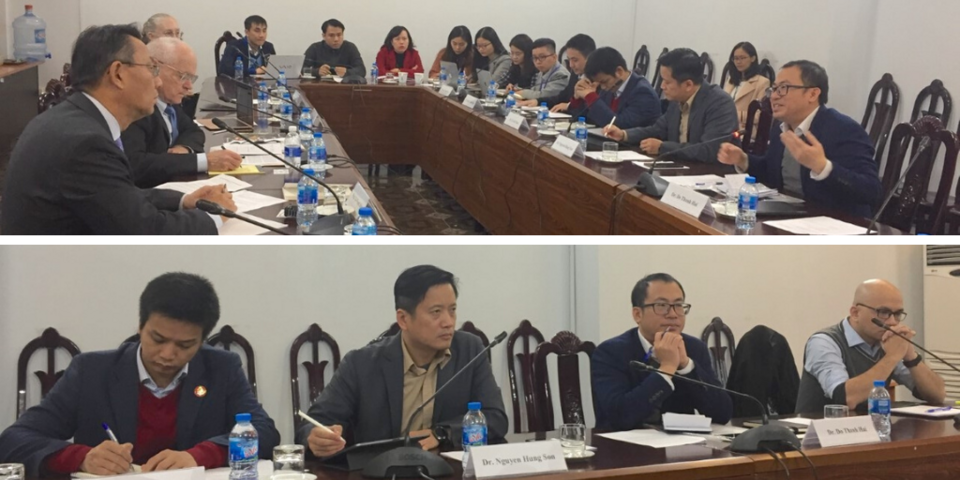
With a focus on health policy, our first day in Hanoi included a visit to Thai Nguyen University, a meeting with government representatives at the Vietnam Ministry of Health, and a seminar on healthy aging and innovation jointly with Hanoi Medical University.

Image
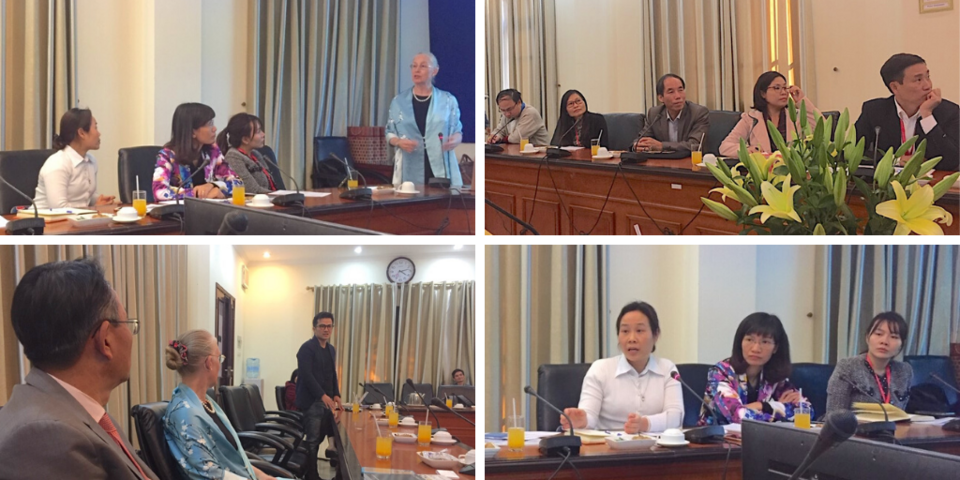
Collage of four images showing participants at a roundtable held at Hanoi Medical University with APARC delegation members

Karen Eggleston and participants at the roundtable held at Hanoi Medical University, December 9, 2019.

Throughout the day, Eggleston presented some of her collaborative research that is part of two projects involving international research teams: one that assesses public-private roles and institutional innovation for healthy aging and another that examines the economics of caring for patients with chronic diseases across diverse health systems in Asia and other parts of the world. We appreciated learning from our counterparts about the health care system and health care delivery in Vietnam.

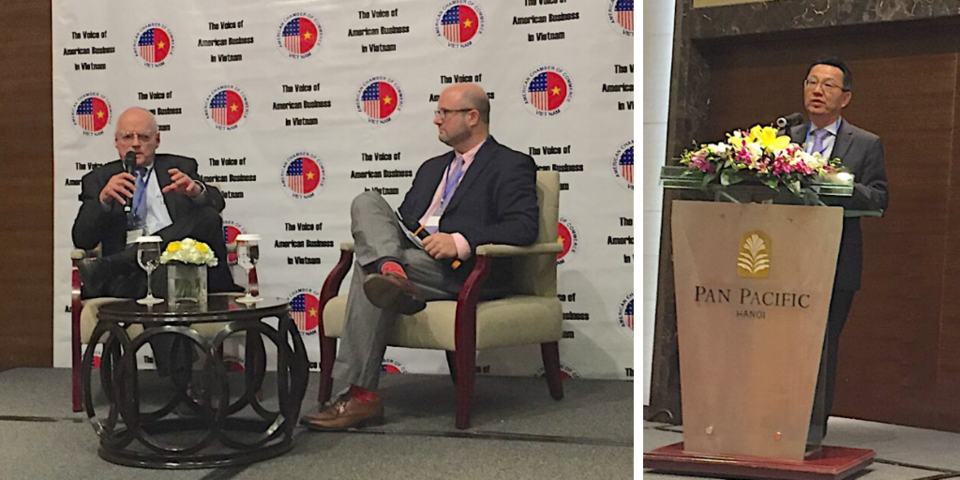
Shifting focus to international relations and regional security, day 2 in Hanoi opened with a roundtable, “The Rise of the Indo-Pacific and Vietnam-U.S. Relations,” held jointly with the East Sea Institute (ESI) of the Diplomatic Academy of Vietnam (DAV). Following a welcome by ESI Director General Nguyen Hung Son, the program continued with remarks by Shin, Emmerson, ESI Deputy Director General To Anh Tuan, and Assistant Director General Do Thanh Hai.

Image
Participants at a roundtable held at the Diplomatic Academy of Vietnam with APARC delegation members

Roundtable at the Diplomatic Academy of Vietnam, December 10, 2019.

The long-ranging conversation with DAV members included issues such as the future of the international order in Asia; the U.S. withdrawal from multilateralism; the concern about a lack of U.S. engagement in Southeast Asia, sparked by President Trump’s absence from the November 2019 summit of the Association of Southeast Asian Nations (ASEAN) at a time when China is bolstering its influence in the region and when ASEAN hopes to set a code of conduct with China regarding disputed waters in the South China Sea; the priorities for Vietnam as it assumes the role of ASEAN chair in 2020; and the challenges for the Vietnam-U.S. bilateral relationship amid the changing strategic environment in Southeast Asia.

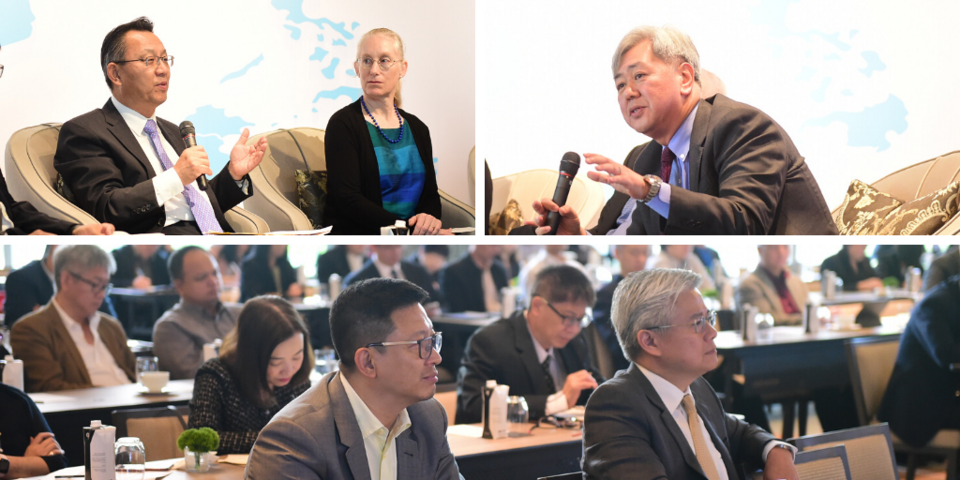
In the afternoon we were joined by members of the American Chamber of Commerce in Hanoi at an AmCham-hosted Lunch ‘n’ Learn session on Vietnam's challenges and opportunities amid the U.S.-China rivalry. The event featured Emmerson in conversation with AmCham Hanoi Executive Director Adam Sitkoff.

Image
Two men in conversation seated on stage and a man speaking at a podium

(Left) Donald Emmerson in conversation with Adam Sitkoff; (right) Gi-Wook Shin welcomes AmCham Hanoi members; December 10, 2019. 

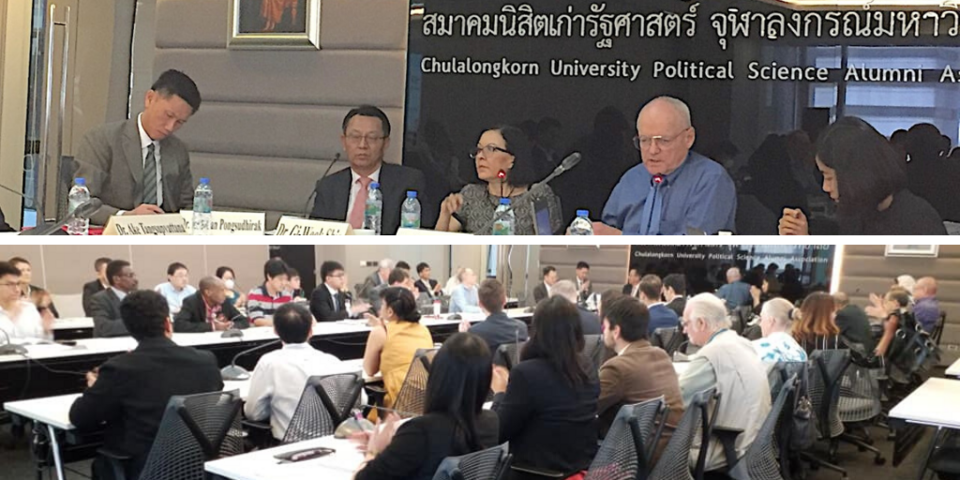
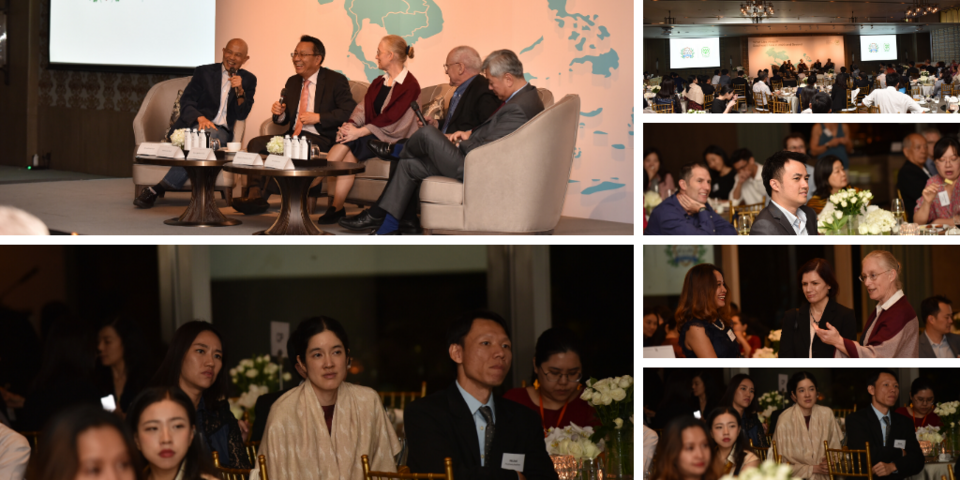
Moving to Bangkok, delegation members Shin, Eggleston, Emmerson, and Kim spoke on a panel for executives of the Charoen Pokphand Group (C.P. Group), one of Thailand’s largest private conglomerates, addressing some of the core issues that lie ahead for Southeast Asia in 2020 and beyond in the areas of geopolitics, innovation, and health.

Image
Participants at a panel discussion with APARC delegation hosted by the C.P. Group, Thailand

Top, from left to right: Gi-Wook Shin, Karen Eggleston, Andrew Kim; bottom: C.P. Group executive listening to the panel, December 12, 2019.

We also enjoyed a tour at True Digital Park, Thailand’s first startup and tech entrepreneur’s campus. Developed by the C.P. Group, True Digital Park aspires to be an open startup ecosystem that powers Thailand to become a global hub for digital innovation.

The following day, Shin and Emmerson participated in a public forum hosted by Chulalongkorn University’s Institute of Security and International Studies (ISIS Thailand), "Where Northeast Asia Meets Southeast Asia: The Great Powers, Global Disorder and Asia’s Future.” They were joined by ISIS Thailand Director Thitinan Pongsudhirak and Chulalongkorn University Faculty of Political Science Associate Dean for International Affairs and Graduate Studies Kasira Cheeppensook. The panel was moderated by Ms. Gwen Robinson, ISIS Thailand senior fellow and editor-at-large of the Nikkei Asian Review.

Image
Panelists and participants at a public forum held at Chulalongkorn University

ISIS Thailand forum participants and panelists, from left: Pngsukdhirak, Shin, Robinson, Emmerson, Cheeppensook; December 13, 2019.

As part of that discussion, Emmerson speculated that – driven by deepening Chinese economic and migrational involvement in Southeast Asia’s northern tier – Cambodia and Laos, less conceivably Myanmar, and still less conceivably Thailand could become incorporated de facto into an economically integrated “greater China” that could eventually reduce ASEAN to a more-or-less maritime membership in the region’s southern tier. Emmerson’s speculation was made in the context of his critique of ASEAN’s emphasis on its own “centrality” to the neglect of its lack of the proactivity that would serve as evidence of centrality and of a desire not to be rendered peripheral by the growing centrality-cum-proactivity of China. The event was covered by the Bangkok Post (although that report’s headline and quote of Emmerson are inaccurate, as neither the panel nor Emmerson predicted the “break-up of ASEAN.”)

Our delegation visit in Bangkok concluded with a buffet dinner reception and panel discussion jointly with the Stanford Club of Thailand.

Image
alumni event

Stanford and IvyPlus alumni listening to the panel, December 13, 2019.

Moderated by Mr. Suthichai Yoon, a veteran journalist and founder of digital media outlet Kafedam Group, the conversation focused on the changing geopolitics of Southeast Asia, innovation and health in the region, and the opportunities and challenges facing Thailand-U.S. relations. It was a pleasure to meet many new and old friends from the Stanford and IvyPlus alumni communities.

APARC would like to thank our partners and hosts in Hanoi and Bangkok for their hospitality, collaboration, and the stimulating discussions throughout our visit. We look forward to keeping in touch!

Hero Image
APARC delegation speaking to Stanford and IvyPlus alumni, Bangkok
All News button
1
Paragraphs

Shorenstein APARC's annual overview for academic year 2018-19 is now available.

Learn about the research, events, and publications produced by the Center's programs over the last twelve months. Feature sections look at U.S.-China relations and the diplomatic impasse with North Korea, and summaries of current Center research on the socioeconomic impact of new technologies, the success of Abenomics, South Korean nationalism, and how Southeast Asian countries are navigating U.S.-China competition. Catch up on the Center's policy work, education initiatives, and outreach/events.

Read online:

All Publications button
1
Publication Type
Annual Reports
Publication Date
Authors
News Type
Commentary
Date
Paragraphs

Original written for Brookings.Com


Since 2014, when Russia annexed Crimea from Ukraine, the United States has provided Ukraine with $3 billion in reform and military assistance and $3 billion in loan guarantees. U.S. troops in western Ukraine train their Ukrainian colleagues. Washington, in concert with the European Union, has taken steps to isolate Moscow politically and imposed a series of economic and visa sanctions on Russia and Russians.

The furor over President Donald Trump’s sordid bid to extort the president of Ukraine into investigating his potential 2020 political opponent raises an obvious question: Why should the United States care so much about Ukraine, a country 5,000 miles away? A big part of the reason is that U.S. officials told the Ukrainians the United States would care when negotiating the Budapest Memorandum on security assurances, signed 25 years ago this week.


A NUCLEAR-ARMED STATE BREAKS UP

In the 1994 Budapest Memorandum, the United States, Russia, and Britain committed “to respect the independence and sovereignty and the existing borders of Ukraine” and “to refrain from the threat or use of force” against the country. Those assurances played a key role in persuading the Ukrainian government in Kyiv to give up what amounted to the world’s third largest nuclear arsenal, consisting of some 1,900 strategic nuclear warheads.

When the USSR broke up in late 1991, there were nuclear weapons scattered in the resulting post-Soviet states. The George H. W. Bush administration attached highest priority to ensuring this would not lead to an increase in the number of nuclear weapons states. Moreover, as it watched Yugoslavia break apart violently, the Bush administration worried that the Soviet collapse might also turn violent, raising the prospect of conflict among nuclear-armed states. Ensuring no increase in the number of nuclear weapons states meant that, in practice, only Russia would retain nuclear arms. The Clinton administration pursued the same goal. With the prospect of extending the Non-Proliferation Treaty indefinitely looming, an alternative course that allowed other post-Soviet states to keep nuclear weapons would have set a bad precedent.

Eliminating the strategic nuclear warheads, intercontinental ballistic missiles (ICBMs), and strategic bombers in Ukraine was a big deal for Washington. The ICBMs and bombers carried warheads of monstrous size — all designed, built, and deployed to attack America. The warheads atop the SS-19 and SS-24 ICBMs in Ukraine had explosive yields of 400-550 kilotons each — that is, 27 to 37 times the size of the atomic bomb that devastated Hiroshima. The 1,900 strategic nuclear warheads — more than six times the number of nuclear warheads that China currently possesses — could have destroyed every U.S. city with a population of more than 50,000 three times over, with warheads left to spare.


ASSURANCES FOR UKRAINE

Before agreeing to give up this nuclear arsenal, Kyiv sought three assurances. First, it wanted compensation for the value of the highly-enriched uranium in the nuclear warheads, which could be blended down for use as fuel for nuclear reactors. Russia agreed to provide that.

Second, eliminating ICBMs, ICBM silos, and bombers did not come cheaply. With its economy rapidly contracting, the Ukrainian government could not afford the costs. The United States agreed to cover those costs with Nunn-Lugar Cooperative Threat Reduction assistance.

Third, Ukraine wanted guarantees or assurances of its security once it got rid of the nuclear arms. The Budapest Memorandum provided security assurances.

Unfortunately, Russia has broken virtually all the commitments it undertook in that document. It used military force to seize, and then illegally annex, Ukraine’s Crimean peninsula in early 2014. Russian and Russian proxy forces have waged war for more than five years in the eastern Ukrainian region of Donbas, claiming more than 13,000 lives and driving some two million people from their homes.

Some have argued that, since the United States did not invade Ukraine, it abided by its Budapest Memorandum commitments. True, in a narrow sense. However, when negotiating the security assurances, U.S. officials told their Ukrainian counterparts that, were Russia to violate them, the United States would take a strong interest and respond.

Washington did not promise unlimited support. The Budapest Memorandum contains security “assurances,” not “guarantees.” Guarantees would have implied a commitment of American military force, which NATO members have. U.S. officials made clear that was not on offer. Hence, assurances.

Beyond that, U.S. and Ukrainian officials did not discuss in detail how Washington might respond in the event of a Russian violation. That owed in part to then-Russian President Boris Yeltsin. He had his flaws, but he insisted that there be no revision of the boundaries separating the states that emerged from the Soviet collapse. Yeltsin respected Ukraine’s independence and territorial integrity. Vladimir Putin does not.

U.S. officials did assure their Ukrainian counterparts, however, that there would be a response. The United States should continue to provide reform and military assistance to Ukraine. It should continue sanctions on Russia. It should continue to demand that Moscow end its aggression against Ukraine. And it should continue to urge its European partners to assist Kyiv and keep the sanctions pressure on the Kremlin.

Washington should do this, because it said it would act if Russia violated the Budapest Memorandum. That was part of the price it paid in return for a drastic reduction in the nuclear threat to America. The United States should keep its word.

Hero Image
gettyimages 763273195
Credit:
Arthur Zych / EyeEm
Creative #:
763273195
License type:
Royalty-free
Collection:
EyeEm
Release info:
No release required
Arthur Zych / EyeEm
All News button
1
Subscribe to Foreign Policy